After hours in the kitchen garden much remained to be done after Saturday.
Garden work began at 6 a.m. I moved to the kitchen at 3 p.m. and worked another four hours.
I was steadily busy throughout waking hours with only water breaks to sustain me.
I harvested kale and weeded the plot, replanted a failed tomato plant, weeded carrots, dug up two small plots to plant cayenne pepper and eggplant, harvested collards and put temporary fencing around them. I mowed the fifth plot and spaded soil in about a third of it. With the near 90 degree temperatures, I picked lettuce before it had a chance to bolt.
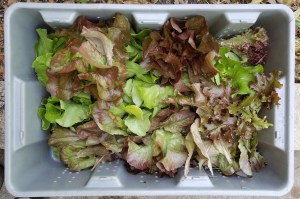
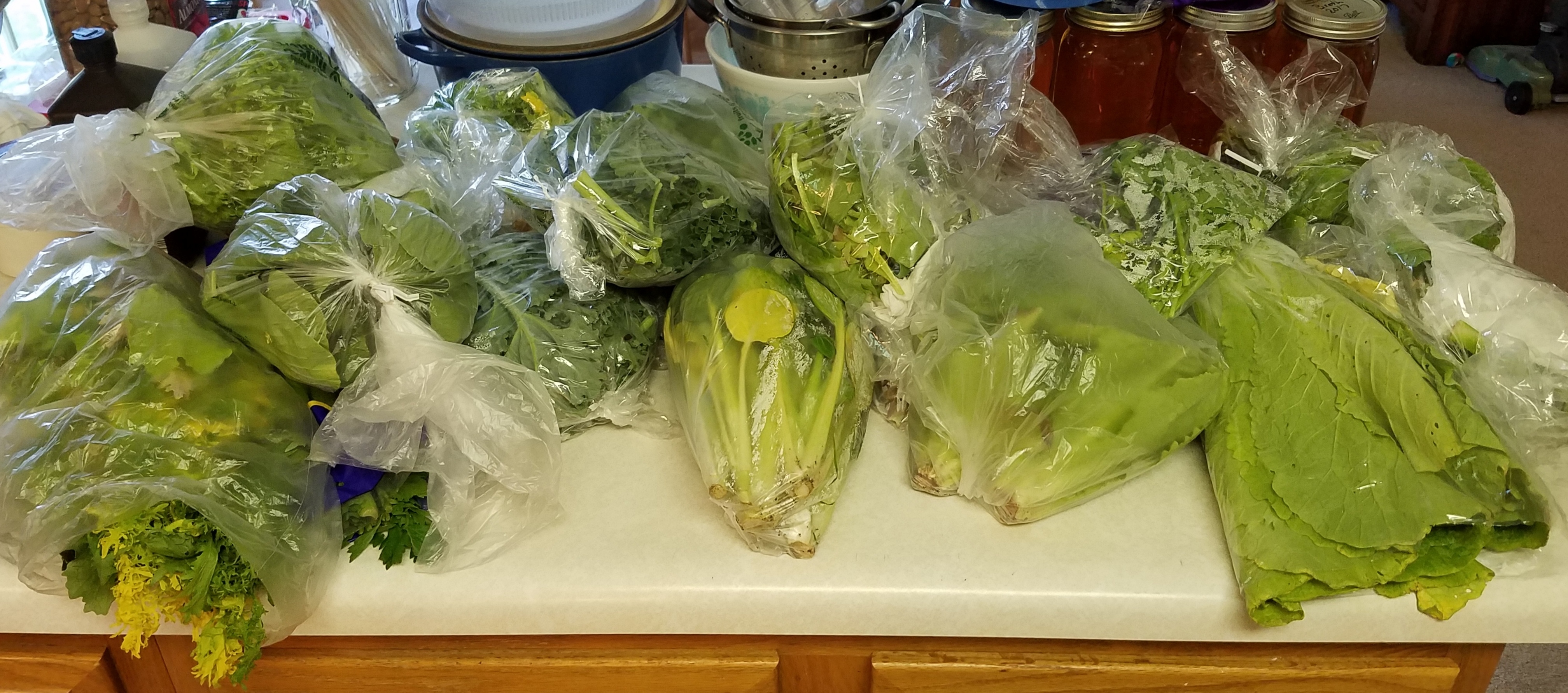
In the kitchen I cleaned lettuce, collards and kale and made dinner of a big salad. I steamed and froze the collards and emptied the ice box of every bag of greens and went through them. The goal was to make soup stock with the cooking greens. It was a dish too far. Organized, they went back into the burgeoning ice box.
Green Vegetables from the Ice Box
The highlight of the day was unexpected. The sugar snap peas are four feet tall and began to flower along the tops — as if an artist daubed white paint on a canvas, impressionist-style. I stopped and looked from different angles as sunlight faded flowery details. Beautiful.
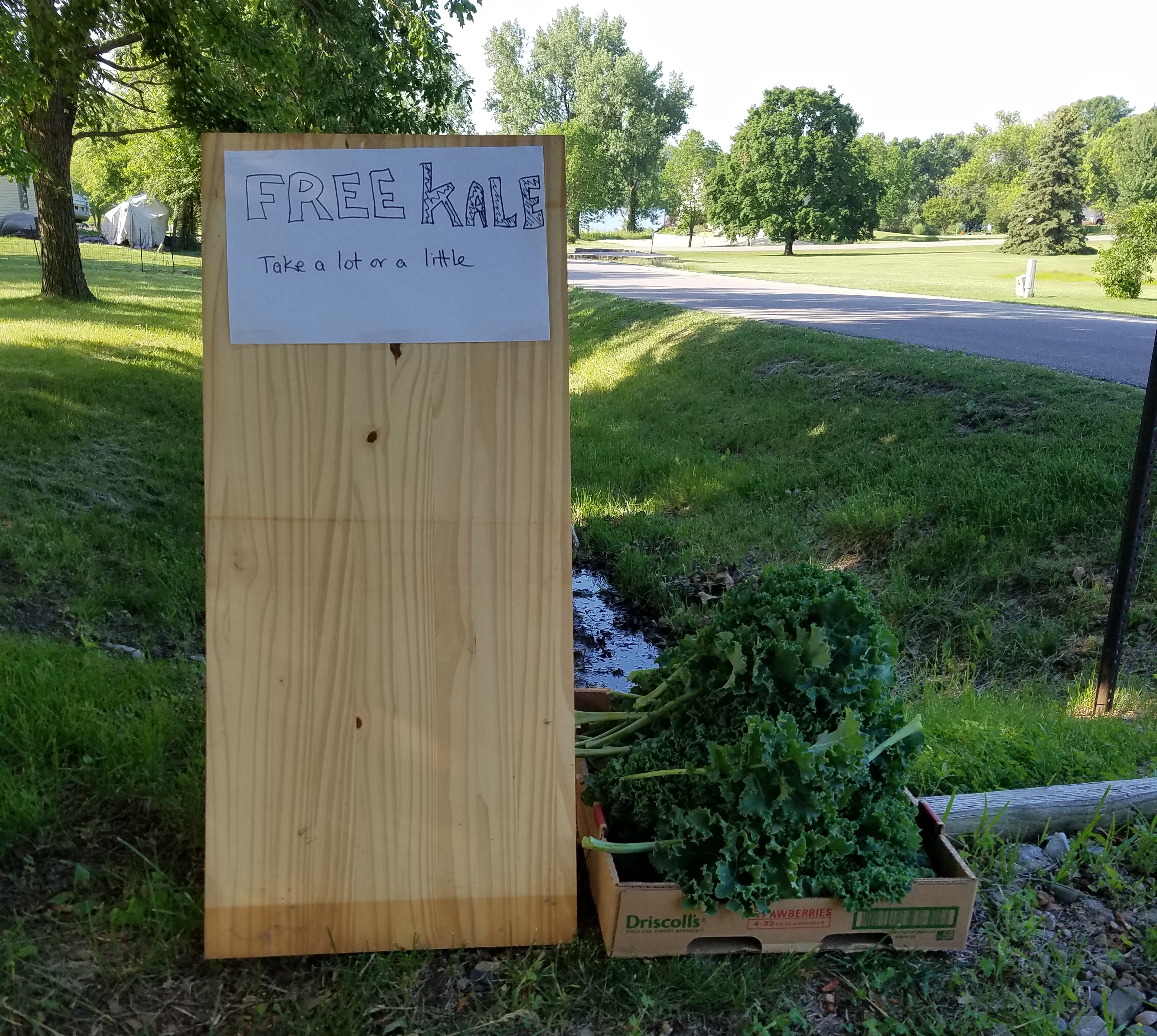
Roadside Kale Distribution
I harvested 12 kale plants and weeded the plot. It yielded two full tubs and more. I made a box of 24 leaves for the library workers and washed the small scarlet leaves to put them away.
I put some of the abundance by the road for neighbors and passers by to take. It was the city-wide garage sale day so the expectation was bargain-seekers would find this spot. It was gone in less than 15 minutes.
After a shower and clean sheets I slept eight straight hours.
On the plus side I was so engaged in our kitchen garden there was little time to think about much else. At the same time it was difficult not to feel like little got done despite evidence to the contrary.
Well-rested, the weekend cycle of watering, weeding and planting starts again. It’s what we do to sustain a life in a turbulent world.
The green up arrived as summer approaches and society wakes up in the season.
Trees leafed out and pasture grasses presented something new and hopeful.
Yesterday we drove south of Iowa City on Highway One. Despite a landscape ravaged by 19th century settlement and 20th century expansion, pleasant scenery appeared in every ditch and around each corner — spring at its best.
That said, the best of spring will yield to summer heat and industry.
Early spring has been a success. Our garden is two-thirds planted and already we have an abundance of greens and radishes. Fruit tree pollination went well. Apples and pears are about a half inch in diameter. I mowed the lawn, producing enough grass clippings to mulch the kale patch. Potato plants have grown almost three feet high. Our garden is producing well.
Spring Vegetable Broth
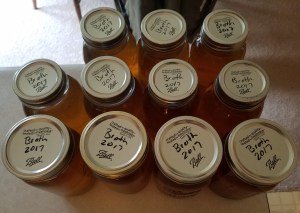
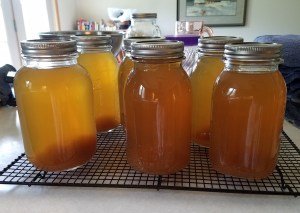
Because of barter agreements with farmers spring brought enough lettuce to make a salad every night, enough cooking greens to put up 15 quarts of vegetable broth, and rhubarb sauce for garnishment. Labor turned into food in a practical way.
Memorial Day weekend was a time for reflection and homelife. Our yard is alive. A domesticated cat attempted to catch birds. A deer lay in the grass by the broccoli patch leaving a pile of excrement as evidence of its presence. One of the two squirrels was hit by a vehicle on the road in front of our house. I found a new type of bug dining on spinach leaves. There is more action in nature just beyond my consciousness. I played my role as a human — bringing culture in the form of a fence to protect the summer squash I planted. I hung a flag above the garage door and honored our war dead.
The cycle of life is being disrupted by global warming. How climate will change in my lifetime is to be revealed. We’ll work to adapt if possible. Even so, for one long moment, the green up was evident.
I took it in, comforted by its arrival and wondering if it is sustainable.
While in Europe, Pope Francis and the G7 leaders bent President Trump’s ears about climate change.
The Pope presented a copy of Laudato Sí: On Care For Our Common Home, his encyclical on consumerism, irresponsible development, environmental degradation and global warming to the U.S. president. He told Pope Francis he would read it.
Reports indicate the six other G7 leaders presented arguments for the United States to stay in the 2015 Paris Agreement on mitigating the effects of climate change. Trump would not commit to doing so by the time he boarded Air Force One for the trip home.
“The entire discussion about climate was very difficult, if not to say very dissatisfying,” German Chancellor Angela Merkel said. “There are no indications whether the United States will stay in the Paris Agreement or not.”
That Trump failed to be part of the G7 consensus on climate may or may not be a sign of his intent. One never can tell with this president.
“I will make my final decision on the Paris Accord next week!” Trump tweeted.
That Trump was willing to listen to his European peers and the Pope indicates he may have an open mind about the accord. However, late yesterday, Jonathan Swan and Amy Harder of Axios reported, “President Trump has privately told multiple people, including EPA Administrator Scott Pruitt, that he plans to leave the Paris agreement on climate change.”
Despite the advocacy workshop for exiting the agreement EPA has become, the result of the president’s decision-making process may be more complicated than making a simple announcement.
Exiting the Paris Agreement would take at least four years. The agreement does not permit states to exit until three years after entry into force (Nov. 4, 2019). It would then take at least a year to finish the process. In that time, Trump could change his mind.
If Trump decides to exit, he would be “willfully, nonchalantly vacating leadership of the world,” former U.S. ambassador to the United Nations Samantha Power said. Another country will step in to fill the leadership vacuum, presumably China with the world’s second largest economy.
A bone of contention with Pruitt and advocates in the hydrocarbon business is the existence of the Clean Power Plan first published by the EPA in the Federal Register Oct. 23, 2015. On March 28, President Trump signed an executive order mandating EPA review the plan. Unraveling the Clean Power Plan is not as simple as signing an executive order. Whether or not the U.S. exits the Paris Agreement, the regulation may stand.
It is significant the first nation Trump visited in his presidency was Saudi Arabia. Saudi Arabia has almost one-fifth of the world’s proven oil reserves and ranks as the largest producer and exporter of oil in the world. Despite concerns about human rights and the treatment of women in the kingdom, Trump seemed elated about the arms deal he made during his visit. His rhetoric isolating Iran may be no more complicated than wanting to take their oil. Iran ranks fourth in proven oil reserves behind Venezuela, Saudi Arabia and Canada.
That 195 states could enter the Paris Agreement was remarkable. Whether it will hold if the U.S. exits is uncertain. Regardless of politics the science on global warming has been identified since the 19th century.
On the morning after the 45th President’s first foreign trip the direction of his administration on climate change is obvious. Government climate change web sites and regulations are officially “under review” in multiple agencies. At the same time the hydrocarbon business is moving to roll back regulations that seek to reduce carbon emissions. The idea of leaving fossil fuels in the ground is not embraced in this White House.
“I think there is a better than 50/50 chance that the Trump administration will stay in the Paris agreement,” Nobel Prize winner Al Gore said. “I think odds are they will stay in.”
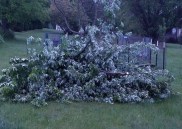
Over the weekend a storm broke off a branch in one of the maple trees. The branch wedged between two others 20 feet above the ground. I couldn’t remove it myself.
The tree service came yesterday with chain saws, ladders and loppers to bring the branches safely down. After work at the home, farm and auto supply store I cleaned up the site and built a brush pile next to the garden. I’ve been thinking of adding two more plots, so maybe, after I burn the pile, this is the time.
Not knowing better in 1993, we planted the maple too close to the house. It needs taking down according to my arborist and climber.
Seedling Cart
I’ve been working in the garden center at the home, farm and auto supply store. Foot traffic has been brisk with customers picking up flats of seedlings for flower and vegetable gardens. Working outdoor provided an opportunity to talk about gardening. I felt in my element.
At home, the lawn is overgrown and our garden is two-thirds planted. The seedlings are ready so I’m waiting for the intersection of dry-enough ground, time at home, and clear skies. As soon as that happens I’ll get more planted.
Four of six garden plots have been planted and are doing well.
Weeds are also doing well.
I’m waiting for a break in the weather to coincide with my work schedule to finish the planting and mulching. This annual conflict was complicated by feeling under the weather on Sunday. I called off work at both farms and stayed indoors recovering. It felt like a lost day.
Saturday I harvested radishes, the last of spring spinach, some turnip greens for salads, and a tub of kale. We officially have more greens than can fit in the ice box.
Spring Vegetable Broth
To use up some greens I made a batch of vegetable broth and canned it. During the next six weeks I hope to can 36 quarts for use throughout the year. There should be plenty of raw material, although carrots are last year’s crop and almost gone, Vidalia onions are from Georgia, and celery is from Earthbound Farms in California.
I’m not an extreme locavore and feel no guilt using a few imported items for a dish. My cooking style is derived from a local food culture which includes my garden and the farms where I work. Above all else, it is about using what is on hand in the ice box and pantry — a lesson learned from some of the best cooks I’ve met. If some non-local ingredients are needed and on hand to supplement a recipe, I’m okay with that. Besides, there aren’t Iowa carrots or celery to be had this time of year.
What to do with all the kale?
I reached out via email to find a home for some kale while it is still fresh. The rest will be preserved if I can make time after work.
I use three methods of preservation: freezing, canning and dehydrating. Until we get a separate freezer our capacity for freezing is minimal and saved for other favorites like broccoli, corn and bell peppers. I haven’t tried canning kale before, and the best use of canned kale seems to be soups and stews. I dehydrated in the past, then flaked it in a food processor or blender and stored it on the pantry shelf. Kale flakes are for soup.
A tentative plan is to take the kale remaining after the give-away and can a dozen pints to use in soups as an experiment. The rest will go into the dehydrator in batches. There is an urgency to getting this done as I planted enough kale to harvest a tub every week from now until late October. Keeping up with processing the crop will be a key dynamic in our kitchen-garden.
The 15-day forecast is for rain next weekend, so hope of getting the garden in before Memorial Day doesn’t seem realistic. Will have to find bits and pieces of time during the week to start turning soil in the last plots, and replanting where the early crops are finishing.
Importantly, I’m not freaking out over the amount of work in front of me. A person can plant only one plot at a time. Sanity comes from focusing on the gardening task at hand and executing it as well as we know how. We need sanity in this sometimes insane world.
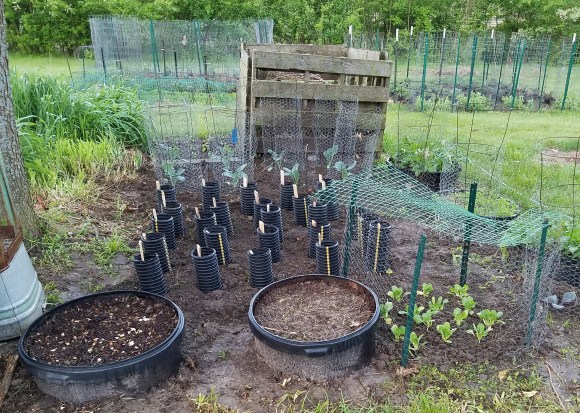
It took most of the day to plant the fourth plot in five varieties of tomatoes.
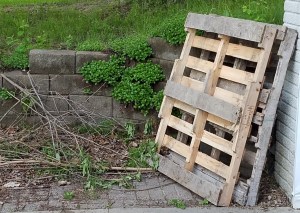
Using two pallets from Kate’s farm I sorted the metal stakes by size then pitchforked the grass clippings that have been on the plot since last fall.
There were numerous worms and grubs under the matted grass — a sign of soil fertility.
Once the surface was cleared, I spaded the entire plot and applied about 30 pounds of composted chicken manure. I broke up the clods of dirt with a hoe, then used a garden rake to till the soil further. I resist using a mechanical tiller, partly to disturb the soil as little as possible, and partly because the expense is more than we can afford. I took several water breaks to stay hydrated.
Tomato Diagram
Once the ground was broken and tilled, I measured. I grew eight varieties of tomato seedlings: Italian, German Pink, Amish Paste, Brandywine and Supersteak are slicers. Black Cherry, Gold Nugget and Saladette are cherry tomatoes. This plot is for the five slicers with the three cherry tomato plants going somewhere else. I’ll use these tomatoes fresh in the kitchen with canning tomatoes coming from my barter agreement with local farms.
I dunked each seedling in a water bath immediately before planting. I dug a deep hole with a trowel and broke up the soil by hand as finely as I could to cover them. I doused each planting with water so they wouldn’t crisp in the sunlight and 80-degree ambient temperature. I re-applied the mulch and caged them. It took 15 stakes to cage 25 plants. The planting is done.
When the sun comes up I’ll check to make sure every plant survived. If some didn’t there are plenty of extra seedlings in reserve.
Tomatoes are a highlight of our summer garden. Taking a full day to plant them is okay, and the precautions against failure are many. Over the years I’ve become a better tomato grower but everything is conditional — on weather, on soil fertility, and on gardening culture. Fingers crossed, this should be a good year.
Spring has been punctuated by conversations with scores of people in my neighborhood and beyond.
On Friday I spent two hours delivering handbills regarding a neighborhood public meeting. About 20 people showed up Saturday at the corner of our two main streets. The meeting was organized to elect trustees to our sewer district. I got a chance to review district history as we conducted official business. There was a solid exchange of information about wastewater treatment, something important to any home owner.
In this community organizing work the real world does not resemble my Twitter or Facebook feeds AT ALL. Conversations, in person, with real people, serve us better than any social media application ever can.
As my nine-day vacation from the home, farm and auto supply store winds down, farm and garden work have been the main focus. The garden is on schedule and about half planted — three plots in with three remaining. There are more seeds and seedlings than there will be room for. Hope for an abundant season is everywhere.
I’ve had numerous conversations about tomato planting. Consensus is we wait until today, May 15, to plant tomatoes. By then the risk of frost has passed. I hope to be planting some of mine soon.
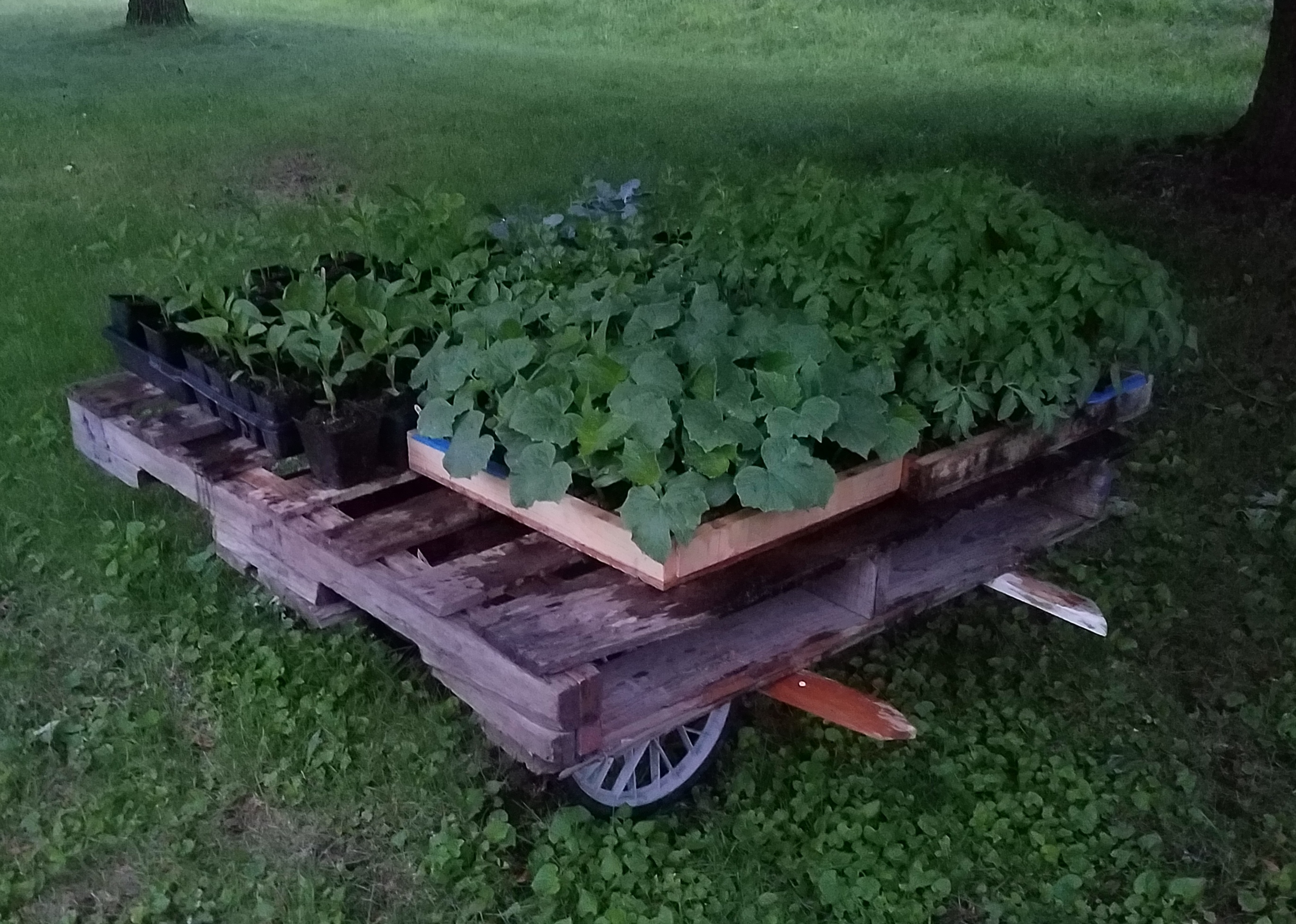
In the meanwhile, the seedling cart is overflowing from new greenhouse arrivals. There is a tray of lettuce, some summer squash, and a tray of leftovers from planting to fill in gaps caused by plant predators or failures. The tomato seedlings germinated well and I’ll have 50 or so leftover. The pepper plants are as good as I’ve raised and offer a better prospect than in previous years. Bartering for greenhouse space took my gardening level up a notch or two — a better start means a better result in the ground.
The five years I’ve been working in community supported agriculture projects provided an education about gardening I couldn’t have gained elsewhere. I’m grateful for the time Susan Jutz, Laura Krouse, Carmen Black, Kate Edwards and others spent explaining agriculture to me.
The sun rose today at 5:46 a.m. and won’t set until 8:18 p.m. More sunlight for a more productive spring. What more could we ask?
The folks I hang with in the local food system are focused on product.
Is the asparagus ready? What about the rhubarb? When should I plant peppers and tomatoes? How much should we put into a member share?
I’m interested in the answers, yet those aren’t my questions. My work in the local food system is to inform and supply culinary endeavors in our kitchen. Technique and creativity seem more important than the fungible commodity fresh produce is becoming. Objectifying and standardizing things, an American obsession, plays a role in the kitchen. At the same time inspiration, creativity and technique seem more important than consumable objects. That’s where I live.
My questions are different from farmer friends. What food can be sourced locally? How can I use an abundance of spring greens before they spoil? What seasoning tastes best with scrambled eggs? What is the best way to preserve food in the ice box? How many pints and quarts of tomatoes shall I can this year? How do I combine bits and pieces from the pantry with fresh food to make satisfying meals? At some point, questioning must yield to creativity.
There is something about Saturday afternoon in the kitchen. It’s partly immersion into the cooking process and partly reliving memories. Saturday was a time to work in the yard and garage, then cook a meal while my spouse worked in town. I used to listen to Iowa Public Radio all day. Due to budget priorities, those programs are gone. Cooking time came with the beginning of Garrison Keillor’s A Prairie Home Companion which is gone too. I now draw life from the task at hand without musical accompaniment.
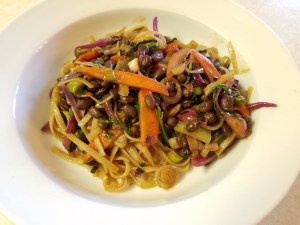
I made an Iowa version of pad thai last Saturday.
The dish has been in the works for a while. A couple of months ago I noticed the warehouse club sold USDA Certified Organic pad thai noodles for about $0.37 per serving. I bought a box on Friday.
With cabbage, onions and carrots from last season; a drawer and more of cooking greens from the farm; spring garlic from the garden; and bits and pieces stored in the ice box and pantry, the dish came together. The resulting meal was tasty, filling and seasonal — satisfying on multiple levels.
My kitchen experience made the dish as much as the ingredients.
I stock basic kitchen staples — high smoke point oil, salt, extra virgin olive oil, celery, onions, carrots and cabbage. Sources included retail merchants and local farms, however, the essence of cuisine is using what’s ubiquitous and on hand. It’s a fine distinction. Regardless of source, what’s in the pantry, ice box and garden now is what’s on hand. Creativity is in that moment.
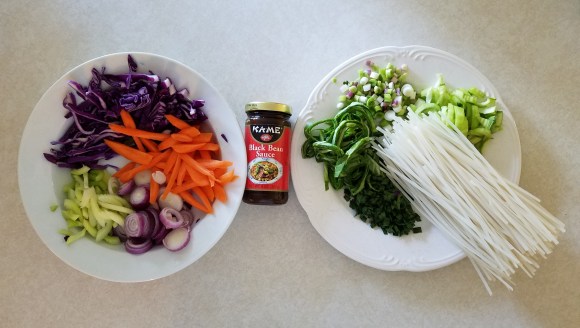
Except for the noodles, no specific shopping was needed to prepare pad thai. Canned black beans and a jar of fermented black bean sauce were the only prepared foods used and I stock both in the pantry.
Spring Garlic
Inspiration for the meal occurred at the intersection of discovery of a small patch of spring garlic in the garden and the memories it aroused. I recall a paper sack of garlic cloves brought home from the library and planting them more than a decade ago. The scent was intoxicating. I harvested enough for a meal.
Where is the creativity? Thinly cutting vegetables, sorting ingredients by cooking time, and measuring seasonings can all be taught. With an eye toward plating, carrots can be cut on the bias, green leaves julienned and celery stalks cut thick. Pad thai noodles are to cook 5-6 minutes, according to the package, then immersed in an ice water bath to stop the cooking. These techniques are like loading a palette with paint.
Creativity begins once the noodles are on and the wok is heated to high temperature. There’s no going back.
Using a high smoke point oil, onions, carrots, celery, cabbage go into the wok first. It’s “stir fry,” not “occasionally stir” fry, so full attention is required at the stove. Season with salt. Once the timer for the noodles expires, strain and dump into the ice water bath. When the first round of vegetables is tender and add plate two (spring garlic, garlic chives, sliced bok choy stems, and julienned bok choy leaves, stirring constantly. Add the drained and washed black beans and a generous serving of cooking greens. Once the greens are wilted, add a couple of tablespoons of fermented black bean sauce. Strain and add the noodles last, garnishing with a couple of tablespoons of extra virgin olive oil. Toss gently until heated. Plate and serve with your favorite sweet chili sauce.
Cheap, prepared food is everywhere in the United States. It’s convenient. It reduces time in the kitchen. It is engineered to appeal to our senses. Most of us eat at a restaurant or get help from the industrial food supply chain from time to time. However, there is no substitute for inspired cooking.
It provides engagement seldom found elsewhere in life. It’s a source of satisfaction hard to replicate. It sustains us in a turbulent world. This kind of inspiration and creativity is needed more than ever.
The weather forecast is for near-perfect spring weather. No rain and a high around 65 degrees.
The day began at 4 a.m. with reading and laundry. I moved the cars down the driveway and rolled the seedlings out of the garage before dawn.
There should be fewer seedlings on the cart by day’s end.
The lilacs are toward the end of the season. I stood inside the branches, lush with flowers, and let the scent envelope me.
Years ago our daughter kicked a soccer ball under the lilacs. For a moment I was distracted… I retrieved the ball then I saw her. This memory of her in sunlight from under the lilacs is part of me this warm spring day. I carried her with me as I prepared for a day of gardening.
After a shift at the home, farm and auto supply store I begin a nine-day vacation. I say “vacation” but really mean “reboot.”
I hope to plant most of the garden, work in the yard and re-engineer parts of our homelife for efficiency. Why? To reap that feeling of being organized and prepared for summer.
It’s not as easy as re-booting a computer. Old habits are embedded in the code of this life.
In any case, I’ll hit the switch and see what happens. Hopefully good will come of it.





 Journey Home
You must be logged in to post a comment.