I woke early and have been listening to boomers roll across the area. There is a severe thunderstorm watch according to the National Weather Service. Rain is expected to continue until around 10 a.m. It will be another good morning to spend in the kitchen.
There has been so much rain I haven’t unrolled the hose to water the garden for two weeks. That is a good thing on several levels. All the greenery has taken off, including plants I put in the ground and weeds. Indeterminate tomato vines are reaching more than eight feet long. When the rain slows down, I need to get under them and see if any tomatoes are ready. I planted the main rows four feet apart, yet the vines in all the rows reach up and touch each other. We like rain.
Thunderstorms are a characteristic of Iowa summer.
While picking green beans on Monday it was so hot and humid I pushed my physical limits. I was drenched in sweat and felt dizzy a couple of times, yet worked to finish picking mature beans. Sorting and cleaning them was a chore yet I got that done in the kitchen before dinner. We did not eat green beans for dinner, having broccoli from the garden instead.
Green bean harvest on July 28, 2025.
Lately I’ve been thinking about my decision to retire during the coronavirus pandemic. The combination of the lock down, becoming eligible for full retirement on Social Security, and the health risks of working in a retail environment brought the decision together. I’m having second thoughts about being retired. It was evident before, although is clearer today, that if the Congress does not address the shortfall in Social Security in 2032-2034, we will need more income than we have. Changing course to engineer a life that produces more income than our pensions produce is in the near future. That will give me something to think about while I work in the kitchen this morning. In the meanwhile, it is peak Iowa summer and we should enjoy it.
When we live in rural Iowa, mail order remains important to our way of life. Shopping by mail has changed since I was a child. In addition to the United State Postal Service, there are Amazon, FedEx, UPS and other company trucks delivering in the neighborhood almost daily. The fact is, much of what I need to operate our household is not available in the city of 3,000 souls near our residence. Mail order is the most efficient way to find what I need, compare price, and receive goods in a timely manner.
Amazon is rightly the whipping post for all that is bad about modern mail order. The company is very large, and has a monopoly on what they do. They are hard on workers. The online retailer has made its owner one of the wealthiest men on the planet, and the upward flow of weallth to already rich people is an essential problem for society. After a family conversation I decided to do something about Amazon in my life.
I looked at my Amazon purchases because I agree, at least in part, about their labor abuses. The book I just read, Nomadland, described the lifestyle of people who travel the country in mobile living vehicles and do temp work, including at Amazon warehouses during the push right before Christmas. The author does not paint a positive picture of working conditions, even if many people rely on that temp work to live. Amazon warehouses are already staffed with robots for certain tasks and the expectation is more humans will be replaced in the near future. For now, the temp jobs fill an economic need for these nomadic workers.
I spent $1,309.27 at Amazon this year, in 43 orders, or $194 per month. Here’s what I’m willing to do: a. cut back on the number of orders to no more than two per month (down from 6.4 per month). b. I plan to cut my overall spending in half.
While some purchases are unavoidable because the item (like the corded electric lawn mower) are simply not available here, I can reduce the amount of foodstuffs I get at Amazon and buy locally when I’m already at the market. Likewise, I have less need to own books. In writing my second book, there are plenty of research materials in our home library and we have a good public library for non-writing related reading.
So that’s the plan. Not too fancy, yet with specific goals. Hoping this will cut back on Amazon enough to improve my life. Mail orders will continue, yet hopefully better managed. Fingers crossed!
Jessica Bruder’s book Nomadland: Surviving America in the Twenty-First Century was recommended on social media. It contains the kind of crisp, clear writing, and solid narrative I seek to create. When combined with the topic of how septuagenarians and others fit in to a modern American economy where it is difficult to earn enough to afford a home, it was a quick read. I didn’t know it when British writer/photographer Marie Gardiner recommended it on BlueSky, yet it is smack in the middle of my reading sweet spot.
Bruder spent three years, driving 15,000 miles gathering information for the book. She interviewed countless people living in many different vehicles driving throughout the country. Each was making a life from dire financial circumstances combined with temporary jobs and a reasonably open road. The stories are compelling.
She worked as an associate at an Amazon warehouse in Haslet, Texas and participated in a sugar beet harvest in North Dakota. Neither job lasted long, yet they gave her a basis of experience to validate what the people she interviewed said. She immersed herself in the culture of the people about whom she was writing.
With a bit of a stretch, there is enough information to use the book as a how-to for living the nomadic life depicted. Bruder explains how people put together a life with complex facets. She presents examples of how people choose a vehicle in which to live. Finding adequate income through a combination of Social Security and temporary, seasonal jobs is important. Social programs like thrift stores, food pantries and SNAP also play a role. The book stresses how individualistic each solution to living can be. There is enough here to spark an interest in doing something similar.
Of Iowa interest is Adventureland in Altoona seeks labor among itinerant nomads called “Workampers.” They have a Workamper program that offers a free hook up campsite that includes electric, water, and sewer. There is no contract or time commitment to work at Adventureland. There are bonuses for working through the end of the season. Among the jobs on offer are ride operations, loss prevention, security, cook, ride maintenance technician, character performer, and others.
Bruder emphasizes the people she interviewed are not desolate. They are affirming members of a society hidden from most of us most of the time. There are few other, similar books. Recommend.
In July, we are in the thick of harvest season. There has been adequate rain, and growing conditions are almost ideal. 2025 will be one of my best gardening years ever. Among the benefits of a productive garden is frequent donations to area food pantries.
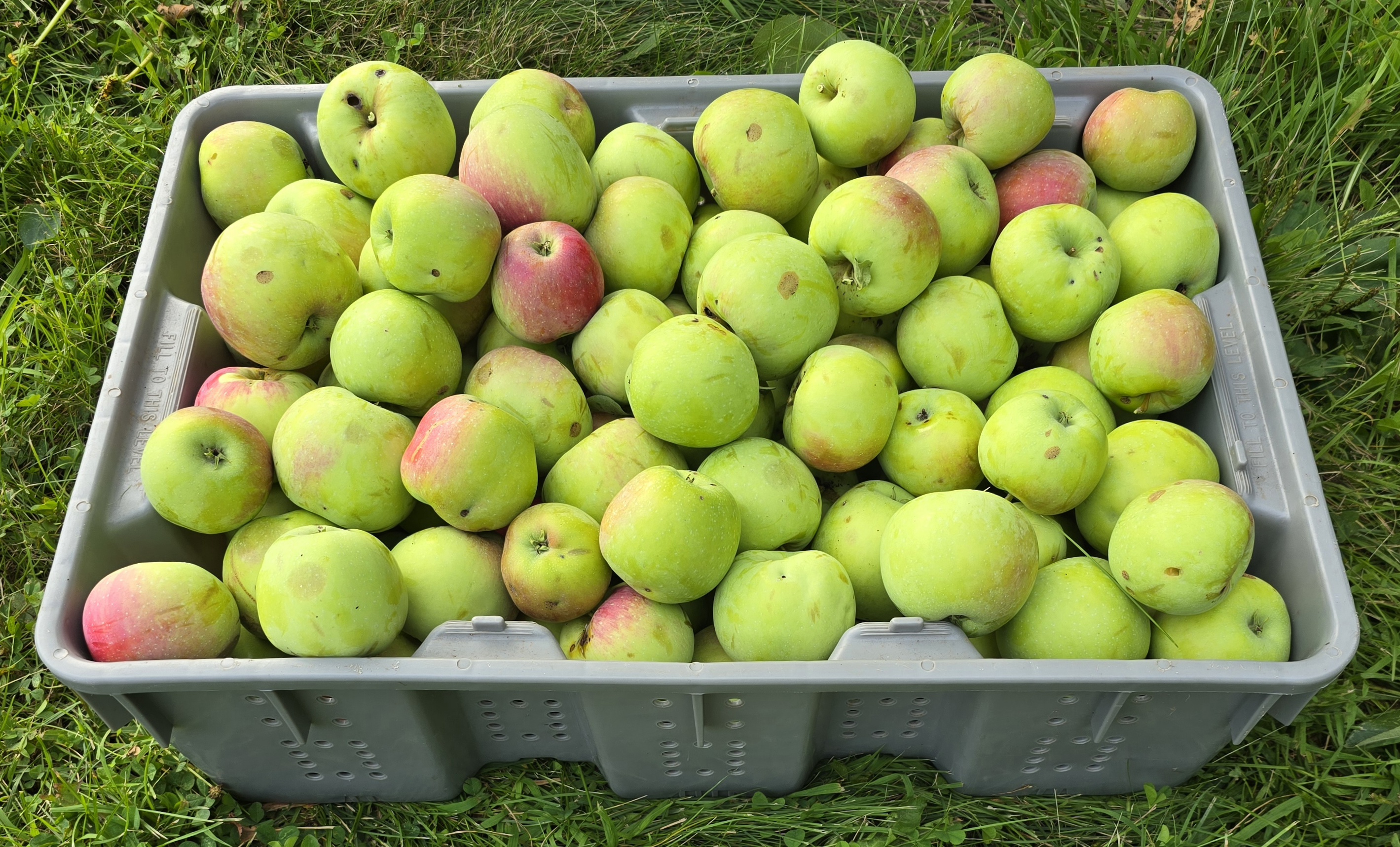
Zestar! apples July 21, 2025
One measure of abundance is Zestar! apples. It was the first large harvest from a tree I planted a few years ago. The taste is sensational: juicy and tart. They will make great applesauce. This year I decided to can applesauce in pint jars instead of quarts. One main use is as a binding agent in my Iowa vegan cornbread and the pint is more likely to be used up before it goes bad.
Use of apples goes way back on my father’s side of the family. Stories survive of family working in the apple canning plant in Appalachia in the early 20th Century. I am happy to have four varieties of apples growing in our back yard. Calling it my heritage is not wrong. I don’t spray, so they are not perfect. Boy howdy! Do I use them up!
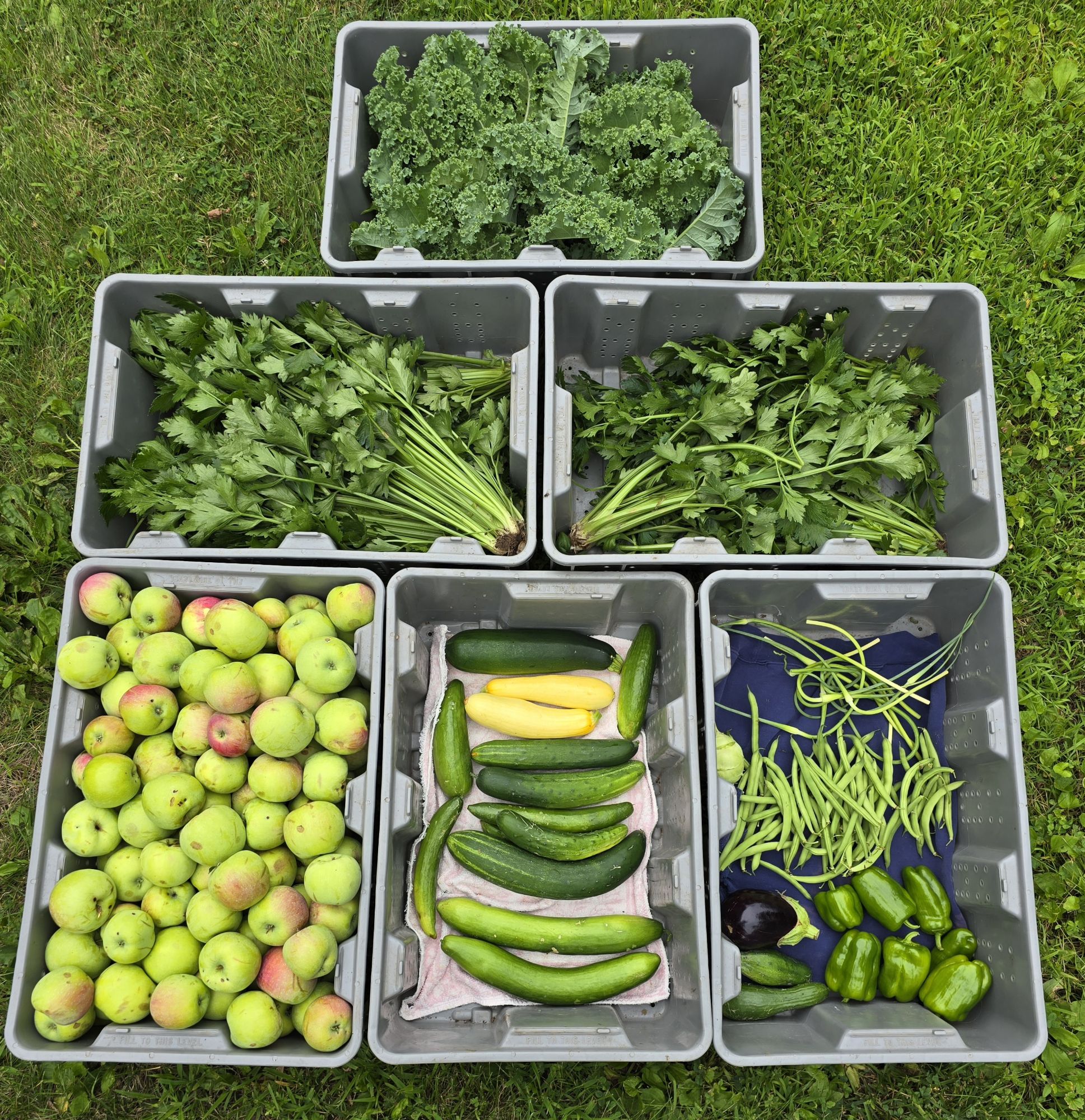
Harvest on July 21, 2025.
When the garden is going gangbusters, the challenge is to use up or preserve as much as possible, as soon as possible. Two of the crates in the photo above have celery in them. Celery gets processed into four different things: I keep “hearts” of celery for cooking fresh, ending up with ten of them this year. The various outer stalks are separated from the leaves. The stalks with some size to them are chopped into small bits and frozen to add to soup. All the very small pieces of stalk and stem are roughly cut, bagged and frozen for use in making vegetable broth. Finally, the leaves are rough chopped, bagged and frozen to add to soup. I use the whole plant. All of this takes a bit of work, yet the flavor makes it worth the effort.
Another big project ahead is using garlic scapes before the garlic harvest. I have a good crop of basil, so I expect I will make garlic scape pesto. I already have plenty of half pint jars of pesto in the freezer, so I don’t need many more. Will see how far along with that I get.
Growing a large garden ties a person to home. There is so much to do in July, if we don’t pace ourselves, we may be tuckered out for the August tomato season. Can’t let that happen.
On July 1, Interstate Power and Light Company, the parent company of Alliant Energy, filed an application to add 1,000 megawatts of wind energy “to help boost Iowa’s electric grid and further diversify its energy portfolio,” Olivia Cohen wrote in the Cedar Rapids Gazette. The timing of the filing takes advantage of tax credits included in the Inflation Reduction Act before they change as a result of the budget reconciliation bill enacted this month. This project seems like a good deal for everyone.
What we don’t see is applications to construct new nuclear reactors to generate electricity. There has been a stream of media articles about pulling the Duane Arnold Energy Center in Palo out of mothballs and bringing it on line again. There is an exploratory committee for that purpose. In addition, the Linn County Supervisors have undertaken to establish a nuclear zoning code for parts of the compliance not preempted by federal authorities. These are not real solutions to meet energy demand.
I wrote before, “The technology at Duane Arnold is old. The physical plant is old. Its permit has been renewed twice. There is a limit to the life of these facilities built in the 1970s. Why throw new money after old technology? We shouldn’t.” If we do anything regarding nuclear power generation, we should wait until known problems have been resolved. That is one of Bill Gates’ current projects. Gates appears to rely heavily on government subsidies for his small modular reactor in Wyoming.
Why even consider nuclear energy? I knew why when I was a kid back in the 1950s and ’60s after President Dwight Eisenhower’s Atoms for Peace speech at the United Nations General Assembly on Dec. 8, 1953. Eisenhower sought to solve the terrible problem of splitting atoms in nuclear weapons by suggesting a means to transform the atom from a scourge into a benefit for mankind. Follow this link for the text of the Atoms for Peace speech. That idea had its heyday. That time is over.
Even Iowa is getting in the act with Governor Reynolds’ Nuclear Energy Task Force created via Executive Order to make recommendations for how we can move forward with nuclear energy in Iowa. The task force was just formed, so we don’t know the direction they will take. Well, we do. There is only one game in town. Generate nuclear powered electricity using government subsidies to offset the high costs which render the idea a non-starter as a stand alone business proposition.
Today our government wants nuclear weapons and nuclear power for the express purpose of making money for contractors and their wealthy owners. Profits are to be propped up by government subsidies. The message, clear in the Alliant Energy application, is government subsidies for green energy are coming to an end under the current administration. Why not phase out and end the subsidies for nuclear power and fossil fuel companies as well? We know why. The government has been captured by these energy industries.
Society has not begun to tap the potential of wind and solar energy. When the issue of storage is solved, the two methods of electricity generation should just take off. It is up to us to resist a resurgence of nuclear power and allow wind and solar to take market share. Based on what is happening now in Europe, they will. The United States has chosen to service oligarchs and large corporations in its energy policy. We should lead rather than do this and fall behind.
If a person doesn’t believe an industry can capture the U.S. government, they haven’t been paying attention. The proposed rescission of congressionally approved funding for clean energy projects, combined with the omnibus reconciliation bill endeavor to strip away any government support for wind and solar generated electricity, electric vehicles, and more. The same moneyed players are at work here to retard progress toward a clean energy future: the fossil fuels industry.
Former Vice President Al Gore of the Climate Reality Project shared his thoughts on the regressive Republican policies:
We don’t have any time to waste if we want to solve the climate crisis in time to avert the truly catastrophic impacts that can still be prevented. But dangerous delay – which is the new “climate denial” – is exactly what Congress has done by repealing the clean energy provisions of the IRA: wasting time we don’t have by trying to prop up the fossil fuel industry while the world burns.
Make no mistake, the clean energy transition will continue in the United States despite these efforts – our direction of travel is clear.
But by prioritizing the fossil fuel industry over true climate solutions – even forcing taxpayers to add yet more subsidies for large oil and gas companies – our leaders are shirking their responsibility to the American people and ceding leadership in the global economy to China, Europe, and others who are embracing the many benefits of a clean energy future. (Statement by Former Vice President Al Gore on the Budget Bill, The Climate Reality Project, July, 3, 2025).
Gore is right. An obvious truth is that if the United States steps back from what once was robust governmental support for clean energy, there are two consequences. The domestic transition from fossil fuels to solar and wind powered energy will continue. The course is set, despite hobbles the fossil fuel captured Trump administration tries to attach to it. Second, if the United States doesn’t want to lead, China, Europe and others will, putting our country at a competitive disadvantage.
Last Wednesday, Reuters reported, “Solar power was the European Union’s largest source of electricity for the first time in June, overtaking nuclear and wind while coal’s contribution fell to an all-time low, data from energy think tank Ember showed.” The next challenge for Europe’s power system is expansion of battery storage and grid flexibility to reduce reliance on fossil fuels when the sun doesn’t shine and the wind doesn’t blow, according to the article. The U.S. should be leading this energy transformation instead of ceding it to other countries.
The future is ours if we will grasp it. Despite Republican efforts to stop the clean energy transition, progress will continue, only this time with the United State playing catch up.
Iranian President Mahmoud Ahmadinejad visits the Natanz nuclear enrichment facility April 8, 2008 Photo Credit: Reuters
I remember watching one of the Soviet Sputnik satellites flying over the back yard of our Iowa home. Besides launching a “space race” between the United States and the Union of Soviet Socialist Republics, Sputnik heightened tensions between the two countries over potential use of nuclear weapons. Back in the 1960s, we graders practiced school drills for a nuclear attack. This period of competition became known as the Cold War. To this day, the U.S. and Russia own most of the nuclear weapons that exist. The NASA website makes a point:
The Sputnik launch changed everything. As a technical achievement, Sputnik caught the world’s attention and the American public off-guard. Its size was more impressive than (the U.S.) Vanguard’s intended 3.5-pound payload. In addition, the public feared that the Soviets’ ability to launch satellites also translated into the capability to launch ballistic missiles that could carry nuclear weapons from Europe to the U.S. Then the Soviets struck again; on November 3, Sputnik II was launched, carrying a much heavier payload, including a dog named Laika. (NASA website).
Our life of living with nuclear weapons changed dramatically since Sputnik. The public is vulnerable to being caught off guard again because few are paying any attention to nuclear weapons proliferation. Last year, Annie Jacobsen published Nuclear War: A Scenario, which provided an update on where the country stands regarding our nuclear weapons complex. Jacobsen’s work is part of the picture.
Our compliance with the Nuclear Non-proliferation Treaty, which commits all parties to negotiate in good faith on effective measures relating to the cessation of the nuclear arms race, nuclear disarmament, and general and complete disarmament, is at a stand still. The story of how that happened is less interesting than the diversion from this core compliance issue caused by attention to North Korea and Iran’s development of nuclear technologies. It avoids the basic question of when will the U.S. and Russia comply with Article Six of the treaty?
Daryl G. Kimball, Executive Director of the Arms Control Association, addressed the recent bombing of Iran by Israel and the U.S. He argues, “U.S. President Donald Trump’s decision to join Israel’s illegal military attacks against Iranian scientists and safeguarded nuclear sites represents an irresponsible departure from his earlier pursuit of diplomacy. It will increase the risk of a nuclear-armed Iran and erode confidence in the nuclear nonproliferation system.”
The nuclear deal that Trump unilaterally abandoned in 2018, the Joint Comprehensive Plan of Action (JCPOA), imposed limits, prohibitions and intrusive inspection requirements on Iran that were to last for 10 or 15 years, with some being permanent, Kimball wrote. He expressed hope that the negotiating framework can still be salvaged, even if it has been severely damaged by this year’s U.S. military operations in Iran.
In the meanwhile, the U.S. government continues to spend hundreds of millions of dollars on our nuclear complex. We don’t hear much about that, except when it’s federal budget time. Ann Suellentrop, vice chair of the PeaceWorks Kansas City board and a member of the Physicians for Social Responsibility Board, noted in the Kansas City Star, “Kansas City’s nuclear bomb parts plant is ramping up significantly.” She provided details:
There is a new federal government plan to increase production of plutonium pits — the trigger that starts the bomb explosion in nuclear weapons — to 80 pits per year in each of the next 50 years. This is in comparison with the current production of fewer than 30 per year. The sites that are supposed to work together on what amounts to a new nuclear arms race include Kansas City’s federal nuclear bomb parts plant, managed by Honeywell Federal Manufacturing & Technologies. That is the Kansas City National Security Campus located in the south part of the city. The recent allocation of taxpayer funds for this National Nuclear Security Administration site reveals a huge jump from the 2025 budget from $1.3 billion to $1.7 billion in 2026. The plant is now doubling in size as it produces electrical and mechanical parts for seven new nuclear weapons programs simultaneously. (Kansas City Star, July 9, 2025).
Despite the efforts of Suellentrop and others, the nuclear weapons spending issue gains little media traction. “We need a mass movement of people to speak up and hold the government accountable,” Suellentrop said. The fact is we need a mass movement to speak up and hold the government accountable in many areas. If such a thing exists, it hasn’t ramped up fast enough.
The irony with the war between Israel and Iran is we appear to be returning to the days of Sputnik. Joe Cirincione recently opined, “we look at the unintended consequences of this 12-day war: the risk of dragging us back to the nuclear anarchy of the 1950s, when many nations — friends and foes — sought nuclear weapons.” The 1950s may be a fond memory for some of us. We definitely don’t want to go back, especially as it pertains to proliferation of nuclear weapons.
2025 is turning into an alcohol-free year. I didn’t even purchase my normal case of bottled beer for the summer. Some days, I don’t know who I am.
I drove across the lakes to the North Liberty Community Food Pantry and donated the day’s harvest of yellow squash and cucumbers. It was the third food bank donation this week. I like having an outlet when I grow too much of something. It enables me to pick the best produce for the kitchen yet find a home for all of it. Patrons of the food pantry truly need what donors provide.
On the way home I stopped at the convenience store to gamble $2 on the lottery. I noticed the display of many types of shots of liquor between the two cash registers and asked,
"Do you sell a lot of these?"
"We do," replied the cashier.
"I imagine you sell a lot on Friday nights," I said. "Actually, mornings are the biggest sales. You'd be surprised how many people need a shot to start their work day."
I went to the orchard where I worked eight seasons and bought Michigan cherries. A family member grows them and they are some of the best I have ever tasted. Expensive? Yes. Worth it? Also yes. It is a summer tradition worth continuing as long as I can afford it. In the sales display with the cherries they had bags of Lodi apples. This signifies the apple harvest has begun its long season continuing into late October.
The first crop of Zestar! apples will soon ripen in my garden. I picked one today and while the sugars are beginning to form, they are not yet ripe. It won’t be long, though, maybe a week or two.
The work of planting is mostly finished. From here, the work changes to weeding, harvesting, cooking, and leveraging other growers for what I don’t produce myself. It is all part of the circle of life when you grow food. I feel a part of something bigger than myself on days like this.
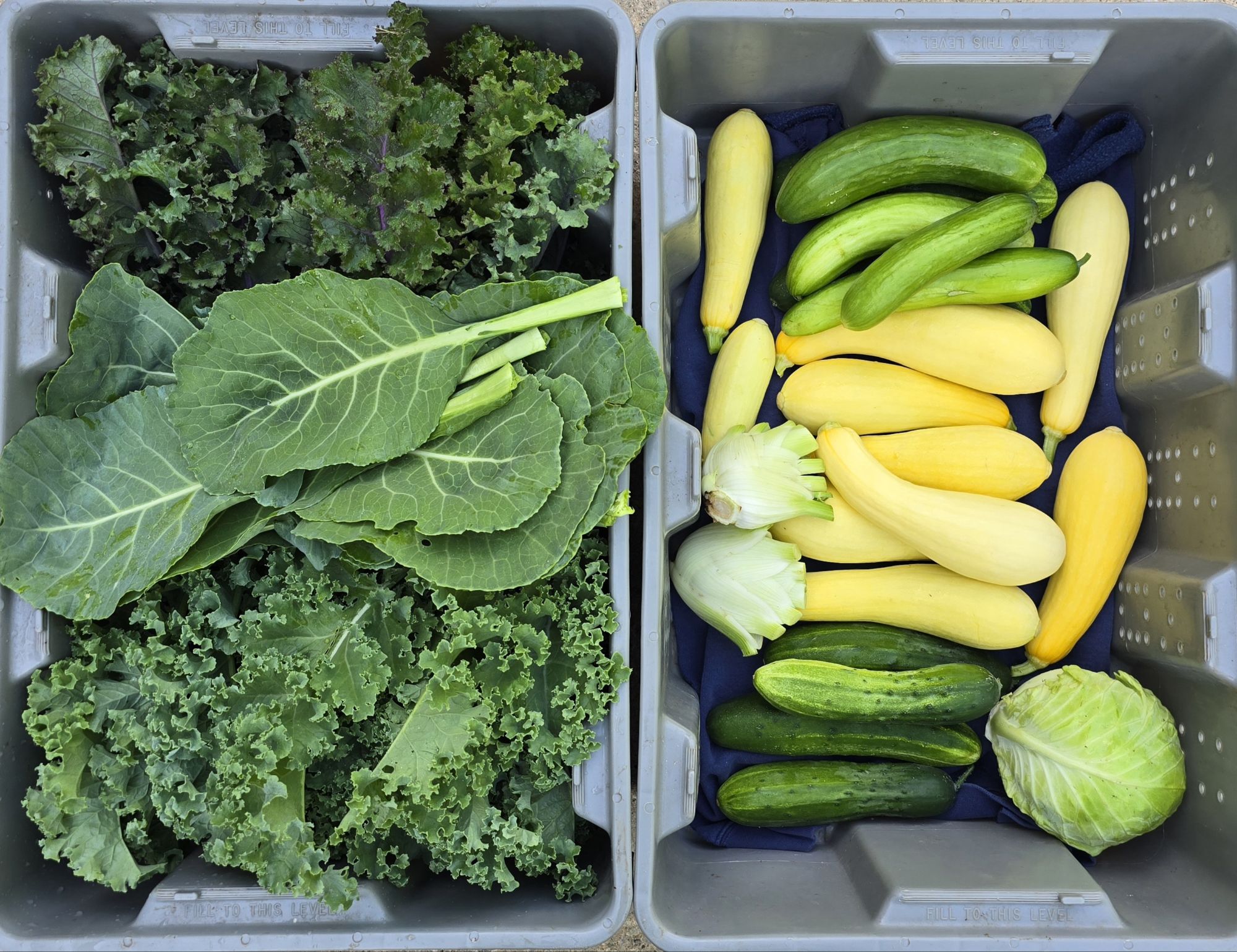
Donation to community food pantry on July 7, 2025.
The gutter clogged during a Saturday afternoon rainstorm. I looked at the forecast and rain was expected, on and off, for the next six hours. I decided to get the extension ladder and climb on the roof to clear the blockage so water wouldn’t overflow into the lower level of the house. I waited until the driveway showed signs of drying and went outside. Even though a misty-feeling drizzle hit my face, I persisted. From the time I got the ladder down until I returned it to its rack was less than 15 minutes. At 73 years, I should limit my time on the roof, yet the problem was immediate, the consequences of doing nothing were unacceptable. The situation wants a permanent solution.
I had a fitful night’s sleep the evening of July 4. Community fireworks were scheduled for July 5, so that didn’t keep me awake. News of the administration’s budget reconciliation was likely at the heart of my restlessness. That, with the courts enabling parts of their agenda. It’s as if every good public work I have done since graduating high school is being undone. It’s intentional, so my restlessness is not without reason.
Today there will be a decent harvest for the food pantry. Yellow squash, cucumbers, and leafy green vegetables, for sure. When the sun rises, I’ll take my daily walk on the state park trail and get into the garden. With the rain, the garden is really producing, to the benefit of our household and some who are food insecure.
Rain has consequences, both challenging and positive. A summer rainstorm provides opportunities to improve our lives, if we are open to seeing them.
The heat and humidity backed off, making Tuesday a pleasant summer day. Ambient temperature got up to the mid eighties, yet a lack of high humidity made everything outdoors tolerable. I spent a good amount of time there.
Like many, I’m not happy the U.S. Senate passed the budget reconciliation bill. It apparantly came down to Alaska’s Senator Lisa Murkowski who, fearing retribution for a no vote, changed her mind and provided the 50th yes vote. That enabled the vice president to break the tie and deliver a win for Republicans. It is now up to the House to concur… or do what they will.
There is a lot to deal with. Senator Adam Schiff pointed this out in the bill:
If it passes, this will be a setback for environmental quality. Many environmental advocates may feel like the U.S. is back to square one. Me? I can’t give up.
For now, we have perfect summer weather. For how long is hard to say.









 Journey Home
You must be logged in to post a comment.