Categories
Living in Society

Favorite Concerts

Last Obama Campaign Rally in Des Moines, Nov. 4, 2012.

Beginning with a Herman’s Hermits concert at Davenport’s Municipal Stadium on Aug. 27, 1966, I’ve attended a lot of live musical performances. In this post, I write about some that stand out. They are listed in chronological order.

Van Morrison – On April 3, 1970, I saw Van Morrison play at the Fillmore East in Manhattan. Members of my senior high school class took a trip to Washington, D.C. and New York. I lived on poker winnings from nightly games with my classmates for the Washington part of the trip. Three of us decided to use one of the free nights in New York to walk from our hotel on Herald Square down to the Fillmore East and see a concert. We had no idea what we were to experience.

Morrison played Brown Eyed Girl, which was popular at the time. Some of my fellow guitar players had tried their hand on that classic in Iowa. The big event was Warner Brothers Records had released the Moondance album in January, and those songs made up most of the show. The whole thing was an experience, including the famous Joshua Light Show. I am thankful for that opportunity even though it was not part of the plan when we left Iowa.

Grateful Dead – When the Grateful Dead played at the University of Iowa Field House on March 20, 1971, I ran a Strong Trouper carbon arc spotlight. The evening started with floor seating, but the crowd promptly stacked all of the chairs on the sides and despite efforts by the campus police to bring order, the band played on. My partner, running a spotlight on the opposite side of the field house, had to leave early to strike a set at Hancher Auditorium. For a while, after campus police turned off the stage lights, I was the only illumination during the performance. I saw the Dead again on Feb. 24, 1973.

Allman Brothers – The Allman Brothers Band was something. When they appeared at the University of Iowa Field House on Feb. 19, 1972 the album they had been working on, Eat A Peach, had been released the previous week. Duane Allman died after a motorcycle accident in October 1971 while they were working on it. The idea of dual lead guitars had not occurred to me but it became a signature sound for the band. I saw them again when they returned on Nov. 9, 1973.

Ravi Shankar – An art student friend and I drove to Cedar Rapids to hear Ravi Shankar with Alla Rakha perform at Sinclair Auditorium at Coe College. The improvisational nature of their music was astounding. I can’t forget it. The date was Feb. 20, 1973.

Eric Clapton – The Mississippi Valley Fairgrounds in Davenport was host to Eric Clapton, Yvonne Elliman, Carl Radle, Jamie Oldaker, and others on July 27, 1974. I had listened to Clapton’s records going back to his work with John Mayall and the Bluesbreakers. The band was clearly into the performance as the sun set over the fairgrounds, making it a memorable evening.

Judy Collins – My friend and I saw Judy Collins perform at the Des Moines Civic Center on July 30, 1982. I proposed marriage to my friend 19 days later. She accepted and we remain married.

B.B. King – My sister and I went to hear B.B. King at the Col Ballroom in Davenport on March 25, 1983. My grade school friend, Red Gallagher opened for the blues legend. There is nothing to say but B.B. was the king.

Sir Elton John – At one of the weirdest concerts I attended, Sir Elton John performed at the Cow Palace in San Francisco as part of Oracle Open World on Oct. 24, 2006. Tens of thousands of Oracle users were in attendance. I knew virtually none of them yet enjoyed the performance. Corporate concerts are just a different vibe.

Bruce Springsteen – The night before the general election, Nov. 4, 2012, President Barack Obama hosted Bruce Springsteen on the streets of Des Moines. My friend Jan and I left a canvassing operation for a house candidate early to drive to Des Moines and be part of Obama’s final campaign rally. The two of us met Obama in the receiving line after his 2006 speech at the Harkin Steak Fry and wanted to get closure on the campaign. No regrets about that decision.
Categories
Home Life

Postcards from Iowa #15

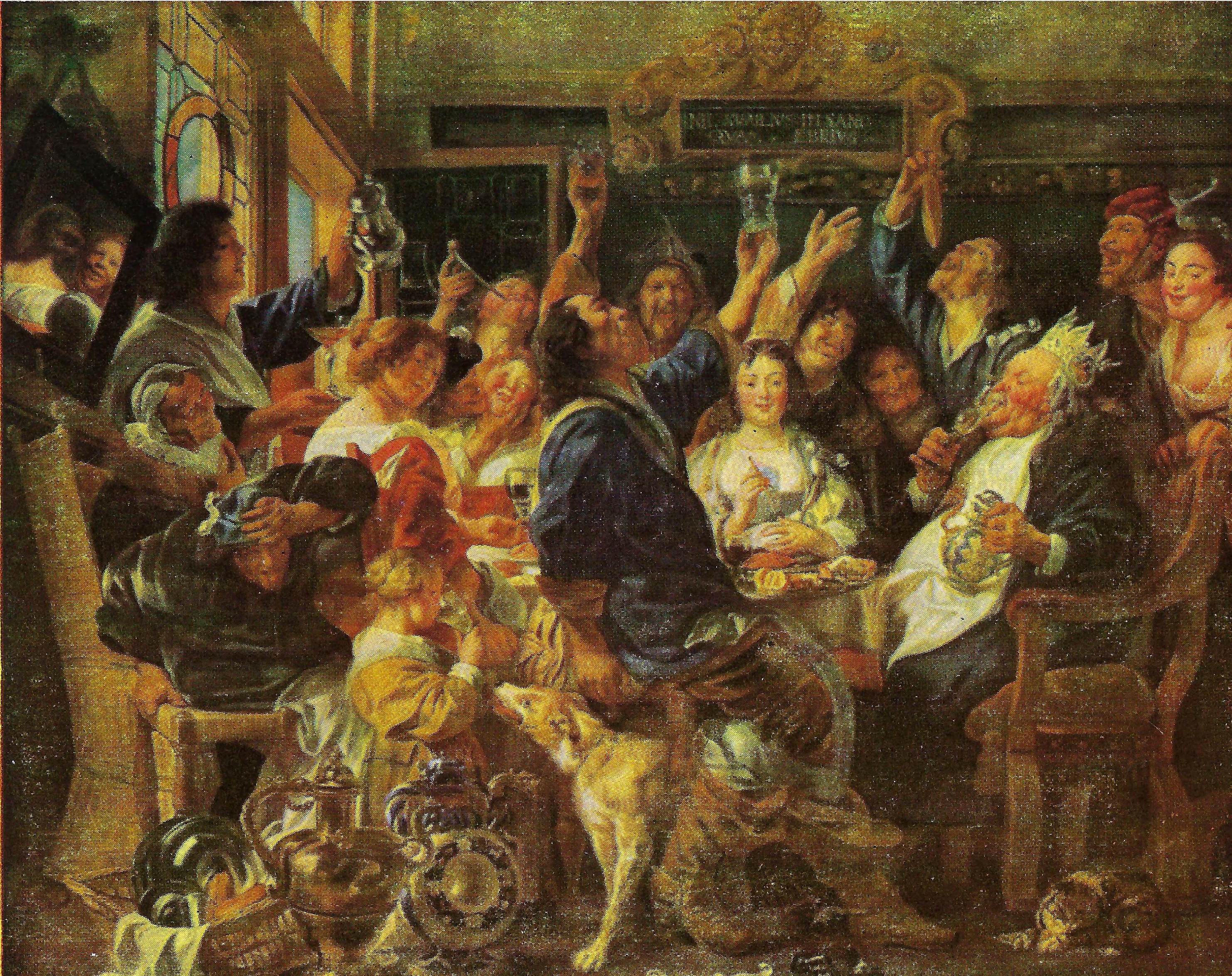
The bean feast, Jacob Jordaens (1593 – 1678) Wien, Kusthistorisches Museum.

Happy Thanksgiving!

Our vegan menu:
Assorted homemade pickles
Wild rice pilaf
Baked Great Northern beans
Acorn squash
Hummus
Peas and carrots
Brussels sprouts
Cranberry relish
Apple crisp
Fresh, local apple cider
Filtered ice water
Final presentation.
Categories
Kitchen Garden

Postcards from Iowa #14

Reverse side: Stella Marrs, P.O. Box 2273, Olympia, WA 98507.

I plugged in the grow light for the first time since summer to move a flat of Ajuga plants indoors. We reclaimed them from the yard, where they spread and spread, all the way down to the drainage ditch. We transferred them from my father-in-law’s home before he died in the 1990s. At the nursery Ajuga plants are quite expensive, maybe $6 per pot. We’ll have plenty at no cost but our labor if we take care of them. They grow like weeds.

On Thanksgiving I plan to lay out the 2022 garden and prepare the first seed order. Second seed order, actually, as I already have the onions and shallots to start in late December. I hope to clear the dining room table and sit down to consider what seeds we have and what we want to grow in consultation with my spouse. It could be a family tradition, one that means something special. We’ll see how it goes as I don’t want to get ahead of myself.

We are not big on year-end holidays and usually spend them by ourselves. Once we make that decision each year, everything hinges on how we feel. There is a slate of phone calls, emails and the like. Being a vegetarian household, the deer, geese and wild turkeys are safe from us as the meat culture is absent. Most people would call what we eat “side dishes.” At a point long ago we reviewed the nutritional values and found we had a well-balanced, if nontraditional Thanksgiving meal.

I don’t know where I got this postcard yet I like it. I do garden organically, although I gave in and started using composted chicken manure as fertilizer. It improved the yield. I don’t use manufactured herbicides or insecticides, organic ones work fine. I get organic seeds when I can find them. To see the face of the farmer, I look in a mirror.

Friday morning there was a partial eclipse of the full moon. It looked awesome set in a bed of bright stars. I couldn’t get a decently framed photo so I didn’t take any. Memory will have to serve.

We have provisioned up for Thanksgiving and have everything we need. If the orchard releases Gold Rush apples today, I’ll go get some along with a half gallon of cider. If the Gold Rush are not available, I’ll stay home and make my own cider for Thanksgiving. I saved enough garden apples in case I needed them.

With the holiday season upon us, the rush to year’s end has begun. 2021 is almost over and we are ready to begin again. I’m here for that. I’m looking forward to another gardening year.

Categories
Writing

Postcards from Iowa #13

Copyright: Joan Liffring Zug, photographer.

Reverse side: Made by Dexter Press, West Hyack, New York. Published by Mennonite Historical Society of Iowa, Kalona, Ia. 52247. Old Order Amish and conservative Mennonite daughters wear traditional plain homemade dresses familiar throughout 450 years of Anabaptist history. These are the children of a buggy maker living and working near the Kalona Cheese plant of Twin County Dairy, Inc., Highway 1, Kalona, Ia.

Two girls posing for a photographer who had permission to take their picture. There has been more than a little controversy about photographing Mennonites and Old Order Amish. It is permissible with the former, and against views about graven images with the latter. The images are well-circulated.

I used to visit the Twin County Dairy when bicycling from Iowa City. Cycling alone for the exercise, I would stop and buy cheese curds at the dairy. That is, if it were open. Often my trips were predawn when the glow and flicker of kerosene lamps came from house windows and the doors of barns. I no longer travel to Kalona as I learned how to produce almost everything I formerly bought at Stringtown Grocery and other shops scattered in the rural area.

Twin County Dairy, established by a group of Amish and Mennonite farmers as a cooperative in 1946, was shuttered in 2014. Kalona Creamery, a part of Open Gates Business Development Corporation bought it the following year. Their businesses included Kalona Organics®, Kalona Farms, Farmers Creamery, Awesome Refrigerated Transit of Iowa, and Provision Ingredients. I don’t know if they have a retail store that sells cheese curds. Since there is a creamery a few miles from home, I have no need to go and find out.

Author David Rhodes wrote about the area in his novel Rock Island Line. I have a library copy of the first edition, published in 1975. No doubt I bought it at a thrift shop. There is a rubber stamp inside the front cover that reads, “Outdated Removed from Circulation.” Young girls in the Mennonite community and their photographs won’t become outdated any time soon.

Categories
Writing

Postcards from Iowa #12

Buzz Aldrin on the Moon, July 20, 1969 – Apollo 11. Photo credit: Neil Armstrong.

Reverse side: Cumquat Publishing Co. P.O. Box 4932, St. Louis, MO 63108

When considering this photo the isolation stands out. Besides Michael Collins orbiting the moon while waiting for their return, Buzz Aldrin and Neil Armstrong were alone. The sense of isolation is profound.

They were trained to deal with the mission and by all accounts did well. It was a unique moment in history, one in which many Americans took pride.

I witnessed what I could on television when it happened or on replay. I remember grainy images, a reality that seemed surreal.

It is a great photograph. One I’ll think about all day.

Categories
Writing

Postcards from Iowa #11

Photo Credit: The American Scene Collection, American Oil Company 1969.

Reverse side: Washington Skyline, Washington, D.C. Located on the axis of the Lincoln Memorial and the Washington Monument, the Capitol Building is shown in the foreground with the Washington Monument illuminated in the background. See the U.S.A. in a Chevrolet. As you travel ask us.

Life would have been simpler if I had stuck to the same path as friends in high school. Maybe follow a narrative such as after school and military service find a job, raise a family, work it until retirement, then settle back and relax in the golden years. Simple.

Actual living was not simple. While many in my cohort married and started a family immediately after high school, I did not and that made a difference.

The trauma of being injured while young, and the subsequent hospital stay, removed me from conventional pathways. I wrote about it in 2009:

My earliest defining moment was the day, at age 3-1/2, when a swing-set set up in the basement of our Madison Street home collapsed and injured my head. My parents were horrified. I remember the pool of blood on the basement floor, holding the thumb of the ambulance driver, taking ether dripped into a funnel to anesthetize me for the stitches to mend my gashed head. I am lucky to be alive. What I learned through the injury and recovery in the hospital was that there is an infrastructure of knowledge and caring to support us when things happen. I watched the routines of the hospital staff, the doctor checking up on me, changing room mates and bed linen, daily visits from my parents and the handling of my propensity to get out of bed and walk around. This experience assured me that although we are vulnerable, we are not alone.

Over the years, Doctor Kuhl would examine the scar on my forehead and talk about my recovery when I visited him in his office. Today, I don’t think of the scar, and suspect most people do not even notice it. What I do think about is that while we are not alone, we must be part of a society that helps protect those who are most vulnerable, including the injured and infirm. When I was very young, I made a withdrawal from this bank and now the debt needs repaying.

Big Grove News, Jan. 18, 2009.

Little has changed since I wrote this. While I relied on the infrastructure of society, at high school graduation I had neither the interest nor skills to get married and start a family. I went to college instead.

In late 1968 or 1969, I sought Father’s approval while figuring out what to do after high school. Maybe I would study engineering, I told him. The practical, rational approach of an engineer to problem-solving was appealing. He neither approved nor disapproved. He looked surprised it was on my mind. He was completing his own education and perhaps was preoccupied. He would be gone soon afterward.

During senior year in high school we made a class trip to Washington, D.C. and New York City. It was my first trip on a commercial aircraft. We saw the U.S. Capitol and Washington monument depicted in this postcard at about the time it was printed. We played cards for nickels and dimes in our room each night. My winnings paid for incidental expenses through New York. In some ways the class trip was the beginning of living on my own and experiencing the world outside my home town. It seems appropriate it would start with the nation’s capitol.

My life divides into segments: preschool, education, work and family, moving to Indiana, and moving back to Iowa. Each was important for different reasons. As I went through time I didn’t know how each step would unfold.

My education, including military service and graduate school, had the momentum of youth. When I finished school at age 29, I was ready to do great things. Available opportunities were a disappointment. The trajectory of youth found me alone and unsettled, without a career or path forward. I would have to make my own way and that complicated things. In retrospect it was a good complication. If I hadn’t left my home town permanently for university, life may have been simpler.

I’m glad my circumstances gave me the chance to leave home and be different.

Categories
Writing

Postcards from Iowa #10

Reverse side: illegible postmark and message written in pencil.

This postcard is intended to be a joke. I love it for its gossipy nature. It was written in pencil and the script has all but faded away. The postmark and address are illegible. If there was a written message, it is gone. Names are written next to the figures in the image, but can’t be read. It is reflective of a forgotten time of white privilege.

What world does this represent? The man and women are unlikely married and that alone is noteworthy according to the sender. If Facebook existed at the time of the postcard, an appropriate comment and discussion thread would be forthcoming.

I have used Facebook since March 2008 to stay in touch with our daughter after her move to Colorado after college. She encouraged me to join. I have no regrets.

To feel better about Facebook, I limit use of the platform. I cross post from Instagram, serve as admin for two private groups, and occasionally post some of my writing there. Most of my daily activity is checking notifications and responding as briefly as I can. I respond with a vague notion that friends who show up in my timeline will be those with whom I interact.

As part of my usage, I curate the “life events” part of my profile some Sunday afternoons. At first it was a timeline of selected musical concerts I attended. Eventually I added other significant events like an audience with Pope Paul VI, buying our first home computer, and selected key moments of engagement in society. I work on it from time to time and it encourages me look up dates and record them as a reference for my autobiography. Because I isolate myself from most of what is toxic about the platform my list of grievances is short. The private group with neighbors is particularly useful in my role as president of our home owners association.

While white privilege persists, societal attitudes reflected in this postcard do not. The circle of people with whom one might share such a titillating message is limited to a small subset of those we know. Most think the better of mocking young love in an age where joy is stripped from many aspects of life. We encourage behaviors of white privilege and keep such thoughts to ourselves. The better behavior would be to determine how to recognize and purge white privilege completely from our thoughts and deeds.

The postcard is distinct. Coming from the time it does, I appreciate the ideas behind it. That taunting, juvenile assertion more often found on the playgrounds of graders than in adult society.

To read all of my posts in the series, click on the tag Postcards from Iowa.

Categories
Writing

Postcards from Iowa #9

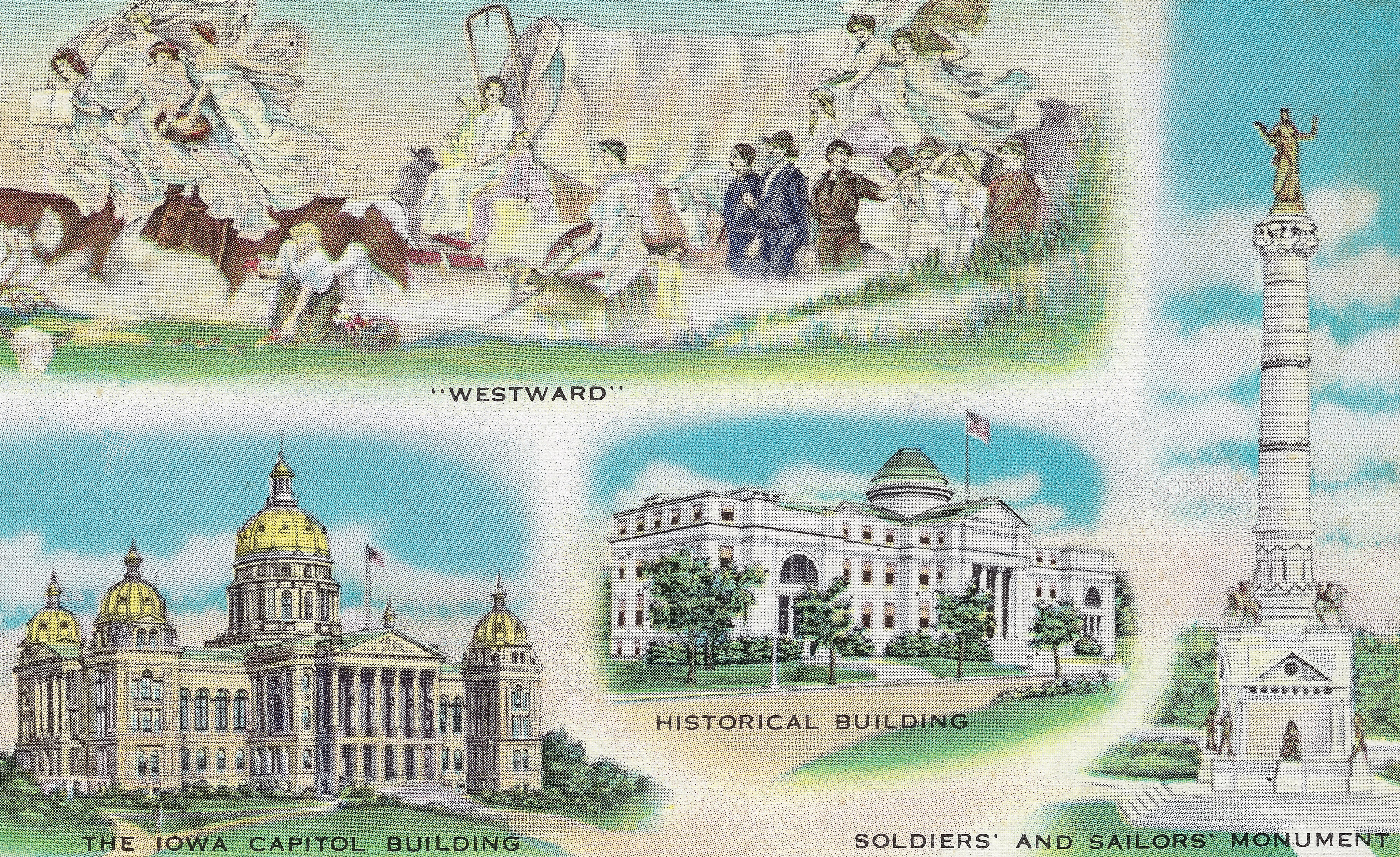
“In All That Is Good, Iowa Affords the Best”

Reverse side: “In All That Is Good, Iowa Affords the Best.” Iowa was admitted as a state Dec. 28, 1846. The Capitol was built 1873-1886 at a cost of $3,296,256. The domes are plated with 22-carat gold. The mural “Westward” hangs at the head of the grand stairway. “Iowa, Her Affections Like The Rivers Of Her Borders, Flow To An Inseparable Union”

We don’t pick the circumstances of our birth. Because life has been tolerable in Iowa I stayed. I had experiences elsewhere: in the military which took me to South Carolina, Georgia and Germany, and a work transfer to Indiana. Both times I returned to my home state. If I had found a place more suitable for living I would have moved there. A person gets used to what they know.

I graduated from the University of Iowa twice yet I don’t consider myself to be a “Hawkeye,” the nickname for graduates. I don’t even follow the sports teams despite large sums of money the state invests in them. I don’t farm or work for someone any longer. As a pensioner I could live anywhere. So far I continue to choose Iowa.

It is not bad living here… yet. Despite growing coarseness in society, where personalities rage at one another, denigrate liberals and intellectuals, and do dumb things, I’m still here. We are a place where Qanon members and dark money lobbyists are close to the governor while I am not. The postcard is not clear about “all that is bad” yet we have plenty of that in Iowa. At the point where there is concern for personal safety I might leave. Where would I go? To a place where my pension dollars would stretch further. Perhaps outside the United States.

The designer of this card was a publicist and an optimist. I recognize the objects on the front side and have been in the state capitol and historical building many times. The idea we are an “inseparable union” is ridiculous in 2021. It would be fitting to mention the two bordering, polluted rivers flow to the Gulf of Mexico where they contribute to a large dead zone. Hardly stuff to be used in promoting the state. The card is undated but is a product of the 20th Century. We are so past that now.

We make the best lives we can. We are handicapped by education, social status and physical attributes. Those handicaps can be overcome. In Iowa I’ve always been able to find work enough to own a house and pay the bills. Emblematic of our financial circumstances is I drive a 2002 automobile. It is low mileage and serves basic transportation needs. I wouldn’t want to make a trip to New Jersey in it.

There is a migration of young people leaving the state. Why would they stay? Drawn to large cities like New York, Chicago and Los Angeles, they also move to Colorado where Denver has become a gathering place for young professional people. Florida used to be a destination until Governor Ron DeSantis came along. Now there is an ongoing exodus from Florida as well. Iowa’s governor seems resolved to follow DeSantis’ lead. It’s another reason young people leave the state.

I like this postcard and wish the slogans were true. If wishes were horses, beggars would ride.

Categories
Writing

Postcards From Iowa #8

Reverse side: Abraham Lincoln from New Salem. This bronze statue by Avard Fairbanks was given to the State of Illinois by the Sons of Utah Pioneers in 1954. It is located at the top of the hill in New Salem State Park near the entrance to the village. Published by Color-View, Inc., 208 N. Main St., Rockford, Ill. Postmarked May 17, 1962 in Rochelle, Ill. with a note from Father.

I grew up in Davenport, Iowa. Iowa is not the land of Lincoln. That is across the Mississippi River in Illinois.

Father sent this postcard from Rochelle, Ill. where he presumably attended a meeting for the Amalgamated Meat Cutters and Butcher Workmen of North America. I don’t recall. I was ten years old. The message on the back was, “I’ll be home before the card gets there so I’m saying goodbye to Rochelle.”

We stopped by Father’s step-mother’s place in Rock Island one time. She wasn’t home. Gladys was grandfather’s second wife after Ina Elizabeth died young of food poisoning. Grandfather died of complications from surgery. According to her obituary, Gladys owned and operated Deaton’s Diner for 35 years. She kept the family name, adding two additional husbands by hyphenation after grandfather died. She told me, in the only letter I have from her, that the marriage into the Deaton family was a business proposition. All three of her husbands are buried next to her in a Rock Island Cemetery we visited decades ago. The cemetery sexton knew “Mrs. Deaton” well.

In high school, we took the bus downtown then walked across the Centennial Bridge to Rock Island where a movie theater was screening a serialized story of The Batman made by Columbia Pictures in 1943. After the television program debuted in 1966, I was all about the Batman. All 15 serial episodes were screened one after another. It was a long walk to see them, but we felt it important to include the serial in our Batman fandom.

On my trip back to Iowa from military service I stopped and stayed with friends in Springfield, Ill. for a couple of days. During that trip we visited Lincoln’s tomb and his house, which had been opened to the public. I recall a number of book shops displaying various Lincoln books in street-facing windows. Many words have been written about the 16th president. He felt more real to me after that visit.

I spent the most time in Illinois when we lived in Indiana. Work took me all over. I got to know Chicago and the suburbs, as well as most other parts of the state. I went anywhere with an opportunity to recruit truck drivers.

I’m lucky to have this postcard. It’s one of the few notes Father sent me. It could easily have disappeared with my comic book and baseball card collections left in Mother’s attic when I moved from home in 1970 to attend college. I don’t think of Father much these days. When I do, it’s comforting to have things I know he touched as well. It is part of making a life in the time of the coronavirus.

Categories
Living in Society Writing

Postcards from Iowa #7

The Pine Barn Inn, Danville, Pennsylvania

Reverse side: The Pine Barn Inn — Danville, PA 17821 As Featured in ‘Back Roads and Country Inns’ Photo by C.G. Wagner, Jr.

I stayed at The Pine Barn Inn while director of maintenance for a large transportation and logistics company. For many years we bought Fruehauf Trailers built in Fort Madison, Iowa. I was in Danville to evaluate a Strick Corporation trailer manufacturing plant as prelude to picking a new vendor. By 1993 the writing was on the wall that Fruehauf was going out of business.

A leveraged buyout in 1986 by the company’s management left Fruehauf burdened with debt, and in 1989 the company was broken up and sold, though one segment, the truck trailer unit, retained the name Fruehauf Trailer Corporation. That corporation declared bankruptcy in 1996 and was sold to Wabash National the next year.

Fruehauf Trailer Corporation Wikipedia.

While many in the truckload segment of the transportation business were buying Wabash National plate trailers, the owner of our privately held company was apparently not a fan. We chose Strick for a non-Freuhauf plate trailer build over others I evaluated.

I traveled a lot during my transportation and logistics career. It came to a point where I would wake on an airplane and not know where I was or where I was going. The job had me traveling to both coasts and from Florida to the Upper Peninsula of Michigan. I had a heavy carbon footprint in those days.

When I supervised a driver recruiting operation I had offices in Iowa, Indiana, Kentucky, Georgia, West Virginia, Pennsylvania and Missouri. We even did driver recruiting in Astoria, New York near LaGuardia Airport. I met people from everywhere and spent a lot of time in transit.

I don’t remember much about The Pine Barn Inn, except it was clean and met my personal needs. That’s what I wanted during business trips. Today I hope most of my traveling is finished. At least I still have this postcard.