Categories
Living in Society

Caucus Night in Big Grove

Off-Year Caucus
Off-Year Caucus

SOLON— If not careful, I will get sucked into partisan politics again. It’s physics. The general lack of interest in partisan politics, combined with party work needing to be done, creates a vacuum that sucks all willing volunteers into the chambers of events.

There is the Democratic county convention (March 8), the district convention (April 26) and the state convention (June 21), to organize and attend. In our precinct, there were seven caucus goers, and we elected one of two central committee members. We all know how much work is involved in being on the central committee, and for most of us, we have been there and done that, resulting in a position remained unfilled. I agreed to be on the committee on committees, mainly interested in the work of preparing for the county convention. All other committee slots went unfilled. Par for the course among experienced caucus goers in our rural part of the county.

A big part of the work at the caucus is signing the nominating petitions. There were more than 20 of them from federal, state-wide and local candidates. Bruce Braley is running to replace U.S. Senator Tom Harkin, Dave Loebsack is running for re-election to a fifth term in the U.S. Congress without a primary opponent, Jack Hatch was the only Democratic candidate for governor with nominating petitions, and it seemed that all of the state-wide offices had candidates. At the local level, county attorney Janet Lyness had a nominating petition for re-election, and four supervisor candidates had thrown their hats into the ring: Mike Carberry, Lisa Green-Douglas, Gerry Kuhl and incumbent Janelle Rettig.

David Johnson of West Branch, who is running for state representative in House District 73, spoke to the caucus cluster of five precincts. I spoke on behalf of supervisor candidate Mike Carberry. We were the only two speakers for candidates.

This year there were only three resolutions, so the most painful part of the caucuses went quickly. I made a motion to accept all resolutions. It was seconded, but during the discussion someone asked that they all be read. What was on our minds was support for the locked out CWA workers at South Slope Cooperative Communications in North Liberty, setting a minimum Social Security benefit of $1,000 per month, and bringing electronic cigarettes under the same regulatory umbrella as tobacco products. What little discussion there was was useful and brief. My motion passed.

Because of the caucuses, the Iowa legislature was not in session. I ran into both my state senator and state representative by chance in the district before arriving at the caucus. Naturally I covered an issue with each of them. Dump trucking more than one issue during a chance meeting diminishes chances of anything being heard, so I picked carefully. I had an email response from my state representative before I went to bed. They are both people committed to making Iowa a better place to live, and I enjoy working with them, even though I don’t always agree with them.

When I arrived home, a buddy called me and said he had been elected to the Republican party’s county central committee. His resolution to repeal the Patriot Act was accepted without discussion. He indicated the dynamic was the governor’s supporters were trying to limit the influence of the Ron Paul wing of the party, presumably to get out of the pickle they found themselves in during the 2012 cycle, and to prevent a challenge to lieutenant governor Kim Reynolds at their state convention. He offered to collaborate on shaking up both parties’ establishment, and I made a note.

After our conversation I made a post on twitter about the second district Republican congressional candidates, and eventually identified there may be three Republican primary candidates for the seat, state representative Mark Lofgren, third time candidate Mariannette Miller-Meeks, and Some Dude Matthew Waldren.

What I failed to mention is among the mostly grey-haired caucus goers are a lot of long time friends. Getting a chance to socialize with them was the best part of the evening.

Categories
Living in Society

Why I Like Dave Loebsack

Congressman Dave Loebsack

LAKE MACBRIDE— Unlike many in my cohort of grade school classmates, I stay in touch with my elected officials and have written them on important issues. Dave Loebsack is my U.S. Congressman, I like him, and it’s no secret. Loebsack receives his share of criticism, but I have stuck by him and will for three simple reasons: who he is not, who he is, and who he could be.

Dave Loebsack is not a Republican. His predecessor, Jim Leach was. I had a long constituent relationship with Rep. Leach. He was elected while I was in the military, and my first letter to him in 1980 was about disposal of radioactive nuclear waste during the nuclear freeze movement. Our views met on a lot of issues over the years. Two things turned me against Leach: his participation in the Kenneth Starr investigations during the Clinton administration, and his authorship of the Gramm-Leach-Bliley Act that repealed part of the Glass Steagall Act. Leach’s role as chairman of the House Banking Committee during Whitewater was the turning point, with repeal of Glass Steagall being the topper.

According to Bill Clinton, “in the House Banking Committee, Chairman Jim Leach… trumpeted every bogus charge against Hillary and me, alleging that we had made, not lost, money on Whitewater, had used Madison Guaranty funds for personal and political expenses, and had engineered David Hale’s SBA fraud. He promised ‘blockbuster’ revelations, but they never materialized.”

I thought it was a ridiculous waste of time that Leach participated in this political witch hunt, and told him so in a letter. By the time I got active in politics again, I felt Leach had to go, and thankfully wasn’t the only one.

Who is Dave Loebsack? His biography is readily available, but from the beginning of my relationship with him, he has been concerned, humble, appreciative and direct in his approach to me and to the political world. This passage from a March 25, 2005 email from Loebsack in response to my questions about raising money for the campaign and gaining support of the political establishment depicts what I mean:

“At the moment, I am quite honestly not sure that I can raise tons of money. However, I think my extensive contacts in the area, the state, and beyond give me a much better chance to do so than many past candidates. Therefore, I am trying even now to raise funds in this ‘exploratory’ stage. And I am not afraid to ask for help. Indeed, you may write me a check (to Loebsack Exploratory Committee) and I will deposit it in an account specifically set up for ‘testing the waters.’

I am sure I have not fully eased your mind on these matters, Paul, but I hope this is a good start.”

I don’t receive personal emails from Loebsack anymore, and I’m okay with that because I see him several times a year in a variety of settings. I have a type of accessibility to my congressman that is part and parcel of why we get involved in politics. As one out of 762,000 constituents, that is pretty good.

The third reason I like Dave Loebsack is the most important, what he could be. I don’t know how he got his initial committee assignments, but as far as I’m concerned, his membership on Armed Services and Education and the Workforce made the effort to elect him worth it.

Over the years, I haven’t agreed with all of Loebsack’s votes, especially on Armed Services. At the same time, ordinary citizens like me understand that we do not elect drones to the U.S. Congress, nor do we want to. It is precisely his outlook and process in the congress, combined with his committee assignments, that make him a strong legislator, one who will hopefully serve for many more years. As time goes by, Dave Loebsack will gain seniority on two committees that are critical to the future direction of our country. Committees whose work is important to the lives of everyday citizens where I live.

As we enter the 2014 election cycle, it’s time to stand up and get to work. I know what I’ll be doing— working to re-elect Dave Loebsack to the U.S. Congress.

Categories
Social Commentary

Snow Fell in Town

Newspaper Office
Newspaper Office

SOLON— An inch of snow had accumulated while I was inside working on next week’s newspaper. When one is the proof reader for a small weekly paper, he gets a preview of what’s happening. There is some action, but not much.

The second session of the 85th Iowa General Assembly began last week, as evidenced by the multitude of newsletters from our state representatives and senators. Our circulation spans two senate districts, so there were a total of four in my folder. As a recovering political junkie, I had already read the four at home, and then some. There was little news, except to say it’s open season in the Iowa legislature. My state representative was holding two listening posts today in Bennett and Lowden. Had the weather been better, I would have driven over.

What was in the news was that J.C. Penney is closing 33 stores and laying off 2,000 employees. On Thursday I accepted a part time job requiring white shirts, and I didn’t have any decent ones. I went to Penney’s yesterday morning to buy them. (Note to self: throw the rags in the closet away, as they are not shirts any more).

Upon arrival, I was one of a small number of customers in the store. A gent greeted me close to the door, offering his assistance. My shirt is an oxford-style, buttoned down collar with long sleeves. The gent attempted to compliment me by suggesting a size smaller than I required, but the photo of the tag from my old shirt clarified the matter. He helped me find what was wanted in short order.

I am baffled by the pricing scheme at large box stores. The tag on the shirt said $30. There was no other price posted. The gent told the cashier to make sure I received the 25 percent unadvertised discount. When she rang it up, the computer/cash register gave me a 50 percent discount. While discussing payment terms, she asked if I had a J.C. Penney credit card. I explained that I do, but prefer to keep all my charges on a single card, so I would use my MasterCard. Another discount. My final cost was $12.75 plus tax per shirt or 42.5 percent of the listed price.

Keep in mind there was no visible price advertising in the store and when I mentioned the discrepancy to the cashier she said the amount was correct. Price was dependent upon the cashier’s entries, the bar code and the computer database. The personal shopping experience was compelling because the price seemed to get lower every step taken toward payment. How do they make money that way? They’ve taken logic out of the process, and one supposes they have their reasons.

I pointed out to the cashier that our store wasn’t on the list to close. She said they were rated number one in the U.S. for sales by size. She asked if I had ever been to the Muscatine store scheduled to close. She had been, and wasn’t surprised because they had so little merchandise in it. We had a nice conversation.

The whole shopping experience was engaging on many levels, but I don’t see how this store could be making any money with so few customers and the vagaries of pricing. If they stay open, I’ll be back if I need additional shirts.

When I got home from the mall, I ordered garden seeds— 26 varieties costing $122.75 including shipping. That plus herb seedlings to be bought at one of the farms and I should be ready for planting. As soon as the snow lets up, I’ll be ready to get outside and prepare the soil.

For now there is snow, and I’m okay with that.

Categories
Environment Living in Society

Defending Obama’s Climate Action Plan

Analysis of Peer Reviewed Scientific Articles

On Thursday, Jan. 16, the U.S. Senate Committee on Environment and Public Works will hold a hearing entitled, “Review of the President’s Climate Action Plan,” begging the question, if a tree falls in a forest and no one is around to hear it, does it make a sound?

A well credentialed panel is scheduled to appear, including administrator of the U.S. Environmental Protection Agency Gina McCarthy. The hearing is important mostly to generate interest in a conversation about climate change that is on life support on Capitol Hill. (For more information about the hearing, click here). Who will be listening?

There aren’t enough votes in the 113th U.S. Congress to put a price on carbon emissions, something that is essential to slowing them. Recently, U.S. Senators Barbara Boxer (D-Calif.) and Sheldon Whitehouse (D-R.I.) announced formation of a task force to revive talk about climate change in the Congress, and to defend President Obama’s Climate Action Plan.

The goals of the task force are modest— introducing some small-scale bills intended to “use the bully pulpit of our senate offices to achieve (a) wakeup call,” Boxer said. She added, “we believe that climate change is a catastrophe that’s unfolding before our eyes and we want Congress to take off the blindfolds.” What will come of this year’s task force is unclear, but anyone paying attention can see the disruptive effects of changing climate on our society. However, as a writer on Daily Kos pointed out, it is another task force in another year, and legislation mitigating the causes of climate change, or dealing with its effects, is expected to be dead on arrival because the votes aren’t there.

Boxer has it right that people on the hill, and in the public, are asleep about climate change. The reason is the money spent by climate deniers. In December, Drexel University released a study of 140 different foundations funding an effort to delay action on climate change. The so-called Climate Change Counter Movement (CCCM) spent more than $900 million from 2003 through 2010. Author Robert J. Brulle wrote that the study was, “an analysis of the funding dynamics of the organized effort to prevent the initiation of policies designed to limit the carbon emissions that are driving anthropogenic climate change. The efforts of the CCCM span a wide range of activities, including political lobbying, contributions to political candidates, and a large number of communication and media efforts that aim at undermining climate science.” The efforts of CCCM have been successful, insofar as “only 45 percent of the U.S. public accurately reported the near unanimity of the scientific community about anthropogenic climate change,” according to the study.

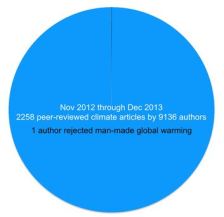
What does “near unanimity” mean? James Powell recently evaluated 2,258 peer-reviewed scientific articles about climate change written by 9,136 authors between November 2012 and December 2013. Only one article rejected anthropogenic global warming. This may not represent a consensus, but consensus is not the purpose of science. Science is to explain the world to us, and we don’t need to strike the word “near” to understand climate change is real, it’s happening now, human activity is causing it, and scientists believe that is the case.

I am not sure whether a group of rich politicians posturing in the Congress will make a difference. However, it’s the only game in town. They are willing to take positive action to support the president’s climate action plan, which doesn’t rely on new legislation that isn’t in the cards anyway. While not hopeful of meaningful action, fingers are crossed, and the game is on.

Following is this afternoon’s press release from the League of Conservation Voters:

WASHINGTON, D.C.– League of Conservation Voters (LCV) president Gene Karpinski released this statement on the creation of the Senate Climate Action Task Force, a group chaired by Senators Boxer and Whitehouse that includes more than a dozen senators committed to pushing for action on climate change:

“Big Oil and corporate polluters have worked with their allies in Congress to prevent action on climate change for far too long. This task force is the latest sign that environmental allies in Congress are fighting back, standing up for basic science and pushing for action on climate change. This is the type of strong leadership we need if Congress is finally going to get serious about addressing the climate crisis and meeting our moral obligation to future generations. We thank Senators Boxer, Whitehouse, Cardin, Sanders, Klobuchar, Merkley, Franken, Blumenthal, Schatz, Murphy, Heinrich, King, Markey, and Booker for speaking out on climate change today and look forward to continuing to work with them to address this vitally important issue.”

~ Written for Blog for Iowa

Categories
Home Life Living in Society

Saturday Swagger

Garden in the Morning

LAKE MACBRIDE— When the drunken arctic air finished its swagger through the upper Midwest, patches of brown grass reappeared in the white landscape. Pools of water formed on the driveway like dammed up dreams, ready to be cut loose when the rest of the snow melts— a false hope of Spring. Feeling restless, I went to town.

Partly, to proofread the newspaper comme d’habitude on Saturday morning. More than that, one of the county supervisors was holding a community discussion at the public library. If life is anything here, it is partly about politics. Several friends were there, and it was good to break winter for a while. It was a campaign stop for the June primary, and also a chance for conversation with friends and acquaintances.

Topics included drug testing, marijuana decriminalization, ever changing synthetic drugs, the overcrowded jail, trails, the para transit service, loss of services in the new mental health regions, and roads— lots of talk about roads. One who lived west of the Ely blacktop mentioned his road specifically. “When will the county address Curtis Bridge Road?” he asked. I listened mostly, and raised an issue or two. It was all good.

Toward the end a woman came in and talked about geoengineering, wanting the county to take action. She had a confusing message. She asked the county to do something about it, but couldn’t say what “it” was. She had a handout with a website which could be the subject of another post… or not. There’s only so much mental capacity and too little time to consider everything.

But allow me to end my drunken swagger. Time has come to be less distracted. Before we accept it and focus, however, the super bowl is coming, marking the last feasible (albeit lame) excuse to delay and celebrate the holidays. What’s the rush? The needs of the growing season will soon be here, catching us unaware. “Just one more thing, that’s all I ask,”  he said to himself.

Whatever the human capacity for wonder, the hydrant of behavior must be articulated so we can focus on one thing at a time. Engaging as hanging with friends may be, and good for the soul, if we don’t focus, our lives will be no different than the recent polar vector— chilling us for a few days only to leave without stunting the disruptive vectors approaching our lives.

When I worked for the oil company, we had employees in about 100 countries. On staff was an expert in addictions. He worked not only on drugs, alcohol and tobacco, but on almost everything that could trap people and diminish productivity. When I spent time with him as part of my training, I learned more about distraction and its relationship to addiction than I thought possible. Admitting we have a problem is first step. My addiction is to following life’s many ideas to wherever they lead. I admit it, and don’t really want to do much about it. There it is.

It will freeze again this month, at least I hope it will. There’s pruning to do, a garden to plan, and income to be generated. A season to be made. Things don’t happen without our engagement. All the while, Saturday turned to Sunday. The proof reading is finished, the auto fueled, and the groceries were bought. It’s time to set things aside and focus on one thing at a time, and maybe get some of them done.

Categories
Living in Society

Politics 2014 in Big Grove

Off-Year Caucus
Off-Year Caucus

LAKE MACBRIDE— Living in Iowa, I feel compelled to write about politics from time to time. It is an irresistible urge, that in many ways runs counter to preferred topics like local food, gardening, sustainability, and the like. In an effort to address this Iowa (and maybe New Hampshire) urge, here’s how things look from Big Grove Precinct, going into 2014.

For ten dollars, a person can get the voter registrations for a precinct from the county auditor. In my precinct, there are 1,305 registered voters. Of these, 499 are Democrats, 413 are No Preference, 391 are Republican, and two are coded “L” which I assume means libertarian. From 20 years of living here, and being very active in partisan politics, I know that during a general election, most people are willing split their ticket and pick who they feel is the best candidate for each position. I’ve found this to be true from the top of the ticket on down. No preference voters have become the key group to watch and work with, although not to the exclusion of others.

We moved to Big Grove in 1993 and during our first presidential election here in 1996, 1,105 people voted, with the breakout for president Clinton 599, Dole 377, Perot 105, Nader 10, Browne 1, and Hagelin 2. By 2012, there was more Republican support with these presidential results: total votes cast 1,123, Obama 555, Romney 551, Johnson 7, Litzel 1, and Stein 1.

Our county has election data available back to 1970, so if one figures out which previous elections are comparable, both turnout and the number of votes needed to win are relatively easy to determine. At the precinct level, party affiliation doesn’t lend itself very well to statistical analysis, since, as I mentioned, people are willing to split their ticket to vote for the person rather than the party.

The 2014 political schedule is as follows.

The first day of the second session of the 85th Iowa General Assembly is Monday, Jan. 13. I have been in touch with my state representative and state senator since New Year’s Day, and let them know my priorities. Now it’s up to them.

On Jan. 21 are the off-year precinct caucuses. Expect very light turnout of party activists on the Democratic side. The Republicans have made these events into a social time, so they may have more caucus-goers, but their attendance is expected to be light, like with the Democrats.

March 14 is the deadline for state and federal candidates to file for the June 3 primary. Already we know there will be Democratic primaries in the governor’s race, the county attorney and supervisor races, and probably some others. Since politics is a low personal priority this year, I won’t engage much until after the filing date. Even then, I’ll engage only enough to pick candidates in the primary.

State legislator per diem runs out on the 100th day of the session, April 22. Presumably the session will end on or about that time because legislators will want to work on the fall campaign.

After June 3, we’ll know who our candidates for the general election are, and soon thereafter we’ll also know how the Iowa Democratic Party will organize around them.

Summer is a slow time in politics, and candidates gain some visibility in parades, town festivals and events as they get out and press the flesh. Otherwise, those that aren’t known to voters work to get known.

Labor Day is the official kickoff of the fall election campaign.

In September and October, people evaluating whether to enter the 2016 presidential race will start coming to Iowa to help candidates raise money and visibility for the general election. I’ll begin talking to registered voters about the election, and start identifying them. In reviewing my list, there are a lot of new names, so it will take a while to get through them. I’ll also help out the county party as best I can.

The general election is on Tuesday, Nov. 4.

So there you have it, Iowa politics in under 700 words. In a turbulent world, taking time to figure out the timeline of political events helps organize for and maintain a level of sanity. I hope readers have found this useful. Now back to our regular programming.

Categories
Living in Society

Holiday Reading — Bill Clinton’s Memoir

End of the Holidays
End of the Holidays

LAKE MACBRIDE— A long standing tradition is the holidays are over on the Feast of the Epiphany. So it is this year. Today the Christmas tree lights will turn off for the last time, and the decorations will be repacked until December. It hasn’t been a noteworthy season, nor a bad one.

I made cherry crisp for dessert last night. The last of a string of holiday desserts coming to an end. During winter, the pantry and freezer replace the freshness of garden and farm, and only so many cherries were kept when they were in season. It was enough to provide the flavor for a while. It won’t last for long.

I tried to finish reading President Bill Clinton’s memoir “My Life” during the holidays. At almost 1,000 pages, it was a bit long for the time allotment, and at times it plodded along with the endless, somewhat desultory recitation of his administration’s accomplishments. He did a lot and I’m up to the point where the Clintons dropped Chelsea off at Stanford.

To hear him tell it, Bill Clinton wasn’t always the sharpest knife in the drawer. Especially when he approved the Independent Counsel Reauthorization Act of 1994 that enabled a conservative judiciary to appoint Kenneth Starr as an independent counsel to investigate Vince Foster’s suicide and the Clintons’ Whitewater real estate investments. One thing led to another, and that’s the problem. Starr’s office became an open investigation of anything that might cast aspersions on the Clintons, their friends and supporters, whether it was grounded in fact or fantasy. I thought Bill Clinton was pretty smart until I read his story of why he signed the law, something he said he didn’t have to do and his predecessor encouraged him not to do. What was he thinking?

I’m not sure I believe all of Clinton’s memoir, but who can blame him for putting the best face on everything? What I do know is what he experienced from the independent counsel’s office and the conservative money spent to tear him down has become derigueur for the president regardless of political party. My beef with Clinton was the way he raised money, letting high level donors stay overnight in the Lincoln bedroom. Having read his explanation of the Lincoln bedroom story, and knowing now it was a conservative talking point, I’m over it. He made a lot of mistakes during his administration, but he admitted them, and did more good than bad by any measure.

I am not over my former congressman Jim Leach’s participation in the Whitewater investigations. He should have known better than to get involved with that, and I have no regrets of working hard over two cycles to remove him from office. I still cringe a little when I see him around the county. Clinton devoted about three paragraphs to Leach, and that was enough to induce nausea.

With the temperatures hovering between ten and 17 below zero today, it’s a good time to curl up with a book. Which I will do after finishing a few other tasks around the still holiday decorated house.

Categories
Social Commentary

The Ship Has Sailed

ForwardLAKE MACBRIDE— All the people waiting for the Patient Protection and Affordable Care Act to collapse under its own weight had better find something else to do. Almost four years in, there’s no way to hop in the DeLorean, go back in time and undo the good the law has already done.

Don’t get me wrong. I expect to hear more laments and entreaties about how wrong it was for President Obama to do it, and that government is taking over health care, yada, yada, yada. Please people. Get a grip. We went through all of these arguments during the Clinton administration. When the Republican idea of filibustering health care reform to death the way Bob Dole did died, so did the idea of repealing Obamacare. If Republicans gained control of the presidency and both chambers of the legislature, how would the repeal even work three years from now? Could they go back in time and undo the mammograms already provided, the colon screenings performed, or take away the happiness people who didn’t have health insurance experienced when they got it? I suppose one Back to the Future reference is sufficient: they won’t be able to go back in time, and some form of the law is here to stay.

The ship has sailed for Obamacare, and by that I mean we are in a period of waiting to know how it will work out. The website is working. The reforms set in place are working. The number of enrollments is increasing. What seems most important about new enrollments is answering the question, what kind of medical treatment will people require? Even though part of the new fee structure includes a premium for excess insurance to cover a bad claims experience, if everyone who comes into a plan needs expensive treatment, it will skew the costs. How will that work out? We won’t know until insurance companies review the data and actuarial experience and set 2015 rates. So we wait. For the close of open enrollment on March 31, and to see the claims experience during 2014.

Josh Mitchell of Talking Points Memo has written that as enrollments increase above ten million people (not a typo, read the article), so does conservative rage. Chill dudes. Greg Sargent of the Washington Post has suggested there are three stages of Obamacare acceptance. Get with the program.

What seems clear to me is that once people get health insurance two things will happen. First, life will return to a semblance of normal, and people will discover that having health insurance is far from a perfect situation. Conservatives will be quick to point this out, although we all know this experience is logical and predictable. Secondly, Obamacare will become the paradigm, generating new struggles to reduce government costs for Medicare, Medicaid, nutrition and other programs, while at the same time attempting to do right by the American people. We’re moving forward in the incredible storm and stress that is living in this country.

If you don’t like it, either move into a yurt, or contribute something positive to the discussion, one our country has been having since Harry Truman was president. A discussion that is likely to continue for the foreseeable future.

Categories
Living in Society

Chickens on the Road

Chicken
Chicken

SOLON— In this small town, people got to talking about the food supply chain when a cooler full of processed chickens fell off a truck destined for the local food bank. The chickens were rejected after the media publicity generated a call from a government agency saying the poultry could not be distributed to the needy. Someone else stepped up with substitute chickens to fill the gap, which can happen in our good hearted community.

That someone raised chickens for the food bank is pretty cool, but is not the whole story. The chickens were discarded because they were not USDA inspected and stamped at a small slaughter abattoir, not because they fell off the truck. As a culture, we are overly reliant on a government food inspection system that may play a role in our legal system, but does not make common sense. It is an example of how we have lost touch with where food comes from and what home cooks have to do to make sure they serve healthy, nutritious meals. The town will be talking about this incident for a while.

On Aug. 30, 1890, President Benjamin Harrison signed the first law requiring inspection of meat products. The law required that USDA, through the Bureau of Animal Industry, inspect salted pork and bacon intended for exportation. Exports of U.S. livestock, and meat products, had fallen under increasingly stringent restrictions by foreign countries. Producers urged the U.S. government to create an inspection program to enable them to compete in foreign markets. Over the years, inspections came to protect the giant agribusinesses and prevent entry, and run out of business, small scale operators like the slaughter abattoir mentioned.

With the rise of consumerism during the 20th Century, notably after Upton Sinclair published his exposé of Chicago slaughterhouses in 1905, meat inspections became de rigueur. President Theodore Roosevelt led passage of the Meat Inspection Act, and the Pure Food and Drug Act, after overcoming his initial dislike for Sinclair. While the slaughterhouses were undeniably gross, as Joel Salatin pointed out in his book, “Folks, This Ain’t Normal,” there is no substantial evidence of mass meat adulteration or related human sickness prior to Sinclair’s reports.  For more information about the history of U.S. meat inspections, click here.

The consumer protection side of this issue gained public attention during a 1993 outbreak of e. coli bacteria in ground meat. Following the Al-Qaeda attacks of Sept. 11, 2001, food security came under the umbrella of homeland security concerns. The fear of pathogens in our food supply has become an obsession among some, and the Solon incident is evidence of how ridiculous things have become. What whit of difference would the USDA stamp have made on this batch of chickens? None whatsoever.

Arthur Schlesinger, in his book, “The Cycles of American History,” had me asking the rhetorical question, “what mood are you in?” It seems clear to me that the public purpose we once held our politicians and public figures to has given way to private interest… to the extent a farmer can’t raise chickens and give them to the needy in our society without some petty bourgeois official saying, “no, it’s against the rules, and my corporate masters have deemed them unsafe.” What a sad state of affairs this is, one that serves large corporations more than people who both have chickens and hunger, but prevents them from getting together.

Categories
Living in Society

Exodus of Leadership

W. B. Yeats
W. B. Yeats

LAKE MACBRIDE— A story that asks the question “who will be the next statesman after Nelson Mandela” is circulating on the Internet, and there is no credible answer. The conditions that raised Mandela to prominence on the world stage may have been unique. The better answer is that someone like him is no longer possible on our connected globe with more than seven billion people. None of the current generation of political, religious or institutional leaders is a candidate for an appellation like global statesman. Suffice it to say Mandela was unique to his time.

Some of the best people in our federal government are making their exits. The departures continued yesterday with the announcement that Rep. Tom Latham of Iowa’s third congressional district was calling it quits at the end of his term. Following on the heels of Senator Tom Harkin’s similar announcement, the two couldn’t be more different from each other. But there is a common thread: Washington has changed.

When President Barack Obama was inaugurated, there was hope for getting things done. In the 111th Congress, Democrats had increased their majorities in both legislative chambers, presumably setting the stage for positive accomplishments with a Democratic president. That hope was dashed almost immediately. Hope was most certainly gone when I visited Washington in September 2009.

I made the rounds to Senators Harkin and Grassley’s offices to advocate for ratification of the New START Treaty and the Comprehensive Nuclear Test Ban Treaty (CTBT). The former was perceived to be a slam dunk, and prospects for the latter were hopeful, and the reason for my engagement. In retrospect, ratification of the New START Treaty proved to be a Herculean struggle, and CTBT had no legitimate chances. I recall a conference call in 2010 with then Under Secretary of State for Arms Control and International Security Affairs Ellen Tauscher where when asked about next steps after ratification of New START, her answer was hesitant. She demurred, indicating we were at the end of the line even if she hadn’t said it in so many words.

One knows there are lobbyists in Washington. Being from Iowa, we are used to lobbyists occupying every square inch of the capitol from the bathrooms to the law library to committee meeting rooms. In 2009, the number of Washington lobbyists was between 12 and 13 thousand people, and they descended upon the capitol in droves each day. I saw them, they can’t be missed. At the same time, lobbyists with substantial ability to influence is a much lower number, in the dozens. When I was walking through the senate office buildings, the presence of lobbyists was akin to what goes on with termites when they find a moist chunk of wood to gain entry into the foundations of a house: our government has been hollowed out.

Yesterday’s Iowa political story was not the announcement that Tyler Olson (Democratic gubernatorial candidate) and Tom Latham are exiting politics. The story being missed is that Tom Harkin and Tom Latham are exiting politics, and what that says about what’s going on in our federal government.

We are in a time when “the best lack all conviction, while the worst are full of passionate intensity.” In high school I knew that verse by W.B. Yeats referred to World War I, but this old poem resonates as clearly as a bell in today’s political environment. Begging the question, what rough beast is slouching toward Washington to be born?