Categories
Living in Society Social Commentary

Opioids: A Conjured Crisis

U.S. Department of Agriculture Secretary Tom Vilsack

Secretary of Agriculture Tom Vilsack scolded the University of Iowa Carver College of Medicine about opioid abuse on Friday.

The institution is not doing enough to train its soon-to-be health professionals on an opioid abuse epidemic that claims thousands of lives a year nationally, Vilsack said, according to the Cedar Rapids Gazette.

The university just got the word about its role in the opioid abuse epidemic last week. According to the article,

After Vilsack’s remarks, UI Health Care medical affairs vice president and dean of the medical college Jean Robillard told The Gazette the institution does plan to make changes in the way it teaches med students about prescribing opioids. He said the UI received information on it from the White House earlier this week.

Vilsack oversees the White House Rural Council, established by executive order on June 9, 2011 by President Obama. Opioid abuse is on a long list of maladies that impact rural communities. It is one issue among many the council hopes to address.

News media and politicians have made much of opioid abuse. Facts suggest at 28,648 (2014) annual deaths related to opioids — including heroin, hydrocodone and oxycodone — abuse is not a leading cause of death in the United States. It’s not even among the Centers for Disease Control’s top ten causes of death, with heart disease, cancer, chronic lower respiratory disease, unintentional injuries and stroke being much more prevalent.

What gives?

Fanning the embers of opioid abuse into a raging wildfire serves the interests of Big Pharma and its minions in the U.S. Congress. The opioid epidemic represents another opportunity for corporations to mold government in a way that serves their interests.

We’ve seen this before with methamphetamine abuse. Methland: The Death and Life of an American Small Town by Nick Reding makes the case that it’s less a drug’s addictive propensity than a combination of economic policy, government complicity with Big Pharma, and corporate policies that are behind the degradation of rural communities like Oelwein, Iowa, the subject of his book.

The short version is when meth had its fiery burn into the media atmosphere, corporations used it as an opportunity to control importation of key ingredients to a profitable cold medicine in a way that led to many small-scale meth lab busts in Iowa, and the rise of methamphetamine trade among Mexican drug cartels. The opportunity regarding opioids may be a little different, but why wouldn’t Big Pharma want another bite from the apple?

It is ironic that Nancy Reagan’s “Just Say No” campaign, part of the “war on drugs,” was window dressing to her husband’s economic policies that drove the underlying causes of abuse and addiction, not only in small towns, but throughout the country.

People suffer from many types of addiction and neither government nor the insurance companies that drive health care are doing much to address them. Opioid abuse is an issue, yet the bigger issue is related to the growing divide between the richest Americans and the rest of us, corporate influence in government, and a K-12 education system that inadequately prepares children to sustain themselves in a society where corporations have the upper hand.

Opioids? Schmopioids! Let’s have a conversation about appropriate school curricula, something Vilsack addressed Friday in a weird, special interest kind of way.

~ Written for Blog for Iowa
Categories
Living in Society

Looking To 2020

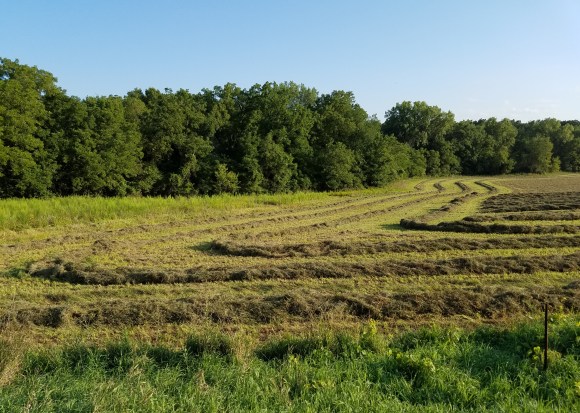
Wind Rows Near Iowa City

The sobering news of the NBC/Marist poll released last week is Hillary Clinton leading the Republican candidate in Iowa by only 4 points (41-37) among registered voters.

In Iowa electing Hillary Clinton president will not be a slam dunk.

If one lives elsewhere in the country, the news was better. Clinton leads the two-way and four-way presidential races nationally and has multiple paths to 270 electoral votes needed to win the election.

Both major candidates remain unpopular. “In Iowa, 36 percent of registered voters have a favorable view of Clinton, versus 58 percent with an unfavorable view,” wrote Mark Murray on the NBC News website. “While Trump is at 31 percent positive, 64 percent negative.”

Clinton is polling well, as she has since announcing her candidacy April 12, 2015. The election is hers to lose, and every indication is she is taking nothing for granted. What mitigates the positives is every conversation I have with voters becomes dominated by how terrible Clinton’s opponent is. He is, and if you feel that way, volunteer or donate to Clinton’s campaign, even if you don’t like her.

Of Iowa’s 1,937,225 active voters, only 615,357 (32%) were registered as Democrats on Aug. 1, 2016, according to the Iowa Secretary of State. Republicans aren’t doing much better at 649,579 (34%). Based on registrations, it should be a fair fight for either party to build a constituency to elect a candidate in Iowa.

It’s not a fair fight, one made worse by the quadrennial Iowa Caucuses. Where to begin about that?

Let’s start with the quote attributed to Albert Einstein, “The definition of insanity is doing the same thing over and over again, but expecting different results.”

Who wants to be insane? None of us who volunteer to work for political campaigns.

I want something that doesn’t exist any more. When my father canvassed for JFK before the 1960 election he used mimeographed sheets made at the union hall. There was a diagram of a generic neighborhood where he recorded the names of voters to help him (and presumably others) keep track of where the election stood. When Kennedy won, we felt our family had contributed significantly to the victory even though he did not win Iowa’s 10 electoral votes.

Deviation from this inclusive, local technique has long been a practice. I associate it mostly with Howard Dean’s 2004 campaign, although others perfected it. Targeted canvassing has been my bone of contention with the Iowa Democratic Party. The practice has broken down neighborhoods in favor of demographic dissection. It isn’t healthy for working together with neighbors to improve our lives, something that should run concurrently with politics.

It’s no secret a large percentage of people seek to avoid conversations about politics and hide their political leanings behind a no party registration. What matters more to those with whom I’ve discussed it is participation in a society in which politics plays a minor role. More engage in politics during the presidential years, but spend the rest of their time living, working and volunteering. It’s the glue that holds what’s good in society together. The current caucus process with two dozen candidates roaming the state and spreading their minority views works against the warp and weave of a just society.

I believe the Iowa caucuses have seen their best years. Jimmy Carter had the right idea after Democrats changed the nominating process in response to the 1968 Democratic National Convention in Chicago. Carter just showed up and met people, as he famously did during the Iowa State Fair. Today, politics has been co-opted by the media and the state fair is a timely example, with a dedicated political soap box sponsored by the Des Moines Register. It’s not unlike any of the other fair exhibits. The nadir of the state fair soapbox for Democrats in recent years was Democratic National Committee Chair Debbie Wasserman Schultz giving out of touch speeches.

The caucuses are getting too large, making it difficult for organizers to find appropriate venues. In our precinct it was a challenge to hold people’s attention until the delegates were selected, after which they bolted and the caucus chair couldn’t fill committee slots for the county convention. Logistics aside, the Iowa caucuses place an inappropriate emphasis on presidential politics almost two years before the election. There is more to life than who’s president. We survived Richard Nixon and Ronald Reagan. We will survive whoever the electorate picks in November.

The opportunity to change this year’s process passed with the state convention and the page turns to the 2020 presidential cycle. Political activists want Iowa to be the first caucus in the nation, but they don’t represent our best interests. They are just one more special interest looking out for themselves. Politics is much broader than the people who caucused for Senator Ted Cruz, the Republican caucus winner in Iowa.

It is time for politically active people to get involved in a way that broadens the electorate and is more inclusive. However, if they don’t heed the message, we’ll find something else to do, raising money for our favorite charities, donating garden surplus to the food bank, and advocating with our elected officials for what is right — regardless of party.

People care about who’s president, but not so much they will set everything else aside. No one wants to be the target of political canvasses. Given the opportunity neighbors will join together to resolve pressing issues, including electing a president. This year presidential politics serves more distraction than help.

~ Written for Blog for Iowa

Categories
Living in Society

Summer Of Weird Normal In Iowa Politics

Farm to Market
Farm to Market

This has been a summer of weird normal, especially for people who follow politics.

Given a presidential contest where many, including this author, predicted Hillary Clinton would be our next president before she announced she was running, nothing has happened to change that potential outcome. If anything, we are more confident than ever she will be our next president.

The focus has been on down ticket races… somewhat.

Last week Michael Barone of the Washington Examiner picked Cedar County, Iowa as a bellwether of the presidential race.

“The Washington Examiner has selected 13 key counties to watch in eight target states with 114 electoral votes that have been seriously contested in recent elections,” Barone wrote. “Each county has the potential to indicate who will carry these states.”

Cedar County owes its place on this list to the fact that it has come uncannily close to mirroring the Democratic and Republican percentages of the target state of Iowa in the last seven presidential elections, never varying more than 1.3 percent from average. Thus it voted 52 to 47 percent for Obama in 2012 and 54 to 44 percent for him in 2008; it voted 50 to 49 percent for Bush in 2004; and in the exquisitely close election of 2000, it went for Al Gore over Bush by a plurality of exactly two votes.

Mirroring percentages is one thing, however, based on my personal contacts with voters in Cedar County during the 2012 election, mirroring is not relevant to current races.

The Iowa Democratic Party placed an organizer in Cedar County this cycle, and if 2012 represents the best efforts to turn out votes for President Obama, 2016 will be even better for Hillary Clinton. That also benefits state-wide candidates Dave Loebsack, and to some extent, Patty Judge. Cedar County voters are willing to split the ticket. Expect them to do so in November.

Democrats are running out of time to nominate a candidate in Iowa House District 73, which includes Cedar County. For practical purposes, the clock ran out a week or so ago.

The Iowa Secretary of State filing deadline for state and federal offices is 5 p.m. on Friday, August 19, and in order to nominate a Democratic candidate, the state party would have to call a special convention that included Muscatine, Cedar and Johnson Counties where the district is situated.

There are plenty of potential candidates, however, those who ran in recent cycles are not interested, and no one else has come forward.

While there has been talk of a write-in candidate, the handicap of not being on the ballot will be a long shot in defeating incumbent Rep. Bobby Kaufmann.

The largest group of voter registrations in Cedar County is no party. On Aug. 1, the Secretary of State reported 3,128 Democratic, 3,792 Republican, and 4,414 No Party active, registered voters. Having worked the district, I don’t put much stock in these numbers. A house candidate from either party could win the district because of no party conversions, the City of Wilton, and six precincts in more Democratic Johnson County.

What makes August part of the summer of weird normal is the lack of political talk about almost anything but the Republican nominee for president. It is normal that a lot of voters activate during presidential election years. What is weird is a combination of things including regular people cozying up to Donald Trump; people who would bleed Democratic if cut saying they won’t vote for Hillary Clinton no matter what; and controversial issues, including climate change, abortion, school funding, incarceration rates, water quality and government spending, being sidelined to watch the national political show.

Life is going on, arguably not in a good way.

~ Written for Blog for Iowa

Categories
Living in Society

Kim Weaver For Iowa’s 4th District

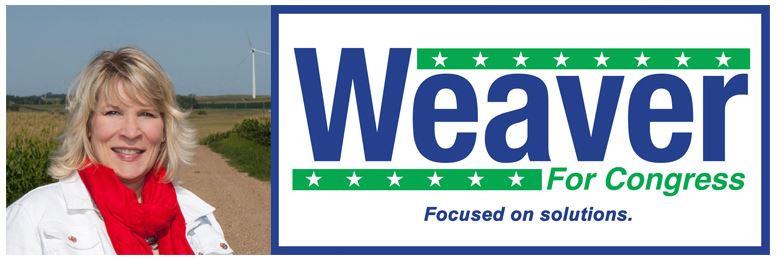
Weaver for CongressKim Weaver believes 2016 is the year to retire Republican Steve King from Congress.

What makes her effort different from those of Jim Mowrer, Christie Vilsack, Matt Campbell, Rob Hubler and others?

The political climate of intolerance and hate people like Rep. King foster has reached its limit, creating a backlash among lifelong Republicans.

Weaver hopes to build a coalition using the unique opportunity 2016 presents.

“The other night I had an interesting conversation with a friend who will no longer be voting for Donald Trump, Steve King or any other Republicans,” Weaver wrote in a fundraising email.

“I watched this lifelong member of the GOP burn his Republican National ID while standing around a bonfire. He told me that he feels betrayed by the party and regardless of the outcome he doesn’t know how we will ease the tensions within nation’s polarized political system. To confront the global crises the world looks toward America for leadership and solutions. He said the divisive rhetoric this year short circuits conversations after a few seconds. From across the fire he looked at me and said, ‘All of this intolerance and hate is crazy. It’s gotta stop.'”

Kim Weaver is a proud native Iowan. Born in Des Moines, she graduated from Roosevelt High School and obtained a bachelor’s degree in communications from Iowa State University. After college she married and later moved to Sheldon where she raised her three children and built a career. Weaver appreciates the value of community and the belief in hard work Iowans hold dear. She is dedicated to taking those values to Congress.

We’ve heard it all about Steve King. Isn’t it time we focused on solutions? That’s what Kim Weaver offers.

Issues most important to Weaver include financial stability for families, student loan debt relief, financial stability for seniors, immigration reform, and making higher education more affordable.

As for King, there is little reason for Iowans to talk about his confrontational and outrageous behavior and statements. In fact, one of my friends had something to say about this.Weaver Tweet

For more information about Kim Weaver’s campaign for Congress in Iowa’s 4th District, visit her web site.

~ Written for Blog for Iowa

Categories
Living in Society

Plasma Sales and Iowa Politics

Farm Greeting
Farm Greeting

(EDITOR’S NOTE: This post was written for On Our Own: Sustainability in a Turbulent World in 2013 and has been corrected and updated). The Cumulus radio station in Cedar Rapids was advertising how a person could earn up to $340 per month selling their plasma. It’s enough to make it worth a look to see if plasma sales could fit into our budgetary bottom line. Sounds kind of grim, but people do it all the time.

Plasma is the pale, yellow liquid portion of blood that helps our bodies control bleeding and infection. When one donates plasma, blood is removed and the plasma separated and saved before being returned to our body. We generate more plasma within a couple of days so twice a week donations are usually possible.

Donating takes about an hour and plasma collection centers make it easy with a straight forward, step-by-step process. They explain how payment is loaded on a debit card. It is literally using one’s body as an ATM.

Several self-employed and low-wage earners in my circle use plasma sales to supplement monthly income. Got a toothache? Better schedule some sessions at the plasma center to get cash to pay the dentist. One suspects residents of our nearby college town use the cash for cigarettes, salty snacks, sugary drinks and alcohol, but in any case, plasma sales can be a reliable and steady source of income if one meets the requirements for donating.

Plasma money could be put to good use. For example, it could be used for political donations. That way, when a political telemarketer called, knowing my annual budget, I could say, “Yes. I’ll donate $100, which will take me four plasma sessions.” Politics would literally be based on blood money then.

We could go a step further and say that all financial contributions to politicians had to originate in plasma sales. There would be a natural limit to how much a person could donate, and a restriction could be placed on corporations that said something like, corporations can make political contributions, but such contributions must be paid via the plasma of shareholders, imposing a reasonable and well-defined limit to corporate money spent on political campaigns. I bet corporations would exercise their “free speech” differently under such a rule.

If my modest proposal about political contributions seems a bit edgy, I am pretty sure it would work. Having skin in the game would take on a whole new meaning.

Most Americans are asleep at the wheel of politics, and would not contribute, so there is little danger of a glut of plasma on the market.

If times get tough, I’ll re-visit adding a plasma sales income line to our household operating budget. For now, I’m just glad I don’t have to do it.

~ Written for Blog for Iowa

Categories
Living in Society

Voter Suppression In Iowa

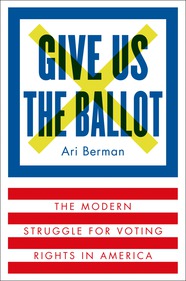
BermanRepublicans have taken the effort to suppress voting rights nationwide, including in Iowa.

Iowa Republicans have done their part, if not as egregiously as in other states.

They would do more to suppress voting rights if they controlled our bicameral legislature and the governorship.

One of the first things Iowa Governor Terry Branstad did in 2011 when he assumed office was to reverse Governor Tom Vilsack’s executive order to automatically restore voting rights to convicted felons who had served their time.

Branstad established an application process for such felons, making it more difficult to regain their voting rights.

“Restoring voting rights to Iowans who have committed felonies is something that I take very seriously as governor,” Branstad said July 11 during his weekly news conference. “To automatically restore the right to vote without requiring the completion of the responsibilities associated with the criminal conviction would severely damage the balance of rights and responsibilities that we all have as citizens.”

“Iowa is one of only three states – alongside Kentucky and Florida – to impose permanent disenfranchisement for all people with felony convictions, unless the government approves individual rights restoration,” according to the Brennan Center for Justice. “On June 30, 2016, the Iowa Supreme Court upheld the state’s disenfranchisement law in a 4-3 split decision in a case called Griffin v. Pate.”

After Griffin v. Pate, State Representative Mary Wolfe (D-Clinton) said the Iowa legislature was presented with an opportunity regarding voting rights.

“In my opinion, the majority ruling seems to invite the General Assembly to amend current Iowa Code to redefine ‘infamous crime’ for purposes of disenfranchisement as something other than all felonies,” Iowa state Rep. Mary Wolfe, D-Clinton said to the Des Moines Register. “I certainly think the average Iowan would not agree that all felonies, every category of felonies, reaches the level of infamous crimes.”

Would such legislation advance in Iowa’s divided legislature? Republicans can be expected to block it in today’s political environment.

Blog for Iowa author Dave Bradley wrote last weekend, “There is no shortage of Republicans in positions of authority who will do nearly anything for their party to win elections, no matter what.”

Iowa native Ari Berman, author of Give Us the Ballot: The Modern Struggle for Voting Rights in America, points to North Carolina as an example of what Republicans have done to suppress voting rights.

Three weeks after the U.S. Supreme Court eviscerated the Voting Rights Act in Shelby v. Holder, the North Carolina legislature toughened its voter ID bill, already the most restrictive in the country, according to Berman.

Quoting North Carolina State Senator Josh Stern, Berman laid out what the bill added:

  • Shortened early voting by one week.
  • Eliminated same day voting and provisional voting if at wrong precinct.
  • Prevented counties from offering voting after 1 p.m. on the last Saturday before the election.
  • Prevented counties from extending poll hours by one hour on election day due to extraordinary circumstances like lengthy lines.
  • Eliminated state supported voter registration drives and preregistration for 16/17 year old citizens.
  • Repealed voter owned judicial elections and straight party voting.
  • Increased the number of people who can challenge voting inside a precinct.
  • More frequent purging of voter rolls.

On Friday, July 29, a federal court ruled North Carolina’s voting restrictions were “intentionally discriminatory.”

Would Iowa pass such a bill? It’s hard to say.

We can expect the conflict over voting rights to continue in the federal courts as Republican-controlled states attempt to reduce the number of people eligible to vote.

Progressive Iowa Democrats should work to retain our slim Senate majority as a firewall against further Republican voter suppression efforts.

To help retain a Democratic Senate majority, send a check to the Senate Majority Fund (Committee ID #9098), 5661 Fleur Drive, Des Moines, Iowa 50321.

~ Written for Blog for Iowa

Categories
Living in Society

Encountering Chuck Grassley

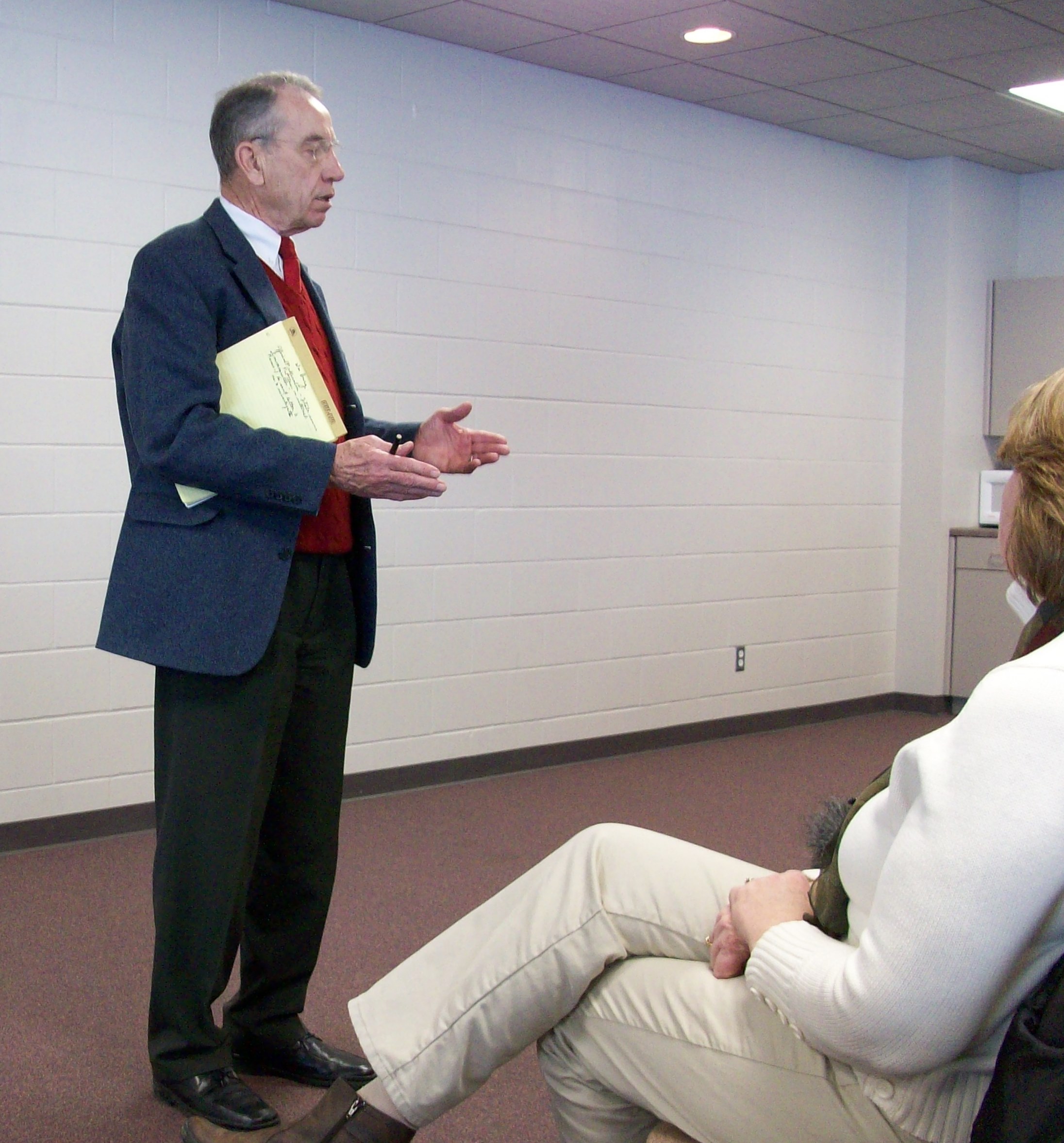
Senator Grassley in Williamsburg, Iowa in 2010.

The conventions dispersed and the road home was ahead as Blog for Iowa writers engaged with Senator Chuck Grassley last Friday.

Both Trish Nelson, in a chance meeting in Mount Pleasant, and Dave Bradley, at a town hall event in Columbus Junction, each encountered Grassley in eastern Iowa.

Both stories are worth hearing and indicate where our senior senator is regarding his life in the Republican party.

“News is sketchy while on RAGBRAI,” Nelson wrote in an email.

She was driving support for a team of veteran RAGBRAI riders and responding to Dave Bradley’s report from the Columbus Junction event.

“Speaking of RAGBRAI and Chuck, guess who I ran into checking out of our Super 8 this morning in Mt. Pleasant?” she wrote. “I even had a few minutes of face time with him.”

“I was like a deer in headlights at first but I managed to stay polite and we had a light, friendly conversation,” she continued. “I asked him what he thought about Hillary’s speech — he said he thought it was good and he fell asleep during it. He said she would just be more Obama.”

“I asked him his thoughts on Donald Trump and he said, ‘he needs to act more presidential,’ as if he was lamenting that he wouldn’t get elected because of that one small thing. I told him Trump can’t act presidential because he is so impulsive and that people are genuinely frightened that he could actually become president.”

Grassley asserted something positive about Trump, which Nelson countered.

“Chuck kind of backtracked and said, Trump ‘only’ has a 25% chance of actually being elected. He said the Republicans have too much ground to make up in the electoral college for him to win. It was weird, as as if he was trying to reassure me by acknowledging that Trump is probably going to lose anyway.”

I can’t believe I didn’t ask him about his obstruction of Obama’s SCOTUS appointment and the judiciary, and for awhile I was kicking myself, but at least I got to address concerns about Trump.”

Later in the day at a Columbus Junction town hall, Don Paulson of the Muscatine County Democrats asked Grassley the question about Merrick Garland.

“Grassley said 30 years ago some senators set a policy of no appointments in a president’s last year,” Dave Bradley reported. “What horseshit.”

Bradley assumed this was a variation on Grassley’s Biden talking point and nothing new.

During her campaign for state representative, Sara Sedlacek lost Louisa County, where Columbus Junction is located, by a significant margin.

“It was probably a 90% Republican crowd,” Bradley wrote. “All white except one. State Representative Tom Sands was there to give Grassley a big smack on the cheeks. Another guy praised Grassley for ‘standing up to Obama — you’re the only one that does.'”

This describes every Republican event I have attended — a venue for Republicans to vent. Dave ticked off these notes:

  • Several said leave the VA (or at least Iowa City) alone.
  • One woman had a prepared speech about puppy mills.
  • Another guy praised Republicans for defunding Obamacare and said they should pass the same bill every day.
  • Couple of other all praise to Grassley statements.
  • One college student did have some challenging questions on gun sales but of course Grassley had very well prepped responses rolled out in his folksy manner.
  • An anti-Grassley guy from Iowa City asked him about term limits — Grassley said he favored them, but you can also always vote me out.
  • Couple of questions on Social Security — Grassley claimed it has 17 more years (2033) but no one is willing to talk about it with everything on the table.
  • One guy claimed Obamacare took $900 million from Medicare — Grassley agreed and said it just disappeared from Medicare.
  • Damn it was painful not to just stand up and call him a f*cking liar.

“Unlike Muscatine much earlier this year (Grassley) is much better prepared and has his talking points down really well,” Bradley said. “Trying to get him to stumble will take an exceptional effort if someone is trying to. He even took pains to refute his not visiting all 99 counties — with a big sign on a stand proclaiming that he visits all 99 counties every year.”

Grassley doesn’t always hold public meetings on his 99-county tour according to a July 20 Des Moines Register editorial.

“Since 2011, he has held only three public, town hall meetings in Iowa’s 10 most populated counties, and there were no meetings of that type in eight of those 10 counties,” they said.

If you want to discuss an issue with Senator Chuck Grassley maybe you’ll randomly bump into him, or maybe you can speak for a couple of minutes at his public meetings. What is problematic about this type of accessibility is the unbridled forum — for Republicans particularly — to say just about anything.

In my experience at similar events, Grassley moderated the wackiest of the wacky. By enabling people to express themselves as he does Chuck Grassley encourages extremism and political spin. He helped create the party of Donald Trump even if he doesn’t think much of the mogul’s chances in November.

It is important to contact our elected officials, especially our federal representatives. However, when Senator Chuck Grassley talks about “representative government,” take it with a grain of salt. What you see isn’t always what you get.

~ Written for Blog for Iowa

Categories
Living in Society Writing

August Recess

View from the Barn
View from the Barn

SOLON, Iowa — While Trish Nelson takes a well-deserved break, I will attempt to fill her shoes at Blog for Iowa.

Delegates from the national party conventions dispersed last week and there is a lot to write about. Party and twitterverse aside, the telltale sign the election campaign shifted to a new phase was when a political friend called last Tuesday for help finding lodging for our Iowa Democratic Party organizer.

As politics takes a summer vacation in August for most Iowans, I want to cover as much ground as I can, and less of what everyone else is posting. Following is part of my storyboard.

I’ll cover each of the four Iowa congressional candidates at least once. This is mostly to learn what I don’t know. My Congressman Dave Loebsack was confident about his chances in the second district when I saw him in July. Monica Vernon is a hard worker and fighter, and the prospects look good for her winning against first term congressman Rod Blum. Jim Mowrer and Kim Weaver are running in the western half of the state, and those races will be informative. These four races are the most important, yet under-covered in the state.

Because of it’s high visibility, I’ll rely on the coverage of others for the U.S. Senate race. As primary winner Patty Judge attempts to upset incumbent Chuck Grassley it is unclear she has the organization to win or that he is truly vulnerable. A campaign operative told me convincing Iowa Democrats Grassley is vulnerable is a key challenge. My reaction when she spoke near my home July 17 was she needs to point out the faults of her opponent less and talk more about Democratic values. Let third parties do the work of calling out Grassley on his many flaws.

Here is an entire month of posting about the presidential contest in four sentences. “Republicans nominated Donald Trump and Mike Pence for president and vice president respectively at their national convention. If they think they are going to win this election solely by demonizing Hillary Clinton they are on crack. I disagree with them on virtually everything so that’s enough said about the mogul and his sidekick. The focus should be winning down-ticket races.”

There will be discussion of the 2020 presidential caucuses during the 2016 campaign and I land in the camp of eliminating Iowa’s first in the nation status. With due respect to Dave Redlawsk, author of Why Iowa: How Caucuses and Sequential Elections Improve the Presidential Nominating Process, the quadrennial presidential caucus should be the first casualty in blowing up the Iowa Democratic Party. I have long believed first in the nation helps Republicans more than Democrats and plan to lay out my case over the next few weeks. Shorter version: Democrats should stop helping Republicans organize in Iowa.

Iowa native Ari Berman posts constantly about the importance of voting rights after Chief Justice John Roberts gutted the Voting Rights Act in Shelby County v. Holder in 2013. What are the challenges to voting rights in Iowa? There has been a lot of posting about the Iowa Supreme Court decision about voting rights for convicted felons. There is more to elucidate.

What else?

At the county fair our group had a corn kernel vote on security issues. Air and water quality were most important to fair-goers’ sense of security by a distance. Forestry management is part of that discussion. People forget the state was once prairie with oak-hickory forests that stood and regenerated for millennia. What is surprising is how slight is the modern role of urban sprawl compared to pressure on forests. I hear almost no one discussing forestry management and its impact on air and water quality yet see farmers tear out riparian buffers on a regular basis to plant a few more rows of corn and beans. This issue needs a voice.

Our government insanely wants to spend more than a trillion dollars re-furbishing our nuclear arsenal. What we should be doing is eliminating it. I’ll share some of the work of my colleagues in International Physicians for the Prevention of Nuclear War during coming weeks.

Nuclear power is on the wane nationally and some attention should be paid to the Palo, Iowa plant. Their permit was extended to 2024, and already there are rumblings at the plant that the “good jobs” there will be going away. It is in Iowa’s best interests to shutter Duane Arnold Energy Center and I’ll explain why.

Lastly, we need an alternative to our industrial food production system. There is a nascent local foods movement, but its rise has not been fast enough. There are substantial questions about local foods sustainability in its present form. Issues like land ownership, creating markets, reducing the use of pesticides, and scalability are all unresolved. If the local foods movement does not work toward solutions, one questions whether it will exist as a distinct entity going forward.

These and other topics will be my summer. I hope readers will follow along as I do my best to make it worth while to return to Blog for Iowa often.

~ Written for Blog for Iowa

Categories
Kitchen Garden Living in Society Social Commentary

High Summer Harvest

Cherry tomatoes, Fairy Tale eggplant, green beans and a pickling cucumber harvested July 16, 2016

Photographs of kale can only be interesting for so long.

The leafy green and purple leaves are producing in abundance — so much so I pick only what is needed, removing imperfect leaves from the plants to the compost heap.

Seven kale leaves stand in a jar of water on the counter to keep them fresh and ready to use.

If summer were only about kale, this one would be an unmitigated success.

Something else is going on.

This week I conversed with a group of twenty-somethings about the new application for smart phones, Pokémon Go. It was the most animated they had ever been. I asserted the application represented the beginning of the zombie apocalypse. They didn’t dispute it. One had already tried the game and moved on to something else. Apparently there are not that many Pokémon to find in rural Iowa.

The continuous stream of violence manifest its latest event Thursday with a terrorist attack in Nice, France. More than eighty people were killed and as many as 300 injured as a lone driver drove a large truck through a crowd gathered to view a Bastille Day fireworks display. The terrorist made it two kilometers before he was shot dead by law enforcement. French President Francois Hollande seeks to extend the existing state of emergency put in place after the November 2015 attacks in Paris.

In American political news, the Republican top of the ticket is set with Indiana Governor Mike Pence named presumptive presidential nominee Donald Trump’s running mate. The less said about this pair the better. Suffice it that I disagree with them on just about everything. The national political conventions are imminent, with the Republicans this week and Democrats the following. Something unexpected might happen at either convention.

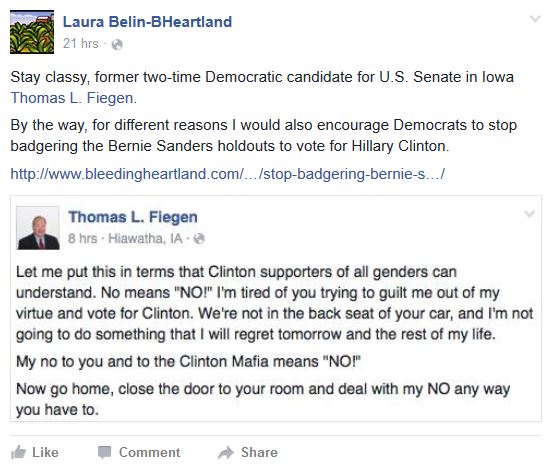
In a strange turn of events, twice failed U.S. Senate candidate Tom Fiegen made a post on Facebook that blogger Laura Belin re-posted:

FB Post Belin

Belin makes sense if Fiegen, not so much. The episode represents further coarsening of Iowa politics. Fiegen likening an effort to persuade him on his presidential vote to sexual advances is plain weird. I know I wouldn’t want to get in the back seat with him on a dark gravel road. Whatever virtue he may have had vaporized after he quit being his own person and hitched his campaign wagon to Bernie Sanders. His current, post being a Democrat, rants serve as an example of how low politics has gotten. I know my mother said if you don’t have something nice to say about someone, don’t say anything, but Fiegen lives in our house district and may foment more ill will. I hope not.

Lastly, this week Deadhorse, Alaska set a record high for any Arctic Ocean location. Is it climate change? How could it not be.

At least for now there is plenty to eat and fewer photographs of cruciferous vegetables.

Categories
Living in Society

Scattered Talk

Hillary Clinton Walking to the Stage at S.T. Morrison Park, Coralville, Iowa

As we live through the final month before the national political party conventions, most people I meet know the presumptive presidential nominees but don’t talk about them.

When they do the dynamic is like this, “I can’t see voting for Trump, but Hillary, you know what you get with her, so I don’t know.”

One person’s perspective is not definitive, yet given the people I know, the dynamic among those newly met has some validity.

If the 2016 general election were to be won or lost on the basis of scattered talk in society (or on social media) that would be a thing. What matters more is work done by the campaigns to register and turn out voters — something less visible than talk inside our social enclaves. By all measures Clinton is working harder and devoting more resources to registering and turning out her voters.

NBC News reported yesterday the Hillary Clinton campaign spent $1.2 million in Iowa this June compared to Trump’s zero dollars. The Iowa Democratic Party relies on presidential money to run its campaign, so the spending is two doses of good news for Democrats. Money to fund IDP operations and Trump’s “different” and thus far losing campaign.

Because of Trump’s celebrity he has been able to distribute a message to voters on the cheap. That served him during the primaries and caucuses. As we turn toward the conventions and the general election, Hillary’s campaign is somewhat predictable, using tried and true methods to win votes. Trump’s is a mystery that includes a Twitter account and public speeches, lacking any perceptible effort to close the deal with voters. If one doesn’t close, there will be no victory.

The Democratic primary churned up a lot of ill will toward Hillary Clinton in the electorate. That’s ridiculous, but also something to take seriously. On the one hand, Democrats continue to get whipped up into a froth about a potential indictment of Clinton (over something, they are not sure what). On the other, we look away from the Republican fraud that took the deaths of four Americans in Benghazi, Libya and turned them into political footballs. Clinton has weathered many storms in a long public career, yet the idea initiated during her husband’s administration — open up an investigation of political enemies and let it go on forever — is as effective today as it ever was in generating the false appearance of wrong-doing. Rep. Trey Gowdy’s Benghazi investigation, as with Whitewater, is demonstrating nothing is there. Even he couldn’t say Clinton lied about Benghazi during yesterday’s presser.

Political pundits, bloggers and partisans like to talk the strategy of elections. What I’m seeing, and believe is better information, is in scattered talk among ordinary people who still believe a presidential election is a choice to be made. To the extent the Clinton campaign can get to those voters and bring them home she can win in November. While the prospects look good for Clinton today, it appears her campaign is taking nothing for granted to win voters.

As June ends and the days get shorter it is difficult to see any other general election outcome than a Clinton victory. The scattered negative talk about Clinton will be a factor. One Clinton is almost certain to overcome.