I drove to the county seat to vote after my shift at the home, farm and auto supply store. There were six or seven poll workers — plenty of staff to handle the day’s last half hour of early voting at the auditor’s office.
The orange ballot box was so full the poll worker had to jostle it for mine to fit in.
Surprisingly, or not, this shit show of an election didn’t pull the final curtain after casting my ballot. The proscenium arch has no curtain after this godawful exposition of what politics has become. Trump may burn the theater down before he is through. Throngs of his supporters would cheer.
My next door neighbor called out as I arrived home. In jeans, a sweatshirt and stocking cap she was gleaning her garden before an imminent frost. She offered hot peppers. I declined as our ice box already has more than needed for winter. We conversed for a while about produce and ideas. We didn’t talk about politics.
This morning I left the glow of the computer screen to go outside.
It’s not going to frost this morning. My weather app tells me 32 degrees in the last half hour before sunrise. Ambient temperatures may dip to freezing, but not long enough to damage much in the garden. Experience tells me it won’t get that cold in the micro-climate of our yard. There’s less chill in the air than when I spoke with my neighbor.
As days move through the calendar experience also tells me election day won’t bring the end of politics as we know it. The body politic is ever changing, ever re-inventing itself, sometimes by design, sometimes by unintended consequences. Those of us who believe the framework of society is enduring also see an opportunity in today’s bedlam for positive change.
Not the hope and change Barack Obama touted in Iowa eight years ago. His administration will leave us with mixed reviews and something different. The clear knowledge that for change to come, we can’t lose hope. At the same time, we must work for change that is much needed in the American society we call home. Many of us will find hope in the ashes of the 2016 campaigns and are willing to work to bring change we know is needed.
People are weary of the 2016 presidential campaign.
Voting began Sept. 29 in Iowa and we can’t get to Nov. 8 quickly enough.
For the most part, decisions about who to support are made. While there have been many surprises this cycle, and might be more, not much can change minds as we move toward election day.
The strength of Clinton’s campaign is in its organizers.
I met Janice Rottenberg more than a year ago in Iowa City. Today, she’s leading the Clinton organizing effort in Ohio, where Clinton stands a 60.6 percent chance of winning 18 electoral votes.
I worked with Kate Cummings, senior program director for Florida Democrats, during the 2012 cycle, She was also in Iowa for the 2016 Iowa caucus campaign. Clinton stands a 71.2 percent chance of winning Florida’s 29 electoral votes.
For his part, if Donald Trump has political organizers it’s not clear who they are or what role they play in his media based campaign. He’s running as if it were a professional wrestling promotion. The WWE hall of famer knows how to run down and dirty and would drag us all to his level if he could. If the Commission on Presidential Debates would allow it, I expect he would call for a 1960s-style professional wrestling cage match like I saw with my father at Municipal Stadium in Davenport. Trump is more a promoter like Vince McMahon than a politician.
George Will wrote this week the Republican post-campaign autopsy can likely be written Nov. 9 in one sentence, “Perhaps it is imprudent to nominate a venomous charlatan.” I’m confident a majority of Americans feel the same way.
It’s all over but the voting, and if there are some surprises, the biggest one will be that Donald Trump receives tens of millions of votes. Republicans who plan to vote for him do so with a sense of duty to their party. After all, the Republican grass roots had the candidate they voted for and feel some obligation to vote for him in the general. They own that and many of us won’t let them forget.
As for Hillary Clinton, it seems like nothing will stop her now. It’s not over, but it’s over.
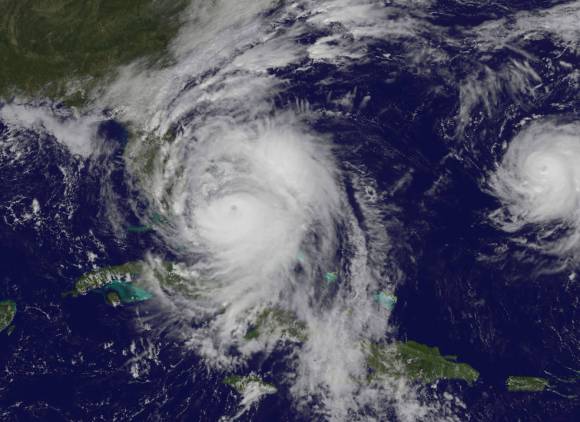
Hurricanes Matthew and Nicole Oct. 6, 2016 Photo Credit – NASA/NOAA GOES Project
Millions of people began evacuating Florida, Georgia and South Carolina in advance of hurricane Matthew. Hundreds are reported dead in Haiti.
Downgraded to Category 3, Matthew began hitting Florida Thursday. It’s expected to pick up velocity.
During the most recent communication with our child in Orlando, she was soaking wet. After determining she had a safe place to stay, I reminded her of Florida’s Oct. 11 deadline to change her voter registration. She’s good in more ways than one.
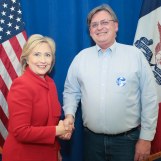
With Hillary Clinton Jan. 24, 2016
My support for Hillary Clinton began as she declared for president April 12, 2015. There was never a question she would win in our precinct, except by what margin. The margin was enough to win two delegates and make Martin O’Malley viable. When O’Malley dropped out of the race after the Iowa caucus we picked up his delegate at the county convention making us three of four for Hillary. My support for Hillary Clinton has not wavered.
The Des Moines Register asked Donald Trump on June 28, 2015 what he would do differently if elected president.
“I would probably comb my hair back,” Trump said. “Why? Because this thing is too hard to comb. I wouldn’t have time, because if I were in the White House, I’d be working my ass off.”
This election is more about hurricanes than hairstyles.
What brought us to the odd and irritating presidential election campaign of 2016 is continued, intentional obstruction of Democratic administrations by moneyed interests beginning with the 1992 election of Bill Clinton. A case can be made this started with Franklin Delano Roosevelt after World War II, but the Bill Clinton administration was a time when Republicans held an ongoing witch hunt working to find something wrong. Politics changed under Clinton and not in a good way.
Hillary survived multiple attacks from Republicans since then, each time ending with a finding there was little or nothing there, including the recent investigations of Benghazi and her email management process while Secretary of State.
We hear about dark money in politics, but it really isn’t a question that Charles and David Koch are key organizers among wealthy people trying to influence, if not buy elections. They and others like them are behind the continuous obstruction of anything in government that doesn’t serve their interests. They have plenty of resources to make their case and taking money out of politics isn’t a long-term solution. I don’t believe it is possible. We should accept that there will always be moneyed interests whose political activities require more sunshine.
Unlike Republicans, Hillary Clinton has been doing her job. She is better prepared to be president than any candidate. The constant attacks and obstruction have made her stronger. It is telling of her strength that Republican Party of Iowa chair Jeff Kaufmann, with little positive to say about Trump, constantly criticizes Clinton.
“The American people have had enough of failed status quo policies which have left them less hopeful for our country’s future,” Kaufmann said in an Aug. 10 press release. “They have had enough of serially dishonest, corrupt, and self-interested career politicians like the Clintons.”
Former Tiffin mayor Royce Phillips’ comments at yesterday’s debate with North Liberty mayor Amy Nielsen in House District 77 represent the accommodation Iowa Republicans make for Trump.
“Do I agree with everything the man says? Of course not,” Phillips said of Trump. He then drew a false equivalency between Trump and other politicians, cozying up to his nominee with every breath.
I call bullshit on Kaufmann, Phillips and other Republicans like them. Kaufmann is a successful campaigner but represents moneyed interests in the presidential race more than he does Iowans. He is experienced in campaigns and must realize that to win he has to keep attacking Hillary Clinton with his every breath regardless of the truth. For Kaufmann and his ilk the election is only about winning and there’s the rub.
Whatever the outcome of the 2016 presidential election, Americans will have reaped what they sowed. My hope is the electorate will send Hillary Clinton to the White House.
In a weird comment during the first presidential debate, seeming to promote his new Washington D.C. hotel, Trump said, “I’m going to get to Pennsylvania Avenue one way or another.” Expect obstruction of Democratic administrations by the richest Americans to continue if Hillary is elected Nov. 8.
For the rest of us, this election will soon be over. We know how to deal with a hurricane by evacuations or by hunkering down in a safe place. We know how to clean up the aftermath and rebuild.
What we don’t know is how the 2016 political campaign will leave us in its wake. Expect the damage to extend well beyond Florida, throughout the country. The rebuilding materials won’t be found at local hardware stores.
(EDITOR’S NOTE: I send more letters to the Des Moines Register than get printed. This topic has been well covered in the news, so I doubt they will run it. Will post a link if they do).
There’s a bitter irony in the letter Iowa’s two U.S. Senators sent the U.S. Army Corps of Engineers Sept. 27 regarding $73 million in funding for a Cedar River project for flood risk management authorized but not funded by Congress in 2014.
The tough, clear message from Senators Grassley and Ernst to the Corps is find the money for the project in your budget. The irony is there will be no specific appropriation by the Congress to meet the needs of Iowa’s second largest city.
The Iowa Department of Natural Resources indicates on its website that eastern Iowa can expect increased frequency of precipitation extremes that lead to flooding. The need for the project is real.
While Iowa’s Senators have taken the Corps of Engineers to task for not prioritizing the Cedar River project, their effort to tie the Corps to the whipping post are transparent in this election year.
The letter is what austerity policy looks like. It’s not good for the people of Cedar Rapids or for other flood impacted areas in Iowa.
Instead of drafting terse letters, show us how Cedar Rapids gets funding for the Cedar River project.
Things are falling apart so Tuesday I begin four days paid vacation from the home, farm and auto supply store. I plan to catch up around the house and run a few errands in and near the county seat — and try to regain a sense of being in control.
It is time to deal with existential realities in the life of a sixty-something.
There is a lot of crap going on.
As I posted Friday, autumn began with a flood, one wholly predictable, but still catching many by surprise. Politicians talked about doing something after the 2008 flood to mitigate future flood damage. Not much talk turned into action. One doesn’t need to be Jeane Dixon to predict there will be more, similar flooding caused by heavy precipitation events during the next ten years.
The presidential election is sucking up space to the extent even I’m tuning it out. Tomorrow is the first televised debate between Hillary Clinton and Donald Trump. If it is streaming I’ll tune in for as long as I can take it (still haven’t solved the problem of owning an analog television set).
Trump is a ridiculous candidate supported by many of my neighbors and co-workers. The Republican Party of Iowa appears to be running a superior ground game when compared to the Iowa Democratic Party. However, this presidential election is changing the rules, tactics and values of ground games. If both parties have mastered similar Get Out The Vote practices, the next winner will breakout with something new. Trump is trying to do that. The outcome is uncertain even if Clinton continues to lead in the polls. Trump would make a disastrous president if elected.
Perhaps a few days of retreat will help me get centered and facilitate positive action going forward. At least that’s the hope. Right now it feels like crashing into September with a long skid into insanity if I don’t do something about it. I intend to take corrective action.
If you have been thinking of running for elected office, a slot is open on the ballot in Big Grove Township.
Mark Haight is the lone candidate seeking re-election as township trustee for two open seats. Mark has unique skills suitable for being a trustee, so I hope you’ll flip the ballot and vote for him.
I announced my decision not to seek re-election six months ago. To date no one has been recruited to fill my seat and that creates an opportunity.
Is it too late? Not at all.
On the first day of early voting in 2012 I noticed there was only one candidate for two seats. I decided in the voting booth to write myself in and campaign to become a township trustee.
I issued a press release, made a post on my blog, and made one speech at a political event on Cottage Reserve where State Senator Bob Dvorsky allowed me to speak to Big Grove residents. I sent a note to friends and neighbors and won the election with 71 votes.
The Big Grove Township Trustees are responsible to provide fire protection and first responder service for the township, manage the Oakland and Fackler’s Grove cemeteries, and to resolve lot line disputes. Our main activity is preparing and approving a budget each year.
If you’ve been thinking about running for public office, here’s your opportunity to campaign and win. The non-partisan board of township trustees is a great place to get started in politics.
Tucked away in a North Liberty strip mall in Iowa’s most Democratic county is a Republican campaign office.
The yard signs along Highway 965 are noticeable only for their comparatively large number (five), and one including an image of the GOP elephant and the letters “G.O.P.”
The county had 18,335 registered Republicans on Sept. 1 and regardless of their chances in 2016, Republicans hope to build on their numbers and influence here.
Former Apprentice finalist and Donald Trump Iowa campaign chair Tana Goertz was slated to appear with State Representative Bobby Kaufmann, who represents six precincts in Johnson County, at yesterday’s grand opening. Current office hours are 1 until 5 p.m. Monday through Friday and 10 a.m. to 1 p.m. Saturday, a token presence in a Democratic county.
Iowa is not a Democratic state. It is Republican, such appellation including many voters who register “no party.” If the Republican Party of Iowa was caught off guard by the 2006 insurgency against their terrible governance, they reacted and have their act together more now than at any time since our family moved back to Iowa in 1993.
Expect Iowa to award its six electoral votes to Donald Trump this cycle, contrary to the claims of prominent Iowa Democrats. It’s not just me saying this. Yesterday’s Monmouth University poll showed Trump leading Clinton by eight points with a 4.9 percent margin of error.
“Among Iowa voters likely to participate in November’s presidential election, 45 percent currently support Trump and 37 percent back Clinton. Another 8 percent intend to vote for Libertarian Gary Johnson, 2 percent say they will support Green Party candidate Jill Stein, 2 percent say they will vote for another candidate, and 6 percent are undecided,” according to the Monmouth University website.
A single poll in September is meaningful only as a wake-up call to starstruck Democrats. As readers may know, the author is with Hillary and nothing has changed since I declared for her before the February Iowa caucus. She could indeed win Iowa’s electoral votes. If she does it will only have been if the Iowa Democratic Party changed its process for voter registration and turnout. There is nothing to indicate any substantial changes and 2016 is not expected to be a wave election for Democrats in Iowa. If anything, there is a solid chance the wake from relative Republican unity will sweep the Iowa Senate into a Republican majority. Democrats are working hard to prevent that from happening.
In 2016 people still talk about the Kennedy administration as if it were bathed in the glow of Camelot. What is forgotten is Richard Nixon won Iowa’s electoral votes. 2016 is more like 1960 in that despite Iowa’s participation in the nominating process, Hillary Clinton will win 270 electoral votes, just none of them in Iowa.
Why do I say that?
Unlike in Democratic states, Republican culture has gone mainstream in Iowa. Democrats have invested too much in chattering social media and too little in mainstream presences like university activities, farming, community groups, churches, and the like. By focusing on the outrageous behavior of Governor Terry Branstad, Bruce Rastetter and other prominent Republicans, Democrats left everyday Iowans behind.
Low wage workers are everywhere in Iowa in significant numbers. Based on my conversations with them, if they vote at all, they are just as likely to vote for Donald Trump as Hillary Clinton, whose name the corporate media associates with all things bad.
The kernel of hope that arises from 2016 Iowa Republican hegemony is that after Nixon’s defeat, Iowans elected Harold Hughes governor. Hughes was a liberal’s liberal who was later elected U.S. Senator. Let’s hope Clinton holds her own nationally, and that 2018 can be a comeback year for Iowa Democrats.
There are still Iowa Democrats who haven’t given up on 2016. I hope they are right and I am wrong.
If we accept the premise articulated by Hillary Clinton’s presidential campaign, that we are stronger together, there is a lot in society requiring our collective attention.
What did we work on? What are we working on? What should we be working on? What did we get done?
If we are separated from the pack, answers to these questions don’t much matter. We might think of ourselves as lone wolves, fending for ourselves in a hostile world, but we aren’t by nature. Being stronger together is a fundamental characteristic of homo sapiens. It’s what we do as a species.
I see three critical issues requiring us to be stronger together to save ourselves from near-term extinction.
The first is applying the golden rule, or the law of reciprocity. When we view the troubles of society through our flawed lenses, there is no other, only the One, of which we are all a part. We should treat others as one seeks to be treated oneself. We should be applying the golden rule to everything we do already. This is basic.
Second is the threat of nuclear weapons. Today, on very short notice, nuclear powers could unleash a holocaust that could end life as we know it. Nuclear war is not talked about much in the 21st Century, however the threat is as real today as it was in the wake of the Hiroshima and Nagasaki nuclear bombings. The United States should begin taking steps to eliminate nuclear weapons. As my friend Ira Helfand said, “We need a transformational change in our nuclear policy that recognizes that these weapons are the gravest threat to our security and must be banned and abolished.”
Finally, we are wrecking our environment and need to stop. Just 90 companies are to blame for most climate change, taking carbon out of the ground and putting it in the atmosphere, geographer Richard Heede said. If that’s the case, and he has evidence to suggest it is, the move to eliminate fossil fuel extraction and use can’t come quick enough. Our governments must intervene, and targeting the 90 most responsible businesses should make it easier. The businesses say they are not to blame for demand from billions of consumers driving fossil fuel use. The technology exists to eliminate fossil fuels and we should work toward its adoption with haste.
The measure of August’s passing was in milliseconds, and September will be the same. The election will be here before we know it, as will the next one. What should be our focus? The three issues outlined above represent a viable starting point, and I plan to get to work. Will you join me?
Meanwhile members of the corporate media complained it has been a long while since she gave a press conference. Republicans complained about the trip for many reasons summed up simply as “it’s Hillary Clinton so it’s bad.”
I would comment further about the complaining, and the repeated calls among Republican supporters to lock her up, but what the hell. There is nothing with which to charge her and the illusion of something being there sustains them in their time of Donald Trump.
Sadly, I revert to the commonplace: let sleeping dogs lie.
My support for Hillary Clinton hasn’t wavered this election cycle, nor will it. The rise of the World Wide Web — with its increased visibility of the human condition — has changed politics forever. I don’t know if it is good, bad or irrelevant. We know more about what people are willing to say in public and it’s a poor reflection of the homes and K-12 schools in which they came up. Hillary won’t fix these things or what ails society — what politician could? I’m not sure they need fixing.
2016 makes the need for people to get along in society crystal clear. Not just locally, but globally. We are doing a wretched job of that right now. It may be beyond humanity’s capacity to get along, even if our lives depend upon it, as some of us believe they do.
Instead of trying to say something profound, I’ll post a video: Patty Judge’s first television ad. We haven’t tuned on our TV set for a couple of years, but she’s trailing the incumbent by 8 points and needs our help.
That’s all I have to say about the 2016 campaign as summer turns to fall and communities get busy with school, the harvest, and with looking forward to next year’s hope.
I believe there is reason to hope and so should you.
Representatives Collin Peterson and Dave Loebsack – July 2013
When I first volunteered to support Dave Loebsack for congress it was a dicey endeavor.
In 2004 I’d supported Dave Franker and he was not the best of candidates. He seemed a throw-away placed on the ballot next to Jim Leach to fill an empty slot. He was serious about his candidacy, but others were not. “Slot-man” would be a good moniker for Franker as he filled the space on the ballot and had very little real support. I was skeptical Loebsack, a Cornell College political science professor, could get elected either.
Leach lost me when he chaired the House Banking Committee’s investigation of Bill and Hillary Clinton’s real estate investments in the Whitewater Development Corporation near Flippin, Arkansas. What else was there to do but support Loebsack? I was in.
Each Tuesday I faithfully arrived to volunteer at Loebsack’s campaign office in Iowa City. What I found, through hundreds of phone calls, was people were tired of Republicans, including Leach. After a while it became clear Loebsack stood a good chance of upsetting Leach. I’m glad he did.
Ten years in, Loebsack has had his ups and downs in support among people who first elected him. While some called for a primary challenge, the only person who did challenge Loebsack, State Senator Joe Seng, ran a weird and subdued campaign and never stood a chance. As recent elections of Terry Branstad and Joni Ernst indicate, the days of Harold Hughes and Tom Harkin liberals in statewide elected office are well over until something changes in the electorate. While no politician is perfect, and other bloggers may argue the point, Loebsack has been liberal enough when it mattered most.
This year Republicans nominated their own slot-man, Coralville surgeon Chris Peters. Since his first re-election, Loebsack has faced a doctor four times and a lawyer once. It is as if Republicans believe the professional class is somehow most qualified to beat an incumbent congressman in Iowa. None of them has gained adequate traction and there is little to indicate 2016 will be their year in the Second Congressional District.
What distinguishes Chris Peters from previous Loebsack challengers is his libertarian leanings. What I mean here is his feeble attempts to participate in the populist uprising against neo-liberalism, as described recently by Martin Jacques in the Guardian.
“Populism is a movement against the status quo,” Jacques wrote. “It represents the beginnings of something new, though it is generally much clearer about what it is against than what it is for. It can be progressive or reactionary, but more usually both.”
Iowans benefit from international trade in soy, corn, beef and pork. To the extent they do, they tend to favor what Jacques describes as the “hyper-globalization era systematically stacked in favor of capital against labor.” This is the hallmark of neo-liberalism, something both Republicans and many Democrats participate in. The Trump campaign is opposed to neo-liberalism and wants to take us back to a freaky version of 1950s America in the midst of the post-World War II economic boom. That may play well among Republicans in predominantly white Iowa, however, voters have not embraced it.
Peters has not distinguished himself from the Republican pabulum about taxes, free market solutions, isolationism and school choice to his campaign’s detriment. He embraces the swill of ideas. Trump may win Iowa, and if he does, it will be because of the Republican Party of Iowa’s well-organized ground game. If one talks to Republicans rationalizing support for their 2016 presidential nominee, the argument is less about Donald Trump and more about supporting their party when party means something. Peters should latch on to the coat tails if he is anything other than a slot-man. He didn’t ask for my advice.
What enables Dave Loebsack’s re-elections is the popular appeal of his story of growing up in poverty and the importance of government programs in lifting him up. As a Congressman he appears to have followed Bob Dylan’s advice in Subterranean Homesick Blues, “Don’t wear sandals; Try to avoid scandals.” While not the most flashy member of congress, he shows up for work and attempts to serve constituents. Loebsack spends almost every weekend with constituents in the district — those who support him and those who don’t. This gives him a reliable finger on the pulse of the district, something a doctor could appreciate and any challenger would find a formidable obstacle.
Will Loebsack get re-elected? Not unless voters stand up for him again. As a seasoned campaign operative and political science professor, Loebsack knows how to manage his re-election effort. He built a political mechanism to seek insight into the district and has established relationships with movers and shakers in the Congress. (One almost tires of his stories about who he met last week in the Congressional gym). Loebsack brings a who’s who of prominent politicians to the district. Recent guests included Steny Hoyer, Deborah Wasserman Schultz, Collin Peterson, Tammy Baldwin, Tulsi Gabbard and others. This cements his relationship with many of his politically active supporters and helps build relationships he will need to get things done in the Congress.
Dave Loebsack’s chances are pretty good for election to a sixth term. My only regret is he is limited to two years at a time.
I don’t presume to know Loebsack’s plans but he has sponsored legislation restricting the revolving door from the Congress into lobbying. Expect him to follow his own bill and stay in Congress at least until full retirement age. If he seeks to remain in Congress until then, that means we’ll likely have to re-elect him in 2018.
I’m in now and will be in in 2018 if we are that lucky.




 Journey Home
You must be logged in to post a comment.