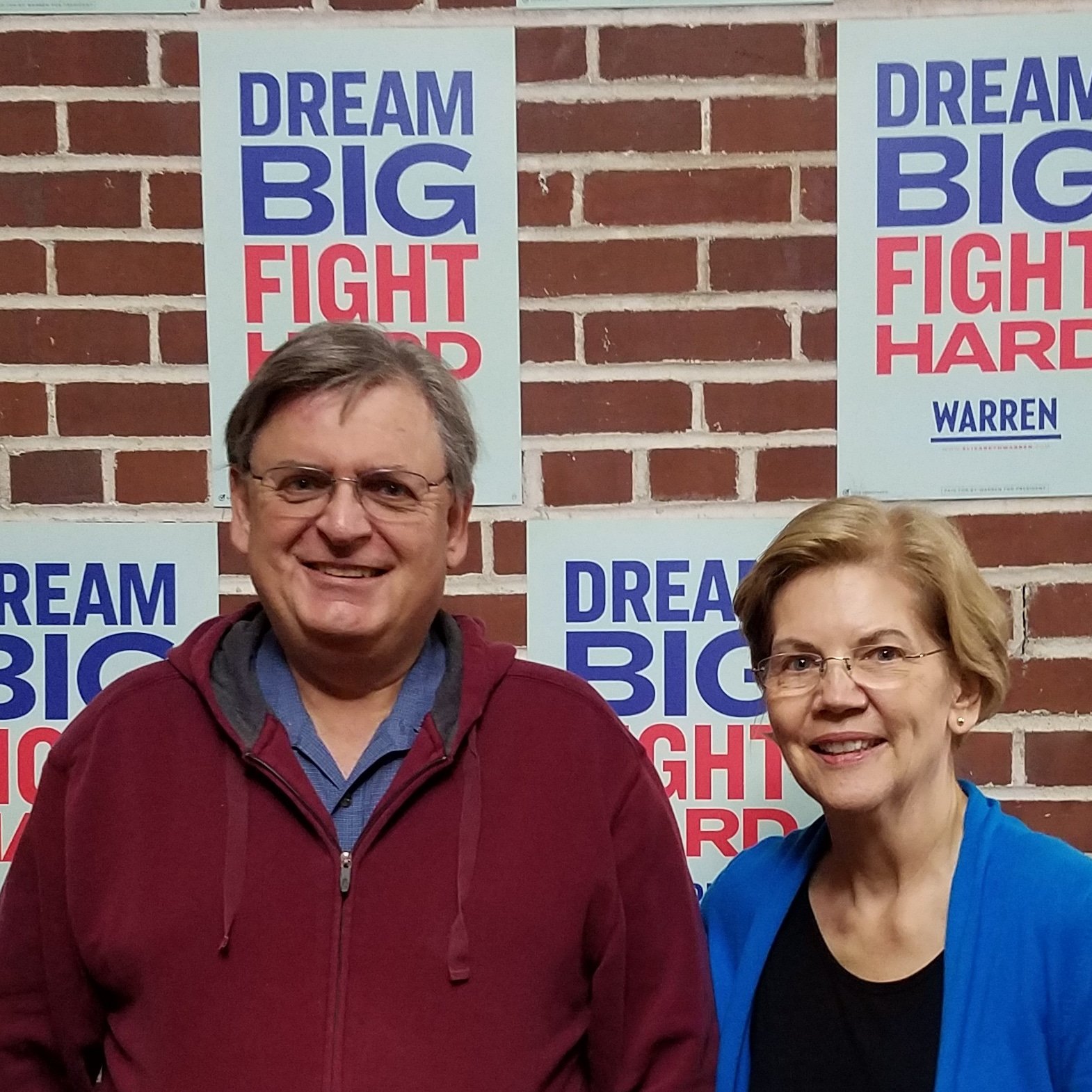
With Elizabeth Warren at the Iowa Memorial Union, Iowa City, Iowa.
I’ve been saying for some time that Super Tuesday — the day 14 states, American Samoa, and Democrats Abroad hold presidential primary elections and caucuses — is the decider for who is viable and who is not in the Democratic presidential primary race.
After mixed results in four early states, the field is down to four main contenders: Joe Biden, Michael Bloomberg, Bernie Sanders and Elizabeth Warren. After today’s voting we’ll see if Bloomberg and Warren remain viable. We’ll see if Bloomberg’s late entry coupled with spending hundreds of millions of dollars of his own money will get him in the game. We’ll also see if Warren’s ground game of political organizers is relevant to our modern politics. The expectation from national media and polling is the race will sort into a confrontation between so-called establishment or moderate Democrats backing Joe Biden, and the non-Democrat progressive Bernie Sanders. I suppose readers know all of that by 4:20 a.m. on Super Tuesday when I’m writing this. I hope there is a clear winner after votes are tabulated.
My plan for Monday did not include dealing with friends and neighbors freaking out over the possibility of a Sanders nomination. What I’m hearing in Big Grove Township is mostly fear that if nominated, Sanders would lose the general election, that he wouldn’t gain the support needed to prevail. Folks were urging support for Joe Biden, who is an equally flawed candidate. My chips were all on the table long before yesterday. The Iowa Caucuses are over and I stood with Elizabeth Warren with no regrets. I made another financial contribution to Warren’s campaign last night and drank a shot of whisky over ice cubes made from the Silurian Aquifer. What a day!
If we review who’s left in the Democratic primary, the top tier is comprised of septuagenarians I ruled out early in the process. I felt we needed new faces to breathe fresh air into the meandering beast the Democratic Party had become. Regretfully, none of the new faces who entered the race had staying power. Some of them, Pete Buttigieg, Amy Klobuchar and Beto O’Rourke, rallied around Biden last night in Dallas, Texas.
In addition to it being freak out Monday by the lake, a number of high profile Biden endorsements were released in advance of today’s voting, including Harry Reid, Barbara Boxer and Susan Rice. Biden is winning the endorsement game with eight current U.S. Senators, 21 former senators, and more than 50 current U.S. Representatives. A question we have to ask ourselves is how much do endorsements matter in 2020? They certainly contributed to the freak out phenomenon going on around here.
When asked, my friends said they would support and work for whoever is the Democratic nominee at the national convention this summer. If it’s Biden or Sanders, they are concerned about losing the general election. Nontheless, to a person they will support our nominee. I don’t know if I talked any of them off the ceiling yesterday because this freak out is not about reason or logic.
What was disappointing was the statement one person made that this was not the year for a woman to win the presidency. If not now, then when, I asked. If we don’t nominate a female for president, there will never be a female president. Their arguments, based on fear of losing the general election, did not hold water.
Maybe Trump was right to focus on Biden in the first place. If that’s who we choose over reasonable and serious objections, Republicans have a well developed plan to win against him. That’s not a case for nominating someone else, I’m just saying.
Today voters will decide who moves forward. It’s now or never for Bloomberg and Warren, assuming Sanders and Biden have reasonable showings. The worst that could happen is the electorate is not of a single mind about who should be the nominee. That would drag the process out for the rest of March when we could be consolidating around a candidate. That’s a flaw in Iowa going first: in 2016 and 2020 we did not produce a clear winner.
I’m ready to get beyond Super Tuesday as soon as the votes are counted. There’s a lot to be done in the coming months and we need to get after it. Hopefully the freak out will abate and we’ll know where we stand. Perhaps that’s too reasonable a wish in the new era of politics.
State Senator Liz Mathis (L) and State Representative Molly Donahue at the Ely Public Library, Ely, Iowa. Feb. 29, 2020.
It should be no shocker that I attended a political event on Saturday. How could I miss it? It was six miles from our house.
State Senator Liz Mathis represents the 34th Senate District in the Iowa legislature. Alongside State Representative Molly Donahue, who represents House District 68, they hosted a legislative listening post at the Ely Public Library.
The closer one gets to Cedar Rapids, the more likely we are to encounter kolaches, a traditional semi-sweet roll originating in the Czech heritage of Iowa’s second largest city. Mathis pointed out the box of kolaches in the back of the meeting room soon after my arrival. About 16 people attended.
I was in graduate school in Iowa City when Mathis began her broadcast news career at KWWL at their then new Cedar Rapids bureau. She has been a broadcast anchor, television producer, college professor, and is currently an executive at the non-profit organization Four Oaks Family and Children Services. Donahue has been a teacher for 30 years with a current focus on secondary students in special education or those who have behavior disorders that can affect their learning. They were well qualified to discuss Iowa’s mental health system, school safety, the K-12 education budget, the school bus driver shortage, and related topics. I listened and tried to learn.
News on Friday was Pattison Sand Company of Clayton sought to extract 34 million gallons of water per year over a ten-year period from the Jordan Aquifer, according to Perry Beeman of Iowa Capitol Dispatch. The water would be shipped by rail to arid regions in the American west, potentially to New Mexico, Colorado, Wyoming, Nevada, Utah, Arizona or California. The Jordan Aquifer is also the source of municipal water for the city of Marion which lies within Mathis’ senate district.
Earlier this month Pattison proposed to extract 2 billion gallons per year from the Jordan Aquifer using wells they drilled to support their frack sand mining operation. This proposal was rejected by the Iowa Department of Natural Resources.
The problem with tapping the Jordan Aquifer is it is prehistoric water, in other words, it has been there a long time. The aquifer does not recharge at the same rate as the Silurian Aquifer which lies on top of it. Once the Jordan Aquifer is drained, the water will be gone and communities that currently rely upon it could be left without a reliable water source.
The climate crisis is evident in the American west. Demand for water exceeds the region’s capacity to produce it through rainfall, snow melt, and underground aquifers. Something’s got to give for people who settled there to survive. Mining and shipping water from Eastern Iowa is not a good idea because what may be abundant to meet our current needs will be diminished by the extraction proposed by Pattison and others. It is easy to see how a discussion over water rights could escalate into regional conflict over this basic human need.
If we look at history, humans have continued to exploit natural resources until they are gone, in many cases leading to the collapse of societies. Our brains are not wired to perceive the threat shipping billions of gallons of water from Iowa to the west could have. We have to pay attention, and the role of government is to look out for the common good.
It is hard to image an overall plan to resolve the climate crisis at its root causes. Further exploitation of natural resources doesn’t solve anything and could potentially make matters worse. At least we were discussing it and in doing so raising awareness on a sunny morning in Ely over kolaches.
On Saturday, Feb. 22, I met with U.S. Senate candidate Theresa Greenfield at a coffee shop in Coralville, immediately after her appearance at the Linn County Phoenix Club. She arrived on time and was thoughtful in her answers to my questions. She got the job done. The following interview is transcribed from an audio recording. Any mistakes are the author’s. Greenfield began with an opening statement.
THERESA GREENFIELD: I worked my entire career in small business from being a community planner for about fourteen years with neighborhood groups, planning commissions and city councils — helping in that local government office.
I worked for a civil engineering company and was a consultant for either a township that didn’t have staff, or maybe a city that had extra projects they just didn’t have enough staff to get that work done. I loved it.
From there I went into home building and eventually became the president of a small home building company in Iowa. That was fun through the recession, until it wasn’t any more fun. We sold the assets at the end of 2011.
I became unemployed like a lot of people in the recession, then hired on with a commercial real estate company. I most recently was their president. I recently resigned to focus full time on this U.S. Senate race.
I’m pretty excited we just kicked off two things, beginning with our “Hear it from the heartland tour.”
We have been intentional about going places. The number one topic I hear about is health care. We began at Boone County Hospital which is an independent hospital, not part of a big system. We just learned a lot about their challenges, the cool things they are doing too, and how they are integrated into their community. Health care is the number one issue that I hear about and they just reiterated all of that.
We also then just put out the first of what I call our “jobs to get done” agenda. Because I grew up on a farm, and that’s what my parents always said, “No boy jobs, no girl jobs, just jobs to get done.” I think we need to think about some of this work in those kinds of terms.
The first job that needs to get done, for me kind of the root of what’s wrong with Washington and the difference between Senator Ernst and myself, is big money in politics. Our first job to get done is end political corruption and end dark money in politics. Bring some transparency to it, end Citizens United, stop the revolving door of lobbyists. If you’re a senator you can’t sit on a corporate board at the same time. It might seem like natural things that we should be doing as pubic servants, but codify it and try to bring an end to that.
BLOG FOR IOWA: How do you view your prospects for beating Joni Ernst?
GREENFIELD: I view them as really good.
BFIA: Why is that?
GREENFIELD: First off, I grew up rural and I think Iowans want Washington to work like our home towns work. You know, we come together and get something done. There’s a lot of frustration.
Senator Ernst ran to be independent, and different, and she was going to make ‘em squeal, and she’s just taken a real hard turn to the right and votes 90-plus percent of the time with Mitch McConnell and party leaders, really leaving Iowans behind on issues that we care about whether you have an R or a D behind your name, or an N, or you don’t vote.
Things like health care. Voting to end and take away your protections for preexisting conditions. Prescription drug costs haven’t come down. Voting to end the ACA which by the way, allowed Medicaid expansion, which we did here in the state… and that has kept so many of our hospital lights on.
Now I grew up rural and with my parents, we got caught up in the farm crisis. My parents had to sell their hogs and their crop dusting business and never farm again. After that the school closed, grocery store closed, these are stories that we hear around the Midwest, and they drive 20-30 minutes to a grocery store, faith community, hospital, health care. If their little hospital closes they’re going to be going 50 miles, who knows? Or they won’t get the health care they need. These are real issues. You need health care? It doesn’t matter if you’re a Republican or Democrat.
BFIA: Would you say that’s your sharpest contrast with Ernst, on health care? I mean would you really make a difference?
GREENFIELD: Yeah. I will go back to the reason about winning. Her favorable rating is now down to about 39 percent in the state. So for me that just says Iowans aren’t loyal to her, and they are going to take a look at a good, strong Democratic candidate. That tells me Iowans are very open and this race is wide open. She does not have a lock on the race.
You know our differences definitely will (make a difference). I’m a “get ‘er done” person who has gotten things done. I want to focus on the things that most Iowans worry about. Health care is number one. Education. Folks worry about the economy and jobs here in Iowa. With net farm income being down 75 percent since 2013, I’ll tell you what, as I travel around this state, people have concerns. And you put on top of that the 85 ethanol wavers. Our farm economy, our manufacturing, our main street folks are very worried and I hear about that.
BFIA: What is your reaction to the president’s recent announcement that he would create additional subsidies for farmers hurt by trade policy? What are you hearing on the campaign trail from farmers who may have gotten some of that money?
GREENFIELD: Farmers I talk to want their markets back, that’s what they want. They want the future. They don’t want to leave a legacy of liability for their family with high debt. They want to leave a legacy of prosperity. They see continuing to get the markets back and grow those markets is what they want to do, and I get it. I grew up hard-working on the farm and that’s what farmers like to do: get up early, stay late, get the job done, and they want to earn a fair profit to do that.
BFIA: So you don’t see the impact, you see a different picture. What you see is the guarantee by the administration not having the desired effect because people want their markets back, people want to do the work, get paid for the work. Did I get that right?
GREENFIELD: Yes they do. But I’ll tell you what, the situation we’re in: bankruptcy rates are at an eight year high right now. It’s personal for me. When my parents had to sell the crop-dusting business, their hogs, and get out of farming, I went to auctions where families’ contents of the farm were put in boxes on hay racks and auctioned off for a buck or two, and no farm family should have to go through that again. Particularly when we can make a difference. That’s where I’m at.
BFIA: How did you decide to get into politics?
GREENFIELD: That’s a great question. I grew up in a little town, Bricelyn, Minnesota, right on the Minnesota/Iowa border. My parents were DFLers Democratic Farm Labor members. My Mom was the one who always marched in parades, went to county meetings, we door knocked. We didn’t phone call back then though because we had a party line… no robo calling. So it’s always been in my blood to be active in a certain way.
But then I got busy raising a family. I had some hope-stubbing experiences for sure. As my kids got a little older I was able to spent more time phone calling, door knocking. I’ve been a little active.
Remember I spent about 14 years working in community planning at the local legislative level — so planning commissions, neighborhoods, city council meetings, all of that. I saw potholes that needed to be fixed and filled — they aren’t Republican or Democratic — there was a problem that needed to be solved communities come together to do that. I’ll tell you I just decided we need some new leaders.
People talk to me all the time about wanting to end the divisiveness in Washington. We do it by making decisions like we do in our home towns, you know, where we come together. So it’s motivated me.
I really got into this race for hard work and family. I carry their struggles, their heart, and their effort to earn a living wage and provide for their families and have their American dream. For me it comes from being widowed at the age of 24. My first husband was a lineman for the power company. He was an IBEW member… we’re a union family. I will always stand tall with the unions. That’s for sure. They built the middle class and I don’t forget why my lights come on and who delivers my mail. I know those are union jobs.
When Rod died of a work place accident and I became a single mom — a 13-month old and another one on the way — I wouldn’t be here today without Social Security Survivor Benefits and hard-earned union benefits. I didn’t get here by myself. I certainly had family and friends and my home town and community.
Today people are struggling. They need leaders that know and appreciate what hard-working families are going through. That’s not what Senator Ernst does. She stands up and goes in line with her large corporate donors and leaves Iowans behind. So I got in the race.
She also talks about wanting to privatize Social Security and cut Medicare and Medicaid. The current Republican budget is very hard on those programs. I’ll tell you what. I wouldn’t be here without them. So this feisty farm girl, I’m getting in the fight.
BFIA: What were the lessons learned from your race in Iowa’s Third District?
GREENFIELD: What I already knew, but it became clear to me with the campaign for congress, is that there is a moral element to leadership. Voters and Iowans they want leaders who will do it right and they won’t look away from what’s wrong and they won’t put their own political gains first. And that’s what I did. When my campaign manager came to me a told me he had forged signatures on my petitions to be on the ballot I knew what the right thing was to do and we did it. I didn’t get a chance to be on the ballot at the end of the day but I can hold my head high and live in my community and respect and uphold our Democracy and election system. You continue to learn, and doing what is right is always right.
BFIA: Why does your experience best qualify you to win the primary?
GREENFIELD: Well it’s a combination of experience. It’s also a combination of doing the work and being able to build the team. Nobody wins by themselves; I say that every time I’m asked. I am running to do a job which is to represent people. When you bring them into my campaign with me and listen to them, that’s how we’re going to win. We have built an incredibly strong team in house but then have earned the endorsement of many, many of our unions AFSCME, IBEW, and others representing 65,000 union members in the state. We earned the endorsement and partnership of so many elected leaders around the state, including Christie Vilsack, Sally Pederson, Congressman Loebsack, and Congresswoman Finkenauer.
What I’ve done is really kept my head down and focused on building that team. I do it by going out and telling my story. Because I think Iowans want to vote for somebody, they want to see themselves in that person. They want to trust that you’ll do the right thing for them. May not always agree on a policy decision, but they know my character and they know my integrity, and they’re going to vote accordingly. We’re going to go out and compete in every county, in every precinct for every vote.
BFIA: If you lose the primary or the general would you consider a run against Senator Grassley if he runs again?
GREENFIELD: Oh boy! I haven’t even thought about that. Here’s what I can tell you though. If I lose the primary I will do everything I can to get our candidate elected.
(Editor’s note: The interview covered additional issues, including Greenfield’s approach to the climate crisis, auditing the Pentagon, foreign policy, and the 2020 Nuclear Non-Proliferation Treaty Conference. For more information about Greenfield’s views on issues, click here).
Two new people, one man and one woman, decided to represent Big Grove Township on the county Democratic central committee. I’m thankful and moving on to new engagement in society beyond politics.
The presidential selection process this cycle was tainted by a bad finish. The caucus results reporting system failed. This weekend the Iowa Democratic Party is re-canvassing some of the caucus results twelve days after the event. It is a futile effort because we know the result. We had many great candidates and a few clinkers. The number of candidates continuing to March 3 Super Tuesday has been winnowed, and for the most part the best survived Iowa. There are really only four who seem viable: Pete Buttigieg, Amy Klobuchar, Bernie Sanders and Elizabeth Warren. Today’s re-canvassing won’t change that.
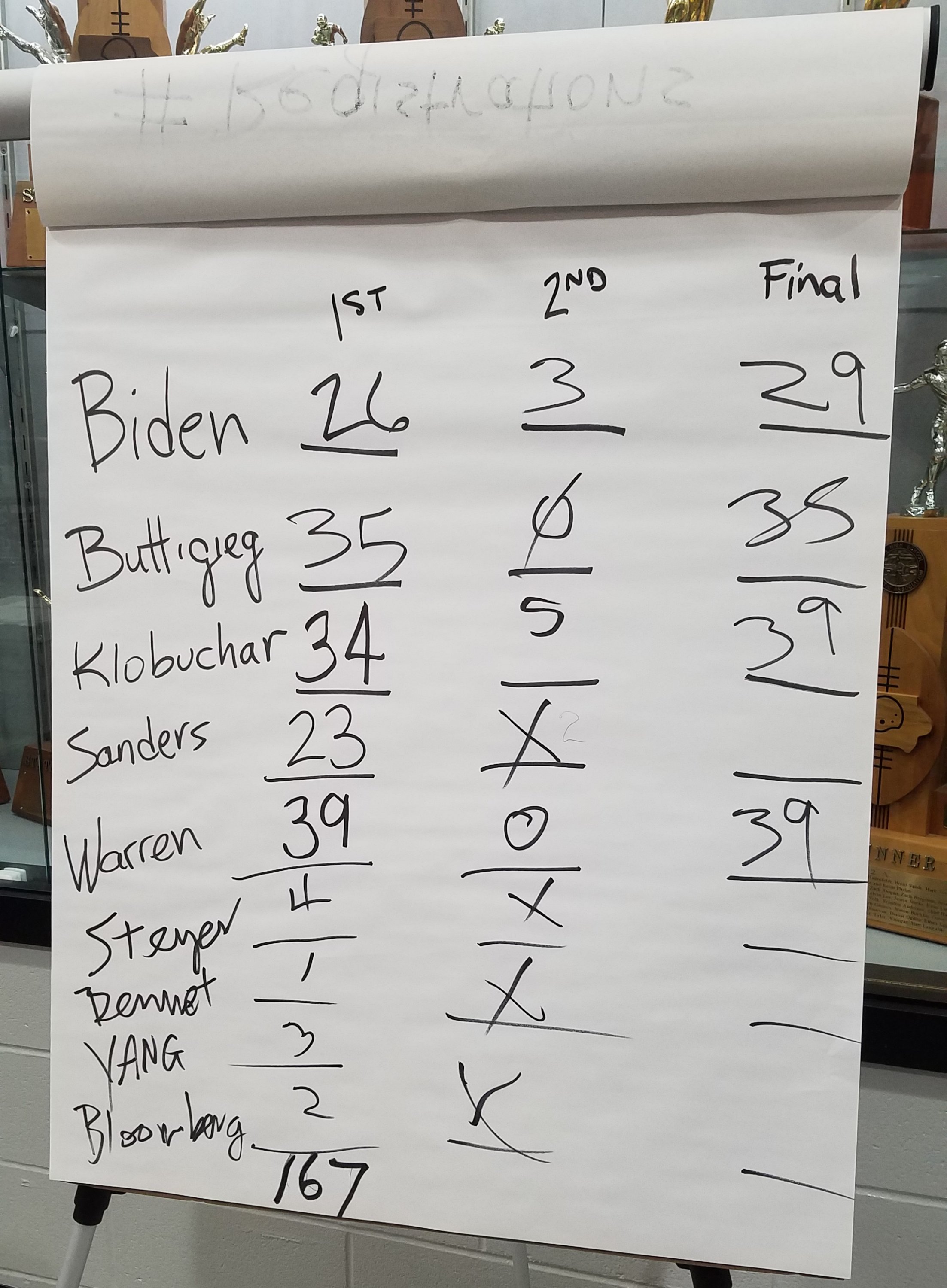
Big Grove Township went Obama – Obama – Trump during the last three general election cycles. In the caucuses those years, we advanced Clinton, Edwards and Obama in 2008; Obama in 2012; and Clinton, O’Malley and Sanders in 2016. This year we advanced Biden, Buttigieg, Klobuchar and Warren with Klobuchar and Warren each having 39 people, Buttigieg 35, and Biden 29, with everyone getting a single delegate to the county convention. Sanders was not viable here, his support from 2016 was cut roughly in half.
The best comparison in presidential campaigns is between 2008 and 2020. Both years we had a significant field of candidates with an unpopular president. We came out of 2004 with a new understanding of how to run a campaign thanks to the ground-breaking work of Howard Dean and his campaign manager Joe Trippi. Dean wasn’t viable in our precinct caucus that year but the lessons stuck, particularly around fund raising, use of databases to target specific voters, and what they called open source campaigning — using the internet to expand a campaign’s voter base. Trippi wrote about his campaign innovations in his underappreciated book The Revolution Will Not Be Televised: Democracy, the Internet, and the Overthrow of Everything.
The campaign techniques pioneered by Trippi in 2003 and 2004 were consolidated, refined, and advanced by David Plouffe who managed Barack Obama’s successful campaign. In The Audacity to Win: The Inside Story and Lessons of Barack Obama’s Historic Win, Plouffe details the process which included integrating diverse databases to micro-target potential voters. He re-booted how traditional door knocking was done, changing from the knock every house process my father followed during the 1960 John F. Kennedy election to a specific and highly targeted list of potential voters. The results showed it worked in 2008, less so by Obama’s re-election campaign when locals were feeling some buyer’s remorse.
Beginning in 2016, with wide adoption of social media, campaigns changed again and produced an environment where media personality Donald J. Trump thrived. Hillary Clinton had a strong background in policy development and relationships with key figures in the Democratic Party. She also had a vast donor network from her family’s long history in American politics. It turned out those things didn’t matter as much, and in retrospect, she had those advantages in 2008 and Obama was able to catch up and pass her. Trump won the election in the electoral college, which is the win that mattered.
In 2020 campaigning changed again. I focused my work on assuming responsibility for running our caucus for the first time since my neighbor who was previously caucus chair moved out of the precinct. I canvassed fewer voters this cycle than I had since 2008 and 2016. The presence of a large field of candidates and my understanding of and maturity in the precinct led me to believe door knocking was not as important. The solid turnout at caucus validated my belief, or maybe confirmed my bias.
The lack of a clear winner in the Iowa caucus is evidence of a breakup of Democratic support. Campaigns bought access to the party voter database and those who used it mailed campaign literature, phoned me, or knocked on our door. Not only has the electorate been divided by repeated computer profile targeting such as I experienced, the campaign process supported more candidates being viable beyond the precinct than in previous cycles. This had two tangible effects: it made the Iowa caucuses less relevant by advancing five candidates, (Biden, Buttigieg, Klobuchar, Sanders and Warren) and it created division that needs mending for the electorate to join together long enough to support the nominee at the Democratic National Convention, at least through the general election.
As we turn toward November, what is the role for someone like me? I see these things:
I’m done with targeted voter lists. There is a bad assumption that there is not enough time to contact everyone, so the list of targets is reduced. We have to contact everyone we can about this election because winning it will not be based on party affiliation, but on person to person contact. We must change our thinking as some candidates already did this cycle.
If we elect a Democratic president, the work is only a third done. Democrats must retain control of the U.S. House of Representatives and flip the U.S. Senate to Democratic control. In Big Grove precinct this means getting people to participate in the process and turn out for the June 2 primary. I favor Rita Hart for congress in Iowa’s second district and the best of five Democratic U.S. Senate candidates. There will be more work to be done on this front.
As a writer I have a platform, and I will use it to promote Democratic and progressive causes. Here I mean Blog for Iowa which gets better traffic than this space.
I’ll volunteer with the county party, especially after the national convention when we expect to have a full slate of candidates.
I’ll donate what I can to favored candidates. It seems unlikely I’ll hit the federal maximums.
The election of two neighbors to the central committee is a positive development for me. It frees me to think differently about our future and to put politics on a lower shelf in the pantry. That may be the best outcome of the 2020 Iowa caucuses.
Defense Secretary Mark Esper wants to end federal funding for Stars and Stripes and re-purpose the $15.5 million to support the “Warfighter.”
Whatever.
When I worked for a logistics company we used the word “Warfighter.” It seemed a synonym for an ATM to me.
Esper’s reasoning is a joke because those funds represent 0.002 percent of the Defense Department budget. Elimination of federal funding represents about half of the news organization’s annual budget, according to Stars and Stripes.
One has to believe Stars and Stripes’ Congressionally mandated editorial independence from the Defense Department is the unspoken problem under the current commander in chief. Esper is a former Heritage Foundation chief of staff and Heritage is the lead agency in implementing movement conservatism in our government. It’s not hard to connect the dots.
I suggest defense money be diverted from development of new nuclear weapons we don’t need to maintain financial solvency of a newspaper first published during the Civil War. Stars and Stripes has been in continuous publication since World War II.
I ask politicians to audit the Pentagon as a first step toward fiscal accountability. I keep asking. If the president can gin up billions in defense budget excess to build the Mexican border wall, there is surely $15.5 million for an independent newspaper to be found in some boondoggle project.
Stars and Stripes was not a big deal to me when I served. We could buy it at the Post Exchange and received free copies only irregularly — mostly when we were on extended maneuvers in the Fulda Gap. If I wanted news, I listened to Armed Forces Radio, or walked down the hill from my quarters to the Mainz main railway station to buy France Soir, Le Monde, or the International Herald Tribune. Of those, only Le Monde survives in print edition today.
Esper’s military service occurred after mine and to be honest, I don’t know the role Stars and Stripes plays in military life today. Our military has access to the internet, and to some extent are able to access information like I can from my Iowa writing table. Our information infrastructure changes constantly, and Stars and Stripes should not be insulated from change.
If Stars and Stripes is a piece of nostalgia, I agree it should be tossed in the bin of history, something the proposed budget cut will ensure. The issue is the squelching of independent voices in our government. The relentless and systematic purging of differing opinions is a problem for us all.
We know the tune, but it is changing to Stars and Stripes Forever For a While under this administration.
~ A version of this post appeared in the Feb. 20, 2020 Solon Economist
I’d just secured the last part of my barter share from a local CSA — a large bag of heads of garlic. I put seven or eight of them into a lunch bag and headed along Highway One toward Iowa City to meet with U.S. Senate candidate Michael Franken.
Franken is running for the Democratic nomination in the June 2 primary. He has a plan.
He believes he can address three key aspects of incumbent Senator Joni Ernst’s appeal: (1) He was raised in rural western Iowa and said, “We were as rural as they get.” (2) As a general grade officer he has a different kind of military experience from Ernst. (3) He had plenty of experience in castrating hogs during his farm upbringing, and worked a stint in a slaughterhouse. He believes these three things address Ernst’s popularity and provide him a good chance to win in the general election.
On Feb. 8, I had my third conversation with the retired Navy Vice Admiral at a coffee shop near Interstate 80. The first two were the result of his fundraising call time. The third was on assignment for Blog for Iowa. I presented the bag of garlic as a gift and began the interview.
Franken returned to Sioux City in 2017 after serving a distinguished naval career. His last assignment was as Deputy Director of Military Operations for the United States Africa Command. If one names a significant military action since 9-11, Franken was most likely involved. His work included military operations in Libya, Mogadishu, Somalia, and combating pirates near the Horn of Africa. Unlike Ernst, Franken has a diverse portfolio of command experience, the gold standard of military service.
Of the primary candidates in the race, Franken has the longest resume of experience working on legislation in the Congress. In 1996 his legislative work began with an assignment as legislative affairs for Senator Ted Kennedy. It continued in between other assignments, totaling ten years in legislative affairs, with his most recent assignment finishing in 2015. He believes his work as a legislative assistant gives him a sound foothold to get things done for Iowans should he succeed in the primary and defeat Joni Ernst.
The unique story about his opposition to the 2003 Iraq War was highlighted in his announcement video which can be found here.
According to Open Secrets, the campaign has raised a total of $333,719, spent $208,934, and has cash on hand of $124,784 as of Dec. 31, 2019.
BFIA: Name two or three of the major naval operations in which you participated.
FRANKEN: I’m very unique in terms of after 9-11 I only served operationally in the Navy one time. The rest of the times were all joint. Due to my exposure early on, due to my relationships developed mostly in Washington, D.C., and at U.S Central Command, and U.S. Pacific Command, I was acceptable replacement for often-times Army officers, U.S. Seals, Marines, etc. There have been eleven, as I recall, named operations since 9-11. I participated in nine of them.
BFIA: Why Iowa after military service?
FRANKEN: As you get more senior in life you’ve got options. What was reasonably apparent was I’ve worked for every president and been in the military since the Carter administration. I just didn’t care as a three-star going back to Washington D.C. with the expectation that I would have a position that close to the administration. I just didn’t want to do that. My prerogative after 36 years of active service.
I requested to retire and (it was) granted by the Trump administration. I came back to a consulting business in Washington D.C. (Chartwell Strategic Advisors, LLC.) where my wife and I owned a home. We have a special needs daughter whose treatment happens in Washington.
When it got to be after the 2018 election I wanted to ensure that the Democratic party had someone who negated the items which got Joni Ernst elected so that it was a level playing field for an aspirant in the Democratic Party. When I saw that not unfold to my liking, I gathered a team together, submitted my nominating papers, and embarked on a run to represent the State of Iowa as best I can.
BFIA: Why does your experience best qualify you to be the Democratic nominee?
FRANKEN: The prime objective is Joni Ernst rode three horses to her candidacy, a. the ruralness, b. the military, and c. the pig thing. So first of all ruralness.
BFIA: Have you ever castrated a hog?
FRANKEN: Hell yes! I can castrate a hog with my eyes shut. I worked three years in a hog-kill plant — stick pen, rendering, chitterlings table, head table, floor… four months, 2,500 hogs a day. I can do it with my eyes shut. Thank you very much young lady I know the difference between the curly end and the snouty end.
My father planted a machine shop. The nearest town was Hudson, S.D. He did it specifically so there would be a long distance between him and any city for implement repair. We got running water in our bathroom just a couple of years before I was born. I’m the youngest of nine.
I mean, I know how to make soap. We had home made soap. We all knew how to sew. We butchered animals in the back. I mean we were as rural as they get… Don’t tell me about Iowa values… piling in the station wagon all of us to go to church on Sunday morning. When I took a bath the water was the color of tea and was tepid because I was last. I’m pretty rural. All those rural homonyms, I got you on that.
BFIA: Ours is a progressive blog. What is your message to our readers?
FRANKEN: Job number one is to congeal around a presidential candidate who can win in the general election against President Trump. Step number one. When the party, when the machinations happen and we congeal around a candidate, fall in, build up your voting base, get those, convince those who are on the fence that four more years of this will not be beneficial to the State of Iowa. All they need to do to see whether I’m right about that is to look in the rear view mirror.
Ask some basic questions. From a national security perspective are you more assured of your future? Is the sanctity of the family farm better? Is education better? Is health care better? I’m sure your stock portfolio is better but how many people does that pertain to? Tell me if you like the national discourse that’s presently going on. Do you think it’s going to improve? Step number one, do that.
I’m that guy that talks about sacrifice. If you are 85 percent for candidate such and such, and 95 percent for something and you’ve got your nose bent out of line because the guy or woman got 85, then frankly be happy that we have such great candidates that you even can choose from more than one. If you look at the cast of characters from 2016, the Republicans weren’t so blessed. Yahoos versus professionals. Let’s march forward.
Step number two. We need to control the senate from the Supreme Court designation to controlling the unhelpful tendencies of a potential second term. First and foremost we need to control the senate.
When you march forward to the general election and you look at the primary. Look at the primary in terms of ties, not who is nice, who they know, who they think would be fine. “Fine” is a bad word. Who’s going to win? Don’t think in four letters think in three letters, “win.” Who can beat Joni Ernst? Who can sit toe to toe, debate her, expose her voting record, pick it apart, corral a national effort behind the person to beat her.
She will have all of the strength of the Republican party behind her. Money will be no object for the Republicans to maintain that seat. You need to win her on the essence of the discussion. You need to punish her in every debate. She needs to whimper in the corner because she’s been supporting special interests in this state, at the behest of special interests and corporate greed, and been hammering the citizens of this state into the rich soil.
If you can’t choose which candidate is that, can do that, then let’s have a debate among the Democratic candidates well before the primary. in every county we can. I’m game. I sign up.
~ Editor’s note: The garlic presented to the campaign was appreciated as some were experiencing cold symptoms. Admiral Franken posted his garlic cold treatment the next day. During the interview he provided responses to addressing the climate crisis, the national debt and the deficit. Any errors in transcription belong to the author. His campaign website is frankenforiowa.org/about.
If the Iowa precinct caucuses created doubt about the efficacy of our voting process, we are not the only ones with concern.
Thom Hartmann, the number one progressive-talk-show host in the United States wrote the book, The Hidden History of the War on Voting: Who Stole Your Vote and How to Get It Back. It will be released by Berrett-Koehler Publishers on Feb. 11.
Blog for Iowa reviewed the book here and on Jan. 21 interviewed Hartmann about it and his work as a progressive. Hartmann was engaged and spoke freely about his book, about his concerns about voting in the U.S., and about his work as a progressive writer and radio personality.
We will run the interview in multiple posts, beginning with Hartmann’s comments about this book. The interview was transcribed from audio and is presented with only minor grammatical corrections for clarity.
BFIA: Can you tell me about the background, why you came up with this Hidden History series?
Hartmann: I’ve noticed a couple of trends. One is that people have less and less time to read books, and myself included. But I think it’s just ubiquitous. Spread across the culture. You can blame screens, you know, or phrenetic lifestyle, cause of the bite that Reaganomics is taking out of the middle class. I’m sure it’s a whole bunch of different factors but the simple reality is people don’t just sit down and spend ten, fifteen, twenty hours reading a book like they did twenty-five, thirty years ago.
So I wanted to come out with a series of small books that were books that a person could read in a weekend or maybe even in a long afternoon. I also have been just an absolute history fanatic my whole, entire life. My Dad wanted to be a history teacher when he grew up, a college professor. He had to drop out of college because Mom got pregnant with me and that was the end of that. But he had 20 thousand books in his basement; a lot of them were history. And we talked history all my life, you know, until my Dad died.
I proposed this to BK Publishers, said I’d like to do a series about things that are contemporary issues that have historical roots that most people are unaware of the roots. They don’t know where this came from, how this came about.
The first one we did was the Hidden History of the Second Amendment which is kind of self explanatory. The second was the Hidden History of the Supreme Court and the Betrayal of America. That is how the Supreme Court basically flipped us into oligarchy in the 1970s and it also takes on the issue of judicial review, something most people don’t know anything about the background of and how angry Thomas Jefferson was about it. The third one was the Hidden History of the War on Voting. I argued it should be titled “Republican War on Voting” because there is no Democratic war on voting. They didn’t want to make it seem too partisan.
It’s fairly evident when you read the book who’s trying to prevent you from voting and who isn’t.
BFIA: Thank you. In the voting book, which is the most recent one I read, is there anything you would like to highlight in particular.
HARTMANN: I think the big aha! For a lot of people who have read the book has been Red Shift and voter suppression. Red shift is something that started showing up around 2000 in the United States.
Around the world exit polls are the gold standard to determine if an election has been fraudulent or not, whether there is election fraud. Historically, and in fact, most countries in the world vote by paper ballot. They don’t vote electronically. As a result it takes a couple of days to count the vote.
Every European Country, Canada, take your choice. I lived in Germany for a year and when they have elections in Germany they call the elections when the polls close because they do it based on exit polls. Exit polls are never more than one tenth or two tenths of a point off, even though it takes them four days to count the vote. We saw this in the U.K. very recently with Boris Johnson.
In the United States our exit polls had always been within a tenth of a point or so of our election outcome. But in 2000 this strange thing started showing up. It got really bad in 2002, 2004, 2006 and 2008, when what showed up was that in a handful of states, that started out four or five and now it’s more like ten or fifteen, the outcome of the election is anywhere from two to five percent more Republican than the exit polls. And that’s why it’s called Red Shift toward the Republican Party.
And for a long time, and this is not a secret, the exit polling companies were so freaked out about this they didn’t know what to do. I mean this was a crisis for them in the 2004 election, the John Kerry-George Bush election. There was substantial Red Shift, including in Ohio where George Bush supposedly won that election.
So when we first saw these changes in numbers, how they almost always benefited exclusively Republicans, we concluded and they seem to follow the widespread adoption of electronic voting machines. The first guess of most people was that this was rigged or hacked voting machines.
I think one of the things we have learned in the years since then, particularly over the last ten years or so, that Republicans are more open and up front about their strategies. We’ve gotten access to some of their memos going back 15, 20 years, (showing) that what they have been doing in states where the Republicans control the state they throw hundreds of thousands of people off the voting rolls in the year before an election, in particular they do it in the Democratic cities.
And then when those people show up to vote they’re told, “Oh I can’t find your name on the roll, but here is a provisional ballot you can vote on this.” They don’t realize that provisional ballots are only counted if an election is contested. So those votes literally never get counted, with very few exceptions.
But when they walk out of the voting place and speak to the exit pollster, who says, “How did you vote?” They’ll say “Oh, I voted for John Kerry.” And they write that down as a John Kerry vote, neither the pollster nor the voter realizing that because the voter will be on a provisional ballot that that vote will never be counted.
In most states if you want to your provisional ballot votes to be counted you have to show up at the secretary of state’s office within 48 hours, and prove that you are who you are, and where you live, and you are a citizen, and basically go through the whole process of re-registering to vote, or proving that your registration was inappropriately removed, which most people don’t even know they have to do much less know that they can do.
I think that’s probably a better explanation for Red Shift because the red shifts seem to be the worst in the states that had the most aggressive voter purges.
While the Iowa caucus news cycle lingers, I am already gone.
After a Saturday of political engagement — an interview with Michael Franken of Sioux City who is running for the Democratic nomination as U.S. Senator from Iowa, and a town hall meeting with my state representative Bobby Kaufmann — Michael Wines of the New York Times contacted me about my experience at the Big Grove precinct caucus. I told him the story… which is metastasizing.
The narrative is repeated so much I might resurrect a circus like Ringling Brothers and Barnum and Bailey to take it on the road. As locals know, circuses are an Iowa thing and four of the Ringling brothers were born in McGregor, Iowa. What more fitting outcome for the caucuses?
Nontheless I am pivoting away from politics. I’m in a position to do so because of great caucus turnout. I’m confident our four delegates to the county convention will show up. Two volunteers stepped up to participate as precinct representatives on the county central committee. Despite lingering interest in what we did, the news cycle will eventually move on. It’s time for me to go.
I unsubscribed from the county party weekly newsletter, thanking the public relations chair, and saying, “I have less need to stay abreast of what party insiders are doing.” There is life beyond politics.
Toward what will I pivot? Will a divot of politics follow?
Our big family news is on Feb. 5 we made the last payment on our daughter’s student loan. Including loan interest, our contributions, and her work study and scholarship, the cost of her four-year education was about $140,000. In the box of letters I sent Mom during college, I wrote my monthly bill at the University of Iowa was $50. Add in the scholarship I had and my college expense was about $6,800 for four years.
My freedom from politics will be used to become a better citizen. Monday I start a brief term on the county Food Policy Council. If that proves to be engaging, I’ll volunteer for a full, four-year term. I’m writing more for Blog for Iowa, have written up one interview, two more are done, and there may be more. I hope to have a better garden this year. I invested in an electric tiller, bought some rolls of mulching, and began planting onions on Friday. There are plenty more projects in the works. There are also the farm jobs, which have been reduced from three to two this season.
A group of us were sitting around a table in the break room at the home, farm and auto supply store on Wednesday. The discussion was about retirement as a couple of us have retired but continue to work because of the social engagement a job involves. Our store manager was there and he told me, “If I were you, I’d retire as soon as possible.” Depending on how the next couple of months go, I may take his advice and help on one of the federal election campaigns.
For now, I’m on to what’s next while sustaining ourselves in a repressive national political environment. Life will be better, at least I hope so.
Caucus Result: Last share of bartered garlic from a local farm.
The Iowa Democratic Party website reports caucus results from 100 percent of precincts this morning. My precinct results are still wrong.
Our four delegates will get seated at the March 21 county convention because of the paper trail, so no worries. It still bugs me.
I don’t have time to dwell on it. I reported the errors to our county party chair and to my state senator. The two campaigns showing zero people after the second alignment and no delegates have copies of the caucus math sheet. In the bigger scheme of things, Super Tuesday should be the shakeout we need in this Democratic presidential nominating process. The mixed Iowa results should deprive campaigns and the media from making sweeping statements about which candidate was the winner. It is likely a good thing.
That there is a statistical tie for top delegate-getters Pete Buttigieg and Bernie Sanders in the first complete reporting isn’t surprising as the electorate of caucus-goers is not of one mind. If this were a race for U.S. Senate or U.S. House of Representatives, the nomination would go to a convention to be decided because neither had garnered 35 percent. In the presidential nominating process, the district and state conventions will simply elect a proportional number of delegates to the Democratic National Convention for each candidate. The national convention is the ultimate decider.
Before I move on from the caucus, one last comment on the erosion of registered Democrats in our precinct.
The decline in registered Democrats in Big Grove precinct is about 20 percent since 2008. Then we had five delegates to the county convention, this year we had four. Then there were six candidates in the first alignment (Biden, Clinton, Dodd, Edwards, Obama and Richardson). Monday there were nine. What’s bothersome is the number of Republican registrants stayed about the same over 12 years and no preference registrations grew. We registered some new Democrats at our caucus, but not enough to offset the trend to less people who identify as Democrats.
People ask should Iowa have a first in the nation precinct caucus. The better question is what will we do to convince like minded people to join us in taking our government back from moneyed interests? Because we’re publicly debating the wrong question our efforts to grow the party are stymied.
This year is the U.S. Census and in 2022 the first election after redistricting. Republicans have repeatedly said they aren’t going to change Iowa’s non-partisan redistricting process. Many feel they can’t be trusted.
I see growth of the county where I live and a likelihood that Big Grove precinct will become more Democratic after redistricting. If that happens it will make my political life more tolerable but it doesn’t address the underlying trend toward an exodus of partisan Democrats.
We don’t know the half of what’s going on in our government, nor have we in my lifetime. I don’t have a crystal ball to tell the future. I do have confidence our country will correct course. It might be too late to make a difference.
Our industrial age exploits natural resources as if they were an endless commodity. They aren’t. Global warming and the unpredictable impact it is having everywhere is science. The success of our political system is it requires engagement from people who have a stake in its outcomes. We are getting better at it in Big Grove precinct. Here’s hoping the same thing is happening in the other states and territories… and all over the world.
I’m running behind because I slept until 4:20 a.m. this morning. I’m usually up getting dressed about 3:30.
It’s not because I still tired from the run up to the Iowa Democratic precinct caucuses, although that is a factor. It’s because I woke before midnight and couldn’t get back to sleep, thinking about the phone application we used to report our results to the Iowa Democratic Party.
This post is not about the process that kept me up last night. I learned a lot about the application over the last few days, but have little more to say than what I’ve already posted in social media. I thought this would be a short post before I get ready for my shift at the home, farm and auto supply store.
It’s about how campaigns organized in our precinct.
We had nine groups after the first alignment. Let’s call the bottom four the second tier (Bennet, Bloomberg, Steyer and Yang). The top tier, each of which have had substantial showing in Iowa polls, was Biden, Buttigieg, Klobuchar, Sanders and Warren. Second tier first.
None of the second tier had much ground game here. They benefited from nearby rallies, mailings, and media coverage. The Steyer group created the largest number of spoiled ballots after they weren’t viable, crossed out his name and wrote Biden over it. A strong local network is necessary to be viable in our precinct and the lower tier didn’t have one. For perspective, in 2008, Bill Richardson, Biden and Chris Dodd all had local caucus organizers. Tulsi Gabbard was the only candidate who held an event in our precinct so it was surprising she had no alignment group. Her host was snow birding in Florida and not on my satellite caucus list.
Bernie Sanders was not viable on Monday. Their group posted a respectable 23 in the first alignment but were unable to persuade others to join them in the second alignment. Viability was 26, so it was a heart breaker. Sanders had a telephone campaign, but as I told one of the county campaign leaders, I hadn’t heard of anyone supporting Sanders. They assured me they would win our precinct and the state. Support didn’t materialize. They parachuted an organizer in the week before the caucus and without a perceptible ground game it was game over. Sanders’ numbers were halved from 2016 when Hillary Clinton dominated the caucus here.
The Biden campaign was similar to Sanders. A long time activist said they were the precinct captain for Biden and proceeded to take a two-week trip out of state before the last weekend. Biden parachuted a precinct captain in for the last week and they achieved viability in the first alignment getting 26 of 26 needed. In 2004 the parachute method of campaigning worked for John Kerry, but in 2020 it was a failing tactic.
The lesson here is a local organizing presence makes a difference. Some of us learned that from Howard Dean. While Dean had few, or maybe zero supporters in the 2004 Big Grove caucus, it was clear some campaigns learned the lesson of his and campaign manager Joe Trippi’s work since then.
The top three in the first alignment had strong local organizers and finished in a narrow band. Warren led first alignment with 39, Buttigieg was second with 35, and Klobuchar was third with 34. In second alignment no one joined Buttigieg or Warren and five joined Klobuchar who was the second choice of many. End result was Klobuchar and Warren on top with a delegate each, and Biden and Buttigieg also getting delegates.
A Warren organizer was working in the precinct for more than six months before the caucus. The top three were in a tight band but their support was strong and if there is a winner, Warren won our caucus. The numbers show it.
A couple notes. The Klobuchar precinct captain was a strong leader who started early in the Warren camp but switched to Klobuchar. She knows who to call and called me to say I should switch to Klobuchar like she did. Her efforts are the reason Klobuchar tied Warren with the largest number of people in their group. The two of us faced off in 2008 when I was precinct captain for the John Edwards campaign and she was precinct captain for Hillary Clinton. We tied at 75 people in each of our groups and they won the coin toss to determine who would get a second delegate. Barack Obama had 97 that year. The precinct had more Democrats and delegates to award back in the day.
There was a surge in support for Klobuchar here in the final month. She started with a base of people who knew her already or had relatives in Minnesota, and grew that base. As Klobuchar said on caucus night, she was punching above her weight.
This needs to be addressed: Our precinct has some of what one of my Facebook friends called functional homophobia, “which means straight folks who are just fine hanging around gay folks — as long as said gay folks know their place, which isn’t in the White House.” A few Democrats railed about the gay candidate during the long run up to caucus night, saying to me, “I’m not going to vote for a homosexual.” I don’t know what this means except our prejudices run deep and even long-time Democrats can be biased or bigoted.
The Buttigieg and Warren precinct captains represent the next generation in Democratic politics. It was their first time getting so active and each had a strong organization behind them. If they are our future, I’m ready for it.
Gotta get ready for work. More on the caucus coming soon.






 Journey Home
You must be logged in to post a comment.