Categories
Living in Society

Inauguration Day 2021

Inaugural pin.

It is a new day in America as Joe Biden and Kamala Harris take their oaths of office and install a new administration this afternoon.

They have a long list of items to accomplish today. The rest of this week, and the whole term, is expected to be a non-stop effort to reverse four years of degradation to our country and its standing in the world. As Biden said during the campaign, he wants to build back better than we were. It is a daunting task. Things have changed since the Obama-Biden administration, although, not enough to lose hope. The official schedule calls for the 46th president to sign executive orders and take other presidential actions beginning at 5:15 p.m.

“Our tradition of a peaceful transition of power, established in 1800, has been broken,” wrote historian Heather Cox Richardson in her Letters from an American. It is hard to dispute.

Security in the U.S. Capitol is unprecedented for the inauguration of a president. Thousands of National Guard soldiers occupy the center of our government. As journalist Laura Rozen put it, “Troops, have arrived in Washington, D.C., after an attempted coup by pro-Trump extremists.” Citizens and friends are discouraged from attending the inauguration in person.

It’s not like our government has been working for anyone but the richest Americans. The economy is in shambles and the coronavirus pandemic rages with more than 400,000 dead of the virus. The Federal Government executed more than three times as many people in the last six months than it had in the previous six decades. Trump’s support for Saudi Arabia in its war in Yemen resulted in a humanitarian crisis. In almost every aspect of life, things we cherished have been violated.

A majority of Europeans believe America’s political system is broken and Joe Biden will be unable to halt his country’s decline on the world stage, according to a recent survey. China is rising and many expect them to eclipse American’s post World War II role as preeminent world leader. Foreign policy, like almost every aspect of governance, was not a strong suit of the Trump administration.

I pay attention to the inaugurations of our presidents. I listened to every inaugural address since Truman, 13 presidents in my lifetime. With an open mind I’ll find Biden’s live stream and listen to his speech. Much as I’d like Biden to be brief, I have followed him for a long time and don’t expect brevity, brilliance, or much that has not been vetted on the campaign trail. Surprise me, though.

Like any new political beginning, our transport vehicle carries a lot of baggage. With Biden and Harris’s experience, one hopes they brought along what we will need to improve our lives. Fingers crossed.

Categories
Living in Society

January 13, 2021

Cedar Rapids Gazette, Jan. 14, 2021.

President Donald Trump was impeached by the U.S. House of Representatives yesterday on a 232-197 vote. He could have gone gracefully after losing the election, but chose not to.

I listened to much of the so-called debate on the article of impeachment and affirmed most politicians don’t really know how to debate or give a speech other than one that promotes confirmation bias.

The future for our country is uncertain, Washington D.C. is going on lock down for the inauguration, National Guard soldiers are on bivouac inside the capitol, and citizens are being discouraged from attending the inauguration ceremony in person. This is not normal.

America is still here after the president’s actions leading up to Jan. 6. We will remain once Trump’s term ends on Jan. 20. Anyone familiar with American history knows we are not perfect. We strive to get better, to form a more perfect union as Abraham Lincoln said in his first inaugural address. On the morning after the impeachment we have a long distance to go.

Categories
Living in Society

Waning Days

Obama’s Last Campaign Rally, Des Moines, Iowa, Nov. 5, 2012

Yesterday afternoon President Trump and Vice President Pence met and decided they would work together for the rest of the administration.

That meeting is similar to one held on Aug. 7, 1974, between President Richard Nixon, U.S. Sen. Barry Goldwater, U.S. House Minority Leader John Rhodes, and U.S. Senate Minority Leader Hugh Scott. The three Congressmen made it clear to Nixon he faced all-but-certain impeachment, conviction and removal from office in connection with the Watergate scandal. Nixon announced his resignation the next evening.

What the Trump-Pence meeting means is neither a resignation from Trump nor his removal by the process outlined in the 25th Amendment to the U.S. Constitution by Pence and the cabinet will be forthcoming. The U.S. House of Representatives has enough co-sponsors of the Article of Impeachment to impeach the president. A vote is expected tomorrow.

Last news was the U.S. House would pass the article of impeachment and immediately transmit it to the U.S. Senate which is scheduled to reconvene on Jan. 19. U.S. Senator Chuck Shumer is seeking a path in the Senate rules to call the Senators back to Washington earlier for an impeachment trail. It is unknown if Trump will be removed from office before the scheduled inauguration of Joe Biden.

Yesterday 14 busloads of National Guard troops arrived in Washington. The FBI indicated armed protests are expected in Washington and in all 50 state capitols on or around the date of the inauguration. The Department of Defense said they will review troops deployed to the Biden inauguration to ensure they don’t have sympathies to domestic terrorists. President Trump declared a state of emergency in Washington, D.C. yesterday, citing the “emergency conditions” surrounding President-elect Joe Biden’s inauguration. The president-elect continues to plan the inauguration ceremony outdoors. Biden is not afraid.

It was clear from the day of Trump’s inauguration his presidency was going to be bad. We didn’t know how bad. On the cusp of a second impeachment by the U.S. House, the president may end his term at a low point. The sad news is there are nine days left and what happens is anyone’s guess. It could get worse. We must accept the bad news of the Trump-Pence meeting last night and hope for the best from our political leaders.

News accounts of time-lines of Jan. 6 events at the capitol are being developed and published. Each hour we learn a little bit more. Those of us removed from the capitol follow the news closely, partly because it is so bad, partly because we hope for an end to the corruption, sedition and incompetence followed by a new, positive beginning.

As Trump prepares to make his exit there is a lot to learn. A book has already been written about what needs to be done to shore up the presidency after the Trump years. There is discussion of whether the White House family quarters will be safe, sanitary and secure immediately after noon on January 20, 2021. Perhaps the new president should stay somewhere else until a detox of the building can be done. There is much uncertainty today as the incompetence of President Trump is revealed, and the hopeful, positive plans of President-elect Biden move forward in tandem.

In the waning days of the Trump administration we are saddened it turned out worse than we foresaw on Jan. 20, 2017. There is little consolation other than that our country endured the indignity of this administration. Despite the breach of the capitol building six days ago our democracy was unflinching and resilient. After Trump, who knows for how long?

Categories
Living in Society

January 6, 2021

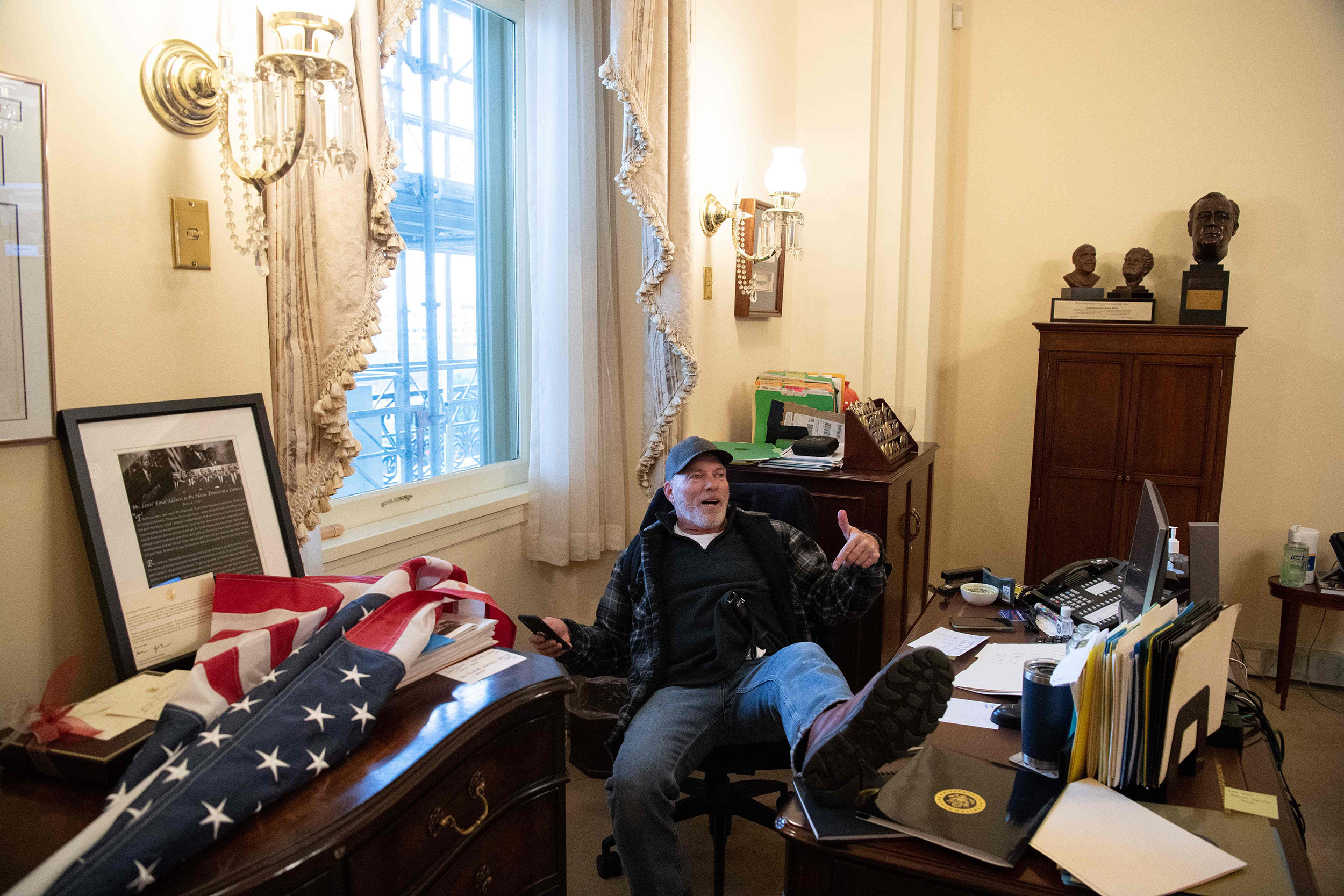
Occupying U.S. House Speaker Nancy Pelosi’s office, Jan. 6, 2021. (Photo by SAUL LOEB/AFP via Getty Images)

There haven’t been days like Jan. 6, 2021 in my life. Ever.

It’s been clear for a while, certainly since Georgia was called for Joe Biden, who won the 2020 presidential election. President Trump refused to recognize his loss. Yesterday during a speech in Washington he said he would never concede.

Trump urging a gathering of well-dressed cosplayers to storm the capitol building was too much. Trump has been too much since his inaugural address. While I need to process it, one thing is clear: two more weeks of Trump would be too much and he should resign. If he won’t, the Congress should remove him.

While growing up, ours was a Democratic family. We were accepted in the community even though Iowa was and still is a Republican state. It likely helped that three of the four presidents in my life by 1968 were Democrats: Harry Truman, John F. Kennedy and Lyndon Baines Johnson. It also helped that Father belonged to the meat cutters union.

Dwight Eisenhower was Republican yet he was also supreme commander of Allied forces in Western Europe during World War II. A number of World War II veterans lived in our community and spoke often about the war. We could relate to Eisenhower. Some of his initiatives, like creating the Interstate Highway system, benefited us directly. Our political life was good and a part of the culture that occupied a small space in each day. Eisenhower would not be elected to anything by today’s Republican party.

As years went by that all changed and political discourse gained hegemony in our lives. It began with Nixon who was forced to resign the presidency because he was a crook. We knew he was a liar after his televised explanation of the war in Cambodia. We didn’t like having a liar and crook as president. The shooting incident at Kent State in 1970 pushed me and others over the edge. I still have the clipping of us demonstrating at the Iowa National Guard Armory in Davenport.

Then there was Reagan who opened the door for dramatic change in our politics. What doesn’t get talked about enough is his ceasing enforcement of the Fairness Doctrine. It led to the rise of right wing talk radio and FOX News, both of which had a deleterious effect on our politics. If Reagan did some good things on nuclear disarmament and for the environment, the downside was much worse. The Reagan Revolution began dismantling the government. Every Republican president after Reagan — George H.W. Bush, George W. Bush and Donald Trump — chipped away at government. Republicans would say the changes were needed. Democrats would say we can do better.

At 1:30 a.m. today I joined 160,000 others in viewing a live stream of the U.S. House of Representatives proceedings regarding acceptance of the certified results of the presidential and vice presidential election. We all should have been sleeping. It was hard to look away even though the speeches were mostly pure drivel. It should be so simple: voters registered and voted, state officials counted the votes and certified them, and certifications were sent to the U.S. Congress to be counted. It should have happened during daylight and but for the cosplay it would have.

I’m tired of middle of the night politics. When issues are important, like last night, I stay awake and listen or watch. If I know the legislators I text or email with them while debate is ongoing. How could I sleep? I’m usually a wreck the next day.

If politics takes more of our time, it’s because old assumptions are no longer valid and so much is at stake. People like me planned our lives based on assumptions about government. Republicans have changed everything and would change it more given the opportunity.

We have to get to a politics of daylight where everyone is respected, can participate, and have a say. Except in matters of war we don’t need to debate at night. Jan. 6, 2021 serves as a reminder we can’t follow the path of Reagan, the Bushes and Trump any longer. We must find a new way together. I’m willing to do my part.

Categories
Sustainability

Epistemological Crisis

Frozen lake, Dec. 21, 2020.

It’s no secret there is an epistemological crisis undermining the authority of knowledge. It may be the most significant problem to grow out of the Reagan administration. That the discussion of creationism versus evolution returned during the 1980s was only the beginning.

There is a difference between justified belief (a.k.a. facts) and opinion and it is epistemological. That is, “relating to the theory of knowledge, especially with regard to its methods, validity, and scope, and the distinction between justified belief and opinion,” according to Dictionary.com. At issue is that solutions to other pressing problems rely on the ability of Americans to separate opinion from facts, something we as a society have become less able to do. Al Gore recently summarized our current situation as follows:

And though the pandemic fills our field of vision at the moment, it is only the most urgent of the multiple crises facing the country and planet, including 40 years of economic stagnation for middle-income families; hyper-inequality of incomes and wealth, with high levels of poverty; horrific structural racism; toxic partisanship; the impending collapse of nuclear arms control agreements; an epistemological crisis undermining the authority of knowledge; recklessly unprincipled behavior by social media companies; and, most dangerous of all, the climate crisis.

Al Gore, New York Times, Dec. 12, 2020

Unless we can agree there are facts, and how to distinguish them from opinions, we may have reached the end of the long, good run that was the American republic.

During the time since Reagan, moneyed interests gained hegemony in our government and society. Thom Hartmann put it this way in his forthcoming book The Hidden History of American Oligarchy: Reclaiming Our Democracy from the Ruling Class:

Billionaire oligarchs want to own our republic, and they’re nearly there thanks to legislation and Supreme Court decisions that they have essentially bought. They put Trump and his political allies into office and support a vast network of think tanks, publications, and social media that every day push our nation closer and closer to police-state tyranny.

Thom Hartmann, The Hidden History of American Oligarchy: Reclaiming Our Democracy from the Ruling Class, to be released February 2021.

It is particularly distressing American oligarchs used the cover of the coronavirus pandemic to increase their grip on the nation and extract taxpayer money intended to alleviate the fiscal crisis it caused. In normal times this would be unthinkable. These are not normal times.

In 1996, President Bill Clinton signed the Telecommunications Act which deregulated use of the public air waves. Regulations put in place in the 1920s through the 1940s were largely repealed. The result has been to consolidate most media under half a dozen corporations which now control the message. Perhaps Sinclair Broadcast Group is the worst in that they distribute editorial pieces from the corporation for inclusion during on-air broadcasts. All of the media corporations play a role in the deterioration of knowledge.

In 1987 President Ronald Reagan directed the FCC to cease enforcement of the Fairness Doctrine. In 2011 the Obama administration removed it from the FCC rules completely. Broadcasters no longer had an obligation to present balanced or fact-based information. The significance to the epistemological crisis these actions brought is hard to overstate.

What do we do about it? For those of us on small, private blogs it is easy: have a basis in fact if we run a story, focus on inquiry and understanding. As Tom Nichols pointed out in his book, The Death of Expertise: The Campaign Against Established Knowledge and Why it Matters, “None of us is a Da Vinci, painting the Mona Lisa in the morning and designing helicopters at night. That’s as it should be. No, the bigger problem is that we’re proud of not knowing things.”

With their 40-year head start, it will be challenging to overtake the oligarch puppet masters who bought much of our government. Hartmann has a dozen ideas to get us started. Gore and Nichols have more. The bottom line is the truth matters, scientific methods matter, and while religious belief plays a role in human culture there is a difference between things we take on faith and those that can be verified through scientific methods.

At the Oct. 22 presidential debate, Joe Biden said, “We’re going to choose science over fiction.” It’s a starting point on a long journey, one which we all should join.

~ Written for Blog for Iowa.

Categories
Living in Society Writing

Bush v Gore

Lake Macbride State Park, Dec. 21, 2020.

Al Gore conceded the Nov. 7, 2000 general election on Dec. 13. It was close, and as we know, it came down to a hand count of ballots in Florida which the U.S. Supreme Court stopped. While Gore won more popular votes than George W. Bush, he lost the electoral college. It was unlike anything I remembered in presidential politics. For weeks I printed out briefs filed in the court case at home and read them all.

I emailed a friend a couple of days after the election while on a business trip to Chicago:

11/9/00 8:35:57 PM
Got your note…what an election. I left the house at about 7:10PM and drove to Princeton, IL, listening to the returns coming in. I stopped at the Days Inn (trying to be closer to Chicago for my early morning meeting Wednesday), and stayed up until after midnight watching CNN and their commentary.
Whoever it is that gets elected is going to have a bear of a time making anything happen. I do not look forward to the next year or two.

Email to Dan Czolgosz, Nov. 9, 2000.

I had hope there would be some redeeming qualities about Bush. Such hope was reinforced by his inaugural address.

I am honored and humbled to stand here, where so many of America’s leaders have come before me, and so many will follow.

We have a place, all of us, in a long story — a story we continue, but whose end we will not see. It is the story of a new world that became a friend and liberator of the old, a story of a slave-holding society that became a servant of freedom, the story of a power that went into the world to protect but not possess, to defend but not to conquer.

It is the American story–a story of flawed and fallible people, united across the generations by grand and enduring ideals.

The grandest of these ideals is an unfolding American promise that everyone belongs, that everyone deserves a chance, that no insignificant person was ever born.

George W. Bush Inaugural Address, Jan. 20, 2001.

Following a brief period of support which lasted until after the Sept. 11, 2001 terrorist attacks, Bush lost me.

The point I would make about the election today is the winning margin in Florida was close, yet the closeness of the race did not make it too difficult for Bush to govern. Whatever support Bush had from the opposition, he squandered it in his reaction to the terrorist attacks and in the invasion of Iraq. Lack of a majority constituency was insufficient constraint to furtherance of Republican goals.

Al Gore’s 2000 loss and the Bush administration’s actions radicalized me to get involved in party politics again. I would no longer take politics for granted. The story about my radicalization unfolded during each of the next ten election cycles.

Categories
Sustainability

This is Our Moment

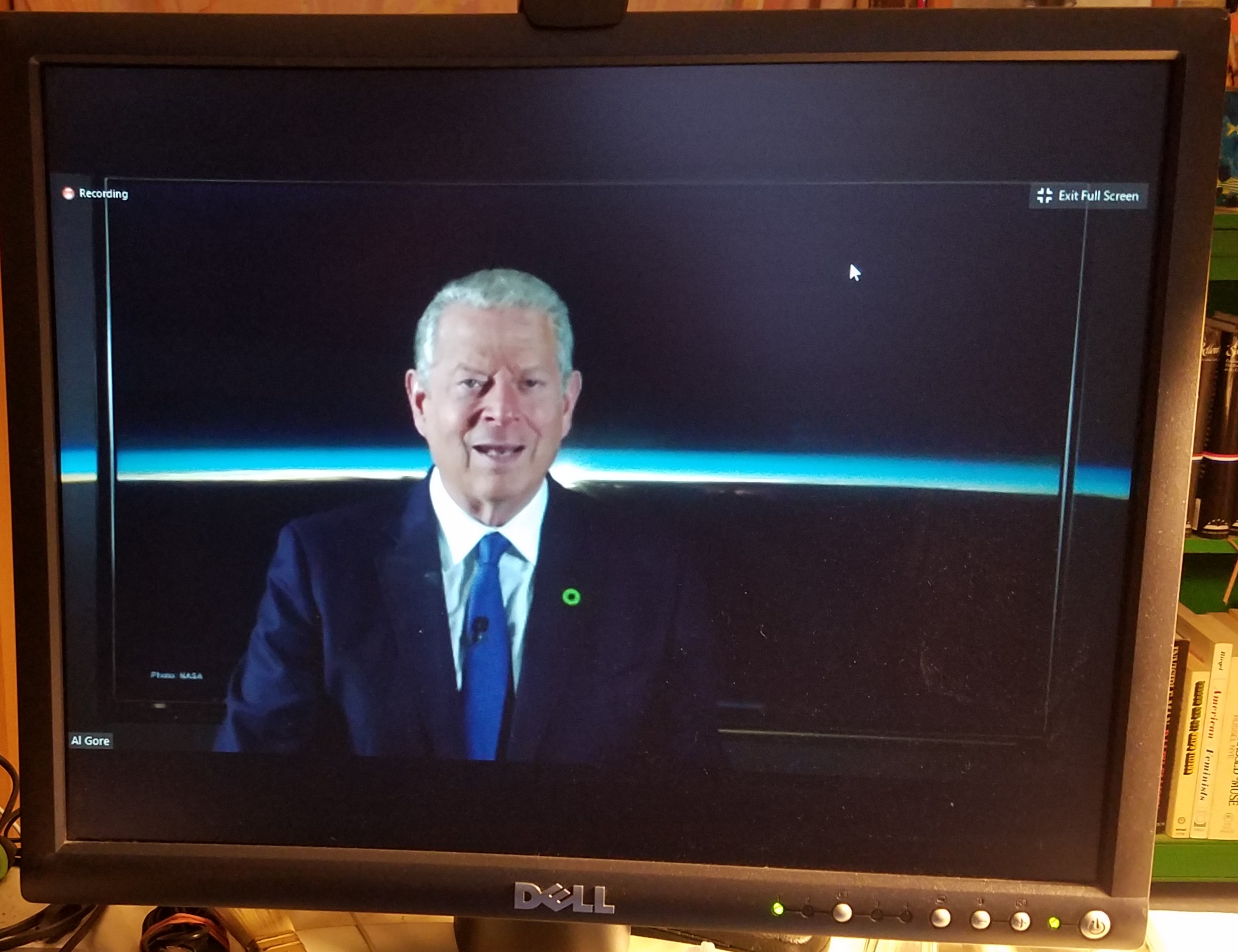
Al Gore via Zoom, Dec. 15, 2020

After the Electoral College vote for president and vice president on Dec. 14, Senate Majority Leader Mitch McConnell publicly congratulated president-elect Joe Biden and vice president-elect Kamala Harris on their win. He noted Harris is the first female vice president-elect, a historic achievement.

In the kabuki dance that is our nation’s capitol, “(McConnell) urged Senate Republicans not to join a long-shot effort led by conservatives in the House to challenge the electoral college results when Congress formally tabulates the vote Jan. 6,” according to the Washington Post. Such an action is doomed to failure as on a straight line party vote it will fail in the U.S. House. Media outlets indicated McConnell wants to avoid such a vote in the Senate.

Former Vice President Al Gore was one of the first world renown environmental leaders to meet with president-elect Donald Trump at Trump Tower in New York after the November 2016 election. The conversation was kept private.

Yesterday, during a 45-minute webinar with members of the Climate Reality Leadership Corps, Gore said, “This is our moment.” The next four years represent an opportunity to address the climate crisis, beginning with the Biden administration’s intent to rejoin the United Nations Framework Convention on Climate Change, better known as the Paris Agreement. Gore had a long to-do list and there truly is a lot to get done to reduce global greenhouse gas emissions. We all must do our part.

McConnell’s announcement and Gore’s speech are the beginning points for a long, difficult journey. Not only does Washington need to recognize scientific truths, we must return to the Obama era practice of embedding climate action in every aspect of the U.S. government. Biden is willing to do so. With the appointment of John Kerry and Gina McCarthy to new roles devoted to addressing the climate crisis, the structural framework is being built.

The Climate Reality Leadership Corps has a number of members across Iowa. The May 2015 training event in Cedar Rapids helped increase our numbers. There are two Iowa chapters of Climate Reality leaders, one in Des Moines, and another in Ames. I joined the Des Moines chapter this morning. Having organized the state for other projects, I’m not sure of the efficacy of developing this chapter, or another in Eastern Iowa, when so many other environmental groups exist in the state. Efforts to pull them together have proven difficult because there is a lack of consensus on priorities. There is also plenty of diverse work to be done. In a society where internet connectivity plays an increasing role, efforts to organize people willing to take action on the climate crisis is energy that should be used to address the climate crisis directly. It is important to be a part of this and other groups. It is more important to focus on the work.

The Sierra Club has a strong presence in Iowa and I support and will work on some of their priorities, such as regulation of companies that seek to pump water from the Jordan Aquifer and ship it out of state. There are other groups as well. In Iowa there are issues that merit our attention. I described them to some long-time friends in an email:

I don’t know what people feel about carbon sequestration as a way to impact greenhouse gas emissions, but it’s all the rage in Iowa. Because it’s all the rage, it is possible, although unlikely, something can be done on it. The danger is it supplants other, more important action that could be taken to reduce GHG emissions.

Another concern is ethanol production. We need a resilient form of agriculture that relies less on making combustible fuel from corn and other biomass. We’ve been at loggerheads for a long time over ethanol yet if we could drive a wedge into this issue in 2021 it would be a positive development.

I don’t know where the University of Iowa is on their blending of biomass with coal, but after numerous attempts, I don’t see any headway in influencing what they do. They should retire the coal plant, and if we could figure out a method or argument to persuade them, that would be a balance between barking up the same tree and a major breakthrough.

Email to Iowa Physicians for Social Responsibility, Dec. 14, 2020.

The elephant in the room is the 2023 Farm Bill. Biden indicated addressing the climate crisis in it is an important priority. While Department of Agriculture secretary-designate Tom Vilsack is known for his alignment with large agricultural interests, and has been no friend to the environment, he is also a good Democratic soldier who will do what Biden asks and who deserves our support as the Farm Bill works its way through the process. Advocates for addressing the climate crisis in Iowa should monitor and devote some bandwidth to the emerging Farm Bill.

Gore waited to make his speech until after the Electoral College vote. We knew what was coming and are ready. There remains a lot to do to address the climate crisis and it will take all hands on deck. This is our moment.

Categories
Living in Society

Need Some New Sawhorses

Woman Writing Letter

I read with interest three letters in the Dec. 10 Solon Economist about the Second Congressional District election in which Mariannette Miller-Meeks won by six votes, according to Secretary of State certified results.

Give it a rest folks.

If Rita Hart wants to pursue her legal rights by appealing to the U.S. House for a new recount, she has that option, it has been used before, and it is perfectly legal.

Hart explained in clear terms why she is appealing to the House: to count every vote. The letter writers apparently didn’t get the message. There will be political consequences for Hart for taking the issue to the House. I don’t think she’s worried about that now.

Republicans better find a new whipping post than Speaker of the House Nancy Pelosi, though. In November she was nominated for another term as speaker and indicated the next congress could be her last. Time will tell, but if she does announce her retirement before the midterms, those old Pelosi-demonizing sawhorses won’t cut wood any more.

By the way, urging folks to contact their congressman with demands is fine. Just remember ours is still Dave Loebsack who supports Hart’s quest for a recount.

~ Published in the Dec. 17, 2020 edition of the Solon Economist

Categories
Living in Society

Building Back Better – a New Farm Bill

Chet Culver and Joe Biden in Cedar Rapids, May 18, 2010. Culver lost his re-election bid as Iowa voters preferred Terry Branstad redux.

My favorite Biden-Harris campaign slogan was “build back better.”

Under Donald Trump, Republicans continued their deconstruction of a government largely built by Democratic administrations beginning with Franklin Delano Roosevelt. They have been trying to undo Democratic programs since FDR passed the New Deal. The Trump administration provided an unprecedented opportunity for them to get to work and they took advantage of it with a wrecking ball. The country will never be the same.

Voters rejected Trump, sort of. He received more popular votes than any previous presidential candidate. Joe Biden and Kamala Harris got more, though, more than 7 million more. Now Biden has a chance to stop the destruction and salvage the good work our government is or should be doing. Whether and how he can build back better is an open question.

In Barack Obama’s presidential memoir, A Promised Land, he indicated the limits of his presidency were substantial. Obama wrote his political capital was mostly spent by the end of summer of his second year in office. The difference between Obama and Biden is the Obama administration briefly had a 60 senator, filibuster-proof majority in the U.S. Senate during his first term. We don’t yet know if Biden will have a majority of even 50 U.S. Senators, plus the vice president. That depends on the outcome of two U.S. Senate runoff elections in Georgia on Jan. 5, 2021 and there is no reason to assume Democrats will win those two seats. There is even less reason to believe Mitch McConnell has changed since 2009. He will obstruct what legislation the Biden administration proposes from day one whether he is in the majority or minority.

Biden did win the 2020 general election with substantial margins in both the popular vote and in the electoral college, which meets on Dec. 14. After the electoral college vote, even Trump acolyte and President Pro Tempore of the U.S. Senate Chuck Grassley said he would recognize the winner. There is no question the winner is Joe Biden.

While we wait for the electoral college to meet, Biden has been appointing his cabinet. Many of the appointees are familiar for their role in the Obama administration.

For Secretary of Agriculture Biden picked the same guy as Obama, Tom Vilsack, who served during the entire Obama presidency in that role. In Iowa people are divided about the Vilsack announcement yesterday. One expects a lackluster technocrat who will undo the damage done by Trump appointee Sonny Perdue, yet do little to accomplish what ag groups say is needed: enforce antitrust laws, strengthen local food systems, advance racial equity in ag, mitigate climate change, and bolster nutrition assistance.

I’ve been with Vilsack on a number of occasions and “lackluster” well describes his personality. If the alternative was four more years of Sonny Perdue, then we are better off if Vilsack does little else besides keep the chair warm. He’ll do more than that. The current farm bill expires in 2023, so a major task of the Biden administration will be to create and pass the next one. It is possible to influence Vilsack, and I don’t mean just by large, corporate agricultural interests. The fact that Chuck Grassley gave a thumbs up to Tom Vilsack last week is a sign that massive subsidies to the wrong kinds of agriculture will be preserved.

We can’t wring our hands and do nothing about the farm bill though. It is the single biggest agricultural policy statement during the next four years. That we don’t start from ground zero with the secretary of agriculture has pluses and minuses.

We wanted a landslide election for Democrats in 2020. The electorate had other ideas. We’ll have to do the best we can. It remains possible to find common ground with Republicans although the slim majority in the U.S. Senate makes change more difficult regardless which party holds it. After the disastrous 2010 midterm elections Obama had a productive lame duck session the rest of that year. Comparatively speaking, Obama had the wind in his sails and Biden’s decisive win in the presidential race did not have the coattails needed to enable change of the kind Obama was able to make.

I live in a red state that went big for Republicans, including President Trump. I’m just happy the rest of the country felt otherwise about defeating the president. I hope Vilsack can get beyond his previous support for big agriculture. It will be up to us to make sure he does.

Categories
Living in Society

Dusty Books

Lake Macbride State Park, Dec. 2, 2020.

Wednesday was discovering thick layers of dust on shelved books in my writing room. A long stream of cobwebs wove its way along the top shelf of one side, through 15 toy trucks collected during my transportation career. To get any focused writing done, of the kind an autobiography represents, the books must be rearranged for quick reference… and dusted.

With all of that I managed a walk on the trail.

I’ve been writing about the closest congressional race in the country here in my congressional district. Yesterday Rita Hart’s campaign identified next steps after the results of the election were certified on Monday. She lost by six votes. Here is the unedited press release for readers as I get back to work planning 2021.

Make it a great day!

Rita Hart Announces Next Steps to Ensure All Iowans’ Votes Are Counted, Calls on Miller-Meeks to Join Effort

WHEATLAND, IOWA — Today, Rita Hart announced plans to challenge the latest vote totals in Iowa’s Second Congressional District, reflecting the need to count all votes cast in the Second District, including legally cast ballots that were not considered in the state recount process, which far outnumber the number of ballots needed to change the outcome of the election. Additionally, given the short six day timeline allotted for a state elections contest in Iowa and the volume of ballots left to be examined across 24 counties, Rita Hart plans to file a petition with the House Committee on Administration under the Federal Contested Elections Act, a decision that allows for enough time for all legally cast ballots to be considered, ensuring Iowans’ votes are accurately counted.

Since Election Day, significant errors in the counting process have led to confusion over whom Iowans in the Second District elected to represent them:

  • On November 6, Secretary of State Paul Pate announced a significant over-reporting error in Jasper County, triggering a county-wide recount. 
  • Then, on November 10, Pate announced yet another reporting error, this time involving under-reported votes in Lucas County. 
  • On November 23, the recount board in Jasper County conducted a machine recount that netted 9 votes for Rita Hart. However, at the urging of the Miller-Meeks campaign, the recount board conducted yet another recount on November 25 that netted just one vote for Rita.
  • Many counties did not fully review ballots to identify valid votes that the machines did not recognize, in part because of the time and burden that would have been required for such a thorough count.

Once the initial district-wide canvass was completed on November 12, the gap between the two candidates was 47 votes. After the state recount process, the margin has narrowed further to just 6 votes — making this the closest federal race since 1984. More Iowans’ votes were counted after the state recount process, but time constraints and a lack of standard rules prevented all votes from being counted. The Federal Contested Elections Act petition will ensure that more Iowans’ votes are counted.

“When the recount process began more than two weeks ago, Rita Hart was down by 47 votes. Since then, more Iowans’ ballots have been counted and Rita has continuously gained ground, narrowing the gap to a mere 6 votes. While that recount considered more votes, limitations in Iowa law mean there are more legally cast votes left to be counted. With a margin this small, it is critical that we take this next step to ensure Iowans’ ballots that were legally cast are counted. In the weeks to come, we will file a petition with the House Committee on Administration requesting that these votes be counted, and we hope that Mariannette Miller-Meeks will join us in working to ensure that every Iowans’ voice is heard,” said Rita Hart for Iowa Campaign Manager Zach Meunier. 

The Associated Press announced earlier this week that it will not declare a winner in the race until all legal options are exhausted.

On background:

  • According to Iowa law, a state election challenge must be completed by December 8, 2020. That tight timeline would not allow for adequate time in which to examine the ballots and evidence needed to ensure all Iowans’ votes are accurately counted in this historically close election.
  • Iowa law prohibits ballots not counting in the initial canvass from being considered in a recount. As a result, there are legally cast ballots that have yet to be counted, far exceeding the current 6 vote margin in this race. These ballots that still have not been counted include ballots cast by military members serving overseas, ballots that were not counted on Election Night despite being legally cast, and thousands of unexamined overvotes and undervotes.
  • It is unacceptable that ballots in an election this close would go uncounted, particularly those belonging to active-duty service members overseas.