Categories
Living in Society

Do Iowa Democrats Need A Political Convention?

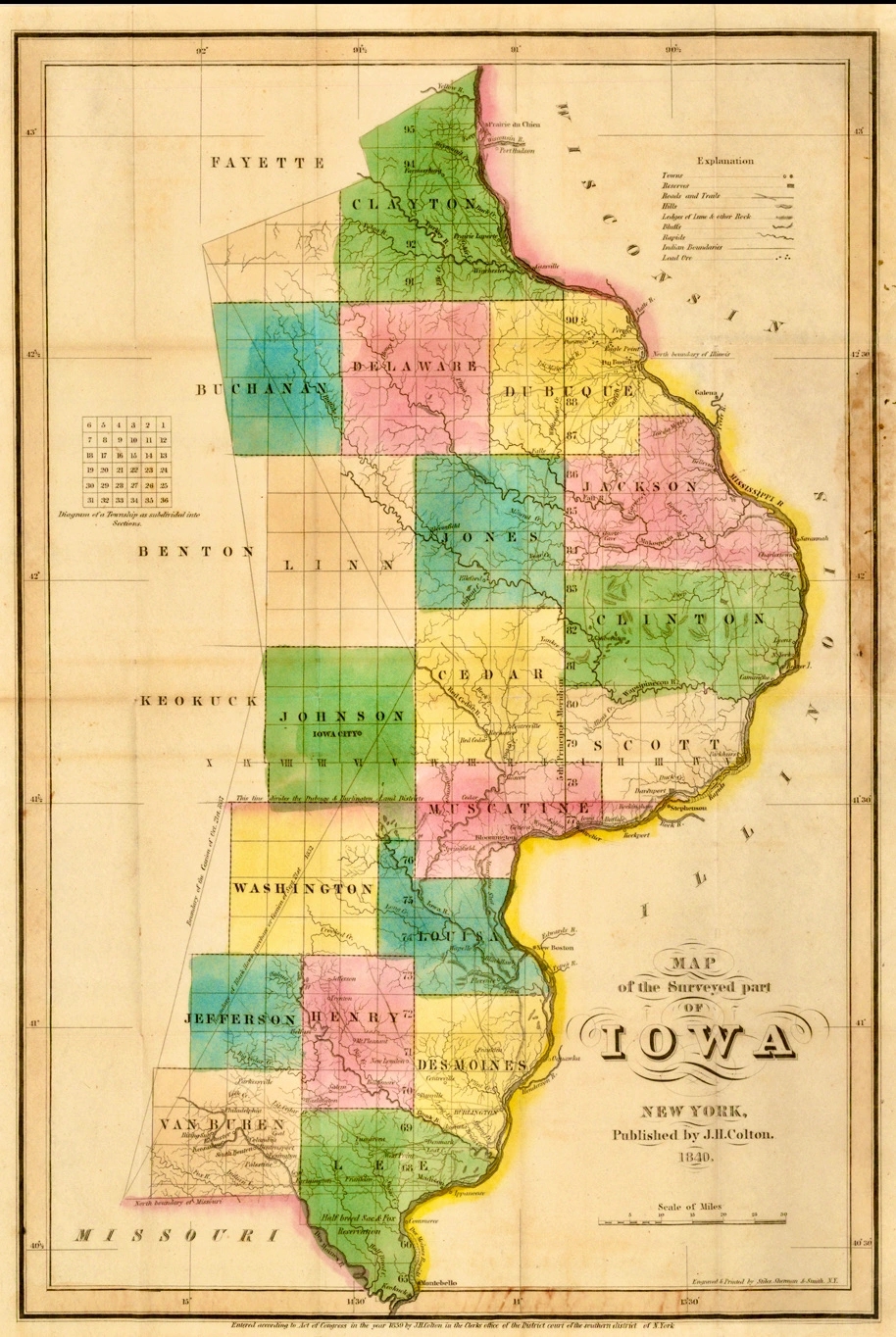
1840 Map of Iowa Territory. Photo Credit – Our Iowa Heritage

I was selected as a delegate to the Iowa Democratic Party state convention which convenes at 10 a.m. today. There weren’t enough volunteer delegates nominated at the county convention, so I threw my hat in the ring knowing I might not attend. By the time readers see this, I will have decided. I don’t believe a political convention is needed to fairly and effectively organize a political party. Our current habits go way back to before the state’s founding.

During the early 1830s, Iowa didn’t have much of a government. Decisions of consequence were made by businessmen such as George Davenport, Antoine LeClaire, and others. A concern for having clear title to sell lots in the fledgling city of Davenport was real, but not always a main concern for speculators. There was also the sticky issue that the Sac and Fox indigenous tribes believed they had not ceded land for early settlers. The resulting 1832 Black Hawk War settled the matter, as far as that goes, in Eastern Iowa and Southwestern Minnesota. When Davenport, LeClaire and others decided to invest in land speculation, as they did when in 1835 some of the initial platting of city blocks occurred in Davenport, there was little government to restrain them.

On July 9, 1840, in what was then called Bloomington (now Muscatine), Democrats held the first territorial convention in Iowa. Delegates from 16 counties adopted a “non-interference with slavery” platform. The convention elected Augustus C. Dodge as delegate to the national congress and approved a brief platform with multiple resolutions for Dodge to take with him to Washington. Read more about early Iowa political conventions in David C. Mott’s Annals of Iowa article titled “Iowa Political Conventions and Platforms.”

The Democratic Party’s first convention after Iowa achieved statehood on Dec. 28, 1846 was held April 24, 1884 in Burlington. Its purpose was to elect delegates to the national convention of 1884. Resolutions adopted at the convention include granting 160 acres to former Union soldiers in perpetuity, reducing taxes and tariffs, and eliminating laws that infringed on the freedom of Iowans. Delegates approved a state central committee of 13 members. In short, these are the sorts of things Democrats do at current state conventions. If all this sounds familiar, it’s because a lot hasn’t changed.

The most significant change that impacts party politics has been decentralization of information through the internet. We no longer need a group of “special” state delegates to represent our interests. What we do need is a way to be more inclusive in our politics, a way that enables us to participate directly if we so choose.

The Iowa precinct caucuses that chose presidential delegates to the state and national convention was an organizing method that engaged people in Democratic politics. More people attended caucus during presidential years, while in the background the same small group of people ran the party. This year, as part of my convention registration, I had to declare I was a Biden delegate. The meaning of that is much less than if I had joined my colleagues at the Biden table during the 2020 precinct caucuses.

With the demise of presidential preference caucuses, the Iowa Democratic Party must change how we operate. Party Chair Rita Hart is well aware of this and has stated as much in public. I am not hopeful the state party as represented by today’s delegates realizes this as well as Hart does. It seems to me, from emails I received in the run up to the convention, there are too many insiders protecting turf through seldom read resolutions and initiatives. Iowa Democrats, and I’m not talking about the small cadre of leadership, must stop tinkering around the edges of having a party, and devote more energy into electing Democrats where we can and across the board. If the state party doesn’t help us do that in tangible ways, we should ditch it.

I don’t believe the national party will let us do away with a state convention. That said, I’m not sure of the value of meaningless rituals like participating in the convention. Presidential preference used to hold our interest. It is likely a good thing that went away so we can focus more on local races. Whether we will is an open question.

Good luck to today’s delegates.

Categories
Living in Society

Migration From Newspapers To Other Media

This chart says a lot about the history of newspapers in the 21st Century. As the number of employees in the business declined by 75 percent, private equity extracted financial resources from these businesses through mergers and acquisitions, leaving a much diminished infrastructure to provide news and information. There are fewer daily newspapers in 2024 compared to 2000.

As newsroom employees are purged, and substacks, blogs, podcasts, and the like proliferate, we are left with fragmented news sourcing around specific reporters’ individual interests. There is a role for that, but obtaining reliable news about things that matter is increasing difficult, both from the news consumer’s perspective and from the newspaper perspective of doing more and more with fewer resources.

I am interested in the issue of blogs as news sources. Like it or not, Bleeding Heartland, Blog for Iowa, and Iowa Starting Line are no news substitute for the vacuum being created by private equity shedding newspaper employees and mining news assets. Iowa Starting Line is part of Courier Newsroom, funded by reader contributions, sponsors, and philanthropic and corporate underwriting, according to their website. Both Blog for Iowa and Bleeding Heartland have been privately funded, although that model is changing at Bleeding Heartland. Funding is addressed on the Bleeding Heartland website: “Readers can support independent journalism and help cover reporting costs, such as public records requests, by contributing here.” This type of funding provides freedom to do what editors think is best. While a lot of solid journalism is accomplished on blogs like these, they are not a replacement for news.

Some journalists found a way to make a living outside the world of newspapers. It is increasingly clear that with the rise of potentially profitable podcasts, substacks, YouTube channels, and the like, there is more money to be made in these new entities than in writing for a newspaper. There are important essays to read in this fragmented news media, yet our formal news environment is the worse for these one-off entrepreneurial enterprises.

While individual reporters venture into single-source, news-like publications, other things are filling the vacuum left by the demise of newspapers.

Political operatives are filling the news void with coordinated, partisan messaging. When Republicans like Kim Reynolds, Joni Ernst, Ashley Hinson, and Mariannette Miller-Meeks all refer to the New York trial of former president Trump as a “sham,” it is not by accident. They have the resources to develop consistent messaging to an increasingly poorly educated populace where they sow the seeds of their right-wingery. Furthering such messaging is important to Republicans maintaining a majority of elected offices in Iowa. The decline of newspapers created this opportunity for them.

At the same time, the rise in misinformation and disinformation in social media is rampant. First, social media is not a public forum as long as a user name and password is required to gain access. Second, a person can say almost anything, subject to after the fact censoring. Most importantly, troll farms can flood the social media space with posts aligned toward a specific perspective. Whether we like it or not, there is a propaganda war going on in social media, and I don’t mean cats are taking over the world. The degree to which Chinese and Russian troll farms work to infiltrate American social media is a substantial political issue.

For all the hobbles attached to news organizations in the current environment, subscribing to a major newspaper provides more value than harm. It is not enough. We must seek out news writers offering distinct, less biased messaging, and follow them where they are. I’m thinking of Heather Cox Richardson, but there are many others. By all means subscribe to a newspaper. Also take the next step to find writers whose work is valuable and follow them where they publish. This means some work we didn’t previously have to perform, yet the rewards will help us cope with a changing news media infrastructure.

Categories
Writing

Weekly Journal 2024-06-02

Turning over the 2024 tomato plot.

Garden work made me tired this week. It took multiple days to prepare and plant the tomato plot, and it is not finished. Other plots are prepared for specialty crops like fennel, okra, peppers, kale and the like, but I can’t get around to putting them in the ground. So it goes with a septuagenarian gardener. Things are slowing.

Election Interference Trial

The biggest news this week, upon which I will spend the least time, is the New York trial of former president Donald J. Trump. I tend to agree with actor Robert DeNiro, who said, “I don’t want to be talking, but I am so upset by it. I have to say something. This is my country. This guy wants to destroy it. Period. He’s crazy.” Read “Keep Hope Alive” for my longer take.

Writing

It seems clear once I finish the current read-through and editing, the next step for my autobiography is preparation to print it for private distribution. That means making about ten or twelve copies as a first run so I can call it done. Font type, page layout, line spacing, long quotation formatting, grammar and punctuation consistency, and more need to be addressed. I should have a professional read it and provide advice, yet I don’t have funds to do that presently. The goal is to have the finished book in front of me later this year.

Part two has more words than part one already, yet most of it is in very rough form. When I’m ready to start, the outline needs completely re-done. This would be followed by a serious write-through. Part of the reason I stalled on part two is the amount of background documentation is tremendous. Journals, notes, files, recordings, and more are stuffed in boxes waiting for me. That’s not to mention more than 5,000 blog posts. I don’t expect to turn every page, yet I must turn a lot of them. The main initiative to do a write-through will be during the hot days of summer and the coming fall and winter.

First things first. I need the first book in hand as soon as is practicable.

Israel-Hamas War

There has been devastating loss of life in Palestine. U.S. policy enables it. Here’s hoping the president addresses this in a meaningful way. He encouraged Hamas to accept the following proposal. Let’s hope all parties can soon agree to a way out of the violence.

“It’s time for this war to end, and the ‘day after’ to begin,” Biden said in remarks at the White House May 31.

Categories
Living in Society

Keep Hope Alive

Trail walking.

After a long shift working in the garden I took a nap. When I woke around 4 p.m., the jury in the New York trial of Donald J. Trump had returned a guilty verdict on each of the 34 charges for which he was indicted. There was no surprise here as I had been following the court action and believed the prosecution’s case was bulletproof, the defense was weak. Sentencing is set for July 11, just before the Republican National Convention. The defendant is expected to appeal.

I was not in a celebratory mood. I shaved, took a shower, and then sat down with my handheld device to check the news. Of course it was dominated by reactions to the verdict. Among the first things I saw was Governor Kim Reynolds’ statement about the verdict, which I quote in full:

America saw this trial for what it was, a sham. For years, Democrats like Alvin Bragg have been trying to put President Trump in jail with complete disregard for our democracy and the will of the American people. The only verdict that matters is the one at the ballot box in November where the American people will elect President Trump again. 

Statement by Kim Reynolds, Office of the Governor Press Release, 4:15 p.m., May 30, 2024.

Governor Reynolds appears to have forgotten the “will of the people” was that Joe Biden become president after the 2020 election. In Reynolds’ statement lies the seed for the destruction of Iowa Republicans as a dominant force in our politics. I don’t think they understand this or what they are doing. I’ve been around long enough to remember another president who was a crook.

In my autobiography, I wrote a chapter on the meaning of Richard Nixon’s resignation:

Richard Nixon announced his resignation from the presidency on Aug. 8, 1974. I had no idea who Gerald Ford was, or what kind of leader he would be. The next day he said, “My fellow Americans, our long national nightmare is over.”

I felt a strong sense of social responsibility and the moral outrage of youth in what I believed were the deception and lies of a man in whom the country had put its trust. Hearing Nixon’s address that night, in our small apartment, was catharsis. I remember this feeling as I typed here in Big Grove Township tonight. I was relieved that Nixon was leaving. More importantly, I felt that the many protests and demonstrations during the Vietnam war had finally borne fruit. Direct action to support a just cause could accomplish things, even force out a sitting president. It was a heady feeling.

Even with many experiences by the time I reached age 22, it was that moment of seeing Nixon resign on television that opened the possibilities of the world. I became aware that direct action, in concert with others I did not know, could engender change in society. I also learned that the people, places, and things we read about can be grounded in a reality that is not that distant from where we live. We are connected to each other in unlikely ways.

Unpublished autobiography by Paul Deaton

In the post Trump era, I no longer feel as optimistic about the future as my 22-year-old self did. I simply realize how much work remains to be done for justice to prevail for all Americans by ensuring Republicans continue in decline. I realize how little time is left to accomplish this. No matter how Republicans try to spin the guilty verdicts, their enabling of Trump has a down side that led us directly to this moment of hope.

If I celebrate the verdict at all, it is because the American rule of law continues to work. No person is above the law, despite ongoing attempts by conservatives to undermine it for political advantage. Trump’s guilty verdict was a victory for the rule of law and that is worth celebrating. If the rule of law does not prevail, there will be no democracy in America.

As the Reverend Jesse Jackson said, “At the end of the day, we must go forward with hope and not backward with fear and division.” He also said, “Keep hope alive.” Words to live by as Trump has his day in court.

Categories
Living in Society

Morning Miscellany

Puddle on the trail on May 26, 2011.

Lately I forgot to take photos while out trail walking. I carry my mobile device with me. Maybe I’m distracted. Maybe the sight of Canadian Geese sunning themselves on a jetty is too commonplace. I did, however, have pleasant walks on the trail before rain started again on Friday. I used an old photo on this post and it serves.

Senate Republicans rejected the strongest, most comprehensive bipartisan border bill we’ve seen in decades. They do not want to solve problems at the Southern border. Period.

The New York Times has been reporting Trump edging Biden in polls for about eight months. Here’s the rub. They have a squishy way of saying who they polled. First it is registered voters, and then it is voters who cast a ballot in the 2020 general election — two very different parts of the electorate. As Nate Cohen reported for the Times, “President Biden has actually led the last three New York Times/Siena national polls among those who voted in the 2020 election, even as he has trailed among registered voters overall. And looking back over the last few years, almost all of Trump’s gains came from these less engaged voters.” An unbiased news outlet would put all this information out in front. The Times buries it and therefore, their reporting is not trustworthy.

Yesterday the U.S. Supreme Court published a decision in Alexander vs. South Carolina Conference of the NAACP, about political gerrymandering. The headline in the Cedar Rapids Gazette read, “Justices find no racial gerrymandering in S.C.” It is political gerrymandering, the high court said, and that is apparently okay because drawing districts is a political process. If you believe that, stand on your head. The majority opinion was written by George W. Bush appointee Samuel Alito who has been in the news this week for his flag-displaying propensities.

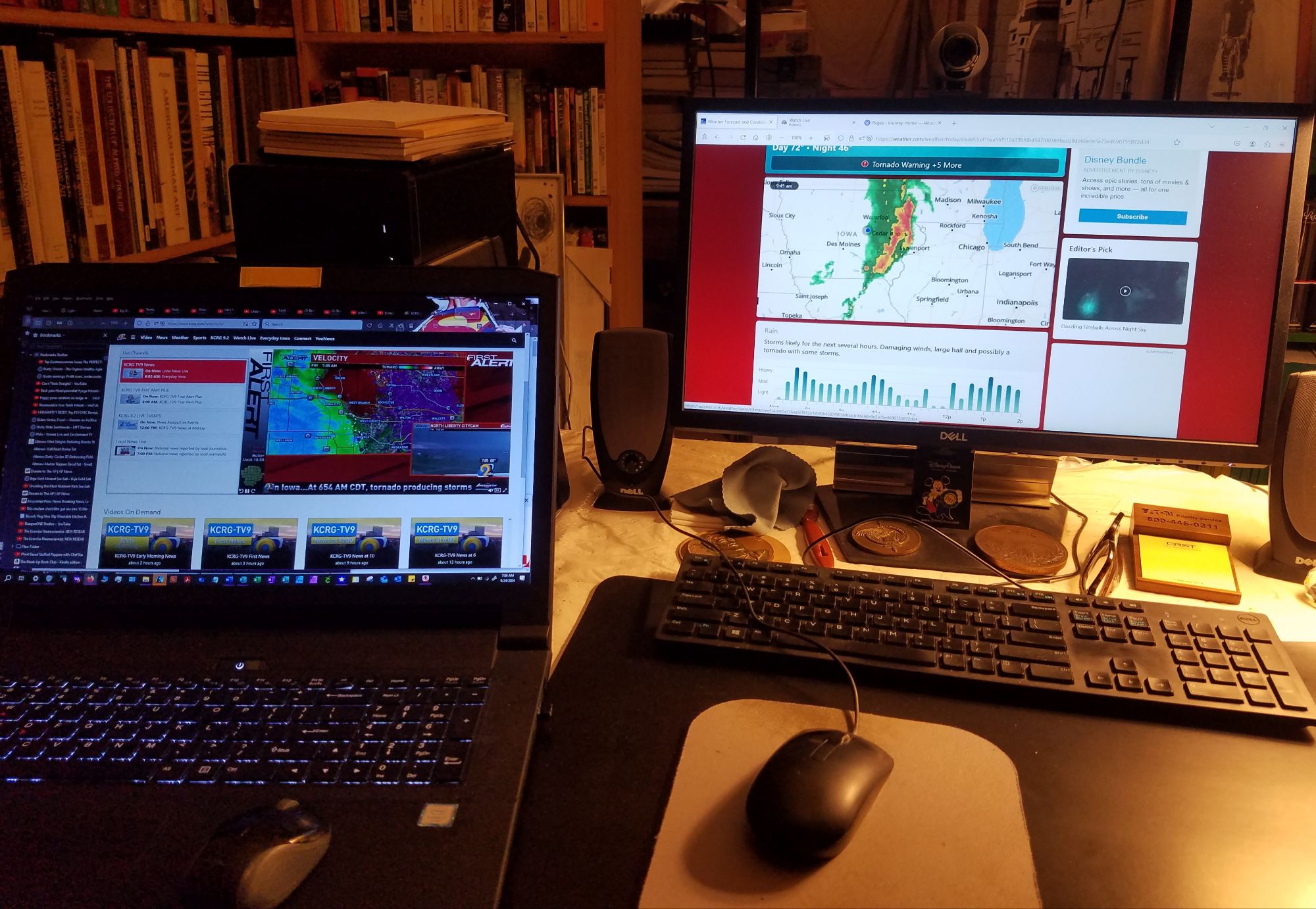
We woke early this morning to the sounds of local sirens warning about a tornado watch. We followed our standard procedure of gathering electronic communications devices downstairs and monitoring the process of the storms. At one point we had a desktop, two laptops and two phones in action. It’s how we Iowans do when it comes to severe weather.

In Iowa when the local severe weather sirens go off, we gather on the lower level with all the electronic communications devices. Friday, May 24, 2024.

Categories
Environment

To EV or Not to EV

Photo by Mike Bird on Pexels.com

Moving the automotive economy toward electric vehicles is a good thing for multiple reasons. An important benefit is to decrease reliance on burning stuff in an internal combustion engine. In the late 19th Century, Rudolph Diesel invented an engine that could burn almost any liquid fuel, including whale oil, tallow, paraffin oil, naphtha, shale oil, and peanut oil. Despite the initial available diversity, the economy followed a track to perfect the gasoline engine and use it for transportation. To a large extent, that’s where we are now, with Diesel’s namesake fuel relegated to trains, buses, heavy trucks, boats, and power generators.

In 2022, we needed a new car and could not confirm a delivery date on available electric vehicle models. They were in high demand and manufacturing could not keep up. We ended up with a three year old used car that got 38 miles per gallon of gasoline. In addition to supply falling short of demand, there are other problems with electric vehicles.

Electric vehicles reduce emissions and are often much kinder to our planet than gasoline and diesel alternatives. Those are positive attributes. The world is not ready for EVs and people experience barriers to using them in the form of charging station infrastructure, insurance, and affordability, in addition to the ability to timely buy one. The federal government has begun to create an environment for the advancement of EVs and Republicans are fighting it tooth and nail.

The latest conflict between doing what’s right for a majority of U.S. citizens, and Republican support for the fossil fuel industry, occurred after March 20, when the U.S. Environmental Protection Agency released a new tailpipe rule on vehicle emissions. “Joe Biden has launched a relentless onslaught of regulations infringing on American consumer freedom,” Congresswoman Mariannette Miller-Meeks wrote in her weekly newsletter. She decried that the administration’s “heavy-handed mandate forces American automakers to prioritize electric vehicle (EV) production and sales.” Well, yeah. That’s the point, along with preserving a livable world. The member of congress failed to mention all the positive things the president is doing to make EVs affordable for consumers.

The decision to EV or not to EV is not the choice of a single consumer. As individuals we have rights, yet the government must not leave the choice of whether we have a livable world in the hands of personal choice. To move the ball where it is needed regarding EVs, the government can and should be involved in nudging industry and consumers to move toward them. Under Biden, government accepted this role. The scale at which the administration proposes to increase EVs as a percentage of the global fleet is staggering. It is also what is needed to address the climate crisis.

My choice would be to use public transportation for every thing. As long as I have to drive because I live in the country, I expect to eventually convert to an EV and learn to love it. We must support the administration as we can, perfect what is flawed about their approach, and never lose sight of the big picture of slowing the greenhouse effect so we can maintain a livable world. In our current political situation, that means electing Democrats.

Categories
Living in Society

Stymied on Immigration

Grain Silos

Like clockwork, the American Civil Liberties Union, along with other groups and individuals, sued in federal court over Senate File 2340, one of the worst, most far-reaching immigration laws ever passed in the state of Iowa. They said the law is unconstitutional. It is common sense the state has no primary role in policing immigration. I expect the ACLU will prevail and the governor has to know it.

Maybe if the Iowa delegation to The U.S. Congress had done their job on immigration this year, things would be different. Instead we have this crappy law and civil rights groups are not going to let it stand.

While states can pass legislation to deal with federal immigration concerns, if the U.S. Supreme Court has a shred of honesty in jurisprudence left, they will reject these state laws when they trickle up to the high court.

I made the post below, called “Rain and Immigration Reform,” on Jan. 29, 2013. It shows in eleven years the country has gotten exactly nowhere on immigration reform.

LAKE MACBRIDE— The sound of rain tapping against the bedroom window woke me this morning. At 4:30 a.m. it was 55 degrees. This broke the record high temperature of 53 degrees set in 1919. According to weather.com, today’s forecast is to hit a high of 60 degrees around 11 a.m. this morning, then temperatures start to fall to below freezing in the next 24 hours. Today is more temperate than the heat last summer, however, it is a variation on a theme of being freaked out because of our changing climate and dealing with adaptation.

Equally freaky was yesterday’s public statement by a bipartisan group of eight U.S. senators in an effort to find common ground on how the country should move forward on immigration reform.  They said in a written statement,

We recognize that our immigration system is broken. And while border security has improved significantly over the last two Administrations, we still don’t have a functioning immigration system. This has created a situation where up to 11 million undocumented immigrants are living in the shadows. Our legislation acknowledges these realities by finally committing the resources needed to secure the border, modernize and streamline our current legal immigration system, while creating a tough but fair legalization program for individuals who are currently here. We will ensure that this is a successful permanent reform to our immigration system that will not need to be revisited.

I have written a lot about immigration reform. Dealing with the 11 million undocumented people who live in the United States, many of whom have been here for decades, is a long standing problem and political lightning rod. That the senate’s bipartisan framework calls for a path to citizenship for these long-term residents, and an effective employment verification system, gets to core problems. Particularly, recent history has shown that if there is available employment in the U.S., undocumented people will come to fill those jobs. If the path to getting a job is restricted by better verification of applicant status, the number of people crossing our borders will be reduced.

Presidents George W. Bush and Barack Obama have attempted to reform immigration, but met resistance. What has changed?

The demographics of the 2012 electorate are now known and President Obama won 70 percent of the so-called Hispanic vote. Hispanics accounted for 10 percent of the votes cast for president. It is a political reality that Republicans cannot walk away from this large and growing segment of the population if they want to remain relevant. Immigration reform is a key issue for Hispanic voters.

Senator John McCain was featured in corporate media sound-bites, reading these three sentences from a press statement yesterday,

What is going on now is not acceptable. In reality, what has been created is a defacto amnesty. We, the American people, have been too content for too long to allow individuals to mow our lawn, serve us food, clean our homes and even watch our children while not affording them any of the benefits that make our country so great.

If the political component of immigration reform was the focus yesterday, there is another issue, related to agriculture. Undocumented immigrants and legal guest workers provide low-cost agricultural labor that natives seem reluctant to offer. In his Jan. 5, 1967 inaugural address as governor of California, Ronald Reagan set the theme on immigration that would follow him through to his presidency, “restrictive labor policies should never again be the cause of crops rotting in the fields for lack of harvesters.” Reagan advocated for and signed into law the Immigration Reform and Control Act of 1986, which was intended to permanently address immigration reform.

Any immigration reform faces an uphill battle in the Congress. That’s why nothing has been done since 1986. That states like Iowa are taking matters into their own hands is laughable. It is also am injustice to immigrants who have been here for years. It is cynical political posturing by which Republicans hope to cement their power in government. Will the problem continue unaddressed for ten more years? Something has to give and the states cannot be the driving force in immigration reform.

Categories
Writing

Weekly Journal 2024-05-05

Lilacs planted shortly after moving to Big Grove Township in 1993.

The week began with delays getting into the garden. Life’s exigencies required attention and garden work was pushed back. There was also rain. There is time before last frost, but not much of it.

Dental Care

Tuesday began with a dental appointment. My dentist sold his practice to a large dentistry operation in 2017. I don’t like outlasting medical practitioners yet as a septuagenarian it happens more than I want. The new group, a large company based in Waterloo, seldom treats me with the same practitioner whether it be hygienist or dentist. Each appointment offers a different vibe and I don’t like it. I mean, I’m used to dentists practicing on their own or with a partner or two and not a constantly revolving carousel of practitioners. I don’t know their business model, yet I suspect the pay is low and the assembly line style of operations yields a lower cost for the owners. It is not patient-centered care.

Trip to Des Moines

It rained on Thursday, making it a good day to take my spouse to see her sister. The rain let up west of Williamsburg and water was standing in Iowa’s neatly rectangular planting areas. Looks like farmers had been in the fields and maybe planted some corn. As we progressed into Des Moines, the state capitol construction scaffolding had been removed from the smaller domes. It was an uneventful trip. The longer I drive, the more I like that.

District Convention

The First District Democratic candidate for Congress was not present at Saturday’s district convention in North Liberty. Iowa political districts are designed around the congressional seat and I have an old-school expectation of hearing from the candidate in person, and getting a chance for a brief side-conversation. I have become a dinosaur. It was not to be.

Absent the candidate, I’m not sure what, besides necessary elections to the state and national conventions, we accomplished. The morning was consumed by a presentation from a third party grassroots group, and an explanation about why we would be using ranked choice voting for the elections. We would likely have saved time if we had skipped these presentations and gone directly to voting.

The third party person gave a presentation that divided campaign work into three buckets: Grassroots groups who would do much of the work around getting voters to the polls, county parties responsible for centralized communication, fund raising, and party organization, and candidate campaigns, which work mostly on their own to secure votes needed to be elected. This division is both useful and problematic.

Do people need something to do in a political campaign? Beyond making sure one is registered to vote and casting a ballot, one can get involved with campaign work, if interested. When Iowa lost first in the nation status after the computer application debacle in reporting results to national media in 2020, we also lost funding from the candidates who spent heavily in the early states to garner attention for their campaigns. Likewise, because Iowa Democrats are in a significant minority, expenditures from the president’s national campaign are not expected. There is work to be done, yet it isn’t clear how such work should be described and assigned to mostly volunteers.

Endemic to the current party structure is a misdiagnosis of key issues to a campaign. More than anything else, politics has gotten local. In Big Grove Precinct, the electorate is divided. During the 2020 presidential election, Donald Trump won over Joe Biden 671 votes to 637. In 2016, Trump beat Hillary Clinton 575 votes to 529. Barack Obama won here in both 2008 and 2012. My precinct has a divided electorate and has recently been won by both Democrats and Republicans. While new people moving to our area lean Republican, the key issue is how does an organizer build a Democrat majority at the polls, recruiting votes regardless of party?

A speaker at the convention looked around the room and suggested the dominance of white-skinned, grey-haired delegates is the problem with the party. Whatever. Had rain not been forecast during the convention hours, I would rather have been working in our yard. The trouble, as I experienced recruiting a replacement for my position on the county central committee, is literally no one is willing to do the work to provide steady volunteer work for local Democrats. That’s a much different problem than skin tone and hair color among people willing to show up on a spring Saturday.

My problem at the end of this week was it was May 5 and so much work remained to get the garden planted. We may have had the last frost and I simply don’t realize it. I am determined not to be distracted during the upcoming week.

Categories
Living in Society

Middle East Protests

Photo by Hurrah suhail on Pexels.com

War has always been devastating yet the devastation of the Israel-Hamas war is unprecedented. What makes this war different is it is occurring in the ever-present media-influenced eyes of a populace unfamiliar with the long relationship between Israel and Palestine. People young and old are being activated by this public war: donating money to relief funds, protesting, and more. There are a lot of moving parts.

That said, I don’t know what else to say, other than there should be an immediate, permanent ceasefire; humanitarian aid should have unfettered access to the Palestinians; and both sides should release any hostages or unlawful detainees. At yesterday’s Democratic district convention, we passed a resolution saying those things.

Some friends with family ties in Palestine were present at the convention. One spoke during debate over the resolution. He pointed out the plight of children in the war zone. What heartless fool could not be affected by this?

I read about the use of artificial intelligence in generating military targets. Computers find targets, which may or may not be reviewed by a human before striking. What algorithms often find is the best place to target someone is in the evening when they are at home. Often the whole family is present when the bombs hit.

On-campus protests have drawn an undue amount of attention. The varying responses by school administrations and law enforcement has been both appalling and comforting. The temptation is to compare it with my own campus protests over the Vietnam War in 1970-1973. That is the wrong impulse. Things have changed on campus in more than 50 years.

Another temptation is to blame the U.S. administration for the war. President Joe Biden is an easy scapegoat. While exerting public pressure for him to change tactics is acceptable in a democracy, it is of itself, no solution. When it comes to the Mideast, there will unlikely be consensus in an approach to peace-making.

It feels hopeless some days. I contribute to relief funds as I can, write my congressional representatives, and pray for resolution. There is no assurance there will be a resolution in the Mideast, and that’s part of the problem.

Categories
Living in Society

Politics Beyond the Expected

Apple blossoms.

Absent live performances during the coronavirus pandemic, the comedy troupe The Capitol Steps, whose periodic radio shows were called “politics takes a holiday,” turned off the lights and folded. It turned out they could not survive without live performances, and as many believed, no one wanted to attend a live performance if one of the side effects was infection with the coronavirus. We learned politics never takes a holiday during a pandemic as Republicans dominated the elections in Iowa.

On Wednesday, I participated in a video conference with about 35 others with former Congressman Dave Loebsack asking First Congressional District Democratic candidate Christina Bohannan a series of softball questions. It was an okay hour, yet we’ve heard almost everything Bohannan said before. Democrats need new ideas, new approaches. Considering the alternative, I’ll support Bohannan with my time and financial resources.

Like with the now defunct Capitol Steps, live performance is everything in politics. A candidate cannot win elections without in person live events. What does that mean?

A county supervisor candidate sent an email this week, asking for help. Specifically, they asked for help doing things related to voters: door knocking, making phone calls, and placing yard signs. They also asked for a financial contribution. The primary election is four weeks away, so their needs are pressing. I’m supporting other candidates for supervisor, so the request fell on deaf ears.

Just before Bohannan’s event I received a text message from the Democratic National Committee asking me to participate in video conference training on how to be more active in the national campaign. If all politics is local, why would I work under direction from the national party? I wouldn’t.

Another contact that day was a telephone call from a local county party organizer. They have a short regimen of door knocking work to reach out to voters and see where they are. To me, door knocking is about one thing: identifying which voters will support a given candidate, then getting them to cast a ballot. I declined the opportunity to take a shift.

All of this is expected, and as you can see I rejected it out of hand. In the meanwhile, incumbent Republicans shape how the general election will proceed. Since they are in power, they have a strong platform to frame the debate. They are framing it. It will be difficult to avoid becoming enmeshed in their verbal construct.

I accepted an invitation to help our state house candidate organize for the election. About a dozen of us were invited. He has no primary competition so we can focus on the general election. He’s new to politics so we can begin with a fresh slate and build upon our core competencies. I’m looking forward to the possibilities of such a campaign.

Our state senate candidate is also new to politics. He is the chief financial officer of the Mount Pleasant school district, and hasn’t run a campaign before. As he organizes, there will be possibilities to get involved with what I hope is a unique and vibrant campaign full of new energy.

Saturday is the district convention, precursor to the state and national conventions. I’m a delegate and will use the time to explore possibilities for organizing with other attendees. Since there is only one statewide candidate this cycle, 2024 will be a cycle of local politics, focused on my state house representation. Hopefully those campaigns will roll out in an unexpected way.