Categories
Home Life

Retreat Into Memory of Trees

Sugar Cookies
Sugar Cookies

Anthony Sells built the first sawmill in Big Grove Township in 1839. There were a lot of nearby trees, hence the name. Things changed.

Farm fields, and eventually subdivisions, replaced the Oak-Hickory forest. Except for the state park and a few scattered parcels, the change has been decisive and permanent.

Memory of trees persists as a place to retreat during the end of year holidays.

Like during much of our lives, food is a holiday consideration — special menus using favorite recipes. We secured fresh cranberries, oranges, Gold Rush apples, sweet potatoes, broccoli, cookie ingredients, apple cider, and a frozen cherry pie from the orchard for the season. Yesterday’s purchases included dark roasted Sumatran coffee (Arabica beans), 64 fluid ounces of half and half for ice cream, special crackers and cream cheese. Planned recipes include cranberry sauce, shortbread cookies, apple crisp, and wild rice. It’s a lot of food for a special meal tomorrow. We’ll eat leftovers for days.

There is more to life than food.

That’s where the camera fades to black and a window into my life is obscured.

The idea of old trees now gone provides solace. Outside living memory, there is no going back to the time before Sells’ sawmill. For most who live here, it is already forgotten.

On this ground we make our own history. Because it lives today, it dominates our outlook and activities. The recipe is not specific and we challenge today what we did yesterday in hope of a better tomorrow.

There is something about the trees. Some linger as Sells’ lumber in structures in the nearby town. What matter more is the idea here was once a different ecosystem. One has to ask, “will what we replaced it with be sustainable?”

I’m working to make it so and so should we all.

Categories
Home Life Kitchen Garden

Cleaning House, Making Soup

Harvest Soup
Harvest Soup

Holiday tradition in our house includes cleaning and decorating beginning mid-December.

Dec. 18 is our wedding anniversary. This year we plan to celebrate 34 years of marriage with a meal at a local restaurant.

Our wedding anniversary is also when the Christmas tree goes up with decorating to be finished by Christmas Eve.

As we cleaned, I made soup using bits and pieces of leftover vegetables and pantry items. It was thick and savory — the way soup is supposed to taste.

The process for soup-making is simple.

Turn the heat to medium high and place a Dutch oven on the burner.

Drain the juice from a pint of canned, diced tomatoes into the Dutch oven and bring to a boil.

Add a generous amount of diced onions (2 cups or more), three or four peeled and sliced carrots, two stalks of sliced celery, and three bay leaves. Salt generously and steam-saute until the vegetables begin to soften.

Add the diced tomatoes.

Next steps depend upon what is on hand.

For this batch I put a quart of turnip broth from the pantry in the blender and added cooked Brussels sprout leaves, and fresh Swiss chard and kale, all from the ice box. I blended thoroughly and added the mixture to the Dutch oven.

Next was a can each of prepared black beans and whole corn from the grocery store.

I found an old box of marjoram in the spice rack and added what was left — about a tablespoon. They don’t sell marjoram loosely packed in boxes any more so it must have been 20 years old or more.

Peeled and diced three red potatoes from the counter and added them to the Dutch oven. I also added the thinly sliced the stalks of kale and Swiss chard.

From the pantry I took a cup of lentils, and a quarter cup each of quinoa and pearled barley and added them.

I submerged the vegetables in filtered water from the ice box.

The rest of the process was to bring to a boil, turn the heat down to a simmer, and cook until it is soup — adjusting seasonings until it tastes good, and making sure the vegetables are covered in liquid.

The effort produced enough for a meal with a gallon stored in the ice box in quart Mason jars. We’ll be eating on that until Christmas day.

Categories
Kitchen Garden

Thanksgiving Menu Planning

Vegetarian Thanksgiving 2013

“What do vegetarians have for Thanksgiving dinner?” a colleague at the home, farm and auto supply store asked this week.

The unspoken assertion was it is difficult to imagine Thanksgiving without turkey as the main course.

He noted, being positive, we could still have pumpkin pie for dessert.

We could, but won’t this year.

Our kitchen has been vegetarian since we married. A vegetarian kitchen doesn’t mean we both do without meat. I occasionally consume a meat dish while visiting with friends or at political events.

In 34 years we’ve never stopped at the butcher nor bought anything from the grocery store meat counter. Not even the popular rotisserie chicken has entered our doorway, nor the even more popular pepperoni pizza. By design we eschew meat products at home and haven’t suffered nutritionally.

That’s not to say I don’t know how to cook a chicken. During a stay at our daughter’s apartment in Colorado, I raided her ice box and cooked soup from a rotisserie chicken carcass and roasted chicken breasts with rice and a vegetable for a dinner as the sun set over Pike’s Peak.

My maternal grandmother worked as a cook both as a live-in maid and in the rectory of the Catholic Church where I was baptized. In her later years, she showed me how to bone a chicken. Without practice, it seems doubtful I could do it again without help.

What will Thanksgiving 2016 look like in Big Grove?

This year the CSA where I work offered a vegetable box for $30. That, along with items already around the house, will be the centerpiece for menu planning. Cost wise, that will be our only expense as everything else is on hand. This year’s estimate of the cost of Thanksgiving dinner is $49.87 for ten people, according to the American Farm Bureau Federation, so we will be eating well, but for much less.

If we use all of the menu ideas we came up with it will take us five hours to cook the meal and five hours to eat it. Like anyone with an abundant table, we’ll have plenty of leftovers.

The menu is not final, however, here’s what it looks like the day before the holiday:

Beverages: Wilson’s Orchard apple cider, Martinelli’s Sparkling Cider, Belgian beer, filtered water and coffee.

Appetizers: Baked pumpkin seeds, Crudites (cauliflower, broccoli, carrots), pickled vegetable plate (sweet and sour pickled cucumbers, pickled daikon radish, pickled red onions, pickled jalapeno peppers).

Salad course: Lettuce salad with fresh vegetables, purple cabbage coleslaw.

Bread: Sage-cheddar biscuits.

Main course: Frittata with organic eggs, braising greens, onions, garlic and thyme.

Side dishes: Steamed broccoli, rice pilaf with collard and Swiss chard, Roasted Brussels sprouts, Roasted vegetables (potatoes, carrots, onions, bell peppers), and Butternut squash  sweet potatoes.

Dessert: Apple crisp.

No matter how dark the night, there is plenty to be thankful for this year.

Let it begin with a Happy Thanksgiving.

After Action Report Nov. 26, 2016: The actual menu varied a little from the plan and I’ve annotated the changes by crossing off dishes not prepared and added those not listed in italics. I made the red cabbage coleslaw but forgot to serve it.

Categories
Kitchen Garden

Garden Plot Six 2016

First Tomatoes Ripening

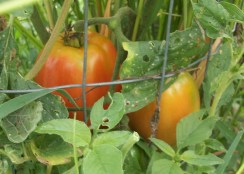
Garden plot six was five varieties of tomatoes — Italian, Amish Paste, Beefsteak, Rose and Kanner Hoell.

It was an abundant crop — about 200 pounds harvested — but most of the crop went bad on the vine due to an inability to spend time harvesting.

The culprit was a busy work schedule that included four jobs during the prime tomato month of August.

Heavy rain produced large sized fruit. When rain was imminent I hurried to harvest — preventing tomatoes from bursting. I didn’t always make it in time.

Lesson learned and applied this year was to give the plants space between them to breathe. So too it is with us. We need freedom from being cloistered to thrive.

Plans for this commodity plot are up in the air until I take a pencil to the 2017 garden plan. Wherever I plant tomatoes, I will give them even more room between plants. In 2016 this paid dividends that made up for my lack of care.

Categories
Kitchen Garden

Garden Plot Five 2016

Cherry Tomatoes from Garden Plot Five

The ambient temperature dropped to 20 degrees last night — a hard frost.

This morning, while raking the remainders of grass clippings in the yard, I found Swiss chard growing in garden plot five.

Chard will be a centerpiece for tonight’s dinner, most likely in a casserole with rice, onions, chopped chard, garlic, eggs, oregano and Parmesan cheese.

While poorly planned — a place for odds and ends of cherry tomatoes, eggplant, cauliflower, hot peppers and a failed section of bell peppers — it produced early with cherry tomatoes and late with aforementioned chard. I pledge to make a better plan next year.

The section of bell peppers took up more than a third of the space. The seedlings went in fine, with protection from ground threats in the form of six-inch sections of four-inch drainage tile, and mulch. Because of working four jobs in August, it got away from me, producing not a single fruit. I can’t recall a year when my bell peppers have done well. Weeding and watering are two important aspects of growing peppers and I didn’t do either one well. But what do I know? A farmer friend gave us adequate seconds from her farm so we are okay with bell peppers for winter.

Four cherry tomato plants is enough for our household. The four different kinds produced before the main tomato crop and were great in salads until the slicers matured and ripened. The cherries were positioned at the edge of the plot for easy picking from the center path.

The eggplant and cauliflower seedlings were gifts stuck in empty rows. Fairy Tale eggplant is great because of its size and length of time producing. Four plants produced more than we could use. I’ve added Fairy Tale eggplant seeds to my December order and will put them in the indoor planting schedule.

Now that frost has come it will be easier to clear the plot. The plan is to clear it and make a burn pile. It was very windy today, so I’ll save these tasks for another day in this unseasonably warm autumn.

Categories
Writing

Bob Darby’s Seedling

Bob Darby's Seedling
Bob Darby’s Seedling

On the last shift of the season I walked in the test orchard picking apples.

20 minutes of bliss.

Beginning with a tree the orchard’s namesake planted in the 1980s, I picked a few there then added Connell Red, Regent and Sheepnose to my bag — about six pounds.

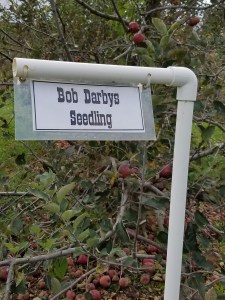
Bob Darby’s Seedling did not make the cut when the orchard expanded.  A lone tree sits at the head of the test grove — a reminder of the founder who collected saplings from friends and neighbors to graft to his own root stock as he increased the variety of apples to more than 120.

After cutting and tasting, the whole lot of fruit will be sauced in our kitchen.

Wilson's Orchard Oct. 30, 2016
Wilson’s Orchard Oct. 30, 2016

And so it is with this and many of the jobs I’ve worked after my career in transportation. It comes down to a beautiful fall day, enjoying the last harvest of this season, and hoping there will be another year.

On my way out of the sales barn the current orchard owner was repairing an extension cord. We live in the same political precinct so local politics was our first topic. Soon we began talking about our customers – how the long, lazy, end of season weekend produced more than its share of long conversations about apples and what people plan to do with them.

I helped a couple from western Virginia near where my father came up find fruit for apple butter. He moved to Iowa to find work when what he described as “Obama’s war on coal” took away his job in the mines. They bought a bushel. We had three separate conversations about coal country, apples, apple butter and getting by. Making apple butter is a family tradition not to be interrupted by the move north.

There were a dozen conversations like this one, each with people of different backgrounds and expectations about apples and local culture. Some found apples in the orchard and those who didn’t bought them from the cooler. I savored each conversation as it happened.

I asked my boss to work next season and he said, “absolutely.”

As long as I breathe air and need paid work to sustain our lives, that’s the plan. Hopefully Bob Darby’s Seedling will survive another year.

Categories
Kitchen Garden

Garden Plot Three 2016

Field Tile Protecting Celery Plants

What is a kitchen garden? Garden plot three.

More than others, vegetables grown here made it to our kitchen and were used. Herbs, onions, celery, broccoli and green beans are always expected from a Midwestern garden. This year plot three delivered.

The story was of technique.

The plot is shaded by the locust tree each morning with full sun after noon. Almost everything planted here thrived. This year’s production included perennial chives and oregano, spring onions, basil, celery, broccoli and green beans.

I used drainage tile to protect young celery seedlings and it worked. Celery plants grew tall inside the 12-inch by 4-inch tile segments, producing enough for the kitchen with extra to give to library workers. There is nothing like home-grown celery.

The success of this year’s broccoli is attributable to protecting the seedlings as they grew. I put one old tomato cage around each seedling and wrapped chicken wire around the cage. As the plants grew, I removed the cages and put a 4-foot fence around the broccoli — tall enough to prevent top-nibbling by deer and close enough together to prevent them from jumping inside the fence. It all worked, producing the best broccoli crop I’ve had.

More than 100 onion sets produced spring onions well into summer. I tried seeding basil, but it didn’t take. Basil seedlings started indoors produced better results with plenty to make pesto.

What made this plot a kitchen garden was the production of aromatics — herbs, onions and celery particularly. In season I used them in everything.

Plans for next year: Split the chive and oregano plants; more basil; cherry tomatoes where the beans were; eggplant and hot peppers; and peas.

Categories
Kitchen Garden

Garden Plot Two 2016

Frost Under the Locust Tree

Garden plot two was productive this year.

Nothing but prairie grasses was on this, or any of the garden plots when we moved here in 1993. Shortly after we dug plot two, I planted mail order trees about 12-inches tall to grow them for transplanting. Due to neglect, the locust trees grew and grew and became a 40-foot giants. One of them blew over in a 2013 extreme storm that passed through. I cut it up and sold it for firewood. The remaining locust tree provides shade for the three northern plots, and adds value to the backyard landscape.

Hosting the two compost piles, the locust tree, and a bed of day lilies, plot two is challenging because of the tree root structure. Pieces of roots as big a two inches in diameter had to be removed for planting. The tree suffered no apparent ill effects after cutting some of the roots.

Radishes and turnips were the first crop, followed by onions. All produced well. After the root vegetables finished, I installed four four-foot tall meshed wire containers to grow cucumbers — pickling and slicers. They produced well. High winds blew one tower over, pulling the roots from the ground and killing some plants. Lesson learned from this experiment is to spread the cages out more and better stake them. After 2016 there is no question cucumbers grow better in the air than on the ground.

Kennebec and Yukon Gold potatoes were planted in big plastic tubs as an experiment. I got the tubs from a friend who gets them with her animal feed. The technique served the purpose of keeping rodents from eating the mature vegetables before I did. Production was okay, although we don’t eat a lot of potatoes in our kitchen. It was enough. I’m not sure the soil composition in the containers was the best. It was mostly compost with some dirt spaded in. Harvest was easy once I turned the weighty tubs over and picked through the dirt for the potatoes. There was no fork or shovel damage to the crop because of the technique.

Burying four more containers about 12 inches in the ground, I planted four types of carrots. The purple ones were a disappointment, but the others produced enough to justify another year. I made a second planting of daikon radishes which produced enough for eating fresh and pickling.

Plans for next year: think and plan more about this plot; move the compost bins to different locations; dig up and move the day lilies to a more decorative place in the yard; plant Belgian lettuce and other early greens; re-mix the soil in the containers and move them along the southern border of the plot for potatoes and carrots; plant radishes and turnips again, adding beets; a second planting is in order after the greens and root vegetables: more thought needed on that. These ideas may change as I give the plot additional consideration.

Categories
Kitchen Garden

Garden Plot One 2016

Bur Oak Acorns
Bur Oak Acorns

It’s time to write about this year’s garden — plot by plot.

Dedicated gardeners reflect on the past year and I am mostly serious about gardening.

As the garden has grown, so has my knowledge of how to care for the soil and grow crops. Evaluation of the year just past is part of learning.

Plot one was the first dug during spring 1994.

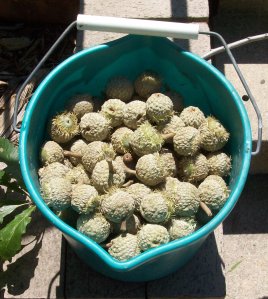
It is dominated by three Burr Oak trees planted from acorns collected the year our daughter graduated from high school. One tree for each of us. It is adjacent to a row of lilac bushes plants in 1994.  As drought conditions often plague Iowa, accompanied by scorching heat, it is better to plant some vegetables in a partly shady area. Shade creates a longer growing season for lettuce and reduces the amount of watering needed. The three oaks and lilacs are staying for now, although eventually may be thinned.

On the north side of the plot are some spring flower bulbs transplanted from the Indiana trucking terminal where I worked. They grew in the ditch near Highway 41 and were likely planted by a previous owner. They bloom faithfully each year and need to be dug and separated.

Next to the flowers is what used to be a row of iris. They are dying and what’s left needs to be dug and separated. Only an occasional flower now appears.

The rest of the plot was planted in garlic rescued from the town library. It eventually spread to cover the entire plot. A few years ago I placed tarps over the middle of the garlic patch to store stakes, cages and fencing. Each spring garlic pops up around the tarp perimeter. I harvest it for spring garlic, otherwise let it grow wild.

This year I pulled up one of the tarps and planted Turk’s Turban and Acorn squash. Both produced and some wait on the counter to be used.

This is the first year I tried an annual crop in plot one, and based on the results, I might try more. The near continuous shade makes crop selection the essential dynamic. While we enjoy the spring garlic, we should convert production to a regular, annual cycle of planting and harvesting garlic cloves. It is not too late this year, but with continuous daily work outside home until November, it is doubtful I’ll get a crop in.

Plans for next year: dig up the bulbs, separate and move to a more decorative spot in the yard; try an early spring crop like turnips, beets or radishes; till the entire plot after spring crop, evaluate, and likely plant beans to fix nitrogen in the soil; plant garlic in the fall.

Categories
Kitchen Garden

Season’s End

Kale
Kale

Yesterday’s harvest yielded kale, some cucumbers and hot peppers.

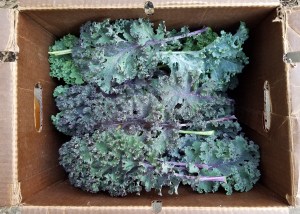
I sent another box of kale to the library for workers. It has been filled with kale countless times in recent years. It’s better quality than what’s available at grocery stores and they use it almost every day — good use for an abundant crop.

The aroma of Bangkok peppers in the dehydrator pervaded the kitchen air as I prepared a simple dinner of spaghetti with tomato sauce made of canned tomatoes, garlic, onion, basil, olive oil and oregano. I peeled and diced cucumbers to make a salad with Kalamata olives, feta cheese, olive oil and balsamic vinegar. There was fresh apple cider from the orchard.

I tasted the pickled red onions and decided to stop at two half-gallon jars. There are plenty to last until spring. Three crates of onions remain — more than enough for our small family.

The solace of kitchen work occupies hands and mind to help us forget what seems intolerable in society. At season’s end it is welcome relief.