Categories
Kitchen Garden

Get Milk?

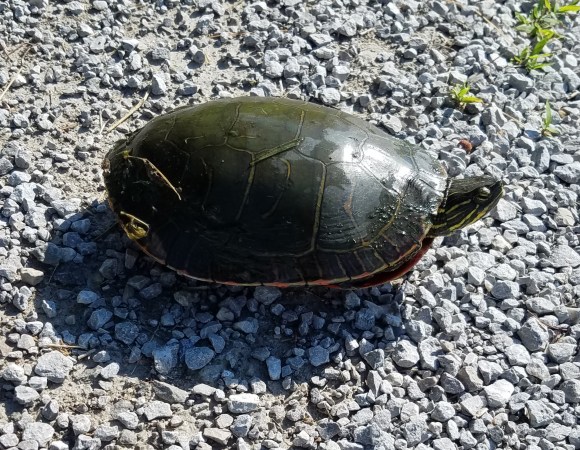
Hiking buddy, June 23, 2020.

My farm friends with community supported agriculture operations take the coronavirus pandemic seriously.

On one farm the crew wears personal protective equipment while working and changed the interaction with customers to control exposure to spread of COVID-19.

On another, the farmers decided, before most planting began, to have the entire crew move to the farm and by self-isolating reduce the risk of COVID-19 spread. They also changed the interaction with customers and cancelled the annual potluck because they believe the coronavirus will not be controlled by autumn.

If any of my friends contracted COVID-19, it would have severe consequences for the operation, including the possibility of ceasing deliveries to customers, at least for a while.

While we deal with the coronavirus an explosion of insects is preparing to assault our garden. In the last 24 hours I observed Japanese Beetles, Colorado Potato Beetles, squash bugs, cabbage worms, and many other species. While the invasion was anticipated, I choose to grow organically so using commercial chemicals to hold them in abeyance is not an option. My main tools are vigilant inspections each morning, hand picking the bugs off the plants when I see them, and for the squash beetles, a mixture of castile soap diluted with water in a spray bottle. To be honest this is just part of nature, and I do my best to protect the yield, giving up as little as possible to insects.

I’ve been making a shopping trip every other week to the wholesale club. Yesterday would have been my day to go but after considering the produce from the garden and what was stored in our pantry and freezer, the only thing we needed was milk.

I’m not lactose intolerant. Maybe I shouldn’t be drinking fluid milk, but I do. With the pandemic it’s a bit stressful sourcing the next gallons. Really that’s all we needed in the grocery category. What to do?

Hell if I was spending 90 minutes driving across the lake, past the Trump bar and the jail Hillary house, near the convenience store where young male adults with large Confederate flags mounted on their pickup trucks congregate, past the correctional facility to the wholesale club where milk is cheap. Too much else was demanding my time.

The options in the small city near where I live did not seem safe from spread of the coronavirus. Three convenience stores sell milk and it’s fresh. The cashiers wear masks and have those plexiglass protectors at the register. It’s the customers with no PPE that cause concern.

There is a grocery store in town. Their milk is also fresh. I’ve not been there since the governor declared the pandemic emergency. The unknown is often an issue. It’s just a gallon of milk… were there better options than the unknown?

I wasn’t ready to give up. There is a dairy store in the next town where the milk comes from their cows. I remembered when they reopened early in the first phase they did curbside pickup. They were taking the risk of COVID-19 spread seriously. I drove the six miles, put on my mask and went in.

The store is always spotless. Three cashiers were all wearing masks, as were other customers inside. I didn’t feel like a freak with my mask, wearing one was accepted behavior. The milk cost more than double what it would have at the wholesale club. The added cost was worth it for the time and gasoline savings. It was also a stress reliever.

I got two gallons so I don’t have to go shopping again soon.
Categories
Kitchen Garden

Sharing the Wealth

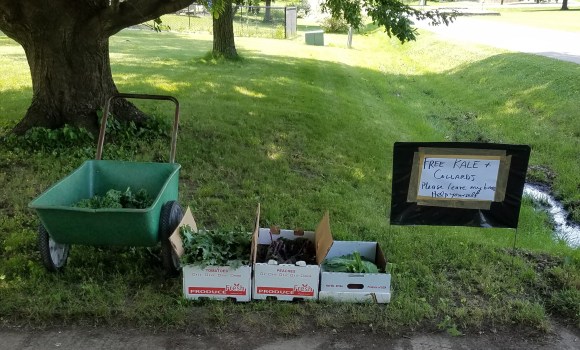
Neighborhood Kale and Collard Stand, June 15, 2020.

Yesterday’s kale harvest was big. To share the wealth I displayed some at the end of the driveway and posted the free give-away on Facebook.

Some of it was claimed, the rest returned to the garden via the composter.

Ten years ago I saved or preserved everything I grew in the garden. Any more I keep only enough to get us through to next year. I’ve visited root cellars filled with very old Mason jars of a garden’s preserves. That’s not who we should be. We take what we need and if we can’t give it away, leave the rest for compost.

Leafy green vegetables are not a favorite around here. I have regular customers who use it in smoothies or bake kale chips. Others prepare it traditionally as greens. The main use in our household is in tacos, soups and stir fries. When out of lettuce we make kale salad. Once in a while I add a leaf to a smoothie. I’m not a smoothie person. I tried kale pesto once and it was okay. Pesto with more flavor, like mustard greens, is better. For a gardener the main challenge is to grow just enough to meet needs. I cut back the space for kale to 18 plants this year. It is still too much.

Combine kale with kohlrabi, collards, mustard, spinach and chard and there is an abundance of greens this year. Next year I’ll use the planting space differently to more closely match what I grow with kitchen usage.

For now there is kale for all who want it.

Categories
Kitchen Garden

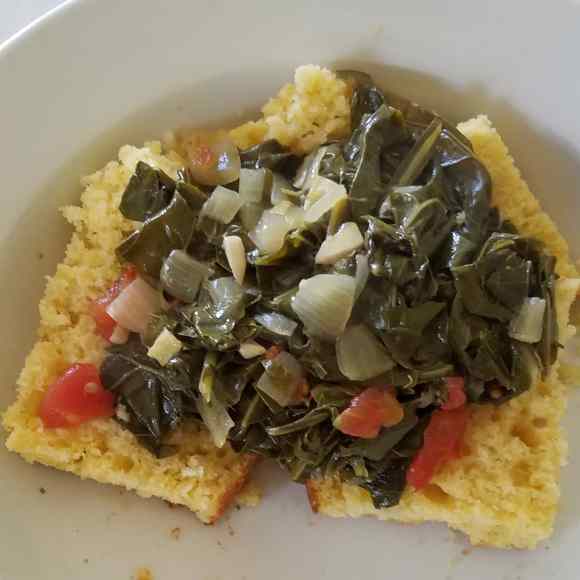
Collards on Cornbread

Collards on Cornbread

Collard greens are easy to grow and the plants produce for a long season. Once one decides to include them in a garden there had better be a plan to use them.

The first picking, before little hungry insects arrive, is the best. Sorting leaves near the composter is a way to cull the best of the best. Yesterday I harvested two pounds of leaves and decided to make collards on cornbread for dinner.

The vegetarian recipe was a collaboration with people I know combined with a few internet searches. Traditionally the dish is made with pork so the issue of how to replace lard and the meat was a primary issue. This dish came out tasty tender.

Collard Greens

One pound stemmed collard leaves
One cup diced onions
One head finely minced garlic (5-6 cloves)
Tablespoon each butter and extra virgin olive oil.
Salt and pepper to taste
One teaspoon hot pepper flakes or fresh chilies if available (optional)
Three cups vegetable broth
One pint canned tomatoes or fresh if available

Measure one pound of stemmed collard greens and cut into half inch ribbons. Set aside.

In a Dutch oven heat one tablespoon each of extra virgin olive oil and salted butter. Once foaming subsides, add one cup diced onions and a finely minced head of garlic (5-6 cloves). Season with salt and pepper to taste and sautee until softened. Add a teaspoon of red pepper flakes (optional).

Once the onions become translucent, add the collards and three cups of prepared vegetable broth. Also drain the liquid from a pint of diced tomatoes into the pot. Bring the mixture to a boil and cover. Stir the greens every so often. Once the volume of the greens is reduced, reduce the heat to a simmer.

Cook until the leaves are tender, about two hours. Add diced tomatoes and continue cooking until they have warmed.

Spoon onto cornbread, including a generous amount of the cooking liquid.

We found the recipe to be quite satisfying and a welcome way to use produce from the garden.

Categories
Reviews

Book Review: Save Me the Plums

Save Me the Plums: My Gourmet Memoir by Ruth Reichl

I’d not heard of Ruth Reichl before a news reporter recommended this book. I had heard of Gourmet Magazine and have no memories of ever reading it.

I liked the book for these reasons:

It provides a window into the New York world of Condé Nast. As a Midwesterner New York seems exotic even though my brother in law lives there. It’s important to gain a broader understanding of the publishing world and to know something about it. Save Me the Plums provides that.

We all need some light summer reading to escape the sh*t storm our current politics, public health crisis, and climate crisis create in 2020. The food writing in Save Me the Plums is unlike anything I’ve read. While not sure of the attraction of something that tastes like sea foam, Reichl takes us into a world few of my cohort experience for themselves.

The book is well written and that makes a difference.

Recommend, especially if one is part of the broader American food movement. One wouldn’t want to be Ruth Reichl yet her story is interesting, different and valuable.

Categories
Kitchen Garden

Weeding the Onion Patch

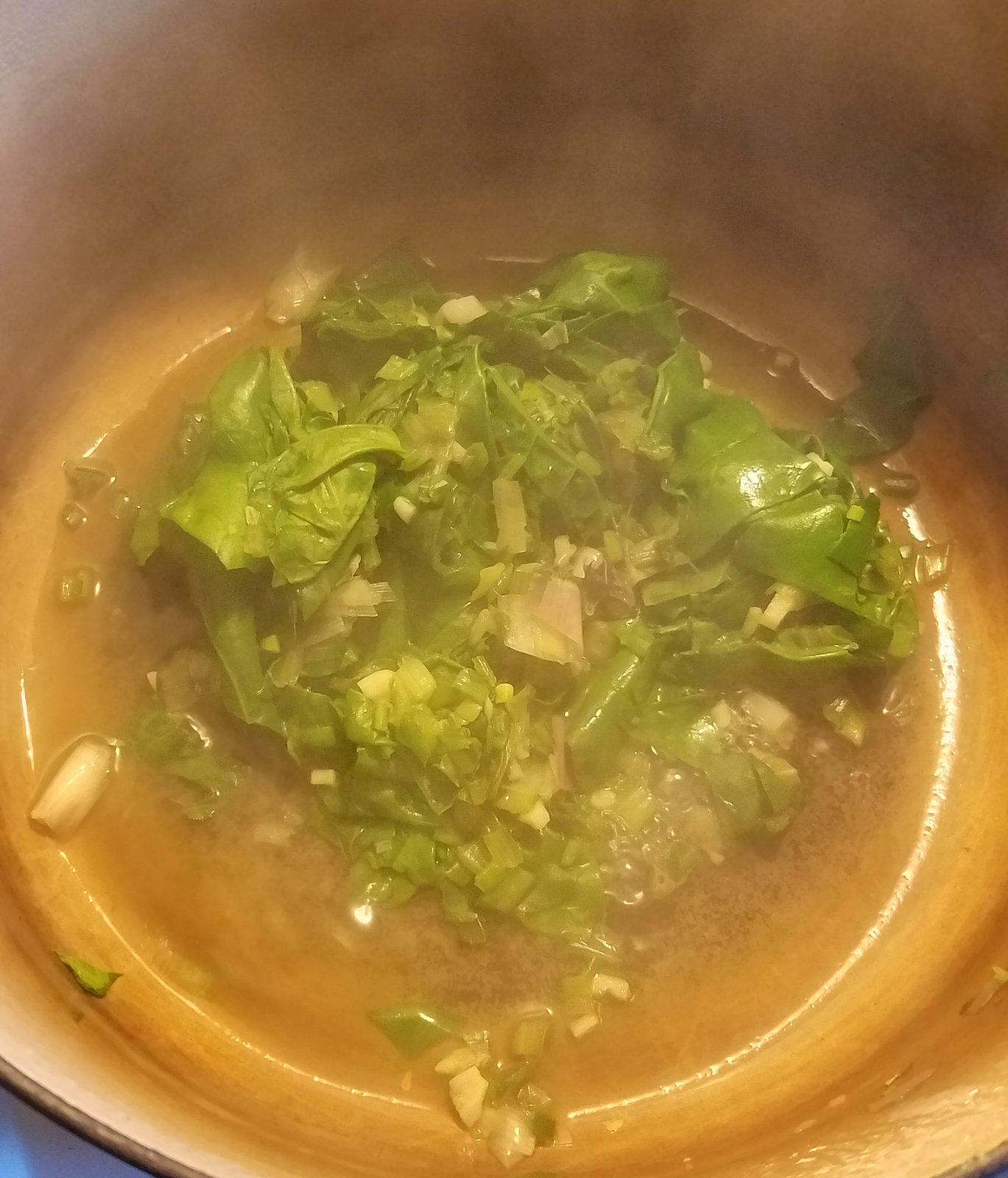
Kohlrabi greens with spring onions and garlic, steaming in vegetable broth.

I’m determined to grow shallots and onions this year. I took the solar powered radio to the onion patch, took down the fence, and weeded until it was done.

The onion starts purchased from the home, farm and auto supply store are growing but not yet forming bulbs. The shallots growing from seed look like they will be something, and soon three varieties of storage onions started from plants will need thinning so there is room for them to grow.

If the garden produces storage onions it would be for the first time. I’m following the guidance of my mentor so there’s hope of success in the form of a bin full of onions stored near the furnace over winter.

A few dozen onions from 2019 remain in the bin. I am so confident of onion success I’m planning to caramelize a big batch of them and transition to reliance on what I grow. More than anything, onions are a mainstay of our kitchen and growing them a key part of making our kitchen garden more relevant.

Among the weeds I found was lamb’s quarters, which grows in abundance without doing anything but planting other things. Lamb’s quarters grows everywhere in Iowa on its own. While culinarians forage these leaves to include in gourmet preparations, in a kitchen garden a cook needs only so many greens. I ate a few of the tender top leaves and composted the rest. They are a tasty green, less bitter than some I grow intentionally.

Around the country protests continue in the wake of videos of the May 25 murder of George Floyd in Minneapolis. The Cedar Rapids Gazette reported large turnout for demonstrations in nearby Cedar Rapids and Iowa City last night. No one knows how long demonstrations will continue or how long it will take government to act on them. The expectation is government will act.

In 1968 after the assassination of Dr. Martin Luther King Jr., and ensuing riots in American cities, it took six days for President Johnson to respond by signing the Civil Rights Act. I don’t see any such action coming out of the Trump administration whose reaction has been to build a fence around the White House and seek to retain power by winning the Nov. 3 election.

While we need to eat, the progress of my onion patch may be the least of our worries. What happened to George Floyd shouldn’t happen to anyone. There is systemic racism in the United States, and we must each do something to address it. What will be the enduring legacy of the Black Lives Matter movement? With our current federal government that remains an open question.

Categories
Kitchen Garden

Rhubarb Crisp

Rhubarb Crisp

Someone asked for the recipe when I posted this photo in social media. I was taken aback.

There was no recipe, I just made it out of the rhubarb and my experience. In a kitchen garden we don’t open a lot of cookbooks.

Ingredients arrive from multiple sources and we consider them, make dishes and meals, using what is available in the ice box, garden, pantry, and our imagination. Experience comes into play. It is a way to source food, cook and eat that isn’t emphasized as much as its value warrants.

Living with a kitchen garden is as good a way to produce meals as I know. It takes some experience but rather than ask, “what is the recipe?” an alternative is “How would this product be made palatable, nutritious and tasty?”

Here’s how I responded to the question:

I saved and diced all the rhubarb that was in my CSA share. It filled this dish. In a mixing bowl I put the rhubarb, one scant cup of granulated sugar, a tablespoon of ground cinnamon, sprinklings of ground cloves and ground allspice, a pinch of salt and two tablespoons of all purpose flour and mixed until incorporated. I returned the mixture to the clean baking dish and sprinkled about one to two tablespoons of water on top. (If I was making apple crisp I would use lemon juice here. Rhubarb is already plenty tart).

For the topping, just use any that you like. This one has a stick of chilled, cubed salted butter, a cup of rolled oats, two thirds cup packed brown sugar and a pinch of salt. I use a pastry cutter to blend everything together, leaving it in chunks. Sprinkle the topping evenly and baked 35 minutes in a 375 degree oven.

That’s a recipe of sorts. If a person eats ice cream, a scoop on the side of a warm, just out of the oven serving of rhubarb crisp would be divine. Or as close to that as we humans can get.

Categories
Kitchen Garden

Warm Weather Vegetable Planting

Mustard greens – walnut pesto with a flat loaf of freshly baked bread.

On Friday I planted the rest of the tomatoes and the sweet, bell peppers. I’m running out of room for hot peppers so I harvested mustard greens and made pesto with ingredients from the pantry. I’ll use that space for a variety of hot peppers.

I have more seedlings than will fit in my seven garden plots so choices must be made. The last plot will be cucumbers with room for whatever else will fill the space, likely the single zucchini plant that germinated, and more hot peppers and tomatoes.

Succession planting is important to space management but the ice box is filled with leafy green vegetables and a family can only eat so many per day.

Rain is forecast in the next hour. As soon as the sun rises I want to harvest turnip greens to make the last of the vegetable broth for canning.

I’m trying to get better at growing bell peppers. Here’s a passage from the Jan. 18 barter proposal to my farmer friend Carmen:

We talked about mentoring on how to grow bell peppers. The idea we discussed was me spending some individual time with you discussing seed variety, irrigation systems, weeding, fertilizing, pest control and other issues, then helping you grow this year’s crop. While this means more labor on my part, I consider that part of the learning process for which I’d be bartering, not an added expense to you. As the crop comes in I would want a fair share for fresh eating and freezing as long as the harvest continues, some prime quality and seconds depending on what’s available. What is the value of that learning experience? I don’t know but I’m willing to settle the remaining accrued value for it, making us even.

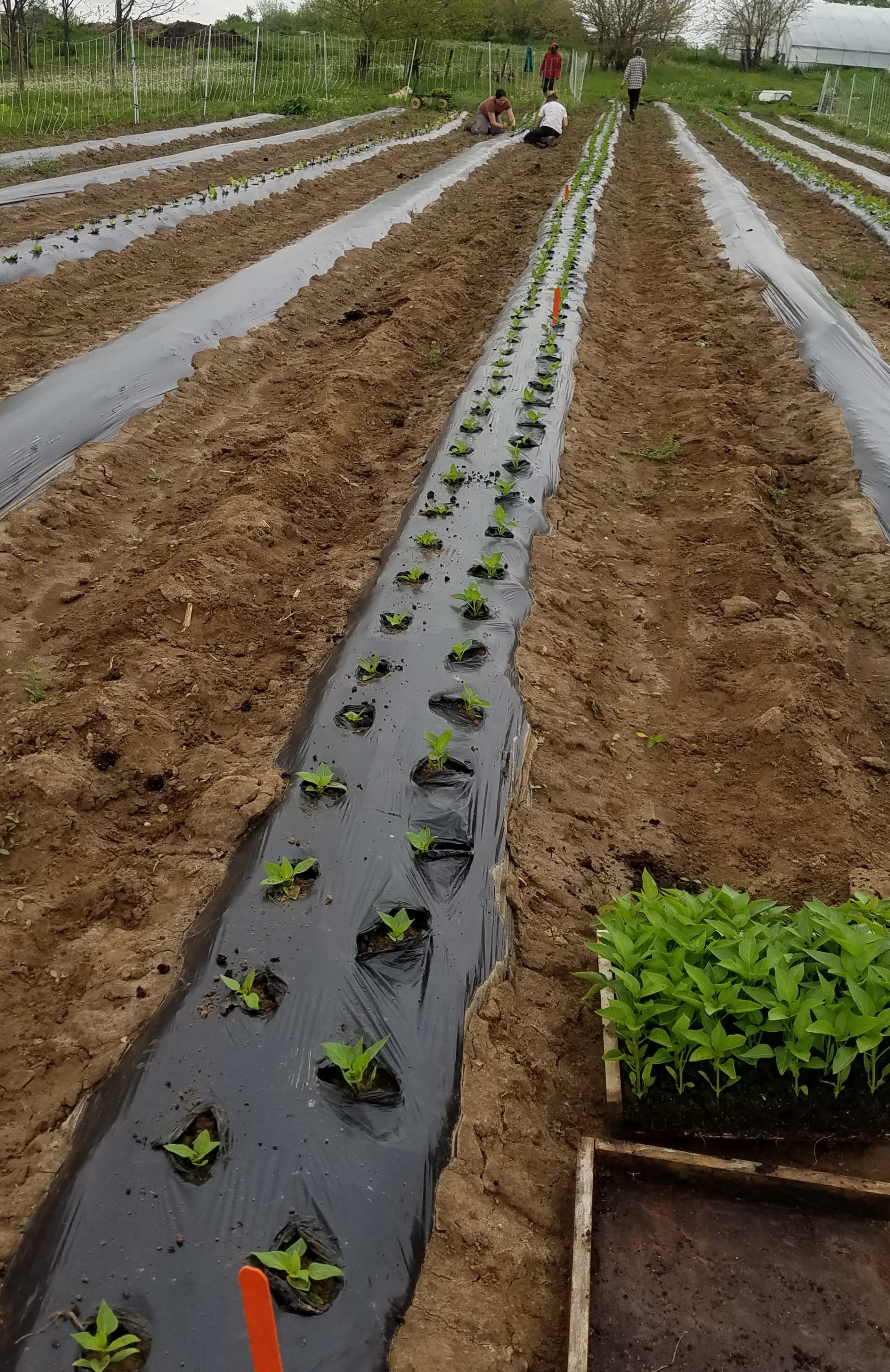
Thursday I spent a couple of hours at the farm planting peppers. Below are comparison photos of the farm’s peppers and the row I put in my garden yesterday.

Pepper row at Local Harvest CSA
Pepper row in my garden.

At the farm they have a mechanical device to lay plastic for the rows. It creates a berm of soil in the middle of each sheet into which seedlings are planted. There is drip tape irrigation under the plastic. In my garden I manually made the berm with a hoe and garden rake, then covered it with a 48-inch layer of landscaping fabric. I placed grass clippings on each side. I have no drip tape and therefore need to make sure peppers are adequately watered.

The seedlings I used were a combination of ones I started and the main crop peppers at the farm. I also put in six plants of Guajillo chili peppers and two each of Serrano and Jalapeno. Fingers crossed I produce some peppers out of this.

A lot of weeding remains to be done. Also remaining is the related grass clipping collection for mulch. For that to happen I need a solid block of weather without rain. Doesn’t look like that will happen today.

Categories
Home Life Kitchen Garden

Lilac Time

Lilacs through the front door.

The lilacs will soon be in full bloom. They don’t last long. What does?

Social distancing in the coronavirus pandemic has me well ahead in the garden, creating an in between time to consider life’s possibilities.

This week I plan to plant tomato and pepper seedlings and get everything I can into the ground. We are past the last frost, although with as chilly as it’s been, things aren’t growing well yet. There’s no hurry.

That said, there has been plenty of arugula, lettuce, spinach, spring garlic, pak choy, mustard greens and spring onions. What we don’t get in greens from our garden we get from the CSA spring share. I have big salads on the dinner menu three times this week and side dishes of stir fried greens every other day but Friday. When I was a younger gardener I didn’t understand the importance of greens to the enterprise. Now I do.

I’ve taken to hanging a U.S. flag over the garage door. The one I use flew over the U.S. Capitol. I paid $16 for it through our congressman. For a long while I flew the flag I took with us on field maneuvers in the Army. I flew that one from the radio antenna during non-tactical road marches. It got worn so I replaced it. Flags wear out. Everything does.

I’m down to my last face mask so Jacque has been getting input on what kind she should make for me. The one I have is a dust mask from the garage workshop. It fits snugly. It serves. The new one will have parts of an obsolete vacuum cleaner bag as the filter medium. While Americans have poor discipline in their behavior to prevent spread of COVID-19 (or lack of discipline, more likely), we’ll do our best not to catch it or transmit. The main thing is going out only when we need to. With the garden and plenty to do inside it shouldn’t be a problem. It’s better for us anyway.

Today’s challenge is figuring out what to do beyond getting through each day. I’d been dodging the idea of retirement and now that the pandemic flipped me to this new status I’m not sure what to do with the rest of my life. I’m not used to working without a clear plan. I need to make one and for that I need new priorities. It’s an in between time for now and those decisions will be delayed for another day.

For the time being, the allure of lilac scent beckons me outside.

Categories
Kitchen Garden Reviews

Book Review – A Cook’s Tour of Iowa

A Cook’s Tour of Iowa by Susan Puckett.

A Cook’s Tour of Iowa is a well-curated collection of culinary culture that represents a certain view of Iowa. It’s the picture Iowans can recognize. We also recognize many of the things mentioned as fading in cultural prominence.

As a resource for writing autobiography, the book conjures personal memories of Iowa things like the Grant Wood Art Festival, Maytag Blue Cheese, the African-American community in Buxton, Iowa, and many more. It is indispensable for that reason.

What is lacking is the diversity of what Iowa has become, even since 1988 when the first edition of A Cook’s Tour appeared. Our culture is also leaving behind things like VEISHA, Old Creamery Theater (no longer in Garrison, or Amana), and some of the festivals and events to which Puckett referred.

If we had an Iowa-themed dinner party, picnic or cookout, one might search the book’s contents for dishes to make for pure nostalgia. However, life in Iowa has become more than that.

I appreciate the work that went into A Cook’s Tour of Iowa. I may not open it often, but knowing it is there provides comfort as the food system changes along with the society that engendered it.

Categories
Kitchen Garden

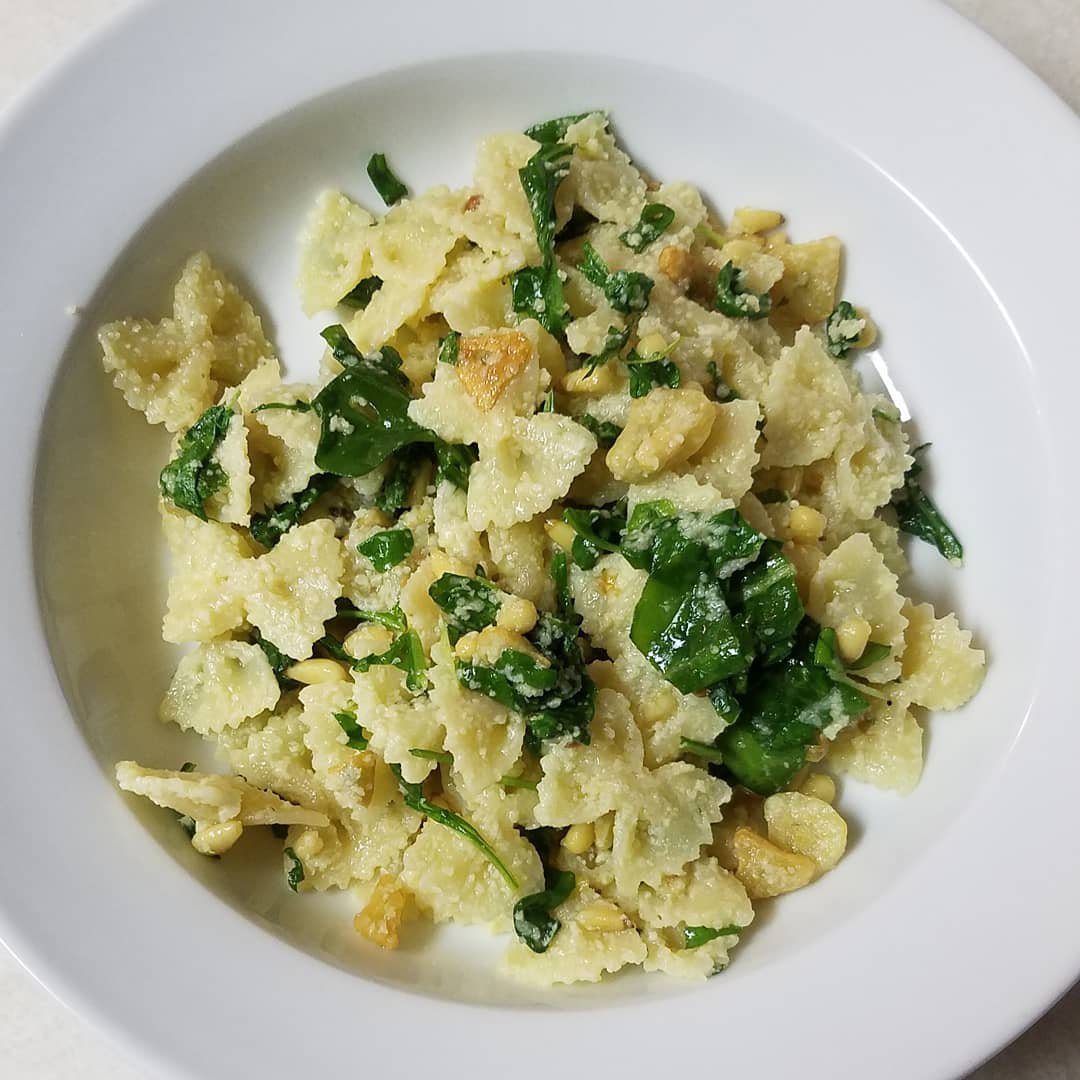
Bow Tie Pasta with Garlic and Arugula

Bow tie pasta with garlic and arugula

The arugula is top quality this year and I’m in a use it up mode. I spent more time preparing for this dish of bow tie pasta with garlic and arugula than usual. I researched recipes and thought a lot about it during the past two days. I used Parmesan cheese from a green can because of the coronavirus pandemic. It came out well but would be better with higher quality cheese. Here goes:

Ingredients:

Big bunch of arugula, half a pound, washed and roughly chopped
2 cups dried bow tie pasta
12-14 cloves of garlic
Quarter cup pine nuts
2 tablespoons extra virgin olive oil
2-3 tablespoons salted butter
1 cup grated hard cheese (Parmesan, Pecorino Romano)
Salt and pepper to taste

Process

Set a pan of water on the stove to boil for the pasta.

Peel and trim the garlic. Then slice finely (1/8 inch).

Once the water reaches a rolling boil, add the pasta and cook according to directions.

Once the pasta is down, bring the olive oil just to the smoke point. Add the garlic, stirring constantly. As the garlic begins to brown, add the pine nuts and cook for a couple of minutes.

Add the knob of butter and stir. Before the foam begins to subside, transfer everything to a mixing bowl. Drain the pasta and dump it in the bowl. Combine until they are incorporated.

Salt and pepper to taste.

Add the arugula and cheese and mix gently until the arugula wilts.

Makes two generous servings.