Categories
Writing

Great Book Sort #1

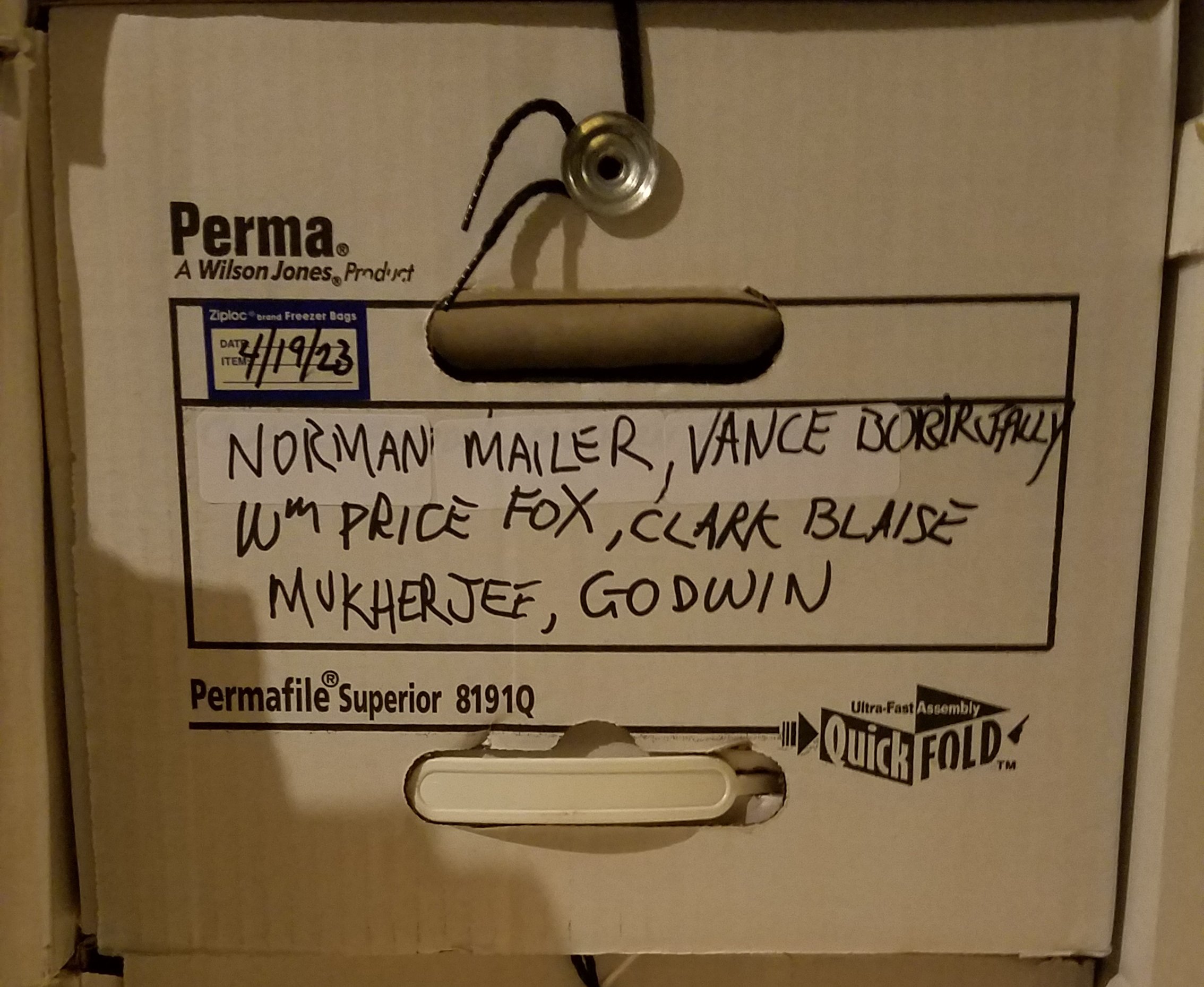
File box full of books.

This year I donated roughly 700 books to the public library used book sale and to Goodwill. Goodwill is less picky about what they will accept, so they received the majority of them. Many of my donations still had the Goodwill price tag from when I bought them. Library downsizing has only just begun.

All but The Moviegoer of my collection of Walker Percy novels went into boxes and out the door. I felt a bit sad about that, but as Vonnegut said, “So, it goes.” I had to decide about my collections by author. Other authors, that I worked equally hard to collect, went into bankers boxes with the names and date packed on the outside. Who knows if one will get into the boxes again, yet they are available and take up no precious shelf space. A few — Bellow, Didion, Irving, Morrell, Faulkner, and William Carlos Williams got their own special shelf space. It wouldn’t be my library without those authors.

I wrote previously about poetry and that decision seems solid. The shelves are easily accessible so when I want to read poetry I can get at the stacks.

Cookbooks are impossible. Half of what I gave away was cookbooks. I can’t seem to part with many more. Yet I must. Truth is, I hardly use cookbooks any more. Having learned how to cook, they serve as cultural artifacts related to places and people with which I have some connection. Reference material for the church where I was baptized, or the American Studies department where I got my degree. In seventy years of living, we generate a lot of connections. A cookbook has usually been involved. They also serve as examples of how to prepare a particular dish or ingredient. Keeping many of them takes up space that could be devoted to other topics. This sorting is far from over.

Hundreds of books about Iowa history and by Iowa authors needs reduction to a shelf of about a dozen to hand off to our child when they are ready. I also wrote about this. More of those got boxed up, leaving the first tier to be read and re-considered on the shelf.

The space for books about U.S. presidents is settled at eye level on two long shelves. The ones by or about presidents in my lifetime is sorted. I had two copies of Eisenhower’s White House memoirs and one is on the bench waiting to be packed up for Goodwill. I have a blank space for the second volume of Obama’s presidential memoir. No space was left for a Trump memoir, I mean, you got to be kidding me.

My African-American studies section has grown, and I need a space for American Indian books. I can’t bear to part with all the ancient writings, although the chances of reading some of them are slight. I may get into Plutarch’s Lives, or I may not. Keeping them for now.

Art books take up too much space. Having so many is a function of my interest in certain artists like Picasso, Joan Miró, Georgia O’Keeffe, Warhol, Hopper, and the like. Some I bought at the artist’s retrospective, and some I picked up at used book sales. Until I get to the point of running out of space, most of them will stay right where they now are.

A byproduct of sorting is finding more books to read. The to-read shelves are packed to overflowing. I’ve also found some lost friends, like George McGovern’s autobiography, Grassroots, and Joe Biden’s Promises to Keep. I put Biden’s memoir into a box, thinking he would never be president. Now it’s up in the presidential lineup.

The great book sort is proving to be beneficial. I have a better understanding of what I have, and organized them into projects for future writing. For now, there are some empty shelves. There won’t be for long.

Categories
Home Life

Iowa Spring – 2023 Edition

Trail walking on April 12, 2023.

My spouse and I noticed the mulberry tree on walkabout Tuesday afternoon.

The mulberry tree was damaged by the 2020 derecho and has begun to die. Branches high in the canopy are losing bark and not regrowing it. Soon it will need to be cut down and recycled. This is the only tree remaining from when we bought the lot in 1993.

We were discussing what to do with the yard. Mainly, we need to plant the area in front of the house where it was cleared last year. A flower bed of some kind will go there.

We took out the maple tree stump last year. We are considering replacement with some kind of tall bush rather than another tree, a forsythia or hydrangea, maybe.

More than half the Red Delicious apple tree is gone due to wind storms yet it seems very robust. Hard to tell if there will be an apple crop this year, yet under normal circumstances, there should be one.

Finally, the trays of seedlings are now outdoors in the greenhouse. It should be easier to water them. Next into the ground are onion sets, beets, and spinach. Hopefully there will be progress midst ambient temperatures in the 70s today.

Now to close this entry out and head for the lake trail for a morning walk.

Categories
Living in Society

Ready for Spring

By the calendar it is spring, yet it doesn’t quite feel like it. Too much darkness, too much rain, and too cold temperatures. Things will break, yet that doesn’t help get through today.

Monday I stopped at my parents’ graves while on my way to the wake for a friend. The dirt on Mother’s grave settled in the three and a half years since she was buried. I don’t know if the cemetery takes care of that, or whether I should bring a couple bags of topsoil, grass seed, a rake, a pair of gloves, and build it up myself. Whatever I do would be converted to the cemetery standard in time. It may not matter over the long term, although I’d feel better after tending her grave.

There have been enough funerals for a while. It is convenient to watch some from a distance via streaming. We don’t get the benefit of fellowship when we attend that way. I knew a lot of people at my friend’s in person wake, so that was pretty satisfying. I’m ready for what’s next and if spring would arrive, that would be it.

I didn’t know what to expect with Christopher Isett and Stephen Miller’s The Social History of Agriculture: From the Origins to the Current Crisis., yet it is slow reading as I drag my way through peasantry, indentured servitude, slavery and variations of people farming for little or no money. It seems a necessary background and the previous half dozen books were easier to read and more enjoyable. I’m halfway finished. Time to hunker down and finish it as there is valuable information therein. With gathering darkness and storms outside, what else is there to do?

It’s been a punk day for weather with me feeling under the weather. We have plenty of COVID-19 test kits, yet I’m confident that is not the problem. I’m okay with a bit of mystery. Soon enough spring will be here.

Probably time to get out William Carlos Williams and re-read Spring and All. Few things cheer me up like his writing.

Categories
Writing

Being Different

Seeded tomatoes and peppers and set them on a heating pad under a grow light.

Saturday seemed busy. It could have been more productive. As a retired septuagenarian, there is never any difficulty staying busy. I do wonder if I could produce more during each day. More production is the American way.

A key aspect of America’s peculiar institution of slavery was efficient use of slaves. Especially on sugar plantations, but on others as well, every daylight hour was to be spent working in the fields or processing crops. If a slave died from being over worked, no problem. They could easily and inexpensively be replaced by another. The lives of slaves on a plantation were short.

The average lifespan of enslaved Africans who worked on colonial sugar and rice plantations was seven years. Extreme physical demands relied on equally extreme instruments of torture to ensure control over enslaved peoples and to protect plantation profits. The economies and societies they built were denied to them, along with human dignity.

National Museum of African American History and Culture website.

Making enslaved humans productive was essential to accumulation of wealth in the highly lucrative production of sugar, rice, cotton, tobacco and indigo. A system of overseers and supervision was developed. While slavery ended with the Civil War, those techniques from plantation days persisted in practice and in many cases are revered by business efficiency experts. In 1850, the average life expectancy for a slave was 36 years.

We’re not accumulating any wealth here, yet feeling like I’m accomplishing more would be a boon. Here’s what I have in mind:

  • About this time last year I stopped regular, daily work on my book. This year I plan to spend less time in Summer and Spring, yet write something or work on research every day. The major obstacle is I can’t seem to get through all the boxes of research documents in a timely manner.
  • Reduction of my book stacks will continue. The goal is to donate every time I shop over in Coralville, or about every other week. I have a process and things are moving more quickly now. Some time each day on this.
  • My goal is to read 25 pages per day. For historical books with a lot of detail, that’s probably right. When reading fiction, it’s too low. The idea is to adopt different goals for different kinds of books. If I can’t read 50 pages of fiction per day, there is something wrong with me.
  • Our refrigerator and pantry are good at keeping food and there is too much of it. I plan to work down the excess by cooking differently. Maybe I’ll find a few recipes that are keepers.
  • Listen to more music. I wrote this playlist in 2005. It is a story of my life in music. Back when I played, I sang all of these.
Cripple Creek (Traditional)
Lord Franklin (Traditional)
Shenandoah (Traditional)
Big Rock Candy Mountain (Harry McClintock)
House of the Rising Sun (Traditional)
500 Miles (Hedy West)
The Cruel War (Traditional)
Blowin' In The Wind (Bob Dylan)
Pack Up Your Sorrows (Pauline Marden and Richard Fariña)
Wabash Cannonball (William Kindt)
This Land is Your Land (Woodie Guthrie)
Freight Train (Elizabeth Cotten)
The Hammer Song (Pete Seeger and Lee Hayes)
Good Night Irene (Huddie Ledbetter said he didn't know who wrote it)
Someday Soon (Ian Tyson)
Early Morning Rain (Gordon Lightfoot)
Four Strong Winds (Ian Tyson)
Both Sides, Now (Joni Mitchell)
What About Me? (Scott McKenzie)
The City of New Orleans (Steve Goodman)
You Ain't Going Nowhere (Bob Dylan)
I Shall Be Released (Bob Dylan)
It's All Over Now, Baby Blue (Bob Dylan)
The Dutchman (Michael Peter Smith)
Categories
Living in Society

Pokey Pokey

Lake Macbride

The veins on my arms do not stand out. Ever. The clinic drew blood for my semi-annual checkup and it took two staff members four pokes to obtain a sufficient sample. I’m an adult and can stand the pokey pokey. I also know about my hiding veins.

The blood test results were posted same day on a health profile hosted by the hospital. Let’s just say I have some work to do after last winter.

My high school friend Mike Tandy died on Thursday. He was on stage crew and close friends with most of our 1970s band members. He occasionally played bass guitar. He was a teacher most of his working life. Rest in peace, buddy.

The last ten days have been relentless with deaths of people I knew well. Now that spring is here, maybe I’ll get some relief. In any case, I bookmarked the three funeral homes in my home town for easy reference.

A thunderstorm blew through Big Grove Township last night. It was severe enough for us to retreat to our safe place on the lower level. After the 2020 derecho, it was no biggie. A little hail and moderate rain fell. We lost electricity for an hour or so. When the lights and stove went out, I put away the dinner I was making and took the ingredients back out when electricity returned. I left the half-cooked brown rice on the stove and without additional heat, it turned out exceptionally well. We need to replicate that process without the loss of electricity.

I binged on poetry reading at the end of the month, finishing books by Czesław Miłosz, Alice Walker, Adrienne Rich, and James Wright. I liked each one in different ways. The fewer mass culture references in poetry, the better. None of them was clean enough for my liking. It bugged me a little that Walker repeated she was “writing poetry again.” Just show me, don’t tell me is a basic tenet of poetry.

The cleaning of an external hard drive proceeds a little each day. Unfortunately, there are unique and useful files on it, so the computer spends several hours each day with the transfer. My obsessive compulsion about saving my computer work paid off in the new finds I have made. It is a drudgery, though.

I don’t care about sports, yet last night’s win by the University of Iowa Women’s basketball team against number one ranked South Carolina was a big deal. I noticed in social media, some friends flew to Dallas for the game. We talk a lot about how divided the country has become. Yet, if one can’t get behind the success of this team, you may be the problem and need a look in the mirror.

It’s tomato and pepper planting day in Big Grove. I had better get after it.

Categories
Home Life

Prairie Home

Selection of books by Garrison Keillor waiting disposition.

It’s time for decisions… about Garrison Keillor.

Specifically, what should I do with this pile of books? Most were purchased at thrift stores for a dollar or less. I may have purchased the poetry book new, and maybe Homegrown Democrat. I can’t recall. Keillor’s books never made an impression on me the way Saul Bellow, Joan Didion, or John Irving did. He fancied himself a modern day Mark Twain, or something. I didn’t see it. Had I read more of Keillor, it may have been different. It’s getting late to start reading him now.

These nine books have been gathering dust in a row on the bottom shelf of the right-side stacks. They have been within reach for years. I could see them from the chair I bought for a buck from L.P. “Pat” Foster at Sharpless Auctions in the early 1980s. It is my writing chair for Pete’s sake! Keillor is a writer! The collector in me amassed the Keillor volumes back when I was in a more accumulating mood.

Disposing of Keillor’s books is a practical problem. Do I expect to read them? No, not likely. Will I refer to something he wrote in my writing? Maybe, yet it is hard to imagine when the radio show made the dominant impression. Do they have sentimental value? Maybe. Are there more worthy books for retention waiting in the next room for shelf space? Yes definitely and that will be the decider.

Keillor’s allure was when A Prairie Home Companion was live on Saturday night, the signal coming through the clock radio atop the Kenmore refrigerator in our Midwestern home. I did things in the kitchen and listened. In important ways, his show made Saturday nights for a long time. I miss them. Will I miss the stack of books? If I would miss them, I might have picked one of them up over the last ten years.

I remember when he signed off the air in 1987. It felt momentous. Our two-year old child wanted to go for a walk in the neighborhood at the same time. No regrets about going with her instead of hearing Keillor live. We all must make choices.

I rigged my cassette recorder to capture the last show while we were gone. When we returned from our walk, I discovered the tape had run out before the show ended. Keillor never went over, except this time. I was able to re-record it on Sunday when it aired on a different radio station that broadcast from the Quad Cities.

We now know Denmark didn’t work out, nor did his then new marriage. He came back to radio. There were other problems, they said. I’m not sure what happened, or in what order. I didn’t pay much attention to his personal life. The star of the show was always the yarns he spun. It felt like it would never end.

In a June 16, 2016 New York Times article aligning with his second departure from the radio program, Cara Buckley wrote, “Everything about “Prairie Home” — the Guy Noir and Lives of the Cowboys sketches, the spots for Powdermilk Biscuits and the Ketchup Advisory Board, the monologues about the fictional Lake Wobegon — sprang from Mr. Keillor’s imagination. But the man spinning the plates at the center of it all managed to stay a mystery, even to people who know him well.”

These days, I’m spinning my own plates. To use a more local metaphor, I don’t have enough time to card my own wool, and spin my own yarn to make a sweater. Plate-spinners have gone out of fashion.

I wish I could have one of those Saturday nights back. Like the one I shared with our child in Colorado Springs in their first apartment there. We went to the grocer together, prepared dinner, and talked to each other with the sounds of a Prairie Home Companion in the background. Those were golden times whose embrace is fleeting.

I will figure it out. These septuagenarian days are also fleeting. In the universe of things to do with used books, these will likely go to the public library’s used book sale. I may have bought some of them there. It seems likely they will find readers in our community, even if I can’t find the time in our prairie home to be one of them.

Categories
Home Life

Morning Routine

Western Sky at Sunrise

To keep our sanity, some daily organization is needed. I have a routine, curated over a period of decades, and in retirement, I follow it closely. I had a thought on Saturday, I should post about it. So here it is.

My morning routine is typed and held by a clipboard near my writing desk. I typed it to make sure I don’t forget anything. Depending on the whims of each moment, I could easily get waylaid.

Whenever I go to bed, I sleep four or five hours and then get up to use the bathroom. I return to bed and attempt to sleep until 2:30 or 3 a.m. Occasionally I will sleep straight through. Infrequently, I’ll sleep until 4 a.m. or later. I feel like I get enough sleep.

Upon waking for the day, I sit up on the edge of the bed and take my blood pressure. I record the numbers on a mobile application and then shed my clothing to step on the scale and record my weight. As long as I have the mobile device in hand, I click on The Weather Channel application and check the hourly forecast for the day.

Next comes clean underwear and socks, and dressing in my at-home uniform of well-worn jeans, a t-shirt, and in winter, a sweatshirt. I make the bed, pick up my mobile device, turn off the light, and walk to the kitchen.

I turn on all the kitchen lights and make coffee with my Kenmore drip coffee maker. I take my morning pills, which are Vitamins D and B-12, plus a low dose aspirin. While coffee is brewing, I head downstairs to turn on the lamp in my writing space and power up the desktop computer. In winter, I tend to seedlings started on a heating pad under a grow light. I perform chores like taking the trash and recycling bins to the curb, checking the salt level in the water softener, and cleaning up projects on my writing table to prepare for the day’s work.

Climbing the stairs, I return to the kitchen and pour the first cup of coffee. I take it to the living room where I sit in my chair, check text and email, and view notifications in my Twitter account. I search for breaking news. Once finished, I read at least 25 pages of the current book on my reading list and record the results in the Goodreads application. I head back downstairs.

At my writing table I log in to the applications I will use that day. I do banking, pay bills, record information, transfer photos from the cloud into file folders, and read newspapers. If there are small tasks related to my writing, I take care of them at the time. For example, this morning, I remembered something that should be included in my autobiography, opened the document, and insert it.

When all of this is done, it is usually 5:30 a.m. and time for breakfast. For me, breakfast is the biggest meal of the day and I take time to make tasty food that will carry me until lunch time. Once breakfast is finished, I clean the kitchen, do dishes, brush and floss, and I’m ready for my day.

There is daily variation, yet I mostly stick to the routine. The first shift of writing after breakfast is the best part of my day. What happens after that is based on a to-do list. Yet on many days, it is free form. Regardless what I do, I feel better for having a morning routine.

Categories
Living in Society

Skipping an Annual Shopping Tradition

Tools

There is not a lot of money to spend on frills at the end of each month. I wrote about this before and while we hope to pay off our outstanding consumer loan this year, an unexpected expense could complicate things. Like many people we live on the edge between financial survival and ruin.

There are broader implications than our single household.

Last year, 48 percent of household expenses were programmed. That means property taxes, water, electricity, sewer, refuse hauling, road maintenance, insurance, telephone, cable T.V., car loan payment, and broadband. There is no escaping these expenses.

Sixteen percent of expenses were food, sundries, gasoline and cash expenses. One can economize here, but all of these categories are necessary. Our food expense is lower because we regularly use produce from the garden.

The balance of our expenses (36 percent) was what I call household operating expenses. This includes clothing, household repair parts, auto repairs, health co-pays, writing expenses, gardening, donations, and anything unexpected that pops up during the year. Sometimes things break and an outside contractor is needed to make furnace, electrical or other repairs. Contractors are not cheap.

I used to go shopping when the Super Bowl was televised. It was a tradition. I’d wait until the neighborhood got quiet, start the car, and drive to the mall to walk deserted passages and browse. It was my personal equivalent of Black Friday. I’m not sure how much I spent on such shopping trips, but not much. The message was more how anti-sports I became after seeing the Iowa Hawkeyes play with coach Ray Nagle back in the day. Sports was and is a waste of time in our household, unless someone we know personally is playing.

With no money left at the end of each month, and we had to take out a loan to pay for some unexpected expenses. Shopping out of tradition doesn’t make sense with a personal loan. It is better not to buy anything extra other than what we need to get by.

I compare this with the post-war boom during the 1950s when large companies banked on a consumer society. The population boomed and people were buying new homes and equipping them with modern appliances and furnishings. The car culture took off. Today, with so much of our expenses programmed and necessary, combined with replacement items, this has to be taking sales away from merchants who once relied upon them. We bought a used car last year, and will buy a major appliance or two this year, but such purchases can’t be driving the economy, at least not in the same way. Cars and appliances are made better to last longer these days and that has to hurt replacement sales.

We are going through the house to purge stuff we don’t need. So much of what we cared about for years, isn’t anything our child wants. We have the room to store old things, although there is nothing wrong with some empty space. I keep thinking I could need, use, or repurpose. I need to let go. It is hard to get a purge started, and we are not ready to call the waste management company to arrange for a dumpster. However; that day is coming.

The Super Bowl will continue to be a non-event here. We’ll make the usual meals, yet we won’t do any shopping outside our normal stocking levels to prepare. I’ll skip a traditional shopping trip that shouldn’t have been a tradition at all. I’ll be better for that.

Categories
Writing

Listening to the Wind

Derecho Woodpile

I work a lot on winter days. Some readers may want to put air quotes around that word. What I mean is cleaning the house, washing dishes, preparing meals, doing laundry, and snow removal. I began to plant seeds in trays to grow seedlings for the garden. In winter, any type of physical activity is welcome and most of it must be done to maintain a household. As a septuagenarian in reasonably good health, I need breaks from time-to-time to sustain activity throughout the whole day. When I do rest, it is in the form of a nap or to sit quietly for a few minutes in my living room chair.

While resting, I listen to the wind.

Since we moved here there have been three major wind events. The first two were what we called “straight line” winds that damaged the house and some of the trees. The last major event was the 2020 derecho. Before these events, I paid little attention to the wind. Now it is more engaging than television, radio, or looking at the screen on my handheld mobile device. It creates a form of solitary alertness well cognizant of the consequences of strong wind.

Listening to the wind doesn’t seem like much. At a certain age it evokes memories that transform the present into something else: a sense of fear, experience, or knowledge about the hazards of living in a turbulent world. Listening to the wind is more than about resting.

When I’m at my writing table I can’t hear the wind or anything else that goes on outdoors. Well, I can hear the predawn fusillade of shotguns during hunting season. It is a quiet environment by design. If I have the space heater on, I can only hear the fan. It is the type of environment suited to concentrating on memory and the imagination. It is the setting for reading and writing.

I’ve been reading Grandmother’s letters from when I was in the military. When she wrote them, she was not much older than I am today. She had at least four heart attacks while I was gone, and fell on the street twice. She was often tired, she wrote, especially during her recovery from hospitalization or the falls. She would stop working and lay on the bed or sit in her living room. Sometimes all she got done was to prepare meals and make her bed. It’s was not unlike how I am today.

The sound of the wind takes me back to the past. While wind may be a present danger, I worry less about it because of my experiences. I know for what to listen in the wind. I become thankful for my health and presence of mind. The wind inspires me to get back to work and improve how I live.

Some days we just need to shut off the noise, take a rest, and listen to the wind.

Categories
Home Life

Friday No. 5

Rainbow. Photo by the author.

It’s the fifth Friday of 2023 and winter is here… not for long, though. The forecast through Feb. 14 is mostly for highs in the forties. While this above freezing forecast sets back my winter fruit tree pruning, I will adapt. Adaptation is what it’s about in the newest era of the climate crisis.

For the first time in nine days I ventured out of the house, off property. The trip to the wholesale club, including drive time, took 90 minutes. At this rate, the fixed cost of the car loan is about $50 per trip. If that usage continues, this vehicle will last a long time. To put it into perspective, every time I leave the house, it is expensive.

Needing a new car was an unwelcome surprise. The drive train and body of the 2002 Subaru Outback would have continued for a long time. The problem came in when repair parts for critical systems were not available because they quit making them. Since we didn’t have $20,000 sitting in the bank, we took out an auto loan and that will be paid back over five years. The car will last that long, but the car payment blocks out other spending. Welcome to the world of being a pensioner.

Spending more time at home is revealing how much upkeep owning a home involves. While we bought the best appliances we could afford, they are wearing out, in some cases after more than thirty years of use. The next challenge is how to pay about $1,200 apiece to replace the four appliances next in queue. Basically, we’ll charge them on a credit card, then pay off the balance with whatever is left of our pensions at the end of the month.

Fridays have become my indoor seeding day. Last Friday I planted stevia to grow indoors (Stevia is zone 9). Today is kale seeding in a tray of 50 blocks. The main crop kale is a combination of Winterbor and Redbor. These varieties grow easily, are tasty, and freeze well. I will also plant Scarlet, White Russian, and Dazzling Blue. The tray will be 15 each of Winterbor and Redbor, six White Russian, six Dazzling Blue, and eight Scarlet. Depending upon germination rates, this should produce enough kale to last through the season and in the freezer until spring 2024.

When spending a lot of time at home, we crave order. I’ve tried to frame a weekly order, yet it is not going well. We don’t have “weeks” in retirement when each day blends into the next. Fridays are the most settled pattern because the regular week is over and we’re heading into the weekend.

Our mind works to create structure. I end up framing a week, however imperfectly. I feel a residual cultural need to say, “Thank goodness it’s Friday.” I resist, and attempt to go my own way. There is a song about that.