Categories
Living in Society

Shoe Boxes and Avoidance

Storage shoe boxes.

I pulled out a shoe box filled with papers from around the turn of the century as an evening project. I find I need something to do after dinner that engages me in staying awake, yet does not engage too much. Sorting through old, unorganized papers is a low-stress thing to do. After the project, I took steps to stay awake, and managed to add 20 minutes to the end of my day. Hopefully that will build until I stay up until 9 p.m. like normal people do.

I said the papers were unorganized, but that’s not true. Some circumstance of time and place gathered them together until I couldn’t stand to look at the pile. At that point I got a shoe box and put them away. In other words, I avoided a better disposition. The shoe box became an unlabeled time capsule to be opened when a whim from the great beyond drew me again to it. Sunday night was that time.

What was in it?

There were a number of cards I received on “bosses’ day.” I didn’t recognize most of the signatures on them. There were work-related holiday cards. One included a photograph of the customer service staff at the trucking firm. It was apparently a time when women used curling irons to style their long hair. The person with whom I had the closest work relationship looked nothing like I remember them. Most men in the photo could not muster a proper smile.

There was a white envelope with 8 x 10-inch photographs. I thought I would frame and display them. Some were work related: an aerial photograph of the terminal I managed in Richmond, Indiana; a staff photo at the Schererville, Indiana terminal. Some were political: me, my congressman and a county supervisor at a parade; an autographed photo of my former state representative at a different parade. There is the portrait I had done of the county board of health when I was chair. There were two photographs from my walks on the state park trail. At this point in history, none of them will be framed.

Being on the county board of health was a big deal. During that time our director left to join a child in Colorado and we held a public search for his replacement. There were clippings in the shoe box. Some of the smartest people I’ve yet known were on that search committee. We got things done and became good friends.

Trust me, I’m not going to review every bit of shoe box content in this post. Suffice it to say that we live our lives in one direction and there is no going back. I found the brochure from the Georgia O’Keeffe retrospective at the Chicago Art Institute. I remember it like it was yesterday. It wasn’t yesterday and that is my point.

The idea is to place all my possessions on a platform where I can see their entirety. It means touching every document, every artifact, at least once. There are questions to answer:

Should I:

  • Put all the cards in one place or sort chronologically or by sender?
  • What about obituaries?
  • What about young people who invited me to their wedding and then divorced? Keep the souvenirs or discard?
  • Should the brochures from events and exhibitions go together or maybe in a book by the artists if I have one?
  • There are a lot of ticket stubs and programs from theater. What about all that?

The questions could be endless, yet paramount is to avoid just putting everything back in the same box and sticking it somewhere, likely inside another box.

It seems time to address all of this and stop avoiding responsibility. Yet shoe boxes are so handy… and not that big… what could it hurt? That is, unless one has dozens of them.

Categories
Living in Society

End of a Season

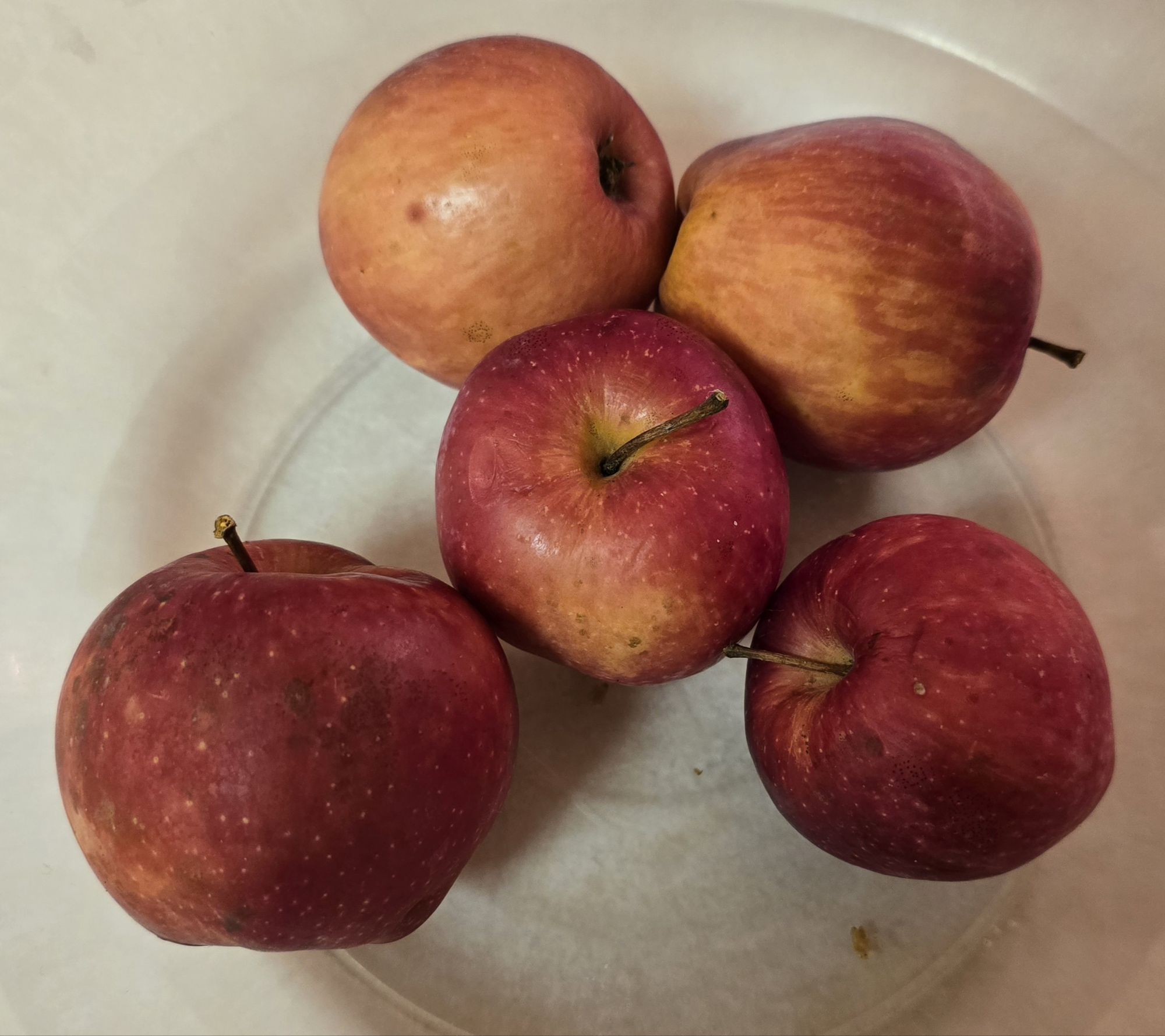
Last five fresh apples.

There are no more apples to harvest from the trees. I made applesauce from the last five on the counter, peeling, coring, and cooking them in a bit of apple juice. When tender, I took the potato masher to them and now I have fresh, chunky-style applesauce. It’s among the best dishes of apple season. There is not much, yet enough to provide a taste of summer.

Now we begin eating storage apples from a special drawer in the refrigerator. I checked them the other day and they are keeping well, even varieties not known to be long keepers. 2025 was a great year for apples, all around.

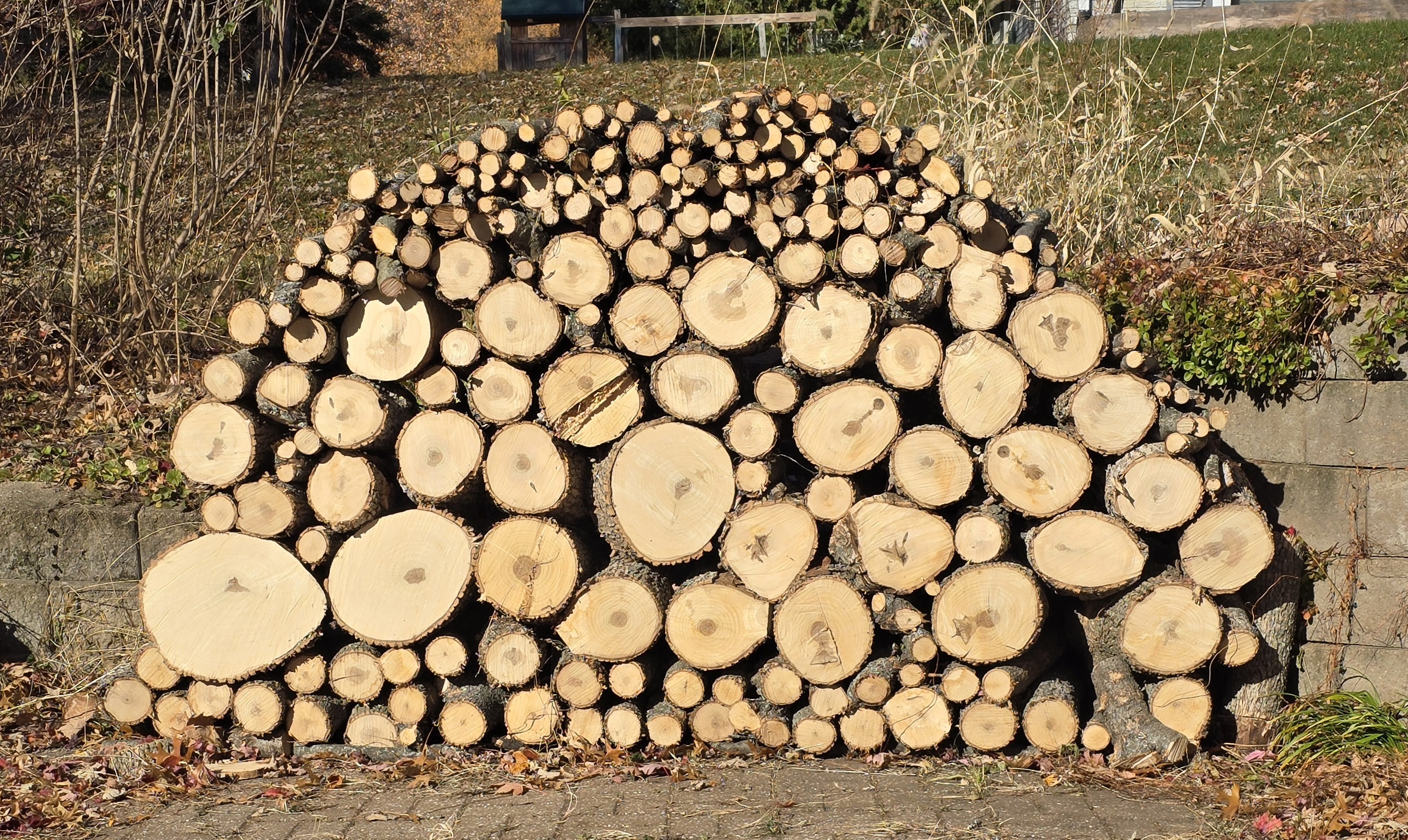
Woodpile from two dead ash trees.

It took about a week from getting a chainsaw, taking down the two dead ash trees, and processing all the wood. We don’t have a fireplace or go camping much, so this woodpile will be for someone else. I offered it to the neighbor who helped take one of the trees down yet he said he has enough for this winter. It is a beautiful thing to look at but I’ll need the space for the greenhouse in the spring.

Burning brush.

Burning the branches took most of a day. The process was straight forward with only a cut or two needed on each before putting them on the burn pile. Everything burned quickly, although there was a lot to burn. I enjoy burn piles and do one each in fall and spring.

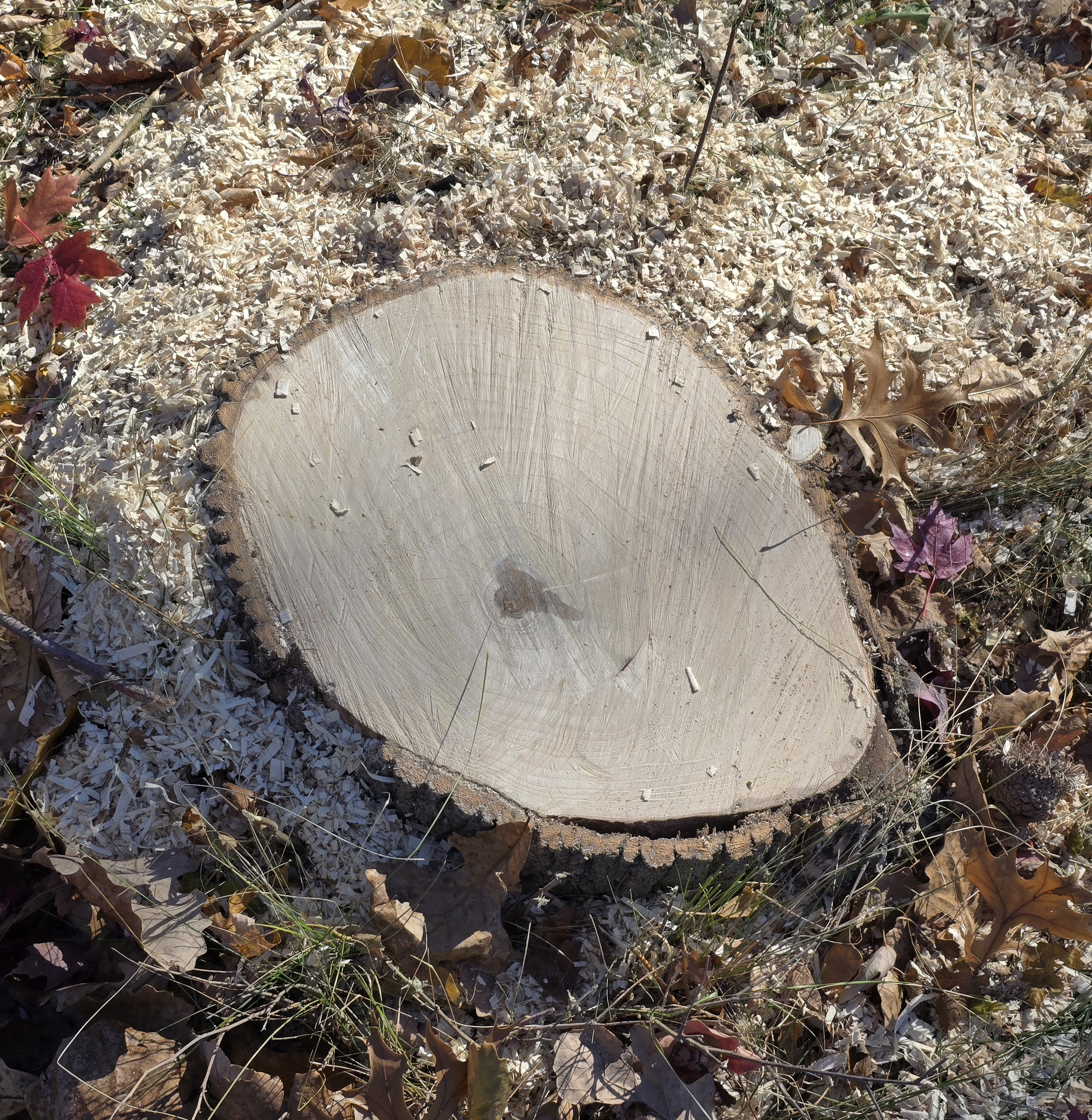
Ash tree stump.

About the only must-do task outdoors is to mulch the leaves now that they have fallen from trees that shed in autumn. That takes about an hour and it should be done this week. After that, I’ll deconstruct what I can of the garden. I know where most of next year’s crops are going, although it is not an urgent fall task. Wildlife continues to enjoy the habitat.

Winter will soon arrive, yet not before we enjoy a few more weeks of autumn. Life at home is an escape from the rest of society. Sometimes we need that.

Categories
Home Life

Time to Change Hats

Project hat issued by the management team when Amoco Oil Company moved all their hard copy data to Oklahoma as part of a large data consolidation project.

After a 25-years of work in transportation and logistics, I accumulated a lot of baseball-style caps. The one in the photo is commemorative of a project where Amoco Oil Company consolidated business information under a single platform. The oil company operated in more than 100 countries when I worked there in the early 1990s. It had almost every computer platform that existed in its wide-ranging, international operations. The goal was to bring computer operations into compliance on a single platform located in Tulsa, Oklahoma, and consolidate all historical paper records in a nearby salt mine. There were six or seven semi-tractor-trailers that hauled the records from 200 East Randolph Street in Chicago. It was such a big deal, they scheduled the move over a single weekend and chartered multiple aircraft, including a large Boeing passenger jet to transport incidental workers involved with the project. That they gave us a hat was a small fraction of the cost of the move.

As you can see in the photo, my data consolidation cap is well worn. Time to let go and choose a new one to use while doing yard work. There is something in the story about the oil company relevant to where I am.

Who doesn’t want all the information and stuff in our lives organized under a single platform? For businesses in the 1990s, data consolidation was a wide-ranging practice among large companies. Part of the de-cluttering process underway here in Big Grove will result in the same thing. With increased visibility of my history, I should be a better family member, citizen, and writer. It should be easier to navigate through the stuff of memories.

Yesterday, at the Armistice Day commemoration in Iowa City, I spoke with a friend about disposition of all of my writing related stuff. I said I would likely burn it all, as our child has little interest in a dozen boxes of personal records. He seemed a bit alarmed and suggested I shouldn’t underestimate the level of interest in archival materials. I’m in something of a yank to go through everything. Disposition is an open question to which there is no pressing need for an answer.

The next step is to pick out a new cap to wear daily and consider disposition a bit further. First thing I need to do is find all of my hats and put them in a single box. That simply requires persistent work. The resulting consolidation should be good for everyone. Perhaps I will appear more stylish.

Categories
Living in Society

Eating Alone – Mac and Cheese

Home made mac and cheese.

My way of cooking macaroni and cheese changed. After some unsatisfying experiments with making it vegan, I now use cheese and butter when I am home alone for dinner. It is on the menu only one or two times per year, so I want it to be satisfying and memorable when I prepare it. I took inspiration for my most recent iteration from Massimo Bottura’s Kitchen Quarantine series during the coronavirus pandemic. Bottura layered the ingredients in a baking dish and I had an Aha! moment.

I have been a mixer. That is, the sauce, noodles, and other ingredients are placed in a bowl and mixed together, then moved to a baking dish and topped with something before baking. Bottura taught me to layer instead, which had never occurred to me. It could be life-changing. Here is what I did.

I preheated the oven to 350 degrees Fahrenheit and greased a baking dish. Next I made a béchamel sauce with four tablespoons each of butter and flour. These two ingredients make a roux, which is cooked a couple of minutes. Milk is added with constant stirring until medium thickness, or it coats the back of a spoon. I embellished the simple sauce by grating some nutmeg into it.

Boiled pasta was ready to go. Either cook it for the dish, or use leftovers. This time, I emptied partial containers of different kinds of dry pasta until I had two cups and cooked until al dente. My thinking is the pasta should be similarly sized, yet that is a personal preference. There are no rules.

Get the cheese ready. This can be anything the cook wants. I like a sharp cheese and used four ounces of white extra sharp cheddar, half a cup of feta, and four tablespoons of grated Parmesan. I had thought to use Gruyère and bought four ounces made in Wisconsin for the project, but it didn’t pass the taste test. If it were Swiss Gruyère, it would.

Next is the layering. A thin layer of sauce on the bottom of the baking dish to cover. Next the pasta spread evenly. Distribute the chunks of feta evenly, followed by the cheddar. The rest of the sauce goes on top, and then into the oven for 30 minutes.

At thirty minutes see where we are. I pulled the dish out and sprinkled the Parmesan on top. I turned the oven up to 400 degrees and let it bake until the crust began to turn brown. The result is in the photograph. Based on the taste, I am now a layer guy.

Mac and cheese is an old dish. In Medieval times it was pasta layered with cheese and baked, not unlike what I did. In the 18th and 19th Centuries, English and European cooks began using a béchamel sauce mixed with cheese (a.k.a. Mornay sauce), and mixing it with the pasta before baking. Let’s not even talk about those Kraft mac and cheese boxes that originated in the 1930s (Mixers, not baked).

My native impulses had me arrive at a rustic-style product that was the antithesis of processed food. If I learned anything by being a part of the local food movement, it is that this kind of dish is what I want.

Categories
Home Life

Gap in the Canopy

Two dead ash trees in the front yard.

If I’d have known the Emerald Ash Borer would take out our two ash trees, I would not have planted them. Yesterday I described the process of removing them.

The sparrows didn’t notice they had been felled. They continued to perch as a flock on the leafless branches. I saw a squirrel checking out the base of one stump. They nest in the Autumn Blaze maple tree and used the dead branches as a bridge to get to the large tree in our neighbor’s yard (On the left in the photo). They would start from the nest, walk across the tall branches to the Bur Oak, to the dead branches of the ash, and then to the neighbor’s tall tree, all without touching the ground. I created a gap in this pathway. The squirrel did not indicate any thoughts on the matter.

Now begins the real work. Anyone can fell a tree: cut, cut, cut… TIMBER! Now is the time for good people to take our saws and make it into firewood and brush. If I had a chipper-shredder, I would make mulch from the brush. For the number of times per year I would use a chipper, the expense is not worth the reward. I got my safety glasses out, filled the oil reservoir, tightened the bar, and ventured out to work after donning my steel-toed boots.

Categories
Home Life

Glorious Autumn

Leaves of deciduous trees on Nov. 4, 2025

Despite the lack of rain, this has been one of the best autumns I remember. It is a pleasure each time I step outdoors and take it all in. With everything going on in the world, we need that type of solace.

Autumn is the time to get the chainsaw out and clear dead trees from the property. A neighbor and I felled two ash trees killed by the Emerald Ash Borer. The occasion gave me a chance to wear the steel-toed shoes I got to work in a Kentucky steel mill back in the day. They even have metatarsal protection.

Steel-toed shoes with metatarsal protection.

I took the first tree down by myself. It took some time to determine where I wanted it to fall. I made a notch cut in that direction. It is important to take the time because as the old saw goes, measure twice and cut once. I made the felling cut and the bar and chain of the chainsaw got stuck. I must have done something wrong.

Hitch to the yard tractor.

I stopped and disconnected the bar from the motor assembly, and was able to pull it out. Not the chain. No problem. I went to the garage and got out my rappelling rope, tied one end around the tree about 12 feet from the ground, and the other to a carabiner attached to the rear of the yard tractor. I positioned the tractor on the cement driveway so there would be traction and gently tugged the tree until it fell over.

First ash tree felled on Wednesday.

My neighbor arrived and we worked together on the second tree. This one had grown with a yoke separating the two main branches. If I felled the southernmost branch the wrong direction, I might take out the neighbor’s fence. We positioned the yard tractor and tied the rope to the tree about 14 feet above ground. I made the notch cut and then my neighbor got on the yard tractor and put tension on the rope. As I made the felling cut, he increased tension, although he lost traction because of the leaves on the ground. No worries the tree fell in the intended direction.

Two tree stumps.

We felled the other main branch and called it a day.

This was the most difficult part of the operation. Going forward, I plan to spend about an hour a day cutting the trees up. I made a place for a brush pile and will salvage two relatively straight limbs to use to stack firewood outdoors and off the ground. I will burn the brush pile when conditions are suitable, and hope to find a home for the firewood. A lot of neighbors are flush with winter firewood presently.

It will take me a week or two to clean up the yard. That part I can do by myself. Autumn days were made for a fellow and his chainsaw.

Categories
Kitchen Garden Writing

Getting a Pumpkin

The pumpkin I bought at Kroul Farms on Saturday.

It has been a couple of years since I froze pumpkin for smoothies so Saturday I went to Kroul Farms which specializes in growing pumpkins. They have orange pumpkins and specialty pumpkins: a lot of them.

Specialty pumpkins at Kroul Farms.
More specialty pumpkins and a little pie pumpkin.

I took mine home for seven dollars and on Sunday I processed it.

First, cut it in half and remove the seeds.

This pumpkin yielded a cup and a half of seeds for roasting.

Cup and a half of pumpkin seeds.

Both halves went into a 400 degree oven and baked about 90 minutes until tender. The timing varies depending upon size of pumpkin and quality of the oven.

Baked pumpkin.

I let them continue cooking on the counter. Next I skinned them and put the flesh of both halves into a large bowl. The use for this pumpkin is smoothies. Since it will go into a blender, I only did a rough mash using a potato masher. The flesh was too wet for smoothies, so I used my conical strainer to drain it. It extracted 4-5 cups of liquid which will go into soup.

Straining the pumpkin flesh.

I cleaned the baking pans and then used an ice cream scoop to make portions on a piece of parchment paper lining the pans. They went into the freezer. Once thoroughly frozen, they go into a Ziploc freezer bag for storage.

Frozen portions of cooked pumpkin.

And that’s how I spent part of my weekend.

Roasted pumpkin seeds.
Categories
Living in Society

Living with AI

Analog sunrise on the state park trail.

It seems clear we will have to live with artificial intelligence, like it or not. As Scottish data scientist and senior researcher at the University of Oxford Hannah Ritchie posted on Monday, “AI could really change things. It has the potential to not only improve the accuracy of (weather) forecasts but also to run them more quickly and efficiently. That then makes them better and cheaper.” Okay… I’m listening.

At the pre-2025 National Oceanic and Atmospheric Administration, weather predicting got very good. I could look at the weather radar on my computer, identify where the storms were going and with what intensity, and then figure out how much time I had to mow before rain started. Because of great weather forecasting, I was almost never wrong. How much better can it get? With the administration’s cuts to NOAA, the machines may be necessary to continue progress, and according to Ritchie, it looks like they have the potential.

For me, the AI game changer has been organizing basic life tasks. On Oct. 10, I wrote:

I’m four days in using AI to help plan a more productive day. With its “Balanced Day Plan,” I immediately eliminated a background concern that there is too much to do and not enough time in which to do it. I am fond of the saying an air traffic controller can only land one airplane at a time. So it is with tasks I have before me. AI finds a way to get it all into a day. If it can’t, it tells me. This serves as a stress reliever, helping me focus on the task at hand, and I do a better job with it. For example, I need to drink more water to stay hydrated. …This pursuit is just getting started and my best hope for AI lies herein.

From there, my life has taken wing. It is curious what a tonic eliminating worries can be. While AI has been great at getting my organizational juices flowing, I have already come to a high water mark with the machine, and from here I can proceed on my own.

I took the “Balanced Daily Plan” and translated it into language that fits in my world. I updated my existing, pre-AI Daily Plan to include the most salient points identified by AI. I was concerned about adequate hydration, so I highlighted in blue some words where my new hydration schedule would occur. I generalized the pomodoro work block process, with three blocks in the morning and two in the afternoon. I was careful to create plenty of space to do necessary tasks and recover once they were done. I decided to move to the kitchen about 3 p.m. and work there until dinnertime. AI helped me to recognize how a day could be structured, something I was not doing with any effectiveness on my own. Now that I re-wrote my regular schedule, I am free to go on my own, and will.

During the pandemic, stuff had a way of accumulating without being adequately addressed. This includes all of the areas in which I work at home. Think of the basics: food, shelter, and clothing. Each of them was a disorganized space where I had no idea what was possible. I got bogged down by stuff accumulated in each area. To get started, I queried AI about the vast quantity of t-shirts scattered throughout the house. The machine result helped organize the collection enough to know what I could be wearing for different purposes, and store the ones not in immediate use in labeled boxes. That had been hanging over me, yet by using AI to do the project I relieved stress and worry about it.

From here it became easier. I cleaned out the refrigerator and found a vast quantity of pickled items. Unaware, I overestimated how many pickles I could eat in a year. The pickled vegetable situation got away from me. I did not use AI for this sorting. The t-shirt project had primed the pump for any type of organizational project. Now I look for those projects to fill some of the space outside pomodoro blocks. This will apply to my workshop, writing space, the kitchen, garden, and all of the defined spaces in our home. This is what I mean when I say my life has taken wing.

AI is not going away. I expect to use it as a tool when I find a project puzzling, poorly designed, or inadequately resourced. No one knows the future of AI despite all the public rhetoric. It is far from easy to use and keeps crashing on what I believe are easy tasks. For the time being, it is one more tool in my workshop to help make life better. That and a few pickles to snack on and I can make it a day.

Categories
Living in Society

Eating Alone – Mexican Fare

Home Made Tacos

When my spouse is away, I haul a small boombox upstairs and crank the volume up. I find myself digging out old compact disks and audio cassette tapes, listening to Iowa Public Radio more, and tuning into the local classical music station. Classical music is more interesting on the radio than in other media because of the announcer. While I wouldn’t call it “going wild,” it’s as wild as I get regarding music these days.

How I prepare Mexican food is different when she is away. When cooking for two I avoid use of ingredients that contain capsaicin, a.k.a. 8-methyl-N-vanillyl-6-nonenamide. According to Wikipedia:

Capsaicin is an active component of chili peppers, which are plants belonging to the genus Capsicum. It is a potent irritant for mammals, including humans, for which it produces a sensation of burning in any tissue with which it comes into contact. Capsaicin and several related amides (capsaicinoids) are produced as secondary metabolites by chili peppers, likely as deterrents against eating by mammals and against the growth of fungi. Pure capsaicin is a hydrophobic, colorless, highly pungent (i.e., spicy) crystalline solid.

It’s hot. Lots of people don’t care for it or are allergic to it, including family members.

When we are together I get my spice by adding hot sauce as a condiment. When I cook and dine alone, I’m free to add it while cooking. Mexican fare is flexible in preparation so the lack of heat while cooking has not been an issue. My process for using chili peppers continues to change. I wrote about the basics in 2019:

The recipe for hot sauce evolved over time from one Juan San Miguel explained in 1977 when we both garrisoned in Mainz, Germany. Those were days before a four-foot section of assorted hot sauces became standard in supermarkets.

I lost contact with him yet the recipe persists. It is a rare day when there is no hot sauce in the ice box.

We carried the condiment in plastic milk jugs and put it on our army rations while on maneuvers in the Fulda Gap. It made our eyes water and changed regular food into edible fire. We laughed a lot in that peace-time army… and ate sandwiches of bread and hot sauce. I continue to make it mostly the way Juan taught me. (Meditation on Hot Sauce, Oct. 20, 2019, Paul Deaton).

This week included making hot pepper paste, dehydrating Cayenne peppers for red chili flakes, blending jars of powdered hot peppers from the pantry to use in shakers, and using a fresh jalapeno when making enchiladas. I found less is more: reducing the number of preparations to just a few that will be used. October is the month to do this as hot peppers are the most abundant late harvesting vegetable. Getting all this kitchen work done while she is gone is a plus. Even I had to wear a KN-95 face mask while mixing the powdered hot peppers. I should be wearing a pair of surgical gloves yet don’t and my hands sting for several hours after preparing fresh chilies. I know I’m alive.

A typical difference when I am eating alone is taco filling. The main recipe I use is a blend of black beans, kale, onions, garlic, bell peppers, tomato sauce and Mexican oregano. When cooking alone, instead of tomato sauce, I make a sauce of dried guajillo chilies. These chilies are not that hot but when allergic to capsaicin, any amount is too much.

Enchiladas are in the refrigerator waiting to bake for dinner. Tuesday is for tacos when I’ll use fresh chilies. I am not a heat nut, yet have a more developed use of chilies grown in the garden than most Iowans. The use of chilies characterizes my kitchen-garden.

Categories
Living in Society

Eating Alone – The Refrigerator

Refrigerator the day after my spouse left on a trip.

This week I am eating alone because my spouse left on a trip to visit her sister. The first thing to do was go through the refrigerator and study the contents.

There were two leftover servings of tofu-vegetable stir fry and a jar of chili. That’s three meals right away. I made both dishes to share for dinner, and leftovers should be equally good.

There are a dozen eggs, fluid milk, butter, sour cream, cheeses, pickles, three kinds of bread — a commercial loaf, sour dough, and locally baked burger buns. The two drawers have storage apples in one, and an array of fresh vegetables in the other. Nothing to compost here as we keep the veg moving. I need to use the last two garden eggplants soon.

The bottom drawer has loads of fresh greens, uncooked flour tortillas, and more cheese. The doors have a partly empty carton of oat milk, a gallon jug of skimmed cow’s milk, the rest of a half gallon of fresh apple cider, and countless jars of mustard, ketchup, sauces and condiments. We are well-stocked!

To sum it up, there are three easy meals of leftovers and diverse sandwich-makings. Eggplant lasagna or something similar is in the works. Tacos are always possible. I have three small heads of Romaine lettuce, so a big salad for dinner could be done. Without doing much of anything, I’m halfway through the solitary eating period. I needed to go to the grocer.

My shopping trip was typical. I spent time in the fresh fruit and vegetable section studying what was available and comparing it to what we need. I bought some grape tomatoes on special pricing, a bag of red radishes, and a bunch of green onions. I get organic celery here because celery is at the top of the list of pesticide-laden vegetables. Buying organic celery makes sense.

In the specialty cheese section I bought some Wisconsin-made Gruyère to melt on something. Next I went to the cereal aisle and added a small box of Post Grape Nuts to the cart. I had been reading about using it as a crunchy topping on salads and thought I would try it. I also got a box of store-brand Raisin Bran because it was on special pricing. (I know! Impulse purchase). I picked out a big bag of Halloween candy for trick or treaters and everything else I got was replenishing staples in the pantry.

My spouse is vegan, so the dairy is for me. That I remain an ovo-lacto vegetarian sets me on a deliberate path to separate us in eating. I learned to make delicious vegan meals we share. The difference is also part of why I sometimes cook for myself even when she is around.

So I have a plan to eat alone this week. It is essential work for the period of physical separation. Because this is no different from any other day, it suggests I eat alone often. I do.