Weather permitting, I expect to prepare part of the garden today.
While the soil is too wet to work, last year’s fencing and cages can be removed to create a space to fell two oak trees, one of which is leaning as a result of the August 10, 2020 derecho, the other needs removal to make room for the remaining one to grow unencumbered. I’m ready.
The seedling operation is ahead of previous years. The debate is whether to put the brassica seedlings directly into the ground, or re-pot them to give the roots more room to grow before transplant. I’ll likely do a mix of techniques and compare. The sprouts aren’t quite to the point of forming the third leaf yet it won’t be long.
New spinach seeds arrived yesterday. The old ones aren’t germinating properly so I bought a new packet of 1,000 Seaside Hybrid Smooth Leaf Spinach seeds from Johnny’s Selected Seeds. I’ll start a couple dozen on the heating pad, and direct seed some as soon as the ground can be worked. My friends at the farm already direct seeded spinach, beets, peas and carrots.
Garlic is coming up nicely. It’s been in the ground for five months and I doubled the amount planted. I picked the best cloves for seed and hope for the best this year. We use garlic most days in our kitchen, so it is an important crop.
The beets I moved from the greenhouse to the heating pad are germinating. As soon as they appear successful, I’ll move them back to the greenhouse to wait for dry ground. The heating pad space will be to start peppers and tomatoes in channel trays. This year I’m going big with Guajillo chili peppers to make sauce for the coming year. In 2020 I experimented making my own Guajillo chili sauce and if successful this year, I’ll replace the commercial Hatch pepper sauce I’ve been using.
It’s been a challenge to use all the canned tomatoes. This year I expect to plant a lot of Roma-style tomatoes for canning and put up about 24 quarts. I’ve been freezing some tomatoes. While it’s easy, I prefer canned. Canned Roma tomatoes are becoming our mainstay for cooking chili, sauce and soups. It reflects a bit of refinement. In past years I canned any tomato I grew, skin on. Peeled Roma canned tomatoes are a much better option. I’m growing a large variety of tomatoes to eat fresh. My process is to germinate plenty and plant at least two seedlings of each type. We like the variety.
As we come out of the darkness there is hope for the day. That’s emblematic of so much in our lives during the time of contagion.
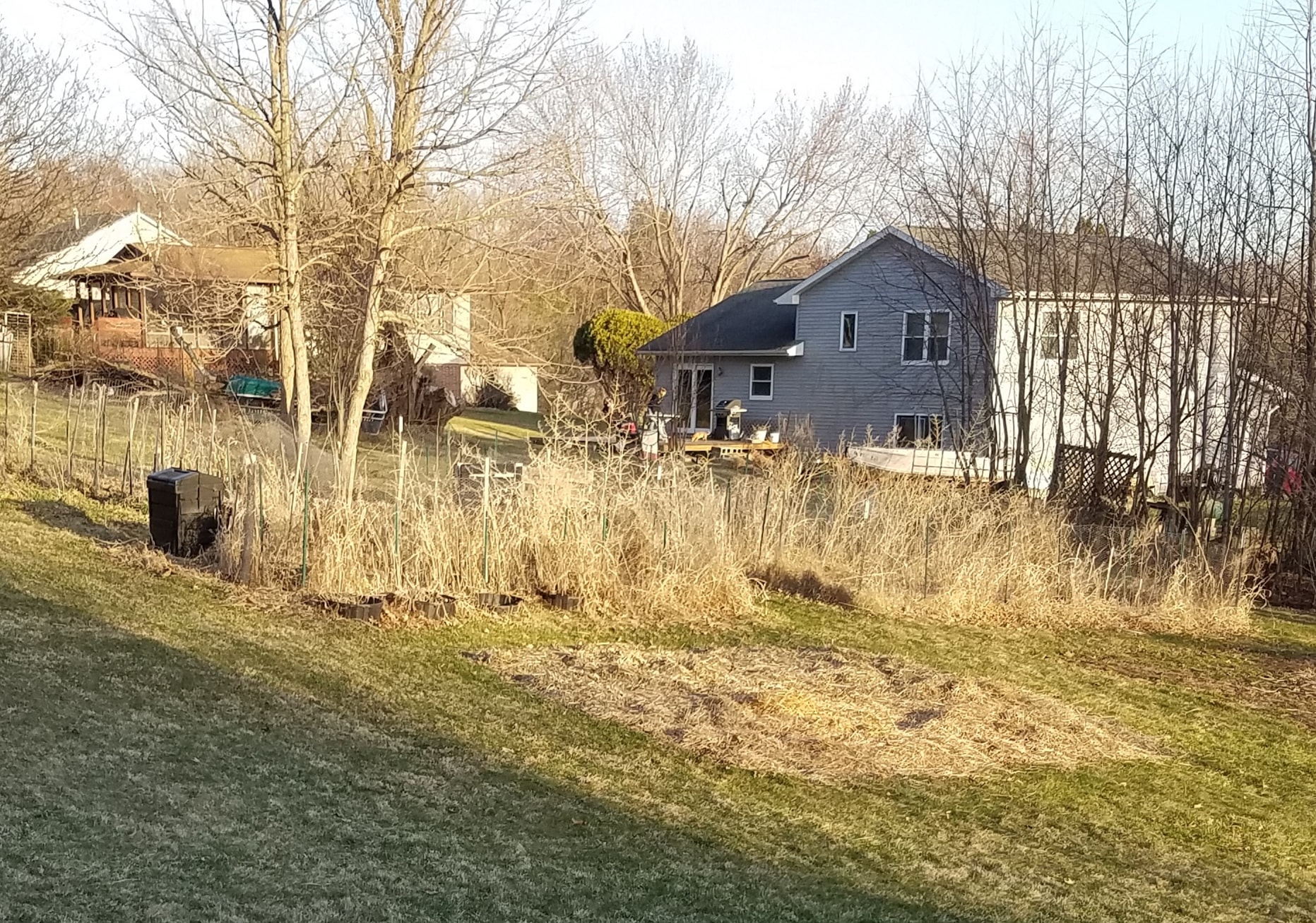
Saturday was a punk day because of Friday’s COVID-19 vaccine booster shot. I felt tired most of the day, took a long nap, and curtailed outdoor activities even though skies were clear and temperatures moderate. I took this photograph of the garden as the sun set. It’s a starting point for the gardening season.
Garlic is poking through the straw and everything else needs clearing. The forecast today is a high of 65 degrees, so if I feel better, I’ll be out in the garden. I need to be out in the garden.
We have three head of fresh garlic left from last year. After using it, there is a pint of pickled garlic, and a jar of commercial chopped garlic to use. If we can’t make it to scapes, I’ll buy some elsewhere to see us through.
The pandemic had us cooking more at home, resulting in flats of empty Mason jars stacking up. Maybe ten dozen have been emptied since harvest. We are almost out of prepared vegetable broth, so I plan to make seven quarts from the freezer to tide us over until turnip greens are ready.
It’s not just me. A lot of us want the coronavirus pandemic to be over. There are some positive signs. At the Friday vaccination clinic one of the people administering shots said there were less than half a dozen coronavirus hospitalizations at the University of Iowa Hospitals and Clinics. No one there was on a ventilator. Outbreaks have been reduced to close to zero at Iowa nursing homes. The media narrative changed rapidly when supplies of vaccine boosted by the Biden administration’s efforts began to arrive. The pandemic is not over, yet as we see the number of cases and deaths decline, there is hope.
Gardening continued during the pandemic. It has been a source of normalcy. As the new season begins, I’m ready to see what adventures arrive in our patch of Big Grove Township. It’s been a long, isolated winter that on this first day of Spring appears over.
The manufacturer made some design improvements in the small, portable greenhouse I bought to replace the one destroyed in the Aug. 10, 2020 derecho. Because I did not return to the farm in February, this space is more important to my garden.
Each day I take walkabout on the property, observing the advent of Spring. I watch overnight temperatures in case frost is forecast. If it is, I bring trays of seedlings indoors. Since the greenhouse was assembled, there has not been a hard frost.
Even though the greenhouse is nice, the prime real estate for seedlings is the heating pad bought for germination. As soon as seeds emerge and have an extra leaf, I move them to the greenhouse to make way for the next wave of starts. I’ve become accustomed to leaving seeded trays at the farm and not thinking much about them. I like being closer to germination in the new process.
All of this brings the kitchen garden one step closer to full development. I don’t know how I did without a home greenhouse for so many years.
Ambient temperatures were in the low 60s on Sunday, creating a suitable environment for a yard walkabout. The report is in: Spring is coming.
The flowering bulbs were the first sign of it. Along with apple trees beginning to bud, garlic is up under the layer of straw, and lilac bushes show new growth. Most of the grass is brown and matted from recently melted snow, yet there is a bit of green scattered around the yard. The signs are unmistakable.
I assembled the portable greenhouse and moved four trays of seedlings outside. It was warm enough overnight to leave them there. I planted a flat of spinach, celery, parsley and cilantro, using up last year’s bag of soil mix. This flat went on the heating pad for germination. There remains indoor work, yet our focus can turn outdoors.
As snow continues to melt in the garden I considered where to plant early lettuce. The ground is not workable, yet soon will be. When it is the seeds can go down and there will be a lot to do.
The calendar shows 13 days until Spring. I’m already there.
The specificity of the garden project is comforting. There is a clear beginning and end. The work product will be useful. It is eminently do-able in a single work shift. I crave more of that over the complicated and grand-scale projects lingering on my to-do list. I yearn for resolution of the vagaries of living in the coronavirus pandemic.
When the Aug. 10, 2020 derecho shook loose buckets of sand anchoring the portable greenhouse to the bricked pad, its time had come. The wind lifted the greenhouse straight up in the air and tumbled it into the next door neighbor’s yard, destroying it.
I bought a replacement as I’ve come to rely on having my own greenhouse to start seeds and store garden seedlings.
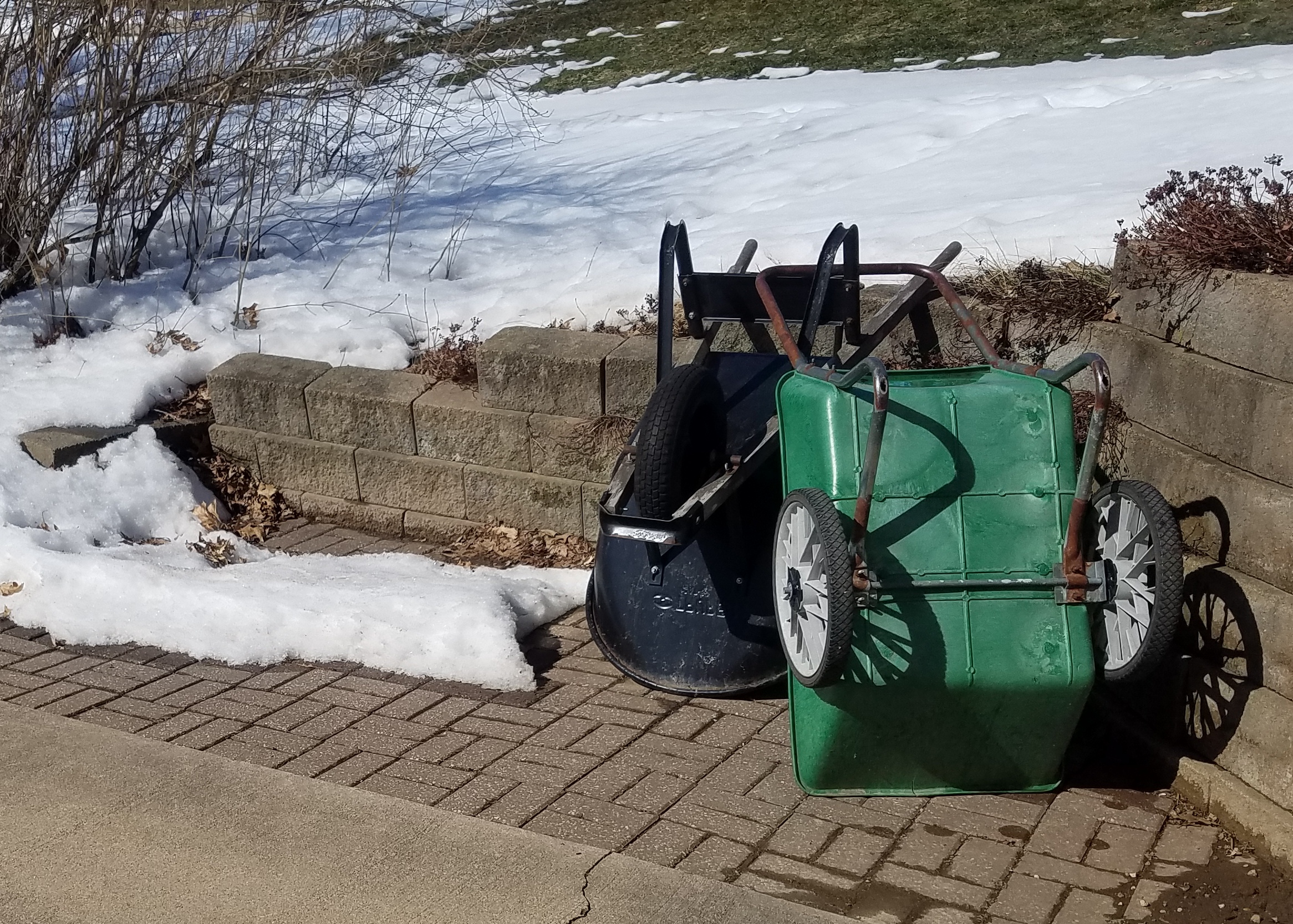
Snow cover melted enough to shovel the rest of the pad and install the new greenhouse. The road in front of our house is dry so I can sweep road sand into buckets to hold this one down. It will be the first outdoors project other than snow removal this year.
The coronavirus pandemic created vagaries that plague us in daily life. The governor’s most recent proclamation found me in the “vulnerable Iowan” category because I’m over 65 years of age. She encourages me to continue to limit my activities outside home, and encourages others to stay away from me. Fine. I’ve done that by provisioning in town every other week. Provisioning trips were the only time I left the property since the proclamation was released Feb. 5. Everything else we need, which isn’t much, we get delivered to home. This part is easy.
We are scheduled for a booster of the Pfizer COVID-19 vaccine on March 19. The pharmacy sent a confirmation email yesterday. What happens after that is unclear. Epidemiologists say we are waiting until presence of the coronavirus in the community is limited. Not sure what that means. There is no reasonable indication of what social behavior in the post-pandemic world looks like. I’m thinking of getting rid of the personal-sized pizza pans I use for entertaining. Should I?
I look forward to sweeping up the road sand and clearing the space for the portable greenhouse. It’s something to latch onto and call finished in a day. Yet I yearn for more, for resolution of the uncertainty of our current lives. It’s not existential angst. It’s simple things like how many gallons of skim milk should I buy at the warehouse club. If things were normal, the number would be one.
I need the greenhouse space soon andplan to work on the project as winter snow melts in Iowa. After that, I’ll pick another, then another, until a sense of normalcy returns.
Snow covers much of the ground as March begins. Last year I planted kale in the greenhouse on March 1. This year the seedlings have four leaves on them today thanks to a heating pad and grow light downstairs.
The farm posted photos of their onion starts and mine look similar. That’s a good thing, bringing hope onion planting and harvest will go well. It’s going to be a great gardening year, I can feel it.
The word count on my writing stalled around 150,000 words. Mostly, it’s because of the larger than expected need for editing. It’s also attributable to a lack of organized research materials combined with the reworking of written passages as new information returns to mind. If I plan to finish this book by the end of the year — and I do — I need to clear the Spring ice jam.
I’m reasonably consistent at producing a daily blog post, yet the longer project has distinct challenges. I spent the last two months mostly indoors, considering my life, and producing a lot of words. What I didn’t know before, and do now, is I can’t go into the same detail as I may want to get the book done by December. Also, there is more editing time than writing a first draft, a lot more.
The press of March is also a factor. More of my time will be spent outdoors, making the early morning writing shift more valuable. I don’t know what that means presently, except more of that time should be reserved for book writing. I do want to finish something by 2022.
This week’s planting schedule is for collards, spinach, and more celery and herbs. Each week there will be more gardening tasks to include until by April, gardening will dominate my days. I knew that going in. On March 1, I’m there.
Driveway on Feb. 22, 2021. First day ambient temperature was above freezing since Feb. 4.
March 2 is the day to plant Belgian lettuce, according to family tradition. It’s garden lore from my Polish grandmother, one of the few tips from her about gardening I remember. This year, Belgian lettuce seems doubtful with more than a foot of snow on the ground seven days out.
If I can work the ground, I’ll plant it. It got warm enough to begin thawing on Monday, so fingers crossed. One has to ask where all the water will go. The answer is to late winter flooding.
Indoors I transplanted brassica seedlings started Feb. 7 to larger pots. The 12 broccoli plants are intended for an early wave. I planted 30 more broccoli seeds in blocks for the main crop. I reduced the amount of collards and kale this year. If I had six each of the two varieties of kale and four collards, that would be enough. I also had six kohlrabi plants in this batch. I need to plant more Redbor kale seeds next planting session as only five seedlings survived.
20 celery seeds are planted. They take the longest time to germinate, although this year I’m trying a new variety and they are on a warming pad to aid germination. If I were still at the farm, I’d plant more and put them in the greenhouse. The table downstairs with the heating pad has only four spots for trays and only two of them heated. I’m learning self-sufficiency in this, my first year away from the farm in a long time.
I have the new, portable greenhouse still in its box. It will stay there until the snow on the brick pad melts. Once it is set up I can move some of the seedlings outdoors and use the space heater when it gets cold. There is plenty of time to get everything started.
We look forward to the thaw more this year than most.
Forgetting to turn off the grow light before retiring to bed is a new bad habit. Seedlings need a daily rest from light, at least for 4-5 hours. I end up turning the light off around 3:30 a.m. when I return to my writing space for the day.
Learning to garden is a never ending process if one is any good at it.
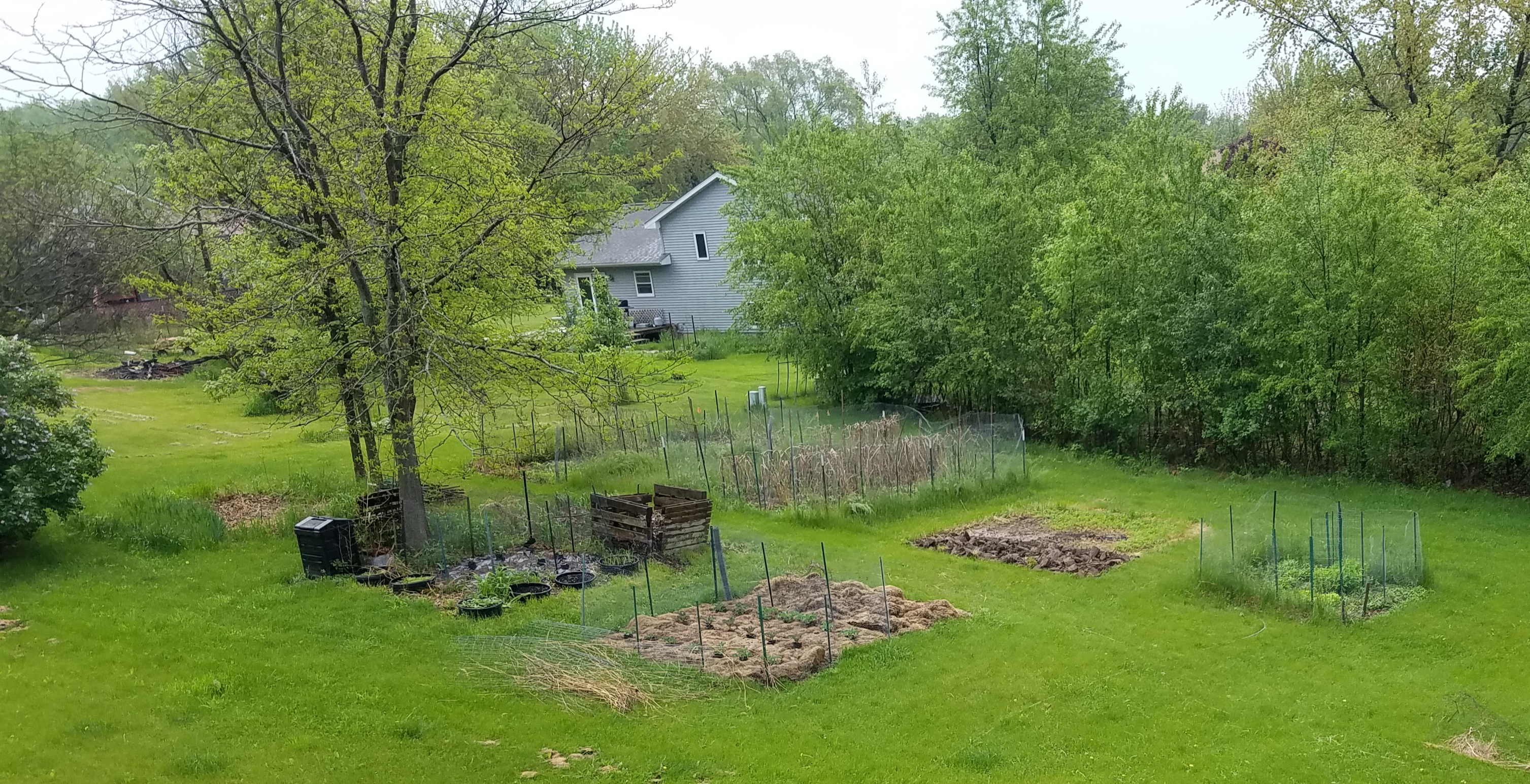
This year the garden is in for big changes. The Aug. 10, 2020 derecho blew over the Locust tree and tilted one of the three Bur Oaks enough it should be taken down. I plan to cut two of the Bur Oaks to provide space for the remaining one to grow normally.
The derecho damaged a lot of fencing I use to discourage deer from jumping into the plots. There will be new stakes and new chicken wire fencing. If we had the resources, I’d install an eight-foot fence all around the garden with a locking gate. There are other projects begging for the money, so that plan is deferred.
The garlic patch is in, but the other plots are an open book. I will rotate cruciferous vegetables and beans. I need a whole plot for tomatoes and a small one for leafy greens. I ran out of garden onions this month, so I want to grow more this year and that will require a bigger space. No final decisions to be made until I plant Belgian lettuce on March 2, two weeks from now, if the snow melts.
The goal of having a kitchen garden is to produce food aligned with our culinary habits that helps meet a basic human need. We have to eat, no matter where, no matter how. It may as well be enjoyable. We’ve all eaten our share of food that doesn’t please our palate. A kitchen garden should address that.
There are inputs to address, other than the garden part of a kitchen garden. Perhaps the most significant is intellectual. Most people don’t frame such a construct although they should.
A kitchen garden is a reaction to the culture of consumerism. An important distinction is reaction, not rejection. I will continue to buy black peppercorns, nutmeg, vanilla bean extract, refined sugar, and all-purpose flour milled elsewhere. How else will we get such necessary ingredients?
For the time being, I’m ovo-lacto-vegetarian (most of the time), which means consumption of dairy products and the good and bad that goes with them. I’m not of one mind on this. For example, I’ll buy a gallon of skim milk from the local dairy 6.2 miles from my house, yet I’ll also stock up at the wholesale club for half the price. I take local eggs from the farm when offered, yet I also buy them at the club. Maybe it’s best to become vegan and eschew dairy altogether. I’m not there yet.
While I am a local foods enthusiast, and my diet centers around being that, I am not doctrinaire. Other people have to consume the results of my kitchen work, although during the pandemic that’s only one other person who I’ve known for going on 40 years. Despite several issues with his behavior and written output — including bigotry, racism and patriarchy — I like the Joel Salatin idea of a food shed. That is, secure everything one can that is produced within a four hour drive of home. I am also not doctrinaire about “food miles.” I’ve written often on the topic and if we work at it, we can secure most of our food produced within less than an hour drive from home.
During the pandemic we haven’t eaten restaurant food even once. If we get out of this thing alive, I see a return to restaurants as a social endeavor. I like our cooking better than any restaurant fare I’ve had the past many years. I expect the habit of cooking and eating at home will persist. How would restaurant dining fit into a kitchen garden? It would be an infrequent adventure in expanding our menu and spending time with good friends.
Another part of a kitchen garden is providing proper nutrition. That means research to understand nutrition enough to combat common diseases — diabetes and cardiovascular disease particularly. Portion control is also part of nutrition, related to maintaining a healthy weight. My research into nutrition was mostly a reaction to medical clinic visits. I sought to change the results of my blood tests regarding cholesterol and glucose through dietary adjustment. The approach has been to discover techniques and processes, then adopt them by habit to weekly meal preparation. Every so often I will consider nutrition in my diet. Mostly, once a new pattern is set, I follow it.
The influence of television and so-called celebrity chefs is part of the intellectual development I bring to the kitchen garden. Before I left my home town for university I spent almost no time in the kitchen learning how to cook. The first meals I prepared for guests were tuna and noodle casseroles made with condensed cream of mushroom soup from a can, once for Mother before leaving for military service, and once for friends at my apartment in Mainz, Germany. My early cooking years — in the 1970s — were trial and error and a lot of marginal, home-prepared meals. I recall at least one loaf of “bread” I used as a doorstop. It was baked while I was an undergraduate, interested in macrobiotic cooking, and didn’t understand how yeast worked.
I learned cooking mostly from television. In 2014 I wrote this about my experience on a work assignment in Georgia during the 1990s:
TV Food Network, as it was known, occupied my non-working time, and I developed an insatiable curiosity about food and its preparation. Emeril Lagasse, Mario Batali, Susan Feniger, Mary Sue Milliken, Julia Child and others prepared food on screen, and I was captivated, watching episode after episode on Georgia weekends. Food is a common denominator for humanity, and I couldn’t get enough. My involvement in the local food movement today has its origins in the contrast between that uninviting place in South Georgia and my food escape.
There is a broader point to be made than one person’s transient addiction to a television network while away from home. It is that American food pursuits, and the economy around them, continue to be based partly upon curiosity.
Curiosity About Food, Blog Post, April 17, 2014.
Over time, Food Network became more formulaic and less interesting. It also moved to a form of cookery competition that diverged from recipe preparation. I don’t tune in today. It opened my mind to the possibilities of food preparation and for that I am grateful.
The last part of intellectual development affecting the kitchen garden has to do with studying recipes. In my ongoing document mining I expect to purge my collection of hundreds of cookbooks. Partly because there are too many for reasonable use, and partly because I have learned the lessons from many of them. Which cookbooks have mattered most?
Like it is for many people, The Joy of Cooking by Irma S. Rombauer and Marion Rombauer Becker is a go-to book when I’m learning to cook a specific dish or vegetable. I continue to use it a lot. I frequently use Mastering the Art of French Cooking by Julia Child, Louisette Bertholle and Simone Beck. I keep copies of other reference books, but those are my main two.
For variety, I have cookbooks by Mario Batali, Giada De Lautentiis, Rick Bayless, Jeff Smith, and Anthony Bourdain, all of whom appeared on television during the period I watched cooking shows. These recipes produce food we like. I also use a few baking cook books, Bo Friberg’s The Professional Pastry Chef, and The King Arthur Flour Baker’s Companion. I’m currently working my way through some cook books used by local chef, the late Kurt Michael Friese.
I studied church and organizational cook books extensively. I adopted very few recipes from them so most are going to go. I’ll keep those that have some sentimental value, ones in which recipes by friends appear, and a set of a dozen or so from my old neighborhood in Northwest Davenport. The purpose of acquiring these cookbooks has been to understand the development of kitchen cookery beginning in the 1950s and ’60s. People used a lot of gelatin and lard back in the day, that’s for sure.
Whatever I learned from studying cookery reduces itself into repeatable main dishes made using understandable preparation techniques. A family only needs so many recipes. As I progress, the kitchen garden becomes more related to cuisine, one recognizable and uniquely our own. It is a cuisine tied to soil I made, the flavors that emerge from it, and the methods used to make it into dishes. The garden has already changed to better match what is going on in the nearby kitchen. That relationship will continue to evolve.
The journey home begins with an understanding of where we’ve been and ends, if we are lucky, with a pleasant reunion with family and friends. A kitchen garden works toward that end.
Kale, broccoli and collards germinated within three days. This is the first year using a heating pad and grow light indoors. My reaction is positive.
Already onions, shallots, leeks, basil and the cruciferous vegetables are in process. Despite more than a foot of snow on the ground the garden starts bring promise.
March 2 is the traditional day to sow lettuce seeds in the garden. If the ground can be worked, I will. Grandmother called this planting “Belgian lettuce,” regardless of the variety of seeds planted. With my new indoor setup I’ll be starting lettuce indoors as well, as soon as snow melts and the greenhouse can be assembled. Annual cycles of gardening have begun.
What’s different this year is the coronavirus pandemic. Iowa has had a slow start up in vaccine distribution with not much relief in sight for the near term. I know some of the places where vaccines will be available and as of yesterday, no appointments were available. The main impact is my decision to avoid working on the farm this year until being vaccinated. That means I’ll have to be more self-sufficient in my gardening. I believe I’ll be fine.
The outdoors temperature is forecast to remain cold for a while. Yet indoors, there is hope of a great garden.
A few onion sprouts poke toward the grow light from channel trays resting on a heating pad. Planted Jan. 20, more of them should germinate soon and rise up. I check them multiple times each day. Successfully growing them is not a given.
We are a distance from working in the garden. Tuesday I cleared a deep snowfall from the driveway in case we have to get out. A neighbor plowed a two-foot berm left by the snowplow at the end of the driveway. We are well-provisioned and can stay home for a while, that is, unless something happens. I would enjoy visiting friends over coffee in town. But for the coronavirus pandemic I would.
Joe Biden has been president for a week. Already he ramped up COVID-19 vaccine distribution to bring an end to the pandemic. News reports say if his actions are effective, we could see the end of major risks of the virus by the end of summer. Partly, it’s why we elected Biden.
Tuesday was a good day for research on my book. I found a historian who used information and artifacts about my Minnesota ancestors to write about Polish immigration. While I printed copies of historical documents when I visited Lincoln County, his work pieces together a story I couldn’t see on my own. He tied together the locations where my Polish ancestors lived in Pennsylvania, Chicago, LaSalle County, Illinois, and Lincoln County, Minnesota with a specificity I hadn’t found previously. His work gave context to their lives in a way I couldn’t see when I visited the home place and surrounding farm community. His short article presented a believable picture of life at the end of the 19th Century that informs understanding of my family history.
For the last few years I’ve had trouble reading. When I visited an ophthalmologist at the University of Iowa clinics, years ago in the before the mobile device era, he identified a condition where my eyes don’t always focus together, resulting in a kind of double vision. Over the years I’ve gotten used to seeing double. Before he identified the condition I wasn’t aware of seeing double. I improved my reading ability by sitting at my writing table with eyeglasses on, instead of reading without glasses in bed or in a recliner. There was more at work than slight nearsightedness. Reading earlier in the day at my table has been more productive. While I wear bifocals and have specially made eyeglasses for desktop computer use and reading, my sight is pretty good. For that, I’m thankful as I read a lot, Now maybe I can read more.
It is another day in the time of contagion. I look forward to the gardening season, yet while there is snow cover, indoor work continues.







 Journey Home
You must be logged in to post a comment.