Categories
Kitchen Garden

Planting Cool Weather Crops

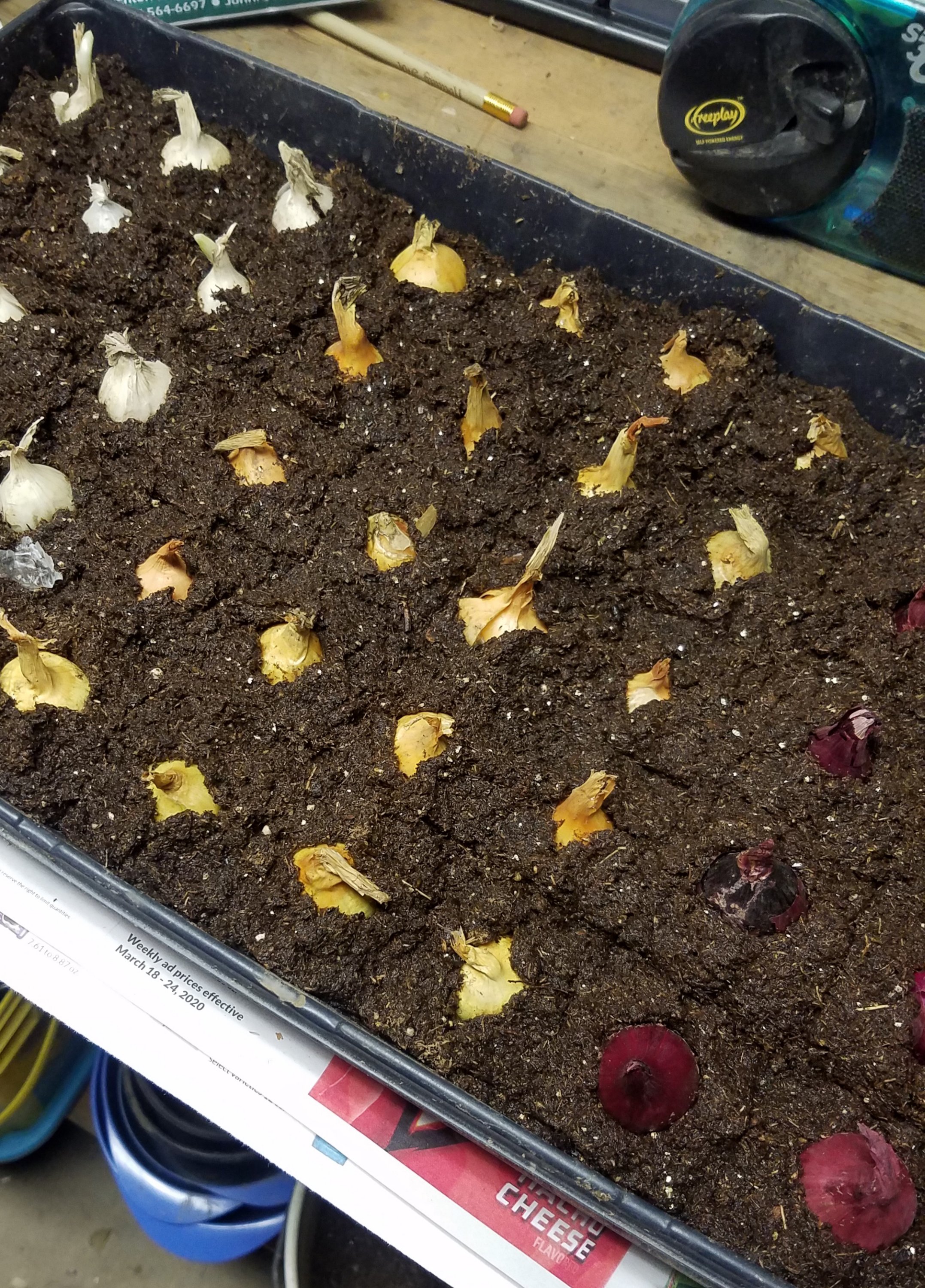
Container planting onion bulbs for spring onions.

On a mild, clear Sunday I planted cool weather crops.

Arugula and lettuce planted in the ground March 2 are coming along. I tasted a tiny arugula leaf to confirm what it was. Mmmm. It won’t be long before I can make a pasta dish using fresh arugula with bow tie pasta.

In spurts of action with deliberate steps — a process developed as I slow down in the garden — I planted beets and turnips to fill out a patch near the early arugula and lettuce, and filled four containers with two varieties of potatoes, one with radishes and another with three types of onions from the home, farm and auto supply store to be harvested as spring onions. I filled out the onion container with basil seeds. It felt like I made progress.

I mulched the leaves remaining in the front yard, cleared off the plot which grew kale and cherry tomatoes last year, and removed the wire containers from the plot near the in ground containers. There’s more work to do as long as the rain holds off. I planted in soil:

Potatoes

Red Norland, ten weeks.
Kennebec, ten weeks.

Onions

Three varieties of bulb onions, three to four weeks for spring onions.

Turnips

Purple Top White Globe, Ferry-Morse, 55 days.
Purple Top While Globe (certified organic), Johnny’s Selected Seeds, 50 days.

Basil

Sweet Italian Basil, Ferry-Morse, 70 days.

Radishes

Red Meat, Johnny’s Selected Seeds, 50 days.
French Breakfast, Johnny’s Selected Seeds, 21 days.
Icicle Short Top, Ferry-Morse, 28 days.
Champion, Ferry-Morse, 28 days.

Beets

Zeppo Hybrid Round Red, Johnny’s Selected Seeds, 50 days.

I removed the automobiles from the garage as I have each spring while planting the garden. I noticed my inventory of powered equipment increased. With a gas-powered trimmer, an electric tiller, two lawn mowers, and an electric and a gas-powered chain saw, it feels like I’m ready. The electric tiller is a concession to age, yet I admit it does a great job of preparing the soil for planting.

Sunday was gardening, as good as it gets. A fit thing to occupy ourselves as we maintain a distance from people because of the coronavirus.
Categories
Kitchen Garden Writing

Clearing the Garden

First Brush Pile Fire of 2020 Gardening Season

It took five and a half hours to plant two apple trees on Saturday.

I need to move the support stakes as I put them too close to the trunk. Hopefully they will be easy to remove as they have been in the ground less than 24 hours.

I planted bare root trees that arrived Friday from Cummins Nursery, Ithaca, New York:

Zestar! on G.210 root stock.
Crimson Crisp (Co-op 39) on G.202 root stock.

Here’s hoping for apples in a couple of years.

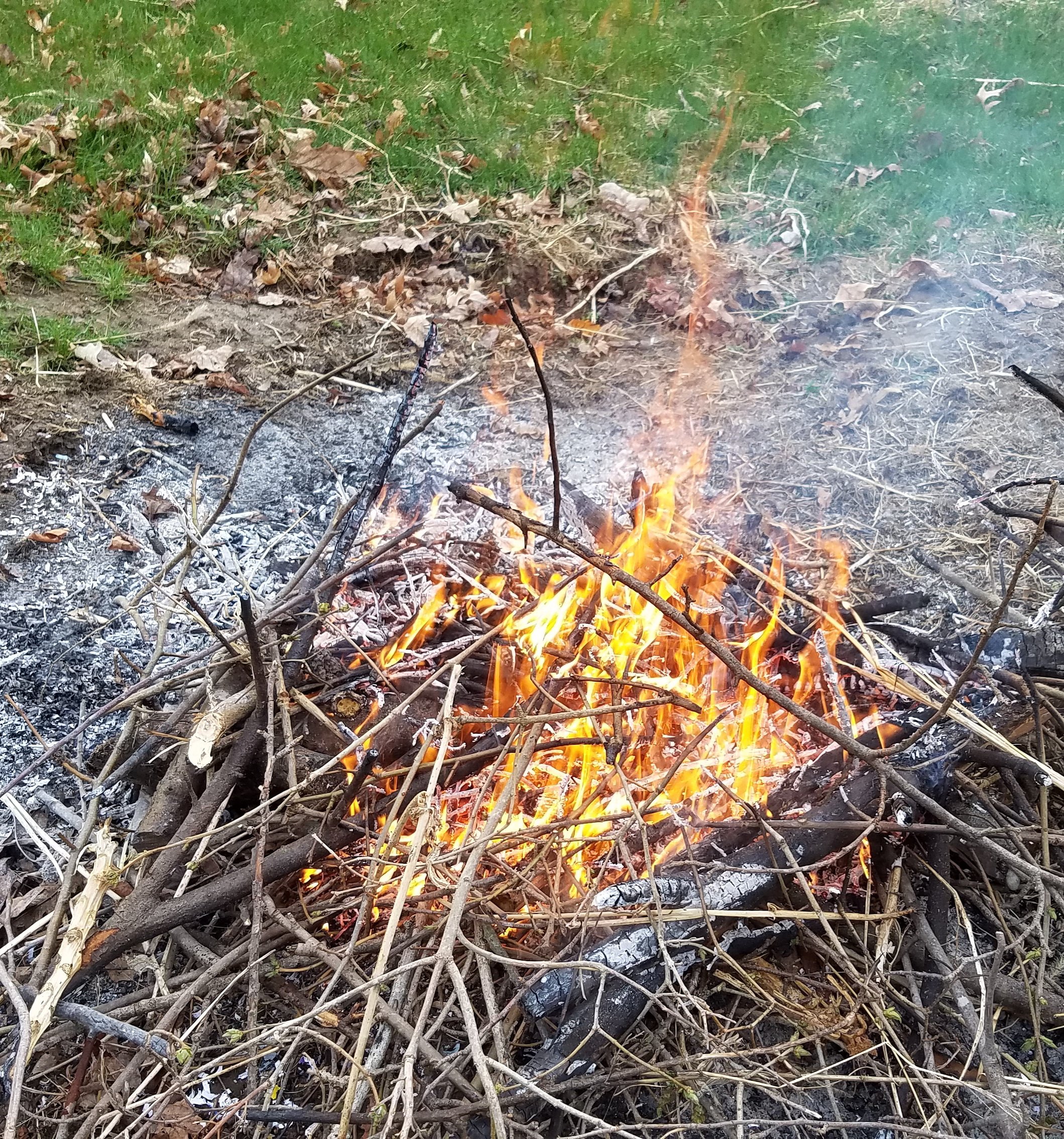
I burned the first brush pile on the to be planted kale plot. It was a clean burn. After sunrise I will spade and till the plot. I also want to plant potatoes in containers and sow peas, beets, carrots, radishes and turnips. If there is time, transplant the first batch of spinach seedlings. There is a lot on the gardening agenda as spring has arrived.

How should I use the time after waking until sunrise, not just today, but going forward? I’m not sure. Other than to continue doing what I am, it is difficult to envision changes from routine as much as they may be needed. I’m too unsettled to contemplate change.

People say it is normal to experience anxiety during the coronavirus pandemic. Knowing I’m normal is not reassuring and has made for restless nights.

The remedy will be to get lost in the work of putting in the garden. If I work longer shifts, maybe I’ll be tired enough at day’s end to sleep through the night. I’m a little sore from yesterday’s work as my spring conditioning regime in the garden begins. Engagement in a project has worked to relieve tension in the past.

It doesn’t help that I’m reading Anne Case and Angus Deaton’s new book exploring why capitalism is proving fatal for the working class with an uptick in mortality rates among white middle-aged Americans from what the authors call “deaths of despair.” There have been enough alcohol, opiod and suicide deaths in this group to reverse the 20th century trend of longer life expectancy. Other wealthy countries continue to see an increase in life expectancy in the new century. Americans do not. I’m looking forward to reading Case and Deaton’s analysis.

All this is not to say I find despair in daily life, I don’t. However, change is on the horizon. Unlike with the sunrise coming in an hour, it’s hard to know what to expect. I affirm today will be a gardener’s day with everything that means. That should be enough to move past the coronavirus engendered anxiety into something more meaningful.

I’m doing the best I can.

Categories
Kitchen Garden

Rainy Spring Dream

Harvesting Spinach – 2013

The forecast was 100 percent chance of rain so I worked on the garden in the garage. I re-seeded dill and cilantro that didn’t germinate. I gave up on the shallots and onions which did not grow the way they should inside our home.

I planted new trays made from small shipping boxes lined with aluminum foil. The box of foil was printed with the date 1972. The improvised flats will serve. I planted:

Cucumbers

Marketmore 76, Ferry-Morse, 68 days.
Tendergreen (a.k.a. burpless), Ferry-Morse, 55 days.
Lemon, Ferry-Morse, 65 days.
Little Leaf Pickling, Johnny’s Selected Seeds, 57 days.
Tasty Jade, Johnny’s Selected Seeds, 54 days.

Lettuce

Buttercrunch, Ferry Morse, 65-70 days

Spinach

Matador, Ferry-Morse, 45 days.

There is a to-do list once the rain finishes and the ground dries out enough to till.

I text messaged the farm about Sunday’s seeding session and we called it off. The greenhouse is full. It’s too cold to put seedlings outside on wagons to harden. We texted back and forth for a while.

Text messages and phone calls are a part of farming that goes on regardless of the crop, almost every day. We stay semi-synchronized, although with a garden I’m very flexible.

My multi-colored Swiss chard didn’t germinate at all. The Fordhook chard didn’t germinate very well. If the seedlings that germinated survive transplant there will be enough chard from the garden for the kitchen. Celery takes the longest time to germinate and the report was it did. Things are looking good. There will plenty of green vegetables to transplant.

Yesterday they tilled and seeded carrots, peas, beets and spinach in the ground. I start my spinach and some beets in trays, but need to plant in the ground as soon as I can get in. Maybe over the next few days. After that, the next step is potatoes, then onions after the ground dries.

While working in the garage I began to dream.

I went on a reconnaissance mission to one of the training areas we used in Germany. I don’t recall where but I got to know Hohenfels, Baumholder, Fulda, Hofbieber, Dipperz and villages at the eastern entry point to the Fulda Gap.

My driver was Cheyenne and had just returned from leave where he attended a Sundance in Montana. I asked him if he ate peyote. He said he had. The driver was an E-1, the lowest enlisted rank. We had busted for getting into a fight and demoted him. He’d been our driver for almost a year. He was the best and the best we had. The peyote buttons remained between him and me. Our battalion commander didn’t want officers driving themselves, so he drove the M-151 quarter ton jeep.

Soon after I arrived in garrison the company motor pool sergeant who gave me a license to operate any piece of equipment in our unit. I’d had familiarization training at Fort Benning and qualified as a jeep driver at Fort Jackson, but the battalion commander was right, I didn’t know jack about fixing the jeep should it break down.

We drove up a ridge high above a valley whose name I can’t recall. It was a beautiful and calm place for reflection. I took notes and viewed the terrain through a pair of binoculars. We watched the clouds blow east up the ascent and over the ridge mid morning. As the valley cleared I finished the work we had come for and then drove back into a village to find lunch.

I don’t know why that experience came to me while planting cucumbers and lettuce. I’m thankful to have had it. It was a fitting dream while doing what I could to advance the garden.

Categories
Kitchen Garden

Spring is Here

Greenhouse with first trays from the farm.

I planted the packets of Garlic Chive seeds near the front steps. I don’t know if they will grow, but I cleaned the space and thought it might work. If they do grow they will be used in the kitchen.

Garlic Chives, Ferry-Morse, 120 days.
Allium tuberosum, Burpee Seeds, 80-90 days.

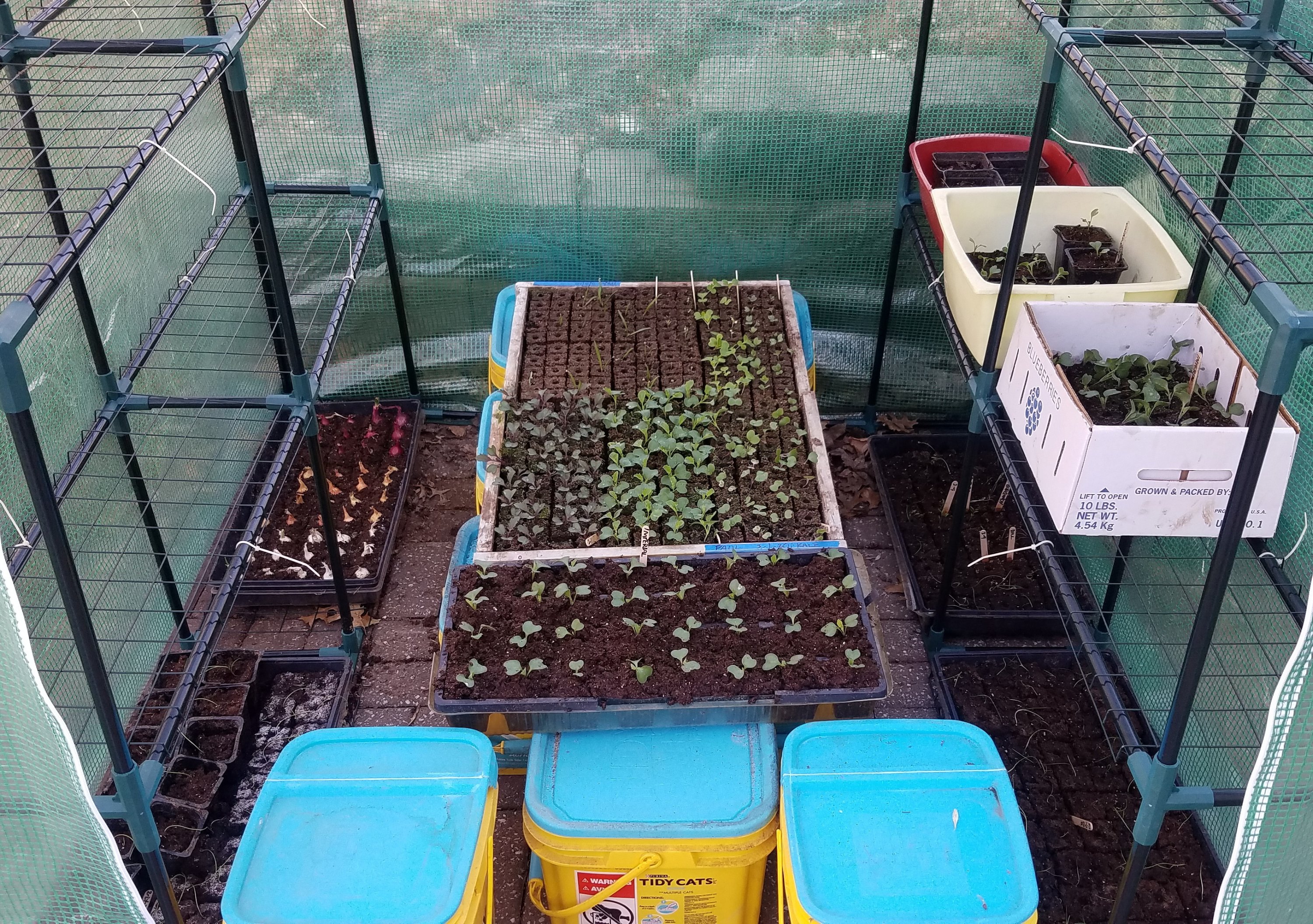
I’m satisfied the portable greenhouse will meet my needs. There are some things to which I must adapt, such as internal temperature regulation and changing moisture levels. From working at the farm for eight years I’m familiar with those issues and don’t expect to have many failures. A strong wind could budge it from the buckets of sand that hold it down. For now, it’s holding its own.

The nursery emailed my two new apple trees are scheduled to arrive on Friday. I submitted a ticket for the One Call folks to mark the utilities. I was here when each utility line was laid so I already know where they are and have planned my planting accordingly.

A burn pile is started on the plot where I’ll plant kale. The kale seedlings are back from the farm and they will be ready to plant after a couple weeks in my greenhouse. Last year I planted 21 plants. This year it will be a smaller number divisible by three varieties, maybe 15 or 18. Unused seedlings will be save for extra, given to neighbors and the leaves cut for a traditional post-planting kale salad.

Cut seed potatoes rest in a tray in the garage. Oral history says let them season to the air for at least four days before planting. I have Kennebec and some variety of red potato. They are planned for the containers this year. I have to remember to give them plenty of water as last time the tubers were in dry soil when I dug them — smaller than expected.

There will be two production plots in the garden. By that I mean a variety of crops will go in them. The big crops are kale, tomatoes, garlic, peppers, cucumbers and broccoli. Each of them will have significant space of their own. Everything else must be in rows of as many plants needed for the kitchen.

The tomato space will be smaller by a third this year. Enough grew last year to keep us in canned tomatoes for another year. I don’t need as many so they will mostly be for eating fresh.

With warmer ambient temperatures I’m spending a little time outside each day. I’m beginning to have a vision of what the garden might be.

Categories
Home Life Kitchen Garden

Planting During Green Up

Storm Brewing

Green up is all around and it’s time to get tomatoes and peppers planted.

Sunday, in a long session, I planted tomatoes, peppers, tomatillos and eggplant — hopefully enough seedlings for our garden with leftovers to share with neighbors. I planted from seed:

Bell peppers:
Pepper Quadrato D Asti Rosso, Ferry-Morse, 95-110 days.
Garden Leader Monster Bell, Ferry-Morse, 75 days.

Hot Peppers
El Eden (Guajillo), Johnny’s Selected Seeds, 65 days green, 85 days red.
Baron (Ancho), Johnny’s Selected Seeds, 65 days green, 85 days red.
Red Rocket, Johnny’s Selected Seeds, 55 days green, 75 days red.
Pastilla Bajo, Ferry-Morse, 80-90 days.
Serrano Chili, Ferry-Morse, 73 days.
Bangkok, Johnny’s Selected Seeds, 75 days green, 95 days red.
Long Thin Cayenne, Ferry-Morse, 72 days.
Jalapeno Mild, Ferry-Morse, 72 days.

Slicers and Plums
German Pink, Seed Savers Exchange, 85 days.
Martha Washington, Johnny’s Selected Seeds, 78 days.
Black Krim, Johnny’s Selected Seeds, 80 days.
Amish Paste, Johnny’s Selected Seeds, 85 days.
Speckled Roman, Johnny’s Selected Seeds, 85 days.
Granadero, Johnny’s Selected Seeds, 75 days.
Brandywine, Seed Savers Exchange, 80 days.
Abe Lincoln, Ferry-Morse, 70-77 days.
Big Rainbow, Ferry-Morse, 80-102 days.
Aunt Ruby’s German Green, Ferry-Morse, 80-95 days.
Box Car Willie, Ferry-Morse, 80 days.
Pruden’s Purple, Ferry-Morse, 67-85 days.
Big Red, Ferry-Morse, 85 days.
Mortgage Lifter, Ferry-Morse, 83-90 days.

Cherries
Jelly Bean, Ferry-Morse, 70 days.
White Cherry, Johnny’s Selected Seeds, 59 days.
Red Pearl, Johnny’s Selected Seeds, 58 days.
Matt’s Wild Cherry, Johnny’s Selected Seeds, 60 days.
Jasper, Johnny’s Selected Seeds, 60 days.
Citrine, Johnny’s Selected Seeds, 60 days.
Taxi, Johnny’s Selected Seeds, 64 days.

Eggplant
Galine, Johnny’s Selected Seeds, 65 days.
Early Long Purple, Ferry-Morse, 75 days.
Black Beauty, Ferry-Morse, 85 days.

Tomatillo
Tomatillo Purple, Ferry-Morse, 75/85 days.

We had a wind storm last weekend and it shook the portable greenhouse so much the two trays on the top shelves fell to the ground. I was able to salvage much of what fell down. The three varieties of leeks will be difficult to distinguish when I plant them, because they went all over the place. Note to self: bring the trays inside during windstorms.

Categories
Kitchen Garden

Onion Experiments

Onions planted in soil blocks.

Growing large storage onions has been challenging. I yearn to grow large onions and use them throughout the year.

Spring onions? No problem. Larger red, yellow or white, the kind we most use in the kitchen, have eluded me.

I’m determined this year will be different. Toward that end I’ve launched some experiments to see how I can do better.

Friday, Feb. 7, I planted Talon Yellow and Red Burgundy onions at home from seed. After six weeks the yellow germinated, the red did not. After chatting on line with another grower, they pointed out fresh onion seed is important. The Talon Yellow seeds were this year’s crop from Johnny’s Selected Seeds and Red Burgundy were end of season discards at the home, farm and auto supply store. Lesson learned: get fresh onion seeds.

That same day I split my Matador shallot seeds with the farm. They are growing their half in the same environment as the rest of their onions, I started mine in a tray at home. Mine don’t look that healthy although they germinated. If the targeted planting time is mid-April, there is time for them to grow and hopefully survive transplant. I’m looking forward to comparing results.

I bought red, yellow and white onions starts from the home, farm and auto supply store. These are the same variety I bought every year since working there. I divided them roughly in half and planted some in soil blocks to give them a head start, and reserved the rest to plant in the ground as soon as it is tillable.

This year I ordered some onion plants from Johnny’s Selected Seeds. They are to be shipped in a couple of weeks and then direct planted in the soil. The varieties are Ailsa Craig, Patterson and Redwing. While more expensive than seed at about 30 cents for each plant, I’m hoping to find something that works in trying it. I would much rather grow everything from seed yet I want other options as back up.

Finally, this morning, I planted six 3 x 3 containers with White Lisbon Bunching Onions from Ferry-Morse (60-110 days). I mixed both pelleted and non-pelleted seeds and broadcast them in the pots. If they germinate and grow, I’ll transplant the entire pots as groups of spring onions. It is a month behind where they should have been started, so we’ll see what happens.

The last part of my experiment is twofold. I am researching types of soil nutrients which support onion growth. My normal process is to hand till composted chicken manure into the soil before planting. If the several garden books in my library suggest another approach, I may try it as long as it is not a commercial, chemical fertilizer. This year I bought a small tiller which will break up the soil more thoroughly than handwork.

I am also planning a disciplined approach to watering and weeding the crop once it is in the ground. Because of our climate, I plan to mulch the crop to retain moisture in the soil. Weeding and regular watering has proven to be challenging, partly because weeding gets away from me and partly because my approach to watering is sparing. With a framework of “experimentation” perhaps I can do better.

I know growing storage onions is possible as I get them from the farms each year. With effort, maybe I can grow my own.

Categories
Kitchen Garden

Last Day of Winter and Garlic is Up

Garlic planted last fall.

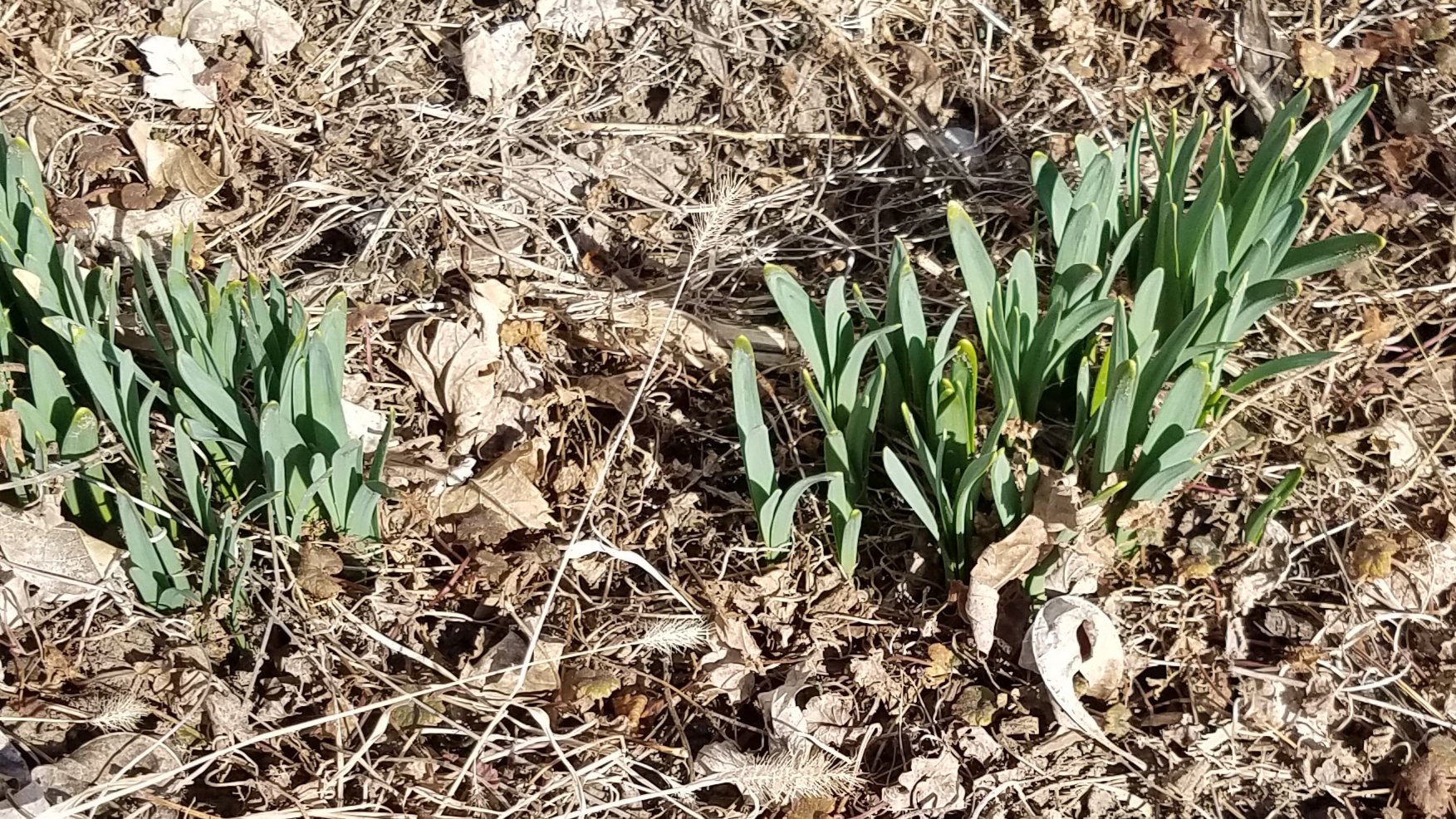
Garlic plants emerged in the garden.

It was a mild winter so I expected they would. The actuality of it is what we crave.

The rows were mulched in autumn, although they could use more. Next time I head into town I’ll pick up a couple of bales of straw. I don’t know when that will be.

In the early morning of a normal work day I weighed whether to work my shift. The managers at the home, farm and auto supply store are the main reason I’m still there. They treat me fairly and have been flexible with my schedule. As coronavirus spreads in our county I don’t want to be exposed. In the morning huddle last week the store manager echoed the guidance of the Iowa Department of Public Health in saying if I’m sick, I shouldn’t go to work. Except for a couple of sneezes this morning, I’m not that sick. There’s more to it than that.

I’m more worried about exposure to coronavirus in a public place than in spreading my germs. My age puts me in an at-risk group to contract COVID-19. Likewise, I’m fighting diabetes with which I was diagnosed last year — another risk group. Most deaths from COVID-19 are in people over age 60. No one in my family is encouraging me to work my shift. At this point I was waiting for the early crew to arrive at the store so I can call off.

During this pandemic it’s hard to know what to do. The number of cases statewide is low at 29 as of yesterday. Of those, 18 are in our county. The number could quickly escalate, so the CDC guidance to stay home if we can makes sense for the 15 day recommended period.

The federal government is flailing. They throw hundreds of millions of dollar proposals around like we have it. The current national debt is over $23,475,000,000 with a budget deficit over a trillion dollars. We’ll have to borrow the money, most likely from China. All the jiggering of the economy seems likely to put money in the hands of people who need it least rather than address the pandemic.

As my garlic grows the tumult of national discourse seems remote. I don’t want to die from coronavirus and am doing my best to manage the risks. When I was at Fort Benning a radio station in Alabama would to play a Merle Haggard song in the wee hours of morning. It explains how I feel as well as anything:

I’m only human. I’m just a man.
Help me to believe in what I could be and all that I am.
Show me the stairway that I have to climb.
Lord for my sake, teach me to take, one day at a time.

One day at a time, sweet Jesus, that’s all I’m asking from you.
Give me the strength to do everyday what I have to do.
Yesterday’s gone, sweet Jesus, and tomorrow may never be mine,
So for my sake, teach me to take one day at a time.

Categories
Kitchen Garden

Seeding During the Pandemic

Kale and Broccoli Seedlings at Two Weeks.

Most of the usual seeders were absent from the greenhouse as I made blocks for 3,840 seedlings. Those who did work tried to stay at least six feet away from each other, although it was hard given the confined space.

“You may be the vector,” I said to one.

“No, you are the vector,” they replied.

It was in fun, but a serious note rang heavy in the atmosphere. None of us wants to die from the coronavirus.

I worked mostly alone as the farmers tended sheep in the barn. There are now 45 lambs and they are not ready to be outside all the time. Before she left I reviewed my planting plan with the farmer, made adjustments, and planted the following for my garden:

Early White Vienna Kohlrabi, Ferry-Morse, 55 days.
Swiss Chard, Mixed Colors, Ferry-Morse, 30-60 days.
Fordhook Giant Swiss Chard, Ferry-Morse, 60 days.
Florida Broad Leaf Mustard, Ferry-Morse, 48 days.
Southern Giant Curled Mustard India, Ferry-Morse, 56 days.
Bibb Lettuce, Ferry-Morse, 57 days.
Buttercrunch Lettuce, Ferry-Morse, 65-70 days.
Parris Island Cos Lettuce, Ferry-Morse, 68 days.

I noticed the kale and broccoli planted March 1 germinated with a high rate. Some of the seeds planted last week have already sprouted, although it will take celery a couple weeks.

19,920 seedling blocks made during the first five weeks. The crew will begin transplanting to the high tunnel maybe this week.

Categories
Kitchen Garden

Refilling the Seed Gaps

Onions Drying

One batch of onion seeds germinated poorly so I seeded the failed blocks with Cilantro, Parsley and Dill.

Cilantro, Ferry-Morse, 28 days.
Parsley, Ferry-Morse, 70-90 days.
Dill, Ferry-Morse, 70 days.

This is my first attempt to grow onions at home and there’s a lot to learn. Once the seeds germinated, I moved them upstairs into sunlight. They grew long and spindly, laying down over each other in the tray. Carefully, I trimmed the tops to about two inches and they sprung up. The expectation is they will start to right themselves and grow more vertically.  The backup plan is to buy and beg some onion starts in case these don’t mature. For the time being I’m not giving up on them.

Categories
Kitchen Garden

Celery – In!

Spring Plants from Indiana

It was another busy day at the farm for seeding session #4.

I planted one tray of

Conquistador Celery, Johnny’s Selected Seeds, 80 days.

and one tray with

Georgia Southern Collard, Ferry-Morse, 75 days.
Pak Choy Toy Choy, Ferry-Morse, 30 days.
Teton Hybrid Spinach, Ferry-Morse, 45 days.
Cilantro, Ferry-Morse, 28 days.

Space is beginning to fill with trays.

I delivered a box of flower seeds for the farm’s coming garden class at a local food pantry.

We talked, a lot, about everything. We were chatty.

I enjoy my time with eight people talking and seeding trays of soil mix. I don’t say a lot, just do my work and bask in the sounds of another day on the farm.

The lamb count is now 40 and there are five new goats.