Categories
Creative Life

A Life of Photos Part IX

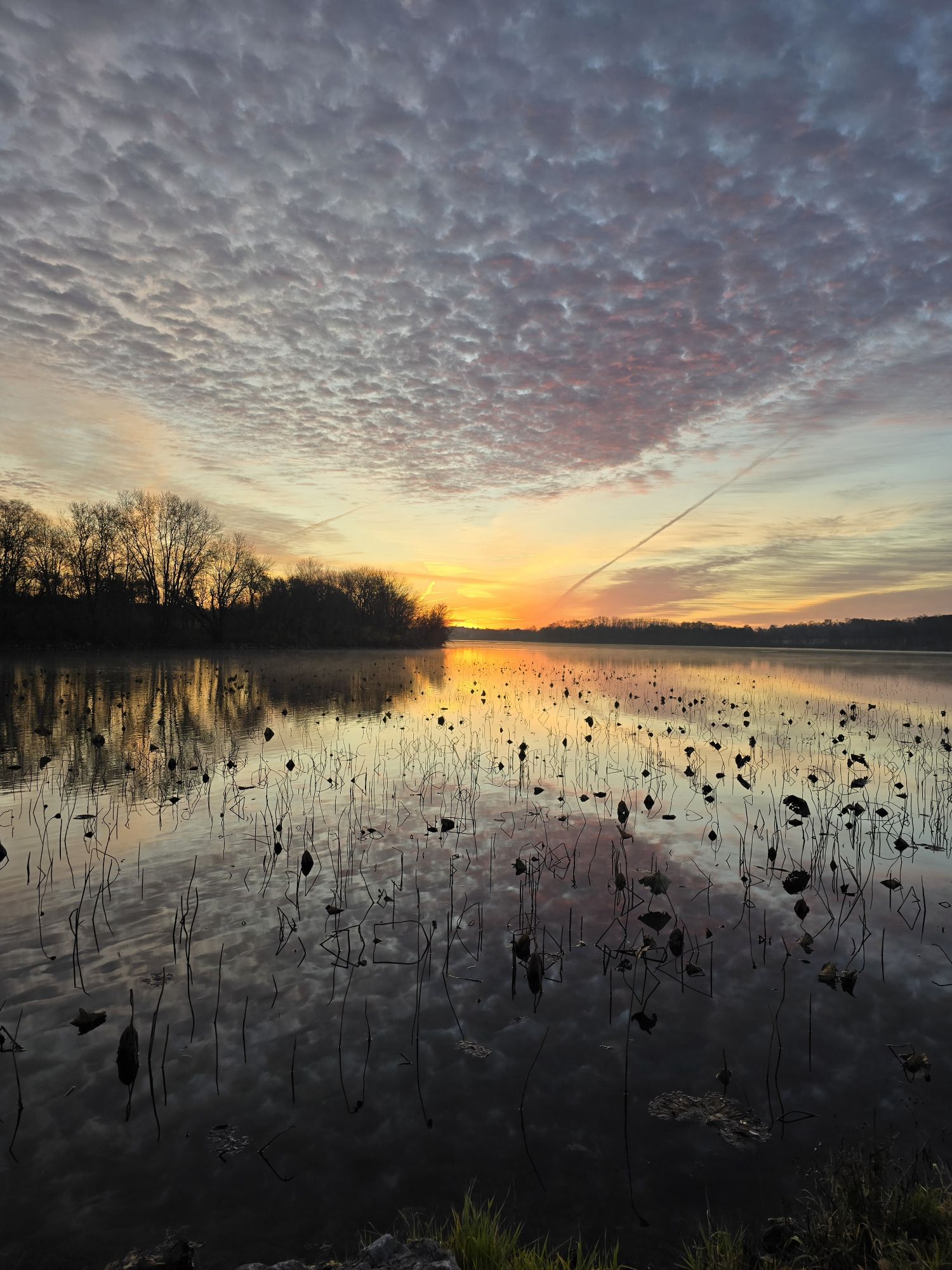
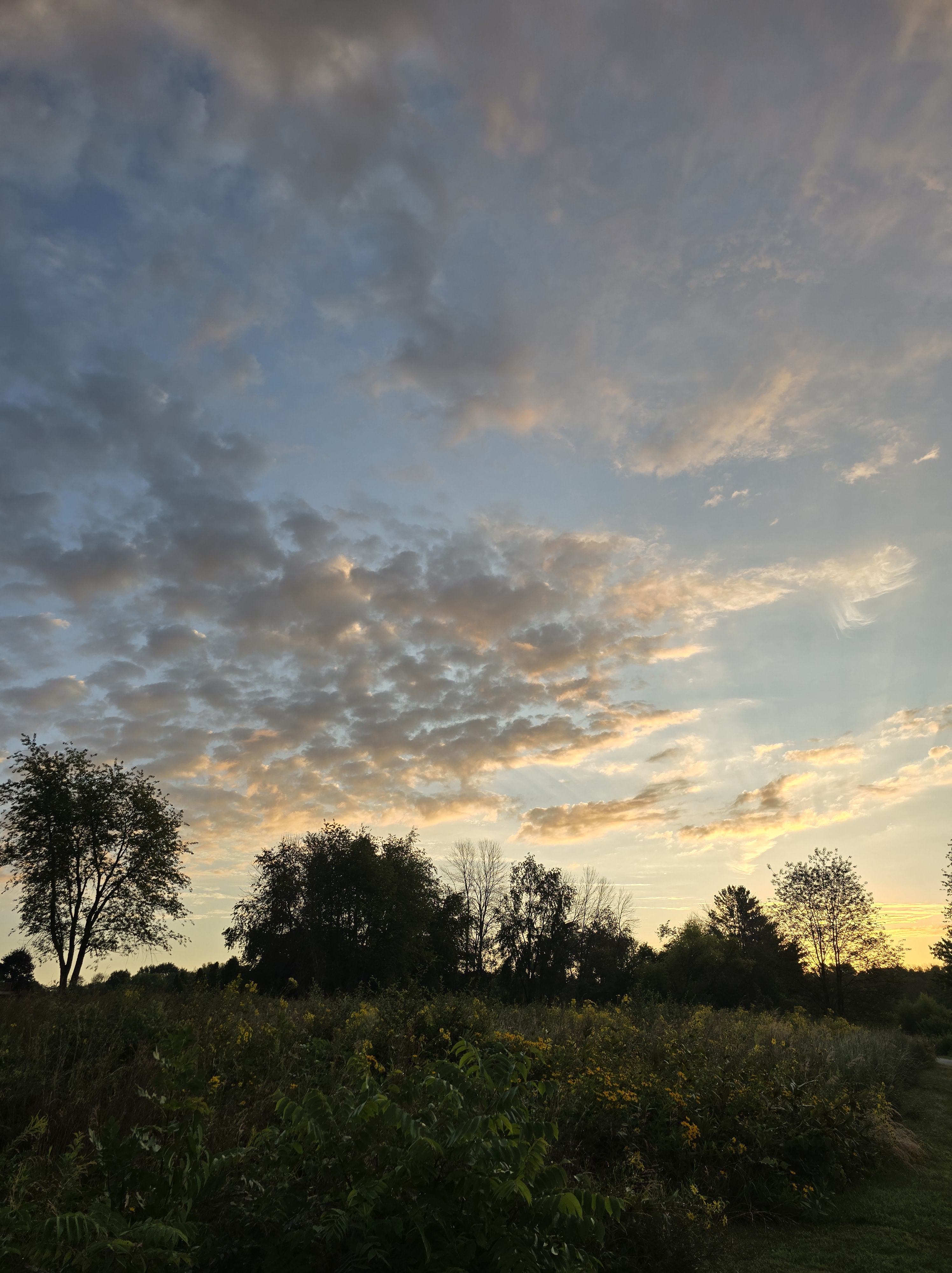
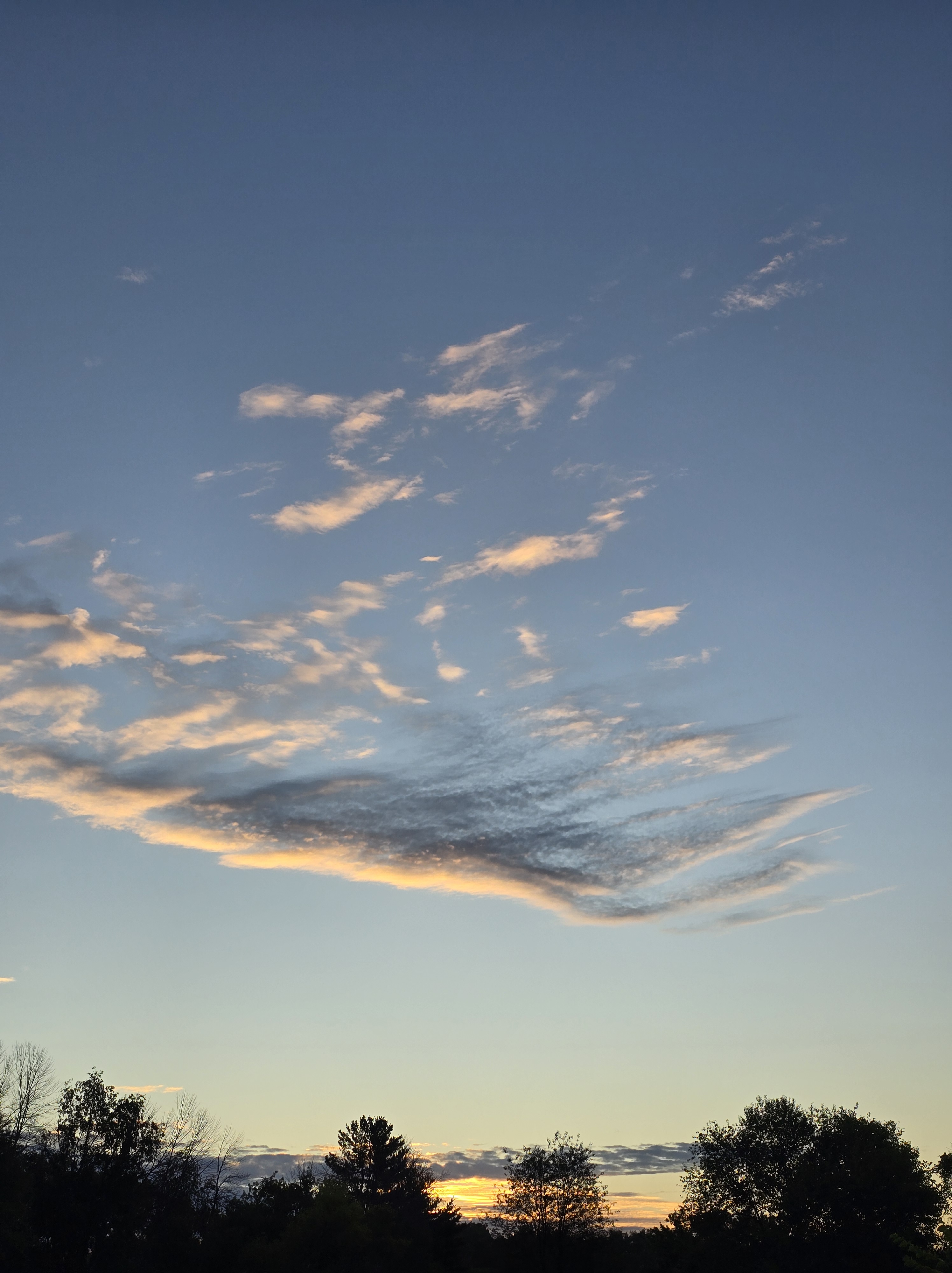
Sunrise on the state park trail. Taken with my Samsung Galaxy S24 Ultra smartphone.

If it seems impossible to curate my life-long collection of analog and digital photographs, that’s because it is. My presumption is of making a useful archive for others to use when I’m gone. However, that is an old school idea poorly aligned with the way photographs have come to be used. I am fine with sharing photos via social media and email. I also believe they have more than transient value. This is at the core of my struggle to make progress in curating my photographic work.

I am interested in technology. My maternal grandmother participated in photography culture and bought a Kodak Brownie and Instamatic 126 at the local drug store. She developed her exposed film at the same drug store. It was a creative outlet for her, creativity being something her family discouraged when she was young. When she asked us to pose in our Easter best clothing, how could we refuse? She had the camera and wanted to preserve the moment. That felt important.

In college, I experimented with a Minolta SRT-101 I bought from one of my band buddies. I got away from posed photographs to the extent possible and captured where I lived, both in my residence and on day trips to neighboring places. I bought a small 35mm camera and a dozen rolls of film to take on my 1974 trip to Europe. When my backpack was stolen in France, I lost all the film and ended up with only two rolls to develop after three months away. When I bought a mobile flip phone, I took a few photographs with the built in camera, notably one of Senator Barack Obama at the 2006 Harkin Steak Fry. In 2008, I bought a Kodak EasyShare digital camera, and then when I converted to a smartphone in 2012 the smart phone became my primary photographic method. There is a whole story in technology. My experience since the 1950s is likely not that different from other amateur photographers in my cohort.

The cultural aspect of my photographic history is more interesting. I was able to own a simple camera because I had an income from delivering newspapers. I became the person in the family called upon to record an event when Grandmother was not available. My early photographs are packed with domestic images of holidays and birthdays, vacations, and the stuff in our lives like pets, houses, cars, and more. In high school, I worked part time at a department store and had means to use photography. I accumulated photographs in shoe boxes and a few albums. Mother had a short filing cabinet on wheels where all of her photographs migrated. Photography has always been a simple, affordable, and happy thing to do. There was always a half life of attention given to photographs. However, we couldn’t bear to get rid of them.

To some extent, my photographs are a visual record of how I lived. At the same time, I have been journaling since 1974 and have given more thought to what I wrote than I did to photographs. As I write an autobiography, I decided to use only one photograph in the first book, and am not sure whether or how many I might use in the second. To avoid consideration of photography as part of my life would be decidedly wrong.

Social media changed how we use photographs. With digital cameras and smartphones, photographs have no operating cost other than the time and attention paid to them. When I take a photograph like the sunrise in this post, I make multiple exposures and edit them to pick the “best” one to post. This form of curation was not easy in analog photography, yet is basic to posting photographs on social media. I archive all my saved photographs on the cloud, yet seldom go back to them.

On social media, we get to know people a certain way. For example, on BlueSky, the 99 accounts I follow post photos and create an account ambience I came to recognize over time. This is a real thing, yet not the same as having an in real life relationship with a person. I submit I have a different relationship with someone I know in real life as compared to their social media account. Both seem valid.

Photography in 2025 does not entail a lot of curation. We take photographs, briefly edit and share them, and then forget them. Seldom do we have a processor make prints. I’m okay with that. When I curate four photos for a post on social media, that suffices to sate my urge toward a creative life. Maybe I will use the same photographs in a blog post, or maybe not. I want to believe there is more to this creative process as I look at thousands of images captured over a life and work to define their meaning and gain insights. Because of my current autobiography project, I am willing to devote time to photography. I continue to believe the words are paramount.

Will I end up with a usable archive? It may seem impossible now, yet I hope it ultimately isn’t. Figuring this out is just another part of my life.

Categories
Home Life

Glorious Autumn

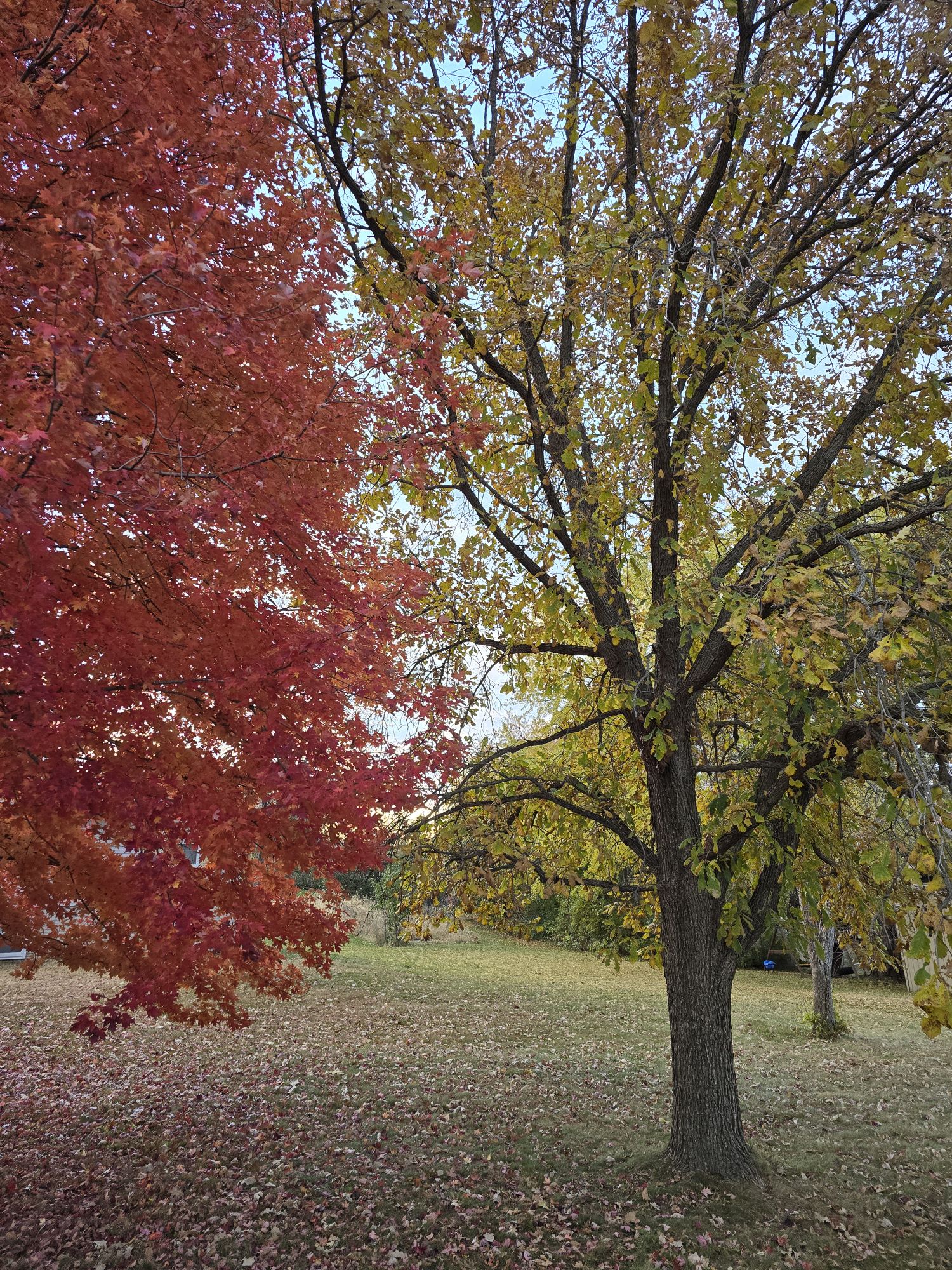
Leaves of deciduous trees on Nov. 4, 2025

Despite the lack of rain, this has been one of the best autumns I remember. It is a pleasure each time I step outdoors and take it all in. With everything going on in the world, we need that type of solace.

Autumn is the time to get the chainsaw out and clear dead trees from the property. A neighbor and I felled two ash trees killed by the Emerald Ash Borer. The occasion gave me a chance to wear the steel-toed shoes I got to work in a Kentucky steel mill back in the day. They even have metatarsal protection.

Steel-toed shoes with metatarsal protection.

I took the first tree down by myself. It took some time to determine where I wanted it to fall. I made a notch cut in that direction. It is important to take the time because as the old saw goes, measure twice and cut once. I made the felling cut and the bar and chain of the chainsaw got stuck. I must have done something wrong.

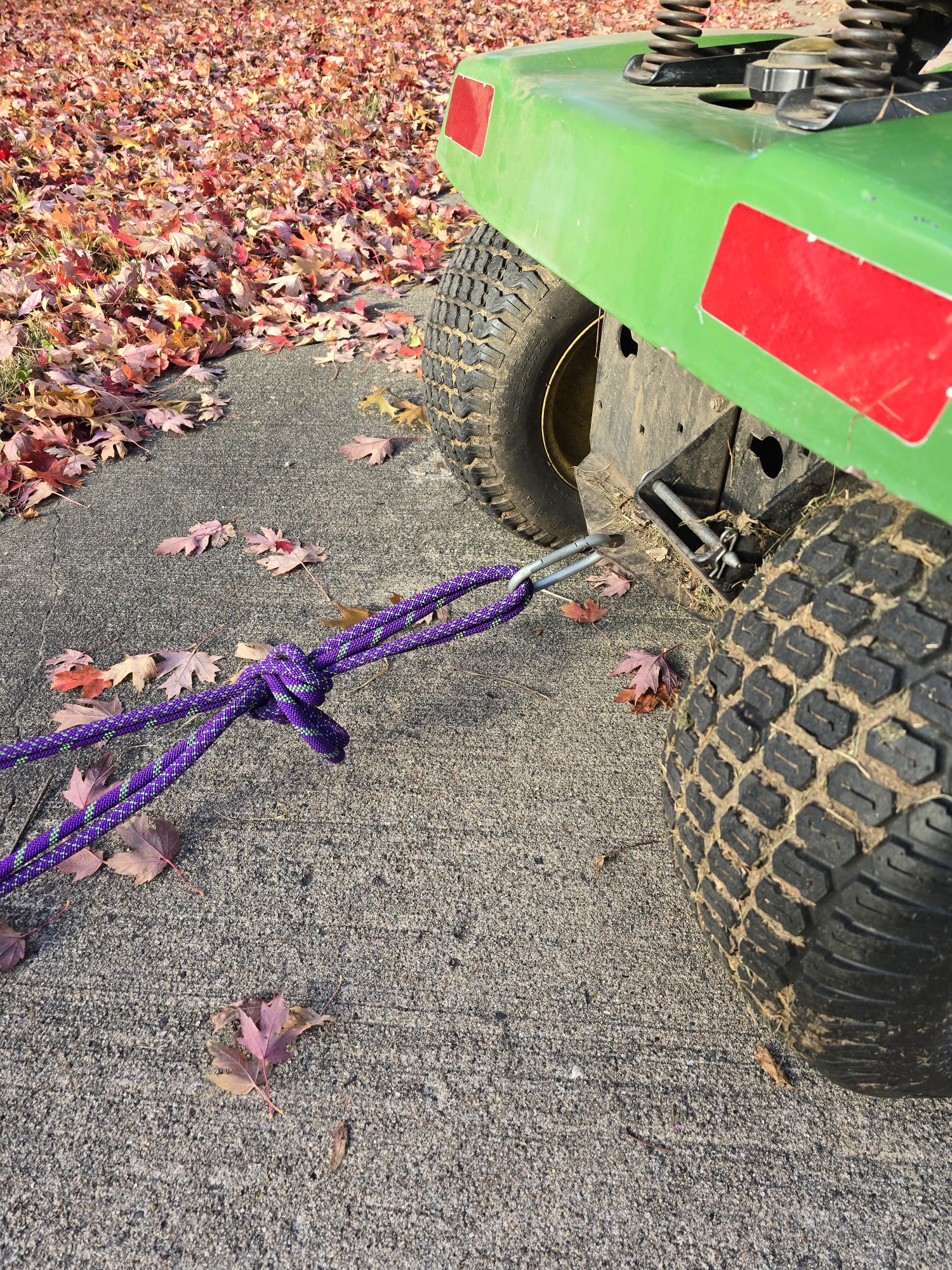
Hitch to the yard tractor.

I stopped and disconnected the bar from the motor assembly, and was able to pull it out. Not the chain. No problem. I went to the garage and got out my rappelling rope, tied one end around the tree about 12 feet from the ground, and the other to a carabiner attached to the rear of the yard tractor. I positioned the tractor on the cement driveway so there would be traction and gently tugged the tree until it fell over.

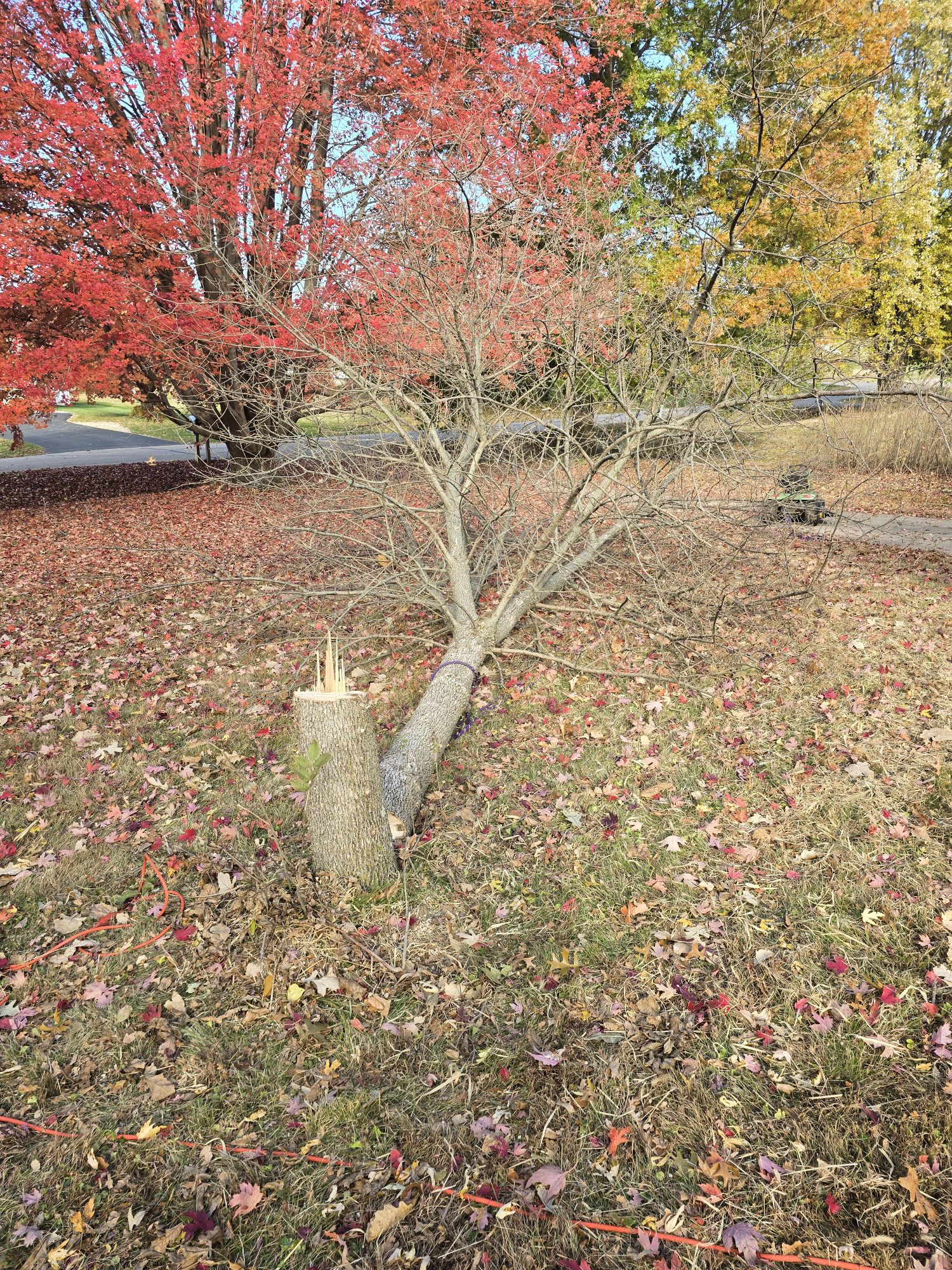
First ash tree felled on Wednesday.

My neighbor arrived and we worked together on the second tree. This one had grown with a yoke separating the two main branches. If I felled the southernmost branch the wrong direction, I might take out the neighbor’s fence. We positioned the yard tractor and tied the rope to the tree about 14 feet above ground. I made the notch cut and then my neighbor got on the yard tractor and put tension on the rope. As I made the felling cut, he increased tension, although he lost traction because of the leaves on the ground. No worries the tree fell in the intended direction.

Two tree stumps.

We felled the other main branch and called it a day.

This was the most difficult part of the operation. Going forward, I plan to spend about an hour a day cutting the trees up. I made a place for a brush pile and will salvage two relatively straight limbs to use to stack firewood outdoors and off the ground. I will burn the brush pile when conditions are suitable, and hope to find a home for the firewood. A lot of neighbors are flush with winter firewood presently.

It will take me a week or two to clean up the yard. That part I can do by myself. Autumn days were made for a fellow and his chainsaw.

Categories
Creative Life

Fog at Sunrise

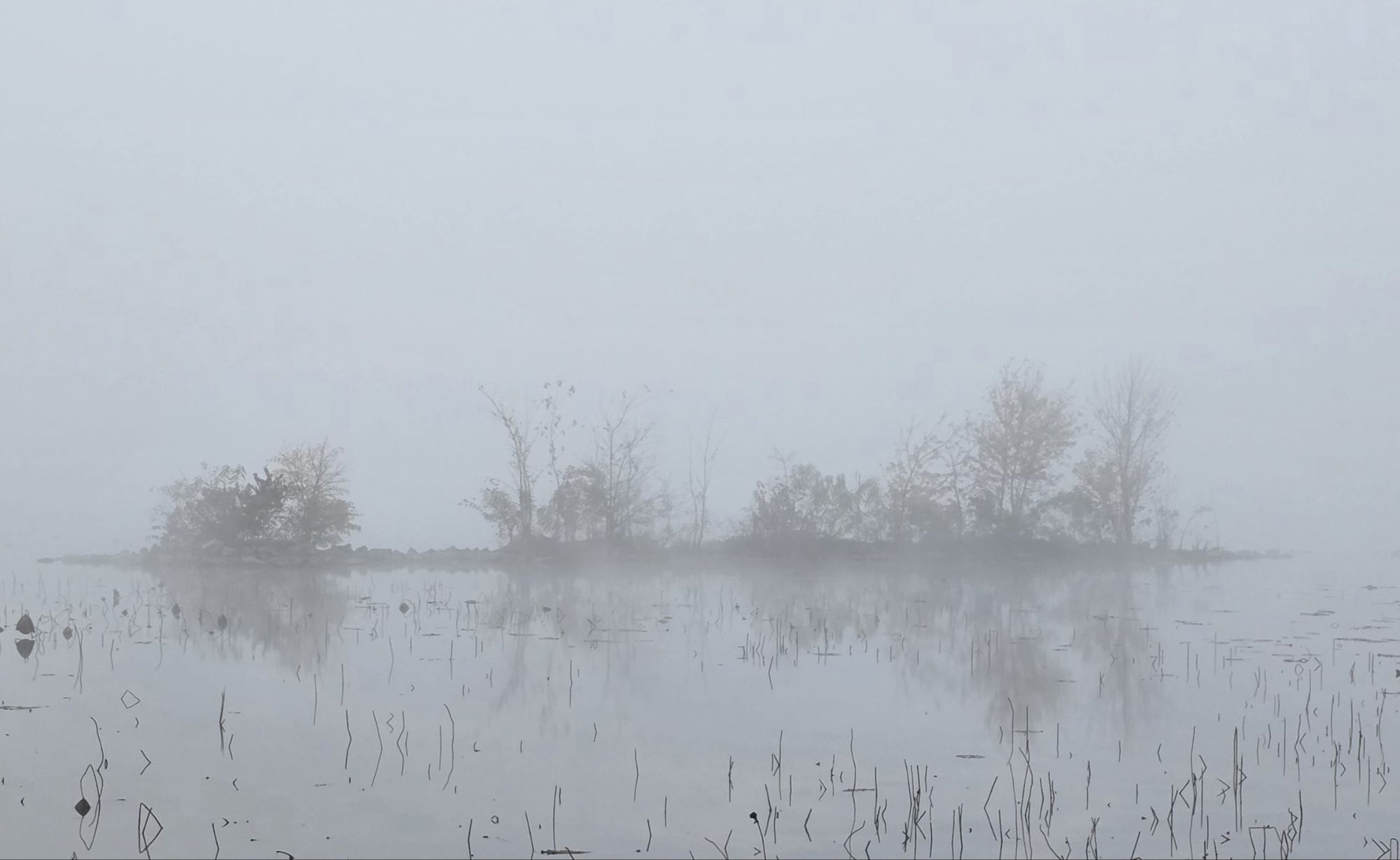
Foggy morning on the state park trail.

It is usually quiet on the state park trail during my morning walk. If someone is coming I hear their footsteps, or if they are on the phone or in a group, their talking voices carry a long distance. It was foggy Sunday morning when I heard young women talking. Before long, I could see headlamps bobbing above the trail. It was plenty light, yet the idea of a headlamp gained prominence over whether or not one was actually needed. I wished them a good morning as they passed me going the other way. They returned the sentiment. Even at dawn there is traffic on the trail.

I leave for the trail 20 minutes before sunrise. It is usually light enough to see and the transition period presents great light for capturing photographs. On Saturday I started walking on the boat dock to get an unobstructed view of sunrise. There was frozen frost on the deck and I slipped and fell on my backside. I let loose my mobile device and feared the worst. When I got up it was just less than halfway over the edge of the dock. I had visions of it plunking in the water, yet not this time. I am one lucky guy.

Last winter I walked the trail almost every morning regardless of ambient temperature and snowfall. I expect to do likewise this year. The state park trail is the perquisite that comes with living here I enjoy most. It also provides an opportunity to work on my photography.

Categories
Living in Society

Reunion Conversations

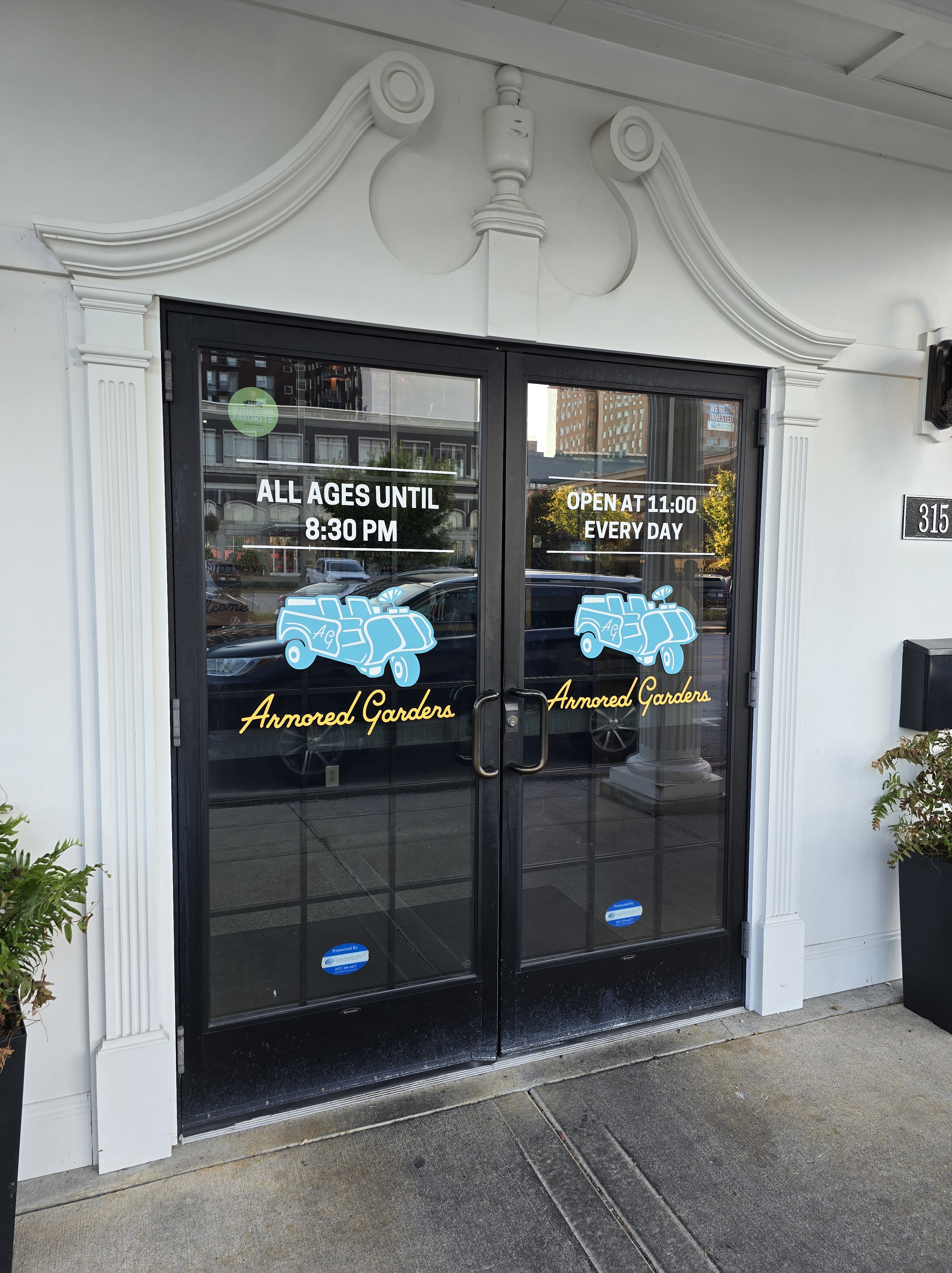
Restaurant where we held our 55th year high school class reunion on Sept. 25, 2025.

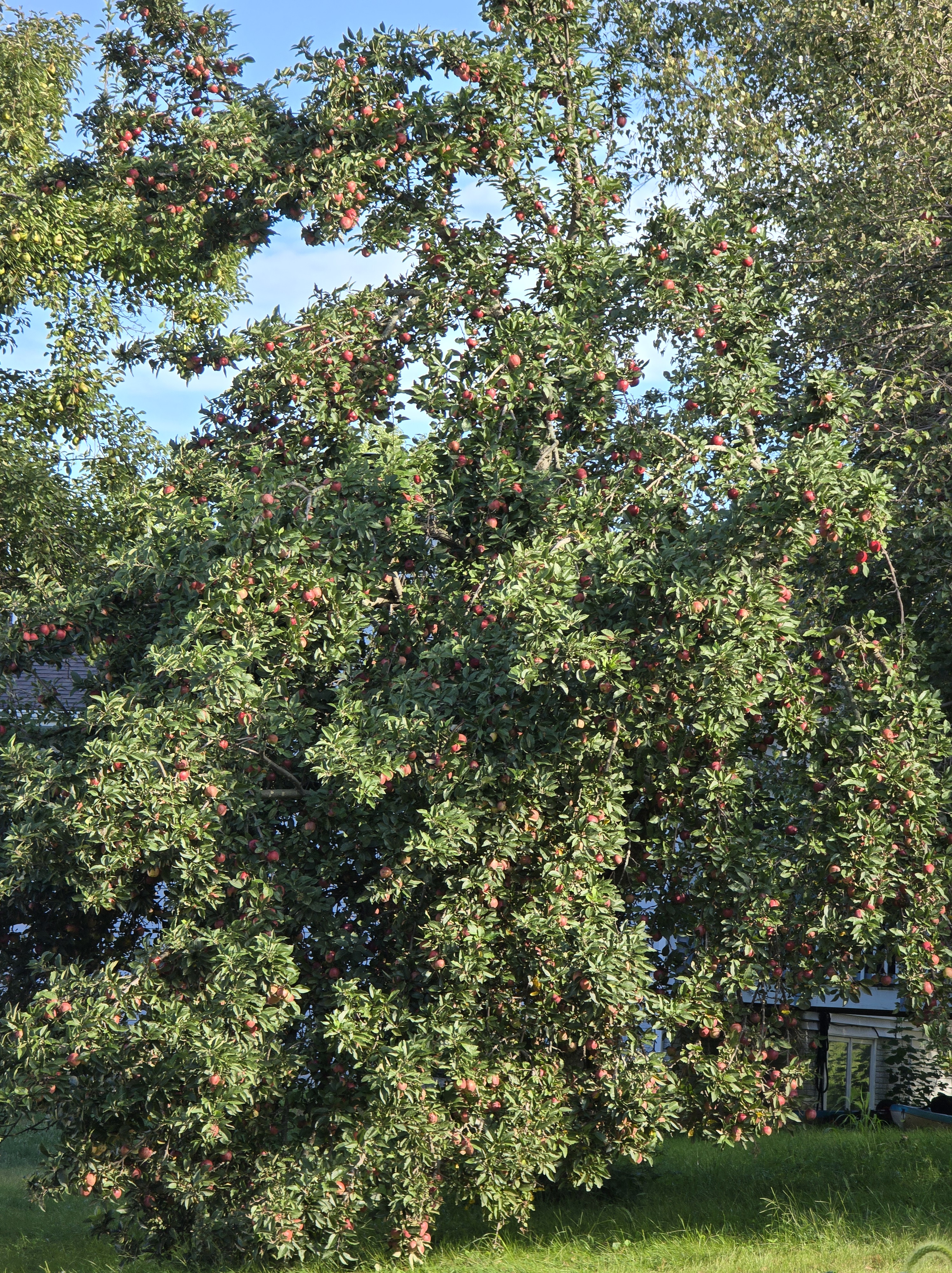
The combination of a punk reaction to my influenza shot and massive intake of information at our high school class reunion led to Saturday being a challenging day. I made it through the fog and by 4:30 p.m., felt like doing stuff. In quick succession, I finished yesterday’s post, canned a batch of applesauce and apple juice, and worked on laundry I started in the morning. In retirement, that makes a busy day.

Our time together at our high school class reunion Thursday night was precious. I don’t want to let go of the conversations. There are only so many of the 8.2 billion people on this jumping green sphere with whom an individual shares a life’s experience. Grade school and high school mates are unique in that regard, in my stable culture, anyway. Through conversation I became aware of developing a tunnel vision of my own history by focusing on a subset of experiences to produce an autobiography. The reunion opened my eyes to a broader experience that exists, of who I was and who I have become.

When we dig ourselves into a tunnel of memory, it seems useful and important to find our way out into our broader experience. I believe the brain captures our experiences yet some of them get relegated to places where they don’t get our attention. Too, our way of seeing filters out parts of our experience so we remember only the filtered events. John Berger said what I am trying to say more directly in his book Ways of Seeing:

Seeing comes before words. The child looks and recognizes before it can speak. But there is also another sense in which seeing comes before words. It is seeing which establishes our place in the surrounding world; we explain that world with words, but words can never undo the fact that we are surrounded by it. The relation between what we see and what we know is never settled. (Ways of Seeing, John Berger).

Our class reunion helped me be more aware of the surrounding world, one that is specifically relevant to me and my classmates.

In addition to memory, my writing focuses on journals, letters, photographs, and blog posts created over a period of fifty years. For every detail captured, there are multiple that exist elsewhere if I can summon them. Talking to people with shared experiences is one way to do that.

A five minute conversation listening to a classmate that worked for an insurance company for 40 years, or another who lived in California for a similar amount of time then returned to Iowa and married a classmate, are ways to do that. Reading an email about how one classmate recruited the widow of another to attend is the same. The easy familiarity of one with whom I played basketball in the grade school playground is another. Spending time with someone who was a neighbor to a close friend I lost in an auto accident shortly after graduation is another. All of these remind me of the broader, yet common world we inhabited, at least for a while. We now inhabit the present together, at least on Thursday night we did.

I don’t seek to wax nostalgic about my high school experiences. The recent conversations remind me of who I once was and help to become a better me in the present. It’s no wonder I don’t want to let go.

Categories
Creative Life

A Life of Photos – Part VII

Mount Rushmore on July 17, 2010. Photo by the author.

How does a photographer capture well-known sites? I would argue professional photographers whose work appears on post cards serve a useful function in capturing a personal experience.

This photograph of Mount Rushmore was created in part by my being there. Composition of the resulting image is due largely to the design of the visitors center which presented a platform from which I took it. The light is good and the talus provides context. However, picking up a postcard at the gift shop eliminates variations inherent in converting a digital image to a print. If you stick to selecting familiar images, postcards can be interchangeable with printed photos in terms of remembering the experience. I submit having both types of image upgrades the experience.

The advent of the “bucket list” likely ended a lot of meaningful photography. If Mount Rushmore were on my bucket list, I might have stepped in front of the camera to record myself with the famous sculpture. Maybe at home I would have a bulletin board where I pinned all my bucket list photographs. People are free to do what they want, but for me, the memory of that moment’s experience is what stands out more than a trophy photograph hanging on a wall or uploaded to a website.

Defining who we are in the context of our lives, and who we want to be matters more than an arbitrary list of places we seek to visit. Above all, it is about the experience. A personal photograph or postcard is a subset of what that experience is. Photos are not necessarily the most important part of it.

What was this experience about? My friend since seventh grade and I left our spouses behind and made a long road trip out west. The furthest point was Missoula, Montana where we visited another high school friend and their spouse. Mount Rushmore was one of the less interesting stops we made. We were so close to it we felt obliged to stop, so we did. It was tacked on to an experience about something else.

I am a bit old school in that I don’t see much purpose to video recording a well-know site. My aunt, uncle, and their family lived in Europe for a number of years. They took home movies on 8 millimeter film when they traveled. I recall one where they visited the leaning tower of Pisa and recorded the kids trying to push it the rest of the way over. It was a family joke, and that’s fine. I hope they bought a postcard to remember the architecture while they were at it, even if that wasn’t their interest. Life is not always a joke.

I had only one photograph in my memoir, An Iowa Life. However, I looked at a lot of them while writing it. A photograph invokes living memories and it was those memories that drove my writing. I expect to return to this image of Mount Rushmore when I get into the post-analog part of my life. For that purpose, it won’t matter if an image was one I took or a postcard. That’s as it should be.

Categories
Creative Life

A Life of Photos – Part VI

Road sign in France, 1979.

It felt like progress as I went through the prints laid out on a table from one shoe box of photographs. I bought some 4.25 x 6.25-inch brown envelopes into which I duly sorted the prints and labeled with the contents. Since prints are scattered all over the house, this should make it a). easier to find a home for loose ones, and b). enable whoever inherits the collection to move quickly through them with a clue as to what they are about. I even managed to pick a few to shred because the images were repetitive or hard for me to know what they were. There were six of those. That’s not many given the scope of the project yet it was a big, personal step. I ran right over to the shredder so there would be no going back.

The photo above was taken when in 1979, friends with whom I worked at a department store in high school visited me in Mainz, Germany. They had married while I was overseas. We drove a rental car around France, stopping whenever and wherever it suited us. We visited a number of cathedrals, including Reims and Amiens, as well as Normandy, Mont-Saint-Michel, Belle-Île-en-Mer, Bordeaux, San Sebastián, Lourdes, Carcassone, and then traveled along the Mediterranean coast to Italy. We crossed the Swiss Alps from Italy and headed back home to Mainz. The two weeks were filled completely and passed quickly.

Hard to say where this sign was located. Somewhere on the Mediterranean Coast. The places we went on the coast were not very touristy. That was one of the ideas that energized the trip. We found our own path and the trip was better for it. We went places where an American Visa card was a novelty and the clerk had to contact someone to make sure it was legit.

I shot two or three rolls of film on my Minolta SRT-101 camera. The highlight of the trip was in Saint-Paul-de-Vence where we overnighted in a small hotel. The artist Joan Miró was in residence at the nearby Fondation Maeght where he was making a film for French television. It was interesting to see the director coaching the artist about how to move for the camera. We toured the gallery and bought posters of the show to remember it by. I framed and still have mine. Alas, no photos of the artist as it wasn’t allowed.

As an organizing principle, putting photos taken on a specific trip together is conventional. None of them found their way into an album, although the makings of one was there. In retrospect, It is hard to believe I could get two weeks away from work as a military officer. Images like this one help me remember how close I was to my small group of high school friends. Isn’t that one of the purposes of photography?

~ Read all the posts in this series by clicking here.

Categories
Creative Life

Week in Photos

It has been a week of great weather. Temperatures were in the seventies, scant rain, and plenty of sunshine. I tried to capture a bit of it for this post.

Cherry Tomatoes in the dehydrator.
Categories
Creative Life

A Life of Photos – Part IV

Grandma Sarah Elizabeth (Dean) Miller’s bentwood rocking chair made from willow. She was my great, great grandmother. Photo taken by the author in 1983, Cox Hollow, Wise County, Virginia.

Sometimes we would go on a trip and take photographs. In fact, in my time, a trip and a film camera seemed to go together. Because I was able to purchase a camera with money from my newspaper route, I took photos when on family trips. When Mother and Father went on a trip they would take my camera. You go on a trip, you take some photographs to develop and show the folks back home. When trip photos got processed, we would sort and edit them. Sometimes we made them into an album. Simply put, trip photography was a cultural behavior with a beginning and endpoint and fixed technology for a trip’s duration.

I’m speaking of the pre-internet days. We got our first home computer on April 21, 1996. We didn’t do much with online photography until May 3, 2008 when I bought my first digital camera to make it easier to post on social media platforms. Back then, the process to put print photographs online had some obstacles, importantly, the lack of a scanner, which was expensive equipment. In 2025, with mobile device technology, that is all pretty seamless. It was not so in the 1980s and ’90s.

This photograph of Grandma Miller’s rocking chair was from a trip my spouse and I made to Virginia in 1983. The image records the artifact. There is a backstory. We both sat and rocked in the chair. We had a discussion about it with my great aunt Carrie who had possession of the rocker when we visited. We discussed it being made from local willow trees. I’m not sure, but believe I have a photograph of Grandma Miller’s daughter, Tryphena Ethel Miller sitting in it. (Spelling is “Tryphenia” on the 1940 U.S. Census). The chair is both an Appalachian artifact and a family heirloom. Forty years later, I don’t know what happened to it, although it may still be sitting on that front porch in Cox Hollow where we first saw it and took this photograph.

On that trip, my great aunt said she did not want her photograph taken. So many years later it is hard to remember the conversation. I believe it had to do with the Appalachian belief or superstition that there was a connection between a photograph and one’s soul or spirit. I was not trying to steal a part of Aunt Carrie’s soul. I respected her wishes and did not take a photo.

Also on that trip, my uncle, spouse and I visited Grandmother Ina Elizabeth Addington’s grave. She died in 1947 of food poisoning. She was also the granddaughter of Grandma Miller. My uncle got teary eyed while we were there visiting his mother, so I did not take a photograph of the grave marker just then. We returned the next day for that. Discretion is an important part of trip photography.

While trip photographs serve as a form of aide-memoire that conjures our living memory of what happened, so often they get separated from memory and stand as orphans. Their dependence on the photographer and the specific trip is a consideration in curating any photographic collection. In this case, I will likely put all the 1983 trip photographs that are not in an album in an envelope together and label it. Likewise, when considering which images to keep and which to label by writing a short note on the back, we can make a big difference when the photographer dies or leaves images behind. Deciding what to do in cases like this is a main task of this project.

This photograph has a date of July 1983 printed in red ink on the back. I added the following text: “Grandma Miller’s rocker. Made of willow. Grandma Miller was Tryphena’s mother.” A person needs to know more than a little context for that to make sense. Compared to most prints I have, those are a lot of words. Working through how and what to write on the back of prints is another main task of this project.

I could say a lot more about trip photography. As an organizing principle, it just makes sense to put all the images captured on a specific trip together. That doesn’t answer the question of passing along one’s heritage. I need to flesh this out in a future post.

~ Read all the posts in this series by clicking here.

Categories
Creative Life

A Life of Photos – Part III

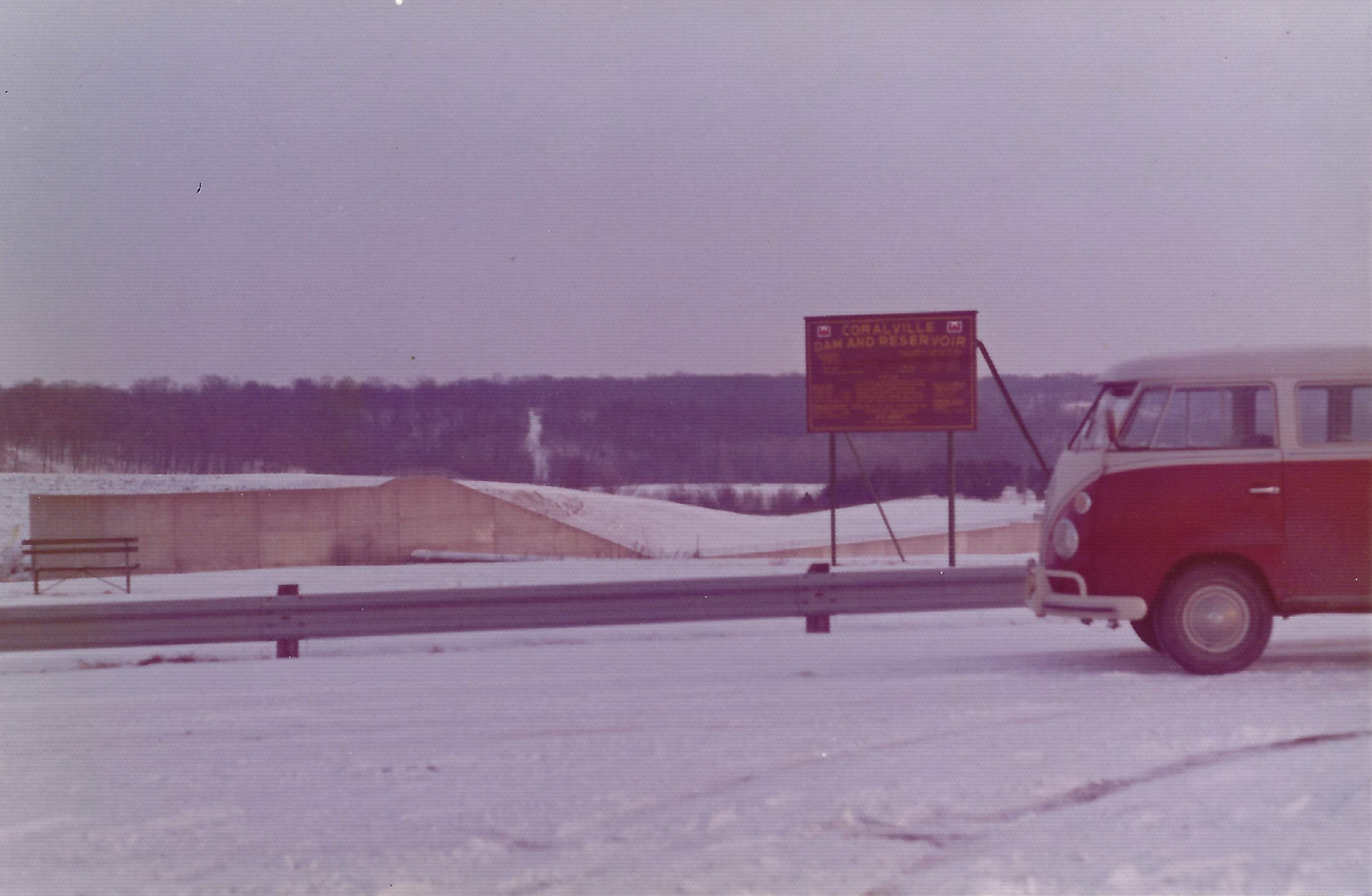
Coralville Dam and Reservoir circa 1973-4.

When in the 1970s I bought a Minolta SRT-101 35 mm film camera I took it on short trips to take pictures and see the results. Film and film processing were inexpensive. I felt I was a step above people who bought their Brownie camera at the drug store to capture moments of family events. I felt like a creative person with everything to gain by capturing images that weren’t necessarily of people, or remembrances of where I had been. So it is with this image which even 50 years later attracts my eye.

I don’t know why I drove by myself to the Coralville Dam and Reservoir that winter day. I have living memory of the experience. From looking at the dozen or so prints I took that day, I was trying something creative, the way an artist fills a sketchbook with drawings. I hadn’t given much thought to framing the image, or anything else a photographer might consider. I’m thankful I included the signage in the frame to help remember where the film was exposed.

The artist’s sketchbook is a good metaphor for these kinds of prints. While there is a result of the effort, namely the print, what is more important is the learning process I went through that day: the practice at capturing images. 50 years ago, I did a lot of practicing. When digital photography came along and became ubiquitous, we still practice, yet if we don’t like the frame we can immediately take another shot. With decades of experience, all of that practice comes into play with every shot we take.

These were days when we didn’t see the image until receiving the prints from the processor, maybe a week or more later. The disconnectedness of the print from the creative act added something. While there was living memory of the photo shoot, the printed result was divorced from that. The image stands on its own. That is one point of being creative.

When I received my share of the settlement with the elevator company related to Father’s death, I equipped our band with an electric guitar, amplifiers, a public address system and the Volkswagen microbus in this photograph. The photograph is proof the vehicle existed. The band equipment has long been sold, yet this photo remains as a reminder of what once was. It is also proof that I was learning a craft.

Check out Part I and Part II of this series.

Categories
Creative Life

A Life of Photos – Part II

Initial photo sort on Aug. 2, 2025.

In the end, photographs are objects. They have qualities — paper, coloration, moisture, processing technique, subject matter, and many others. In the beginning, one has to take a pile of them and just start organizing. This is especially true if during the collection process, there was no organizing principle, other than all photos go into a certain box labeled “photos.” It’s a process, or may be one once I have gone through everything on an initial pass. Here I’m talking about paper photographs.

Somehow I ended up with large quantities of photos, stacked one-on-one, placed together only by happenstance. Now I review them, one-by-one, to see where the journey leads. The immediate task is separating them into groups according to when they were taken. For example, there is a set of our young child getting a home permanent. They obviously go together in their own stack. Another stack is photographs I took when I lived in Mainz and from the travels around the area. It is a tall stack because I avoided thinking too much about them. They are easily grouped for later analysis. Going through them quickly is a necessary first step.

The hardest part of a review and sorting is to turn off memory while doing it. That was a stumbling block because I easily got distracted by memories evoked by the prints. I also felt I had to turn immediately to my autobiography and write about a set of photos. Now, one pile, one box, is sorted at a time. I group the objects together as they appear before me and as I recall how they went together.

Each pile could be a story in itself. To get through them, the stories need to be set on the sidetrack to be hooked up to the train later. Maybe it’s not optimal, yet it is a way to get from randomness to a better understanding of what I have available… and how each image might be used. This process will be about my personal cultural attributes, some of which I know, and some lie unawares in the conglomeration of personal cultural artifacts.

For now, I decided to make a weekly post about how my photography process evolves. The first one is here. Going forward, I will use the tag A Life of Photos. I hope readers will follow along.