Categories
Reviews

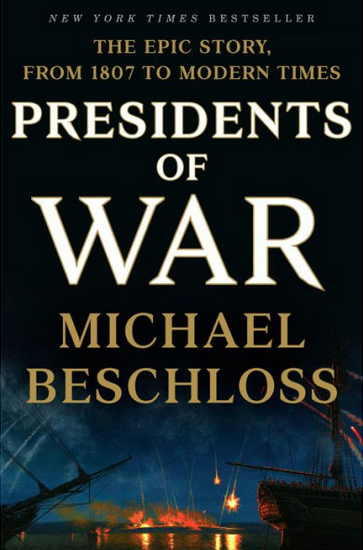
Book Review: Presidents of War

The Mason City and Urbandale school districts have both been in the news because of their efforts to comply with the new Iowa law which restricts what school children can read in class or in the school library. While this is a specific initiative driven by a small number of conservative groups, it seems appropriate to ask what should adults be reading? I submit it is books like Michael Beschloss’ 2018 history Presidents of War.

Presidents of War is a history of the use of presidential power conducting our nation’s wars beginning with the War of 1812 through the Vietnam War. Beschloss points out repeatedly our war presidents did not closely follow the intention of the framers of the constitution or the words in the document. They took liberties to accomplish their various objectives, some of which were needed, some political, some deceptive, and some flat-out ill-advised. Even the revered Franklin Delano Roosevelt weighed political considerations in his conduct of World War II.

In his review on Gates Notes, Bill Gates brought home why the book is important:

The richest insights for me came from the fact that the book’s broad scope lets you draw important cross-cutting lessons about presidential leadership…

[…]

Beschloss didn’t unearth much new material about any of these wars. But looking at each president and each conflict with a similar lens is what makes the book a worthwhile read.

Gates Notes, Bill Gates, May 20, 2019.

The barrage of misinformation and outright lies in our daily lives is non-stop. The technique is to drop a factoid, then pivot to an argument that has a political or commercial point to make. The point often isn’t rational or based on the asserted fact. It is hard to believe folks will summarize the complexity of World War II , or any of our wars, in a brief social media post to perpetrate a lie. Yet they do. We should be able to agree to leave World War II out of the pitch to buy life insurance. If we can’t, society has bigger problems.

Beschloss spent more than a decade writing this book. In the acknowledgements he wrote parts of the book were 40 years in the making. The reason to read Presidents of War is it equips us to deal with misrepresentations and lies in social intercourse. “Those that fail to learn from history are doomed to repeat it,” Winston Churchill said in a 1948 speech in the House of Commons. By presenting historical truth in the book, Beschloss enables us to call foul when someone misrepresents it.

In our political discourse, we spend a lot of time assessing our presidents. Presidents of War, and others like it, give us incontrovertible information about which presidents messed up and which didn’t. We should consult such information before blurting things out about Joe Biden, Donald Trump, and others like a loose cannon.

One aspect of Michael Beschloss’ package is he is active on social media and a historical consultant to news organizations. Room Rater consistently gives him a 10/10 for his presentation of self in video commentary. I mean, those are not really credentials we used to consider. As a historian, he became a participant in popular culture and this contributes to the book being readable and understandable. Presidents of War demonstrates proficiency in historiography as well as being relatable.

School boards are banning books and that makes it important for parents to be active readers. If you wanted to start reading again, or just need a good next book, President of War would be a great starting place.

Categories
Living in Society

Don’t Tell Us What To Read

Shelf of books about Iowa.

A fundamental right in the United States is to choose what we each read, see and hear. The First Amendment of the U.S. Constitution gives us this right. Where is the boundary between educating our children and providing them free access to all forms of cultural expression regardless of content?

This is not a new question and society has been answering it in different ways for as long as I can remember. The Iowa legislature decided to codify where the boundary is and passed a law last session. Based on the new law, the Urbandale School District pulled almost 400 books from their stacks and curricula. Most districts are expected to be overly cautious in their approach to compliance. The state has been less than helpful in providing guidance on how schools and libraries should handle the new law. Urbandale reversed course on many of these books. There needs to be binding guidance from the state board of education before districts begin pulling books. State Senator Janice Weiner posted on X, “IMO all districts need to write and demand binding guidance.” In the military my drill instructor would describe this situation as it is playing out in real life a “goat screw.”

Control over which books K-12 students could access at school was evident in the 1950s and ’60s. We didn’t call it K-12 back then. When I was young, teachers kept an eye on my reading and made their opinions known. If they didn’t like a particular book, I read it at home where my parents supervised me. I got my first library card in 1959 and have been reading books from the library ever since.

My first conflict was in eighth grade over a book written by Ian Fleming, one of the 007 series. The priest saw I had it and confiscated it because of James Bond’s interaction with women. I discussed it with my parents and eventually bought another copy from the corner drug store with my allowance.

In high school I heard about J.D. Salinger’s book Catcher in the Rye and wanted to read it. It was prohibited and unavailable in the school library, or even in our local bookstores. I went across the river to a Rock Island bookstore where I bought it, and read that one too. I was free to manage the conflicts between teachers and my reading.

Fast forward from the 1960s and here’s where the controversy over boundaries for student reading seem to be heading, according to the Cedar Rapids Gazette editorial board:

Our public schools will be shackled by authoritarian, politically motivated edicts intended to dictate what hundreds of thousands of Iowa students can and can’t learn in school. State actions that historically have been aimed at improving public schools will be used instead to narrow their educational missions to please a minority of outraged parents whose complaints are being elevated by Republican politicians eager to attack public schools.

It’s called “parents’ rights,” but the rights are only for parents who agree with Moms for Liberty.

We don’t need state lawmakers to intervene in local disputes over books. There are processes in place locally to challenge books. Just because banning a book is not easy does not mean the local process is flawed. And one school district’s decision should not affect other school districts.

Editorial, The Cedar Rapids Gazette, Feb. 10, 2023.

What I can’t abide is the state Legislature regulating which books should be allowed in schools. This decision should be between teachers, librarians, and parents. The claim parents don’t know what books are in schools or somehow don’t have input seems bogus. If the Legislature wants to do something on libraries, fund online access to card catalogs throughout the state. We don’t need lawmakers telling us what to read.

Categories
Reviews

Book Review: The Hidden History of American Democracy

Is democracy the default state of humanity? In The Hidden History of American Democracy: Rediscovering Humanity’s Ancient Way of Living, author Thom Hartmann presents the case that democracy is our default state, overcome only by the intrusion of dictators, popes, and kings using the power of great wealth, control of media, or the force of arms and technology. He explains where society has gone astray and what we can do to restore democracy.

The Hidden History of American Democracy is the ninth volume in Hartmann’s Hidden History series. Like its predecessors, it is accessible and easily readable, especially for readers immersed in the issues it covers. Hartmann creates a narrative grounded in historical documents yet seems fresh, and modern in its interpretation. The first two parts of the book dispel myths about democracy and the meaning of our constitution. The rest of the book frames the modern war on democracy and regulated capitalism; outlines a 21st Century democracy agenda; and presents a call to action.

The United States is not a Christian nation. Although Christianity was introduced in North America by European settlers in the 16th and 17th Centuries, and has experienced periodic revivals, it did not appear to take. The founders did not envision the newly formed country as Christian. They took precautions to avoid affiliation of the government with religion. Author of the Declaration of Independence and US Constitution Thomas Jefferson studied the Bible yet was decidedly not Christian. In fact, the US Constitution never explicitly mentions God or the divine. In this book, Hartmann creates a narrative about the founding using Jefferson’s own experiences with the Cherokee and other indigenous people, depicting American democracy’s indigenous and broadly based intellectual roots.

While the US Constitution isn’t strictly based on the Iroquois Confederacy, it does have some elements in common with it. The greater impact of Native Americans, however, was in helping to shape the thinking of Enlightenment thinkers from Spinoza to Locke to Montesquieu to Jefferson.

Thom Hartmann, The Hidden History of American Democracy.

Here in Iowa, people refer to the US Constitution as if they read it. What they say and appear to believe about it doesn’t match the text. Not only do citizens believe the United States was founded as a Christian nation, they superimpose misguided characteristics on the Constitution regarding gun ownership, the U.S. Supreme Court, the Electoral College, the branches of government and more. In part two of the book, Hartmann takes apart these cultural myths in an effort to return us to a basic democratic outlook from before some were led astray.

The high water mark for post World War II democracy may well have been the election of Ronald Reagan as president. 60 percent of middle class Americans lived “the American Dream” in 1980, according to Hartmann. So-called Reaganomics, or the rise of neoliberalism, brought de-regulation of capitalism, “which measurably set back the working and middle classes while also weakening our democracy,” Hartmann said. Both Republicans and Democrats espoused principles of neoliberalism, ending in an all-out war on democracy and regulated capitalism. It is hard to find fault with Hartmann’s analysis of this important issue.

The rest of the book outlines a 21st Century democracy agenda. In it, action steps such as making voting a right instead of a privilege, changing the relationship with the U.S. Supreme Court so there is a form of oversight or “regulation,” expand the U.S. Senate immediately by adding two new states (Washington, D.C. and Puerto Rico), providing health care for all, and more.

Thom Hartmann

Importantly, part of Hartmann’s agenda is for each of us to get involved in our democracy.

You may think your voice is but a faint whisper in the wilderness, but there are ways you can amplify it at no cost other than a bit of effort. Write letters to the editors of your local newspapers. Become active on social media. Volunteer with the dozens of great good-government groups and organizations devoted to saving our environment, our democracy, and our world.

Thom Hartmann, The Hidden History of American Democracy.

As we enter the 2024 general election cycle, many of us are seeking things we can do to make a difference. A good way to start is to read The Hidden History of American Democracy: Rediscovering Humanity’s Ancient Way of Living and share it with your friends.

The author interviewed Thom Hartmann about the book on July 10, 2023. Readers can hear the 31:25-minute interview by clicking here.

Thom Hartmann is a four-time winner of the Project Censored Award, a New York Times bestselling author, and America’s number one progressive talk show host. His show is syndicated on local for-profit and nonprofit stations and broadcasts nationwide and worldwide. It is also simulcast on television in nearly 60 million U.S. and Canadian homes.

To buy a copy of The Hidden History of American Democracy: Rediscovering Humanity’s Ancient Way of Living, click here. The book is available July 18, 2023.

Categories
Writing

Great Book Sort #1

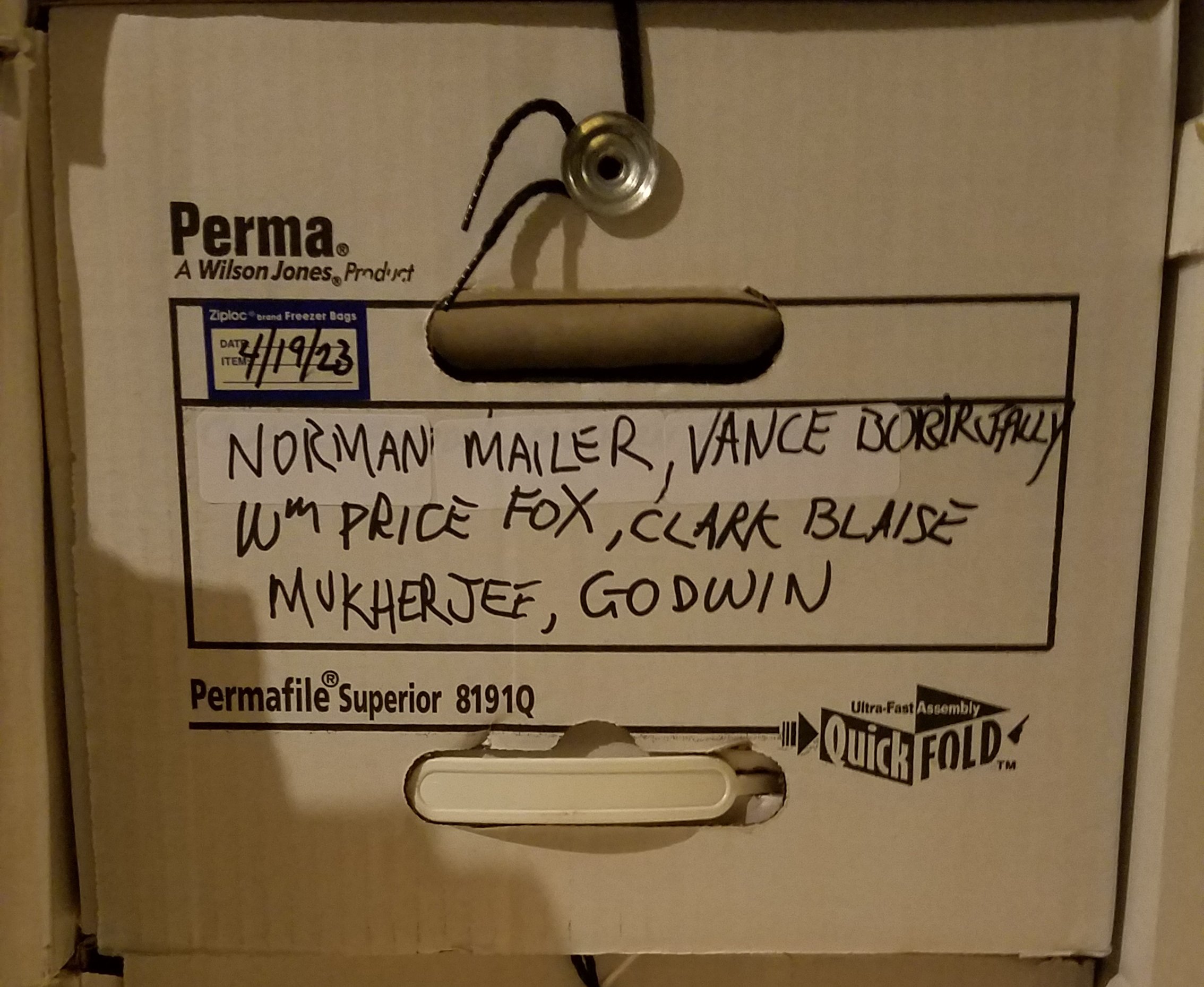
File box full of books.

This year I donated roughly 700 books to the public library used book sale and to Goodwill. Goodwill is less picky about what they will accept, so they received the majority of them. Many of my donations still had the Goodwill price tag from when I bought them. Library downsizing has only just begun.

All but The Moviegoer of my collection of Walker Percy novels went into boxes and out the door. I felt a bit sad about that, but as Vonnegut said, “So, it goes.” I had to decide about my collections by author. Other authors, that I worked equally hard to collect, went into bankers boxes with the names and date packed on the outside. Who knows if one will get into the boxes again, yet they are available and take up no precious shelf space. A few — Bellow, Didion, Irving, Morrell, Faulkner, and William Carlos Williams got their own special shelf space. It wouldn’t be my library without those authors.

I wrote previously about poetry and that decision seems solid. The shelves are easily accessible so when I want to read poetry I can get at the stacks.

Cookbooks are impossible. Half of what I gave away was cookbooks. I can’t seem to part with many more. Yet I must. Truth is, I hardly use cookbooks any more. Having learned how to cook, they serve as cultural artifacts related to places and people with which I have some connection. Reference material for the church where I was baptized, or the American Studies department where I got my degree. In seventy years of living, we generate a lot of connections. A cookbook has usually been involved. They also serve as examples of how to prepare a particular dish or ingredient. Keeping many of them takes up space that could be devoted to other topics. This sorting is far from over.

Hundreds of books about Iowa history and by Iowa authors needs reduction to a shelf of about a dozen to hand off to our child when they are ready. I also wrote about this. More of those got boxed up, leaving the first tier to be read and re-considered on the shelf.

The space for books about U.S. presidents is settled at eye level on two long shelves. The ones by or about presidents in my lifetime is sorted. I had two copies of Eisenhower’s White House memoirs and one is on the bench waiting to be packed up for Goodwill. I have a blank space for the second volume of Obama’s presidential memoir. No space was left for a Trump memoir, I mean, you got to be kidding me.

My African-American studies section has grown, and I need a space for American Indian books. I can’t bear to part with all the ancient writings, although the chances of reading some of them are slight. I may get into Plutarch’s Lives, or I may not. Keeping them for now.

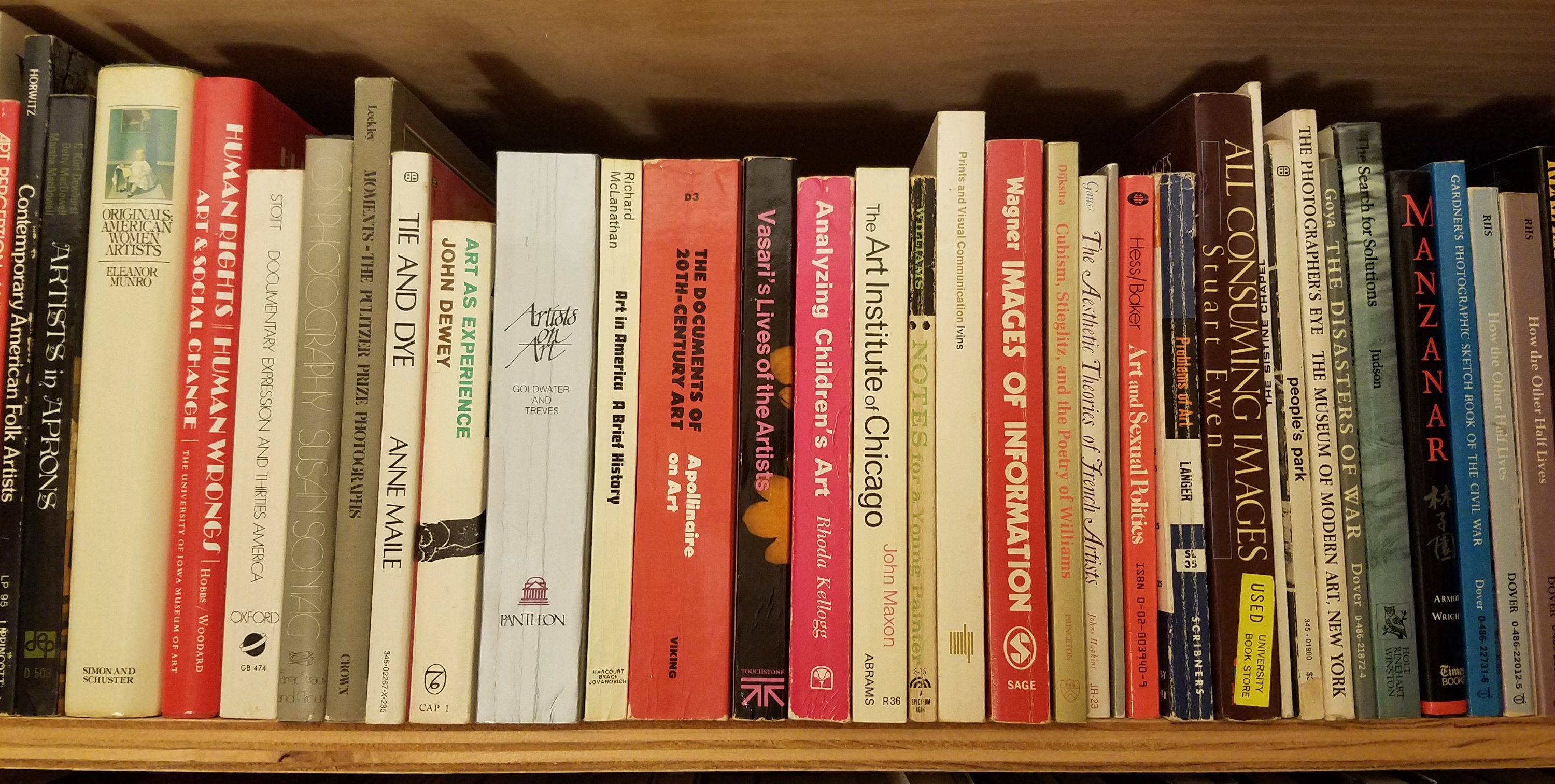
Art books take up too much space. Having so many is a function of my interest in certain artists like Picasso, Joan Miró, Georgia O’Keeffe, Warhol, Hopper, and the like. Some I bought at the artist’s retrospective, and some I picked up at used book sales. Until I get to the point of running out of space, most of them will stay right where they now are.

A byproduct of sorting is finding more books to read. The to-read shelves are packed to overflowing. I’ve also found some lost friends, like George McGovern’s autobiography, Grassroots, and Joe Biden’s Promises to Keep. I put Biden’s memoir into a box, thinking he would never be president. Now it’s up in the presidential lineup.

The great book sort is proving to be beneficial. I have a better understanding of what I have, and organized them into projects for future writing. For now, there are some empty shelves. There won’t be for long.

Categories
Home Life

Prairie Home

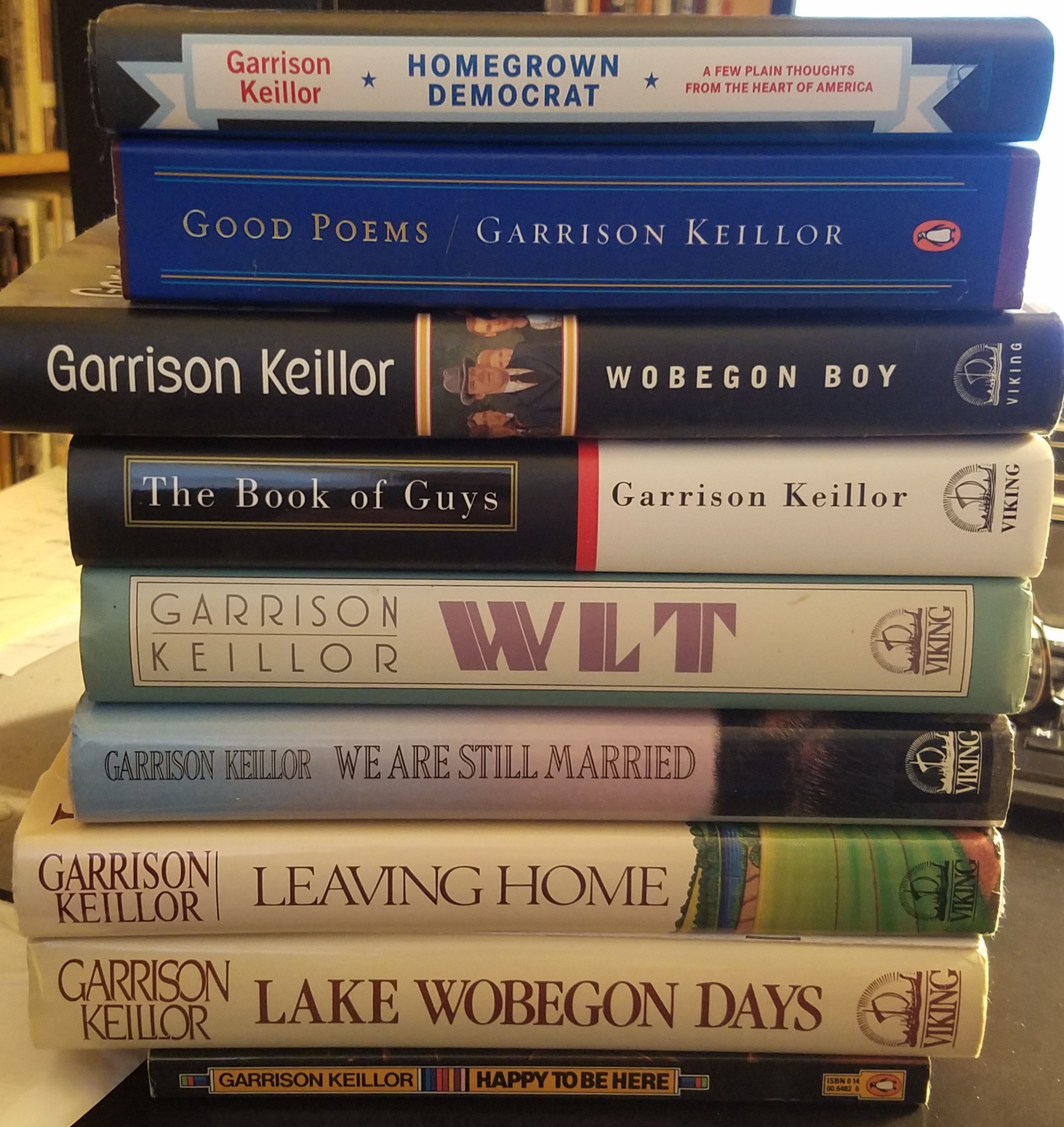
Selection of books by Garrison Keillor waiting disposition.

It’s time for decisions… about Garrison Keillor.

Specifically, what should I do with this pile of books? Most were purchased at thrift stores for a dollar or less. I may have purchased the poetry book new, and maybe Homegrown Democrat. I can’t recall. Keillor’s books never made an impression on me the way Saul Bellow, Joan Didion, or John Irving did. He fancied himself a modern day Mark Twain, or something. I didn’t see it. Had I read more of Keillor, it may have been different. It’s getting late to start reading him now.

These nine books have been gathering dust in a row on the bottom shelf of the right-side stacks. They have been within reach for years. I could see them from the chair I bought for a buck from L.P. “Pat” Foster at Sharpless Auctions in the early 1980s. It is my writing chair for Pete’s sake! Keillor is a writer! The collector in me amassed the Keillor volumes back when I was in a more accumulating mood.

Disposing of Keillor’s books is a practical problem. Do I expect to read them? No, not likely. Will I refer to something he wrote in my writing? Maybe, yet it is hard to imagine when the radio show made the dominant impression. Do they have sentimental value? Maybe. Are there more worthy books for retention waiting in the next room for shelf space? Yes definitely and that will be the decider.

Keillor’s allure was when A Prairie Home Companion was live on Saturday night, the signal coming through the clock radio atop the Kenmore refrigerator in our Midwestern home. I did things in the kitchen and listened. In important ways, his show made Saturday nights for a long time. I miss them. Will I miss the stack of books? If I would miss them, I might have picked one of them up over the last ten years.

I remember when he signed off the air in 1987. It felt momentous. Our two-year old child wanted to go for a walk in the neighborhood at the same time. No regrets about going with her instead of hearing Keillor live. We all must make choices.

I rigged my cassette recorder to capture the last show while we were gone. When we returned from our walk, I discovered the tape had run out before the show ended. Keillor never went over, except this time. I was able to re-record it on Sunday when it aired on a different radio station that broadcast from the Quad Cities.

We now know Denmark didn’t work out, nor did his then new marriage. He came back to radio. There were other problems, they said. I’m not sure what happened, or in what order. I didn’t pay much attention to his personal life. The star of the show was always the yarns he spun. It felt like it would never end.

In a June 16, 2016 New York Times article aligning with his second departure from the radio program, Cara Buckley wrote, “Everything about “Prairie Home” — the Guy Noir and Lives of the Cowboys sketches, the spots for Powdermilk Biscuits and the Ketchup Advisory Board, the monologues about the fictional Lake Wobegon — sprang from Mr. Keillor’s imagination. But the man spinning the plates at the center of it all managed to stay a mystery, even to people who know him well.”

These days, I’m spinning my own plates. To use a more local metaphor, I don’t have enough time to card my own wool, and spin my own yarn to make a sweater. Plate-spinners have gone out of fashion.

I wish I could have one of those Saturday nights back. Like the one I shared with our child in Colorado Springs in their first apartment there. We went to the grocer together, prepared dinner, and talked to each other with the sounds of a Prairie Home Companion in the background. Those were golden times whose embrace is fleeting.

I will figure it out. These septuagenarian days are also fleeting. In the universe of things to do with used books, these will likely go to the public library’s used book sale. I may have bought some of them there. It seems likely they will find readers in our community, even if I can’t find the time in our prairie home to be one of them.

Categories
Living in Society

The Great Shuffle

Filled Bankers Boxes.

The back seat of the Chevy Spark is loaded with boxes of books to be donated to Goodwill. Between this load and the previous two, I downsized by about 500 books. It doesn’t look like I made a bit of progress.

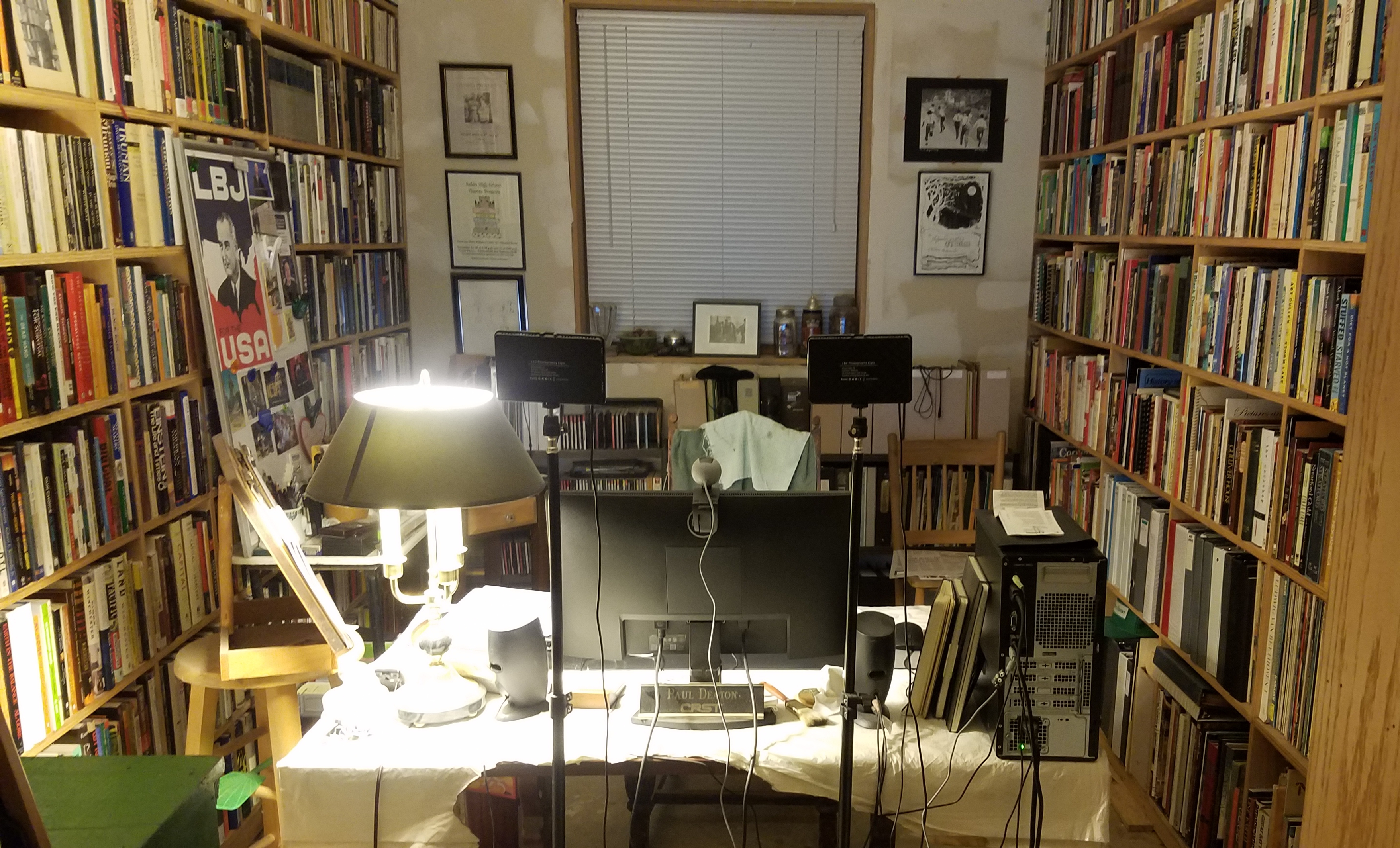
The goal is to reduce the library so it fits in my writing room, which holds about 2,000 books. Remaining books should be linked to some actual or potential writing project. I’m done keeping books because I might refer to them later. As I look at each book, this is a litmus test: am I going to read or use it now, or not. There is a long way to go to reduce the quantity to fit the space.

It snowed overnight and the ground is covered. It should melt during the next couple of days, yet today will be indoors work. I’m ready for spring.

The house is getting crowded with vegetable and flower seedlings. I finished with early planting yesterday. Next week I tackle tomatoes, peppers, arugula, and lettuce. Once there is a warm, clear day, I’ll move the mulch and set up the portable greenhouse so all the seedlings can move there. With the cold, wintry mix weather, I haven’t felt like outdoors work.

I drafted an obituary for my high school friend‘s widow this morning. It is difficult to compress 71 years of life into 500 words. This is especially true for a physician who has had countless contacts with people in the community, and lived a full life. An obituary still serves as a public notice of death and is important.

Facts need research before going to publication. In several ways, the obituary is a last chance to get things right. We owe getting it right to the deceased, and to the survivors. I tend to be less specific if I don’t know something with certainty. Thus far, no one has complained I left anything out.

I finished my 19th book of the year and need to browse the stacks for the twentieth. Lucky for me, there are still plenty of options.

Categories
Reviews

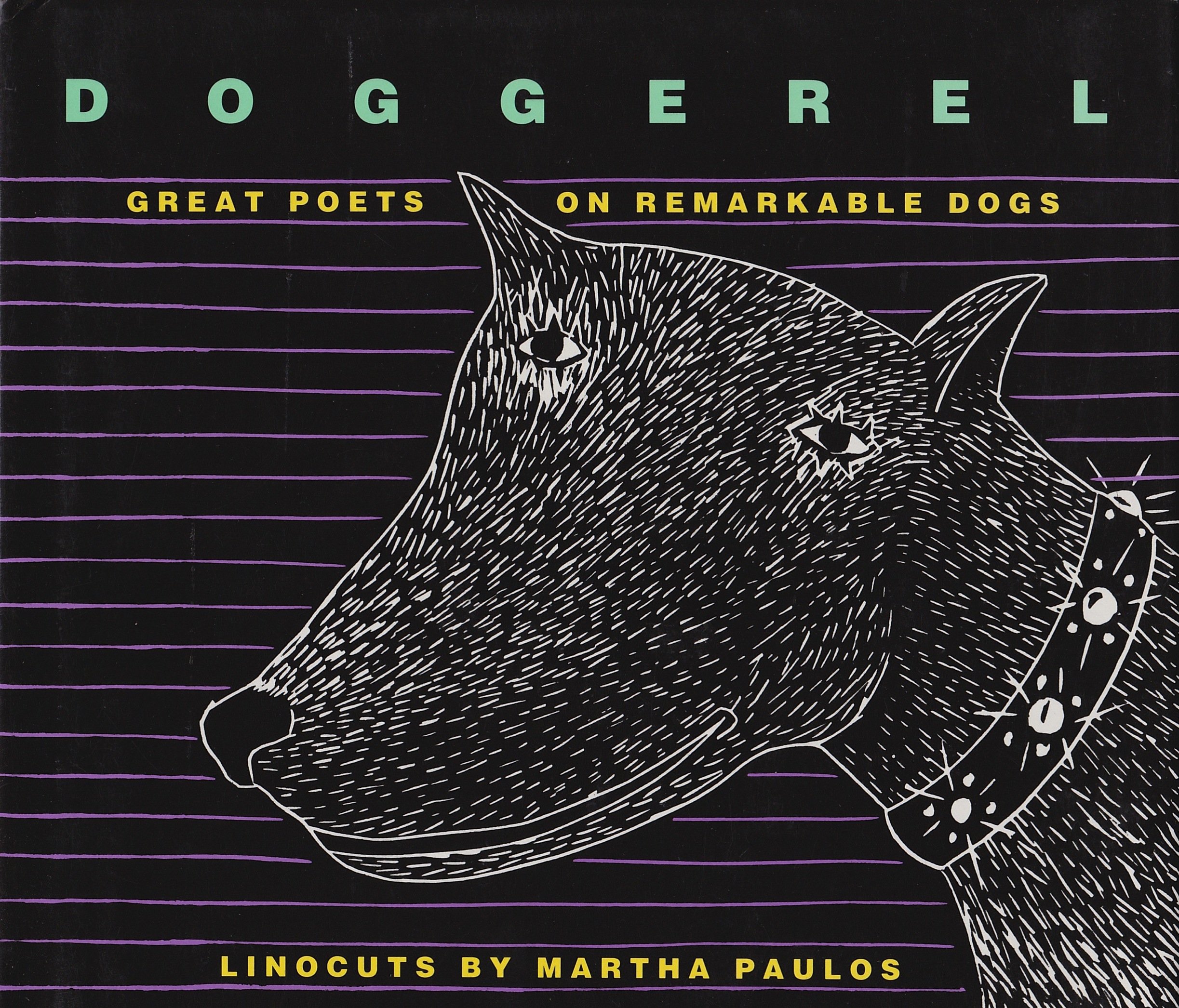
Book Review: Doggerel

How does an artist survive and thrive in a highly competitive creative environment? Produce a book like Doggerel by Martha Paulos. More than thirty years after publication, it seems fresh and holds interest.

The linocuts in this book are compelling and well-executed. The poems written by their respective (famous) authors add to the linocuts. Nothing about this book is a hagiography of dogs and that seems to be the point. The book is funny, and based in a society the reader can understand. Who hasn’t been chased by a dog while riding a bicycle?

Linocuts take more time to produce than other media. Paulos’ high level of technical craftsmanship made it worth our time to appreciate her art.

Recommended for people working toward a career in creative endeavors. Also for anyone interested in linocuts. If a person collects dog stuff, they should get a copy for Doggerel’s uniqueness.

Categories
Living in Society

Art in a Life

Art and art history books, Dec. 14, 2022.

Most Iowans don’t value art like that displayed at the University of Iowa. Increased public awareness of this attitude is part of the coarsening of Iowa culture in its current wave of neoliberalism. As a writer, how should art and art history be incorporated into my work? Should they be?

Debate in the Iowa Legislature after the 2008 Iowa River flood permanently damaged the University of Iowa Museum of Art was whether to sell Jackson Pollock’s Mural. Scott Raecker, Republican chairman of the House appropriations committee, introduced a bill requiring the university to sell the painting, then valued at $140 million. The ideas were the asset held no equivalent value for the university museum, and the money could be placed in a trust fund with the interest funding undergraduate scholarships. The bill was written about in news media, yet failed. When the new University of Iowa Stanley Museum of Art opened in August 2022, Mural had been restored and returned as a centerpiece of the permanent collection.

Arguably the three most famous paintings in the museum, Mural, Joan Miró’s A Drop of Dew Falling from the Wing of a Bird Awakens Rosalie Asleep in the Shade of a Cobweb and Max Beckmann’s Karneval were in the collection during my undergraduate years. I discussed and wrote about them in art history class. They made an impression on me, one that would follow until I had an opportunity to see Miró work in person at a French gallery in Saint Paul de Vence in 1979. Art occupies part of my life today.

I attended major retrospectives of work by Pablo Picasso, Georgia O’Keeffe, Andy Warhol, Edward Hopper and others. While traveling in Europe I visited major museums where the so-called great master paintings were in permanent collections. I spent a lot of time at the Musée de l’Orangerie in Paris where the Claude Monet exhibition captivated me. I experienced art in a way most Iowans have not. Revered artwork holds a place in my world view even if I not more generally where I live.

In Davenport after Father’s death I spent time with artists, both my age and older. I didn’t demonstrate any talent for drawing, painting, or other visual arts. At university I took a class in ceramics where I explored the medium and produced a few good pieces. Most of those were sold, given away, or have otherwise gone missing. I also tie-dyed fabric. Since graduation, I haven’t done either at all. I saw how much work went into being an artist, the level of financial reward, and doubted I could make that commitment.

Is there more than art in the background for my writing?

The immediate problem is I am running out of shelf space and some of my art and art history books will have to go. Some stack-trimming is in order. Major books containing reproductions of an artist’s work will stay. Some of the secondary and all tertiary analysis will go. The challenge is there are so many books to read and so little time. That I need to be writing, rather than studying, is a basic fact of life.

Beyond the space problem, finding a link between writing and the visual arts has been something for me to avoid. I don’t like artistic name-dropping (or any kind of name-dropping) in writing. There are few circumstances where a description of a work of art could play a role in a narrative. The use of works of art and artistic theory must lie in the creative process.

The challenge in art is process is often visible. For example, in 1974 I wrote about Beckmann’s Karneval, “The main actors are merely broad areas of paint bordered with heavy black lines, and what is more, the bodies do not correspond to the anatomy of the human body.” While such description helped me understand the work, in narratives there is little use for words that don’t get to some existential point directly. We seek bodies that do correspond to human bodies because the narrative may depend upon such understanding among readers to further the story.

The next time my long-time friend from Missouri visits, we’ll spend time at the Stanley Museum. I will put Vasari’s Lives of the Artists on my reading list. I will revisit Walter Benjamin, Susan Sontag, John Berger and Roland Barthes. These good intentions are designed to help me be a better writer. The next part of following through is harder.

Categories
Living in Society

Reading While Aging

Books by Iowa-connected folks.

On the corner of my sorting table rest piles of recently read books. I am shocked at the level of retention from the experience. It is not as much as I want. Is there an issue with reading while aging, or not?

In an article titled, “Reading in Normally Aging Adults,” authors associated with the American Psychological Association present the following article abstract which describes the physiological and cognitive process. Sorry, it is a bit long, yet everything in it is important.

Skilled reading requires coordination of knowledge about language with a broad range of basic cognitive processes. While changes due to aging have been documented for many of those cognitive processes, the ability to read declines little during healthy aging. Aging is associated with slower reading, longer eye movements and more regressive eye movements, but the qualitative patterns of older adults’ eye movements in response to lexical characteristics (e.g., frequency) and sentence characteristics (e.g., word predictability) largely resemble those of younger adults. The age-related differences in reading behavior are due in part to older adults’ reduced visual abilities. In addition, they may result from compensatory strategies wherein older adults rely more on their intact semantic intelligence and less heavily on perceptual processing of text, or alternatively they may be a consequence of older adults being less adept at effectively coordinating word recognition with processes of oculomotor control. Some age-related declines are seen when reading comprehension and text memory are assessed at lower levels of representation for complex sentences. However, older adults perform as well or better than younger adults when higher-level meanings of a text are assessed. These high levels of performance reflect older adults’ ability to draw on crystalized semantic intelligence that provides well-organized structures in long-term memory of the patterns that tend to occur in natural language. (PsycInfo Database Record (c) 2022 APA, all rights reserved)

Reading in normally aging adults by Gordon, P. C., Lowder, M. W., & Hoedemaker, R. S. APA PsychNet.

My take away is that while my vision has somewhat deteriorated, mental capacity remains strong, and I can draw on information and experience gained in my past to better and more quickly understand what I am reading. According to other articles I read this morning, reading can maintain mental functioning, and stave off common mental illnesses among the elderly like Alzheimer’s disease.

The money quote is, “However, older adults perform as well or better than younger adults when higher-level meanings of a text are assessed.” In theory, these psychologists say, since I have visual acuity, I retain the potential to be as good a reader as anyone.

Why am I worried about the piles of books read yet little remembered?

The abstract points to a borderline area of reading: the interaction between read text and the stored intelligence in my brain. To what extent am I processing what I read in context of past reading experience, and to what extent am I taking in text to gain new experiences? My fear is it is the former. If we read, it should be to expand our knowledge and experience, not to intake words and sentences as a form of confirmation bias.

Because I curate a large home library, I plan to continue reading for as many months and years as possible. My daily reading goal is 25 pages from a book. For the most part, I exceed that amount depending upon how engaging the writing has been. Importantly, I want more than to check off the daily reading goal box on my to-do list. I want to gain knowledge and experience that will help me better cope with society. I want to read to become a better writer.

By year’s end I will have read almost 60 books. If the text is being assimilated into my existing cognitive capacity, there is nothing wrong with that. I take up each new book with hope it will reveal something about society, something specific in life, an answer to a question or something about myself. I also read to see how other authors write. As long as I take a few minutes to appreciate each book after finishing it, I am of an age where everything read becomes part of my world view.

Categories
Living in Society

Reading 2022

Sorting books for library downsizing.

The garlic rack converts to a table by using a remnant of a 4 x 8 sheet of 3/4-inch plywood used to build our child a loft bed for college. I laid it down on top of the two by fours used to hold garlic as it dries. The rack is tall enough so garlic leaves don’t touch the floor. As a table I can work without bending over. It is a useful space to sort things out.

I read 50 books thus far this year. They are listed on the Read Recently page which is updated after I finish each one. Here are the highlights of this daily activity.

By far, the most interesting book was Year of the Tiger: An Activist’s Life by Alice Wong. She was born with spinal muscular dystrophy and her book stands out as a tale of living an active life with a disease that confines her to a wheelchair. In her discussion of Twitter, she describes how the social media platform is used by disabled persons who may have no other public voice. As Elon Musk acquired and is changing the platform, I hope he improves the disability community’s ability to participate in this aspect of society.

Memoirs and biography were too small a portion of the books I read. As someone writing their own autobiography, I should be reading more in this category. Each of the four I read was important. I enjoyed Loretta Lynn: Coal Miner’s Daughter more than Ted Kennedy: A Life by John A. Farrell and Like a Rolling Stone by Jann S. Wenner. Lynn’s book was relatable in a way Kennedy and Wenner are not. A person can take only so much of the life story of rich people. I associated Joan Liffrig-Zug Bourret, who died in the care center in town this year, with the many cookbooks she published at her Penfield Press. Her memoir, Pictures and People: A Search for Visual Truth and Social Justice tells a story that goes well beyond her chronicling of the Amana Colonies in Iowa.

When We Cease to Understand the World by Benjamín Labatut seemed unique and necessary. The Chilean author presents, as The Guardian put it, “an extraordinary ‘nonfiction novel’ that weaves a web of associations between the founders of quantum mechanics and the evils of two world wars.” It was unlike anything else I recently read.

I read fiction for diversion and to see how other writers do their work. Amor Towles’ The Lincoln Highway was the best of the lot this year.

In poetry, how did I miss Mary Oliver in my life? I don’t know but Devotions: The Selected Poems of Mary Oliver was well-written and engaging. I’ll be returning to this excellent volume.

Rising Tide: The Great Mississippi Flood of 1927 and How it Changed America by John M. Barry tells a story essential to anyone who is from or is writing about life in the Mississippi basin.

Related to my autobiography was The Trader at Rock Island: George Davenport and the Founding of the Quad-Cities by Regena Trant Schantz. This is an essential book about the settling of the Midwest. What was most surprising is it was just published in 2020. I would like to have read this when I was a teenager in Davenport.

There were no real clinkers in this year’s books. What made a difference in reading more was setting a daily goal of reading 25 pages in a book. I hope readers find my review of 2022 reading to be useful. I’d love to hear what you are reading in the comments.