At 168 pages, the book takes readers through the founders’ vision of the courts, the Powell Memo, the growing influence of fossil fuels companies on the court, judicial review, and the constitution’s preference for property rights over human rights. Hartmann also covers the court’s involvement in key American movements and issues, including labor, abolition, racism, abortion, environmentalism, and the rise of the TEA Party. The final section of the book offers solutions to “save the planet, democratize, and modernize the Supreme Court. It’s a page turner.
“But isn’t Hartmann preaching to the choir?” engaged readers might ask.
What’s important about this book is it exists at all.
Blog for Iowa, and others like it in Iowa and around the country, rose up in the years after the 2004 general election offering an alternative voice to right wing talk radio, evangelical Christianity, and a media landscape where the Fairness Doctrine no longer applied and cable news companies gained hegemony with partisan, conservative messages 24/7. In addition to progressive national and state-based blogs, radio and television personalities competed to gain a progressive audience. Thom Hartmann is one who survived and thrived. He is currently the number one progressive talk show host in the United States according to the about the author section of the book.
The purpose served by The Hidden History of the Supreme Court and the Betrayal of America is presenting a narrative of the key elements of the Supreme Court’s history to a progressive audience.
So often ideas about the Supreme Court are formed by snippets of information in various media about specific decisions, the judicial nominating process, and groups like the Federalist Society which lobby the government for appointment of certain types of judges. Increasingly social media is a key driver for informing our opinions, yet it presents an incomplete picture. It is not enough. What has been lacking is a more comprehensive look at the supreme court told in language that is easy to understand. Hartmann delivers that and more.
Here’s a clip of Thom Hartmann reading from his book. The Hidden History of the Supreme Court and the Betrayal of America is available from the publisher and most places where books are sold.
The Democratic Party seems on the brink of descent into a primal ooze as we now debate political staffers forming unions in campaigns. What’s there to debate?
Presidential candidate Pete Buttigieg gets the overarching policy right. “Freedom means the ability to organize in order to hold employers accountable and advocate for fair pay,” according to his website.
To the extent political campaigns employ anyone, those employees have a right to organize. That said, the articles, discussion and posturing about unions and campaign organizers organizing a union are a distraction from the need to defeat Donald Trump, hold the Democratic majority in the U.S. House of Representatives, and gain a majority in the U.S. Senate.
I have some questions about organizing the organizers.
Why?
Suzan Erem, who has been a consultant to labor unions, recently posted on Facebook, “no self-respecting union organizes workers whose jobs have at best an 18-month shelf life.”
Either an individual campaign provides a living wage and acceptable working conditions for employees or the candidate suffers the consequences in a primary election. If workers organize a union, the candidate should be willing to sign a contract quickly and get on with the campaign. When there are grievances, they should be timely addressed.
It is important to remember pay and benefits are not what leads talented people to work on a political campaign. The question of organizers unionizing should be a self-motivator for Democratic candidates. Employees have the choice to organize and it should mostly be part of the background noise of a campaign. It should be a non-issue.
Bandwidth?
“An unnamed person has alleged to a federal agency that the union representing some employees of Sen. Bernie Sanders’s presidential campaign did not properly address a grievance,” Sean Sullivan wrote in the Washington Post. A dispute between a labor union (United Food and Commercial Workers in this case) and a represented member is never good. When it escalates to the National Labor Relations Board, lawyers get involved.
As Sanders and his staff spend time and resources on this NLRB case and resolving any other grievances with their union, the clock continues to tick toward the Iowa Caucus and the dozen states with primaries and caucuses on or before Super Tuesday. Managing labor, organized or not, will take bandwidth.
When the union appears to botch the process as suggested in Sullivan’s article, it is a burden on everyone involved. Some other priority will be neglected while time is spent on this grievance. News outlets may pick up on the NLRB case and neglect covering candidate policy.
To What End?
The period of employment for paid campaign workers is relatively brief. Anyone who has worked on a campaign knows a lot of hours are involved. If it’s too much, why wouldn’t an employee go to their supervisor and ask for relief. If they are not satisfied with the way it is addressed, move on to what is next. It’s not like campaign organizing is a permanent career even if one is still working at it after beginning in the 2008 cycle.
Organizing a union is not always a speedy process. In the meanwhile, the election is just around the corner, after which employment ends for the most part and any union becomes moot. If the campaign is successful there may be another job in Washington, D.C. If it is unionized it would be a separate bargaining unit.
Most working people have an opinion about unions. I do too, and mine is multi-faceted. Unions have good intentions yet outcomes for rank and file members vary in efficacy. During a presidential campaign, especially during the primary/caucus portion of it, the main organizing has to be getting enough votes to get the candidate to the next stage whether it’s winning the primary or the general election. Organizing a union has to be done quickly and efficiently or it becomes a distraction.
Is it wrong to collect seeds from a prairie restoration project for use in a home garden or another prairie restoration project?
I posed the question on social media. While the responses weren’t that many, they were a unanimous yes.
Not so fast!
“Stealing is stealing,” Cindy Crosby, author of The Tallgrass Prairie: An Introduction wrote.
A prairie manager I know was out for a stroll on his site when he came across a woman cutting buckets of blooms. Horrified, he said, “Lady, what are you doing?” She replied testily, “Well I tried to cut the flowers up by the visitors center for my party and they wouldn’t let me. So I came out here.”
Wildflowers will replenish themselves, right? Maybe and maybe not.
I asked our local state park ranger for his thoughts about harvesting seeds from prairie restoration areas. His response was speedy and made sense, “You are good to take seeds from the plants but just do not remove the plant itself and you will be ok.”
That’s good enough for me. I’ll be watching the patch of restored prairie for seed formation and try some of the varieties in our home garden.
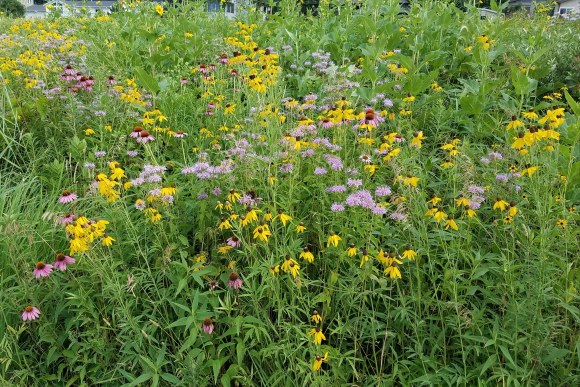
Prairie used to cover more than 85 percent of Iowa land, according to the Neal Smith National Wildlife Refuge. Today less than one tenth of a percent of original tallgrass prairie remains in the state. A prairie restoration project, like the ones at Iowa state parks, is a work of human hands and culture.
People like Cindy Crosby have a personal investment in work they have done to restore prairie. Even if such restorations are anything but natural, and a constant struggle to keep invasive plants like garlic mustard at bay, they add cultural value in the form of habitat for plant and animal species and the narratives spun around them. We should tread lightly in their work, take what we need, and leave the rest.
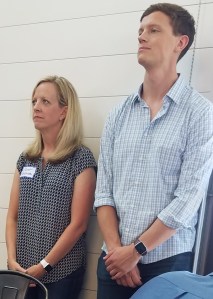
State Auditor Rob Sand and State Senator Janet Petersen waiting to go on stage at the Zach Wahls birthday fundraiser in rural Iowa on July 14, 2019
State Auditor Rob Sand spoke at the Zach Wahls birthday fundraiser in rural Johnson County on July 14. He was brief.
Sand’s brevity is becoming a feature of his political tenure. Those of us who hear a lot of political speeches appreciate his willingness to be brief, be brilliant, and then be done.
Blog for Iowa wanted to hear more from Sand so we asked him to participate in a questionnaire via email. He said yes. The questions and Sand’s responses follow, published without significant editing.
BFIA: What do you feel is most important about the first six months of your tenure as auditor? Why?
Sand: In just six months we have accomplished a lot of what we set out to do during the campaign. The office has never promoted efficiency, which I said I would do. Our new PIE initiative (public innovations and efficiencies) will do just that. In addition, very soon we have two individuals with law-enforcement experience starting in the office. I campaigned on the need for professional diversity in the office, and we are making it happen.
BFIA: In my previous article I pointed out the municipality that was dissatisfied with your predecessor’s annual audit of their books. How do you view the role of the state auditor’s office in helping counties and municipalities meet their statutory audit and financial review needs?
Sand: The most significant departure under my time in office will be that we will begin providing real assistance on efficiency and innovation. Historically, the office has not used its ability to do that. That changes now. We should always be doing everything we can to save taxpayer money.
BFIA: I noticed you are a hunter. How did that become a feature of your public appearances as auditor. What is your view of how Iowa DNR expends resources to support hunting and wildlife in the state?
Sand: I believe that most Iowans are interested in not just policy but also who you are as a person. I grew up hunting and fishing with my dad and still do it today, so it is a way for people to get to know me a little bit. Plus, there are endless puns is to be made about finding bucks.
While I have not done a specific review of DNR in my six months in office, I can tell you that the state needs to do a better job supporting hunting and fishing generally. There were a number of bills last year which were harming the ability to add public land for hunting or any other use.
BFIA: What do you like best about the job? Least?
Sand: Compared to prosecuting financial crime, which I was doing for seven years prior, it’s great to be able to wake up in the morning and work on making systems work better, and preventing bad before it happens. Prosecuting by its nature is entirely reacting to bad after it happens.
As for my least favorite part, I’m sure if I were a better politician I would tell you that every single moment is an honor. But since I’m honest, the part I like least are the trite and formalistic aspects of being an office executive from a paperwork and sign-off perspective. I prefer to dive in and do real work.
BFIA: What areas in state government seem ready to improve from an auditor’s viewpoint? Explain.
We are always on the lookout to make government more honest, operate with better integrity, and improve accountability. We also want to see improved efficiency. That applies to every part of government, and as soon as we stop looking for it or asking for it in one part, that’s where it will be needed most!
BFIA: What is your hope for the future of the state, from a personal standpoint.
Sand: I think we need a better focus on putting the public first. Partisanship needs to take a backseat.
A brief biography of Rob Sand can be found on his Wikipedia Page here.
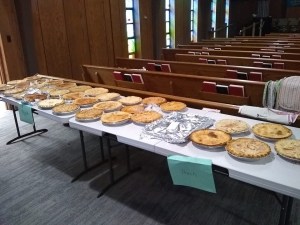
RAGBRAI riders stopped at the Norwalk Christian Church for pie. Photo Credit – Trish Nelson
Trish Nelson will be returning to the editor’s desk next week.
Among things she did while on hiatus was ride a couple days of RAGBRAI, posting this photograph of pies behind empty church pews. The image says something more although I’m at a loss to put words to it. It can speak for itself.
Time for me to go on hiatus for a while as well.
Tomorrow I return to the apple orchard where I work in the sales barn doing whatever is needed for the season. If I’m lucky, I’ll have great conversations with some of the thousands of guests who show up on a weekend. If I’m extra lucky, those conversations will be about apples, gardening and farming.
We political activists need to do our best work to elect a replacement for Dave Loebsack in the Second Congressional District and a U.S. Senator to make Joni Ernst a one-term senator. We also need to retain the hard-won seats of Cindy Axne in the third district and Abby Finkenauer in the first. If we have a candidate in the fourth district, there’s work to be done there as well. Those campaigns will have to wait until after the presidential preference in February, because a person can land only one plane at a time. I favor Rita Hart in the second district and Theresa Greenfield for U.S. Senate. There are no clinkers among those running in the primary.
As far as the Iowa caucus goes, I’m in the same boat as a lot of readers. I want to pick a candidate for president to work with after Labor Day. If I can’t decide which one by then, I may go to caucus uncommitted and join a group that needs one more person to be viable.
I expect to run our precinct caucus (because of a lack of volunteers) and don’t want to get into the unseemly discussions we had during the vote count in 2008. Being uncommitted would be a positive in that regard.
Democrats can’t afford to have winners and losers this cycle, so the pre-caucus dynamic is different from 2008 when there were 8-10 candidates for president and everyone worked hard for their guy or gal to be the one. The only thing that remains the same this cycle is Mike Gravel is running again. (Update: The afternoon of the day this was posted, Gravel suspended his presidential campaign).
Someone asked me who were my top three potential presidential candidates. I had to think, but came up with this answer:
Anyone other than Biden, Sanders, Warren and Harris needs a breakthrough by Labor Day (maybe Thanksgiving) to ouster these four poll leaders. Polls and second choices will drive the presidential preference Feb. 3.
If not this week, then soon, the less than one percenters will hopefully have made their point and gracefully exited the race to work on other Democratic priorities. I’m very sorry Senator Kirsten Gillibrand is in this group. She couldn’t get over the Franken blow back among Democrats I know and lost important donors. She is uncompromising on women’s rights.
Look at it this way. Once I figure out what/who I’m supporting I’ll swallow the red pill and follow the rabbit hole where it leads. With the primary in June, there’s plenty of time to work on Rita Hart and Theresa Greenfield after caucus.
Or look at it another way. If Warren had run in 2016, I would have worked hard to make her the nominee. I’m satisfied she’s not too old today. There’s no one else left in the top 4 besides Kamala Harris. I’m less than confident a woman can get elected in 2020. I don’t like most of the men.
So there’s my indecision. If I can’t decide by Labor Day I may not declare and throw my one preference to which ever group could be viable with it, except maybe Sanders.
The most important endgame is coming together once we have a nominee. Keeping the red pill in a waterproof vial for now.
Hope readers enjoy the rest of summer. Thanks for the clicks during the last five weeks.
Jimmy Carter at the Iowa State Fair, August 1976 – Photo Credit – Des Moines Register
On Jan. 19, 1976, the day of the Iowa precinct caucuses that started Jimmy Carter on a path from relative obscurity to becoming the Democratic nominee for president, I was in U.S. Army Basic Training at Fort Jackson, S.C.
I didn’t really care who became president because anyone would be better than Richard Nixon.
As we now know, “Uncommitted” won the presidential preference that year getting 37 percent of the delegates with Carter coming in second with 28 percent. He became president and served for a single term from 1977 until 1981.
On July 19 Carter announced he was losing his religion. “Women and girls have been discriminated against for too long in a twisted interpretation of the word of God,” he said.
After six decades in the Southern Baptist Convention, at the point when leadership determined that women must be subservient to men, he decided to leave.
“At its most repugnant, the belief that women must be subjugated to the wishes of men excuses slavery, violence, forced prostitution, genital mutilation and national laws that omit rape as a crime,” Carter wrote. “But it also costs many millions of girls and women control over their own bodies and lives, and continues to deny them fair access to education, health, employment and influence within their own communities.”
The view that women are somehow inferior to men is not restricted to one religion or belief, he said.
Read Carter’s entire article in The Age here. What is the context for Carter losing his religion?
Earlier in July and before Carter’s letter, U.S. Secretary of State Mike Pompeo announced creation of the Commission on Unalienable Rights to examine the role of human rights in US foreign policy. It is expected the commission will be a vehicle to roll back protection of human rights in US diplomacy.
“What does it mean to say or claim that something is, in fact, a human right,” Pompeo said at the State Department according to CNN. “How do we know or how do we determine whether that claim that this or that is a human right, is it true, and therefore, ought it to be honored?”
“Words like ‘rights’ can be used for good or evil,” he said.
What is or isn’t a human right has been debated even though the Universal Declaration of Human Rights was adopted in 1948 by the United Nations. One can assume the same impetus that led Pompeo to embrace the Rapture is at work in this commission. I expect a new attack on women’s rights driven by the same prejudices Carter discusses in his letter.
At 94 years, Jimmy Carter continues to serve our nation and a global community. If there is justice God will forgive him for losing his religion to continue his efforts in pursuit of women’s rights.
It must be hard for out of state political organizers to penetrate the shield of work, family and friends behind which many Iowans spend most of their time.
That’s especially true as the large field of presidential candidates self-sorts in the polls, resulting in what seems an inevitable field of Biden, Harris, Sanders and Warren. If they can gain traction through some sort of campaign breakthrough, maybe add Booker, Buttigieg, Klobuchar and one or two of the others people recognize. A recap of 20 Iowa polls from 538.com is here.
According to a June CNN poll 44 percent of primary voters had decided their first choice for president, with most of the rest saying their choice is subject to change. There is a long Iowa tradition of waiting until the last minute to decide for whom to caucus in presidential years. What plays a role this cycle is the common statement, “I support X, but will vote for whoever the party nominates because we have to beat Donald Trump.” Against this background, organizers have to identify voters to support their candidate, knowing minds could change in the more than six months until the Iowa caucuses. Based on my experience there will be a groundswell behind candidates who are perceived as potential caucus winners.
The basics of political organizing haven’t changed in a long time. My father explained how he organized for the 1960 campaign of John F. Kennedy. The union provided mimeographed 8-1/2 x 14 inch sheets with a blank grid of homes on it. Dad’s job was to contact people in each house on the blocks he was assigned, discuss the election with them, and record the results on the sheet. The completed sheets went back to the union hall. Dad had no trouble completing this work in a timely manner and he enjoyed meeting with neighbors. It was pretty basic, and of course Kennedy won that cycle.
Things are different in 2019. To be successful, candidates have longer range plans than contacting voters and dutifully recording their opinion in a database. For example, Elizabeth Warren has organizers holding “office hours,” working on art projects, tabling at farmers markets, attending local events, and working on farms. There may be some payoff to such activities in the form of signed commitment cards. What seems more important is outside organizers become part of the community. When we think of the candidate, we can put a face with that name and have a contact for outreach if there is a question. It is not just Warren using a longer term approach and candidates who don’t seem unlikely to gain traction.
There is also the money issue, which has rendered contact with most candidates via email, social media and other communications methods meaningless. People get it. Campaigns cost a lot and sending me three or four emails per day soliciting donations is a numbers game in which you hope to wear us down with repetition.
What makes this year different is the shield. It is hardening. In case you missed it, things are not great in America these days. Beginning with health care, including Medicaid, Medicare and the Patient Protection and Affordable Care Act, Republicans are trying their best to undo it all. The care provided in these programs has never been the best. Just ask someone who needs care or knows someone who does. At the same time, they represent something positive in our lives. Social Security is a target even though it is funded separately from the government and viable at least until 2034. Republicans also seek to break up the scientific approach to problem solving in USDA, EPA and other government agencies turning them more political. The Justice Department re-instated the death penalty this week. Government is becoming more political than it was. Post-World War II progressive initiatives are being rolled back.
Whatever the outcome of these long-standing Republican initiatives, voters are withdrawing into smaller, isolated communities where they protect their own interests first. As others have noted, this gives rise to an us vs. them view of the world with which political organizers have to work. People have become skeptical that participating in politics has much meaning and push back on politics except within their group. Under the shield, political discussions can be very active, but mostly among group members regarding their core concerns.
Community organizing remains an important aspect of penetrating the shield of isolation. Finding common ground with friends and neighbors and with others in the community, is no panacea, yet it remains a centerpiece of problem solving. The trouble is picking an action, and there has been little agreement in groups to which I belong or with which am familiar unless a problem is obvious and significant.
Behind the shield, behavior harkens back to tribal both in selection of targets for action and in attitudes and methodologies used to achieve them. If a community’s drinking water is sub-standard, members are likely to take action if they can. Politics? Not so much.
It is difficult to see how the Democratic presidential nominating process will turn out. What seems clear is voters’ disaffection with politics has created a type of isolation that requires a new kind of campaigning. Someone will be the Democratic nominee for president and a majority of Democratic voters will support him/her. However, the thrill is gone in primary campaigns among Democrats, which makes traditional, individual campaign strategies and tactics less useful in producing a winning candidate.
There are no easy answers. Hard work and grit will play a role as they always have. Voters will be canvassed as they have been for generations. To the extent campaign organizers don’t work to penetrate the shield, their efforts seem unlikely to produce a winner in the Iowa caucus.
In the meanwhile, summer is here and is fit distraction from political talk. Maybe people will engage outside their tribe when the new year begins. For now we need protection from the harsh summer of Trumpism.
Racism is a feature of the Trump administration geared toward activating marginal voters who support his racist statements to get them to vote to elect Republicans, posits Thom Hartmann in the clip below.
“When Trump said this he knew exactly what he was saying,” Hartmann said on his eponymous program, referring to the president’s statement addressing four Democratic U.S. Congresswomen, “Why don’t they go back and help fix the totally broken and crime infested places from which they came.”
Hartmann explores racism related to the president’s comments, answering the questions “Why won’t the GOP comment on Donald Trump’s racist comments?” and “Has the GOP now moved so far to the right that this will get Trump re-elected?”
He suggests politics as we know it — each party’s base voting for their candidates with the middle or swing voters being targeted for conversion each election cycle — has been turned on its head by the president.
I don’t know if he’s right, but it’s food for thought as we enter a high summer of RAGBRAI, sweet corn, tomatoes and vacations.
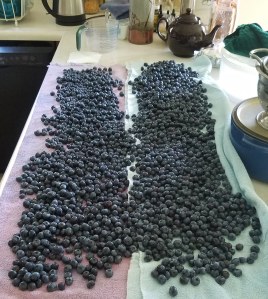
Drying 10 Pounds of Michigan Blueberries for Freezing
There is a strong argument nothing is wrong with our food system.
There is a strong argument everything is wrong with our food system.
To talk about a “food system” at all presumes a lot that may or may not be true.
It’s no secret large corporations increasingly control food production, distribution and marketing. Scalability is a key issue with providing nourishment for billions of people. The hand of large land owners, chemical companies, seed genetics companies, processors, banks, equipment manufacturers and consumer outlets runs throughout each household’s food ecology. Households have a food ecology even if they don’t speak of it using such fancy words. What appears at a meal is influenced at every point in the distribution chain by large corporations.
It’s also no secret farmers, especially small-scale farmers don’t earn a lot of money for their long hours each season. Neither do equipment manufacturing workers, seasonal farm help, truck drivers, grocery store workers, or restaurant workers. Whether one is a contractor for a large international meat-producing corporation or produces heirloom hogs for a meat locker, at the end of the day a diverse and ever changing personal economic structure is needed to ensure viability this year and in the near-term future. People struggle to make a living by farming alone.
At the same time, grocery stores are packed with food and if there remain some food deserts without one, enough food is produced in the United States to feed everyone. I met an executive from a large container manufacturing company when I worked in the Chicago Loop. He said the issue wasn’t having enough food, it was preserving and distributing what we already produce. That remains true, his statement representing another large corporation wanting a piece of the food supply action.
The deck is stacked against young farmers who want to produce food outside the mainstream. I’m thinking of friends that operate Community Supported Agriculture projects or grow specialty crops. Producing meat and vegetables for the local market has been a staple in society at least since medieval times. When there are a lack of well-paying jobs, or capital, if people have access to a piece of land for a season, attractive fruit and vegetables can be produced and sold at a margin that looks better because labor cost is removed from the calculus.
It goes without saying a farmer will work 60 or more hours a week, sometimes turning $100,000 per year in revenue derived from diverse sources (produce, livestock, grazing and retail sales) and living on a fraction of that. Land ownership? Only a small percentage of young farmers can afford to own land.
Consumers can afford a hodge-podgey food system with diverse sourcing, abundant supply, wide variety, and absence of much concern for how food arrived at our table. If corporations own equity in land, equipment and patented seed genetics, it’s hard to see that on our 9-inch dinner plate.
What matters more in this discussion is not whether a food system is good or bad, but whether that is even a thing. If each household develops its own food ecology, including best practices regarding water use, soil conservation, seed genetics and other resource use, that’s not good enough. If a food system exists, what it requires is scalability and that’s where corporations can and likely should play a role. Not evil corporations designed for extraction of resources and cash, but people joined together with common purpose regarding nourishing a growing population.
Asserting there is or isn’t a problem with our food system is itself a problem. It is much more fluid and undefined than that. Like vegetable farmers we need to accept each season for what it teaches us, hoping we can sustain ourselves for another season.
Is the Ohio federal court’s recent release of Drug Enforcement Agency data about manufacture and distribution of oxycodone and hydrocodone pills significant?
Maybe.
I found last week’s Washington Post presentation of scrubbed data engaging for the ten minutes or so it took to drill down to Iowa and the county in which I live. Readers can do likewise by clicking here.
The data doesn’t change much. If anything, it confirms what I wrote in 2016:
Fanning the embers of opioid abuse into a raging wildfire serves the interests of Big Pharma and its minions in the U.S. Congress. The opioid epidemic represents another opportunity for corporations to mold government in a way that serves their interests.
According to data, Iowa took delivery of 562,927,414 of these pills manufactured by Actavis Pharma Inc., SpecGX LLC., and a few other companies between 2006 and 2012. They were delivered to Walgreens, Wal-Mart, Hy-Vee, and a number of other independent and chain pharmacies.
I live in Johnson County, which took delivery of 12,158,306 pills, or enough for everyone to have about one per month. Two days a week I drive by the Walgreens in Coralville which received the highest number of pills in the county. I had no idea, and in the long view, I’m not sure it’s significant. In part, the opioid epidemic is driven by availability and ease of access. The drug companies are making sure the pills are available.
There is a human aspect of the massive distribution of narcotics. The Washington Post intends to mine the data for stories beginning with those of southwestern Virginia where my father’s family first appeared in the 17th Century, and distribution of opioids was highest in the country. I haven’t enjoyed the coverage of Norton, Virginia and surrounding Wise County.
For comparison, Wise County took delivery of ten times the number of oxycodone and hydrocodone pills as Johnson County, Iowa, with the highest number delivered to Family Drug in Big Stone Gap. In Norton, Virginia, 306 pills per person were delivered according to the Washington Post. Dennis Boggs of Norton summarized the problem to the Washington Post. “There’s not a lot to do,” Boggs said. “It gives them something to do around here.” He was talking about using these legal narcotics.
“What they did legally to my state is criminal,” Senator Joe Manchin III (D-W.Va.) told the Post. “The companies, the distributors, were unconscionable. This was not a health plan. This was a targeted business plan. I cannot believe that we have not gone after them with criminal charges.”
Manchin has a point and it serves mine. Pharmaceutical companies are executing a business plan, one that includes substantial influence of the Congress. If the human misery of easy opioid availability is hard to take, look at it from a business standpoint. Companies are working an abstract plan designed to maximize revenue and profits within current regulatory framework. Once lobbyists have set the rules for prescription, manufacture and distribution of opioids like oxycodone and hydrocodone, such regulation turns out to be very little regulation at all, at least when it comes to protecting the public.
This distribution of oxycodone and hydrocodone is a different face on the same problem, the influence of corporations on our government. It is important not to be distracted by the drama.
Last year Governor Kim Reynolds signed HF 2377 into law. The law focuses on narcotics users and those who prescribe them in hope of reducing the number of opioid users in Iowa, according to the governor’s press release. The vote for the bill was unanimous in both the Iowa House and Senate. Given the comparatively low level of opioid pill distribution in Iowa, revealed by the Washington Post data, aren’t there other, bigger problems for political focus? Things like fixing Iowa’s disastrous privatization of Medicaid which impacts lives as well.
Data can measure the success or failure of HF 2377. What is hard is to measure the intent and human impact of large corporation business plans. The newly revealed data is pointing to corporations as the problem in the opioid crisis.




 Journey Home
You must be logged in to post a comment.