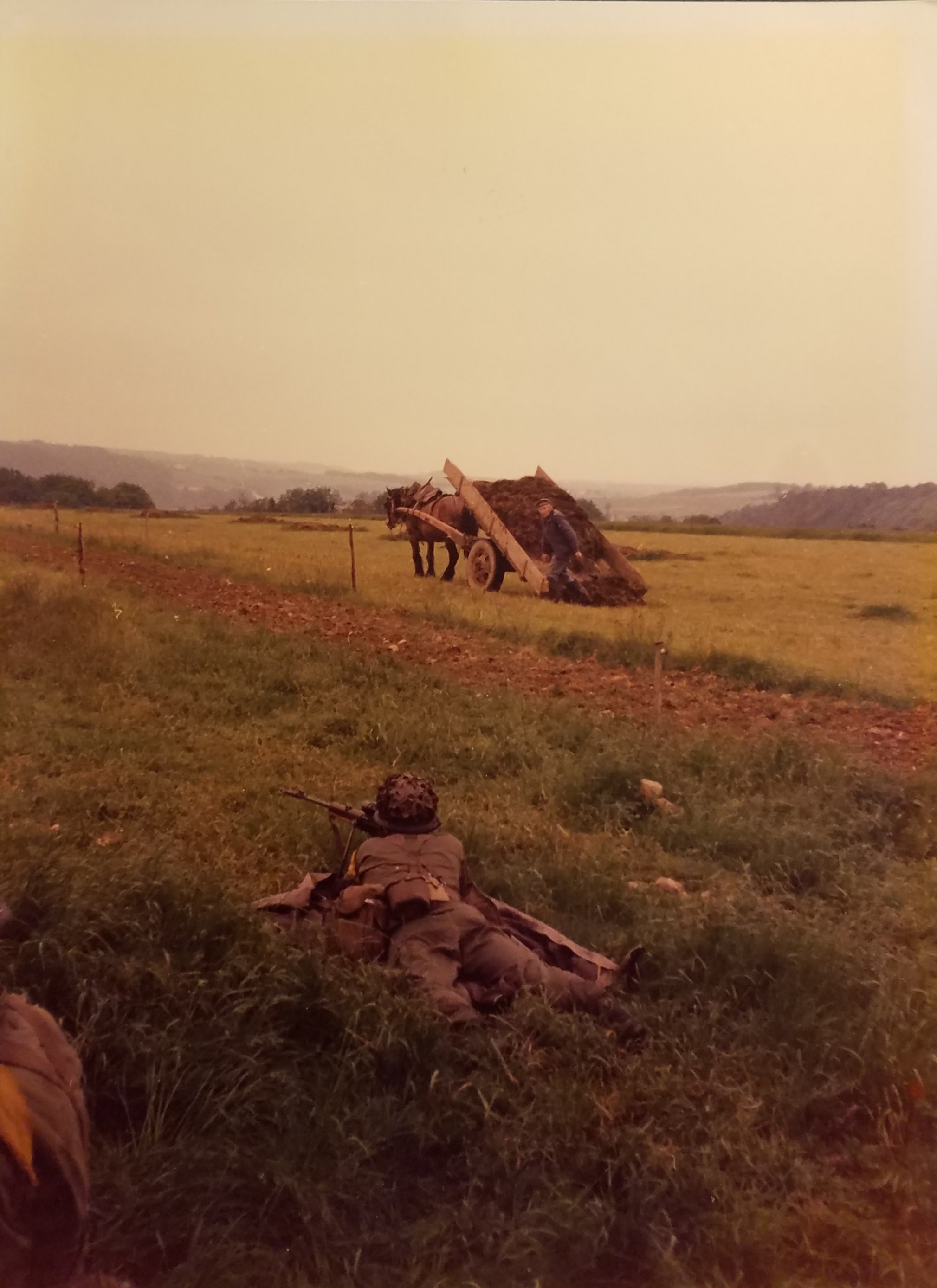
Farmer spreads manure while we were on maneuvers with the French Infantry Marines in Brittany, late 1970s. They keep the horse before the cart in Brittany. Photo by the author.
Three and a half years into retirement I’m not close to being finished culling belongings. It takes time, yet it’s more complicated than that. In particular, when I find a neglected packet of photographs, I can spend hours chasing memories close to whatever main event prompted me to take them. Moving to digital photography in 2007 hasn’t made it easier. If anything the number of photos multiplied each year because of the ease in taking them. Digital files mount up and I developed a special back up process so I don’t lose them. There are so many.
Everywhere I look in my archives, I find more photos all arranged in a hodge-podge manner. Once found, I remember taking most of them, yet how to tap them for pragmatic narrative is problematic. Each batch leads down a different rabbit hole.
I enjoy time spent with photographs yet need discipline in how I use my writing time, which sorting photos is. With the explosion of film photographs when I was a pre-teen, followed by digital in 2007, there are so many that simply looking at them is a huge task. There are six decades worth!
Luckily, Mother was keen on downsizing while living. Included in her belongings were many photos and she let me go through them, taking some prints, but mostly scanning them to files. That, too, was a massive undertaking. I got the images I wanted leaving the hard copies for my siblings.
When writing any book, the number of photos that can be included is small. I’m reading Rachel Maddow’s book Prequel and she used one or two images per chapter. That seemed like a lot. When I print my blog book each year, the photographs make the pages vibrant. They are a small subset of what’s available. I recently changed the size of them after recognizing the photo was as important as the text in many cases.
Sometimes I use a photograph as inspiration to write a paragraph or two without planning to include the snapshot in the book. A photograph can stir living memory from that mystical storage place in our brains. Often the narrative is better than the image. It focuses the reader’s attention on aspects of the story that drive narrative. Too many photos can get readers distracted from the narrative.
I have a short term project in my writing, but big picture I need to distill the boxes and crates of belongings to a usable number. I should pick photographs that advance a narrative, or record some specific moment in time. Seems like writing 101 and I’m only just arriving at this forking path.
Modern Woodmen Park (formerly Municipal Stadium), July 29, 2013. Photo Credit: Bohao Zhao, Wikimedia Commons.
Municipal Stadium in Davenport, Iowa was an important part of my growing up. As much as anything, it was a central gathering place for big events for the local proletariat in this sleepy city on the Mississippi River. Our family or I attended events there, including musical performances, high school football games, professional wrestling matches, and a revival meeting. I once attended a Minor League Baseball game there.
By the 1950s and ’60s no culture of big community events existed in Davenport. Segments of the population did gather at a stadium for events tailored to their interests. Promoters tried to make something of our sports teams, yet everyone seemed to have their own life with accompanying other things to do. Here are four things in which I participated at Municipal Stadium, as we called it then.
Herman’s Hermits
On Aug. 27, 1966, Herman’s Hermits played in Davenport at the Municipal Stadium. In the wake of Beatlemania, this was the best our Midwestern city could do. My cohort had watched the Beatles on the Ed Sullivan Show and talked about it at school. I had visions of becoming a musician, having gotten a guitar at the King Korn Stamp Store soon after the British Invasion began.
I don’t recall how I got tickets, but I had income from my newspaper route. Mother made the arrangements for bleacher seats. It was a sunny day for the concert.
If I wrote down everything I remember about the concert, the paragraph would not be long. Besides the concert, the Times Democrat story of Peter Noone and other band members shopping in the book section of the M.L. Parker Department Store struck home. It was the same place I had begun buying books with my own money. That made everything pretty real. A few of my classmates also attended the concert. The songs the band performed were not memorable, even the ones played on the radio.
All Star Wrestling
Father and we kids attended a professional wrestling match at Municipal Stadium. The stands were not packed although because of the popular Saturday morning television program, All Star Wrestling, the event drew a good-sized crowd. Patrons were unruly, with arguments breaking out among them. I almost got into a fight after mouthing off to a stranger. That day there was a cage match during which constructing a cage of chain-link fencing was part of the spectacle. Young women would visit the motel across the river where the wrestlers stayed and attempt to accompany them on tour. Such plebeian entertainments were typical in my home town.
The American Wrestling Association (AWA) was an American professional wrestling promotion based in Minneapolis from 1960 until 1991, according to Wikipedia. It was founded by Verne Gagne and Wally Karbo, originating as part of the Minneapolis Boxing & Wrestling Club. Unlike modern professional wrestlers of the WWE, Gagne was an amateur wrestling champion who was an alternate on the U.S. freestyle wrestling team at the 1948 Summer Olympics. He ran the AWA with a conservative sensibility, Wikipedia said, firmly believing that sound technical wrestling should be the basis of a pro-wrestling company. Cage matches reflected no basis in technical wrestling as Gagne had come to know it.
New Flying Buttresses
When Mother settled with the elevator company in 1973, after Father’s death, we kids got a share. Mine amounted to about $4,000, which I hastily spent on a Volkswagen micro bus, a Fender Telecaster Thinline guitar, a public address system and two Peavey guitar amplifiers. Some stage crew buddies and I formed a band. I’d call it a garage band but we mostly played in the basement of the bass player’s family home, or in Mother’s dining room. Because we invested in equipment from a music store on the Illinois side of the Quad Cities, when they staged a concert for bands to whom they sold equipment, we were invited to perform.
Municipal Stadium is the largest venue in which I played. We only performed a song or two, which made the rigamarole of setting up and tearing down, the main part of the time we spent there. We were all stage crew, so we lived in that realm. We played Six Days on the Road by Earl Green and Carl Montgomery. I remember breaking a string during the performance. We didn’t have a name and were introduced as Paul Deaton and his New Flying Buttresses. The name lasted exactly for that single gig.
Johnny Cash
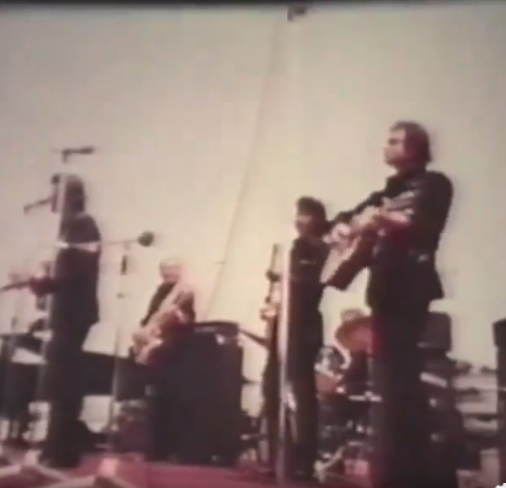
On July 22, 1974, Johnny Cash, Carl Perkins and their band traveled to Davenport to perform at Municipal Stadium at the request of the Rev. Tommy Barnett, then of the Westside Assembly of God. During his tenure as pastor, Barnett grew the congregation from 76 to more than 4,000 members. Westside buses could be seen each Sunday, plying the neighborhoods throughout the lower part of Davenport, picking up its church-goers for service and then delivering them home.
Carl Perkins and Johnny Cash playing at a Tommy Barnett Revival at Municipal Stadium. Screenshot from a video of uncertain provenance.
Cash was supportive of Barnett at the time, although he recanted his support in one of his memoirs. In researching this post, I found numerous stories about the concert, and having been there, found almost all of them to be greatly exaggerated. A short video of Barnett and Cash includes a panoramic shot of the crowd at Municipal Stadium (Link is here). The stadium and bleachers show the concert was well attended. I’d come to the concert to hear my shirt-tail relative June Carter Cash, but she stayed behind in Tennessee at the last moment. Since I had already been baptized, I passed on the opportunity to walk to the stage and be saved.
These are the kinds of events that attracted working class families in Davenport during the 1960s and ’70s. We weren’t Marxists, yet the word proletariat fits.
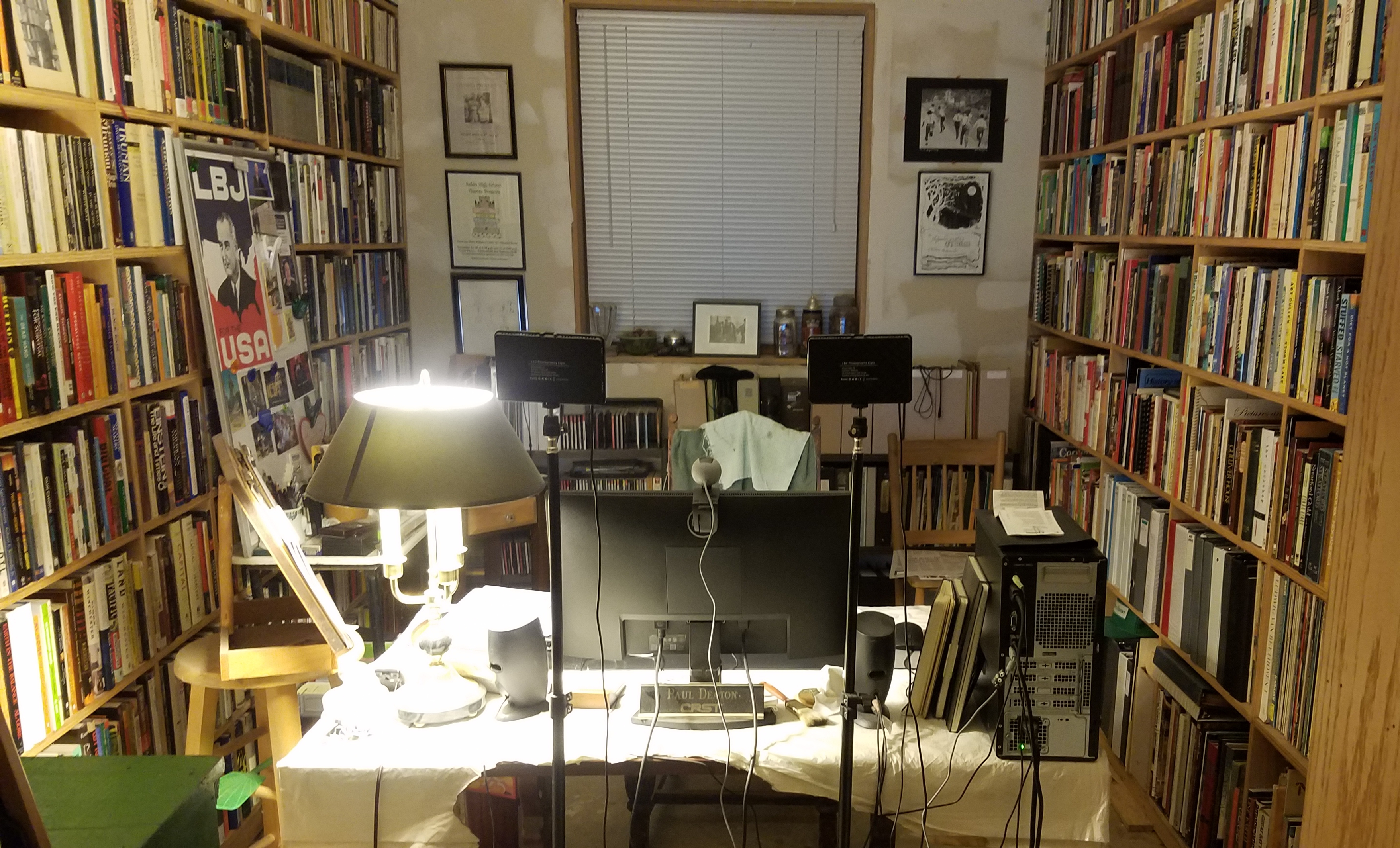
A library is curated, which means it inherently contains the biases of the librarian or curator. How will books be organized? When space is at a premium, which go to a thrift shop and which go into a box for potential future use? Which books should be acquired and which checked out of a library? I have a lot of books — a few thousand in my writing room alone. My collection of books, papers and other media is idiosyncratic. That’s as it should be. The meaning of the collection goes little further than the door through which I took this photo. My library mostly serves my writing.
As winter approaches, the pace of my reading increased. I’m reading about 50 pages a day and more if the text is engaging. Since the coronavirus pandemic began I read an average of 58 books each year. A recent Gallup poll found Americans started 12.6 books per year and finished five of them on average. This chart from the poll tells the story that reading books in America is in decline:
When I retired during the pandemic I adopted a firm rule that no matter what, I’d read at least 25 pages per day. This is harder when garden work is in full swing, and easier when I’m more home bound in winter. What I didn’t plan is how to curate the books and papers accumulated since the 1950s. Curation includes acquisition and disposal, two skills I haven’t practiced with consistency in decades.
I used to buy books at thrift shops and yard sales, but I haven’t been to one of those in years. I do buy new books, mostly based on recommendations from people I know on social media or related to my writing projects. The whole thing is hodge-podge and it shows.
Work on my autobiography energized the curating process. In addition to telling my story, writing includes going through possessions the way a Forty-Niner panned for gold in the California Gold Rush. The yield has been more than a few good nuggets.
In addition to preparing a bound book, I hope to reduce possessions by 75-90 percent. You can’t take it with you and our millennial child may never be able to afford a house. Nor would I want them to accept and store all my stuff. When they visit, we discuss what is of interest and what is not. It is a recurring thing we do that I enjoy.
Who knows when I’ll need to refer to a 1920s book titled Rural Sociology? I want to be able to find it when I do. Will I ever need to refer to my facsimile of the 1771 edition of the Encyclopaedia Britannica? With Google I likely won’t need it to gather information, yet there are reasons to keep it… idiosyncratic ones. Should I keep my copy of Charles and Mary Beard’s The Rise of American Civilization, purchased at the local library used book sale to which it was donated by the estate of Alexander Kern? Kern was one of the first American Studies professors in the program in which I matriculated. His more important papers reside in the University of Iowa Special Collections. Don’t get me started on the problems with the Beards’ book. I feel I should keep it just for those issues.
Using the verb to curate is not likely the intended use for what I do with my collection of stuff. Cataloguing the books is out of the question. Like most people, I seek truth and meaning in my life. Part of that is dealing with too many books, papers and media by making something of them the way my forebears mined coal. I want a work product both recognized and useful to others.
Based on the numbers in the Gallup Poll, I’m different from most Americans when it comes to reading and collecting books. I’m okay with being different.
It is totally shocking that I’ve been procrastinating getting back to work on my memoir. It’s not like there is anything better to do.
Today I started with a small piece of editing. The task has been languishing on my to-do list and now it’s done. I decided to work on Part II, which is my life after university and military service, beginning the summer of 1981.
After graduate school, I took a trip, found a job, and met my future spouse. I wanted to stay in Iowa and Johnson County is an oasis in a cultural desert of corn, soybeans, hay, oats, hogs, cattle, and sheep which was and remains Iowa. I had no interest in returning to my home town of Davenport. There was really no other place to live in Iowa, I reckoned. The challenge today is memory and artifacts from the second part of my life are too numerous to mention them all in a book. I don’t relish going through everything to cull items for the narrative. Hence the procrastination.
I worked as an admissions clerk at the University of Iowa Dental Clinic after graduate school. We saw patients from all around Iowa — wealthy patients with private insurance, indigents with limited means, and everyone in between. Anyone who came to my desk was accepted for treatment. The exposure to people from diverse backgrounds was inspiring. In 1981 I didn’t worry about much beyond getting to work on time, learning what I could about people, and doing my best.
Outside my admissions work I put hours and hours into researching and writing fiction. I developed a couple of frameworks, read lots of books, and viewed countless movies. Somehow I failed to realize that writing means producing a certain number of words on a regular basis. I know that now and thus far produced about 127,000 words of an autobiography. All the same, I’ve been avoiding the big task of culling things into a viable narrative. I feel there are one, maybe two chances to go through everything while I’m alive. I want to gain what insights I can and get the story right.
I wrote a task for tomorrow: read the next 100 pages of the draft and take notes. This will lead to updating the outline and help identify where the narrative devolves into a series of snippets from journals and cut and paste paragraphs. The best way to get going is take one step each day and make sure it gets done. I don’t know any other way to get started, and time’s a wasting. This is what I mean by it’s time to get to work.
Past peak fall colors on the state park trail on Oct. 25, 2023.
Rain and thunderstorms are forecast through 3 p.m. We need the rain. On my trail walk yesterday the culvert where water runs off the watershed remained bone dry. If winter arrives, and there is inadequate rain, we will start the growing season behind the curve. That has consequences.
An acquaintance saw Rachel Maddow in Phoenix last night. Maddow is on her book tour for Prequel: An American Fight Against Fascism. My copy is waiting in queue to be read. I delayed reading Prequel because I needed a break after reading Wallace Stegner’s intense history of the opening of the American West. With social media we all do everything together all the time. Books I recently read have a page on this blog, here. Do join in and try one of them!
I started the first task on a sorting table. The sorting table is a place in my writing area where I bring boxes and piles and lay them out so I can dispose of the contents. It serves a number of functions, the most important of which is doing research for the main creative work in progress. In addition to determining dates and ideas to be included in writing, the sorting table serves to identify books to be taken to Goodwill, books to go on the to-read shelf (which is now overly full), and documents and artifacts that need further sorting and contemplation or recycling. Today’s stack had a box containing mostly bookmarks along with receipts for events I attended and my military driver’s license. There is good stuff in the box yet it’s a hodge-podge of life’s detritus. Some of it is going in the trash bin after all the paper gets shredded to start brush pile fires.
There is garden work to do after the rain. For the time being I’ll hole up at my writing table and focus on getting a few things done. Thanks for reading.
I haven’t written about how qualified and competent Joe Biden is as our president. He is uniquely qualified to be president, especially right now. That I haven’t written about this may be due to possessing that certain Iowa bias based upon his three dismal appearances in the Iowa caucuses, including in 2020. I don’t blame him for axing Iowa in the nominating poll position. No one asked for my opinion. He is successfully holding back the forces of authoritarianism and fascism.
Vice President Joe Biden, May 2010 in Cedar Rapids. Photo by the author.
While returning to writing my autobiography it’s immediately clear: I have a lot of work to do. Given the limited window of October 2023 to March 2024, what work will I do? I need to get Part II framed up with main events so I can later hang details upon it.
The early part of a life is easy to describe because during education and early work experience, a single thread can tie everything together. That’s less the case as a person moves on to next steps, which may include marriage, a family life, relationships, work, and pursuit of health, welfare and happiness. I wrote previously about this and what I said then holds true. Part II is to describe the life for which I spent 30 years preparing.
A related process is going through boxes of belongings and downsizing. Partly this helps focus on aspects of the story I might have forgotten. Partly, the unused detritus of a long life should be passed on to people who might use it today. This is better done by the owner than left to heirs. Our child doesn’t want all the stuff that fits into our house, so I would be serving her interests by processing it now. For a while, I’ll be going through and eliminating possessions, keeping what best fits the story as it evolves.
Lastly for today, I need to set aside a specific time of day to write. That’s likely to be after I finish morning tasks and eat breakfast. I hope to settle into my desk by the eight or nine o’clock hour and write until noon.
Writing desk while living at Five Points in Davenport in 1979-1980.
For three weeks after graduate school in May and June 1981, I visited a number of friends. The trip took me to Springfield, Illinois; Columbus, Georgia; Fort Rucker, Alabama; New Orleans; and along the Mississippi River north through Vicksburg Mississippi; Portageville and Ballwin, Missouri; and then home to Iowa City. It was the last trip after finishing my education and before applying said education to my life. I had no idea how things would turn out.
The trip was unlike the Grand Tour I made after undergraduate school. Since then, I had served in the military, lived in Europe for three years, attended graduate school on the G.I. Bill, and moved through degree preparation like a fish swims through water. Two artist friends brought a bottle of champagne to my place and helped celebrate my graduation. We discussed audiences and art. How much are artists influenced by their audiences? Should they be influenced? I believed then, and more so now, a writer must concern themselves with an audience. In 1981, I had no art, little public writing, and no concept of audience other than people who held a certain undefined social status.
Each place I went held vestiges of antebellum life. From the black housekeeper of an IRS worker, to racist attitudes among my former Army buddies, to a local culture where the next Ku Klux Klan meeting was all the social buzz, it was everywhere I went.
What struck me more than anything was the ordinariness of people I met. People stood at odds with the American culture I know. Or maybe, they represented an American culture I hadn’t come to know. While Lincoln’s bones rest in Springfield, the living there seemed unprepared to take up the unfinished tasks of the dead. Instead they participated in a culture devoid of life as they performed old, well-patterned ceremonies of living that had lost their meaning by 1981. My trip was a hard reckoning with reality.
Near Columbus, Georgia I visited a place that today is called Historic Westville. The ticket I bought is printed with the message, “Westville. Where it’s always 1850.” Westville is a fabricated village made from buildings built before 1850 and moved to what was once an open field. It was to represent the zenith of cultural life in the antebellum south. People who had visited Colonial Williamsburg would be disappointed by Westville, yet the designers did the best they could. Attendance was slight the day I visited.
In one building I met a period costumed woman who showed me an example of home spun thread. There was a spinning wheel and she showed me how it worked. However, despite the knowledge, she didn’t know how to make homespun herself. I found something about this disappointingly characteristic of modern day Americans. We may know the ideas behind how things work, to actually do such work, to put ideas into motion, is a step too far for many. Americans, above all else, must practice those things they know are important. When it came to equality under the law, the south of my trip failed to measure up.
After finishing my long education I had to get going in life. I felt an urge to put into practice what I learned during the first thirty years. I knew then I couldn’t be like some of the friends I encountered on this trip south. What I would become was both unknown and an open book. As much as any other time, I began writing that book in 1981.
Writing desk while living at Five Points in Davenport in 1979-1980.
The writing choice before me is a garden of forking paths. What winter 2023-2024 produces will depend upon a number of decisions I make this month. As I pursued completion of an autobiography, things got complicated.
Do I next work on the first part, leading up to the time of this photo, or pursue the second part? I wrote more than 60,000 words in each thus far. Part I is about me being born through graduate school, Part II is about marriage, fatherhood, career, health, socialization, and intellectual development.
There is a case to work on Part I. I sent out copies of the draft finished last winter to a few friends. The feedback presented ideas of which I hadn’t thought. There is a substantial revision in the future. Do I do that now, while the feedback is fresh?
There is an equally powerful case to work on Part II. Stylistically, I’m not sure what I will do, yet the chronological approach of Part I does not seem as relevant or possible. Fleshing out what that will be is a time-consuming process with potential revisions and re-writes ahead. Do I take a stab at it and get something down on paper this winter before editing and revising the whole work?
I’m leaning toward the second path. The chronological format until 1981 makes sense because I was enacting a path to education that was part of my upbringing. By that year I felt my education was finished and it was time to live the life for which I spent 30 years preparing. The rest of the book is that story.
The trouble is there is too much information, too many resources, and too many complexities to incorporate in the narrative without making it too long. I must choose which elements will be presented. Some of this is easy, and parts are complicated.
Part of the narrative is the highlights of our life as a family. It is no one’s business what goes on in a family. At the same time the context of family makes us who we become. I want to lay down a bare bones history for our child to read and hopefully know in addition to their own memories and narratives.
Work life is also important. Beginning with my time in transportation and logistics, earning money to support our lives took much energy, physical and mental. Family and friends saw one side of this. Preserving what I experienced is equally important.
Two geographies stand out. The first is described on the U.S. Geological Survey map titled Davenport, which includes Davenport, Iowa City, and the part of Cedar Rapids in which we lived. Most of my life was spent in this geography. The second is what I call The Calumet. It is Lake County, Indiana and Chicago, yet more than that. For six years Merrillville, Indiana was the base camp from which I explored the Eastern United States with work. In addition to annual waterfowl migrations, lake-effect snow, and a culture driven by the end of the industrial revolution’s expansion, it was the place where our child started school and we owned our first home.
There may be additional narratives which include politics, volunteer work, my writing life, cultural engagement with music, radio, television, and photography, and development of a kitchen garden. The book will end with the coronavirus pandemic and a hopeful look forward at the rest of my seventies and eighties.
Just writing this post has been helpful in picking which path. As soon as I get the garlic planted, I’m ready to devote my full attention to writing. Next step will be de-doing the outline.
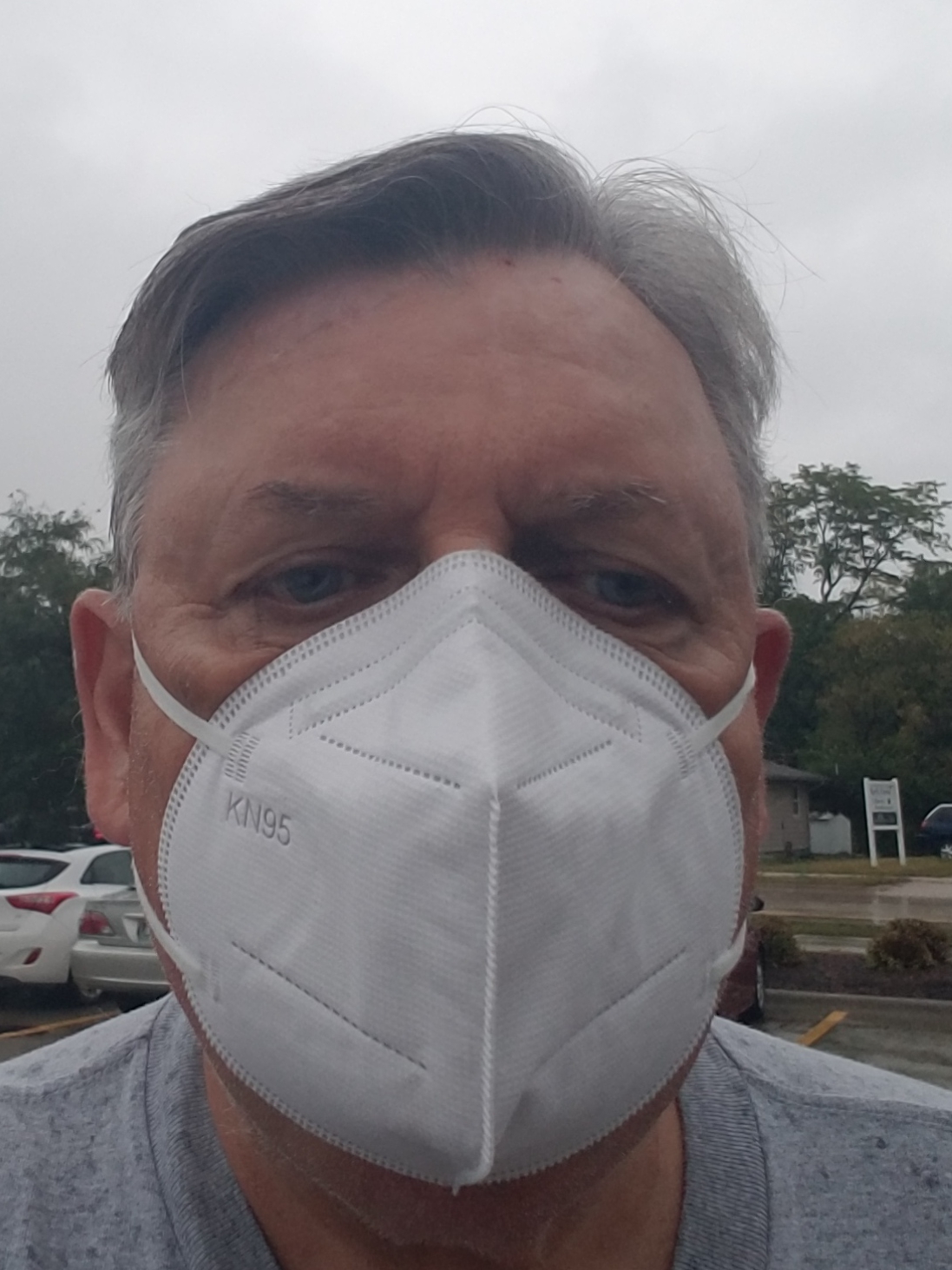
I began wearing a mask in high traffic public places this week. Too many local and personal friends recently contracted COVID-19. One died of the virus.
No single narrative describes my or anyone’s life.
That said, I wrote my obituary, a two hundred word narrative intended to communicate generalities of who I was, and meet a specific public need without being too special. I’m not talking about this. I have a few other narratives in mind.
I’m fortunate to have copies of my resumes dating back to 1975. I’m not sure employers do resumes any longer, favoring online applications that protect their legal liabilities. However, almost 50 years of resumes show my changing story. I keep up my LinkedIn profile with accurate jobs and dates of employment. I’m not really talking about these public-facing narratives either.
What is most interesting to me are those times when my personal narrative shifted. There are seven in between times at this writing:
The time between graduation from university until enlisting in the U.S. Army, especially the time spent living in an apartment on Mississippi Avenue in Davenport in 1975 (18 months).
Living at Five Points in Davenport after military service beginning in 1979 (Eight months).
The time between graduate school and getting married, especially the time living in an apartment on Market Street in Iowa City beginning in 1981 (18 months).
Working for a large oil company in the Chicago Loop beginning in 1989 (18 months).
Retiring from transportation and logistics beginning July 2009 (17 months).
Coping with retirement income needs beginning November 2012 (14 months).
Dealing with the coronavirus pandemic beginning March 2020 (Two months).
Each of these periods proved important to how my life changed. They contribute more than what fits in a 200-word obituary. They are at the core of my autobiographical writing.
At the moment, I’m researching the third in-between time in Iowa City for my autobiography. Some of that writing will spill over to these pages, so stay tuned.
Overnight temperatures reached 50 degrees this week. I examined our trees the next day and the Green Ash and Autumn Blaze Maple were both kissed by cool weather and leaves had begun to turn. Summer is over before we know it.
There is a large-scale sporting event this morning. I had to look it up: The University of Iowa football team is playing Utah State at Nile Kinnick Stadium. It’s a day to avoid the traffic and congestion in the county seat.
I attended a few football games at Kinnick. When in graduate school, I lived near the stadium where the house-owner rented his yard for game-day parking. Sometimes patrons had an extra ticket to give us. When I worked in Cedar Rapids, one of my supervisors was a sporting enthusiast. He required his managers to attend certain games with him so I went with the group to Kinnick for an unremarkable contest. During meetings with national staff, we were required to attend professional sporting events. That’s how I was able to watch Patrick Ewing play basketball in Dallas. I don’t regret learning of the ballet-like moves of professional basketball players. Sports has not been my thing.
In high school, almost every freshman boy tried out for the football team. I didn’t make the cut and decided to pursue interests in the arts: reading, writing, music, and theater. High school was an awkward time and I spent most of my non-classroom time on the high school stage crew, reading, or practicing the guitar. Most of my classmates seemed to have a natural instinct to find a partner and be with each other. That wasn’t my thing either.
Being part of a sports team was not that interesting. I suppose of one were on the 1961 New York Yankees roster it would be different. When I played baseball for the Sears Roebuck team it was never at that level. That was a team: Whitey Ford, Elston Howard, Roger Maris, Moose Skowron, Yogi Berra, Clete Boyer, Mickey Mantle, Bobby Richardson, and the rest. On a Saturday in the 1960s, one could listen to the neighbor’s backyard radio broadcasting Chicago baseball games from across the alley. After Roger Maris broke Babe Ruth’s home run record in 1961, I lost interest in watching or listening to baseball games on television or the radio.
In 1982, when I worked at the University of Iowa, the football team had a berth to the Rose Bowl for the first time since 1959. It was a really big deal and half the city cleared out to travel to Pasadena for the game. I lived on Market Street in a small apartment and tuned in to watch on my 12-inch black and white television. Iowa was pathetic. Washington shut out Iowa 28-0, the first Rose Bowl shutout in 29 years. “Sports are important at a Big Ten university,” Hayden Fry said in his memoir. He apparently didn’t mean winning was.
It will be cool this morning, with temperatures rising to above 90 degrees this afternoon. I’ll work among my apple tress for a while, then turn indoors to process garden produce. I can see the end of the garden. It has been good this year.
Now that the season has begun to turn, I linger under the foliage. At least for a few more times as late summer becomes autumn.




 Journey Home
You must be logged in to post a comment.