Categories
Living in Society

Creativity With Cameras

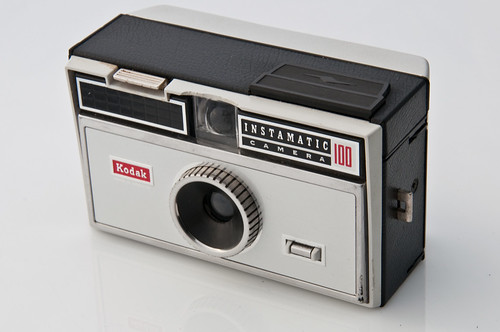
Kodak Instamatic 100 Camera. Provenance unknown.

Editor’s Note: This is a chapter from my autobiographical work in progress.

By 1962 I owned a camera and used it to photograph our neighborhood. It was an early form of creativity that stayed with me all my life.

I walked north from home on Marquette Street and took snapshots of the Levetzow’s holiday display at the intersection with High Street. They owned Model Dairy Company and at Christmas filled their whole yard with lighted Christmas decorations. On the southwest corner of their house was a large crèche. To its right was a lighted display of Santa, his sleigh, and reindeer. We viewed them as an affluent family, such affluence being on conspicuous display at the holidays. They had a kid-sized model of their dairy delivery van, although none of us local kids got to drive or play with it.

I photographed the holiday display at the house across the street to the south. This was a rental through which families moved frequently. Eventually, a young Joe Whitty and his family moved there when he worked at the nearby Mercy Hospital bakery. He later opened his own chain of pizza and ice cream restaurants called Happy Joe’s.

Using a camera was an inexpensive way to have fun. Because the process took so long, it seemed more creative: requiring thought, editing, and an ability to understand the camera viewer and how it would relate to the finished print. I did not crop many photos at first but accepted what the processor developed.

We posed for pictures with my film camera. I gave more thought to each frame than I might today because the results were not immediately available. There were only so many shots on a roll of film, so it felt necessary to get the framing and pose right. It was a process of experimentation and of managing expenses. Developing film could take a while, depending upon when the entire roll was exposed, and when one could get it to the drug store to be developed. Photographs were special and I believed they would have enduring value.

There is a photo of me in my altar boy cassock and surplus, one of us kids bowling, and many posed photos of all of us in the foyer. One favorite foyer photo is of Mother and Father dressed up in costumes to go out on New Year’s Eve in 1962. The following January, I captured my sister’s birthday party during which we all danced the twist. Mother took some of those shots. My parents had just begun listening to long-playing records at home and had copies of popular LPs by twist artists like Chubby Checker and Fats Domino.

In 1963 I began buying color film. Pictures survived: of Easter, my sister’s first communion, a trip to the park, Father standing next to the wrecked 1959 Ford. Mostly they were posed and signified a special event.

Mae was an influence on my photography. She purchased inexpensive cameras at the drug store and used them to record moments with the family. After researching the Polish community near Wilno, Minnesota, I came to believe her behavior with cameras in the 1960s had its roots in the inner cultural and spiritual realm filled with drama and emotion I described previously. The surviving photograph of her sister Tillie’s confirmation is one example of this. The desire to pose and capture a photo was something creative I didn’t understand at the time. We were plain folk and when we got dressed for church, or to attend an event, it was a big deal. Mae wanted to capture those moments on film, consistent with her Polish upbringing. It’s a natural impulse that presents an interpretation of who we were. Of course, we always wanted to put the best foot forward in these constructed frames.

Because photography was a technology with numerous steps, and there was a cost of film and prints, I don’t have many photos from my earliest days. However, I have a lot by comparison. The ones that survive tell me who I was and inform us about our family culture. They are an important part of remembering who we were. From that early time, I began thinking about how to narrate my life using a camera. There is a direct creative thread running from 1962 to the present and spun on my use of cameras.

Categories
Writing

Snow in the Grove

Garden seedlings watching it snow from indoors.

Precipitation was forecast all day Wednesday so I did my exercising indoors. On Tuesday, I went to town and bought a Powerball ticket. I understand the odds of winning are against me. Most days I fail to match a single drawn number. Other days, I don’t buy a ticket. At least we can depend upon it snowing in early spring.

I’ve been working on our high school class reunion. We missed the 50th because of the coronavirus pandemic. We scheduled a 50th-ish reunion this July. The former classmates on the planning committee are all great.

When I think of high school, I return to the most dominant feature: the death of Father in an industrial accident on Feb. 1, 1969. Dealing with his sudden death occupied me during the remaining 16 months of school. It was a brutal and clear demarcation of my life. There was a before and an after which defined who I was, and who I would be.

High school was no fun. I checked things off while in school. Tried out for football and swimming and didn’t make either team. Played intramural basketball with some of my nerdy friends plus the one Hispanic person in our class. Sang in chorus all four years. Was inducted into the National Honor Society. Was on the stage crew. Got a part time job after school at a local department store. Bought a used Volkswagen Beetle to get around and began driving it to school. Practiced and played guitar, taking lessons from someone not far from our neighborhood. While this seems bucolic as written, whatever was pleasant about it vanished with Father’s death.

I was lucky to form a new group of friends after Father died. They helped me through a turbulent time. My new friends helped me cope with finishing high school, and getting through college. Not to mention their help with the pressures of a society in transition in the late 1960s and early ’70s.

I had only begun to discuss how I would live my life with Father when he did not return from the meat packing plant. He didn’t have any suggestions as we discussed college and beyond. I enrolled in engineering classes at university but couldn’t master calculus or the slide rule. Without my new friends, I would have drifted into oblivion. With their help, I graduated in four years with a degree in English.

It is good to remember all this about high school now. For that, the reunion and its planning will serve. I still have friends among former classmates. I enjoy thinking about them while stuck indoors during this spring snowfall. It will be good to see them again. The odds of that are better than winning the Powerball.

Categories
Writing

Turning a Corner

Draft chapter page April 1, 2024

With chapters of part one of my autobiography named and numbered, it feels I turned a corner from being stuck, to completing the narrative this year. As soon as I typed them all and shrunk them to fit on a single page, it became clear what I had to do next to produce the first volume.

In naming the chapters I re-read part one. The narrative seems sound. The story has defined beginnings, middle points, and an ending. The ending leaves enough suspense to engage readers until I finish part two. Finishing part one this year is definitely possible.

The next step is to return to the text and make a “final rough draft.” What that means is to edit chapter by chapter and resolve any open issues through editing. I had a tendency to defer open issues until “later.” With this phase of the writing, there will be no “later.”

On Tuesday I finished the Dedication, Preface and Chapter One. The early chapters have been worked the most so editing should proceed quickly. There are 62 chapters, so if I proceed with due haste, I should have a finished final rough draft by Labor Day. Some of the later chapters were rushed last year in the interest of “completion.” They will need more work than earlier ones.

Once the final rough draft is finished, I plan to find a reader or two to provide feedback. Many thanks to the three early readers. I don’t want to wear them out with this project so I’m picking new ones. I will also price a professional reader to go through and make suggestions. If I can afford it, I’ll go that route. Following the readers, there will be corrections, more editing and hopefully a “final” product..

At that point, I will need to weigh options. While there is finality in “final rough draft,” is a book ever really final? If any changes are needed — a chapter added, narrative clarified — that will be the time for it.

Once I settle on the narrative, formatting is next. The hodge-podge of cutting and pasting that produced it will have been pasteurized by then. I can focus on making paragraphs, quotes, punctuation, line spacing, chapter breaks, and spelling consistent throughout. This is a kind of work that should feel good when finished, but will be a bear while going through it.

I will need to decide what to call my maternal grandmother. I visit her character at least ten times in the narrative. She was referred to by her birth name Salomea,* nickname Mae, Mae Robbins, Mae Nadolski, Grandmother, and Busha over the years. This will be the time to decide usage so readers recognize her wherever she appears..

While we don’t know exactly what this year will bring, I’m hopeful that by early 2025 I will be holding this book in my hand.

*Footnote: It seems possible Grandmother was named for Salomea of Poland, a princess and queen during the 13th Century.

Categories
Writing

Weekly Journal 2024-03-10

Garlic on March 5, 2024.

Garlic is up in the garden: yield looks pretty good. Somehow building a brush pile escaped me this week so I need to get cracking on that. Many robins and other birds have arrived. Lilacs are beginning to bud. All signs are present for an early spring.

Class reunion

Nothing can sober a person like figuring out who died from one’s high school class. For my class of 1970, our research shows 42 of about 260 classmates have died. That is in line with what insurance company actuarial tables suggest should be our experience. It doesn’t make dealing with those deaths any easier. “Who died?” was the most frequently asked question at our 40th reunion in 2010 so the planning committee is front loading work to have a better answer this time.

When I work on the organizing committee for a reunion I’m more likely to attend. My main interests are finding out what people have been doing during the years since we graduated, planning the event, and catching up on news. I would not likely attend if I wasn’t on the planning committee. The event is in July, dubbed the 50th Reunion (Delayed) because we canceled during the coronavirus pandemic when our 50th would have been.

Charlatan

I finished reading Charlatan: America’s Most Dangerous Huckster, the Man Who Pursued Him, and the Age of Flimflam by Pope Brock this week. It is a well-researched and easy to read book about early 20th Century medical practices and associated quackery. Dr. John Binkley, the charlatan, is reminiscent of B.J. Palmer, son of the discoverer of the chiropractic principle, who lived in Davenport. Palmer started the first radio stations west of the Mississippi River in Davenport and Des Moines, paraded elephants through the city streets to advertise the chiropractic principle, and had a museum called Little Bit O’Heaven at his chiropractic school. The museum had artifacts collected during his global travels. While chiropractic thrives into the 21st Century as a respected medical profession, its trajectory in the early years is tied to that of the goat-gland charlatan depicted in this book. Worth reading for this and other reasons.

State of the Union

I viewed video of the entire State of the Union Address. It took me multiple segments to get through it. Biden did an excellent job, of the kind I expect from a Democratic president. I also viewed video of the Alabama housewife (and U.S. Senator) who delivered the Republican response. They have nothing! Seriously, Biden got criticized for having a campaign TikTok account. Do Republicans not know about the numerous objections among users to federal attempts to regulate TikTok? OMG! Governor Kim Reynolds made a press release reacting to the State of the Union with a tepid response. Why did she even bother if she had nothing to say? Republicans really do want to take the country backward.

Hope your week went as well. Cheers!

Categories
Writing

Weekly Journal 2024-03-03

Morning coffee.

The week started with days where the ambient temperature reached a high in the 70s, dipped on Wednesday to the teens, then rose again the rest of the week. The expectation for first week in March is highs in the 30s and 40s, so it seems unseasonably warm.

Creamed crumbles on toast

I don’t have many meals derived from Mother’s cooking. As important as cooking has become to me, I can count on one hand the number of dishes I now make that she did, too. One of those is variously called chipped beef on toast or creamed beef on toast. Mother made this for Father as a reminiscence of Southern cooking in which he came up. I don’t use beef in our kitchen, yet I made this for breakfast one day. I use vegetarian recipe crumbles as a meat substitute.

Saute half cup of finely diced onions in two tablespoons of butter and add one finely chopped clove of garlic. Season with salt and pepper. Add dried home made hot pepper powder. Add a cup of recipe crumbles and cook until thawed from the freezer. Add two tablespoons of all purpose flour and combine everything while on medium low heat. Add one cup of milk (cow milk or oat milk, whatever is the kitchen standard) and combine. Lower the heat and cook until the mixture thickens. Toast and cut into 3/4-inch squares two slices of bread. Pour the creamed crumble mixture evenly over the toast and enjoy.

Tracking writing

I edited the first ten chapters of my book. I created a spreadsheet to track what I did and how the daily word count changed. The fact that I am now including numbered chapters is a revelation. It helps organize topics in a way I hadn’t considered. I now gather topics from different places in the narrative over a span of years under a single header. It helps reduce the amount of duplication that plagued me from the cut and paste method of composition with which I began. I am satisfied I made progress last week.

Email rabbit hole

I have email files beginning in 1999. There are hundreds of thousands of stored emails and I don’t plan to read them all. When I begin a session of email reading, I become lost for hours in a rabbit hole of forking paths. For example, the emails I wrote and received about updating the county plan for dealing with a contagious disease epidemic seem prescient in light of the coronavirus pandemic ten years later. This research will yield a paragraph, maybe two in my chapter about the coronavirus pandemic which closes the book.

What I seek the most is emails from friends and family to use in other parts of the narrative. Facts are recorded with dates attached to them and they help evoke memories of that time. The trouble I see is advancing technology may render some of those files obsolete. For now, the current version of Microsoft Outlook opens all the saved files, yet I’m anxious to go through them even if it would be better to wait until I’m writing those parts of the narrative.

Publication

I decided to publish Part I of the autobiography first. The narrative goes through finishing graduate school and taking work at the university where my spouse and I met. I was 30 years old on our wedding day: a clean breaking point for the narrative. The second part of the book will be more difficult to write because there is so much material to condense. I delay that challenge by deciding to finish part I this year, God willing.

Summary

It was a good week. Hopefully increased garden tasks can be added to my life without compromising the writing. March brings the pressure of spring and I am ready for it. On Friday, March 1, we saw the first Robin in our yard, along with another flock of smaller birds. Spring is definitely coming.

Categories
Living in Society

Art Books

Shelf of art books

My relationship with the world of art is tenuous at best. A few high school and university friends practiced the visual arts. They were, and in some cases still are, multidisciplinary artists. I viewed myself as a multi-media creator yet throwing a pot, painting a watercolor, or drawing a sketch are activities in my portfolio that have been lost to exigencies of living a modern life. I have a lot of art books and art memories. It’s a big topic, so I’ll limit myself to three things: books in my library, artists I’ve seen or knew in person, and major shows I attended.

Art books take up too much space. When I built the bookshelves in my library I designed a shelf to accommodate them. Having so many is a function of my interest in certain artists like Picasso, Joan Miró, Georgia O’Keeffe, Andy Warhol, Edward Hopper, and the like. I saw major retrospectives of each of these artists and usually bought a book to remember the work. I picked up many art books at used book sales. Until I get to the point of running out of space, most of them will stay right where they are in the library.

Among the pantheon of artists who lived during my lifetime, three come to mind: Joan Miró, Louise Nevelson, and Leslie Bell.

I saw a major Miró retrospective in Paris in 1974. I wrote in my journal, “The show of Joan Miró was very complete and what impressed most were the ceramics and weaving. The paintings lacked something in such great numbers, better just a few to contemplate rather than such overdose.” Later, on a 1978 trip through Italy with friends, I saw the artist filming a program for French television at Fondation Maeght in Saint Paul de Vence. While Miró is known as a Catalan painter, the unexpected encounter on the French Riviera cemented him as French to me.

Louise Nevelson came to Iowa City for the installation of Voyage at the University Lindquist Center. I happened to be at the installation site when the artist walked up to have a look at the space. She was scheduled to give a lecture at the Museum of Art later that day. The University describes the work in place:

Voyage was the first sculpture purchased with funds provided by the Art in State Buildings Program, initiated in 1978. With public works such as Voyage, Louise Nevelson creates a visual dialogue using existing scenery and groups of vertical elements, evocative of trees or plant like forms. Nevelson preferred to see her large-scale outdoor sculpture, which she undertook in the last fifteen years of her life, as environmental architecture. Voyage fits this description as it commands attention within the closed-off courtyard of the Lindquist Center. Yet, it does not overwhelm the entire space. The work invites dialogue with the viewer, offering a variety of shapes, forming spatial relationships with both the spectator and the architectural environment.

Iowa Facilities Management website.

One local artist I knew well was Leslie Bell, an art professor at Saint Ambrose University. Les was a couple years ahead of me in high school. I came to know him more as a musician than a visual artist. He was good at whatever he did. I recall picking him up while hitch hiking to a friend’s home. I engaged his band to play at our fifth high school class reunion. He was part of a small group of intellectuals in the Quad Cities. He helped create a film festival around the time I returned from military service. We were not close friends. He was an example of someone successful in making art a career. He influenced many students at Saint Ambrose. I thought about him while I tried to figure out how to live in my home town as an adult in the early 1980s.

I visited so many art museums during my life. During trips to Europe I made a point to see the works of Johannes Vermeer, which are not gathered in a single location. I saw a lot of them. I made a point to see Monet’s work in Paris. I bought a book of Byzantine mosaic images when visiting Ravenna, Italy in 1974. I saw the Picasso retrospective at the Museum of Modern Art in New York City, the Andy Warhol retrospective at the Art Institute of Chicago, and the Georgia O’Keeffe retrospective somewhere. The latter was so much about the artist and not about the location of the retrospective. Seeing art in person is essential and I did my share of it.

How shall I use the couple hundred art books in my library? For reference, of course. There has to be something more than that. I’ve been creating so long, I don’t need many references. As long as I have the space, they can sit on shelves waiting for my attention.

Categories
Writing

Weekly Journal 2024.02.25

Morning coffee.

Beginning today, I plan to post a weekly journal of significant activities for the week ending on Sunday. This week, I already wrote about my trip to pick up soil mix, cooking lentil soup, movies, and a short, developmental piece from my work in progress autobiography. This week’s entry may be short.

The purpose is to make a conscious decision to reduce how many times I post here and use that time to advance my autobiography. With spring arriving in four weeks, I need more writing time. I debate changing how I describe my autobiography to my “WIP,” or work in progress like all the cool writers do on Threads. Autobiography seems like too big a mouth full and I don’t like “memoir.”

On Saturday and Sunday, I’m filling in at Blog for Iowa for a while, and those posts will be cross posted here without comment. I strive for a broader audience and put more effort into selecting topics for those Iowa readers. I’ll also cross post any writing that gets published in the newspaper, or other places in the real world, also without comment. A letter to the editor is often a re-working and shortening of something else I posted here, so it seems like duplication to publish the letter like the one that made last Thursday’s Cedar Rapids Gazette here as well.

I’ve pretty much given up on a range of topics that used to be important to me. Cooking, recipes, gardening, local food, and others remain parts of my life. I just don’t feel I have anything new to say. I am weary of writing about “organic practices” when so many people are food insecure. I plan to give those a rest unless I prepare a great dish and want to preserve how I made it. I may highlight unique ways I find to increase food security among those who need it.

I’ve been taking a lot of photos of morning cups of coffee. I post them on my Threads account, tag them a certain way, and there is a group that goes into a frenzy of liking them. These posts get, by far, more views than any others I put up. It’s sad, but it’s something.

That’s it for this week. Let’s all make it a great one next week!

Categories
Living in Society

Nascent Photographer

Digital camera with extra batteries circa 2014.

By 1962 I owned a camera and used it to photograph our neighborhood. I walked north on Marquette Street and took snapshots of the Levetzow’s holiday display. They owned Model Dairy Company and at Christmas filled their whole yard with lighted Christmas decorations. On the southwest corner of their house was a large crèche. To its right was a lighted display of Santa, his sleigh, and reindeer. We viewed them as an affluent family, such affluence being on conspicuous display at the holidays. They had a kid-sized model of their dairy delivery van, although none of us local kids got to drive it.

I photographed the holiday display at the house across the street to the south. This was a rental through which families moved frequently. Eventually, a young Joe Whitty and his family moved there to work at the nearby Mercy Hospital bakery. He later opened his own chain of pizza and ice cream restaurants called Happy Joe’s.

We posed for pictures with my film camera. I gave more thought to each frame than I do today because the results were not immediately available. There were only so many shots on a roll so I felt I had to get the framing right before exposing film. It was a process of experimentation and expense.

Having a camera was complicated because one needed film and never knew how photographs would come out when taking them. Developing film could take a while, depending upon when the entire roll would be exposed, and when one could get it to the drug store to be developed. Photographs were special. I possessed a sense they would have enduring value.

There is a photo of me in my altar boy cassock and surplus, one of us kids bowling, and many posed photos of all of us in the foyer. One favorite foyer photo is of Mother and Father dressed up in costumes to go out on New Year’s Eve in 1962. The following January I captured my sister’s birthday party during which we all danced the twist. Mother took some of those shots. My parents had just begun listening to long-playing records at home and had copies of popular LPs by twist artists like Chubby Checker and Fats Domino.

In 1963 I began buying color film. Pictures survived… of Easter, my sister’s first communion, a trip to the park, Father standing next to the wrecked 1959 Ford. Mostly they were posed photos signifying a special event.

Using a camera was an inexpensive way to have fun. Because the process took so long, it seemed more creative: requiring thought, editing, and an ability to understand the viewer and how it would relate to the finished exposure.

My grandmother was an influence in my photography. She purchased inexpensive cameras at the drug store and used them to record moments with the family. The desire to pose and capture a photo was something creative I didn’t understand at the time. We were plain folk and when we got dressed for church, or to attend an event, it was a big deal. Grandmother wanted to capture those moments on film. It’s a natural impulse that presents an interpretation of who we were. Of course, we always wanted to put the best foot forward in these constructed frames.

Because photography was a technology with numerous steps, and there was a cost of film and prints, I don’t have many photos from my earliest days. However, I have a lot by comparison. The ones that survive tell me who I was and inform our family culture. They are an important part of remembering who we were. From that early time I began thinking about how to narrate my life using a camera. There is a direct creative thread running from 1962 to the present and spun on my use of cameras.

Categories
Living in Society

A Movie Weekend

Full moon through maple tree, March 6, 2015.

The atmosphere was particularly clear Saturday night. Moon bright, stars twinkling. A fine time to be outdoors despite the cold. On Sunday, for entertainment, I read The Movie Ad Book by Malcolm Vance, a book with 120 full page, color reproductions of classic motion picture posters.

My canon of movies makes a short list. Chronologically, World War II movies I saw in downtown Davenport were formative. Saturday morning I picked up the city bus near the hospital where I was born and rode downtown to pay my newspaper bill. After hanging out for a couple of hours, when theaters opened, I saw matinees of The Great Escape, The Longest Day, and other films about the war. I grew up in a culture where World War II veterans were everywhere.

Grandmother took the whole family to see The Sound of Music during 1965. She particularly identified with the Maria Rainer character. Of course, this was also a film about World War II. It was the only time I remember going to a movie theater with her.

I saw early James Bond films in Davenport, beginning with Goldfinger, released in 1964. Dr. No and From Russia With Love made return engagements, so I was able to see them. Even then we expected all of Ian Fleming’s Bond books to be made into films. The last Saturday matinee of a Bond film I saw was Thunderball, released in 1965. It was a special time for a young newspaper boy.

I have little remembrance of films I saw from beginning High School in 1966 until returning from military service in 1979. I remember seeing The Graduate in a Quad Cities theater, likely in 1968. While serving in Germany, our battalion showed Patton repeatedly while we were in the field. It was always a challenge to keep projector light bulbs going because generator surges caused a couple to burn out during each screening. In garrison I remember seeing Superman with Christopher Reeves during its initial release, and Close Encounters of the Third Kind at a theater in Wiesbaden, dubbed in German and subtitled in English. During a trip to Holland, I saw Annie Hall in an Amsterdam theater in English with Dutch subtitles while the buddies I traveled with went to the red light district.

When I returned to the United States, I saw Apocalypse Now which made an impression on me. So did The Deer Hunter. When I entered university for my graduate degree in American Studies, I became completely absorbed in seeing every possible film. It was a way of understanding film as an expressive art form to enhance my writing. I sought every film by Rainer Maria Fassbinder who was at his peak creativity. I saw most of his feature film movies during that period. During our first year of marriage I saw the entire Berlin Alexanderplatz series. It was surprising when he died in summer 1982 of a drug overdose.

The first time I did anything with my future spouse, we went to see Blade Runner in 1982. We also saw Tootsie and Out of Africa in theaters. Most of the long-form movies we saw were on VHS and CDs checked out from a library or commercial video rental store. For a while we made movie-watching a regular family event at home. Of the films seen during that period, I would watch the first film in The Matrix series again. Another keeper is Michael Moore’s Roger & Me about the auto industry in Flint Michigan. I spent a lot of time in Flint when I worked for a transportation firm.

Of the 120 movie posters in Vance’s book, I saw about 30. I was serious about film study in graduate school, but the 40 years since then eroded my interest. These days, I can hardly picture myself sitting still 120 minutes at a time to watch a movie. I’ll be sending my copy of The Movie Ad Book to Goodwill to be recycled with another reader. It was a fun Sunday thinking about films and how they affected my life.

Categories
Living in Society

My Pandemic Story — Part 1

COVID-19 home test and home made facial mask.

When I was on the county board of health we updated our pandemic response plan multiple times. It was all in a day’s work, although most revision work was done by staff. The board was expected to agree. I read the document and it looked okay to me. That was ten years before the coronavirus pandemic entered society. At least the public health department had a plan.

Before too much time escapes, I want to write my story of what happened during the pandemic. A basic framing of the pandemic is as follows:

  • 3/11/2020 WHO declares COVID a pandemic.
  • 2/15/2022 Pandemic normalized by Iowa Governor Kim Reynolds.
  • 9/18/2022 “The pandemic is over,” Joe Biden said.
  • 5/11/2023 Federal COVID-19 public health emergency declarations ended.

COVID lingers in society. People continue to get the virus and die from it today. There are tens of thousands of COVID-19 admissions to hospitals each week. The coronavirus remains with us and it looks like it will be with us for a long, long time.

Soon after the WHO declared COVID-19 a pandemic, on March 13, 2020, I got together with a grade school friend in the county seat. We had lunch in an almost deserted restaurant, then ended our day together at a bar in Tiffin. Patrons crowded around the bar while my friend and I took a table at some distance from them. There were many more empty seats than people that afternoon. We had little idea what the coronavirus would mean to our daily lives.

By March 18, the coronavirus was spreading throughout the county. News media reported most deaths were among people over age 60. I was in reasonably good health but I didn’t want to take chances at my retail job where I was exposed to and had contracted all sorts of viruses. They offered an unpaid leave for the duration of the pandemic. There was no argument at home when I decided to take it. They optimistically gave me a month, by the end of which we expected the public health emergency to be over. I then decided we were making it okay on our pensions and retired on April 28, 2020.

During the time since March 2020, I wrote 307 posts tagged coronavirus. I also kept a journal in which the coronavirus was a constant presence. Thus far we avoided contracting COVID-19. I wish I could say the same about everyone I know but can’t. Both friends and neighbors died of COVID-19.

I want to write at least a few thousand words about the pandemic for my autobiography. The main changes brought by the early pandemic were concerns about having enough food, maintaining isolation at home, leaving paid work, and figuring out how to best cope with the virus. I will spend some time reviewing the impact of social media and video conferencing technology. I became familiar with Zoom, Google Meet and Discord as a way to participate in meetings remotely. Video conferencing had a long-term effect on how we live.

As far as today’s pandemic goes, we are still coping with information about the spread of new virus strains and surges in case counts. I want to stay current on COVID-19 vaccinations. If I hear there is a surge in case counts, I’m more likely to wear a facial mask when grocery shopping or in an indoors public space.

I have homework to do before finishing this story. There will be a Part 2, and as many parts as needed to tell the story. This post is a way to get started.