(Editor’s Note: I’m working on a longer, autobiographical piece this winter. From time to time I’ll post findings from our family archives. The following was dated Dec. 11, 2010).
If I get this one chance to remember my maternal grandmother, what would I say?
That she was part of our family since my earliest remembrances.
That she encouraged me as her aunt had not encouraged her, that horrible instance when playing the piano would never be possible.
That she worked as a seamstress into her 80s and worked hard in what we would call menial positions.
That she reaped the benefits of the social programs of FDR and because of them, was able to live on her own until finally she had to go to the Kahl home, a place she had worked earlier in her life, to be tended by the Catholic charities for whom she had also worked.
That she had suggestions for how to life my life, but they were neither mandates, nor things I would not do willingly.
That she had become a part of my life, incorporated into my being like mixing pancake batter.
That she would come to adore her great granddaughter and be the first to offer her a piece of meat at a family meal.
That she would be sorely missed when she died while we lived in the Calumet.
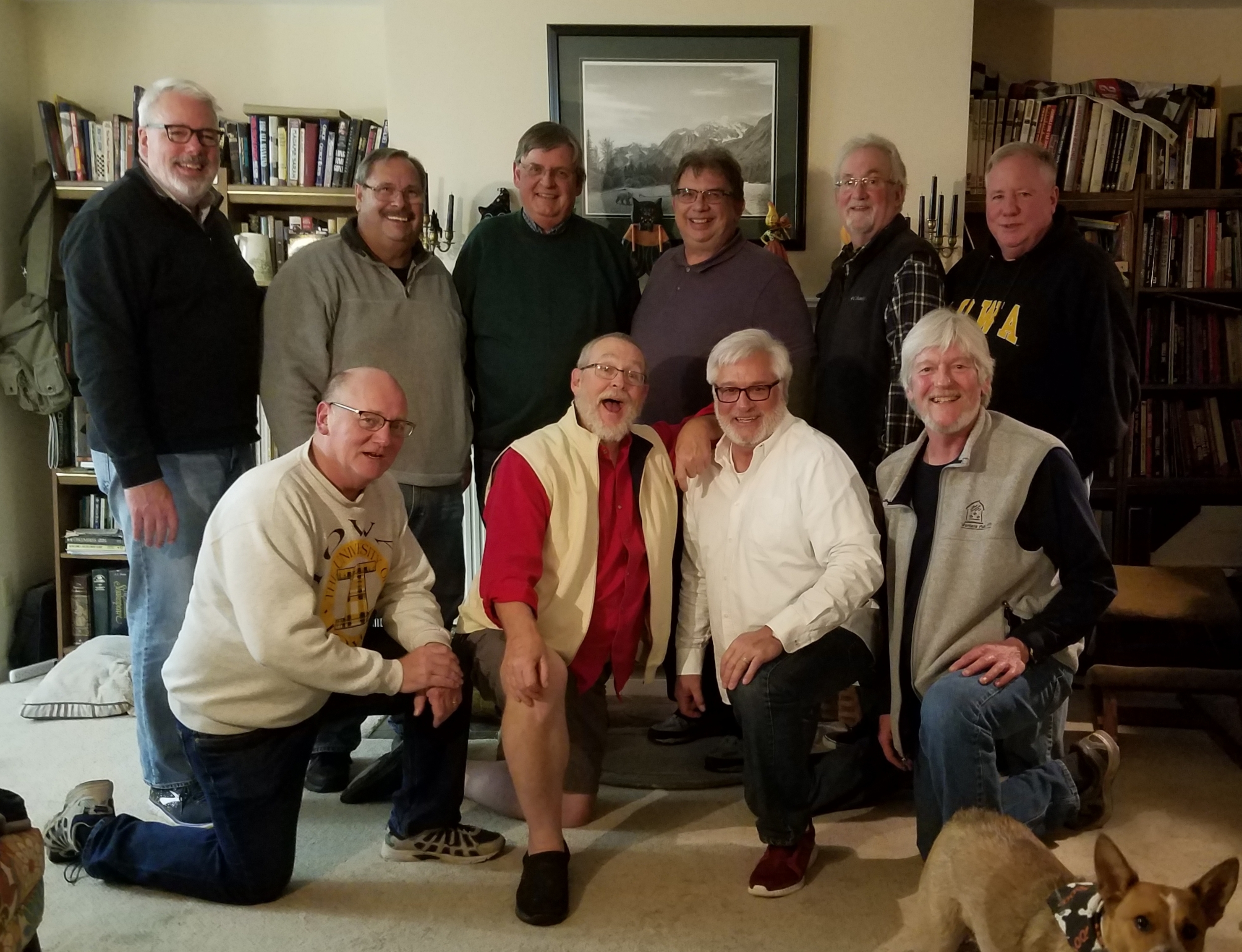
Stage Crew Reunion, Coal Valley, Ill. Oct. 19, 2019
Over the weekend ten former members of our high school stage crew gathered for a reunion at a private home in Coal Valley, Ill.
I made apple crisp from backyard apples, picked up some sweet cider and a host gift of dessert apples at the orchard, and drove into the Mississippi valley.
It’s been decades since conversing with some of my friends. I didn’t know what to expect. The investment of time and energy yielded a positive return.
Spending time with a specific cohort is a little weird from the get-go. Most of my days are now spent either at home, or with a diverse group of peers whose ages range from teenager to octogenarian. All of us at the reunion had birth dates within a small range. I was the oldest.
In four cases attendees resembled other siblings closer to my age. Once I got through the kinship embarrassment we moved on to more positive topics. The afternoon into evening was a series of individual and group conversations set in different parts of the property, culminating in a potluck dinner and photo. There were a couple of takeaways.
As I drove through the Illinois side of the Mississippi toward the reunion I noticed high water from flooding. Some parts of Rock Island County have been flooded for more than 100 days according to one reunion attendee. On Sept. 27, Michelle O’Neil of National Public Radio reported the administration granted Illinois Governor J.B. Pritzker’s request for a federal disaster declaration there. River flooding has been particularly bad in the county this year.
While our conversations were not “political” the way Facebook, Twitter and other social media are, we covered a number of politicians, including Iowa Governor Kim Reynolds, and Governor Steve Bullock and Senator Jon Tester from Montana. I was pleased to hear Mike Matson won his Oct. 8 Davenport mayoral primary. The Elizabeth Warren bumper sticker on my vehicle went unmentioned and despite the fact most present live in Iowa, there was no discussion of the February 2020 Iowa caucuses.
A group gathered near the smoker where our host was preparing hot dogs and beans for the potluck. The conversation turned to answering the question “which types of medicine are you or have you taken?” It was a very long conversation, complicated by various maladies and medical conditions of group members. Taking only a lose-dose aspirin and a B-12 vitamin, by the end of the conversation I felt I had escaped something.
As we settled inside for dinner, the soundtrack was music that included drummer Ginger Baker who died Oct. 6. Four of us played together in a band during the early 1970s. Our set list included songs by Cream’s Eric Clapton.
The reunion was a reminder of the mostly male environment in which we attended high school. Only two female spouses were present, our host and another who came so the host wouldn’t be the only female in an otherwise male group. Until senior year our high school segregated men and women in different parts of the building. By being on stage crew and in my case, in chorus, we did see some of the women in our high school. As I went on to military service after college, the mostly male upbringing continued.
Our society doesn’t include many stage crew reunions. A lot of folks don’t attend more inclusive high school reunions. If our host Mike hadn’t been motivated to get the crew together this one wouldn’t have happened either. I’m glad it did.
Monday afternoons my spouse and I devote time to organizing the household, reducing clutter, and cleaning.
It’s a long-term project we do together. We schedule it on the calendar. Sometimes it means working together on a household issue. Sometimes it means moving boxes and furniture. It definitely means cleaning. Yesterday I spent an hour shredding personal papers. There’s is a lot to do.
We each have reasons for the project. Mine is to eliminate belongings accumulated in 67 years so when I’m gone those left don’t have to deal with them. In particular, I don’t want our daughter to have to spend weeks doing work I should have done. I also want a more comfortable place to live.
The project conflicts with my desire to produce new work. Yet a few hours a week won’t kill me as I slow down into retirement. As the work gets organized, there is a lot to like about it. Now or never is the time to consider all this stuff.
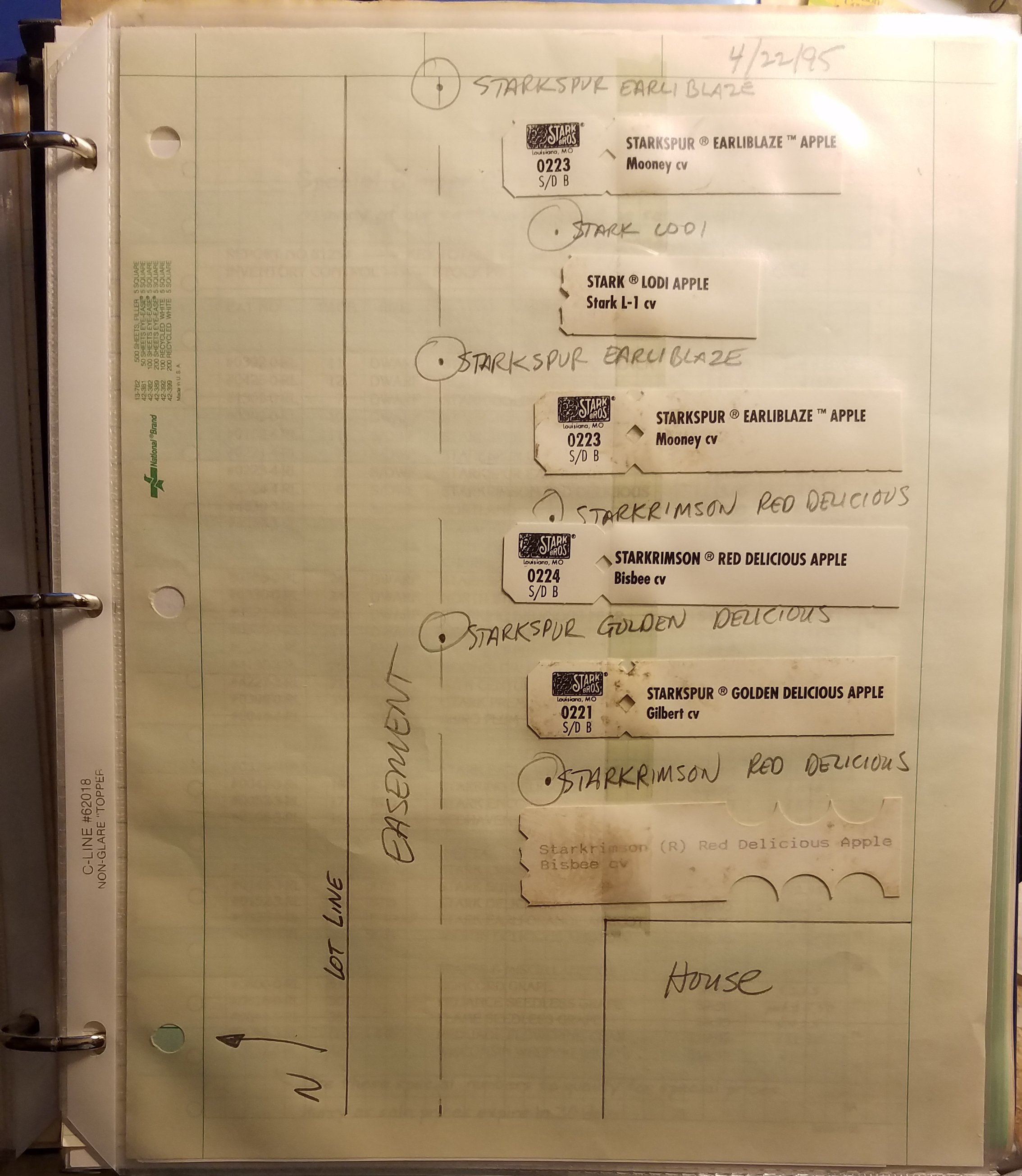
1995 Apple Tree Planting Record
Among recent findings was the planting record for our grove of fruit trees. Planted on April 22, 1995, I began with six varieties of trees, which over the years has been reduced to three: one Red Delicious and two Earliblaze apple trees.
Yesterday I ordered two new apple trees: one Zestar! and one Crimson Crisp. I’ll take out one of the Earliblaze trees and increase the distance between plantings. The idea is to get a succession of ripening fruit — the same thing I originally intended. The new ripening order will be Zestar!, Earliblaze, Crimson Crisp, then Red Delicious. I plan to plant one or two Gold Rush Trees, but the nursery is sold out this year. Gold Rush is a late apple that stores exceptionally well. Planting trees is a longer term commitment than a couple of seasons so I don’t mind waiting until 2021 for those.
I know more about apples today than I did when we moved to Big Grove. That’s mostly due to working at a local orchard during apple season. It changed how we view them dramatically, introducing new flavors and varieties. Whatever apples we have in our home orchard, we’ll supplement them with other local fruit. I probably think about apples more than most people.
If I were to tell my story, the seven seasons of working on farms and at the orchard would be part of it. Not only is the work a source of food, it is about culture and learning. It is about integrating our kitchen with an ecology of food that includes fewer items from the grocery store and more I grow or have a hand in growing.
Producing a crop of apples is a sign of something. To begin with, it is a long-term commitment to growing. The rest is about how the trees are cultivated and apples are used. If all I did was make hard cider with them, that would be something. I want more from life than that. I’m in it for the long haul.
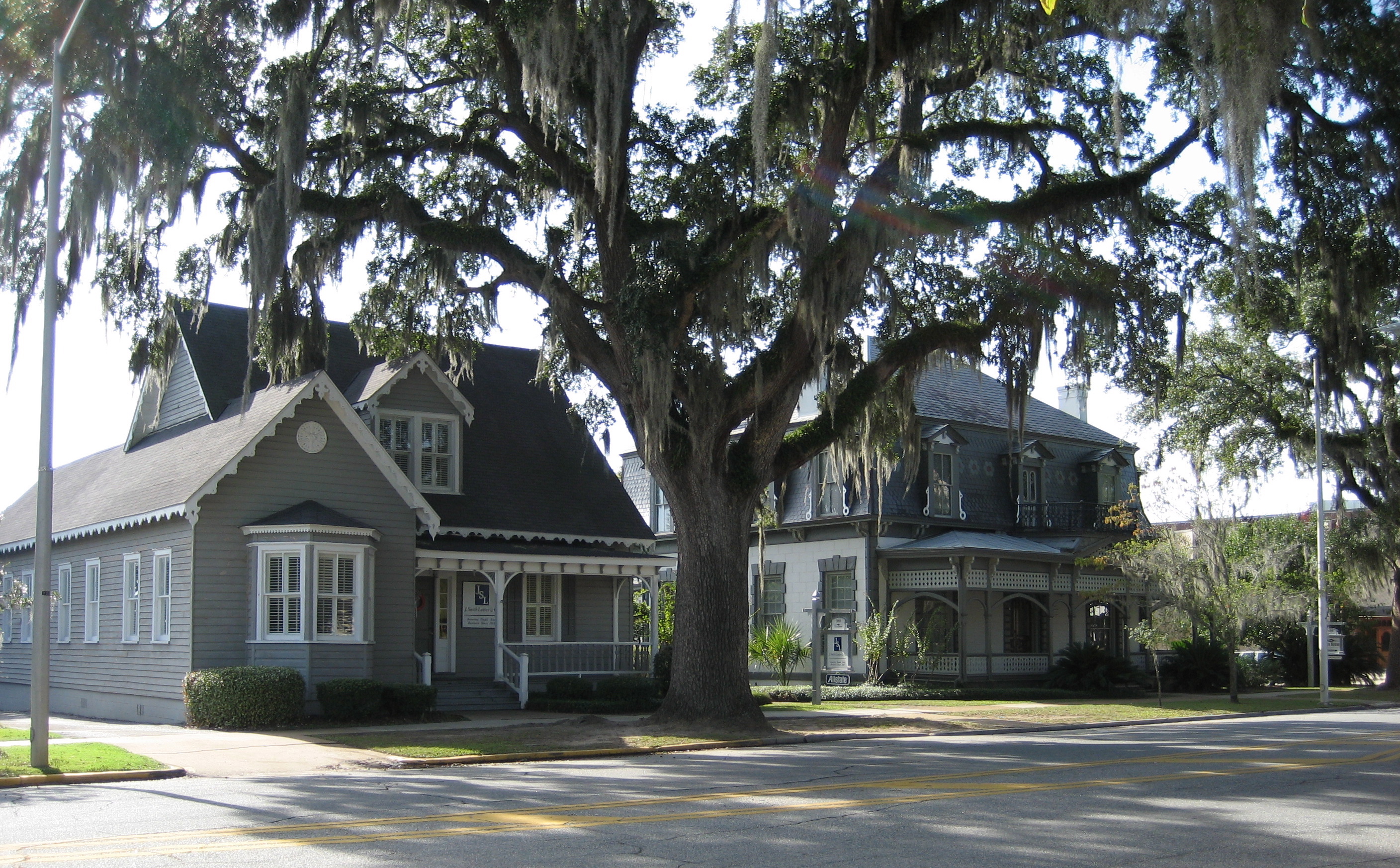
Spanish Moss on a Tree in Thomasville, Georgia Photo Credit – Wikimedia Commons
My memory of South Georgia is specific. I don’t know if it’s real.
As a child, our family drove from Iowa to visit Tallahassee, Florida, the place Father lived after re-uniting with his father after Grandfather’s release from prison. For the record, Grandfather’s conviction for draft evasion was a misunderstanding. He hadn’t meant to be a draft dodger during World War II, according to his late, youngest son Eugene. Dad graduated from Leon High School, then enlisted with his brother Don in the U.S. Army.
That trip was to visit relatives in Wise County, Virginia, according to a recent conversation with Mother. The Tallahassee stop was a side trip. I don’t recall whether the memory occurred southbound or northbound, maybe both.
The memory is of riding in the back seat of the family automobile as Father drove on two-lane Highway 319 where Spanish Moss hung from oak trees with branches extending over the road. Mother was in the passenger seat, I was in back with my brother and sister. Except for Dad, we had never seen Spanish moss before. We did not have that in Iowa. We visited the plantation where Father stayed, Leon High School, and maybe stayed over in a motel, I can’t remember. These events and the long trip at slow speed through the Spanish moss-hung oak trees rolled into one over time, It was almost 60 years ago.
In 1997 I had a three-month work assignment near Ochlocknee, Georgia. My project was located at the largest employer in the county, which was and is involved in mining and processing minerals for a variety of consumer applications. No local ever complained to me about the mines. The rest of the economy was agricultural: peanuts, cotton and pecans.
Because Tallahassee was the closest airport, I flew home from there every other week, driving the same road I had as a child, replete with oak trees hung with Spanish moss. I lived there long enough to recognize other flora and fauna. In particular, pine forests and pecan plantations. The road seemed the same as my childhood memory. I made this regular trip between Ochlocknee and Tallahassee for most of my stay.
The memory sparked an interest in Janisse Ray’s memoir, Ecology of a Cracker Childhood. I wrote the following brief review in the Spring edition of the Prairie Progressive:
Other than authors of country music, few write about the pine forests of South Georgia. Janisse Ray’s memoir, Ecology of a Cracker Childhood, is important for the sense of place it creates. She grew up in a junkyard with ever-present extreme poverty, mental illness, and fundamentalist Christianity. Her story is one of growing self-awareness and hope in a land where both were in short supply.
While Ray is ten years younger, we share cultural references. Perhaps the most significant is the sense of loss she describes for Long Leaf Pine forests and their ecology. I feel much the same living in a state where what was here — tallgrass prairie — has been replaced by fenced parcels where farmers grow crops and raise livestock. Her experience in Georgia informs my life in Big Grove.
Ray mentions Thomasville, Georgia a couple of times in the book. I stayed in Thomasville while working at the mine. There was little daylight between work and rest so my life then was very specific.
The biggest excitement during my stay was when an inspector found a boll weevil in a trap during the season. Boll weevil traps were part of an early warning system to prevent damage to the important cotton crop. One of the plant workers at the mine had a government contract to inspect boll weevil traps. When he found one it made news all round the county.
The first boll weevil appeared in Thomasville in 1915. The insect did its part to bring down the antebellum economy where cotton was a global mainstay. Boll weevils had supposedly been eradicated by chemicals by 1990, but weren’t.
Ochlocknee, Georgia was a poor place where cattle casually roamed Main Street and a Model T Ford sat up on blocks in someone’s yard. I went to the auction house one night, but had no way to transport anything home. I listened to the bidding and tried to keep my hands down. Lunch at the Depot Restaurant was a meat and two sides with iced tea. A diner could pay extra and get a third side. The restaurant has since closed. When I encountered locals outside the job site, the conversation was a mix of complaining, gossiping and harshness. The place and its people defined hard-scrabble.
I had few friends in south Georgia. After working a 13-hour day at the plant, I made dinner at a hotel and watched cable television including a fledgling channel called Food TV. The name later changed to Food Network. I attribute my interest in food and cooking to those nights alone in Thomasville. My involvement in the local food movement has its origins in the contrast between that uninviting place in South Georgia and my nightly food escape. We didn’t have Food TV in Iowa at the time. Like Spanish moss, it seemed exotic.
The main memory, of driving through Spanish moss hanging from branches over the highway, is essential. It is an unchanging remembrance of something seen as a child in a way that shaped me. It has no time or place and some days I don’t know if it’s real. It is the human condition to believe it is real, and eternal. So I do.
Author at Kraft Foods Oscar Mayer plant on Second Street in Davenport, Iowa Nov. 25, 2011
Feb. 1 will mark 50 years since Father was killed in an accident at the meat packing plant. Memories of Dad have hardened into meaningful stories. I was thinking of him when I woke this morning.
What I remember most is his trying to get out of life as a factory worker. He never made it.
He didn’t like it that he got his hands so dirty, that work in the plant was degrading. His father felt the same way about mining coal. Father and son, they both tried to escape their work culture and couldn’t. Dad encouraged me to find a different path and I tried. After two summers working at the plant during college, doing some of the hardest work in my life, I declined their job offer to become a plant foreman after graduation. It was the only offer I had.
The most important decision I made after Dad died was whether to leave Davenport and attend the University of Iowa as he and I discussed. Mother encouraged me to go and I did. For years I didn’t understand that the August 1970 trip to Iowa City was it. My relationship with family changed in a way that was unexpected and forever. I didn’t realize it at the time but I mourned Dad’s death long afterward. I don’t know exactly when — probably during military service — I was able to live with the loss.
After a shift Dad would head over to the Knotty Pine or Pete’s Midwest Tavern where he would cash his paycheck and socialize. It was what people did, the culture of meat packing. That night he cashed his check at Pete’s Midwest over his lunch break. I kept the coins from his pocket after he died, Mom used the bills the way she would had he gone on living.
Losing a parent before life begins can be tough. It was life-altering for me. Fifty years later I don’t think of the loss. It is a part of me about which there is no thinking, only doing. What else is there to do except go on living?
I was born in a hospital established in 1869 by the Sisters of Mercy on Marquette Street in Davenport, Iowa. Marquette was one of the first streets laid out by city founder Antoine Le Claire.
I attended Kindergarten at Thomas Jefferson Elementary school at 1027 Marquette Street, and in 1959 our family purchased an American four-square home at 2025 Marquette Street, a block and a half from my birthplace on top of the hill, a block from the church where my parents wed and I was baptized and confirmed.
My parents married at Holy Family Catholic Church on Fillmore Street. According to Mother it was a quickly arranged ceremony with her brother serving as best man directly from work with butcher’s blood on his clothes. There were no photos of the newlyweds or wedding party.
The Sisters of Mercy and Le Claire provided an ever present background to life in my home town. I remember visiting the cemetery on River Drive where 1873 cholera victims were buried in a mass grave. Sisters of Mercy had tended the sick in a makeshift hospital at a downtown warehouse. That there was a “downtown” is attributable in part to the grid of streets Le Claire laid out in the old part of the city. Antoine Le Claire’s grave marker is prominent near the entrance to Mount Calvary Cemetery where many of my family members are buried.
Davenport was home until the death of my father in 1969 when I left to attend university in Fall 1970. I returned to Davenport for visits, for a couple of summers during college, after returning from an extended trip to Europe upon getting my B.A. in English, and after military service. Davenport was never again like it seemed during my early years. We don’t often have such brutal delineation in our lives as when Father died in an industrial accident. The times I considered returning permanently didn’t last.
Davenport and my life there defined who I am. It was not just the grid of streets where things were measured in blocks in the benevolent presence of nuns.
My earliest defining moment was the day, at age 3-1/2, when a swing-set set up in the basement of our Madison Street home collapsed and injured my head. My parents were horrified. I remember the pool of blood on the basement floor, holding the thumb of the ambulance driver on the ride to the hospital where I had been born, taking ether dripped into a funnel to anesthetize me for the stitches to mend my gashed head. I am lucky to be alive.
What I learned and came to believe through the injury and recovery in the hospital was that in a city there is an infrastructure of knowledge and caring to support us when things happen. I watched the routines of the hospital staff, the doctor checking up on me, changing room mates and bed linen, daily visits from my parents and the handling of my propensity to get out of bed and walk around. This experience assured me that although we are vulnerable, we are not alone.
Over the years, Doctor Kuhl would examine the scar on my forehead and talk about my recovery when I visited him in his office. Today, I don’t think of the scar, and suspect most people don’t even notice it. What I do think about is that while we are not alone, we must be part of a society that helps protect those who are most vulnerable.
When very young, I made a withdrawal from the bank of social responsibility and now the debt needs repaying. Who I became in life was partly attributable to my parents, however the influence of the Sisters of Mercy in a home town laid out by Antoine Le Claire is undeniable. It is also inescapable.
~ From a draft of a personal memoir about living in Iowa.
Editor’s Note: This series of nine posts was written from Jan. 18, 2009 until March 15, 2009 as I considered my life and what else I might accomplish. They are consolidated below unedited and in the order I wrote them. I left my transportation career shortly after completing this series on July 3, 2009.
I. Each of us has a collection of moments from our lives that define who we are and what we can and will be. Our lives are not predetermined. We can effect change in ourselves and in our relationships in society. Too often, we can get caught up in the trivial and small minded conflicts of daily life. There are plenty of these. We need to be better than this for at stake is everything we hold to be important. Above all, we should strive to be engaged in our daily lives, less creatures of habit and more innovators of the ordinary. Today, in this moment, we have the power and potential to create a life beneficial to ourselves, but more importantly, beneficial to others. Defining moments have informed us in how to behave, and we owe it to ourselves to consider them from time to time.
My earliest defining moment was the day, at age 3-1/2, when a swing-set set up in the basement of our Madison Street home collapsed and injured my head. My parents were horrified. I remember the pool of blood on the basement floor, holding the thumb of the ambulance driver, taking ether dripped into a funnel to anesthetize me for the stitches to mend my gashed head. I am lucky to be alive. What I learned through the injury and recovery in the hospital was that there is an infrastructure of knowledge and caring to support us when things happen. I watched the routines of the hospital staff, the doctor checking up on me, changing room mates and bed linen, daily visits from my parents and the handling of my propensity to get out of bed and walk around. This experience assured me that although we are vulnerable, we are not alone.
Over the years, Doctor Kuhl would examine the scar on my forehead and talk about my recovery when I visited him in his office. Today, I don’t think of the scar, and suspect most people do not even notice it. What I do think about is that while we are not alone, we must be part of a society that helps protect those who are most vulnerable, including the injured and infirm. When I was very young, I made a withdrawal from this bank and now the debt needs repaying.
II. At Northwest Bank and Trust Company, while getting my first checking account, I was deprived of the knowledge that my father would die later that night at the meat packing plant. I had been working at a department store after school and had saved enough to want to spend some of it. The bank was open late on Fridays. I can still remember the light inside the bank and the help from the teller. To do this on my own was a big step and I knew it. As it turned out, it was a step I needed to take.
We were shocked when the knock came on the front door. Two men, Clarence from the union and another I can’t recall, were there to tell our mother what had happened. We kids waited in mom’s bedroom. We were all crying together that night. Life came at us that February morning, ready or not.
Death was somewhat abstract. We watched the fighting in Vietnam in the newspapers and on television. A grandparent had died and was buried at Saint Hyacinth’s in LaSalle. We heard about World War II from neighbors who had served. We knew we would not live forever, but we did not consider death as a present option. This started to change as I heard a newscaster report my father’s accident on television.
During the days leading up to the funeral an endless stream of people came to the house. Relatives, co-workers, friends with covered dishes and desserts, people from bars and restaurants near the plant, fellow students from the chiropractic college, our insurance agent, and many others. My father’s two brothers and sister came in their only joint visit to our house. My mother’s brothers and Aunt Dorothy drove non-stop from California. Even though my father had not finished his conversion to the Catholic faith, a funeral mass was held and the church was packed to capacity. Even the elementary school children filed into the balconies and back of the church. As I sat in the pew, listening to Monsignor Barnes, I realized that Dad’s death and his funeral were community events. I felt that I was part of the community and still do.
Whatever arguments I had with Dad ended that night. I still think of him from time to time and miss him when I do. I was lucky. Lucky that I was about to embark on my studies at the University of Iowa and lucky that mother had the means to support my brother and sister if I left. We talked about me staying to help instead of going to college. She released me from the nest and for that I will always be thankful.
As our lives continue, the lesson I learned that Friday night is that before you know it, life is over. If we want to accomplish something, we need to do it now, as there may not be a later. It is a lesson that I forget, but to which I always return. I had a hard taskmaster in that defining moment in 1969.
III. When news of the Woodstock Music and Art Fair hit the television, there were already tens of thousands of people in attendance. I was working at a department store and when Dennis offered to drive to Woodstock in exchange for gas money, I gave it consideration. I declined the opportunity because I was scheduled to work Saturday. His new GTO with the Hurst transmission would surely make it out to New York, but I had other things on my mind. Today and this weekend has felt like that August afternoon in 1969 with friends hopping planes and driving cars to the Washington DC to participate in Barack Obama’s inaugural events. Today, like then, I have to work. In a sense, not much has changed over the years.
Dennis and I did not go to Woodstock. What I learned was that the actual being there does not inhibit the participation. That decision making, the idea that the road to Woodstock started in a parking lot in Iowa made this remote event tangible and within the scope of our daily lives. I felt connected, even if I did not traverse the country to get there. As it turns out, Woodstock was so well documented that I learned enough about it to understand and participate vicariously. In the case of Woodstock, actually being on Yasgur’s farm did not matter and that is my point.
When we consider information about events arriving in our locale, that information has a basis in reality. As a participant in mass society much of what we learn and understand is molded by an ever changing media in many formats. In a sense, the gap between our inner eye and that of another is the same whether the person is sitting next to us on a couch or is a thousand miles away. When Rene Descartes said “I think, therefore I am,” he was not aware that there would be a Woodstock or an Obama inauguration but in that moment, in the parking lot of the Turn-Style department store, I became aware of the Cartesian outlook in a way that has become part of who I am. Living in society is not about us. It is about communicating through the unseen ether to others in engagement that is as old as civilization. It is something in which it is worth engaging.
IV. Richard Nixon announced his resignation from the presidency on August 8, 1974. I had no idea who Gerald Ford was, or what kind of leader he would be, but the next day, when he said, “My fellow Americans, our long national nightmare is over,” I packed my boy scout backpack and a baby blue bag my grandmother made for me with a couple of changes of clothes, a passport, $2,000 in American Express travelers checks, a sleeping bag and ten rolls of Kodak film and left for Europe.
After college, I shared an apartment with a fellow band member on Walling Court in Davenport, Iowa near the former home of jazz legend Bix Beiderbecke. I felt a strong sense of social responsibility and the moral outrage of youth in what I believed were the deception and lies of a man in whom the country had put its trust. Hearing Nixon’s address that night, in our small apartment was catharsis. I remember this feeling as I type here in Big Grove tonight. I was relieved that Nixon was leaving. More importantly, I felt that the many protests and demonstrations during the Vietnam war had finally borne fruit. Direct action to support a just cause could accomplish things, even force out a sitting president. It was a heady feeling. I wasn’t sure what would be next, but I felt that I could take a couple of months and find out what else was in the world.
That I began with Europe was no surprise: studying English literature in college, neighbors who had served in Europe during World War II and art history classes in high school and in Iowa City. Then, I believed that the United States was a derivative of the European experience. With my mother’s side of the family coming from Poland and my father’s from Virginia, it was not a stretch and my travels confirmed this. I saw Twelfth Night at the Royal Shakespeare Company in Stratford, England. I saw a poster of Bix Beiderbecke when I emerged from the Metro on the left bank in Paris. I ran into a friend from Davenport while taking a bus to the Piazza San Marco in Florence. I discovered a Europe that was familiar and a world small enough for these things to happen. At a youth hostel in Rome, a stranger took me over to the Vatican City and got me tickets for an audience with Pope Paul VI. I learned enough Italian so that when I traveled to Ravenna to see the Byzantine mosaics I could register for my room and order meals in the native language. I bought a cameo on the Ponte Vecchio in Venice, the same place mentioned by Shakespeare in The Merchant of Venice. Jacque wore that cameo at our wedding. I also saw the glockenspiel in Munich along with the place where the Israeli athletes were murdered by terrorists during the 1972 Olympic Games. I was moved by the Dachau concentration camp. I was enamored of the paintings by Vermeer. It was a busy trip, unplanned and random. With Eurail pass in hand, there was always another train to take me someplace new.
Yet it was that moment of seeing Nixon resign on television that opened up the possibilities of the world. I became aware that direct action, in concert with others I did not know, could engender change in society. I also learned that the people, places and things we read about can be grounded in a reality that is not that distant from where we live. We are connected to each other in unlikely ways.
I refused to purchase a copy of Nixon’s memoirs until after his death. I did not want him to benefit from my interest in his presidency. In a way, Richard Nixon, with his deceit, arrogance and imperial presidency, contributed to my awakening to the possibility of social change through direct action. This awakening led me to understand that what I had studied in school was grounded in reality. It was an unlikely connection for which, in retrospect, I am thankful.
V. In January of the bicentennial year I packed again and left for basic training at Fort Jackson, South Carolina. I had been living in a one room apartment near the Mississippi River and the combination of willingness to serve and the end of the Vietnam war led me to seek out the Army recruiter, enlist for Officer Candidate School and put aside concerns about risking my life by saying it was better for peace lovers to join the military and lead, rather than leave it to the likes of Lieutenant William Calley. Calley is the convicted war criminal who was responsible for the 1968 My Lai Massacre, and an example of what was worst about the military during the Vietnam era. We could do better than that.
The impression I made on the three member officer panel when I interviewed at the recruiting office could not have been good. It was probably the shoulder length hair, blue jeans and independent thinking that put them off. Truth is, they had a quota to meet, I met the requirements and had maxed out the proficiency tests. Even if I washed out of OCS, I would continue to have a military commitment as an enlisted service member and they had an enlisted recruitment goal as well. I was in.
Among the large group of us at Fort Jackson, I seemed to be the only one who had brought any money. I had withdrawn $200 from my bank account for expenses until payday came. I found that there was no significant need for money since food, shelter and clothing are complimentary with basic training. In fact, any outside clothes that we had brought had to be put in storage until we were finished with training. During the first week, we were eligible to take an “advance” and most did before we walked down to the post exchange. I bought a t-shirt with something like U S Army printed on it. Many spent every bit of the $25 advance as if it were the first money they had in months. For some, it probably was.
And that night came the shakedown. Two E-5’s who were on snowbird status, soon to leave the military, came into the barracks, turned on the lights and proceeded to inspect every soldier’s belongings, confiscating unauthorized food, adult magazines and other items deemed inappropriate for a soldier going into boot camp. This seemed odd in that these were the same non-commissioned officers who had walked us down to the PX, and they knew what we had bought. When they got to my area, one of them picked up my copy of the works of Geoffrey Chaucer, written in Middle English and thumbed through the hardbound book roughly, asking, “is this pornography?” I had bought the book for Stavros Deligiorgis’ course in Chaucer, and I recalled the professor reprimanding students who wrote notes in the margins. Given the nature of some of the characters and passages, and the frequent appearance of the Canterbury Tales on lists of banned books, I could have easily answer the sergeant’s question yes, but after consideration said “no” and this defined the moment.
The Canterbury Tales is not pornographic, but the actions of these two thugs may have been. I bit my tongue, holding back the moral outrage and blue language to survive the moment. These two piss ant crackers denigrated the best ideals of our armed forces and were emblematic of what was wrong with the post Vietnam military. I had walked among the graves of American soldiers at Arlington and the awe and respect I gained there was vaporized that night.
I took a breathe, and then realized that this was why I had enlisted. If we wanted to heal the wounds in the military, it was going to take a large rasher of tolerance to win the respect needed to effect change. If I was going to get into a position to influence the outcome of any future combat engagement, I had to get through training and not get kicked out for what would have been considered insubordination. Making change in society is partly about patience and perseverence. It is also about picking which fights to fight and that was the lesson I learned in this defining moment.
The early volunteer Army had its problems. When I was stationed in Germany, we found that the majority of our soldiers were tied into the illegal drug culture. It turned out that a group of non-commissioned officers was running a prostitution ring across the street from Lee Barracks. The deputy division commander, a brigadier general, was having an extramarital affair with an enlisted woman who worked for him. Those days were like excerpts from a painting by Hieronymus Bosch.
The coming of soldiers like Paul Gorman, John Galvin, Tom Carney and Norman Schwartzkopf represented a new path and one that ultimately transformed our military into a more effective organization. One that is more worthy of its heroic past. This work was difficult, and I was proud to have been a small part of it.
As we sat around camp fires, in jeeps in small villages and at the officers’ club, we knew that the next mission would be a war in the Middle East over oil. When I left the military, we were already evacuating Iran and getting ready for the conflict. Norman Schwartzkopf was a friend to many of my fellow officers, had received his first star and was heading our way. For me, oil was not worth fighting for. On a rainy October morning in 1979, I left for home, ready for what would be next.
VI. When I landed at McGuire Air Force Base, returning home from three years of living in Germany, my impression was that the United States was a dirty, cluttered place, ill settled and ill managed despite our 200 year history as a country. I compared this to Europe where I had walked along the crest of the Taunus mountains on a ruined wall where the northern border of the Roman Empire had once reached. My friends Larry and Debbie had an apartment in a castle built before the settlement at Jamestown. The United States seemed new, rough hewn and unfinished. I was hoping this applied only to New Jersey.
We arrived just after dawn, following the sunrise across the Atlantic and I immediately checked in at Fort Dix to finish my processing so I could get over to Elizabeth, New Jersey to pick up the yellow pickup truck I had shipped from Bremerhaven weeks earlier. My expectation was that I could get this done and get out of New Jersey that day and I did. I had taken 45 days of leave in conjunction with my separation, so I was still in the Army as I picked up my truck and headed west.
I don’t remember where I stopped, but late in the evening, jet lagged and tired, I got a hotel room for the night. I believe it was in Cambridge, Ohio. Almost thirty years later, it is hard to remember. I recall driving by Three Rivers Stadium where people were gathering for a game. I remember looking down a hill that led west and wanting to go there, despite my tired state.
I stopped in Springfield, Illinois to visit Dennis and Diana. Diana fed us cornbread and beans and Dennis and I saw the film Apocalypse Now in a theater. This film experience, after seeing half a dozen films in theaters in Germany and Patton with George C. Scott about a dozen times while on maneuvers, enthralled me, even if I did not understand Coppola’s work. It whetted my appetite for cinema in a way that few other events have affected me. I had been missing a lot while overseas.
Home again in Davenport, I rented an apartment at Five Points, which was a center for German immigrant culture while I was growing up. I had nothing but a few bags with me when I arrived in the apartment. I bought a desk and book shelves to set up a study. I bought a large round cocktail table like the ones fellow officers had in Mainz. I took delivery of the goods shipped from Germany and the items I had placed in storage before leaving for basic training. There were things from my mother’s house. I sorted through everything. I started attending a local film group’s screenings and tried to get involved in the local culture so as to start a new life. My friends had mostly gotten married while I was in Europe and I bought them all belated wedding gifts and made the rounds to catch up with them and learn about their new lives. I could not settle down.
I scheduled an event at my apartment for November 25, 1979, a wine tasting and dinner party. I was no cook, but planned on lasagna, since I could understand the recipe and had made it once while in Germany. I went to Gendler’s wine cellar and bought bottles of the various types of wine that were grown near my apartment in Germany. I invited people over, and found that I spent most of my time in the kitchen instead of with my guests. The dinner was well received and the drinking after culminated with a vote for the best and my cutting up my military identification card to signify my official exit from the active duty military.
Everyone stayed for a long time, my old friends from before the military, from high school, college and work. The evening was drawing to a close, and the men felt like they had not done enough drinking and asked me what else I had. What it was, inside my freezer, was a bottle of Jägermeister. The men gathered around the kitchen table and toasted the evening, our reunion and the days ahead. It was then that I knew it would be impossible to renew my life in the Quad Cities. It was a defining moment.
The feeling was described by Saul Bellow in his book Henderson the Rain King, “I want.” This desire had taken hold of me and I knew my life was not to be in Davenport. I went to Iowa City, applied to the Graduate College for the January session and was accepted into the American Studies program. I was eligible for the GI bill to help with the cost of the degree. I commuted for a while, then moved to Johnson County and have not looked back. For a moment, I felt my roots in that Five Points apartment, but the world was calling and I had to go and did.
VII. I got my masters degree in American Studies in a fever. I was determined to vindicate my undergraduate effort which was troubled by lack of direction and a desire to get out of school. I had money saved from my time in the Army and with the GI Bill, could afford to attend classes full time. I finished in 17 months with a 4.0 grade point average, without breaking a sweat.
I carried a clipboard I bought in Germany and kept notes on lined paper. I recall some classes favorably, especially Stow Persons’ class on American Intellectual History. But graduate school was about meeting a different group of people rather than the studies. I had a relationship with every person who attended the required American Studies seminar in the fall semester.
One of the many books I read was Berger and Luckmann’s The Social Construction of Reality. Wikipedia explains the book as follows: “The work introduced the term social construction into the social sciences. The central concept of The Social Construction of Reality is that persons and groups interacting together in a social system form, over time, concepts or mental representations of each other’s actions, and that these concepts eventually become habituated into reciprocal roles played by the actors in relation to each other. When these roles are made available to other members of society to enter into and play out, the reciprocal interactions are said to be institutionalized. In the process of this institutionalization, meaning is embedded in society. Knowledge and people’s conception (and belief) of what reality is becomes embedded in the institutional fabric of society. Social reality is therefore said to be socially constructed.”
What defined graduate school for me was gaining the understanding that while many talked about ideas, there was often no basis for their understanding of the subject. They would quote Berger and Luckmann’s work, but when asked, they said they had not actually read it. It turned out that I was one of a very small number who had.
This was the learning I had: that unless we are grounded in reality, the reality of the mundane, our conversation becomes nothing but the exhausted air of hollow lungs. I left graduate school convinced that I needed to get grounded and glad for the redemption of my undergraduate years.
VIII. Our relationship took a big step on our wedding day at the Unitarian Universalist Society of Iowa City on December 18, 1982. If one looks at the photograph of us standing in front of the church door, right after taking our vows, there is what happiness looks like. The day was also an embarkation on a search for truth and meaning in our lives like no other.
So, in the moment of that photograph, on a warm December day, with a small gathering of family and friends and a modest reception and wedding trip planned, we started the journey that together we continue. Words can’t capture how we felt except to say, it was a defining moment full of every potential that life offers.
IX. Through our lives, things happened, some more memorable than others. Who we are was defined when we were very young. In a lifetime, against the outlook of our youth, there are moments worth considering that have further defined our character. For me, after our wedding, it was finding the next job, the birth of our daughter, the decision to move to the Calumet region of Indiana, the decision to take a job at the oil company, spending a day with the president of the logistics company in West Chester, Pennsylvania, closing a $12 million dollar sale at work, our daughter’s high school graduation party, Grandma Perkins funeral and many more. At our core, some part of our childhood wonder persists and we measure ourselves against the hopes we had and the life we have realized. We are not ready to stop living.
Despite setbacks, much has been accomplished, and what is important is our life to come. We want, or need to be a part of society. What hurts most is when we are treated with disrespect in that society. Some disrespect is institutional and some is personal, and neither should prevent us from working in society towards a common good. This is our epiphany and our hope: our reason to continue living.
This month marks 25 years since I was first hired by my current employer. I have gained experience in our business and have been able to get by economically, even if I didn’t get ahead. Over the years, I left the company three times, in 1989, 1998 and 2003. Each time I left, someone asked me to come back and I did. That part of my life is drawing to an end.
Without a pension or substantial retirement savings, there will be no retirement for me as my mother has had, with income, health benefits and a stable economic life. When I consider social security, it has become the ultimate Ponzi scheme, designed with an outlook that has been proven unsustainable by our aging society and unsupportable by the young people who will have to pay into it. What I may have thought would be a “retirement” has become “changing jobs” and it getting to be time to make that change.
Accepting this situation, in late winter, in the morning quiet, getting ready to head into work for a Sunday session of finishing a software design project is a defining moment. What comes next will be up to us.
LAKE MACBRIDE— The talk of raising the minimum wage to $10.10 per hour, as President Obama suggested in his state of the union address, is from another country. He means well, but at $10.10 per hour, a life is hardly sustainable, even with overtime. What would better serve low wage workers is lifting the entire economy, combined with reducing regulations that hinder the efforts of small scale entrepreneurs. Where I live, the future is not about wage rates as much as it is about putting together a life that may include a job or jobs, but is not dependent upon them. Sustainability will be about creating local answers to the question, how shall we live?
The current discussion about wages is not really about sustainability. It is about boosting income for lowly paid workers. There are arguments that posit a relationship between increasing the minimum wage and reducing poverty. If increasing the minimum wage is an anti-poverty program, then I’m all for it. Especially if we agree that the action would not address the overall struggle people have to exit working poor status. Unless our elected officials index any potential increase in minimum wages to a formula that tracks buying power, all that will have been accomplished by raising the minimum wage is to throw the working poor a bone for today’s soup pot.
When I was a child I asked my father if we were poor. He said being poor was an attitude, and he did not consider our family to be poor. As I wrote elsewhere, “I had a normal city childhood among people who never had much money, but had a well defined culture centered on family, work and church.” It’s the presumptions about how today’s culture is defined with regard to the minimum wage that drive me mad.
Robert Reich has written that wages should track the economy. He said, if people have money to buy things, the economy does better. Government plays a role in stimulating the economy by making monetary payments to individuals through social programs, giving them more money to spend. Yet, most people I know don’t look at living with the same macroeconomic view Reich espouses, and are not fans of consumerism. Everyone wants to be a global strategist, but few want to apply equal skill and energy to improving life on a more granular level.
The analysis local people use, one that starts spending the new money that an increase in minimum wages would generate on education, training and the like, is ridiculous. People who are working poor, or living from paycheck to paycheck, already know how they will spend any extra money that comes into a household budget. The annual five or six thousand dollars we are talking about, in many cases, has already been spent on loans, medical bills, using credit cards, and incurring other forms of debt that are part of how people make cash flow without adequate income. To say that a $2.85 per hour increase in minimum wages would enable the working poor to exit poverty and join the middle class reflects a basic lack of understanding of the situation.
Advocating for an increase in the minimum wage is okay for those who are financially established, but it is a middle class progressive perquisite. Where I have trouble with it is in differentiating myself from the rest of the people on the planet as someone who is better than anyone else. I don’t do everything I would in the community; I wish I could do more. I also believe someone has to be working on a granular level to find a sustainable, replicable answer to the question, how shall we live? There is not much pay in doing that.
LAKE MACBRIDE— At 6:56 p.m. on Dec. 28, 1951, I was born at Mercy Hospital in Davenport, Iowa to Mr. and Mrs. Jack H. Deaton. Curiously, my mother’s full name is not on the birth certificate, although the attending physician, Howard A. Weis, M.D., is. We lived at 1730 Fillmore Street, a duplex shared with my maternal grandmother, down the street from where I was baptized, and three blocks from the hospital. A few photographs and memories of that time survive. I believe I had a normal city childhood among people who never had much money, but had a well defined culture centered on family, work and church.
Soon after, we moved to a house my parents bought at 919 Madison Street. While there, I was hospitalized for a head injury from a swing set in the basement, and still carry the scar. My sister was born in 1955, and my brother in 1956. In 1957 I entered Kindergarten at the Thomas Jefferson Elementary School on Marquette Street where my teacher, Ms. Frances Rettenmaier wrote about me, “he has good work habits and is willing and able to accept responsibility in the room.”
My parents sold the house on Madison on contract, and we moved to a rental behind the Wonder Bakery on River Drive. I attended first grade at Sacred Heart Cathedral where Sister Mary Edwardine, B.V.M. was the first of six nuns, along with two lay teachers, who taught me in parochial grade schools. I recall this because Mother kept all of my report cards. During the spring of 1959, my parents bought the house where I lived until leaving home to attend college in 1970. I transferred to Holy Family School in the parish of the same name, and spent some of the best years I recall as the Polish-American odd duck among children who were mostly the descendents of German and Irish immigrants. I met my best friend in the seventh grade and our friendship has endured. I entered Assumption High School during the Fall of 1966.
My father died in an industrial accident on Feb. 1, 1969, and the company he worked for gave me a four-year scholarship which I used at the University of Iowa beginning the Fall of 1970. My grades were lackluster in college, and I drifted, but graduated in four years with a bachelor’s degree in English, listening to the commencement exercises on the radio while I tie-dyed some shirts in the basement of our rented house on Gilbert Court in Iowa City.
When Richard Nixon resigned the presidency on Aug. 9, 1974 I felt a weight had been lifted. I had a little money and decided to tour Europe after college, visiting Canada, England, France, Spain, Italy, Austria, Germany and Holland. While in Rome, I had an audience with Pope Paul VI.
I worked a couple of low wage jobs in Davenport upon my return to Iowa. When the Vietnam War ended with the fall of Saigon on April 30, 1975, I decided to follow in my father’s footsteps and enlist in the U.S. Army that winter. I began basic training at Fort Jackson, S.C. in January 1976, took Officer Candidate Training at Fort Benning, Ga., and was assigned to a mechanized infantry battalion in the Eighth Infantry Division in Mainz-Gonsenheim, West Germany.
I served in the Fulda Gap, attended French Army Commando School, and was an exchange officer with a French Marine regiment in Vannes, France. On two occasions, some of my Iowa friends were able to visit and we made brief tours of Germany, France, Spain and other countries.
In 1979, after military service, I returned to Davenport and was accepted into the American Studies Program in the graduate college of the University of Iowa. I received my master of arts degree in May 1981, achieving a 4.0 grade average and feeling I had made up for my lackluster undergraduate years.
In order to stay in Iowa City after graduate school, I secured a job at the university, where I met my future wife, Jacque. We were married on Dec. 18, 1982. I began a career in transportation in March 1984 at CRST, Inc. in Cedar Rapids. Our daughter was born in 1985 in Iowa City and brought home to our house on the southeast side of Cedar Rapids. We relocated to Merrillville, Ind. in 1987, where I was a terminal manager for two years. I left the company to work for Amoco Oil Company in Chicago and eighteen months later, returned to CRST. I was transferred back to Cedar Rapids in 1993 and retired on July 3, 2009 as director of operations for CRST Logistics, Inc.
During the time after Nixon’s resignation until the 2000 Al Gore v. George W. Bush election, I remained mostly inactive in politics. The election and George W. Bush’s administration, especially after the Sept. 11, 2001 Al-Qaeda attacks, incensed me enough to get involved again. Beginning with the 2004 election I was very active in partisan politics and contributed in a small way to significant victories in 2006, 2008, 2010 and 2012. My political life culminated in getting elected as a Township Trustee during a write in campaign in 2012 while I managed an unsuccessful campaign for a statehouse candidate.
When our daughter left home to attend college in 2003, I began to get more involved in our community, and was appointed to the county board of health for two terms. This led to meeting friends around the state and country, and I became involved in a number of organizations, including Physicians for Social Responsibility.
I contributed to advocacy efforts to pass the Smoke-Free Iowa Act, to stop the coal fired power plants in Waterloo and Marshalltown from being built, to ratify the New START Treaty in the U.S. Senate, and to stop a nuclear power finance bill proposed in the Iowa legislature. In August 2013 I graduated from Al Gore’s training as a member of the Climate Reality Leadership Corps.
Having helped organize to protect our environment on the first Earth Day in 1970, I have come full circle, making environmental advocacy the center piece of my volunteer time today.
Importantly, I began blog writing in November 2007.
LAKE MACBRIDE— The afternoon was spent making applesauce with the last of the fallen apples from the Sept. 19 storm. They stored well, and six quart Mason jars and a pint are processing in the water bath canner. It’s local food more so than most: they fell about 30 feet from the kitchen window during the storm.
After experimenting with applesauce techniques, I cored, but did not peel the apples, cut each into about 16 pieces, steamed them in a bit or water until they released their own juice and begin to fall apart, and processed them through a food mill. I also made chunky-style apple sauce, using a potato masher before spooning it into a jar. No spices or sweeteners here. They can be added when serving, but this applesauce really needs no additives.
Is the story of my applesauce afternoon worth writing or reading? I don’t know about the latter, but the process of writing helps me understand life on the plains in a way that takes the rough, dull and lonely parts out, rendering it into a sweet pulp to serve to friends and family, and packaged to give as a gift. Seriously. Who wants to hear about the rough, dull and lonely parts of life anyway?
There is the actuality of the time spent and the image above. If that’s all there were in this post, an autobiography of a moment in time, it would not be worth reading. The hope is that by imagining a life, and writing it down, some value can be added, and if we are lucky, an epiphany reached.
According to WordPress, there are more than 72 million blogs on their site. Add in the other sites and there is a lot to read, many thoughtful, some hate-filled, and more than a person could ever consider. For the blogger, it is a way to write, an outlet for expression in a world where only a very small number of writers get read, and even less get paid. We need outlets.
There is a first draft quality to a blog post. A flawed freshness that can be like the life from which it is expressed. Sometimes it is sticky, syrupy sweet or messy, and that goes with the territory. We’re not the Scientific American or Harvard Business Review in the blogosphere. What we hope to be is an expression of the imagination. Taking the desultory moments of a modern life as the ingredients of something better, something universal. Bloggers mostly fail to reach the sublime, but once in a while, things come together.
So there it is, the ABCs of writing in autobiography, blogging and canning. Write about what one knows, do actually write on some platform, and think in terms of a finite product that is useful to someone, to nourish a body, but more importantly, one’s intellect and spirit. There are benefits, not the least of which can be jars of applesauce.







 Journey Home
You must be logged in to post a comment.