Last night I spent time reading in a Discord group. That means about seven members of the community got together on the platform, set a timer for 45 minutes of quiet reading, then had a discussion after we finished. A couple of things stood out.
The host provided the platform and played music to read by.
The online chat was turned on but not many commented after saying hello. We each went about our business: various permutations of reading.
The point of the gathering was to have one more thing to do together in the established online community. Reading is good.
We didn’t all share what we were reading. My book was A Freewheelin’ Time: A Memoir of Greenwich Village in the Sixties by Suze Rotolo. Rotolo was an artist widely known as Bob Dylan’s girlfriend from 1961-1964, according to Wikipedia. Dylan acknowledged her influence on his music.
I was the oldest person, by far.
We had a voice discussion about public libraries. The group likes libraries. I mentioned they are easy on the pocketbook. In particular, we discussed process: visiting in person, using online tools, the value of checking a book out vs. buying, and placing reserves. The others were not that different from me in terms of process. I wrote about that here.
The time went quickly, and it was fun to know others were reading while I was. The after reading discussion was positive. A community event in a life where we need more of those.
Being a bit out of it yesterday after Satuday’s late (for me) festivities, I managed my daily walk on the trail and tended newly planted collards and kale seedlings. Last year was a garden bust for our favorite leafy greens. We are still living off frozen from 2023.
There won’t be much action here for a while. There is a lot to do during gardening season.
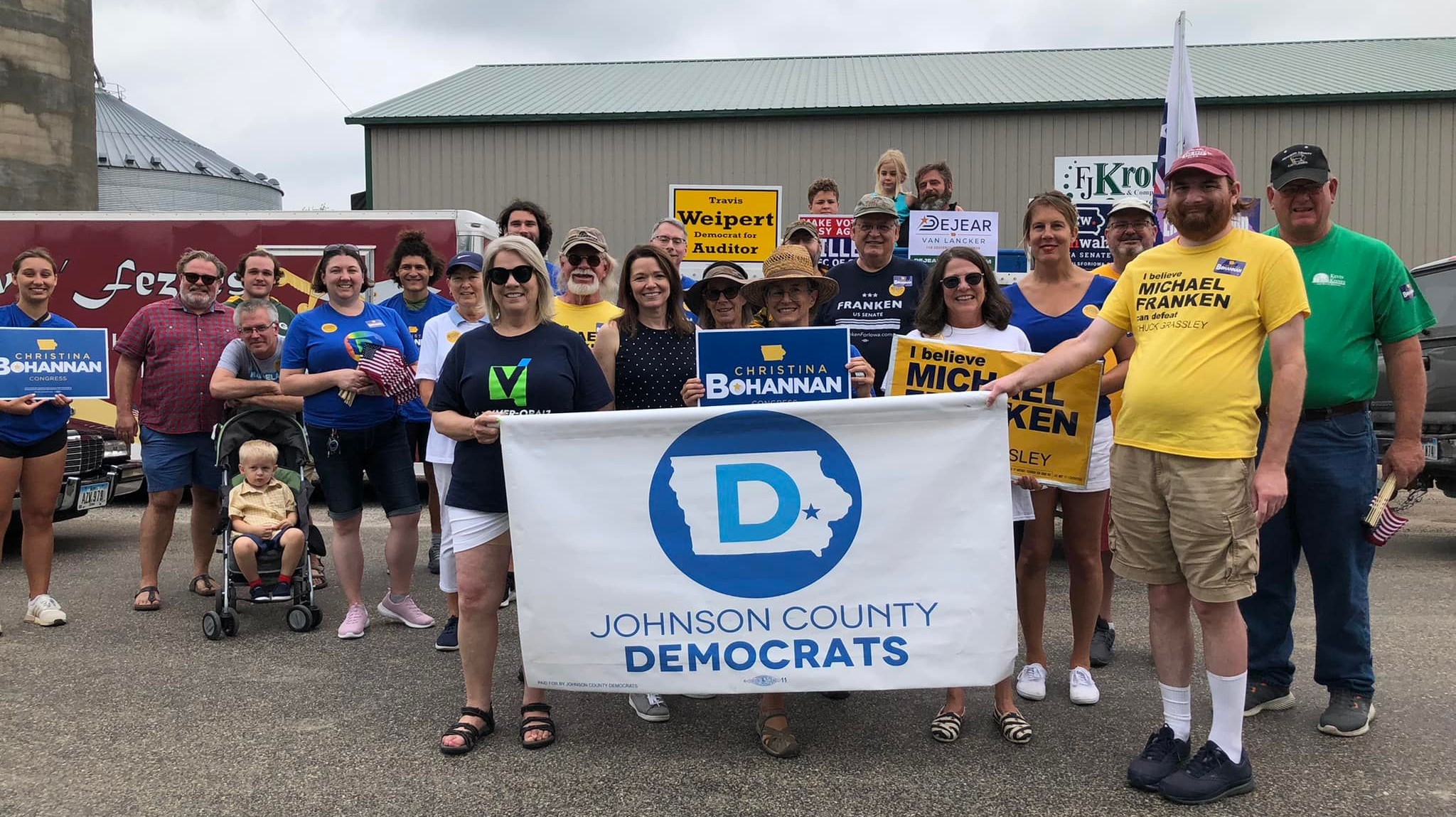
Editor’s Note: On Saturday, May 10, 2025 I was inducted into the Johnson County Democrats Hall of Fame. These are my remarks, prepared for delivery.
Thank you for the warm welcome into the Johnson County Democrats Hall of Fame. This recognition means a lot.
I queried myself using artificial intelligence and the result came back: “Paul Deaton is a long-time Democratic activist and commentator based in Johnson County, Iowa.” I do comment on things. People take issue with some of my comments. In particular, Jeff Kaufmann used to contact me when I wrote about him on Blog for Iowa. After a couple of times, I explained to the Cedar County Republican he was a public figure now and subject to criticism. That was the end of that.
For the rest of my time, I have a few stories.
My father got me interested in politics. During the 1960 election, his union asked him to organize our neighborhood for John F. Kennedy. We moved there the previous year, and didn’t know many people. He did what he knew best and went to his basement workshop to get out his drafting tools. He drew a prototype city block. When he was satisfied with it, he took it to the union hall where they mimeographed copies using that stinky purple ink that was common back in the day. He introduced himself to every person on our block and continued until he had everyone’s information handwritten on his map. While Richard Nixon won Iowa that year, JFK won the general that was enough for our family to celebrate.
During the 1964 election I had a newspaper route. Each week I took the city bus to downtown Davenport to pay my bill. Our family was for Lyndon Johnson. I noticed there were campaign buttons that said “LBJ for the USA” on them. One Saturday after paying my bill, I went to the Democratic Headquarters and asked for one. They said no, you must do something to get one of those. Undeterred, we negotiated and agreed I would stuff envelopes, then they would give me a button. Thusly, I worked on my first political campaign. When LBJ won in a landslide, I just figured Democrats would prevail the same way in every election thereafter.
I was not a fan of Jim Leach. After his House Banking Committee convened Whitewater Hearings in 1995, I was outraged after watching the proceedings on television. The more I watched, the madder I got. Leach was the worst for overseeing that sham inquiry.
When I reactivated in politics during the 2004 election, I felt Leach had to go. In 2006, Dave Loebsack announced for Congress and I wanted to help. One night a week I drove from work in Cedar Rapids to Iowa City to do whatever was needed to help Dave win. Typically, Tyler Wilson was there alone when I arrived in the dimly lit office.
I’d ask, “What can I do to help?” Wilson would point at a tall stack of paperwork and say, “These people need to be called.” I called until it became too late to call any longer. I learned from these phone calls the worm was turning on Leach. I didn’t need to do any convincing. Most people to whom I spoke felt like I did and some were switching their vote from Leach to Loebsack. As we all know, Dave won the election. It was a big deal.
During Loebsack’s first campaign I got involved with something called “Rapid Response.” Trish Nelson and Ellen Ballas recruited me to join them. They are here tonight. Coming out of the Howard Dean campaign, the idea was to read the news and quickly respond to Republicans using letters to the editor as our medium. We latched onto an issue which Ellen dubbed “faux headbands.” These were made of a single feather and a headband, what white people conjured as representing “Indian.” We wrote letter after letter about Jim Leach’s use of faux headbands in district parades. Clearly, we embarrassed Leach into stopping his racist practice and that was our goal all along. His campaign responded to our relentless barrage of letters: “In respect to your concerns, we decided not to distribute them in the future.” Can you trust Republicans? Our friend Dave Bradley recounted a story about the 2006 Wilton parade at the end of summer.
Leach had said they would no longer hand them out, but they did. They were behind us in the parade, so we had no idea what they were doing. When we got back to the staging area, I walked a block or two to see if there were any headbands. I found three right away, picked them up, and returned to help take our float down.
Just then the Republican float rolled into the staging area. They saw me with my feathers and scattered like chickens in a thunderstorm. Leach, State Senator Jim Hahn, Jeff Kaufmann and all the others running like they had seen a ghost. One guy saying he was going to beat the hell out of me, but he was running away. What a memory.
One last story.
The town of Stanwood, population 673, was in our district in 2012. If you’ve never been there, it has a post office, a library, a school, a manufactured home transporter, a pallet supply company, and Ditto’s Family Restaurant. If you are a doomsday prepper you would fit right in as some houses had firewood stacked to the second story. If you are into the Confederate flag, one was displayed in Stanwood, which no one seemed to mind. It was a picture of a newly emerging America. It was and likely still is a rough place like so many small Iowa cities.
When the next person on my walk list was an octogenarian Democrat I felt we would have a good conversation. I knocked on the door and the voter rushed out on the porch and without acknowledging me said, “Did you see what Obama just did?” No, I hadn’t. He told a lengthy tale of woe before I determined he must have been watching FOX News or listening to Rush Limbaugh. I don’t recall what upset him, yet I assured him what he heard was not true. The moral of the story is right wing media was affecting voters in a way I couldn’t counter at the door. I realized then how important media reform was to our political movement. Much more important than door knocking friendly neighborhoods.
Thanks again for the recognition. I am slowing down a bit these days yet will always be looking for something useful to do.
Photo by Jessica Lewis ud83eudd8b thepaintedsquare on Pexels.com
It’s time to shift gears and focus on getting the garden planted. That means my long streak of daily posts may break. I’m okay with that.
The rest of May will be devoted mainly to gardening.
Making a daily post to prime the writing pump has worked. I added 20,000 words to the book draft since the streak began. Thing is, if I don’t get a garden in in May, there won’t be much of one.
So, shovel in hand, off I go. I hope to get the work done so I can return to posting more regularly.
Editor’s Note: This is a work in progress for a chapter in my autobiography titled Toward a Kitchen Garden.
Mother was a good cook based on the meals she served us while growing up. She took home economics in high school yet learned most of her skills related to cooking at home. She would make dishes for Father that reminded him of his southern roots, like creamed beef on toast. I remember her meatloaf served with mashed potatoes and a vegetable, her beef soup served on rice, and carrots and peas. The meatpacking plant where Father worked had a full-service butcher where employees got a discount. There were experiences with organ meat (kidneys and liver) which was inexpensive. This suggests a mostly meat as the main dish diet.
Mother was the first woman I knew who prepared tacos in her kitchen. In retrospect, a contributing reason she took up this dish was the introduction of pre-packaged tortillas and other “Mexican” ingredients into our local grocery store before the advent of Mexican food sections like one can find at a supermarket today. It was another chance to use many ingredients normally found in her pantry to make something different and special.
When we ate outside food, Chicken Delight was walking distance from our home. I remember ordering take out or delivery pizza from them more than chicken. When we ate out as a family, it was at a restaurant like the Bell Eat Shop where I mostly ordered a hamburger and fries. We had a long tradition of dining at Riefe’s Restaurant. Smelling their kitchen from our rented home across the alley is one of my earliest memories. Eventually, each of these restaurants closed, with Riefe’s closing permanently on Dec. 23, 2015.
Those things said, I do not have strong memories of what or how Mother cooked, or about what food I ate before leaving for university. Mother kept me out of the kitchen while she was cooking and brought serving dishes to the dining room table where the family gathered for a meal. I did not develop an interest in Mother’s recipes.
I began cooking in my junior year at university. I lived in a trailer home with my high school friend Dennis and tried various dishes to save money and avoid eating out. I tried baking bread and didn’t understand how yeast worked. I used the resulting loaf as a door stop for a while. What food I made during the rest of my undergraduate years is lost in history.
At some point I learned to make tuna and noodle casserole. I served it to Mother before leaving for military service, and then when I had some friends over to my apartment in the military. I liked the taste of it, yet it was not a sophisticated dish. It was what I knew how to make.
Perhaps my most influential culinary experience was in South Georgia. I worked on a logistics project in Ochlocknee in 1997-98. I decided to stay in the nearby county seat at a motel with cable television—a needed escape after working 14 to 16-hour days. I had access to cable television’s TV Food Network.
I developed an insatiable curiosity about food and its preparation. Emeril Lagasse, Mario Batali, Susan Feniger, Mary Sue Milliken, Julia Child and others prepared food on screen, and I was captivated, watching episode after episode on Georgia weekends. Food is a common denominator for humanity, and I couldn’t get enough. My involvement in the local food movement today has its origins in the contrast between that uninviting place in South Georgia and my food escape. There is a broader point to be made than one person’s transient addiction to a television network while away from home. It is that American food pursuits, and the economy around them, continue to be based partly upon curiosity.
It seems clear that American curiosity about food and food preparation drives what we find in markets. It is a commonplace that corn syrup can be found in every aisle of a traditional mega mart, but it is the endless combinations of diverse ingredients that attract our attention then get us to buy. By developing and marketing new things—for example, quinoa mixed with chocolate or chicken, troll or pole and line caught tuna, gluten and GMO free products, and a host of others—purveyors of the consumer economy seek to engage us through the current sales cycle. I suspect we will stop buying at some point, returning to staple foods, or moving on to what the food marketers deem next.
I began using a process I now call “improvisational cooking.” What does that mean? There are two broad categories of cooking. Most regular dishes and meals allow for variation in taste, ingredients, seasoning, and cooking methods. Others, like baking, do not. It’s what I’m doing today, and I believe how many Americans organize their cuisine. It means creating a food ecology from which I pull in elements from our garden, local farms, and area markets to prepare meals based on what’s readily available.
Occasionally I purchase items on-line or via snail mail when I want something that’s not locally available. For example, I recently bought bags of dried Mexican-grown Guajillo chilies and Mexican oregano on-line. At the end of my cooking day, it is a never-ending process that produces, as Tamar Adler called it, “an everlasting meal.” Exploring the symbiosis between traditional and improvisational cuisine is a popular topic when talking to friends and neighbors about cooking.
Improvisational cuisine draws from the broader society. For example, when I make tacos today, typically for breakfast, they are more improvisational than Mother’s were, but use some of the same techniques. I buy raw flour tortillas to cook as I need them and occasionally make my own with corn Masa. The tortilla is a delivery system for a pan-fried amalgam of fresh vegetables, herbs and spices, a sauce, and protein topped with salsa or hot sauce, fresh tomatoes in season, and a form of soft cheese. It is a recognizable dish even though the ingredients vary from day to day and from season to season.
I do use recipes. My go-to recipes are memorized or written in a red spiral-bound notebook I bought on vacation in Stratford, Ontario. In the back I put a few loose-leaf handwritten recipes from Mother and my maternal grandmother. My go-to cookbooks are Julia Child’s Mastering the Art of French Cooking, Joy of Cooking by Marion Rombauer Becker, and a couple of others. I am downsizing my collection of hundreds of cookbooks yet kept three shelves on display in my writing area. The influence of Mother and Grandmother is more one of technique rather than a particular dish.
An example of a cooking book I read cover to cover is Tamar Adler’s An Everlasting Meal: Cooking with Economy and Grace. More than anything, she presents a narrative about cooking that goes beyond a single meal or dish to how we connect them together. I also read Anya von Bremzen’s Mastering the Art of Soviet Cooking: A Memoir of Food and Longing. Again, for its narrative more than cooking tips.
I studied church and organizational cookbooks extensively. I adopted very few recipes from them. I keep cookbooks that have some sentimental value, ones in which recipes by friends appear, and a set of a dozen or so from my old neighborhood in Northwest Davenport. The purpose of acquiring these cookbooks has been to understand the development of kitchen cookery beginning in the 1950s and ’60s. People used a lot of gelatin and lard back in the day, that’s for sure.
There is a lot of good stuff in cookbooks, although a lot of repetition as well. Over the years I’ve been enthusiastic about certain chefs — Child and Rombauer Becker, Rick Bayless, Mario Batali, Giada De Laurentiis, and Tamar Adler. I’m hoping to find new inspiration in Anthony Bourdain, José Andrés, Sally Schneider and Nigella Lawson. In any case, the result I envision is a new repertory of about 25 main course recipes that have predictable nutritional value and can be made with mostly local ingredients. I also hope to learn new ways to prepare vegetables. Whatever I learned from studying cookery reduces itself into repeatable main dishes made using understandable preparation techniques. A family only needs so many recipes.
I am now lacto-ovo-vegetarian which requires and fosters a constant dialogue about nutrition, cooking, ingredients, flavors and diet. Being vegetarian strips away most traditional dishes, like the ones I ate while growing up. Occasionally we mimic meat dishes in our household with the growing number of manufactured meat substitutes. If we make a pie chart of our diet, those meat substitutes would occupy a tiny slice. I have also been diagnosed as diabetic, which means closer monitoring of blood sugar as well as related dietary changes.
The cuisine we developed in Big Grove Township focused on techniques to use readily available ingredients to make repeatable dishes. We used to regularly eat pasta, pizza, macaroni and cheese, bread, chili, soup, casseroles, toppings with rice, and manufactured non-meat burger patties. Fresh and frozen vegetables are basic. Fruit is seasonal and desserts infrequently made or purchased. With my spouse becoming vegan, elimination of dairy products became my newest learning opportunity as a cook. I continue to develop that list of 25 main course recipes.
When the garden comes in vegetables dominate the plate. Tomatoes are a favorite and we have fresh with most meals while they last. When lettuce comes in, we make big salads for dinner. For the time being, I don’t bake bread very often, eschew meat and meat products, and use only a few manufactured products for their ease and serviceability within the context of our cuisine.
Most nights it’s easy to get a meal ready for dinner. Our repertory includes easy and complex dishes which satisfy if done right. I prepare dinner for both of us four or five nights a week and we are on our own for breakfast, lunch and snacks. It works.
If we are serious about sustainability and local food systems, we must get beyond curiosity, and distraction from the challenges of a turbulent world. We must get to the production of things that matter in our lives on the prairie. At some point during the last ten years my talk about a “local food system” became talk about a “kitchen garden.” The goal of having a kitchen garden is to produce food aligned with our culinary habits that helps meet a basic human need. We have to eat. It may as well be enjoyable. We’ve all eaten our share of food that doesn’t please our palate. A kitchen garden should address that.
A kitchen garden is a reaction to the culture of consumerism. An important distinction is reaction, not rejection. I will continue to buy black peppercorns, nutmeg, vanilla bean extract, refined sugar, and all-purpose flour milled elsewhere. How else will we get such necessary ingredients?
While I am a local foods enthusiast, and my diet centers around being that, I am not doctrinaire. Other people must consume the results of my kitchen work. Despite several issues with his behavior and written output — including bigotry, racism and patriarchy — I like the Joel Salatin idea of a food shed. That is, secure everything one can that is produced within a four-hour drive of home. I am also not doctrinaire about “food miles.” I’ve written often on the topic and if we work at it, we can secure most of our food produced within less than an hour’s drive from home.
For the time being, I’m mostly ovo-lacto-vegetarian, which means consumption of dairy products and the good and bad that goes with them. I’m not of one mind on this. For example, I’ll buy a gallon of skim milk from the local dairy 6.2 miles from my house, yet I’ll also stock up at the wholesale club for half the price. I take local eggs from the farm when offered, yet I also buy them at the club. Maybe it’s best to become vegan and eschew dairy altogether. I’m not there yet.
In a free society, people should be able to do what they want with only minimal restrictions to protect the commons. In our consumer society, that is a joke. For a local food system to be sustainable beyond the initial curiosity of trying it out, something fundamental must change. It is a need— perceived or real— to change from the act of consuming to the act of production. That involves a lot of hard work, and I’m not sure it could be done in the current society.
In my kitchen garden cooking remains a work in progress.
Nate Willems announces campaign for Iowa attorney general
Willems, who has spent his career fighting for working families, pledges to protect community safety and hold corporations that rip off working families accountable
MOUNT VERNON, Iowa – Nate Willems, a lifelong Iowan and attorney who has delivered wins for tens of thousands of Iowa workers, released the following statement announcing his campaign for Iowa attorney general:
“Iowans deserve an attorney general focused on protecting Iowans and standing up for our fundamental rights and freedoms. As attorney general, I’ll work to keep communities safe by holding violent criminals accountable and I’ll take on corporations who try to rip off Iowans by price gouging or stealing their hard-earned wages.
“I’ve spent my career representing tens of thousands of Iowans who have had crimes committed against them. I’ve successfully taken on corporations who think they’re above the law and steal wages, require off-the-clock-work, hurt their employees, or violate the rights of working men and women in our state. As attorney general, I’ll fight to make sure every Iowan gets the justice they deserve. I’ll work with law enforcement and local prosecutors to secure convictions for violent criminals, restore consumer protections, and give working families the voice they deserve.”
Representing working families, Nate has witnessed firsthand how some corporations steal Iowans’ wages, force overtime work without pay, misclassify their work to cheat them out of benefits, and make it tougher for Iowa families to succeed. With prices soaring, Iowans can’t afford to have their hard-earned money stolen by big corporations. That’s why he has taken on greedy corporations for those Iowans and won. He has secured historic victories, including recovering $15 million for 11,000 current and former hospital and clinic workers in Iowa, $1.7 million in backpay for custodians, and won the largest collective bargaining wage increase in Iowa history on behalf of local police officers in Carter Lake, among countless other victories across the state.
Nate was born and raised in Iowa, growing up in Anamosa where his father worked as a Main Street attorney and his mother was a public school teacher. Today, he’s proud to call Mount Vernon home where he lives with his wife Maggie, a local public school teacher and state champion-winning volleyball coach, and their three daughters.
Nate has always been driven toward public service and determined to make our state and community stronger. As the state’s largest law firm dedicated to serving the people, the Attorney General’s office has an opportunity to take on and solve serious challenges. As Attorney General, he will work with prosecutors and local law enforcement to secure convictions for violent crimes, improve consumer protections, and hold corporations accountable when they break the law.
Previously serving two terms in the Iowa House of Representatives from 2008 to 2012, Nate fought to ensure every Iowan could access a quality public education, find a good paying job, and passed key legislation to strengthen the rights of Iowa workers. Since 2010, he has been a full-time labor lawyer and partner at Rush & Nicholson, P.L.C., in Cedar Rapids, the state’s largest workers’ compensation firm. (Willems for Iowa press release, May 7, 2025).
Brief CV from Rush & Nicholson website:
“I put on my law school application that I wanted to represent Iowa labor unions and their members. I feel as strongly about that today as I did 14 years ago but have added representing injured Iowans, victims of wage theft and wrongful termination to my practice. I am only a lawyer because it allows me to go to work every day to represent people who genuinely need help.” (Rush & Nicholson Lawyers website).
Career Highlights:
Practicing law since 2007.
Member of the Iowa House of Representatives (2009-2013).
Legal specialties: employment law, labor law, wage and hour, and workers compensation.
Community Involvement:
First Presbyterian Church of Mount Vernon Church (Session Member)
Hawkeye Labor Council Executive Board
Linn County Democrats Central Committee
Professional Associations:
Iowa State Bar Association
Linn County Bar Association
Education:
J.D., University of Iowa College of Law, 2007
B.S.F.S., Georgetown University School of Foreign Service, 2001
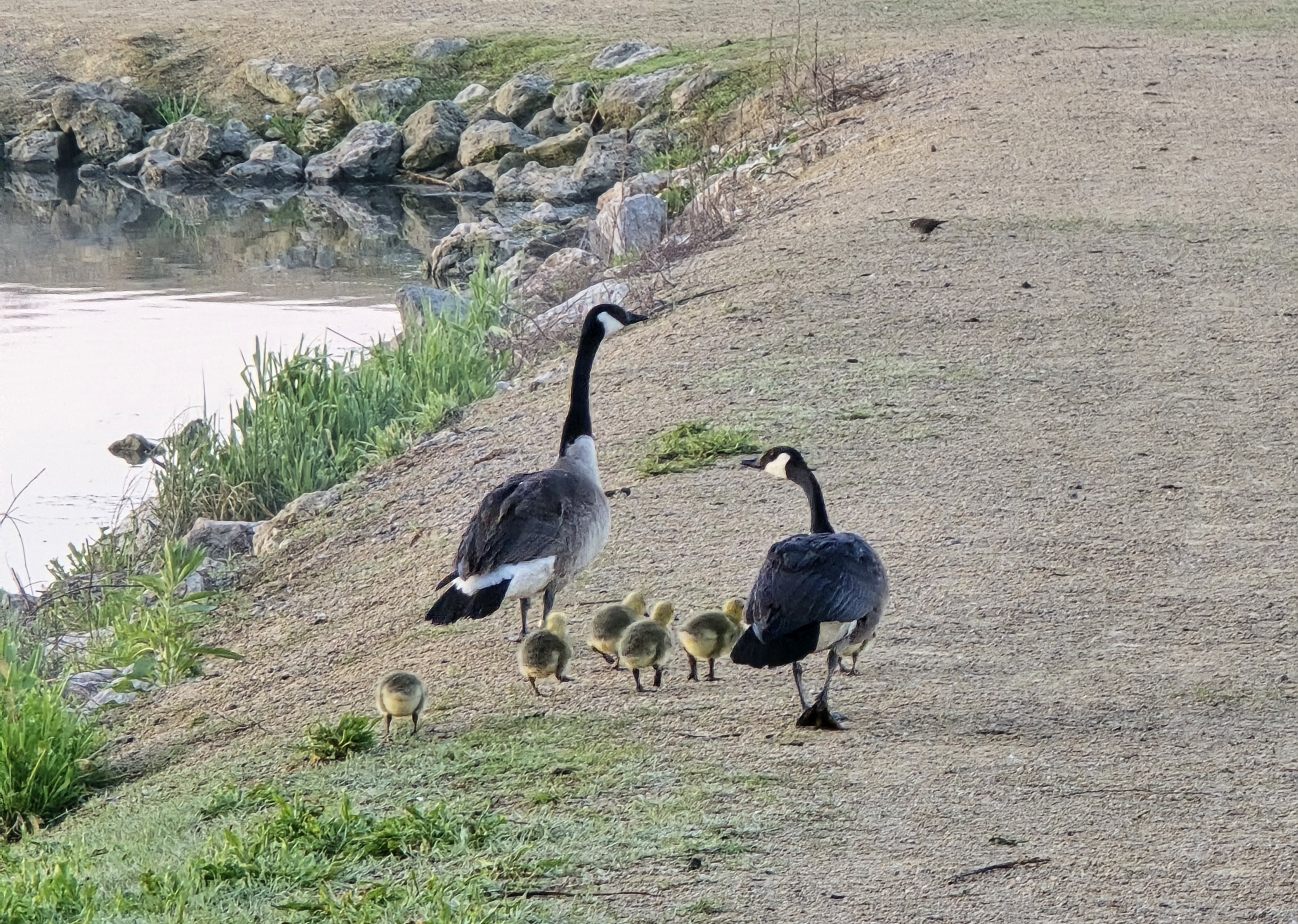
Saw this family on the trail Tuesday morning. Spring is definitely here!
Our family was discussing whether or not to stock up on things we commonly use like toilet paper, dried pasta, canned beans, rice, tomato sauce, water and coffee. I hear there may be shortages due to the president’s trade policies. The way we provision in normal times is to constantly have a buffer of pantry items on hand in case we can’t get to the store for a couple of weeks. We didn’t go crazy, yet we won’t run out of toilet tissue or pasta any time soon.
The Congress delayed markup of the reconciliation bill until next week. Bits and pieces are becoming known with the biggest question being what they will do with Medicaid. I wrote Rep. Mariannette Miller-Meeks Tuesday afternoon:
I urge you to avoid changing Medicaid using the reconciliation process. Everyone knows Medicaid reforms are needed. Any changes in Medicaid should be accomplished in regular order in a bipartisan manner. Thank you for reading my email.
At 3:04 p.m. the same day her office responded as follows:
Dear Mr. Deaton, Thank you for contacting me to express your support for Medicaid. Views from fellow Iowans help inform and guide me in Congress, so I greatly appreciate your insight and opinion.
As a physician and former Director of the Iowa Department of Public Health, I understand the crucial role healthcare plays in our lives. I am committed to working with my colleagues in Congress to ensure that state Medicaid programs have the resources they need to help people in need while ensuring the long-term financial viability of this necessary healthcare program.
To that end, I have been working on legislation that will strengthen and streamline Medicaid, such as:
H.R. 1019, the Medicaid Program Improvement Act, which would improve the accuracy and reliability of address information for Medicaid beneficiaries, ensuring seamless access to healthcare services while reducing the chances of people being enrolled in multiple state Medicaid programs.
H.R. 1509, the Accelerating Kids’ Access to Care Act, which would streamline the process for out-of-state pediatric care providers to enroll in another state’s Medicaid program to reduce care delays, while also safeguarding important program integrity measures.
In Congress, I will continue fighting to ensure Iowans have quality access to healthcare.
Thank you again for contacting me. If there is anything I can do to be of assistance, or if you would like to receive my e-newsletter, please visit MillerMeeks.house.gov. You can also follow me on Facebook at facebook.com/RepMMM and on Twitter @RepMMM. Again, I thank you for your opinion and look forward to serving you. Please do not hesitate to contact my office in the future.
She didn’t really address my concern, yet at least someone in their office noted my email. Not holding my breath about “regular order.” Guess we’ll just have to wait and see what kind of partisan cuts Republicans will make when the markup is finished.
I may need another walk along the state park trail.
There is a golden spring season from the appearance of first buds to full leafing out of deciduous trees, flowers, and bushes. Later in May, insects descend upon us and start spoiling the pure beauty of trees especially, but every living plant in our yard. A gardener does the best they can to keep them away from the good stuff. The fragrance and beauty of lilacs is a fleeting spring pleasure.
Spring shows us where nature is if we have the eyes and mind to see it. Our Autumn Blaze maple tree was damaged in the 2020 derecho, and the years since then have taken their toll.The bark is shedding around the main trunk, and there are cracks in the trunk where the derecho twisted the tree around in high winds. I suppose insects crawled into the cracks. The tree can sense something is wrong and this spring grew many more seeds than used to be normal. Their presence indicates the trauma of the derecho and that something is wrong so it needs to propagate. While I may have to climb up on the roof to clean the windblown seeds out of the gutter, the true meaning is that the time left for this tree is limited.
Autumn Blaze Maple tree with seeds on May 5, 2025.
I planted two Green Ash trees before the Emerald Ash Borer was known in popular media to be a threat. The first one succumbed last year and the second did not leaf out this spring. I examined the tree trunks and branches and the tell-tale boring holes where the insects enter underneath the bark are evident everywhere. Luckily the trees are small enough I can remove them myself.
We enjoy the lilac flowers while we can. They are truly a spring blessing.
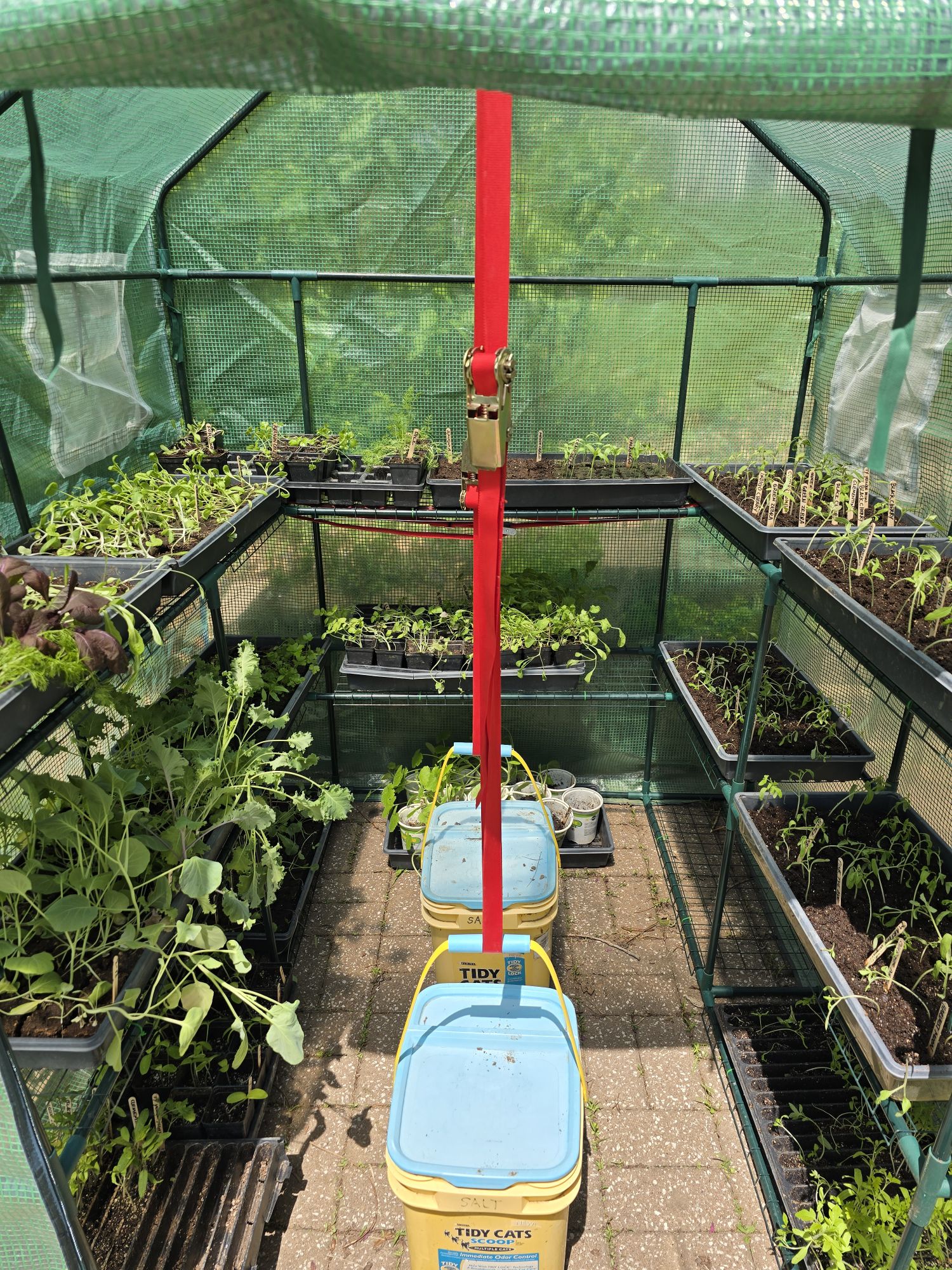
Over the weekend I assembled the greenhouse, moved trays of seedlings from inside the house, and transplanted tomato starts from channel trays into full-sized blocks. I feel I am way behind on the garden, yet things are moving.
The first day outside is always dicey for the seedlings. It is plenty warm, but the direct sunlight can be strong on them. Lettuce is wilting a bit. I make sure the trays are well watered and cross my fingers, hoping they will recover overnight. I’ll have a better idea how everything went at sunrise this morning after ambient overnight temperatures were in the 40s.
The tray of cruciferous vegetables, kale and collards, is ready to go into the ground. The plot is cleared so I just need to turn it over, fertilize, till the ground, lay down sheets of garden cloth and plant. “Just” is doing a lot of work in this paragraph.
While I enjoy watching seeds grow into vegetables and fruit, I have been less enthusiastic about the garden this year. I plan to cut back by two plots, leaving five. When time allows, the plot by the compost bins will be converted into some kind of storage. In time, I may put up a shed for garden tools. I plan to take better care of the plots that are in production.
I am hoping to get a crop, yet also cut back on the number of varieties. I grow what I can use in the kitchen-garden rather than production of the most produce possible for its own sake. It has me looking at things differently. Any more, I put up tomato sauce and pickles in canning jars and freeze leafy green vegetables to use until the following season. If I have a big garlic or basil crop, I make pesto and freeze pureed garlic and olive oil.
I had a pain in my left hip for the last couple of weeks. Today, I relented and took two ibuprofen after breakfast. It worked. I was able to get through a four-hour shift of loading the greenhouse. I don’t like taking pain medication, but after today’s experience, I might do so again. I find it is a gardener’s friend.
I tried using Google’s Gemini artificial intelligence query for the first time last week. Then I tried ChatGPT. This post is about what the ai software returned with a query of “Tell me about Paul Deaton Johnson County, Iowa.” The responses are at the bottom of this post, yet I think my commentary may be more interesting.
Because of the way responses were written, combined with the fact I don’t have my defense shields up, I’m inclined to believe what I read. The ai software is taking advantage of my naivety. In a text world environment, my default belief is a human has written the text. That’s not at all true with ai software. While most sentences are well-composed, the smooth narrative hides all the stuff that is missing from real life as if it doesn’t exist. It’s a superficial answer to my query.
Naturally, some statements are completely wrong. In particular, I have not lived my whole life in Johnson County. ChatGPT is particularly bad here, saying, “has resided there for over 25 years, living in Iowa City, North Liberty, and currently in Swisher.” I have lived in Johnson County for more than the last 25 years, yet in none of those cities.
Both ai software queries picked up that I worked on Lyndon Johnson’s 1964 campaign. I Googled “Paul Deaton Lyndon Johnson” and found the ai software likely learned this from Bleeding Heartland or the Cedar Rapids Gazette, although I mentioned it many times in public spaces. ai software only picks up stuff that is prominently and publicly available on the internet, apparently. Bleeding Heartland is the source of multiple data points in the queries. I write more about myself on this blog and Blog for Iowa than I have on Bleeding Heartland. ai software appears to be cherry picking information that is most easily available.
There was no apparent reference to the 100 newspaper articles I wrote that were published in Johnson County for the Iowa City Press Citizen, the Solon Economist, and the North Liberty Leader. They weren’t the stuff of Pulitzer Prizes, yet they exist. Likewise, with the exception of Veterans for Peace, there is no mention of the many peace and social justice organizations for which I volunteered. Absent is any mention of working on the campaigns of Dave Loebsack, Rita Hart, Christina Bohannan, or several presidential candidates for whom I wrote letters to the editor. The reason VFP is prominent we made a diligent effort to make sure we were covered by traditional news organizations. That effort got picked up by ai software.
I find the main problem is a bias towards present-day points of view and internet exposure, also called presentism. There is a pronounced tendency to interpret the query in terms of what’s available right now in certain places. While the ai software states some facts about me, there is no deeper analysis. They editorialize in a way that wants to stroke the “Paul Deaton” ego without knowing anything in depth about them. If news organizations are using this kind of ai software to write articles, heaven help us: it is not news.
Here are the query results. I’d be interested in your comments about using ai software.
First, Gemini:
While there isn’t extensive information readily available about a “Paul Deaton” specifically tied to Johnson County, Iowa, several mentions suggest he is a politically active individual within the Democratic party there.
Here’s what the search results indicate:
Active in Johnson County Democrats: Paul Deaton is identified as a “lifelong Democrat living in Johnson County” and a “Democratic activist.” He was even inducted into the Johnson County Democratic Party’s Hall of Fame in 2025. This indicates a long-standing and significant involvement in local Democratic politics.
Political Commentary and Blogging: He is an author at “Bleeding Heartland,” a progressive Iowa politics blog, and also contributes to “Blog for Iowa” and his own website, “Journey Home.” His writings cover a range of political and social issues in Iowa and beyond. Recent topics include reflections on Armistice Day, analysis of Iowa politics, and book reviews.
Early Political Involvement: His first political work was reportedly for Lyndon Johnson’s presidential campaign, suggesting a long history of engagement in Democratic politics.
Views on Policy and Politics: Based on his writings, Deaton appears to hold progressive views. He has discussed topics such as water quality in Iowa, the challenges facing the Iowa Democratic Party, and the importance of political engagement. He seems to prioritize policy alongside political strategy.
Local Connections: He has been involved in local events, such as Armistice Day observances in Iowa City, and has connections with other local figures involved in politics and community initiatives. For example, he mentioned meeting Maureen McCue when they were both on the Johnson County Board of Health in 2006.
In summary, Paul Deaton is a long-time Democratic activist and commentator based in Johnson County, Iowa, with a history of involvement in local and state-level politics and a progressive viewpoint reflected in his writings. (Results of a Gemini query, May 3, 2025).
Now ChatGPT:
Paul Deaton is a prominent figure in Johnson County, Iowa, known for his extensive involvement in journalism, activism, and local politics.
Background and Community Involvement
Originally from Davenport, Iowa, Deaton moved to Johnson County for college and has resided there for over 25 years, living in Iowa City, North Liberty, and currently in Swisher . He is a lifelong Democrat, with his political engagement dating back to the Lyndon Johnson presidential campaign.
Deaton has served on the Johnson County Food Policy Council from 2016 to 2020 and was a founding member of the Iowa chapter of Veterans for Peace . He has also been active in organizing political events, such as candidate meet-ups in Solon.
Writing and Journalism
As a journalist and commentator, Deaton contributes to various publications, including Blog for Iowa , Bleeding Heartland , and The Gazette. His writings often focus on political analysis, book reviews, and social issues, reflecting his commitment to progressive causes.
Advocacy and Public Engagement
Deaton is actively involved in advocacy, particularly concerning peace and social justice. He co-founded the Iowa chapter of Veterans for Peace and has participated in events calling for humanitarian aid and ceasefires in conflict zones. Additionally, he engages in local issues, such as advocating for library funding in Solon, Iowa.
Through his multifaceted roles, Paul Deaton continues to influence and contribute to the civic and political landscape of Johnson County, Iowa. (Results of a ChatGPT query, May 3, 2025).









 Journey Home
You must be logged in to post a comment.