It was 90 degrees Fahrenheit when I finished putting in hot peppers yesterday. With that, the main garden planting is finished. Ahead is maintenance, weeding, and replanting: normal stuff, part of what makes gardening enjoyable.
The next major event is expected to be the appearance of garlic scapes. In the meanwhile, the leafy green vegetable plot has been producing an abundance. I enjoy my afternoon trips to the garden to pick greens for the kitchen.
The portable greenhouse will come down soon. The only things left are a tray of seedlings for the covered row (lettuce, Pak Choi, arugula, herbs), a tray of Milkweed starts, and an experiment in using old onions and leek seeds. It is best to take it down to reduce exposure to high winds in the neighborhood.
I have multiple days of tree maintenance next. The chainsaw service center is relocating due to the City of North Liberty wanting their land. My chainsaw was the next mechanical device to go into the shop, although I am not driving 45 minutes four times to take it there. I may see if Stihl has a reliable electric chainsaw. The home, farm , and auto supply store where I used to work is a Stihl dealer, and remains in the orbit of retailers I visit in person.
Low humidity makes the high temperatures tolerable. From here on out, I expect to spend early morning daylight in the garden and then move to other work. For those who have been following along, I expect to start a daily writing regimen when summer begins next week.
It’s been two weeks since I opened my draft autobiography. With the end of garden planting in sight, it’s time to turn back to that work. When I read what I’ve already written it seems like magic. Who wrote all of that? Me. It was me, as unlikely as that sounds.
There are a few kinds of writing on this blog and I’ll be considering them as I go about another day in the garden. The last few weeks have been what I would call “moment capture writing”: I write about a significant event that happened in a few, brief paragraphs and move on. In many ways, these are my favorite posts to read because they tell of moments in my life that might otherwise be forgotten.
Hannah Ritchie wrote a Substack post called “Under-the-hood of writing on Substack.” In it she opines about the type of writing that’s needed on Substack (or blogs). She wrote:
If you do have some tolerance for criticism and have ideas to share, I’d tell you to consider doing longer-form writing. By “longer-form” I just mean more than social media posts or comments; 1,000 to 2,000 words that lets you craft a narrative and explain your thoughts with nuance.
This reflects my blog-writing approach. I’m almost always working through some intellectual puzzle. More on that later. For the moment I must use the last remnants of a very warm night to take care of indoor chores so I can get out to the garden after sunrise.
This week I grew more lettuce, Pak Choi and greens than we needed to use fresh in our kitchen. I took the excess to a local food pantry where they don’t get many fresh, leafy green vegetables. We growers and donors are asked to arrive on Monday mornings.
I put a followup on my calendar to time my harvests so excess can go directly to the pantry each week.
Our food pantry is located in the basement of the Methodist Church. Each Monday afternoon, the shelves are open for anyone to come and take what they need. The pantry serves a clientele of about 35 food-insecure people. If fresh goods are left at the end of the day, a local food rescue driver arrives and takes them to another food pantry open the next day. It is an efficient system.
From what I hear, my fresh greens are usually popular. I don’t know the clients, and don’t really need to know them to do what I do.
The needs are similar everywhere there are food pantries. Here is the current want list from ours:
Mandarin oranges
Canned tuna and chicken
Pasta sauces
Ramen noodles
Chunky Soups
Peanut Butter
Canned fruit
Kids cereal
Toilet paper
If readers have the means, I encourage you to help your local food pantry. It is something easy to do whether you are a gardener or not.
Thomas Jefferson, Writing the Declaration of Independence by Henry Wolf. Photo Credit – Smithsonian Institution.
In defending her vote for the reconciliation bill working its way through the Congress, Rep. Mariannette Miller-Meeks wrote in her congressional newsletter, “(the bill) delivers real relief, starting with a new $4,000 tax deduction for Americans over the age of 65 who make less than $75,000.”
No senior I know asked for a tax break, especially one for which the federal government will have to borrow some $2.4 Trillion according to the Congressional Budget Office. Miller-Meeks does not understand the needs of constituents.
Most seniors living solely on Social Security, pensions, and savings don’t pay federal income taxes. Especially when we hardly take home enough money to get by.
It is basic household finance to know a person shouldn’t borrow money to pay ongoing expenses. That’s exactly what this reconciliation bill does.
She wrote, “(The tax deduction) leaves more financial breathing room for… helping raise grandkids in tough times.” Helping raise grandkids? She must mean helping train them to be compliant worker bees to repay the loans their forebears took to live on.
There is nothing wrong with Washington, D.C. that removing Miller-Meeks and those like her from office won’t fix. She should not be re-elected.
As summer arrives on June 20th, I think about beverages I seek at least once each year. I hope to change all that and pick something as my standard beverage. That’s what I say at the beginning of each summer.
Diet Coke When I’m at the convenience store playing Powerball, once a summer I pick up a Coke or Diet Coke and drink it. This year it was Diet Coke because I am watching my caloric intake. It will be a cold day in hell when I try another of those. It has no flavor. Coke is not it. If Diet Coke was invented “just for the taste of it,” I don’t know what taste they are marketing. I won’t be yearning for another one of these.
Yoo-hoo A couple times a year I pick up a Yoo-Hoo chocolate flavored beverage at the convenience store. I probably should not. The beverage is made mostly from water, high-fructose corn syrup, and whey. I associate drinking Yoo-hoo with living in the south, yet that makes no sense. It was invented in Garfield, New Jersey in 1928 and has been owned by multiple international conglomerates. In a moment of weakness, I’ll likely have another. It fills a certain niche.
Iced Tea I buy the cheapest black pekoe tea bags and brew a pot of tea in an old Brown Betty. The first glass is poured hot, directly from the pot over ice. By far, this is the most refreshing beverage of summer. I make it a couple of times per summer for the refreshment and the remembrance of summers past.
Lemonade When I volunteered with the home owners association I bought a large container of lemonade mix for our annual meeting and potluck. I never used much of the container and from time to time I make some for myself. It is basically a sugar fix, something I need to watch. I may try making lemonade with Italian Volcano lemon juice. The flavor is great and I can control the amount of sugar.
Jack Daniel’s Old No. 7 Tennessee Whiskey I had a finger of this whiskey in a bottle I bought maybe ten years ago. I finished it off and decided it’s time to eschew distilled spirits unless I am celebrating with friends. It’s intoxicating effect is too much for this aging frame. The other thing is distilled spirits can be very expensive, even at the wholesale club.
Mass Produced Beer I used to buy a case of beer from the wholesale club each summer. I iced the bottles down in a cooler we got for a wedding present, and enjoyed one or two after a hot sweaty day of working outside. They are wanting $30 or more for the brands I like, so that one is getting sanded off in the woodshed. If I have a beer this summer, it will likely be with friends at the site in town where it was brewed.
Iced Water There is still nothing like a glass of water poured over ice. After all the trips down memory lane with the other beverages, I expect this will be the standby. It should be. Filtered water straight from the refrigerator is simply the best.
Editor’s Note: This post is one in a series of quick, short, fill-in posts while I spend most of my time and energy planting the garden. Things are looking good, yet I’m not there yet.
Someday I hope to visit Buffalo Ridge Orchard in Central City, which is near where my spouse’s family settled in Iowa after the Civil War. Their farm store is opening for the season today and this spring truism appeared in their newsletter, “This week we have all the makings for a wonderful salad and charcuterie board. We are well stocked with lettuce, radishes, salad turnips, Milton Creamery cheese, and Over the Moon salami.” While we don’t do charcuterie, the abundance of my garden overfills my salad bowl daily. Our grocer carries a good selection of organic vegetables like cauliflower and cucumbers to fill out the salad. We are living in the best times.
Back to work in the garden today. Hope you are finding local spring produce available where you live.
Editor’s Note: These short posts are intended to help readers follow along while most of my energy is diverted away from writing. Once the garden is in I’ll be back to normal posting.
2025 rendering of the tomato plot. Total 71 cages this year.
Tomato seedlings were in the ground on Wednesday. Every one of them survived until Thursday. So far I don’t need to use the extras I held in reserve. They need mulching, although I didn’t have the energy for it. Once mulched, I’ll install a tall fence to keep deer from easy access.
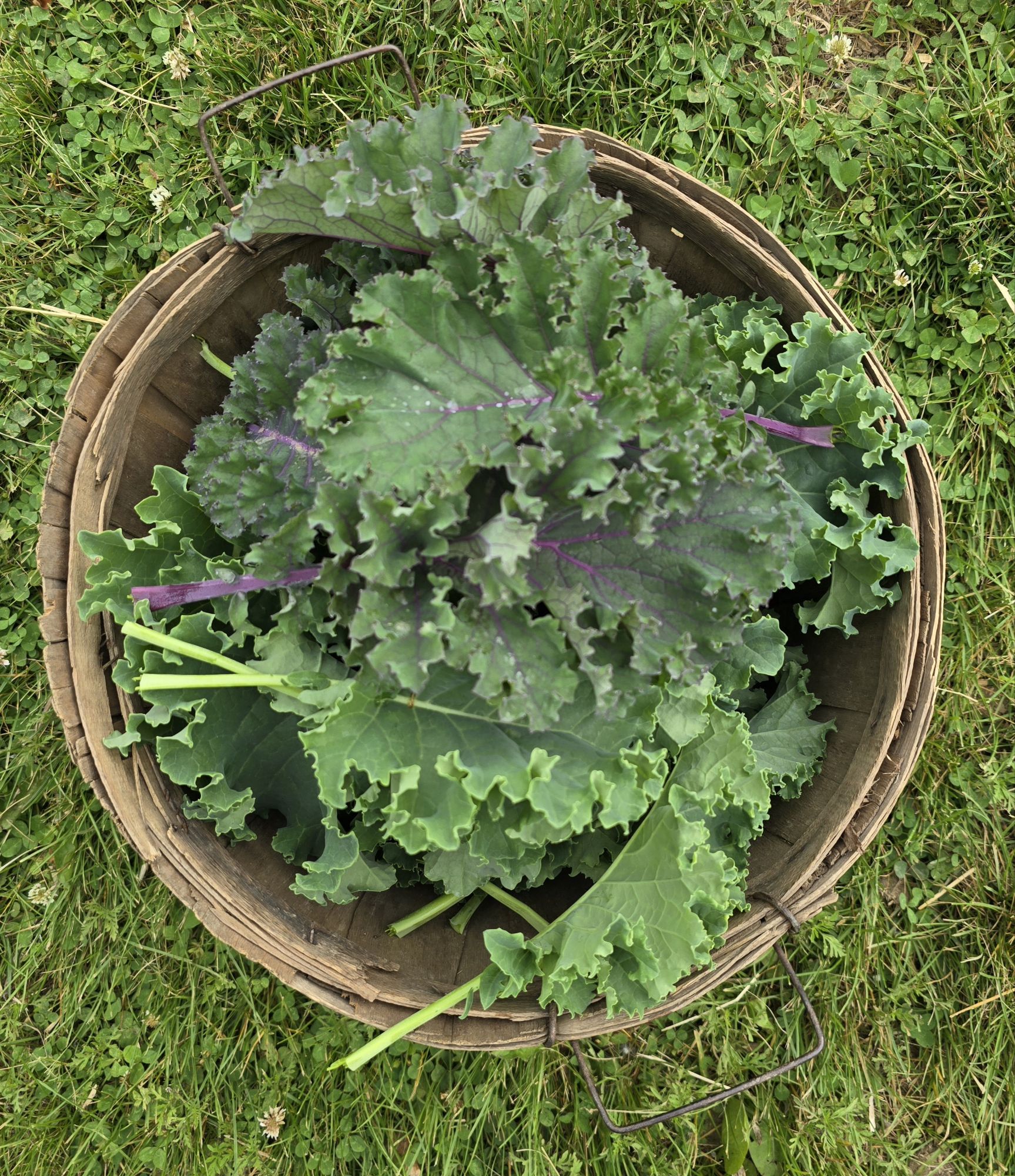
I harvested a passel of leafy greens and spent a couple hours in the kitchen cleaning them. Arugula, three kinds of lettuce, Pak Choi, two kinds of kale, and collards. In my early gardening days I didn’t give much thought to greens. Now, after working eight years on a farm, I couldn’t live without them.
In other news, Thursday night I rejoined the county Democratic central committee. No one else will do the work, so I will until I find someone else.
Editor’s Note: I managed to post every day during garden planting season. Some, like this one, are brief. I’m still distracted from writing by the garden.
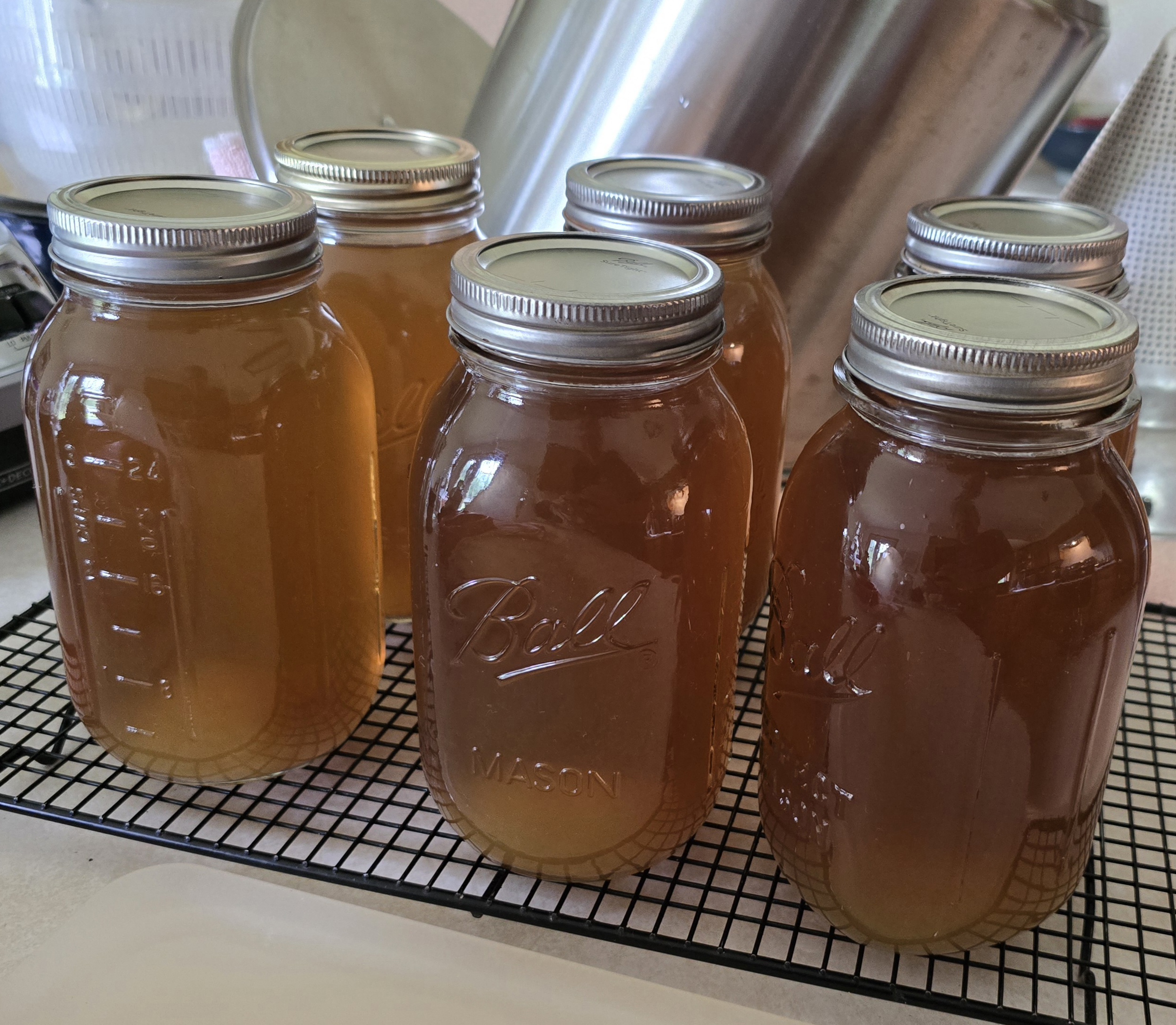
Six quarts of vegetable broth. The spring version helps clean out the freezer.
While working in the garden, hiking on the trail, cooking, or resting, I’m thinking about my return to writing once the garden is planted. It is particularly important to finish the second book this year and then decide whether or not to put both books in places where people can buy them in 2026. Having a schedule is part of the process. Doing the actual writing is another.
I mentioned that a chronological narrative beginning with arrival in Big Grove Township is not appropriate to this part of my autobiography. On May 25, I wrote:
Up to the time we moved back to Iowa in 1993, a chronological narrative seemed appropriate. Beginning here, in this place that was a vacant lot when we arrived, life got complex to an extent a time-based narrative doesn’t really capture those 32 years. There was no single narrative.
There are some stories I want to tell. Family life after the move back to Iowa is important. My work in transportation and logistics after 1993 covered a lot of territory, yet I want to reduce this to some major stories along with a summary of all I did after returning to Big Grove. Work has been important in my life, so a long chapter about that is in the offing. Becoming empty nesters was a profound change and that merits its own chapter. There was a long period when our child lived in Colorado and Florida, which made frequent visits difficult. My work in environmental activism, on the board of health and in the local food system all are worthy topics with personal meaning. When the money ran out in 2013, and how I coped with that seems important. There is a lot here, yet a lot gets left out by covering these topics. Sorting through all this has been on my mind.
Another writing-related thing is answering the question, What to do about Substack? I don’t post frequently there, but when I do, I get a lot of organic views, more than I do here. Now that the print service I was using to make hard copies of this blog went out of business, I haven’t found a suitable replacement, and maybe it is a good time to move. More on this topic as the summer continues.
Editor’s Note: Still planting the garden and making short posts as I can. It won’t be long before I’m back to normal posting.
The Tuesday forecast was for rain… all day. Before it began, I got out in the garden to measure tomato rows and inspect the leafy green vegetables. Little white moths have been busy laying eggs, so once the rain finishes, I’ll apply DiPel to take care of the coming caterpillar hatchlings that love greens as much as I do. Proper application of this naturally occurring pesticide makes a real difference. We need rain.
I picked the first basket of kale before the rain. I reviewed the freezer and there remains plenty of 2023 crop. I’ll take bags that have the largest number of ice crystals and use them in vegetable broth. There are plenty of other bits and pieces in the freezer — broccoli stalks, summer squash, and collards — that will all go into the pot. I bought a big bag of organic celery, seven pounds of organic carrots and a big bag of yellow onions at the wholesale club. Add bay leaves and a little salt and I’ll have a good spring batch of broth for water bath canning.
It looks like 70 tomato cages will fit, with enough space around them to get at them for harvest. Now it’s a question of when the rain will finish. It’s always something.
Editor’s Note: I’m still working with short posts until the garden is planted. Won’t be long.
The garden soil is well conditioned and breaks up easily while using a rototiller. I move slowly through each row and take in the smells of this fertile soil. I probably shouldn’t breathe in the fine particulates, yet the scent of the earth is intoxicating… I can’t help myself.
The only way I can coax my 73 year old frame to do the work is to move slowly and take frequent rest periods. Basically, I till a couple of rows and take a seat on my tree stump for five or ten minutes. A couple more, then I go in the house and get a drink of water. It takes longer this way, yet I am in this for the long haul and want to live to have many more gardens. According to the Social Security life expectancy table, that means 11 or 12 more gardens if my strength holds.
Ambient temperatures got up to 90 degrees Fahrenheit, so I called it quits as soon as I tilled the whole plot, put down fertilizer, and raked it all in. Hot weather is forecast for Tuesday, so I’ll be up early getting tomato seedlings in the ground soon after sunrise.
Editor’s Note: Still short posting while I work on the garden. About another week to go before the main planting is finished.






 Journey Home
You must be logged in to post a comment.