An early reader of my autobiography asked about this paragraph.
When I was born, Davenport was already a tired town. I hadn’t realized it, of course, because my family life was positive and supportive. I felt I could be anything I wanted, and this notion was reinforced once I started school. I grew up in a time of hope, despite challenges. We had vague knowledge of Davenport’s beginnings. I came to believe while being from there, I was not of there. (An Iowa Life by Paul Deaton).
“I am most surprised by your statement that you did not believe you were ‘of there.’ Looking for more explanation here,” they wrote.
In response, I wrote:
My mother and father brought a defined culture with them when they moved to Davenport and I was born. I came up in that culture, which for Mother was based in rural Illinois where she was born, and for Father, it was in western Virginia. In going through the history for this book, it occurred to me that I did not experience any culture indigenous to Eastern Iowa, but rather what my parents brought with them and lived. Yes, I was from Davenport, but not a person who grew up in a culture that was local. I contrast that with Provincial France where people are a literal extension of the soil, the sea, and the air. Mine was a distinctly American experience. (Letter to a friend, Sept. 6, 2025).
When I re-write the book, which I will once its companion is finished, I plan to add this explanation. As long as we live in a consumer society where the work to produce our lives lies in places, corporations, and people with whom we have no relationship, except for a commercial transaction, we cannot be of there, much though we yearn to be.
As the garden turned from tomatoes to apples, I captured plenty of images. Here are some of them.
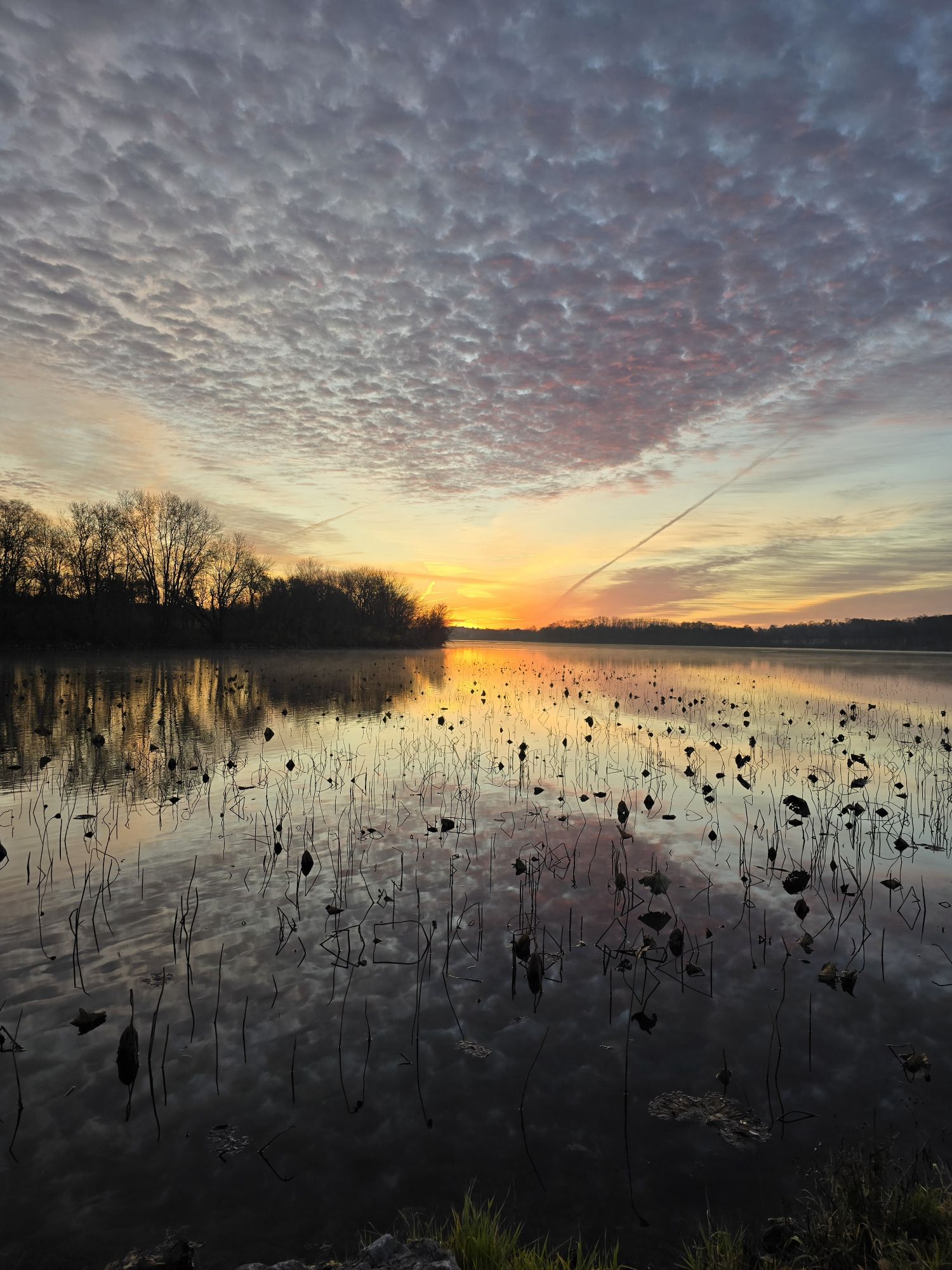
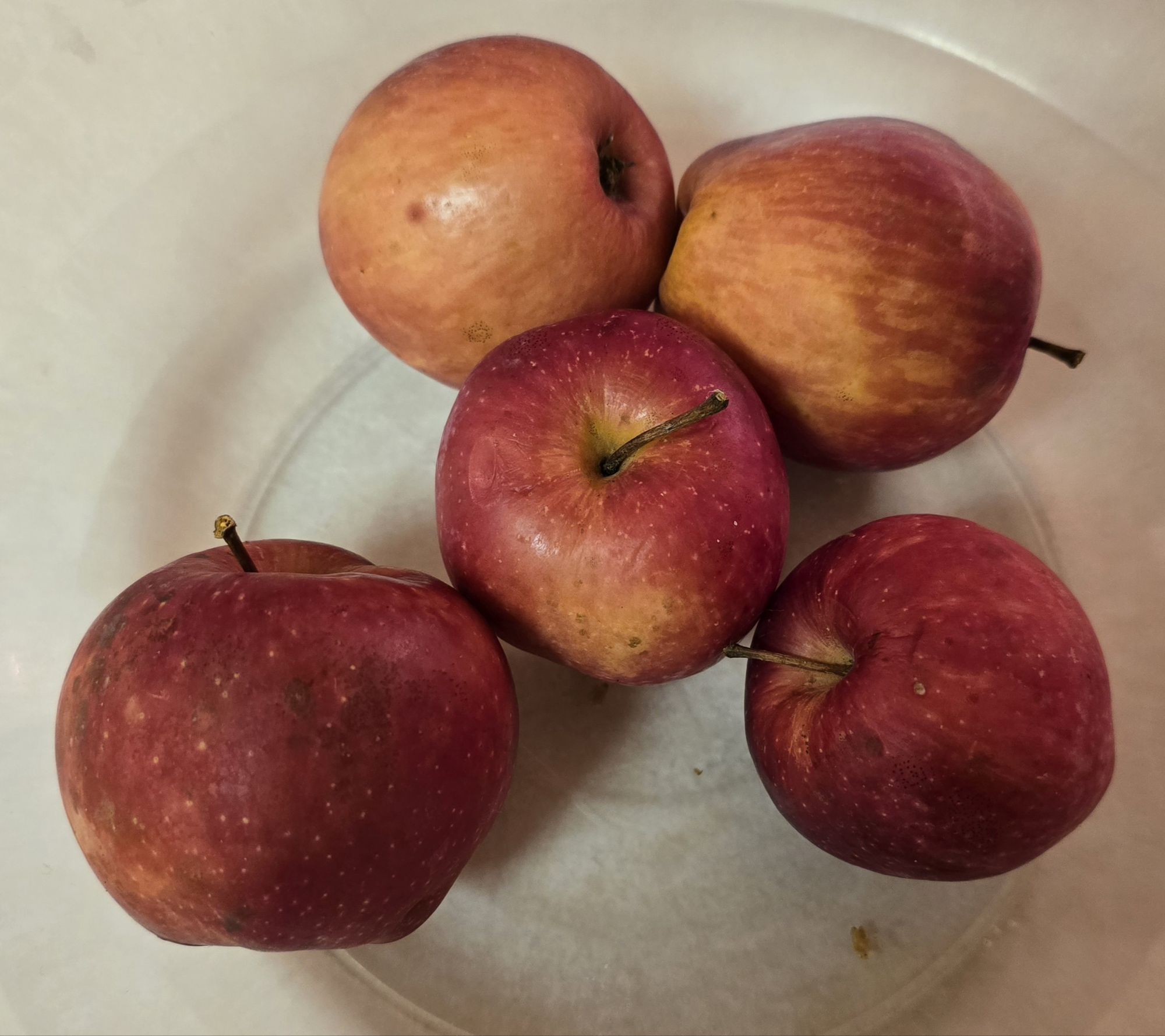
Last of the garden tomatoes.Collard greens.Gleaning the garden.Bur Oak tree acorns.Sunrise on the state park trail.Milkweed bugs.Sunrise on the state park trail.Red delicious apples.Tomatoes donated to the food pantry.Cold pickled hot peppers.Bowl of pears.Big salad for dinner.Wild flowers.
Ambient temperatures were in the high 40s as I made my way along the state park trail. The chilly air stimulated bare skin exposed by my short sleeve t-shirt. Even though it was before 6 a.m. three others were out running. Two had lights and one did not. When younger, I used to run five miles each morning in moonlight, so I never carry a light. I memorized the trail and know where the one tree root crosses so I don’t trip on it in the dark. Darkness dissipated as Earth rotated, bringing us into the light.
The weather has been perfect for about a week. It is the kind of summer weather we seek. Thursday the high temperature was below 70 degrees.
The garden is winding down, with only one or two varieties of tomatoes left ripening. There are also hot peppers which will produce until the first hard frost. Leafy green vegetables continue to grow but the freezer and refrigerator have enough to last until next year. I pick what we need to eat fresh and leave the rest. Apples are aplenty. I will end up leaving a lot on the tree for wildlife. Autumn is not here, yet we can sense it is close.
I made enchiladas for dinner on Thursday. I modified my standard ingredients, substituting fresh tomato sauce for the canned I use in winter. There are still garlic scapes in the refrigerator, so I used those too. It is an easy meal for after a long day of working with apples.
The garden garlic has been racked in the garage for three weeks and is ready for trimming and storage. I’m not in a hurry to get that done. Using a small fan to blow on it helped them dry more quickly and thoroughly.
I have five bins holding a bushel and a half of apples, sorted by juicers and saucers, downstairs near the furnace. I plan to fill the other three bins and then turn to sauce first, followed by juicing. We don’t eat much applesauce, mostly using it to substitute for an egg in vegan corn muffins. Once a year we make an applesauce cake. The refrigerator drawer can take a few more of the best apples for storage. This year has been a mad rush in the garden.
When I tear down the squash patch I expect to find a winter squash or two. That operation was ill-advised in that I couldn’t get to the vines and lost track.
The acorns on the Bur Oak trees are full sized. I expect squirrels will make quick work of them.
Such is my life in Big Grove Township. We live our best lives here… as best we can.
Apple season begins in earnest as Red Delicious ripen. I’ll pick the best few dozen for storage and make cider vinegar and applesauce with the rest until my allocation of pantry space is filled. I didn’t know it at the time, yet this is why I planted apple trees.
The Red Delicious harvest began Tuesday and it won’t take long to fill all eight of my tubs with fruit. After that, kitchen work begins as I race the clock to meet goals before the rest of them fall from the tree.
The most challenging work is running three or four bushels through my small juicer. It is worth the effort to have apple cider vinegar. I also jar a couple of quarts of fresh apple juice.
The other four trees have finished. By far, the best flavored apple was first to ripen: Zestar! I canned pints of applesauce from most of the harvest. Crimson Crisp and Earliblaze filled the time gap until Red Delicious ripened. I labeled each jar of applesauce with the variety of apple. The best of each variety was washed and placed in a refrigerator drawer for storage. I should have fresh apples at least until January.
This activity signals the end of summer. 2025 has been a great one for garden produce. Maybe once all the work is done I can kick back and take it easy for a couple of days. I’m not there yet.
“There are only ten minutes in the life of a pear when it is perfect to eat.” ~Ralph Waldo Emerson
A gardener learns to take bits of fruit and vegetables and make something of them. These pears came from the tree outside our kitchen, a tree that has been producing almost every year since it was planted in 2003. Most of the fruit goes to wildlife, yet I picked this bowl full to make sure we took advantage of the sweetness inherent in them while we can. They did not disappoint.
Here is a post written in 2014 during pear harvest. I feel much the same way today:
Pear Harvest
Our pear tree is very tall. So tall the highest fruit can’t be reached without a ladder and a picker. Even then, some will be left on the tree.
That’s okay because the shelf life or pears is very short, and we have all the pear butter we can use already in the pantry from last year. We’ll bask in the glory of fresh, organically grown pears for a week or so, and give a lot away during that time.
The money spent to purchase this tree was paid back years ago. Just this year, I paid attention to how to harvest them, and found this information from Stark Brothers to be useful. If left on the tree, pears ripen from the inside out and taste mealy. Don’t want that.
This one tree has been the perfect producer for us. Not too many pears, and not too few.
It turns out I’m okay with eating pears for a few short weeks when they come in, and have little craving for them the rest of the year. One more way to sustain ourselves throughout the year with local food without eating the same thing over and over.
The deal for private equity firm Sycamore Partners to buy Walgreens closed on Aug. 28. We know what that means.
Private equity will restructure the company, sell off what parts it can, restructure real estate holdings, close stores, layoff employees, and increase company debt, while making their executives an obscene amount of money. Walgreens bankruptcy seems likely in the near-term future based on what happened with companies like Toys R Us. Sycamore Partners’ deal is leveraged with “more than double the average debt level used by private equity firms to acquire companies last year,” said U.S. Senator Elizabeth Warren in a letter to them. All of this is what private equity does in the United States. It does not contribute one whit to improving the consumer economy. Importantly, some consumers will lose access to pharmacy services when stores close.
On my way to the wholesale club I pass two Walgreens stores, which seems like a lot. I notice neither of them is within walking distance of residential housing. In other words, they depend upon our automobile culture. A person doesn’t go to Walgreens except to get something specific. This kind of shopping faces competition from online retailer Amazon where we can point, search and click to have a product Walgreens may or may not carry delivered to our home within a day or two. Amazon trucks are ubiquitous in our rural neighborhood. We see them more often than we think of going to Walgreens, whether or not we buy from them.
I have a Medicare Part D prescription drug plan and the company that administers it dictates which pharmacies are available to me. I wanted to use the nearest pharmacy to support their small business but they weren’t on the list. I picked the warehouse club because I go there twice a month for groceries anyway and getting my prescription would save a trip. The last time I went inside a Walgreens, it was because they are a UPS drop off point. I have also shopped there to review their large inventory of over the counter medications to find a specific dosage of vitamin B-12. They did not have it, so I got it by mail order from the manufacturer.
When I was a grader we had a locally owned drugstore with a pharmacy a block and a half from our home. In the mid-1960s, whenever I had extra money from my newspaper route, I would go in there to see what they had. Mainly, I looked for reading material (comic books or paperback novels) and candy. I was infatuated by baseball cards sold with a stick of bubble gum. Over the years, the drug store disappeared as automobile culture and larger scale retailers influenced our shopping. During the ten years I lived there, they were a part of the cultural landscape. In part, discounters like Walgreens contributed to their demise.
The only person I knew who depended upon Walgreens was my maternal grandmother who lived in downtown Davenport. There were no grocery stores there — today we would call it a food desert — but Walgreens sold a few grocery items like milk, butter, eggs, bread, and selected canned goods, all of which she bought. Without an automobile, it was a big production for her to visit a supermarket, involving a bus ride or having a relative pick her up and take her there. She got her prescriptions from Walgreens which was within walking distance.
Access to Walgreens is not important to me. I buy all of my bandages, ointments and sundry health items at the pharmacy in our nearby city. We went without a pharmacy for a while, and I’d like to see them be successful. Thing is, I don’t buy $100 of sundry items from them in a year, so Walgreens or no, it has been a struggle for them to survive.
The world we knew continues to change. Some parts of the future are hopeful and some definitely are not. Big Pharma will figure out how to sell us their medicines. As Walgreens begins the slow dance toward going out of business, I accept it as the failure of large retail franchises that can’t compete with Walmart or Amazon. It is a condition of modern society, and retail in particular. I hope they make it yet doubt they will. There are other causes than saving Walgreens that deserve my attention more.
It felt like progress as I went through the prints laid out on a table from one shoe box of photographs. I bought some 4.25 x 6.25-inch brown envelopes into which I duly sorted the prints and labeled with the contents. Since prints are scattered all over the house, this should make it a). easier to find a home for loose ones, and b). enable whoever inherits the collection to move quickly through them with a clue as to what they are about. I even managed to pick a few to shred because the images were repetitive or hard for me to know what they were. There were six of those. That’s not many given the scope of the project yet it was a big, personal step. I ran right over to the shredder so there would be no going back.
The photo above was taken when in 1979, friends with whom I worked at a department store in high school visited me in Mainz, Germany. They had married while I was overseas. We drove a rental car around France, stopping whenever and wherever it suited us. We visited a number of cathedrals, including Reims and Amiens, as well as Normandy, Mont-Saint-Michel, Belle-Île-en-Mer, Bordeaux, San Sebastián, Lourdes, Carcassone, and then traveled along the Mediterranean coast to Italy. We crossed the Swiss Alps from Italy and headed back home to Mainz. The two weeks were filled completely and passed quickly.
Hard to say where this sign was located. Somewhere on the Mediterranean Coast. The places we went on the coast were not very touristy. That was one of the ideas that energized the trip. We found our own path and the trip was better for it. We went places where an American Visa card was a novelty and the clerk had to contact someone to make sure it was legit.
I shot two or three rolls of film on my Minolta SRT-101 camera. The highlight of the trip was in Saint-Paul-de-Vence where we overnighted in a small hotel. The artist Joan Miró was in residence at the nearby Fondation Maeght where he was making a film for French television. It was interesting to see the director coaching the artist about how to move for the camera. We toured the gallery and bought posters of the show to remember it by. I framed and still have mine. Alas, no photos of the artist as it wasn’t allowed.
As an organizing principle, putting photos taken on a specific trip together is conventional. None of them found their way into an album, although the makings of one was there. In retrospect, It is hard to believe I could get two weeks away from work as a military officer. Images like this one help me remember how close I was to my small group of high school friends. Isn’t that one of the purposes of photography?
~ Read all the posts in this series by clicking here.
I’m getting to a place where I wrote the best of what I will about Labor Day. In 2022 I wrote this post, which covers the bases. No need to re-write it this Labor Day weekend. There is more to life than annual traditions.
It is no secret unions are in decline. In his new book, Coming Up Short: A Memoir of My America, Robert Reich points to the problem. The post-World War II economy was so affluent that unions did not seem necessary to most people in the wake of reforms that happened during the Franklin Delano Roosevelt administration. As a result, there was less impetus to form unions, and in right to work states like Iowa, a union could represent a workplace but workers were not required to join. The latest from the Bureau of Labor Statistics (2024) is, “The union membership rate of public-sector workers (32.2 percent) continued to be more than five times higher than the rate of private-sector workers (5.9 percent).” As we know from the administration’s move to invalidate union contracts among Veterans Affairs workers, the pressure will be on to diminish union strength among public-sector workers.
While summer is not over, the garden is winding down with leafy green vegetables, tomatoes, hot peppers, and apples remaining to be harvested. Instead of time off this weekend, I need to focus on work in my kitchen and garden, then digest what just happened. Short version: I withdrew from in-person society and reduced my contacts with people I know to focus on the immediate place where I live. I strove to make that life better.
Vegetables and fruit grew as well as they have ever done in my garden. The abundance produced from a small number of seeds and minimal cultivation is astounding. In particular, the green beans, cucumbers, and leafy green vegetables have been of good quality and mostly pest free. All five apple trees produced fruit. So did the pear tree. This year has been a bin buster.
As my concept of a kitchen garden matures, I have become a better meal planner and cook. One of the benefits of writing a meal plan has been a reduction in our grocery bill. If we write the meal plan to the garden, and then shop to the meal plan, the tendency is to spend less money, waste less food, and cook better meals. When I go to the grocer, my cart looks a lot different from other shoppers (yes, I look). More fresh fruit and vegetables and a small percentage of branded products. Life around the garden and kitchen makes more sense. I’m thriving in it.
Right now I have three pots going on the stove: two tomatoes and one hot peppers. Learning to process these items took time, but I know where I’m going. I mostly can tomato puree from plum tomatoes. I pickle a couple of quart jars of sliced hot peppers and then make a hot pepper paste to use on tacos. I learned to can only what we need.
This summer I exercised daily, even when the weather kept me indoors part of the day. That, combined with counting calories, led me to lose about a pound of weight per week. I have a way to go to get my BMI below 30. However, I feel healthy and that is important.
It has been a summer of plain folk living our best life. There are challenges, yet it was a decent summer in a turbulent time. For that, I am thankful.
It has been a week of great weather. Temperatures were in the seventies, scant rain, and plenty of sunshine. I tried to capture a bit of it for this post.
Cherry Tomatoes in the dehydrator.Morning on the trail.Wildflowers on the trail.Sunrise.Green Zebra tomato.Pre-dawn on the trail.Red Delicious apple tree in August.Mist on the lake.
There is a lot of chatter in the national news media about the price of electricity. We are apparently in a war with China over dominance in artificial intelligence, which requires a lot of electricity. National Public Radio reported, “Electricity prices are climbing more than twice as fast as inflation.” We don’t hear that so much here in Iowa except on national media. Why? According to Bill McKibben, “The average Iowan will spend 39% less on electricity than the average American because it produces 57 percent of its electricity from the wind, the second-biggest wind state in the country.” If you throw solar arrays, and other renewable energy into the mix, Iowa’s total share of renewables is 64 percent.
Spoiled as I am by normally low electricity rates, when last month’s electric bill arrived it was 51 percent higher than the same period last year. What the heck? Although the total amount of the bill was comparatively low — typical for Iowa — I had to look at it.
The price per kWh of electricity from our electric cooperative has been stable and predictable. It wasn’t a rate change that caused our increase. Our monthly usage increased from 429 kWh to 745 kWh. The average American household usage is much higher than that. The reason for higher costs was this increased usage.
What happened? The average temperature increased by four degrees year over year. We likely ran the air conditioner more because of it. It was also oppressively hot this July, which meant spending more time indoors and using more electricity with the washer, dryer, stove and our electronic devices. We also had a millennial house guest for an extended stay. They did online streaming from here with a multitude of electric devices which sucked more juice. In sum, the increase was explainable.
Why are people concerned about increasing electricity costs? Donald J. Trump is president. He does not seem well educated about electricity.
On Trump’s first day in office he declared an “energy emergency” for made up reasons. The unstated reason is he extorted oil, gas and coal companies. “Candidate Trump literally told the fossil fuel industry they could have anything they want if they gave massive contributions to his campaign, and then they did,” according to McKibben. Trump’s payback for the bribe was to hobble the renewable energy industry.
The Trump administration immediately began to do absolutely everything in its power to stop this trend (to develop more sun, wind, and batteries) and replace it with old-fashioned energy—gas, and coal. They have rescinded environmental regulations trying to control fossil fuel pollution, ended sun and wind projects on federal land, cancelled wind projects wherever they could, ended the IRA tax credits for clean energy construction and instead added subsidies for the coal industry. Again—short of tasking Elon Musk to erect a large space-based shield to blot out the sun, they’ve done literally everything possible to derail the transition to cheap clean energy. (Trump is shockingly dumb about (electric) energy, Bill McKibben on Substack).
More than ninety percent of new electric generation around the world last year came from clean energy. This was not because everyone in the energy business had “gone woke,” McKibben wrote. Texas, arguably the most un-woke place in the U.S., installed more renewable capacity than any other state last year. It was because you could do it cheaply and quickly—we live on a planet where the cheapest way to make power is to point a sheet of glass at the sun.
I don’t know what happened to Republicans. Senator Chuck Grassley used to be one of the big supporters of wind energy in Iowa because of the way wind turbine arrays meshed with farm operations, giving a farmer another revenue stream.
Under Trump we have taken a step backward and let China, Europe, and literally everyone else take the lead in developing the electricity of the future which taps power directly from the sun.
We can and must do better than this as we consider our energy future.
You must be logged in to post a comment.