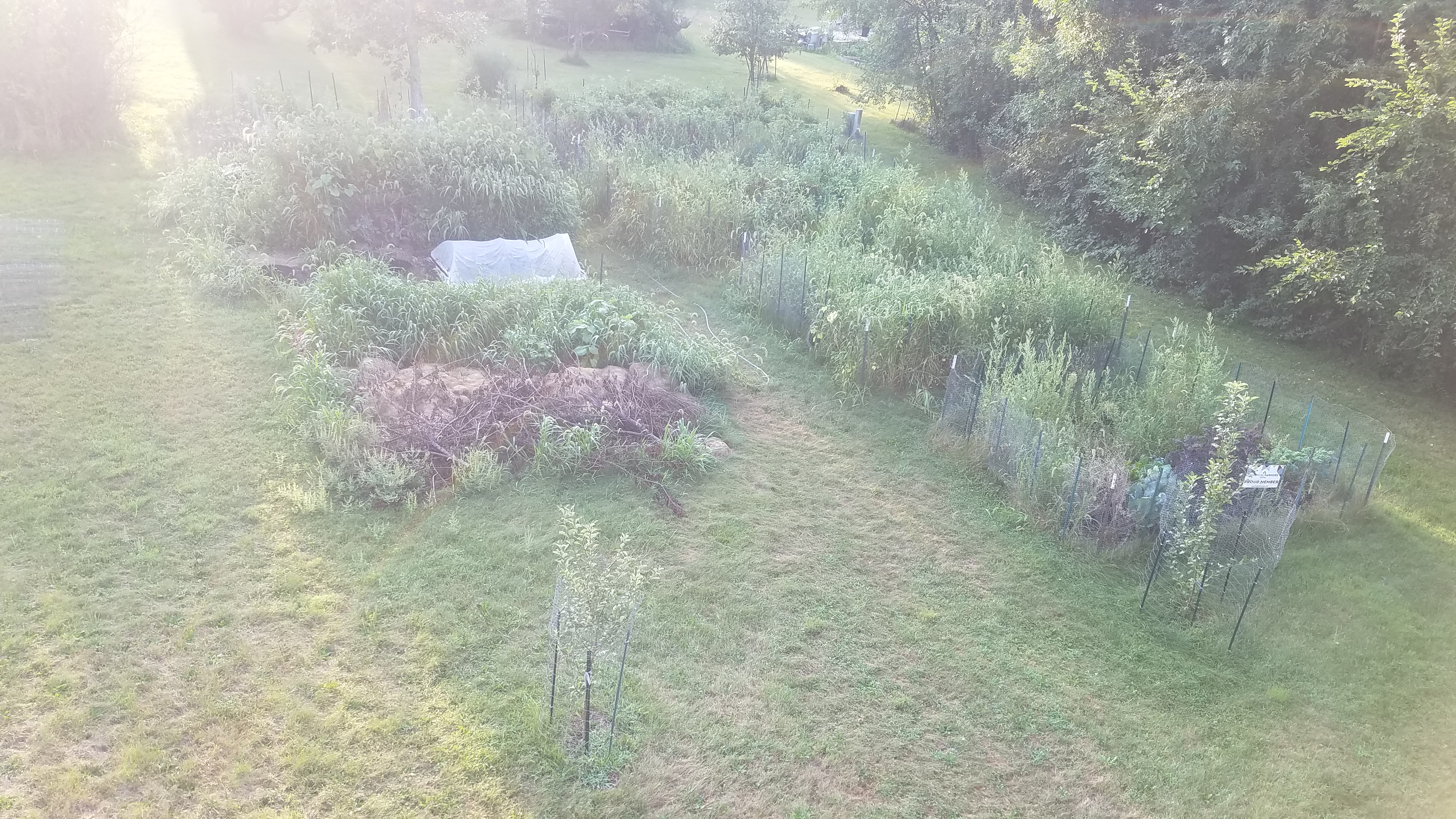
View of the garden from the rooftop, Aug. 28, 2021.
The gutters overflowed with water in a recent rain storm. During the following heat and humidity I climbed the ladder to have a look. Sure enough both sides were plugged with leaves and maple tree seeds. It took less than a minute per side to clean them.
While up there I inspected the roof. The south peak is showing wear, as it is windward. The roof will be good for a while longer. It was the only planned ascension this year.
I go indoors when the heat index is in the 90s. Ten or more years ago it didn’t bother me to work hour after hour in heat and humidity. With a cooler of water bottles on ice, I had everything needed to work straight through. The record drought in 2012 raised my awareness. I began needing a break from the heat about every hour or I would get dizzy. Now I don’t push it. If the forecast is in the high eighties and it’s humid I find indoors work to do.
It’s not like the lawn needs mowing. While the two recent rains greened things a bit, most of the grass remains dormant. I don’t like mowing when it is in this condition. The number of yard and garden tasks is backlogging into a real project. There is no reason it can’t wait until the ambient temperature is cooler.
Perhaps the worst thing about drought-like conditions, combined with a resurgence of the coronavirus, is the isolation. I have intense desire to be with people. Like with the heat and humidity, I’m taking no chances and staying home.
There will be a fall, I’m certain. It will get cooler. I will work in the yard again. In the second year of the pandemic I yearn to do things with people. I’ll be ready when inhospitable conditions abate.
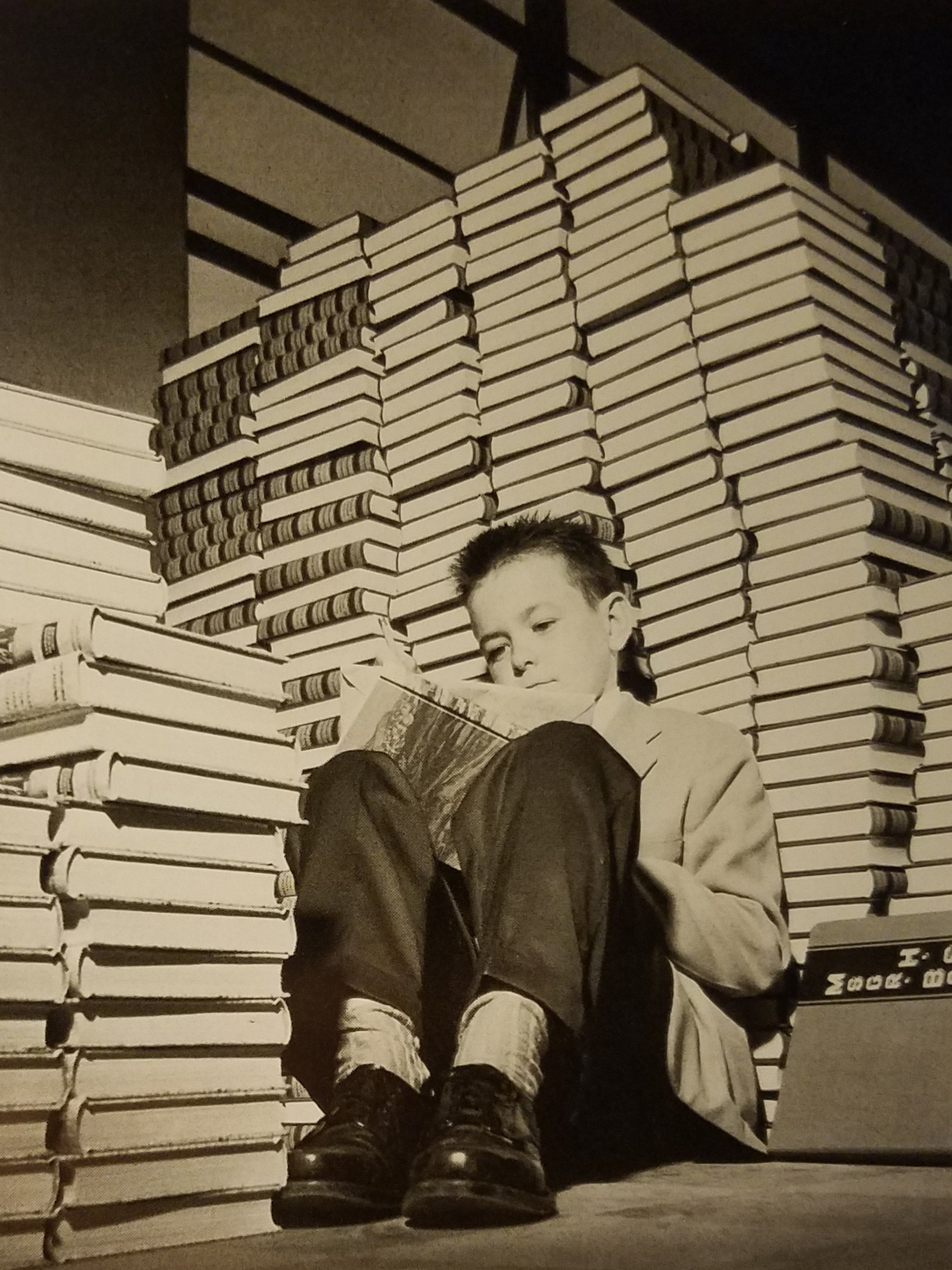
Text on the postcard: “Student, c. 1960. Photographer Unidentified.”
When young our capacity seems limitless. When I got my first library card in 1959 I believed I could read every book on the Bookmobile that stopped each week in our neighborhood. I looked forward to returning books I read and getting new ones. Outside of school, it was a highlight of the week.
Mother got me a subscription to My Weekly Ready, the arrival of which was another highlight. I bought a few children’s books at the local drug store. Keeping up with reading was easy with the energy of youth.
When I lived in Iowa City in my twenties, I started a project to read every book in the public library. It tested my limits. I started at the beginning of the Dewey Decimal system and didn’t make it out of the philosophy section.
I didn’t hear about the Horatio Alger story until I was in college, but that could have been my story, lifting myself up with diligence, honesty and altruism as I read and read and read, waiting for some happy circumstance to present itself and bring me the good things of life. We now know what I was feeling was the privilege of being white and middle class.
I look back to those days, with their libraries full of reading material, and consider my devotion to the act of reading. It was a solitary life and I was mostly okay with that.
What I didn’t realize, that would have helped me if I did, was to get anything significant done in society it takes a context that includes others. I was ready for a life of rugged individualism, in which through my own hard work I could pull myself up by my bootstraps and experience success. I didn’t understand how divisive that could be, pitting my own efforts against others to ensure personal success above all else. Live and learn.
Today I have piles of books I want to read just like the schoolboy on this postcard. However, my intent is different than it was in the 1950s and 1960s. I seek insight to take collective action on things like the climate crisis and more. I provide for my basic existence — food, shelter, clothing, transportation and healthcare — yet that serves only as a platform to do other things with a network of people.
Some days I wish to be that boy sitting next to a stack of books while reading. If I were, there would be things to tell him.
Text on the postcard: “Underwood Motel, 1100 Lincoln Highway, Schererville, Indiana 46375. Heated Pool – Air Conditioned – Room Phones – Free TV – Honor Most Credit Cards – Located on U.S. #30 – Just West of U.S. #41 Near Calumet Expressway to Chicago Loop. Phone: 219-865-2451. Handwritten note: $19.80 per night.
When I transferred with work to manage a Schererville, Indiana trucking terminal for a company called Lincoln Sales and Service, I stayed at the Underwood Motel. It took a while to manage our move, maybe six to eight weeks. We ended up buying a house in nearby Merrillville, Indiana.
Our fuel attendant worked at the motel and that plus the low price is why I stayed there.
The six years we lived in Northwest Indiana were busy. It would change my view of work forever. The country was in transition from what it was post World War II, to what it is now. Due to the Reagan revolution, it was hard on workers. I lost track of how many potential drivers I interviewed during this time… more than ten thousand. Theirs was a story of dehumanization of workers laid off by companies that felt they had to to be “competitive,” whatever that meant. It was a time of ubiquitous management consulting firms who restructured businesses to direct more revenue and earnings to owners, share holders, and high-level managers. It was busy because most of the time I worked in uncharted territory with little guidance unless there was a lawsuit or workers compensation claim.
I’m glad for the experience. I hated the experience. In the crucible of manufacturing in transition, thousands of workers were trying to adjust. I was there to listen and heard one hella story. I hired some of them, doing what I could to ease the transition.
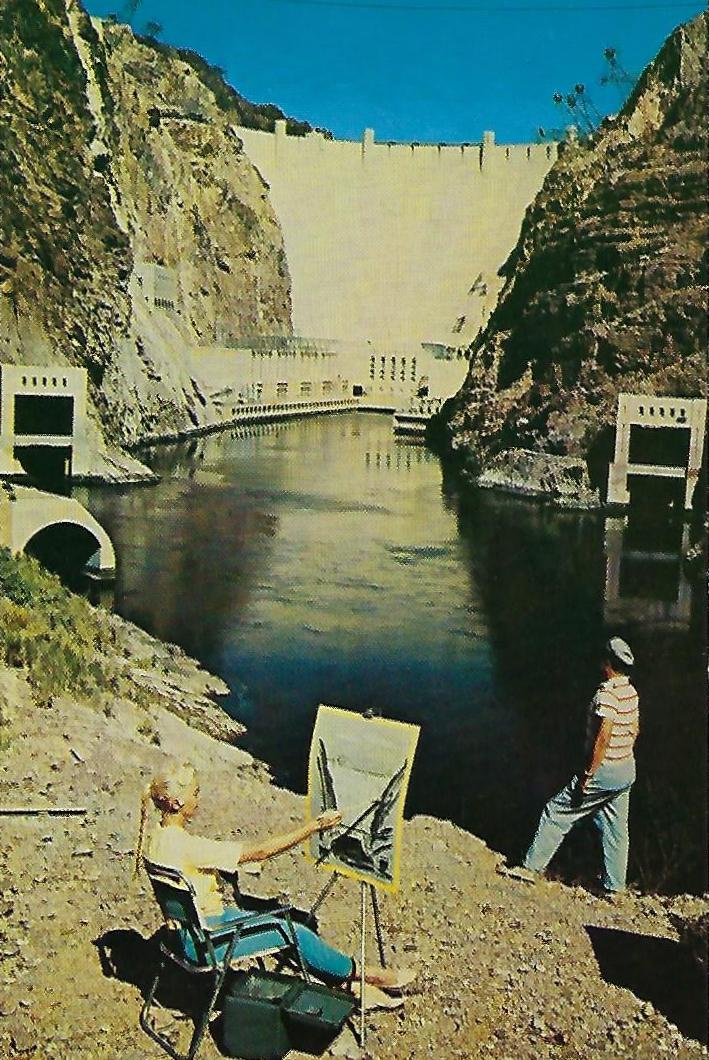
Hoover Dam. Photo credit: Las Vegas News Bureau, undated.
Text on the postcard: “Looking towards the outlet tunnels and huge powerhouse below the world’s highest Dam. This $125,000,000 project is one of man’s greatest engineering achievements. Height 727 feet above bedrock, crest 1,244 feet, and 650 feet thick at the base.”
When I was in high school our family went to California so my parents could attend a union convention. We made a family vacation of it, the last one before Father died. Mother’s two brothers lived in the Los Angeles area so we spent time with each of them. We stopped to see Hoover Dam on the way home.
Today, Lake Mead, the reservoir created by the Hoover Dam, is at its lowest level since it was built. The continuing drought in the West will have a significant impact on people who live there. It’s clear we must act to slow global warming.
Side dish of sliced tomatoes at our picnic lunch on Aug. 13, 2021.
Friday was a travel day during which we visited family in Chicago. It was the first family gathering at their place in a long time. We’d been preparing for the trip for over a month. To maximize visiting time, we packed a picnic lunch and ate at the apartment.
It was a good day.
Children return to school in two weeks, Iowa hospital beds are close to full with COVID-19 patients, and we haven’t had a view of the sun unobstructed by haze from the Western fires since I don’t know when. A flotilla of 14 hot air balloons rose over us near Davenport as we drove home. Their bright colors were muted by the pall over the landscape.
Beyond family, these day are not so good.
Despite difficult times we go on living.
It is becoming a habit. I walked around the neighborhood where they live and ended up browsing in a used bookstore. I bought three books and got three punches in my frequent user card. Yes, I have a frequent user card, and plan to return to get all the punches. We made it home safely before sunset.
As I finish my seventieth year on planet Earth I’ve been considering why I read and why I should.
Reading has become such a habit it’s unclear I’m approaching it the right way. As Socrates is said to have asserted, an unexamined life is not worth living. I want my remaining days to be worth living and for reading to be part of them.
I’ve become a lazy book reader. I read in bed, in the middle of the night when sleep fails me, and when I wake too early to get up. I read when I can’t fall asleep when I should. I have four subscriptions to newspapers along with several daily newsletters and countless emails. I read articles linked in social media and of course the posts on my pages.
Most of that reading is good, yet the backlog of books to read is growing. There is also a randomness to how I pick books. Unless I’m on a deadline to write a review of an advance copy from a publisher, my choices are somewhat impulsive, based on what a friend said, who wrote the book, or the context in which I heard of it. A retiree has few deadlines and constraints when it comes to reading. There is a sense my impulses on reading have not always been the best for me.
According to my Goodreads tracker, I’ve read 30 of a 36-book goal for 2021. In July I read one book and I’m working on my first in August. I like the Goodreads reading challenge because it gives me a point of focus. I feel good clicking the link to say I finished a book. Whatever I do, I’ll keep using the social media platform.
There is an existential angst to all this although I don’t intend to dwell there long. I need to move from habit to active engagement in reading–I know that. I also need a better strategy for picking what to read and when to read it.
Taming the internet and it’s 24/7 fire hose of words is important. Scrollers gonna scroll, and I am one. It is one thing to get through the feed to find what’s engaging. There is no reason to follow a rabbit hole in real time, every time. When there is a linked article, I could use the application Pocket to save it to read later. If an article is worth reading, it will still be so at a designated time. I already devote some of my morning routine to reading. It should be easy to add saved Pocket articles to the mix at that time.
When I consider reading done this year, the best part was researching my ancestors settling in Minnesota. It resulted in this piece of writing for my autobiography. More of that would be good. As the gardening season commenced, my interest in autobiography waned and I moved on and outdoors. Once the garlic is planted in October, I expect that kind of reading to resume. It is some of the best I do and I want that.
Like many, I read to learn. I’ve been tracking my reading on this site for years. It’s a simple list of books with the most recently read at the top. If one looks through them, there is not a particular theme or concentration. Someone I know will recommend or write a book, and it falls into the reading queue. I have a long reading queue which want organization.
When we consider the gravest threats to our lives during the coming decades, the effects of climate change may be the most challenging. I expect to continue to read books , studies and articles about the environment as a mainstay of my reading.
This blog is about gardening and cooking, creating a “kitchen garden.” When I read about these topics, I’m looking for something specific: how to combat a pest, for instance. The best of what I read is doing the research in my library of cooking and gardening books–finding answers to questions about process. I don’t read many gardening or cooking books cover to cover.
An example of a cooking book I do read cover to cover is Tamar Adler’s An Everlasting Meal: Cooking with Economy and Grace. More than anything, she presents a narrative about cooking that goes beyond a single meal or dish to how we connect them together. I also read Anya von Bremzen’s Mastering the Art of Soviet Cooking: A Memoir of Food and Longing. Again for its narrative more than cooking tips.
The thing I’ve been dodging here is my book reading. How does one get from being a lazy reader to more engaged? The answer is obvious. Set aside prime daytime hours to read, and stick to a schedule. Instead of using reading to fill hours I should be sleeping, make it the main event for at least part of the day. Morning is the best time so adding an hour or two to my daily outline might serve.
The harder part is in book selection, working on the reading queue. It is easier when I’m working on a project like researching my Minnesota ancestors. Like a coal miner, you just follow the vein. I also want to be moved by what I read. I’m thinking of On Earth We’re Briefly Gorgeous by Ocean Vuong. I want things from reading and haven’t given them adequate consideration. All I can see is the growing book stacks waiting to be read and no way out except to spend the time.
Why do I read? To learn, to enjoy, and to be a better human. Why should I read? To retain relevance in a changing world. Without devotion to ideas found in books relevancy can be difficult. So I end where I began, with questions. There are a couple of things I can do for better reading. I can’t wait to get started.
It’s been a hectic 36 hours. We have the U-Haul truck loaded and ready for our 1,180-mile trip beginning tomorrow. We all took naps this afternoon now that this part of the work is finished.
There were a lot more swords (props and the kind used in LARPing) than I thought there would be.
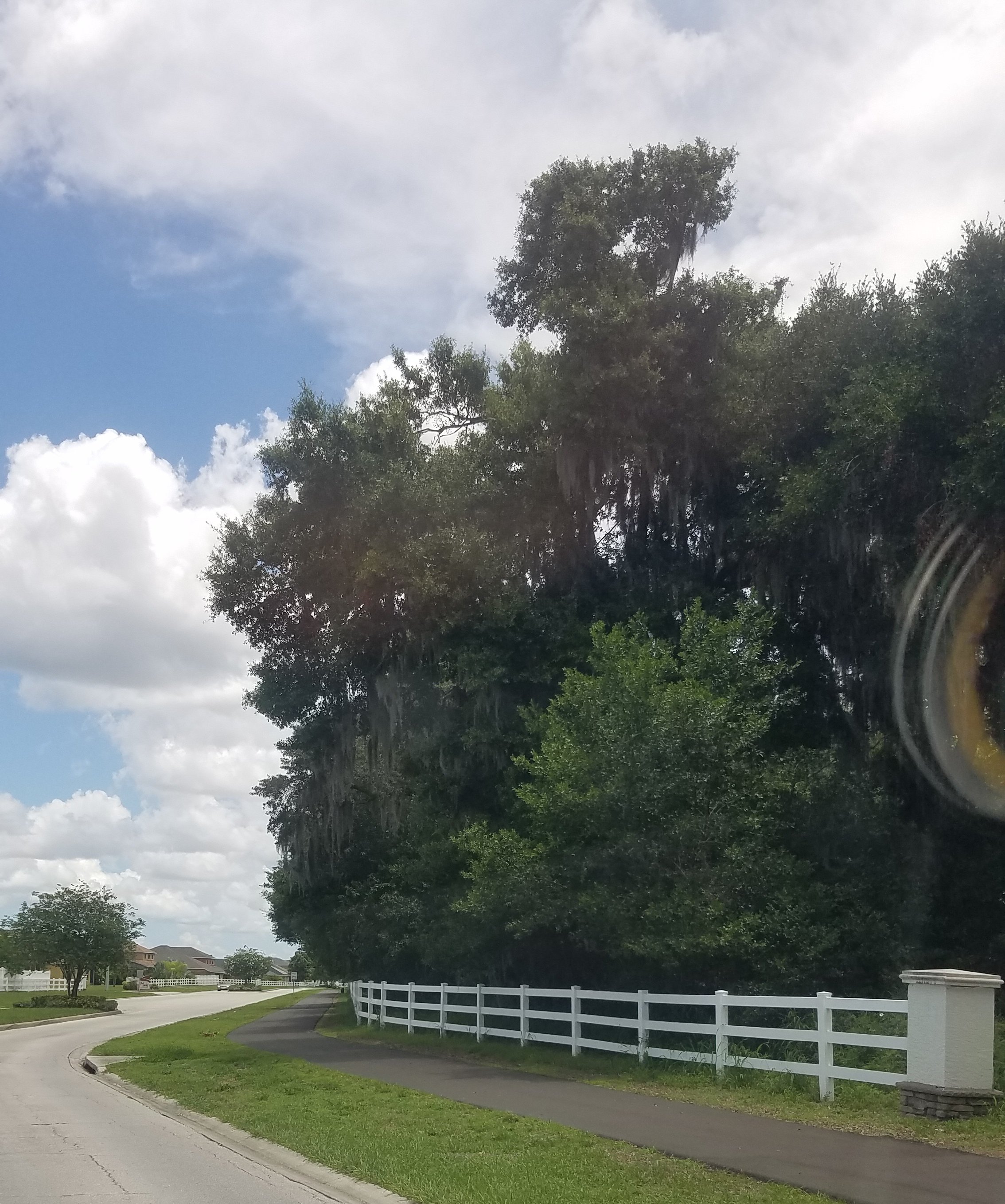
I like visiting Florida. You can’t hardly see the Spanish moss in the picture, yet I remember it in live oak trees on a family auto trip to Tallahassee when I was eight or so. Father graduated from Leon High School there. Spanish moss is everywhere in Central Florida. It is a seminal memory.
Now that our child is leaving the Sunshine State, it’s hard to imagine returning.
We’ve been busy with logistics yet I had time to engage in dialogue with locals: the convenience store cashier and the U-Haul staff. I’ve been cooped up in the house during the pandemic for so long, I forget what it means to be among people. I could talk with locals for more time than we have.
We didn’t say much. There’s a lot I could say when I return to Big Grove. Right now were resting in Lake Alfred and looking forward to tomorrow.
One thing though about tomorrow. I left all my rainbow t-shirts for Pride month at home because I been through Georgia before.
I just finished reading Mary Karr’s The Art of Memoir and it inspired me to write this introduction to my autobiography. I don’t know if I’ll use it, but I think it works toward identifying my voice in the narrative, as she suggests we should. There will be revisions in the coming months and years as I continue to work on the book. Feedback welcome in the comments.
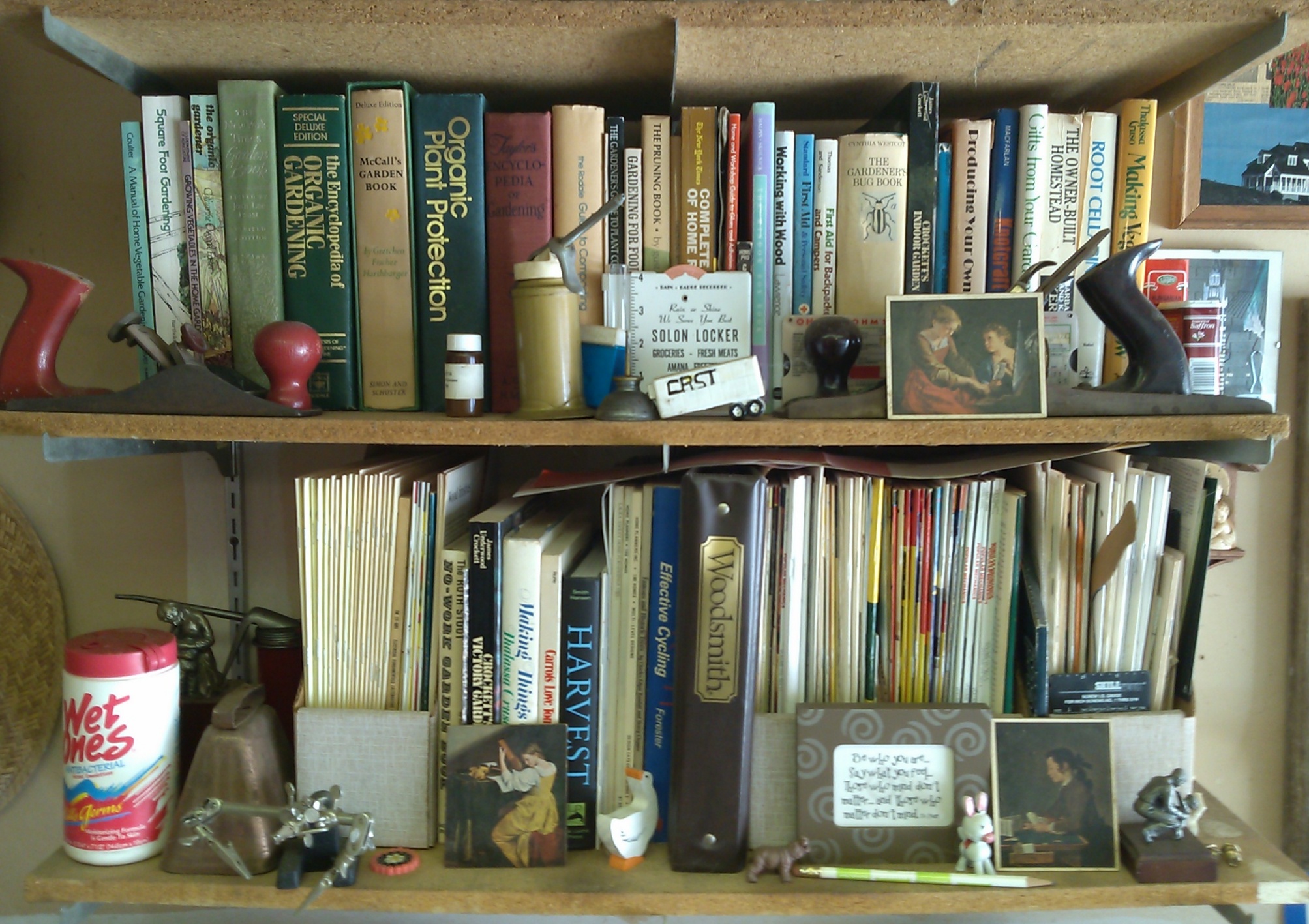
This memoir was written in the unfinished lower level of the split foyer home we built in 1993. We thought we would have finished our home by now. In a not-specific year I framed a couple of rooms with two by fours and installed drywall and book shelves in what would eventually be my writing place. The county assessor got wind of the improvement and sent someone out to inspect. They decided to wait until I finished before increasing the assessed value. Piles of building materials bought at the time remain stacked around the space. The current lumber shortage has me thinking about selling the two by fours.
I can’t say when finishing the house will be on the agenda. However, finishing this book is front and center.
We have a wireless router that connects everything. Who in my cohort doesn’t? What’s significant about the library table surrounded by book shelves is not the Dell desktop resting on it. This refuge is a chance to get away from the internet and be the person I am with my successes and failures. My non-internet traffic is more valuable than what I write online.
Our arrival in Big Grove Township coincides with broad adoption of internet service providers. Before mobile telephones, I used a pager and stopped at a phone booth to answer a page. It felt a bit risky, especially when I stopped near the Robert Taylor Homes on the South Side of Chicago at a well-lit bank of payphones. It’s what we had and truck drivers who paged me couldn’t wait.
I used a typewriter until we lived in Indiana, when we got a word processor with a dot matrix printer. In Iowa, we got our first home computer in 1996. The accelerated pace of improved personal communications since then was unlike anything we knew. This impacted this memoir.
In the chronological first part of my life I’m dealing with experiences, memories and outside sources to create a narrative. My memory is faulty. The majority of my experience is embedded in me or in boxes of photographs and papers. Growing up during the time of Polaroid and Eastman Kodak, the photographic record is significant. Likewise, the boxes of documents going back to kindergarten have a lot of information in them. Old documents, like my parents’ wedding announcement, may exist online but most of my remembrance of those days is a physical presence not far from me. The act of selection for inclusion in this book had a significant influence on the narrative.
My memory and experiences are subject to interpretation and people’s remembrances of them differ. Like any memoir author, I had to address that before presenting the finished work. This book is an effort to tell the truth and say what I know about my life as best I can.
The story relies less on memory after graduation from university when I started a hand-written journal. The continuous written record since then was enhanced by the adoption of email, social media, and personal blogs. Digital photography was an important aspect of the record beginning in 2007. There is plenty to draw upon and it can be quoted as-is, avoiding the interpretation of others.
My view of the world is flawed. What I see isn’t always what others see, and that’s what could be a reason to read further. Perhaps the most clarifying part was writing the story of my Polish ancestors in Minnesota. Drawing on memory, artifacts, my personal journal, and interviews with local informants, it became clearer than ever the kind of people from whom I rose. It revealed a type of life that could provide meaning in an rapidly changing social environment.
The ditch in front of the house finally dried on June 7, 2021.
Sunday was literally a day of rest. After planting the next rounds of lettuce and spinach, and mulching tomatillos and the second round of radicchio, I drove the Lincoln Highway to Boone to pick up my spouse. When we arrived home, I took a long nap, then stayed up later than normal so I could sleep through the night until morning. The tactic seems to have worked. I feel well-rested this morning.
Last Monday I noticed the ditch in front of the house finally dried. Saturday I mowed it, raked up the clippings, and piled them near the garlic patch. Some years the ditch stays wet until July, yet this year I believe we are entering a drought, and will soon pass the “abnormally dry” stage and get right into it. Moisture management in the garden remains important during drought conditions, and mulch plays a role.
In March I slowed the pace of writing my autobiography. Partly, it was due to increased gardening activity. It was also due to a quandary about approaches. Over the last two months I worked through ideas and am going to shift what I’m doing.
The breaking point was the piece I wrote about my ancestors settling in Minnesota. You can read it here. I’m pretty happy with how this introduction turned out, and the research behind it. Because there is well documented writing about this specific community in Lincoln County, Minnesota, it was possible. The challenge is not all periods of my family history are like that.
My maternal grandmother was the third generation to live in Minnesota. When she moved to a Polish community in Illinois, without her first husband, and with her first two children, the man she married had more obscure origins. The U.S. Census record shows him living at home and working as a coal miner before they met. We know that history and later in life he worked as a coal mining demonstrator at the Chicago Museum of Science and Industry. He also suffered from coal workers’ pneumoconiosis. One of my main childhood memories was of him spending an inordinate amount of time in our bathroom coughing up phlegm from his diseased lungs. Black lung disease eventually contributed to his death and during the Carter administration Grandmother was awarded black lung disease benefits based on his case. I will tell this story, without other written records, yet it seems to miss the mark.
There is no avoiding writing the early parts of my autobiography from scratch, blending memories, photographs, and what documentation exists. Because I have written so much, beginning with my personal journal in 1974, the question, and sticking point, was how to handle that writing, which has been more or less continuous since then. An answer is emerging.
My stylistic lack of discipline over 50 years of writing drives 2021 me crazy. If I could go back in time and talk to the younger me I’d say, “Just tell the story.” It’s too late for that. The written record is what it is, with its changing bad writing habits.
At the same time, I always planned to use this writing in my autobiography. The epiphany while out in the garden this spring was I can tell parts of the story by using text written in real time. In other words, instead of re-writing my history the way I wrote the Minnesota piece, and using journals, newspaper articles, and blogs like a source document, I can assemble existing work in piecework fashion, the way a person makes a quilt. The form would be an autobiography written in real time, beginning after college graduation.
This morning I reached catharsis on approach. There will be four stylistic parts of the autobiography. The historical part like the Minnesota piece, recounting of first memories, a blended recounting of schooling beginning with Kindergarten until college graduation, and then everything after beginning with my written journal in 1974. I like the piecework approach this implies.
It’s only Monday, and something good has come from this week.
This retro post is from July 16, 2012. If the Sisters of Mercy had any influence on me in the late 1960s, it was in the phrase “all for the honor and glory of God,” which, at one time, we were required to write on every school paper. In a world more connected than ever, reaching out beyond the veil of our own humanity with purpose seems as important as ever. It is not enough to believe that God is watching our every move. We must also live in society. I witnessed women making traditional lace in Morbihan. We have to get beyond the appearances of things, as comforting as they might be, as well as they might fit into a traditional world view. Hope you enjoy this recycled post.
We are isolated beings, wrapped in a veil of humanity, closer to God, or its divine essence than we realize. Such veil, metaphorical or not, is woven of delicate threads, like the lace of Morbihan, or silk from China. We could spend a lot of time marveling in its delicate needlework or shimmering surface. Yet we are compelled to reach out beyond the veil. A Cartesian view of life, if there is one.
Some say we should live our lives in the presence of God and perform all works for its honor and glory. The Sisters of Mercy taught us this and had us inscribe on each sheet of school work, words to the effect, “all for the honor and glory of God.” If God is reading this blog, my offerings may not be living up to divine standards.
Yet there is a compulsion to communicate, in manners crafted and on the fly. Verbally and in writing. In the silence of being, writing, especially in e-mail and on the internet, comes as a natural outlet for our need to express ourselves when other people are not around. It is difficult to accept that there is just God and me in the universe, and that I should be satisfied to live in the Presence of the Lord.
This weekend I had a conversation with a friend about everlasting life. We agreed that if the everlasting version is like the current one, the attraction is not enough to tithe and focus on the next life after this one. There is too much inequality, too much trouble today, to relish a state where our worldly problems are solved, the veil of life on earth torn and we visit with our deceased predecessors. It all seems an ill-designed nostrum for ailments that are not really ailments, but the stuff of our lives.
So we write, partly to clarify our thinking, and partly to satisfy our need to reach out to others and express the value of our lives, one life among the billions of people walking on the planet. Whether anyone reads or understands our writing is not the point, although we hope they do. The point is that if it is only me in the Divine Presence, then I am not yet convinced of the connection with the rest of humanity. Something I believe exists, and is more than a mere veil protecting me from the light of society.




 Journey Home
You must be logged in to post a comment.