LAKE MACBRIDE— After completion of the Sept. 19 storm cleanup, the monetary cost will be $230.50, including hiring an arborist to tend to two trees and a construction company to repair the fascia on the southwest corner of the house. It was not much, and a lot less expense than others in the neighborhood experienced.
I avoided the cost of disposing of the fallen branches by cutting them into two types: firewood to be sold, and brush to be burned. The cost is in time, with one or two more four hour sessions of cutting ahead, and at least two more burns when the wind dies down. We’ll evaluate the condition of the damaged trees and lilac bushes and make adjustments after the burning is finished. With pruning, the lilacs can be saved.
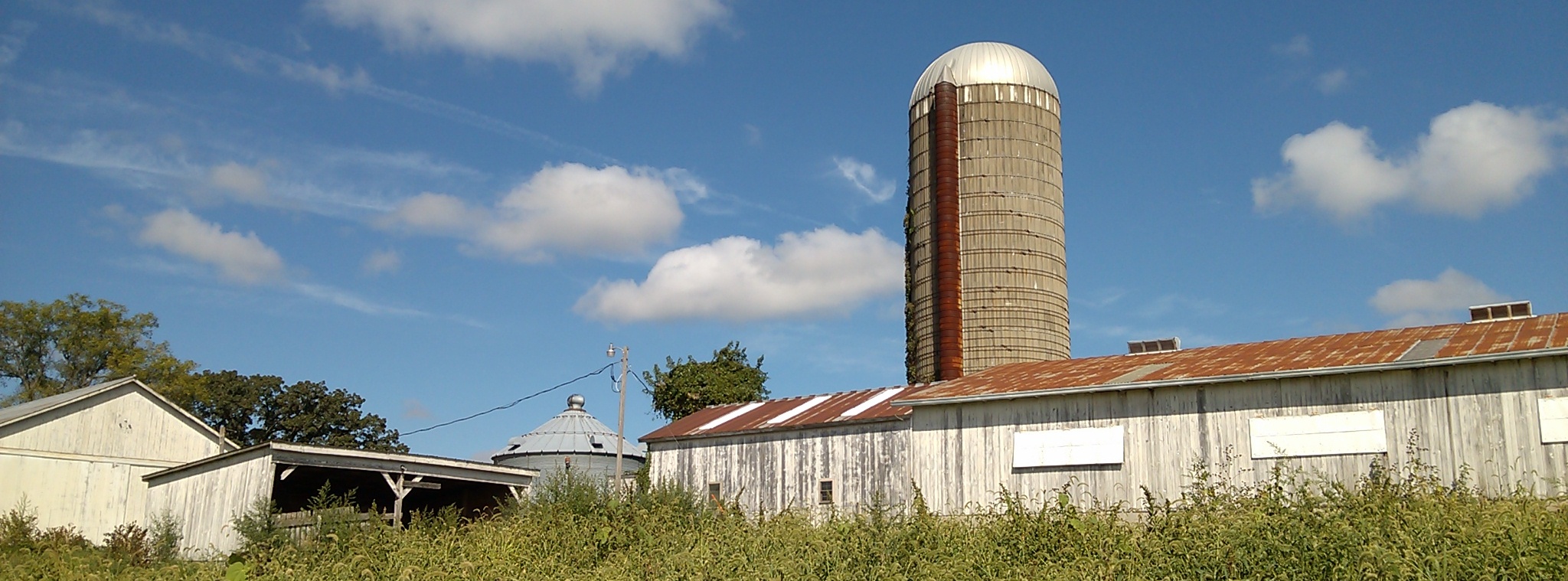
Burn Pile Site
Beside our checking account and labor, and a share of the bill for the damage in our subdivision, another toll from the storm lingers— the idea that this worst in 20 years weather event, coupled with recent severe drought and terrible flooding, is just the beginning of the effects of climate change on our lives. Whatever severe weather we might have had was intensified by the effects of global warming. That a monetary value can be assigned is a sign of things to come.
Farm and newspaper work continues over the weekend, so the cleanup will wait until next week. Cleanup displacing other things to be done to advance our socioeconomic status in Big Grove. The storm cleanup reinforces the idea that climate change is real and happening now. We need to do something to protect what we hold dear, we can’t be effective alone, and the time to act is now.
On Oct. 22 and 23, The Climate Reality Project will connect the dots between carbon pollution and climate change with the global live-streamed broadcast “24 Hours of Reality: The Cost of Carbon.” here’s the link:
In Iowa, men and women in the agricultural community are talking about the likelihood of four or five more years of continued drought. Harry Hillaker, Iowa state climatologist, indicated 2013 was the wettest spring on record. He confirmed this summer’s drought conditions in Iowa. Like this year, the prospect for coming years is wet springs combined with long summer periods of little or no precipitation. There is no doubt human activity is contributing to this extreme weather, and that carbon pollution is the driving force behind it.
Not only are extreme weather events happening in Iowa, they are happening throughout the world. Extreme weather has a tangible cost in dollars, and in its impact on human society. 24 Hours of Reality will bring a global perspective to the climate crisis.
There are a lot of reasons to participate in 24 Hours of Reality, and here are three topics of interest in the program:
Chances are, you’re exposed to the cost of carbon pollution in ways you may not even realize— and the bill just keeps getting more expensive. 24 Hours of Reality will provide a tool to calculate the cost of carbon to individual communities.
Climate change can lead to rising food prices in wealthy nations, but in some regions, the consequences can be much more severe, threatening basic food security and leading to political instability in Somalia.
One of the greatest costs of climate change is what it means for our health. The broadcast goes to towns across Australia to witness the consequences of carbon pollution in terms of fire and flooding, and address what such changes mean for the health of ordinary people there and the world over.
for a presentation and discussion about climate change and what we can do about it.
Monday, Sept. 30 at 6:30 p.m. at the Solon Public Library, 320 W. Main St., Solon Iowa.
The link between climate change and more frequent and intense weather events is no longer in doubt. Climate Change is real, it’s happening now, and we can and should do something about it. This hour-long event will present the science of climate change, discuss its causes and effects, and lay out ways to address the causes of climate change and prepare for it.
Iowa State Senator Rob Hogg is a fourth generation Iowan who represents the 33rd Senate District in the Iowa legislature. He is the author of the new book, “America’s Climate Century: What Climate Change Means for America in the 21st Century and What Americans Can Do about It.”
Paul Deaton is a native Iowan and Solon area resident since 1993. He is a member of the Climate Reality Leadership Corps, part of a global initiative with more than 5,000 leaders trained personally by former vice-president Al Gore.
LAKE MACBRIDE— The sound of chain saws echoed through the neighborhood yesterday, including in our yard where a tree service climbed the Autumn Blaze maple tree and removed the broken branch high in the canopy. They also removed a large branch from the maple tree on the north side of the house. The branch was growing toward the structure, and could have fallen on it should another intense storm come through. It seems increasingly likely another intense storm will hit, sooner rather than later.
The storm peeled back the southwest corner of the metal facing on the roof. From the ground, it appears there is water damage to the underlying wood, it will have to be inspected and repaired. One can accept the reality of intense weather, caused by climate change, but it is much more than words on a web page. The work of recovery absorbs our resources and time, and portends more of the same. Dealing with disasters, even small ones like ours, is not how we intended to spend our life when we were in grade school.
On the plus side, there is a buyer for the firewood the disaster will produce, and finding an inexpensive tree service will be an asset going forward. I bartered some of the cut maple wood with a neighbor who will use it to smoke meat. In return, he will press some apples into cider. The storm’s wake left more neighboring than I can recall in a long time.
According to the U.S. Census, our household is above the median net worth for people our age. Not by much, but enough so that to say we are working poor is inaccurate. Poor people don’t have a net worth. At the same time, trying to make ends meet is challenging.
The reality of working seventy hours per week for less than a living wage, is there is less time, energy and resources for everything else. At the center of this life is the notion that we can maintain priorities and get the most important things done. Add disaster recovery, and the equilibrium is upset.
It’s approaching 5 a.m. in Big Grove, when I’ll depart for the newspaper, hoping to finish the week’s proof reading and catch the grand opening of a new restaurant in town before heading to the orchard for work. In the hour or two of daylight after my shift, I’ll glean a garden plot to make room for the disaster brush pile. Once that is done, organize for our presentation at the library on Sept. 30. We make plans, work the plan, and hope for the best— sustaining our lives in a turbulent world.
National Farm Bureau’s spokesman Mace Thornton was recently quoted by David Biello in Slate Magazine, “we’re not convinced that the climate change we’re seeing is anthropogenic in origin. We don’t think the science is there to show that in a convincing way.”
That a large national organization with strong Iowa roots would assert such a thing is ridiculous.
First of all, farmers experience the effects of changing climate directly. If they do not connect the dots between the increasing use of fossil fuels and the warming planet, it is the talk of bureaucrats and paid analysis not grounded in the science of the greenhouse effect and its relationship to climate.
Secondly, whether farmers are convinced that climate change is anthropogenic (i.e. caused in part by human activity), has become increasingly irrelevant. The USDA has already begun to incorporate climate change in its projections and outreach. According to Biello, “many American farmers— even those who would question whether climate change is man-made— are already doing exactly what efforts to combat climate change would require: precision agriculture to cut back on fossil fuel use, low or no-till farming, cover crops, biodigesters for animal waste, and the like.”
Climate change is real, and it’s happening now. If you would like to hear more about the science of climate change and what you can do to help remediate its causes, please attend a public meeting with me and Senator Rob Hogg on Monday, Sept. 30 at 6:30 p.m. at the Solon Public Library. All are welcome.
Footnote: Slate Magazine, July 16, 2013, Why Don’t Farmers Believe in Climate Change? by David Biello. Link to article here.
LAKE MACBRIDE— Yesterday’s presentation to a group of university students went well. In 30 minutes and 70 slides, a story of the climate crisis and its relationship to food systems unfolded in what felt like my most confident public speaking to date. The students seemed engaged in the narrative, and the questions at the end were thoughtful. Perhaps I have found my sweet spot.
One of the hopes for On Our Own: Sustainability in a Turbulent World has been to work through ideas and practices in local food systems. This included real world experience working on four farms, maintaining a large garden at home, and networking with people who play various roles in our local food system. The question has been, can one more person make a living producing, selling and promoting local food? The answer is yes, but I enjoy writing and speaking about it more, leaving a quandary regarding how to go forward.
My work with the Climate Reality Project requires a certain amount of public speaking and writing, but it is volunteer work. Local food system work, like any paid labor requires full attention and is physically challenging, leaving little room for other things. Balancing the two, and resolving the quandary, may be possible, but the path is not clear yet. That’s good news for readers of this blog as I reflect on this year’s local food system experience and work through how to spend next year during the coming weeks.
LAKE MACBRIDE— A co-worker and I were talking about the weather on the farm. For city-folk readers, people who work in agriculture do that a lot. I asked her, “when was the last rain?” Without hesitation, she answered, “in July.” And except for a couple of sprinkles, last night’s rain was the first since then. It was luxuriant.
My job at the orchard is related to the u-pick operation, and the rain meant customer activity would be suppressed after a very busy Saturday of temperatures in the 70s and clear skies. No orchard work for me today, so, to the grocery store to pick up some necessities and soon I’ll be at work in the kitchen preserving food.
There is a lot of food to work on. The first crop of apples is ready to be used today or never, so that will happen. It will either be juice or apple butter. Not sure yet. The pears are also in, so I’ll use 4-5 pounds to make a batch of pear butter while the rest ripen.
I have half a gallon of Concord grapes, from which I will make jelly.
From the aging hot and bell peppers, I’ll make pepper sauce with onion, tomato and garlic. Anything tomato-y or onion-y will get added to the pot. It is a variation on my traditional hot sauce mix, and designed to use up produce in the refrigerator. This will be run through the food mill and processed in pint jars.
Tomatoes are everywhere in the kitchen and garden. Some will be canned, some cooked into a batch of chili, and not sure what else. The vines are really producing this year, in my garden and at other local food sources.
So with this tentative plan in place, off to the kitchen and the work of sustaining a life on the Iowa prairie.
Update: 9:19 p.m. The stove was on most of the day, and I made chili and fruit salad for dinner, seven pints of pear butter, three pints of concord grape jelly, two pints of diced tomatoes, and six quarts, one pint and one half pint of hot pepper sauce. Did two loads of dishes and cleaned all the pots and pans before retiring to bed.
RURAL CEDAR TOWNSHIP— A co-worker was asked when the last rain fell. The answer was July. In a community supported agriculture project, there is no option other than to irrigate when drought comes, and that means a series of hydrants spread throughout the farm, and frequent draws on the underground reservoirs. So far, there has been enough water.
In the list of 2014 legislative priorities recently sent to our state representative, I wrote the following paragraph,
Once again Iowa was short on rainfall, especially the last 6-8 weeks. If the dry weather and drought continues, there will be pressure to irrigate row crops in a place where traditionally we have had enough rainfall to do without. In late July, I traveled to Chicago and along Interstate 88 they are already irrigating corn. Water use will be a key issue for Iowa going forward, and if irrigation of Iowa corn and beans starts, I’m not sure how management would be structured, but more attention to water use would be needed. The legislature should play a role, in evaluating the science, and taking appropriate preventive action. Evaluating the science doesn’t mean just calling the folks at Farm Bureau, asking for an opinionaire from their members.
That there is a connection between human activity, climate change and the current drought can be a matter of some discussion in Iowa. For the most part, industrial agricultural producers see the climate changing, but do not attribute it to anthropogenic origins. It is just another thing to deal with while farming. Those of us more familiar with the science of climate change see the direct connection. The two positions haven’t yet been reconciled.
June 2013 was the 340th consecutive month with a global temperature above the 20th century average. 2012 was the 36th consecutive year with a global temperature above the 20th century average. On a local level, here in Cedar Township, this translates into wanting rain and wondering what would happen if the well runs dry. The answer to that question, is farmers may give up, especially small scale local producers like the one where I work.
There is a connection between the global climate crisis and extreme weather events like this year’s drought. As global CO2 levels have increased above 400 parts per million, global temperatures rose in tandem. As temperatures increase, the atmosphere can hold more water vapor. This makes rainfall and flooding more frequent and intense like spring 2013 was in our area.
The effect of global warming, and the hydrological cycle’s absorption of water vapor, also creates longer intervals between rainfalls, making droughts even worse. Because of the atmosphere’s increased capacity for hold water vapor, the land can become parched without irrigation.
People who live from the land, have to do something, and in Iowa we have relied upon abundant rainfall to grow crops without irrigation. As climate changes, that means considering how to make the land productive absent the conditions that led us to be what we are. It requires us to to adapt to the changing climate, and take action to mitigate the causes of this year’s flooding and drought. Before we begin large scale irrigation, Iowa should consider the consequences of increased water usage.
Locally, the climate changed, when we least needed or expected it. There is little to do now, other than adapt and mitigate the human causes of climate change.
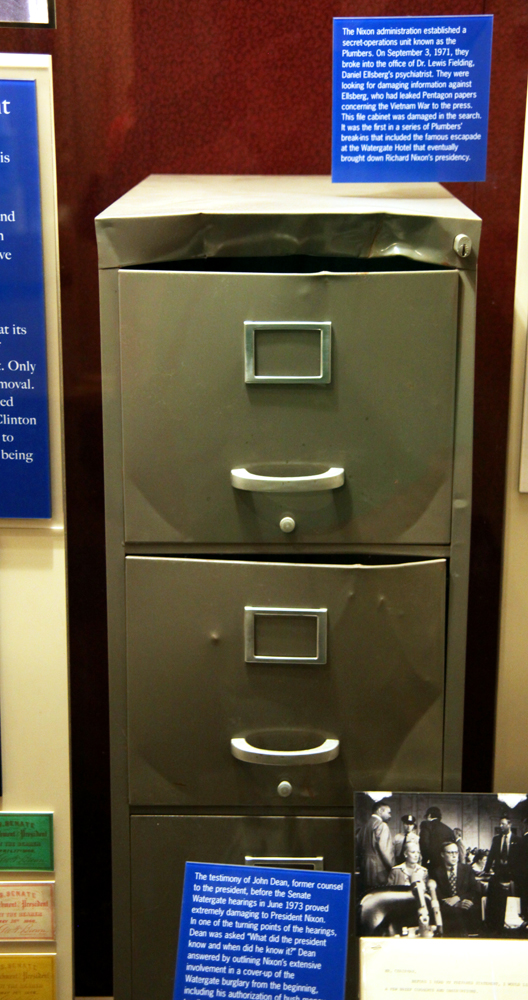
Daniel Ellsberg’s Filing Cabinet at the Smithsonian
The corporate media became fixated on an aspect of Chelsea Manning’s defense by attorney David Coombs, that he suffered from gender identity disorder, after the verdict was rendered Wednesday. It’s news that Manning read a statement titled, “The Next Stage of My Life,”on the NBC Today Show yesterday. What is getting lost in the media frenzy is what Manning did, and whether his time served is adequate punishment.
If Manning had done nothing more than release the video clips of the July 12, 2007 Baghdad Airstrikes to Wikileaks, history would have been well served. (Note: the videos linked at these websites are graphic depictions of modern warfare, and not suitable for all audiences).
Manning also released 250,000 U.S. diplomatic cables, and 500,000 army reports that came to be known as the Iraq War logs and Afghan War logs. He was a whistle blower on what he felt was, and clearly were, war crimes. In the Uniform Code of Military Justice, whistle blowing on war crimes is permissible, and encouraged, at least it was when the author was trained in the post-My Lai massacre military.
By the sheer volume of documents released to Wikileaks, all of which Manning could not have read, she showed recklessness that equates to the criminality for which she was tried and convicted. That she got caught by writing about what she did in an Internet chat room demonstrated the naivety of youth. Unlike the actions of our military, that’s no crime.
According to the Guardian, here’s where things stand:
“A court-martial sentenced Pfc. Bradley Manning to 35 years in prison for leaking government secrets. Manning is to be dishonorably discharged. He loses all pay. He is convicted of six Espionage Act violations. The sentence is expected to be appealed.
Manning, 25, is eligible for parole. He must first serve at least a third of his sentence. He has more than three years’ time served and has been credited 112 days for his “inhuman” treatment in a Quantico brig in 2010-2011. In a best-case scenario for Manning, he might be released before he turned 35.
The sentence was “more severe than many observers expected, and is much longer than any punishment previously given to a U.S. government leaker,” the Guardian’s Paul Lewis writes.
Judge Denise Lind announced the sentence in a hearing that lasted about two minutes. Manning had no visible reaction to the verdict. There were gasps from the crowd. As Manning was led out, supporters shouted “we’ll keep fighting for you, Bradley,” and “you’re our hero.”
The ACLU, Amnesty International and other rights advocates and Manning supporters decried the verdict. It is unjust for Manning to spend decades in prison when the perpetrators of the wartime atrocities he exposed go free, Manning supporters argue.”
Chelsea Manning is expected to request a pardon from President Obama, who is expected to deny it.
A 35-year sentence is harsh, as were the conditions of 1,293 days of pretrial imprisonment. Courage to Resist and the Bradley Manning Support Network provided pretrial support to Manning, and are expected to continue supporting her. The sentence won’t deter whistle blowers.
The question posed by Chelsea Manning’s actions is one we all must answer for ourselves. When there is wrong in the world do we attempt to right it? Although Manning, like every human, is imperfect, if we don’t try to right wrongs in our lives, who will? That’s why I too am Chelsea Manning.
Wednesday, the Washington Post published an Ezra Klein interview with former vice president Al Gore, titled, “Al Gore explains why he’s optimistic about stopping global warming.”
Gore finds there is reason to be optimistic that public sentiment is changing regarding the rapidly increasing amount of CO2 in the earth’s atmosphere and the fingerprints of man-made pollution found in severe weather occurring around the world. While climate deniers get upset, even outraged when people mention this fact, Gore believes it is possible to win the conversation on climate change. What does he mean by that? He explained,
I think the most important part of it is winning the conversation. I remember as a boy when the conversation on civil rights was won in the South. I remember a time when one of my friends made a racist joke and another said, hey man, we don’t go for that anymore. The same thing happened on apartheid. The same thing happened on the nuclear arms race with the freeze movement. The same thing happened in an earlier era with abolition. A few months ago, I saw an article about two gay men standing in line for pizza and some homophobe made an ugly comment about them holding hands and everyone else in line told them to shut up. We’re winning that conversation.
Winning the conversation on climate change means making it socially unacceptable to deny the science of man-made global warming pollution. According to Gore, “the conversation on global warming has been stalled because a shrinking group of denialists fly into a rage when it’s mentioned.” Focus on the word shrinking.
“… in spite of the continued released of 90 million tons of global warming pollution every day into the atmosphere, as if it’s an open sewer, we are now seeing the approach of a global political tipping point.”
According to Gore, it has already begun among politicians, including conservatives, who have grown weary of politicization of the science of global warming by climate deniers.
Another reason for optimism is the sharp and unexpectedly steep decrease in prices for electricity produced from wind and solar, providing a financially viable alternative to fossil fuels.
Some people really dislike Gore and what he represents. The film “An Inconvenient Truth” prompted some of this reaction,
The single most common criticism from skeptics when the film came out focused on the animation showing ocean water flowing into the World Trade Center memorial site. Skeptics called that demagogic and absurd and irresponsible. It happened last October 29th, years ahead of schedule, and the impact of that and many, many other similar events here and around the world has really begun to create a profound shift.
The truth about the man-made contribution to climate change is out. As it is understood, Al Gore’s optimism is expected to be vindicated.
Read the entire Ezra Klein interview with Al Gore on the Washington Post site here.




 Journey Home
You must be logged in to post a comment.