CEDAR RAPIDS— Vehicular transportation is required when a person lives in rural Iowa. Horses and bicycles won’t do, so there are trucks and cars. A year ago I bought a 1997 Subaru Outback Legacy to get me around, and it has been a serviceable vehicle. It was popular in its day, and remains so.
Most repairs can be effected by a mechanic in town, but a few items require the dealership support of trained mechanics, certified parts and the latest diagnostics. It’s an example of accessing the global supply chain and technical support staff. I seldom, if ever, want to make the trip, but am there now, using ultra slow WiFi to connect to the Internet while I wait.
The days are filling up with activities, but the whole system depends, upon getting around and hauling stuff with me. At least there is coffee.
LAKE MACBRIDE— The winter of thinking and planning is over, leaving the doing and its requisite long days and short nights.
Yesterday began at 5 a.m. with finishing my newspaper article about the forestry meeting in town. Afterward, I spent a couple of hours at the farm, worked a shift at the warehouse, and attended a meeting about the global roll out of a nuclear abolition initiative with Rotary International. I returned home at 9:30 p.m. It was a long day.
Rotary International is engaged in its final work to eradicate polio around the world. What’s next for them may be working with others to bring an end to nuclear weapons. I signed up as one of three Iowa speakers for International Physicians for Prevention of Nuclear War, and its U.S. affiliate, Physicians for Social Responsibility, as we seek to engage Rotary Clubs worldwide. Rotary International and the International Red Cross Red Crescent Societies are the only non-governmental organizations recognized by the United Nations, and both have expressed an interest in nuclear abolition for humanitarian reasons. This is a really big deal, even if we don’t hear about it in the U.S. corporate media. I am thankful to be a small part of it.
The seeds planted indoors have sprouted. The growing season has begun.
LAKE MACBRIDE— The talk of raising the minimum wage to $10.10 per hour, as President Obama suggested in his state of the union address, is from another country. He means well, but at $10.10 per hour, a life is hardly sustainable, even with overtime. What would better serve low wage workers is lifting the entire economy, combined with reducing regulations that hinder the efforts of small scale entrepreneurs. Where I live, the future is not about wage rates as much as it is about putting together a life that may include a job or jobs, but is not dependent upon them. Sustainability will be about creating local answers to the question, how shall we live?
The current discussion about wages is not really about sustainability. It is about boosting income for lowly paid workers. There are arguments that posit a relationship between increasing the minimum wage and reducing poverty. If increasing the minimum wage is an anti-poverty program, then I’m all for it. Especially if we agree that the action would not address the overall struggle people have to exit working poor status. Unless our elected officials index any potential increase in minimum wages to a formula that tracks buying power, all that will have been accomplished by raising the minimum wage is to throw the working poor a bone for today’s soup pot.
When I was a child I asked my father if we were poor. He said being poor was an attitude, and he did not consider our family to be poor. As I wrote elsewhere, “I had a normal city childhood among people who never had much money, but had a well defined culture centered on family, work and church.” It’s the presumptions about how today’s culture is defined with regard to the minimum wage that drive me mad.
Robert Reich has written that wages should track the economy. He said, if people have money to buy things, the economy does better. Government plays a role in stimulating the economy by making monetary payments to individuals through social programs, giving them more money to spend. Yet, most people I know don’t look at living with the same macroeconomic view Reich espouses, and are not fans of consumerism. Everyone wants to be a global strategist, but few want to apply equal skill and energy to improving life on a more granular level.
The analysis local people use, one that starts spending the new money that an increase in minimum wages would generate on education, training and the like, is ridiculous. People who are working poor, or living from paycheck to paycheck, already know how they will spend any extra money that comes into a household budget. The annual five or six thousand dollars we are talking about, in many cases, has already been spent on loans, medical bills, using credit cards, and incurring other forms of debt that are part of how people make cash flow without adequate income. To say that a $2.85 per hour increase in minimum wages would enable the working poor to exit poverty and join the middle class reflects a basic lack of understanding of the situation.
Advocating for an increase in the minimum wage is okay for those who are financially established, but it is a middle class progressive perquisite. Where I have trouble with it is in differentiating myself from the rest of the people on the planet as someone who is better than anyone else. I don’t do everything I would in the community; I wish I could do more. I also believe someone has to be working on a granular level to find a sustainable, replicable answer to the question, how shall we live? There is not much pay in doing that.
LAKE MACBRIDE— We had just made it home from dinner at a relative’s home when the wind picked up. We timed the visit so as to return before yesterday’s storm. When we got in, the windows rattled while a neighbor’s wind chimes clanged in the stiff breeze. Snow blew all night, covering our tire tracks leading to the garage. “Blizzard conditions, strong winds and life-threatening wind chill values (were) all possible in Iowa on Sunday,” according to the National Weather Service. This morning, the wind has died down, leaving temperatures below zero and the driveway to shovel.
Two new paying jobs are in the works. I am officially a newspaper correspondent. The publisher gave me a couple of story assignments on a trial basis. There is a school board meeting in the county seat tomorrow, and a city council meeting the following week. I’m to write a brief article about the events for publication in our local papers. Saturday morning I spent an hour training with one of the editors, talking about process and expectations. I’m looking forward to the challenges of a new form of writing. As she said Saturday, the pay is pocket change.
The other new job is as a shift supervisor at a warehouse club in Coralville. I will be part of a three-person management team for a company that does in-store product demonstrations. It has been a very social job, comprised of constant interaction with retail shoppers. I enjoyed that aspect of the work during my first week’s training. With the new work, about 85 percent of the year’s expenses are funded, which means the hunt for more paying work will continue.
Hunt for Revenue
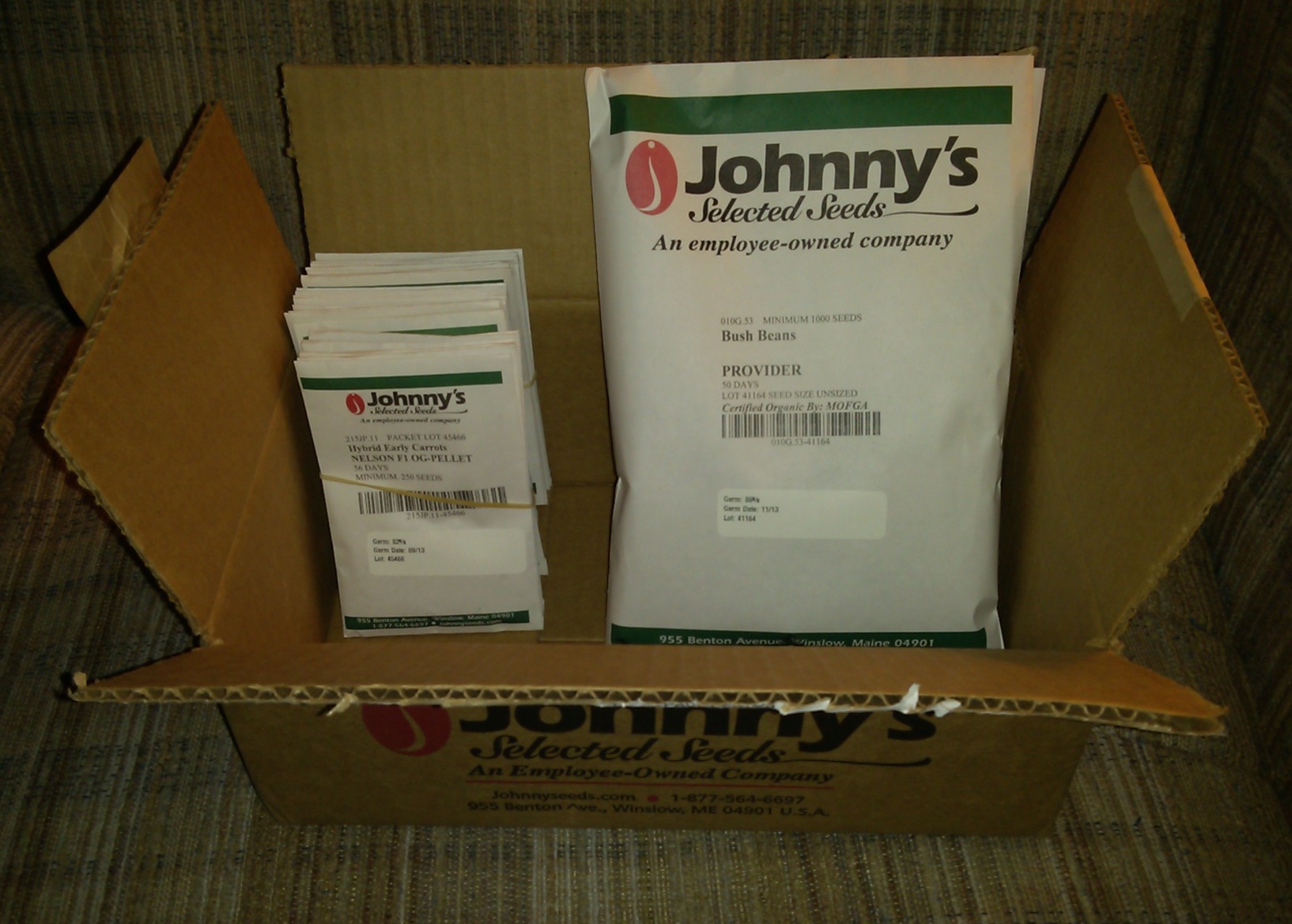
Final news of the weekend is the seed packets arrived on Saturday. By my grandmother’s oral tradition, the time to plant “Belgian lettuce” is March 2, so there is plenty of time to write a plan for the garden. Last year, the ground was still frozen on March 2, and with the crazy weather we have been having during recent years, I won’t predict. As soon as the ground is workable, I’ll plant the remainder of last year’s lettuce seeds in a tribute to Grandmother.
Seeds Have Arrived
I bought celery seeds, and am looking forward to the experiment in growing this vegetable. There are also a lot of carrot seeds, seven varieties of tomatoes, six varieties of peppers, and much more. I have worked a garden of some kind every year since our wedding. This year’s garden is expected to be another layer of refinement in a process that has developed steadily over more than 30 years. I’m looking forward to setting up the table near the south-facing window to start seeds indoors again. Simply put, there is hope on Monday, after the storm.
LAKE MACBRIDE— By the time I returned from military service and finished my master’s degree in 1981, American businesses were well into shedding the costs of human capital. I have pointed to the Reagan administration as a driver of this phenomenon, and will continue to refer to the post-Reagan era, but it began much earlier than that.
When I was ready to start a career, there were no local and viable opportunities for a job that offered what I expected in a benefits package, a pension or substantial retirement plan. The government job I took did not offer health insurance, or a retirement plan. If I thought about retirement at all as a 30-something, I relied on Social Security and Medicare to keep me out of poverty in old age. I still do.
The private company I picked when I left government had a marginal retirement plan, based on profit sharing. They developed a 401k plan when the 1978 IRS change began to be spread throughout private industry in the mid to late 1980s. 401k plans served to limit a company’s pension liabilities. Businesses then began to reduce the cost of health insurance and other payroll benefits.
Today, businesses continue to seek ways to shed the cost of human resources through outsourcing, off shoring, the use of temporary workers, and subcontractors. They also hire consulting firms that specialize in compensation programs, making sure that employee wages are kept consistent with the marketplace, namely lower than what a company might develop organically. To think pay and benefits offerings would return to the 1960s, when good-paying union jobs were available, would be to deny the reality that is today’s work environment.
A friend posted a link to an article titled, “Forever Temp?” that discusses manufacturing’s movement toward temporary workers. It is worth reading. The benefit of temporary workers is substantial for businesses. The cost of training, worker’s compensation, absenteeism, recruiting, personnel and existing employer-employee contracts can be avoided. This practice is so common that moral outrage over the loss of union jobs with good benefits is worn out. Temp workers are the new normal.
Perhaps the expectation that a person could enter a career and work in it until retirement is misguided. There are some cases where it is possible, but not for the vast majority of Americans. What matters now, is whether a job will persist, whether a paycheck is accurate and paid on time, and that there is a commitment to safety in the workplace. All of these things workers in the recent past used to take for granted, but now rely upon government intervention, rule making and enforcement.
Truth be told, I’d rather deal with the uncertainties of the current economic environment than become wrapped in the cocoon of the work-a-day world for low pay. I’d rather be prepared to make it on my own.
LAKE MACBRIDE— My earliest memory of Nelson Mandela, who died yesterday, is associated with the image printed on this button. At the time, South Africa seemed like a remote corner of the world, and there were other substantial, and more local, social justice issues with which to be involved during and after I attended college at the University of Iowa. I recall President Reagan’s veto of the Comprehensive Anti-Apartheid Act in 1986, and for me, it typified what was wrong with that administration. I supported the act and congress overrode the president’s veto. Others have said more eloquently what I would, may Nelson Mandela rest in peace, and may his legacy live long.
On Thursday, I had breakfast at Sykora Bakery in Cedar Rapids, interviewed for a low wage job, attended a lecture on the nuclear disaster in Fukushima, visited my congressman’s local office, and met with my insurance agent to attempt to finalize health and dental insurance policies for 2014 during open enrollment. It was a busy day and a mixed bag.
After spending most of the last four and a half years working in low wage jobs, one would think I would have a clearer view of the challenges of low wage workers in Iowa than I do. Having given it some thought overnight, a little clarity appeared.
There is a role for government in low wage work, and it is less about fixing a higher minimum wage, and more about providing part of the social safety net. Government programs like Social Security, Medicare, Medicaid, SNAP and others matter a lot. The work of the U.S. Department of Labor provides worker protections for low wage workers. What matters more is its help in transitioning from lowly paid work to something better, and breaking out of the low wage environment.
Unions have become mostly irrelevant to low wage workers. According to the Bureau of Labor Statistics, in 2012, 6.6 percent of private sector workers were members of a union. The idea of unionizing minimum wage workers like those at fast food restaurants, is ridiculous because of the high turnover. This is especially true in the current regulatory environment. Like it or not, market conditions will set the pay and benefits of most lowly paid jobs, while unions watch as bystanders. As someone who recently sought and found a number of low wage jobs, if a person works at it, they will seldom have to compromise for minimum wages.
Anyone who is paying attention knows that in making a living, money is one of many components, and not always the most important one. The lower on the socioeconomic scale one falls, the more money helps, but the less it matters as one draws increased support from a social network.
So that’s where thing rest on Friday morning. I need to quit resting and get after it.
LAKE MACBRIDE— The stack of holiday requests for money is growing, and this year there is not much extra to spread around, which makes the picking easy. In fact, besides paying annual dues to a couple of national organizations, no other organization will be getting anything. That’s the way it is going this year.
The last of the red delicious apples were used for a family dinner on Sunday, ending the Thanksgiving holiday season cooking with a few extra pounds of weight and a refrigerator full of leftovers. Or, as I posted on twitter, “baking apple crisp for family dinner across town. #localfood is great, but done with cooking in favor of leftovers for a long, long while.” While preparing a menu for our Thanksgiving meal, I realized how much food we have in the house, and it’s a lot, especially if one likes daikon radishes. We won’t have to buy many groceries except milk, lemons and limes between now and New Year’s Day. That frees up time for other things.
What are those other things? A short list includes finalizing a decision about our health and dental insurance during the annual open enrollment period (I’ll post about that when I do), cleaning house with my spouse, decorating for the holidays, and most importantly building a business plan for 2014. If 2013 was a hodgepodge of turbulent activities, I expect next year to be more orderly and sensible. The key aspect of the research and development of a business plan is networking with people to identify opportunities. In practical terms, that means becoming more social, and instead of turning down invitations, accepting them more. The agenda will rapidly become packed.
This also means keeping to my schedule of devoting a few hours each morning to writing. Not only here, but a larger project, the results of which I hope to self publish on Amazon.com. More on that as the plot thickens, literally.
Lastly, I attended an event with our U.S. Congressman Dave Loebsack yesterday. It is something to see the changes in him since he was a college professor challenging a 30-year incumbent, and he got excited and involved every time a person wrote a letter to the editor supporting his campaign, to someone who wants to get re-elected and has to deal with more than 750,000 constituents.
The League of Conservation Voters, that evaluates members of congress on environmental issues, gave Loebsack an 87 percent lifetime score, which means his views are similar to mine when it comes to his voting record. The only higher score in the Iowa delegation is Rep. Bruce Braley at 88 percent. U.S. Senator Tom Harkin is rated at 93 percent in 2012, with a lifetime score of 83 percent. The Republicans in the delegation are scored very low. Loebsack’s 2012 score is 69 percent, which reflects his growing movement to the center based upon having a much different district than he did when we first elected him in 2006.
What that means is on rare occasions like yesterday, when I get one-on-one time with him, I feel a need to briefly and succinctly talk about the need to put a price on carbon. I believe he shares my views, but has to suppress them in a move to the center to get re-elected. Among the many things he said during his remarks yesterday, was that he wanted to get re-elected, and the district has diverse views. I too would like to see him re-elected.
December will soon be gone, but there is a lot of living to do before it ends. Better get to some of that post haste.
LAKE MACBRIDE— With the Thanksgiving holiday upon us, thoughts turn to turkey in a lot of households. Unlike during most of our vegetarian holidays, I am dealing with 100 locally grown, free range slaughtered birds tomorrow. Along with others, we are taking delivery from a local farm, sorting and weighing, and preparing them for delivery in the CSA shares next week. I’ve never been a dead (or live) turkey wrangler before, so despite the implications, I am looking forward to a new experience.
We see a lot of wild turkeys near our home. Mostly, they browse in the field near the lane to the highway, or are seen flying over the road. For those of us that remember when Iowa turkeys were an endangered species, it is always a happy sight. But enough turkey talk.
If the farm work has been winding down, it comes to a halt after delivering the final shares on Tuesday. We’ll settle up and settle in for winter. That it’s snowing as I write this post is a sign of the time of year. Confronted with the end of year holidays, it’s time to take stock of home life and work life, and make plans. This year’s planning will be as important as in any previous year.
Home life is patterned by habits formed over a lifetime: more indoor work— cooking, cleaning, writing and reading— and the part of work life devoted to research and development— studying opportunities and determining viability. As with most who live an alternative lifestyle, funding cash flow during 2014 will be a pressing issue, although I am not yet willing to sell plasma to do so.
If 2013 was anything, it was an experiment in lowly paid work, first in a warehouse, assembling kits for Whirlpool, and then on a number of farms. What I’ve found is my aging frame can take the work, but there are limits to how the tendons and muscles can tolerate increased physical activity. I am optimistic about performing physical work in more active jobs.
That said, I don’t plan to return to the warehouse, even though they invited me to return when the farm season was finished. The pay was low, and the social networking not good enough to distill further benefit. So what’s next? That’s the question for answering during the next few weeks. There are ideas, but no plans yet. I am thankful for the ability to be in this position as the snow falls and winter approaches.
LAKE MACBRIDE— While we were washing root vegetables, the ambient temperature started at 34 degrees and made it to 51 by the end of our shift. A cold, wet day that yielded the soundest sleep I’ve had in a long time. My hands are chapped, and application of lotion and salve to re-moisturize them has had no effect. The repetitive motion of grasping a carrot and squeezing the water nozzle to wash it would be problematic if continued. Once the carrots are washed, it’s done for 2013.
As a paid farm hand, my view of local foods production is different from the farm owners and managers. Where there is inefficiency, or extra production, there is an opportunity to perform paid work.
Part of local food production is a constant discussion about how to improve efficiencies, and my participation is welcome. However, each planting, at each step of the process, is surrounded with a complex mix of issues, challenges, techniques and possible courses of action. In order to answer a question, broad experience is needed, and usually, I don’t have much to add.
The season is winding down, and eventually the crops will be harvested, prepared and distributed, hopefully by Thanksgiving. It will be time to move on, richer in knowledge and experience if not in money. That matters in our life on the Iowa prairie.
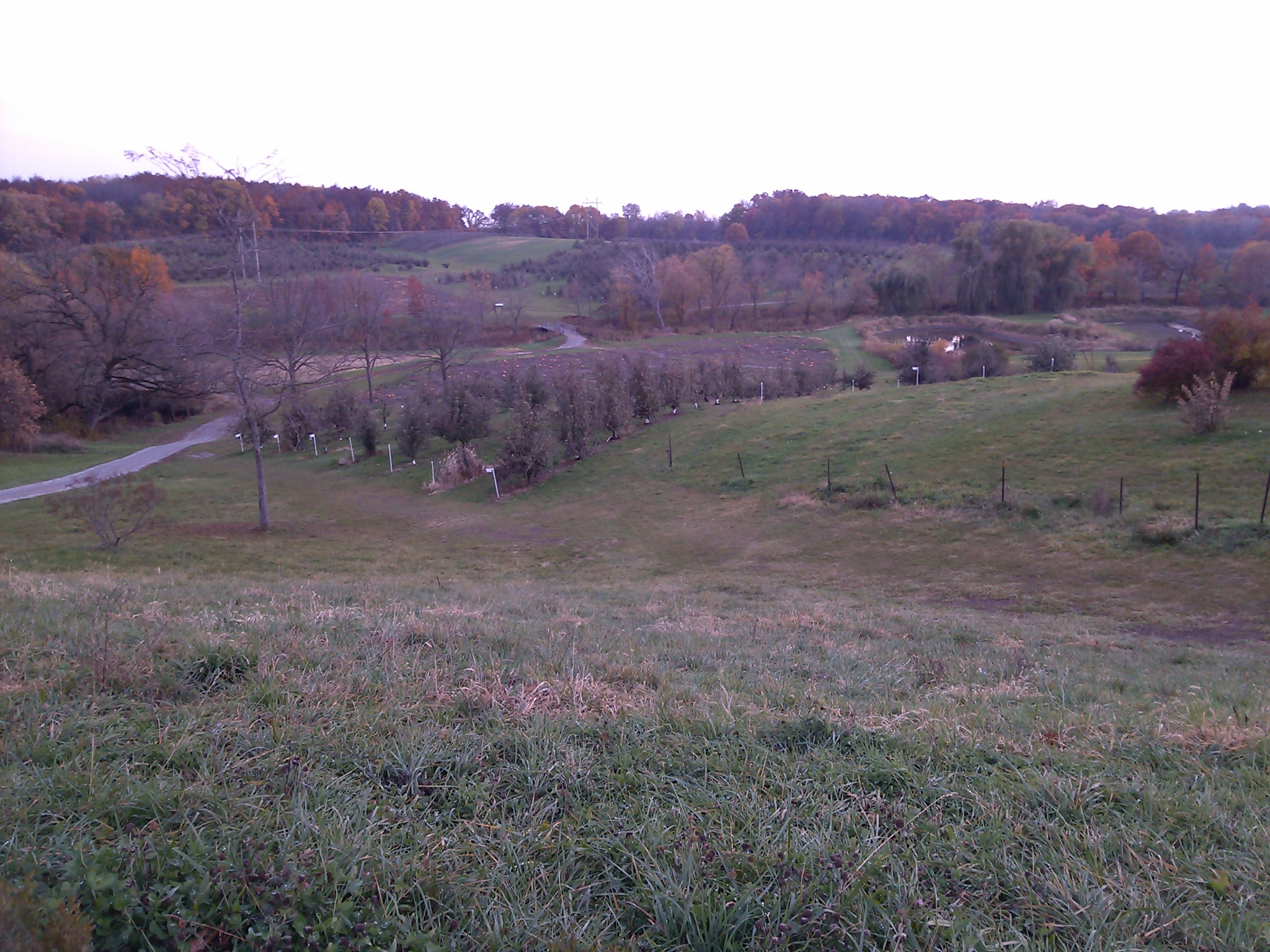
RURAL IOWA CITY— Thursday was the last day of the 2013 u-pick season at Wilson’s Orchard. There were a few cars in the lot, and pumpkins displayed outside the sales barn. Out back, the flatbed truck was loaded with a tall pile of pumice left from apples just pressed for cider. Inside, there were five or six types of apples in the cooler, along with cider, apple turnovers and the numerous items in the gift shop. An employee was positioning apples slices on a dehydrator shelf. There was a sense in the air of counting the hours until closing up shop for the season. 2013 has been a great year for apples.
Stopping on the last day is a habit worth forming. It has the potential of being a personal tradition— the kind we build our lives around. I hope to work at Wilson’s Orchard again next season.
The Gold Rush apples are not in yet. They have parentage of Golden Delicious and were cultivated for their long storage properties, perhaps as long as seven months. It will be the first year we tried them, and it is only one of many varieties sampled this year. I’d say they are delicious, but that would be an apple joke. According to a colleague, the chief apple officer will pick them from the Solon orchard next week, and they will be available for purchase on Nov. 16-17 when the sales barn is open for holiday shopping.
Pumpkin Display
During 2013, Wilson’s Orchard was a local phenomenon. People came from all around the area to pick apples, seeking the fruit, but also family entertainment. Being the mapper, and later in the season, one of four tractor ride drivers, I was part of the show and met people from all over, each with a personal story about what brought them to the orchard. It was great fun, and one of the best work experiences I’ve had since leaving my career in logistics and transportation. The intersection of apples, farming, small business management, customer relations and speaking opportunities hit my sweet spot.
At the end of the season, this unique experience stands out, and hopefully will live long in memory. Lessons learned there will be applied elsewhere in a life on the Iowa prairie in a turbulent world.








 Journey Home
You must be logged in to post a comment.