Categories
Social Commentary

Navigating Health Insurance Change – Part 2

Insurance Agent Office

LAKE MACBRIDE— While gaining an understanding of how the health insurance exchanges may change our family budget, I decided to wait until the government worked through the initial computer problems evident at the start-up of open enrollment. Last night, the glitches seemed resolved.

I logged on to healthcare.gov, created an account, applied, determined eligibility to choose a plan from the market place, live chatted with an agent who offered to have a specialist call me within 48 hours, and was ready to hit enroll on a plan (I didn’t) in less than 40 minutes. Given the challenges of the questions asked, the online experience met expectations.

When saying there were challenges, what I mean is  a projection of 2014 household income is required to complete the application. That may be easy for a wage worker in steady employment, but for self-employed people it can be a bit of a WAG (wild-ass guess).  Most people who work low wage jobs are focused on getting through the present and income forecasting is unfamiliar territory. We know how much we need to earn, but that is different from creating an accurate forecast of what we will earn, which is the question the ACA application asks.

There is an option to check a box that says, “I don’t know.” Because of the tax implications of the ACA, more specificity in the application can make it easier come tax time. That is, what we submit on the application impacts what, if any, tax credits might be available for the year. If we get it wrong, we will have to reconcile the tax credits taken to subsidize premiums with the government based on actual income. If income is understated, we may have to reimburse the government for part of the tax credit. The tax credits are an important consideration in the application process, as it impacts net health insurance policy pricing.  I plan to discuss this aspect of the application process with an ACA specialist in hope of getting it right, so I can take the tax credit now, and not have to reimburse it when we file our 2014 tax return.

Something else that wasn’t expected was that only one of the two of us was eligible for a policy through the exchange. We expected to change to a family policy, not two individual policies and this introduced another variable in the evaluation process. After resolving how to project income for 2014, I will ask my individual health insurance policy agent about costs for a replacement policy for one of us. Based on similar situations with which we are familiar, we could still save about $100 to $200 per month over our current health insurance premiums. It is worth pursuing.

As I mentioned in the first post about navigating the change in health insurance, getting facts and working through them is essential, and there is no hurry to make a bad decision. In a society where instant gratification is the expected norm, spending this time runs against the grain. However, it is the only rational way to make a decision, and some of us still believe using reason and common sense when making a decision that impacts our family still matters.

Categories
Social Commentary

A Minimum Standard of Living

Blog Action Day GlobeLAKE MACBRIDE— If there is a right to a standard of living in the United States, one wouldn’t know it. In vague cultural terms rests an idea of fairness, that each of us will have an opportunity to pursue our dreams as individuals. For so many, threats against our personal security, lack of economic means, and inadequate access to food, shelter, clothing, medical care and social services prevent the pursuit of anything but survival. For some, that has to be enough.

Government helps, but is constrained by what is politically achievable. During this year’s state of the union address, President Obama called for an increase in the national minimum wage from $7.25 to $9 per hour. He said, “we know our economy is stronger when we reward an honest day’s work with honest wages.  But today, a full-time worker making the minimum wage earns $14,500 a year.  Even with the tax relief we put in place, a family with two kids that earns the minimum wage still lives below the poverty line.  That’s wrong… We should be able to get (an increase to $9 per hour) done.”

It hasn’t happened yet, and in any case, what a slap in the face. While raising the minimum wage would provide some help to people who are working poor, not enough help to reach a standard of living one expects in a nation like ours. Change the hourly amount to a so-called living wage, or a family wage, and it would not be much better. These things are intellectual constructs that have little to do with the way people live, and in any case there is more to life than wages in a system rigged to benefit the wealthiest among us.

According to Article 25 of the United Nations Universal Declaration of Human Rights, “everyone has the right to a standard of living adequate for the health and well-being of himself and of his family, including food, clothing, housing and medical care and necessary social services, and the right to security in the event of unemployment, sickness, disability, widowhood, old age or other lack of livelihood in circumstances beyond his control.”

In our country, government imperfectly picks up part of the responsibility for a minimum standard of living, and there are those who say government provides too much. That leaves provision of a standard of living up to each of us and to those we hold dear. As we consider standard of living as a human right we first have a duty to ourselves. It is to provide for ourselves so we can provide for others.

If you are reading this post, consider that you have a standard of living enabling you to give something to others. Give of yourself, to someone who needs it, be they family, friend, neighbor or stranger. We would do this not for ourselves, but to lift us all up in community. A place where standard of living would be measured by what we do together.

Categories
Social Commentary

Navigating Health Insurance Change

Wellmark PhotoLAKE MACBRIDE— As a self-employed writer and farm hand, having health insurance means buying an individual policy in the marketplace. The implementation of the Affordable Care Act’s (ACA) health insurance exchanges and initial open enrollment beginning Oct. 1 was a precipitating event for me and for others. There will be changes and some of them have little to do with the ACA.

There is a pent up demand in business to shed the cost of providing health insurance for employees, or to make it a fixed financial benefit. Already after Oct. 1, there is anecdotal evidence that small businesses are pulling the plug on group policies, and large businesses, like Mercy Medical Center in Cedar Rapids, are changing the rules for insurance benefits to exclude part time employees who are currently covered. If there is a way to stabilize or reduce the cost of having employees, businesses will find it, and the ACA appears to be providing the whipping post for moving forward to meet this long-standing want. Corporations and small businesses appreciate the opportunity this major cultural event represents. The days of employers providing health care to employees as a basic benefit are ending, if not over.

Wellmark Blue Cross and Blue Shield, Iowa’s largest health insurance provider, decided not to join the Iowa health insurance exchange during the first year. The expectation is the company will apply to be part of the exchange beginning Jan.1, 2015. In an interview with the Cedar Rapids Gazette last July, Wellmark CEO John Forsyth said, “the company was concerned about the lack of information available and the roll out of the exchange in Iowa.” Forsyth was skeptical of the federal government’s ability to implement the ACA smoothly. In addition to some website glitches in early October, some of the rule-making is incomplete. Wellmark’s decision is understandable from a business perspective, and the impact is that the network of health care providers available in the exchange during 2014 may be significantly reduced without Wellmark’s participation.

What’s a person with an individual health insurance policy to do? Wait. First, wait until December to look at joining the exchange on Jan. 1, 2014. Perhaps some of the details like provider coverage will be better identified to make the consequences of changing more understandable. Second, someone who has a grandfathered plan (no changes in policy since President Obama signed the ACA), may not want to change until there is more certainty about the outcome. The open enrollment period goes through March 2014 during the first year. Take advantage of that extra time. Third, resist the efforts of Wellmark and other providers to rush a decision to remain the same, or lock in rates. Whether or not the Iowa insurance exchange will offer lower rates for equal coverage is uncertain. No reason to make a decision until one gets enough facts about the rates and coverage, and compares apples to apples.

There were five insurance company sales representatives in a health care reform seminar last week, compared to yours truly as the only member present. Organizations who sell health insurance have a lot to lose with implementation of the ACA, and the move to a marketplace. These insurance agents answered all of my questions, and the information provided will help in making a decision about health insurance. Getting facts and working through them, as I did, is essential in navigating change in health insurance, and there is no hurry to make a bad decision.

Categories
Kitchen Garden Social Commentary

At the Farm Bureau Annual Meeting

Resolutions
Resolutions

NORTH LIBERTY— Craig Hill, Iowa Farm Bureau Federation president, spoke last night at the annual Johnson County Farm Bureau meeting. What he said was surprising. He acknowledged that the lack of adequate regulation of air and water quality in China was problematic if people wanted to breathe and drink clean water. Specifically, he pointed to the pollution of coal-fired power plants in and around major population centers. He also commented on the poor water quality. He didn’t go so far as to say more regulation was needed, but for him to acknowledge these problems with this audience of anti-EPA folks seemed remarkable to me. One can only ignore the pollution of our air and water for so long, until action eventually will be required. If he didn’t say it that way, it was only a matter of degrees of separation of our positions.

The annual meeting is the only place I go where we take time to hear introductions of an organization’s insurance sales staff. They all seem nice, and competent, but seriously, there is only so much time and so much to do, why this? The answer is that my health insurance premiums through the Iowa Farm Bureau are the single biggest household expense we have. It is important to tune into what the organization is doing at least once a year. There is also a free meal, which is distinctive in its roots on Iowa farms. Too, as the years add up, I am getting to know more people who attend this event. Attending the annual Johnson County Farm Bureau meeting has become a part of living in rural Iowa.

Categories
Living in Society Social Commentary

Hope for a Small Town

Onion Work
Onion Work

Whether it was the high school football game between Regina and Solon, or the new restaurant and microbrewery, Main Street was hopping when I returned from the political fundraiser in Coralville. Cars lined the streets and people were standing at the intersection of Main and Iowa Streets. That hasn’t happened for a long time. Perhaps there is hope for the future of small towns.

My state senator’s birthday party/fundraiser has been an annual event for 27 years. 90 minutes dovetailed with some necessary errands, it was a great way to catch up with friends made during past political campaigns. We learned our U.S. representative is now a Costco member, and he and his spouse were planning to go there after the event. No talk of Syria, or really anything political from the congressman. This group is his home constituency, and we get it that there is more to life than politics. There has to be since the 113th U.S. Congress isn’t doing much. Senator Bob Dvorsky announced he was running for another term.

Onions
Onions

My day was spent at the farm cleaning onions. The work was not complicated, removing the top and roots, inspecting and sorting. The day passed quickly, and afterward, at the convenience store in town, the clerk called me, “hun.” Short for honey and a term of familiarity for locals, one of which I have become.

Categories
Social Commentary

An Iowa View of Syria

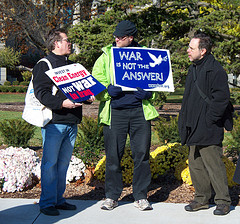
War is Not the Answer(UPDATE: Sept. 4, 2013, 3:30 p.m. CDT: A new report from Russia, including a 100-page United Nations report on the chemical attack at Aleppo, Syria, indicates non-standard Syrian chemical weapons used in attack. Russian analysis suggests Syrian rebels may have launched a chemical attack, rather than the Syrian government. Click here to read more).

The horrific use of chemical weapons in Syria is a violation of international law and a crime against humanity. President Obama was right when he said, “in a world with many dangers, this menace must be confronted.” Where he was wrong was when he said, “the United States should take military action against Syrian regime targets.”

A couple of things don’t matter about the American response to Syria’s use of chemical warfare against its citizens.

The commentary from the right is the usual anti-Obama anything parade of made up crap. Former U.N. ambassador John Bolton said to FOX News, “the White House candy store is open,” meaning the Syria vote agreed by Democratic and Republican leadership in the U.S. house and senate will become yet another round of congressional political swaps of votes for pork. Some on the fringe even say Obama is using Syria to distract from fake scandals in his administration. The whining voice of the right and its fringe don’t matter because the public is tuning in.

President Obama differentiates between an aerial bombardment and boots on the ground. Only the most cynical or naive among us don’t understand these are two aspects of the same thing. He said, “our action would be designed to be limited in duration and scope.” All wars are, and this one would be no different in that regard.

What matters, that isn’t being said much, is as my colleague at Physicians for Social Responsibility, Dr. Robert Dodge, wrote in the Huntington, W.V. News, “the military intervention being debated is not intended to end the violent conflict that has killed more than 100,000 Syrians. It won’t help the nearly two million Syrian refugees return home or get the more than 6.8 million people in need access to humanitarian aid.” These are real people with real needs, and little assurance that an American air strike will benefit them in tangible ways. Our recent and costly invasion of Iraq stands as an example of how U.S. military adventurism does little for people outside a small group of war profiteers.

It must be tempting to think U.S. intelligence knows where Syrian weapons of mass destruction are located, enabling the targeting and destruction of their government’s capabilities. But things go wrong, more often that we would like.

Individuals in the Syrian government committed a crime when they used chemical weapons against a group of Syrian citizens that included children. We have courts to prosecute such criminals, beginning with the International Court of Justice. The International Court of Justice is where this crime should be confronted.

An invasion of Syria, and that is what a target air strike would be, would perpetrate more violence in an already war torn country. Iowans may be able to tune out the world for a while, but we must resist what our government does in our name. For my part, I join with the Quakers who wrote, as one of 25 non-governmental organizations, this open letter to President Obama reiterating the notion that war is not the answer:

August 28, 2013

Dear President Obama,

We, the undersigned organizations, are writing to express our grave concerns with your reported plans to intervene militarily in Syria. While we unequivocally condemn any use of chemical weapons along with continued indiscriminate killing of civilians and other violations of international humanitarian law, military strikes are not the answer. Rather than bringing an end to the violence that has already cost more than 100,000 lives, they threaten to widen the vicious civil war in Syria and undermine prospects to de-escalate the conflict and eventually reach a negotiated settlement.

In the course of more than 2 years of war, much of Syria has been destroyed and nearly 2 million people- half of them children- have been forced to flee to neighboring countries. We thank you for the generous humanitarian assistance the US has provided to support the nearly 1 in 3 Syrians- 8 million people- in need of aid. But such assistance is not enough.

As the U.S. government itself has recognized, there is no solution to the crisis other than a political one. Instead of pursuing military strikes and arming parties to the conflict, we urge your administration to intensify diplomatic efforts to stop the bloodshed, before Syria is destroyed and the region further destabilized.

Sincerely,

Friends Committee on National Legislation
American Friends Service Committee
Church of the Brethren
Code Pink
CREDO Action
Democrats.com
Fellowship of Reconciliation
Global Ministries of the United Church of Christ and Christian Church (Disciples of Christ)
Historians Against the War
Institute for Policy Studies
Just Foreign Policy
Oxfam America
Peace Action
Peace Education Fund
Physicians for Social Responsibility
Presbyterian Church, USA
Progressive Democrats of America
RootsAction.org
Shomer Shalom Network for Jewish Nonviolence
United Methodist Church, General Board of Church and Society
USAction
Veteran Intelligence Professionals for Sanity
Veterans for Peace
Voices for Creative Nonviolence
Women’s Action for New Directions

Categories
Social Commentary

Blog Action Day 2013

On Our Own: Sustainability in a Turbulent World will be joining the global Blog Action Day on human rights on Oct. 16. If you would like to join in, register your blog at http://blogactionday.org

Categories
Environment Social Commentary

The Founders and Climate Change

Thomas Paine
Thomas Paine

It must get a Republican’s hackles up when a Democrat talks about the founding fathers. After all, it was Republican Warren G. Harding who coined the term, first using it in his keynote address at the 1916 Republican National Convention. The term is less than one hundred years old, much younger that our family roots in Virginia where ancestors named their male children after well known revolutionaries from the state. Leave it to a Republican to omit women as founders, but women’s suffrage and the 19th amendment to the U.S. Constitution wouldn’t come until four years later. Harding, while elected as president in a landslide in 1920, was never a visionary, unable to see the scandals in his own administration.

What we know about the founders was they were part of a natural aristocracy, or gentry, as Stow Persons described it in his book “The Decline of American Gentility,” based more on talent and taste than birth or financial status. 13 were merchants, seven were major land speculators, 11 were large scale securities speculators, 14 owned or managed plantations or large farms operated by slaves, eight received a substantial percentage of their income from holding public office and the rest were occupied as small farmers, scientists, physicians, retirees and other occupations. There is no evidence my forbears were included in this group, although they were in Virginia by 1680.

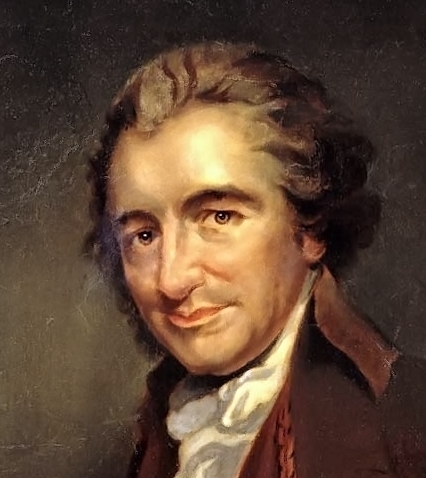
I never thought much about the founders while growing up, focusing on those revolutionary figures who were from Virginia, where my father’s family settled: George Washington, Thomas Jefferson, Patrick Henry and  James Madison. I also liked Thomas Paine, who while not a Virginian, wrote the practical sounding and popular pamphlet “Common Sense.” He also wrote “The Age of Reason,” his book that advocates deism, promotes reason and freethinking, and argues against institutionalized religion in general and Christian doctrine in particular. We’re getting to the point of this post.

Thomas Jefferson, James Madison, Thomas Paine, Benjamin Franklin, Ethan Allen and George Washington were deists, or influenced by them. Deists insisted that religious truth should be subject to the authority of human reason rather than divine revelation. Consequently, they denied that the Bible was the revealed word of God and rejected scripture as a source of religious doctrine.

They were also products of the Age or Enlightenment which was a cultural movement intending “to reform society using reason, challenge ideas grounded in tradition and faith, and advance knowledge through the scientific method.” These views proved to be unpopular, and emblematic of this was the fact that only six people attended Thomas Paine’s funeral as he had been ostracized for his ridicule of Christianity.

Anyone who knows this history must see the irony of modern day citizens who constantly refer to the founders, yet eschew the scientific method, especially as it pertains to climate change. We know why that is.

In mass society, media plays an important role in educating the public, just as Paine’s “Common Sense” informed the American Revolution. The public’s attention has been bought and sold by the hydrocarbon industry through prolific and continuous advertising. The executives of the oil, coal and gas industry must know the science of climate change, and that they are mortgaging their children’s future to make a buck near term. Yet they continue their work as slaves in the fields of corporatism.

There was an age of enlightenment, but its promotion of scientific inquiry has today been replaced by something else. A combination of misinformation, partisan politics and fundamentalist faith. Arguments about the science of climate change fall on many deaf ears, and opposing voices create a voluminous din that echoes in valleys carved over millennia that predate Europeans on this soil.

As I write this post, I am reminded of William Faulkner’s Nobel Prize acceptance speech.

I decline to accept the end of man. It is easy enough to say that man is immortal simply because he will endure: that when the last dingdong of doom has clanged and faded from the last worthless rock hanging tideless in the last red and dying evening, that even then there will still be one more sound: that of his puny inexhaustible voice, still talking.

My response is simple, climate change is real, it’s caused by us, the effects on humans are getting worse, and we can do something about it without changing our way of life or hurting our economy. We should do something about it before it’s too late. The founders resolved the issue of their time, now is the time for us to return the favor by solving the climate crisis.

Categories
Home Life Social Commentary

On Urban Chickens

Chicken Feeding
Chicken Feeding

LAKE MACBRIDE— It is with a bit of trepidation that I venture into another expository piece about urban chickens. As people continue to move from rural areas to cities, attracted by jobs, apartments, and a type of society reliant upon the aggregation of diverse human interests, to raise chickens at home seems anachronistic.

By definition, city life eschews barnyard animals. Getting rid of urban chickens, pigs and cows was part of the rise of the public health movement. Whether intentional or not, urban society, by definition, replaced the need to produce one’s own food. Why else would so many people have left the farm but to take advantage of society’s mass production capacity? To seek a return of urban livestock is a throwback to an era that was not necessarily better.

Nearby North Liberty is considering an ordinance to allow city folk to raise chickens in their yards. As I mentioned in my March post, this type of pursuit seems to be a material interest in pursuit of respectability among peers, rather than about nutrition. What makes the North Liberty proposal different is the requirement for neighborhood consent, rather than providing a courtesy notification of a chicken coop under construction. If passed, the ordinance would build community feelings, predictably on both ends of the love-hate continuum. Already there’s squawking.

At first reading, it is unclear to whom the ordinance would apply:  whether or not the city would preempt home owners associations with a local address from making their own rules. The way the current ordinance is written, home owners associations could be more restrictive and disallow home chickens even if the city does permit them. Preemption has a long and controversial history in Iowa, notably as it applies to concentrated animal feeding operations where lobbying groups want control centralized in Des Moines in the self-interest of focusing their lobbying efforts with less resources. I’m confident the city council will work through this issue.

Some cried foul over the 25 foot rule (the coop, fowl house, or fenced pen area shall be a minimum of 25 feet from any property line), saying it was too restrictive, or the chicken coop location would be aesthetically challenged. This aspect of the draft ordinance serves my point that urban chickens are more like pets than food sources. More like a landscaping ornament or a window treatment for a view of lives where there is not enough constructive work to do.

The limit is four chickens, kept in a confinement facility— hens only. There were no instructions on how to determine if a chick was a rooster or a hen, but a Facebook friend resolved the issue by saying, “once a cockerel is old enough to crow, it’s big enough for the dinner plate.” This raises the issue of chicken slaughter. My grandmother lived on a farm, and knew the process well. During my time in French Army Commando School, we learned how to turn the gift of local partisan support into food for survival. Slaughtering animals for meat just doesn’t go with contemporary notions of city life. Maybe it should.

What I am saying is the idea of urban chickens is adjunct to local food systems. It is more an expression of bourgeois libertarianism in a consumer culture, than a revolution in local food production. Gil Scott-Heron famously wrote “the revolution will not be televised,” and we are hearing too much about regulation of urban chickens on the T.V., so a reverse logic applies: the local news is covering the story, so therefore it can’t be a revolution.

In the end, a community should have self-determination on how people live. I’m not against urban chickens, but don’t see the point. It seems like a lot of work and expense for a small number of boutique pet chickens. Why not buy the best eggs from the grocery store, or farmers market, or barter for eggs and save the money? And maybe get a dog or cat at the animal shelter, as they make better pets.

Categories
Social Commentary

Directions in High Summer

Lake Macbride
Lake Macbride

LAKE MACBRIDE— Some days it’s hard to know the path. On Friday, still tired from long days in Chicago and facing a full slate of regular work combined with the search for paying work, it was a bust. Saturday was better, engaging in society— a slow walk with neighbors and friends.

Part of living in Iowa is an endless stream of birthdays, graduations, anniversaries and other celebrations. On Saturday there were two, the one year wedding anniversary reception for a friend in the peace and justice movement, and a 50th wedding anniversary reception for a neighbor I got to know shortly after we moved to Big Grove. Both events served great food and drink, and enabled me to get caught up with friends.

Conversations included a discussion of dating in the 1960s, the recent Green Party national convention in Iowa City, next week’s Veterans for Peace national convention, what to do with zucchini, demonstrations for nuclear abolition, nuclear power, Blackhawk and Poweshiek, pioneer cemeteries, gardening, a YouTube video shot in high summer and more.

I don’t often visit Central City, where one of the events was held, and stopped for directions. Off Highway 13, a local was selling produce. He had a grain wagon decorated with advertising for his farm stand on the highway. When I asked if he was from the area, he said, “of course.”

He sold seasonal produce, the usual fare, including melons, zucchini and tomatoes. He had a flat of Missouri peaches, fresh and made into jam, and when asked about them, showed one he had begun to slice, offering a taste. Sweet and juicy. I bought a pound and a half for two dollars and he gave me directions to the park where the event was being held. Of course, he knew where it was.

Two decades after the rise of the Internet, being with people in social settings remains compelling. We are drawn to events with a craving for company. Bearing cards with handwritten notes, hoping to give greetings and hear stories, little has changed over centuries.  It is an important part of sustaining a life on the Iowa prairie, and help in finding our way in a turbulent world.