Categories
Living in Society

Politics Takes No Holiday

Curing Yukon Gold seed potatoes, 2021.

The election contest in Iowa’s Second Congressional District is expected to continue until July, according to Marc Elias, counsel for the Rita Hart campaign during a March 23 press conference. By then the term will be 25 percent finished, and today, it is unclear whether the votes to seat Hart in the U.S. House of Representatives will exist after the House Administration Committee finishes its work.

According to Elias, and this is not new, there are 22 legally cast, uncounted votes, Mariannette Miller-Meeks acknowledged publicly such votes exist, and there should be a fair process to count them. The Miller-Meeks position is the election has been certified by the State of Iowa, Hart skipped the Iowa court system in pursuit of an appeal, and that should be that.

Miller-Meeks is not voting the way she should on most issues. She did vote for the Violence Against Women Act, unlike other Republican members of Iowa’s congressional delegation. She has been against many other Democratic priorities, including HR-1, the For The People Act. Because she was seated in the Congress, she is free to vote how she will. That doesn’t mean we have to like it, and it sustains my interest in Hart’s election contest.

Hart’s appeal is not like Trump’s legal cases, at all. Hart’s position from election day has been that all legally cast votes should be counted. A key issue is that in no other contest arising from the 2020 election have Democratic attorneys denied Republicans (i.e. Trump) had a right to make a contest. Miller-Meeks first action was a petition for dismissal of Hart’s contest. Consideration of the petition was deferred by the committee chair and that led us to Monday’s filings and yesterday’s press briefing.

Incumbency is powerful, even for Miller-Meeks who began her term in January. Because of that, she gained a sense of authority that has been respected by her peers and by members of the news media. I keep reminding folks Miller-Meeks’ appointment was provisional. That, however, gets sanded off in the woodshed of daily political reporting.

Seven members of the media asked questions during the press conference. The nature of questions reflected the media narrative that has been and continues to be woven more than facts of the contest.

Nicholas Fandos of the New York Times asked about Hart’s decision to bypass the Iowa Court system to take the contest to a partisan U.S. House of Representatives. I’m losing track of how many times the Hart campaign has explained this, beginning in November 2020. Fandos also asked Elias if there was a conflict of interest issue because he represented some members of the House Administration Committee in other cases. I thought that was a pretty good question until I heard Elias’ answer: “It’s nonsense. I don’t represent the House Administration Committee. I represent Rita Hart. Everyone knows that. There is not some secret going on there. I’m handling this like any other case.”

Every member of news media who spoke had some narrative to support. While news media maintains an obvious bias, and we expect them to have a narrative to dumb down stories for readers and viewers, it’s unfortunate and tedious when we have to spend our time arguing with media rather than paying attention to the facts of a case.

We knew, based on history, that a contested federal election would take time to resolve. We also knew most of such cases brought to the Congress were dismissed. The problem for Second District Democrats is whoever is the candidate for the Congress in 2022 needs to be working this summer and the Hart-Miller-Meeks contest may not be resolved by then.

If Hart wins the contest and is seated in the Congress, incumbency will play a significant role in 2022. However, if the contest is dismissed, or if it is pursued and the whole House rejects it, we’ll be behind the eight ball. Pursuing this election contest puts Democrats in a difficult situation as we prepare for the 2022 campaigns.

I support Hart’s contest in the House Administration Committee with the opinion we should count all the votes and let chips fall where they may. In the meanwhile we have to hold Mariannette Miller-Meeks to account for her terrible voting record. That’s something we did before and will pursue going forward. I suspect Second District Democrats can multi-task as long as we know that’s what we are doing.

Categories
Living in Society

Count All the Votes

Rita Hart

Provisional Congresswoman Mariannette Miller-Meeks accused Rita Hart of choosing politics over the law in pursuit of an appeal to the certified results of the 2020 general election for Congress. That is ridiculous.

The law that covers the close race is the Federal Contested Election Act of 1969, and both candidates have been complying with it. It’s a given that this election contest is political. It’s about a close political election for Pete’s sake.

Rita Hart’s case hasn’t changed since she made the appeal: There are legally cast votes not counted. Count every vote.

The reason Miller-Meeks makes an accusation is to divert our attention from due process. She is justifiably concerned about losing her provisional seat if Rita Hart wins the appeal and replaces her in the Congress to represent Iowa’s Second Congressional District. If the U.S. House Administration Committee finds legally cast votes were not counted, as Hart did, and those votes show Hart won the election, she should be sworn into office. Just because there is hysterical Republican fear doesn’t mean the challenge should be withdrawn, or is somehow suspect.

The election was close. While the governor signed certification of the six-vote win for Miller-Meeks, there was no mandate from the electorate. She did not have a plurality. Now that Miller-Meeks’ call for dismissal of Hart’s appeal was rejected by the committee, the process should continue until its natural end. The next deadline is Monday, March 22, when briefs are due to the committee.

Senators Chuck Grassley and Joni Ernst issued a joint statement in which they assert Hart’s appeal is not legitimate. Here it is, but it is snake oil. Don’t swallow it!

Both the original vote count and recount confirmed Mariannette Miller-Meeks won her election. There are legal avenues through which candidates can litigate election disputes if they believe there are specific election irregularities. Rita Hart declined to take legitimate legal action in Iowa courts and instead chose to appeal to Washington partisans who should have no say in who represents Iowans. That’s an insult to Iowa voters and our nonpartisan election process. We are confident in the fairness and accuracy of Iowa’s election system.

In addition to Iowa’s U.S. Senators, a cast of the usual characters has been speaking on Miller-Meeks’ behalf. Among those who made public statements are Paul Pate, Kim Reynolds, Randy Feenstra, Tom Cotton, and former United Nations ambassador Nikki Haley. Miller-Meeks took her case to FOX News chat hosts Bret Baier and Laura Ingraham recently. The Republican outrage is universal.

Miller-Meeks also made a well-publicized trip to the U.S. – Mexico border to decry a “crisis” there. Not so fast!

Miller-Meeks told Radio Iowa on Monday that people should be outraged. I’ll tell you who has no reason to be outraged by Rita Hart’s pursuit of an appeal, it’s the half of the electorate who voted for Hart.

The Republican noise machine has been refined in recent years to dissemble, distract and mislead citizens when they don’t like what they see in society. The fact remains Miller-Meeks’ election was certified by the Iowa Governor as winning by six votes. Even if the House Administration Committee finds Hart won and flips the election result, the main point here is the election was exceedingly close. Neither Hart nor Miller-Meeks should be doing much celebrating.

I’d like to see Hart seated in the Congress. I have also been around Iowa politics long enough to realize a close election can easily turn the electorate that produced it. It could go either way.

In Marc Elias, Rita Hart hired one of the best attorneys in the country to represent her during the appeal. Democrats who seek to put Hart in the Congress for more than the remainder of the current term should be focusing attention on the 2022 general election. I predict that election won’t be close.

Click here for a news update from the March 20, 2021 Iowa City Press Citizen.

Categories
Living in Society

Polish-style Soup at Home

Seeded tray of garden vegetables.

As part of a new Saturday tradition, I made a pot of vegetable soup.

Mine is a variation of Krupnik, which is a thick Polish soup made from vegetable broth, containing potatoes and barley (kasza jęczmienna, archaically called krupy — hence the name). I modified the traditional recipe, eliminating meat, mushrooms and dairy, and adding dried lentils for protein. I also used up items in the freezer — shredded zucchini, leeks and green beans. It’s a thick, hearty soup that goes well with a slice of bread. It makes an easy dinner that can simmer on the stove all day, with leftovers. While Mother and Grandmother didn’t make the soup, they would likely recognize mine if they were still living.

On Friday we have an appointment to get the second of two doses of the Pfizer COVID-19 vaccine. It’s a necessary step along the way toward returning to a semblance of normal. It will take 10-14 days after the second shot for our bodies to build immunity. After that, we’ll follow CDC guidelines to begin to engage in society again. It’s been a long road.

There is not much unique about this information. It reflects a shared experience not only in the small community where we live, but by fall, for most Americans. President Biden indicated last week vaccines will be available for all who want it. We’re hoping enough people get vaccinated to abate the pandemic this summer.

With our only child living many miles away, our Sundays are usually just the two of us. There are phone calls and occasional video conferences, yet the isolation is palpable. I’m not sure that will change once the coronavirus pandemic is over. We developed new habits and a new way of living that folds into the isolation. It is good preparation for aging.

I’m glad to be finished with dangerous work. My days of working in steel mills, packing houses, and manufacturing plants are behind me. I didn’t realize the risk of infections that came with retail work until retiring. I haven’t been sick since leaving the home, farm and auto supply store. Likewise I haven’t flown on an aircraft in a long while. Last week, I bought gasoline for one of the automobiles for the first time since December. The reduction in work and travel-related risk is positive. Yet I yearn to be with people.

When the coronavirus recedes I plan to seek some form of work. Because of our pensions and relative good health we are okay without it. I want to interact with people, in person. For now I’ll tend my garden and conserve resources… and make Polish soup on Saturdays.

Categories
Living in Society

Bittersweet March

First time crossing the bridge in 2021.

A year ago yesterday the World Health Organization declared the coronavirus a global pandemic. It has been a weird year.

March is full of anniversaries: March 7, the governor activated the state emergency operations center for COVID-19; March 8, the state hygienic laboratory reported the first three Iowa cases of COVID-19; March 9, the governor signed the first Proclamation of Disaster Emergency Regarding COVID-19; March 24 was the first Iowa death attributed to COVID-19; and March 29, the president extended the federal stay-at-home order until April 30. That’s in addition to the historic anniversaries like the beginning of spring, our daughter’s birthday, and recurring tasks of the month to begin planting for the garden, return to farm work, and sweep sand from the road in front of our house to use next winter.

The good news is our families and the families of friends well-survived the pandemic, thus far. Now that production and distribution of the COVID-19 vaccine has ramped up, there is a chance for every adult in the U.S. to be vaccinated by the end of May. That would make Memorial Day something worth celebrating.

How has my life changed during the last 12 months? There are some obvious ways. I left work I had been doing for others. My last day at the home, farm and auto supply store was April 2, 2020, then I did not return to the orchard in autumn or to the farm in late winter this year. I haven’t eaten at a restaurant — either dine-in or take out — since my friend Dan and I had lunch at Los Agaves restaurant on March 13, 2020 — no bars or coffee shops either. I started checking the air pressure on the auto tires because we went weeks without using one or the other. I moved all the neighborhood meetings to telephone conference calls and participated in any other groups to which I belong via video conference ( I am not a fan of Skype and Zoom meetings). I perfected a recipe for home made pizza and read 66 books. I began riding my bicycle. One of the few things that didn’t change was work in the garden, although it benefited by my being at home more.

There were less obvious changes:

  • Using up the pantry and freezer.
  • Reduction in food variety.
  • Wearing holes in my socks.
  • Laundry once a month.
  • Taking naps.

In beginning my autobiography, I wrote a lot of words. The value of the project has been considering where I came from and who I have become, with an eye toward the future. It is a fit undertaking for quarantined times.

The emotion I feel after a year of restricted activities is of longing. I’d like to get back to in-person society and social events. We are heading that direction with the Biden-Harris administration. It can’t come soon enough.

I don’t know if a celebration is in order. These anniversaries are more like the terrorist bombing of Sept. 11, 2001. We don’t like them but feel obligated to mention them. And so, it goes, in Big Grove Township.

Categories
Living in Society

Politics in the Biden Administration

U.S. Capitol, Washington, D.C.

I wrote four posts tagged politics since Joe Biden and Kamala Harris were inaugurated. I feel we are in a new time, where politics matters less than other parts of society.

The longest piece was a dirge about losing a sense of community I barely got to know before it vanished. There were also two book reviews and a letter to the editor of the newspaper. Compared to where this blog has been in 14 years, that’s not many political posts.

In the early days of the Biden administration something has changed about our politics. I can’t determine what it is. Our politics continue to matter and the slim majority Democrats hold in the Congress will likely pass the first major bill later today in the American Rescue Plan Act. The Senate passed it already and House Democrats say they have the votes.

Yesterday 13 non-controversial bills were pulled from the docket in the U.S. House. Rather than passing them on a voice vote in quick succession, a Republican asserted their privilege and called for a roll call vote on all of them. I’m not sure the purpose of this stunt which irritated both Republicans and Democrats. The roll calls would have delayed the vote on the American Rescue Plan Act and House Democrats would have none of that.

Biden’s history as Barack Obama’s vice president shows. He’s taking no quarter with malarkey. While Obama beat Biden by signing the American Recovery and Reinvestment Act on Feb. 17, 2009, 27 days after inauguration, negotiations for the Patient Protection and Affordable Care Act took a year by the time Obama signed the law on March 23, 2010. The lesson Biden learned from Obama was a new president does not have that kind of time to spend on a single bill. When we are a year into the Biden-Harris administration, the window of opportunity to pass substantial legislation may well be over. Biden appears to have taken the Rev. Dr. Martin Luther King Jr.’s words to heart:

We have also come to this hallowed spot to remind America of the fierce urgency of now.

This is no time to engage in the luxury of cooling off or to take the tranquilizing drug of gradualism.

Now is the time to make real the promises of democracy; now is the time to rise from the dark and desolate valley of segregation to the sunlit path of racial justice; now is the time to lift our nation from the quicksands of racial injustice to the solid rock of brotherhood; now is the time to make justice a reality for all of God’s children.

It would be fatal for the nation to overlook the urgency of the moment.

March on Washington Speech, the Rev. Dr. Martin Luther King, Jr. Aug. 28, 1963

Changed politics during the Biden Harris administration is a feature, not a bug.

Categories
Living in Society

Tax Time

Sunrise, March 7, 2021.

We received a final tax document last week — an explanation of the coronavirus relief check sent on the last day of 2020. There is about a month to file taxes on time in the United States. I do ours and help our daughter with hers. It’s time to get to work on them.

The only time I had a problem with filed tax returns was when the accountant applied a tax credit incorrectly. We had to pay it back with a penalty. The following year, I decided to complete our returns myself. It was a good decision.

In other times I would post the YouTube video of the Beatles song Taxman from Revolver. The album was released Aug. 5, 1966, the summer before I started high school, in my second year of learning to play the guitar. I remember winning a copy of Revolver at a Freshman dance that year. I’m not sure it is an accurate memory. It was when I met my friend Joe, who would attend Georgetown after high school and then become a physician.

I had not worked a job that produced a W-2 form in 1966, and wouldn’t until 1968 when I earned $934 in taxable income working as a stock boy at the Turn-Style Department Store.

In the 21st Century gig economy I’m not sure how people contribute to Social Security and Medicare without employer deductions and taxes. The reason we are able to survive on our Social Security pensions is we contributed for most of our working lives and the benefit is based in part on how much one earned:

Social Security benefits are based on your lifetime earnings. Your actual earnings are adjusted or “indexed” to account for changes in average wages since the year the earnings were received. Then Social Security calculates your average indexed monthly earnings during the 35 years in which you earned the most. We apply a formula to these earnings and arrive at your basic benefit, or “primary insurance amount” (PIA). This is how much you would receive at your full retirement age—65 or older, depending on your date of birth.

Your Retirement Benefit: How It Is Figured, Social Security Administration, 2013.

In a gig economy the margins are often quite thin for gig workers. The idea of paying Social Security and Medicare taxes gets sanded off in the woodshed of economic survival. The government program worked for us and will — at least until 2034 when the trust fund is projected to begin losing value unless the Congress fixes it. However, it doesn’t work for individuals unless they pay in at a predictable pace. I haven’t read a study of the impact of the gig economy on Social Security and Medicare, but would.

In 1966 I wanted to learn: to play the guitar, do well in my studies, and get along with my cohort. The future was open ocean and my boat had been christened by grade school nuns as college bound. I can’t recall thinking about taxes during that time, not even once.

To participate in high school one required some cash. There were expenses, although not many. I had to give up my newspaper route after eighth grade, so I paid for dances, books, guitar strings, bus fares, and school activities with my savings and allowance. I was privileged to be able to live in Northwest Davenport where Father held a union job, I had access to funds, and the neighborhood was safe. Those were the best times, full of hope and opportunity. I thought to myself, maybe I could record an album like Revolver some day.

Whatever the combination of privilege, economic security, social stability, and a peaceful home created, I benefited from it. I continue to benefit. My life hasn’t turned out as expected, yet in 1966 my expectations had not been completely formed. I stay out of trouble today, in part because I realize I must pay income taxes. It is a baseline for participation in American society and I’m in.

Categories
Home Life

Pandemic Weekends

Snow melt heading to the lake on March 3, 2021.

In the isolation of the coronavirus pandemic, weekends are less of a thing. Days go by. Without a calendar, one day can’t be distinguished from another. Even before the pandemic, when I worked full time, the idea of a Monday through Friday work week followed by a weekend was seldom reality.

Perhaps the best expression of weekend culture I experienced was in June 1977, while on temporary duty with the French Infantry Marines in Brittany. I arrived on a Friday and was whisked away to a small cafe where at once we began putting away cognac while introducing ourselves. After checking into lodging and changing clothes, there was an afternoon meet up at the officers’ club with more pastis than I can remember as officers kept buying rounds. This was followed by an evening dinner with Chinese-style food, champagne and wine at the home of a field grade officer.

Saturday morning was free time. I walked from my room to downtown Vannes where I observed women making lace near the sea as had been done for generations. Rejoining my host and a friend, we dined that evening at a restaurant serving oysters of Locmariaquer. Although I’d never eaten oysters, we ordered the signature, regional dish and chatted over the meal. After dinner we went to a dance with a live band and were out late.

I began Sunday with a run. It became a day of eating and drinking again with an afternoon meal at a private home, followed by a dinner of snacks from the ice box and pantry at my host’s apartment. By Monday I felt somewhat “poisoned in my veins” from all the food and drink of the weekend. Maybe one needs to drink alcohol for a weekend to exist. Given the popularity of beer with televised sports, I’m not wrong.

In retirement, even without the pandemic, the weekend is a bit challenging. Since we’re mostly at home and have no relatives living close, there’s little to distinguish it from the rest of the week. In a usual scenario the weekend is centered around meals with home made pizza Friday night, home made soup on Saturday, and Sunday night open as we prepare to begin the next week.

When young, attending church services was part of the weekend. I remember the change of Vatican II when we could attend Mass Saturday afternoon instead of Sunday. In some ways, attending church framed the weekend when I still lived at home. The churches near Big Grove don’t really fit. Instead of church, I read on Sunday afternoons and often take a nap.

Our daughter began streaming last year. She streams a crafting program Sunday afternoons in which I usually participate. With this, meals, and a life to live, we’ll eventually assemble some kind of weekend normalcy. The pandemic has been sobering to the detriment of how I remember the weekend. The good news is there is a chance to re-invent it for the better.

Like with anything we must make the most of what opportunities present themselves.

Categories
Juke Box

Juke Box – Red Dirt Road

Getting a late start today, and no, I didn’t stay up late to hear the full U.S. Senate reading of the American Rescue Plan. Here’s one of my favorites songs. Make it a great Friday!

Categories
Living in Society

Three Weeks Until Spring

Snow melts first over the septic tank.

The thaw began and there is no stopping it. The ground remained covered with snow for most of February, yet no more. Snow cover is slowly melting and will soon be gone. Above the septic tank was first to go.

36 hours after the COVID-19 vaccination I still feel normal. Even the soreness around the injection spot feels better. I emailed the farm to see if we can make arrangements for my return after the booster shot in a couple of weeks. The farmers are all twenty and thirty somethings so their priority group has not been approved for vaccination yet. There are protocols to negotiate before making my way back to farm work.

I applied to be a mentor in the Climate Reality Leadership Corps U.S. Virtual Training beginning on Earth Day. There are three virtual trainings this year, one in the U.S., one for Latin America, and one global training. To find out more, follow this link. If I’m accepted, this would be my third time attending, the second as a mentor. I’m feeling bullish about reengaging in society after getting the first dose of vaccine.

Democrats got solidly beaten in the 2020 Iowa general election. I’m not sure what I want to do to help rebuild the party. I’m also not sure the party can be rebuilt in a way to win elections anytime soon. In any case, it’s time for the next generation to take the reins. While I will remain supportive, I’m stepping back. Politics won’t be a priority as we slowly exit the coronavirus pandemic.

Getting out of the pandemic is a first priority. We are doing our part to follow the governor’s guidelines and hope others will too. What’s certain is I’m getting spring fever and can’t wait to get outside and do normal things again. It’s only three weeks until Spring!

Categories
Living in Society

Vaccination, Inoculation the Fight is the Same

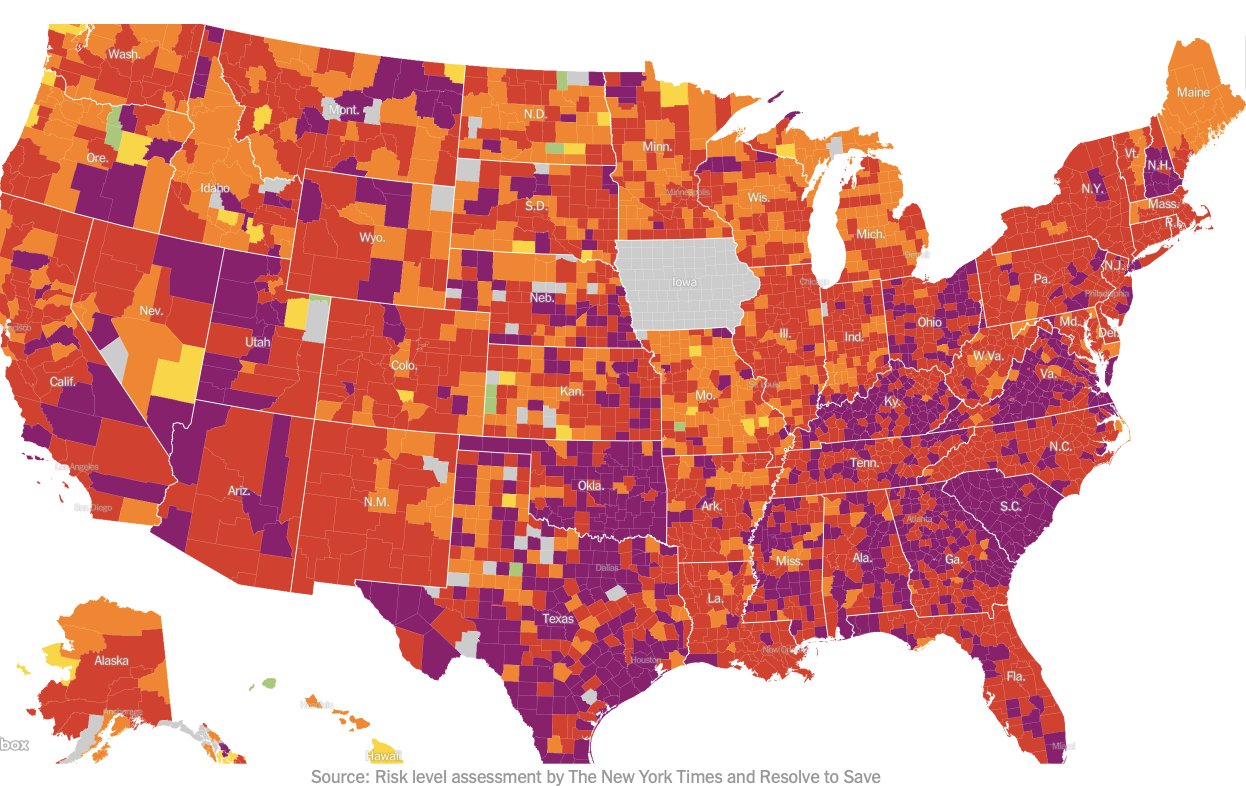
New York Times COVID-19 Tracking Map Feb. 26, 2021. Iowa ceased reporting by-county statistics last week.

The science of inoculation for infectious disease has long roots. “Inoculation against smallpox is believed to have been practiced in China as far back as 1000 BC, and is reported to have been common in India, Africa, and Turkey prior to its introduction into western societies in the 18th century,” Matthew Niederhuber wrote while at Harvard University.

There continues to be debate in he United States about inoculation and its cousin vaccination. That is, if by debate one means people jabbering at each other without knowing what the heck they are talking about.

I got the first of two doses of the Pfizer COVID-19 vaccine the first opportunity I had at 2:15 Central Time on Feb. 26, 2021. I was chair of the county board of health. What would you expect me to do but get it? A vast majority of people should get vaccinated if they have the chance, close to 100% of the population. It is up to government to make sure they have the chance. Whether enough will is an open question.

The program that brought a vaccination clinic to our community — with dozens of volunteers and a sophisticated level of logistical organization and expertise — was part of the Biden-Harris administration’s effort to speed up vaccination by distributing the vaccine through commercial pharmacies. The time line is short and simple. On Feb. 2 — 13 days after inauguration — the White House announced the First Phase of the Federal Retail Pharmacy Program for COVID-19 Vaccination. Three days later, on Feb 5, I received the first of several organizing phone calls to create a mass clinic, a partnership between the local pharmacy, the Solon Senior Advocates and a community church. Yesterday and today is the clinic for which all appointments are taken. The action was swift and effective. It was the result of a president who knows what he is doing in a public health emergency.

The State of Iowa is not that well organized. A Republican lawmaker asserted this week at the State House the pandemic was over. The Iowa Department of Public Health ceased reporting a by-county breakdown of key statistics related to the pandemic. Republicans literally pretend the state is ready to get back to normal even if the coronavirus doesn’t care about that. Surviving a pandemic is one of the reasons we need a strong federal government: states like ours can’t get needed things done.

Our city’s only pharmacy coordinated arrival of the vaccine and the event. They hoped to vaccinate 500 people using Iowa Department of Public Health criteria, including people like me who are more than 65 years old. The clinic is a 65+ only event organized by groups that work with senior citizens constantly.

If we are lucky, and that’s a big if, things will resemble normal again come the end of year holidays or in the first half of 2022. That is a conservative estimate based on input from the scientific community that works with infectious disease.

Let me go back to the first paragraph about the introduction of inoculation to prevent infectious disease in Western societies.

On a November day in 1721, a small bomb was hurled through the window of a local Boston Reverend named Cotton Mather. Attached to the explosive, which fortunately did not detonate, was the message: “Cotton Mather, you dog, dam you! I’ll inoculate you with this; with a pox to you.’’ This was not a religiously motivated act of terrorism, but a violent response to Reverend Mather’s active promotion of smallpox inoculation. The smallpox epidemic that struck Boston in 1721 was one of the most deadly of the century in colonial America, but was also the catalyst for the first major application of preventative inoculation in the colonies. The use of inoculation laid the foundation for the modern techniques of infectious diseases prevention, and the contentious public debate that accompanied the introduction of this poorly understood medical technology has surprising similarities to contemporary misunderstandings over vaccination.

The Fight Over Inoculation During the 1721 Boston Smallpox Epidemic by Matthew Niederhuber, Harvard University

This was the same Cotton Mather involved with the 1692 witchcraft episode in Salem Village. Mather and his father, Increase Mather, are often blamed for a fanning the flames of public hysteria and delusion born of ignorance and superstition of the time regarding witchcraft. Not so fast, wrote historian Stow Persons in American Minds. Witchcraft is more complicated than that. So it is with inoculation and vaccination. Cotton Mather’s redeeming grace, even to the most skeptical modern readers, was related to introduction of inoculation to prevent smallpox. Here’s what you might not know.

Cotton Mather is largely credited with introducing inoculation to the colonies and doing a great deal to promote the use of this method as standard for smallpox prevention during the 1721 epidemic. Mather is believed to have first learned about inoculation from his West African slave Onesimus, writing, “he told me that he had undergone the operation which had given something of the smallpox and would forever preserve him from it, adding that was often used in West Africa.’’

The Fight Over Inoculation During the 1721 Boston Smallpox Epidemic by Matthew Niederhuber, Harvard University

During Black History Week I’m highlighting the source of the idea of inoculation and vaccination in Cotton Mather’s African slave. The lessons to take from this weekend’s clinic in Solon are cultures other than American made significant contributions to the science of infectious disease, the federal government must be involved in mitigating a pandemic like the coronavirus, and sticking one’s head in the sand of ignorance won’t get us back to normal in a post pandemic society.

We must act positively in our communities and in conjunction with scientific experts. If such experts are not available at the state level, then we do what we can ourselves, including local coordination of federal programs.