Categories
Living in Society

Summer Community Parades are Back Despite the Pandemic

State Senator Kevin Kinney and County Supervisor Lisa Green-Douglass at the Solon Beef Days parade in Solon, Iowa on July 17, 2021.

Most people along the parade route reacted positively to the Johnson County Democrats entry in the Solon Beef Days Parade on July 17. All over the state, parades have re-emerged as a social activity after missing last summer because of the coronavirus pandemic. While the parade was a positive event reflecting community values and attitudes, it’s clear the pandemic is not over as vaccinations lag behind what is needed.

Nationally, 161 million people are fully vaccinated against COVID-19, representing 48.5 percent of the population. We are about the same percentage in Iowa with a million and a half people, or 49.0 percent of the population, fully vaccinated. The daily rate of vaccination has slowed considerably during parade season.

On Friday, Nick Coltrain of the Des Moines Register reported the majority of hospitalizations for COVID-19 are among people who are not vaccinated:

Almost all of the people hospitalized with COVID-19 since the spring have been unvaccinated against the disease, spokespeople for three of Iowa’s largest health care systems said.

At the University of Iowa Hospitals and Clinics, upward of 90% of patients admitted due to COVID-related illness since April have been unvaccinated, spokesperson Laura Shoemaker told the Des Moines Register. About 95% of patients hospitalized at UnityPoint facilities since March 2021 were not fully vaccinated, spokesperson Macinzie McFarland said. And at MercyOne’s Des Moines hospitals, 97% of patients hospitalized for COVID-19 were not vaccinated, spokesperson Clara Johnson said in an email.

The COVID-19 vaccine has been widely available to anyone 16 and older since April 5.

Iowa City Press Citizen, July 16, 2021

It was fun giving small American flags to children lining the parade route on Saturday. We live for such moments of small joys and happiness. However, the potential for disaster looms in the fall when children are required to return to in-person instruction at schools around the state.

We know the way to avert disaster is to get a higher percentage of the population vaccinated. Yet there is not an approved vaccine for children under age 12, and poor vaccination rates among school-aged children who are eligible. With the combination of low vaccine rates, a resurgence of COVID-19 cases, and a population that clings irrationally to the idea that the COVID-19 vaccine is in some way dangerous or not needed, trouble is fermenting in Iowa.

While enjoying parade season, I hope our actual experience in the fall proves me wrong about new, school-based COVID-19 outbreaks. We have the information to do what is right. Yet as raconteur, philosopher and satirist Ron White said, “You can’t fix stupid.” That’s where we are with half Iowa’s population.

~ Written for Blog for Iowa

Categories
Living in Society

What’s In A Week?

Onions drying in the greenhouse.

Once life is separated from the work week everything changes. It’s not that we become unhinged. Days just resemble each other without differentiation.

As denizens of the United States, if we seek continued participation, we need something to tell days apart. The worklife week served as we had one. For me, it fell apart during the coronavirus pandemic and the resulting retirement from paid work.

I developed a morning routine which begins around 3 a.m. and continues until it is done. It is my time to learn about the world and my role in it. I like the routine because, for the most part, I own this time of day, every day. After that things can get muddled.

I want to have a weekend… a Monday and Friday. I need a hump day. I want them to mean something. What I find is without a job, the days blend into each other. Increasingly, I accept it.

I don’t know what to do about it. I feel a need to do something. Today’s Monday. Maybe I’ll start there.

Categories
Living in Society

Is Jessica Reznicek a Terrorist?

Jessica Reznicek Photo Credit: Twitter @FreeJessRez

Jessica Reznicek, a 39-year-old environmental activist and Catholic Worker from Des Moines, Iowa, was sentenced in federal court June 30 to eight years in prison for her efforts to sabotage construction of the Dakota Access pipeline.

In November 2016, Reznicek and Ruby Montoya, a former preschool teacher, set fire to heavy construction equipment at a pipeline worksite in Buena Vista County, Iowa.

Over the next several months, the women used oxyacetylene torches, tires and gasoline-soaked rags to burn equipment and damage pipeline valves along the line from Iowa to South Dakota. Their actions reportedly caused several million dollars’ worth of damage and delayed construction for weeks.

Catholic activist sentenced for Dakota Access Pipeline vandalism by Claire Schaeffer-Duffy at NCROnline.com. To read the rest of the article, click here.

Reznicek’s criminal penalties were substantial. In addition to jail time, U.S. District Court Judge Rebecca Goodgame Ebinger included $3,198,512.70 in restitution and three years’ post-prison supervised release after she plead guilty to a single count of damaging an energy facility, according to Common Dreams. It’s hard to argue her protest was intended to be non-violent. She used an oxyacetylene torch to damage the pipeline without knowing if fuel was in transit.

Reznicek is being prosecuted as a terrorist. Is that what she is? It seems unlikely the board of directors or billionaire Kelcey Warren of Energy Transfer Partners felt terrorized. They had reason to know there would be protests during construction, and likely built defense from them into their operating, overhead, and risk management budgets. For ETP, pipeline protests represented business as usual. In 2018 there was a “protect the protests” direct action in Dallas, Texas where demonstrators accused ETP at its corporate headquarters of attempting to silence them with lawsuits.

Like many in the Des Moines Catholic Worker community Reznicek has been willing to break the law in peaceful protest and has been arrested. In 2014, she was detained for nearly 48 hours and then deported after flying into Israel to support Palestinians in the Israeli-occupied West Bank, according to the Des Moines Register. It seems obvious the Iowa Legislature had people like Reznicek in mind when they recently increased penalties for protesters.

I received the first of a series of emails from Reznicek during the Occupy Movement in 2011. She was an organizer for Occupy Iowa, Occupy Des Moines, Occupy the Caucus, Occupy Monsanto, Occupy the World Food Prize, and other direct action protests. She was arrested at some of these protests. It seemed like boilerplate organizing. Whatever cache the Occupy movement may have had, the work she did was straight forward with transparency. It was not a terrorist plot the way in 1995 Timothy McVeigh plotted to bomb the Alfred P. Murrah Federal Building in Oklahoma City. It would be better for the peace and justice movement if Reznicek did not have to spend her time serving time and defending herself in this prominent case. It goes with the territory, though.

The answer is no. Jessica Reznicek is not a terrorist. Society needs more people like her to call attention to injustice. If there is a cost to her protests, she has been willing to accept responsibility. If asked, my neighbors would say justice was served with Reznicek’s prosecution and sentencing. As it plays out in the judicial system, some of us wonder who will step in to fill her shoes in the peace and justice movement. It may be someone, but it won’t be her for a while.

~ Written for Blog for Iowa

Categories
Living in Society

Iowa Redistricting is Coming

Prairie Restoration Area at Lake Macbride State Park

Like most Iowa political activists, I’ve been looking forward to new political districts to be created during the decennial, non-partisan redistricting process. Republican legislators repeatedly asserted they wouldn’t change the law and didn’t.

While door-knocking in Wilton during the first election in our current districts, a voter asked where I was from. When I answered, they said, “that’s too far away. I don’t want to be part of that district.” I suspect there was a lot of that going around.

Because the Trump administration botched the U.S. Census (intentionally, most agree), we’ve been waiting for final numbers so a special session of the Iowa legislature can be called and the matter put to rest before the September deadline. On Wednesday, Katie Akin with Iowa Capital Dispatch reported the new census numbers should be released Aug. 16. She laid out the redistricting process in her article, which can be read here.

Most voters don’t care as much as I do about new districts, and the shortage of congressional and state house candidate activity this summer is evidence careers are on hold until redistricting is finished by Sept. 15 when the governor is required to sign the law.

One assumes Iowa Republicans are no different from in other states and want to redistrict in a way that increases their hold on government, or at least solidifies present advantages. How far will they go?

The measure of monkey-business is whether the map prepared by the Legislative Services Agency will be accepted by Republicans on the first or second vote. If it isn’t, that’s a sign trouble is afoot. Laura Belin at Bleeding Heartland has been following and writing about the process and I defer to her granular detail, which can be read here.

In 2011, only two legislators voted against the first map and it was adopted without fanfare. The best Democrats could hope for in 2021 is something similar.

Politico makes the case Republicans are weighing “cracking ” cities to maximize the number of members of congress in each state. As Mount Vernon attorney Nate Willems posted on Twitter, “Fortunately it would be unconstitutional to try to divide Polk County into two congressional districts.” If Polk County could be divided, that would put current congresswoman Cindy Axne at a disadvantage during her re-election campaign. While Iowa Republicans have previously violated the constitution in passing laws, to do so by dividing Des Moines into two separate congressional districts seems unlikely.

“It’s been my experience in studying history that when you get real cute (with redistricting), you end up in a lawsuit — and you lose it. And then the courts redraw the lines,” said Rep. James Comer (R-Ky.). “So my advice would be to keep Louisville blue.”

So it is for the Democratic island of Johnson County, Iowa, which is expected to gain one more state house district completely within its borders. The key element of gerrymandering is to concentrate the opposition party in fewer districts. If there is a way to do that, trust that Iowa Republicans will. I expect they will leave Johnson County alone.

For their part, Iowa Republicans have been tight-lipped about redistricting. As the last legislative session demonstrated, they can keep a secret and surprise us with things normal people wouldn’t expect. Let’s do our part to make sure the redistricting process is truly non-partisan by staying in touch with our legislators and holding them to account. I know I will.

Categories
Living in Society

Needed Rain Fell

Fresh from the garden cauliflower.

A gentle rain fell through the night and continues this morning. We need rain to assuage the drought. When it rains, garden-watering is more thorough and much appreciated. A benefit was not having to water the garden by hand last night.

In unexpected ways my trip to Florida was life changing. The driving was uneventful and easy. It was easier for me because our daughter led our convoy and all I had to concern myself about was fuel and keeping the rental truck between the highway lines. We spaced overnight breaks so we weren’t exhausted when we arrived each night. We splurged on food, using delivery services like Door Dash, Grub Hub and Uber Eats. We took care of ourselves. Like a vacation, the time was golden even though we didn’t do anything special besides be together.

I hadn’t visited her in Florida since 2013. I missed visiting at a place she lived for five years, the only residence of hers I hadn’t seen. The seven day trip was the most time we spent together in a long time. What’s changed is now that she’s closer–a mere day trip away–we can make plans that the 1,290-mile distance between us made impossible.

Something else changed.

There is a renewed urgency to get things done, to focus on what’s most important. I want to cross things off my to-do list. During the first part of the coronavirus pandemic I seldom looked at or maintained a to-do list. The trip changed all that.

I don’t know how this will turn out yet I’m hopeful. Hopeful we can spend more time together. Hopeful to find more meaning in quotidian affairs. Hopeful to get things done that are worth doing. I didn’t expect that, but it’s welcome.

It was drizzling rain when I went to the garden. I picked three head of broccoli, a head of cauliflower, four bell peppers, a cucumber, a zucchini and a handful of cherry tomatoes. Every day is like that. Rain is important to a healthy, abundant garden. The future is a slate wiped clean by the trip from Florida. For now, we have enough rain.

Categories
Living in Society

Masking in the United States

Baggage Handlers at Orlando International Airport, June 27, 2021.

I recently flew to Florida to help someone move to the Midwest, my first non-local trip since the World Health Organization declared COVID-19 a global pandemic on March 11, 2020. We convoyed from central Florida to Chicago, following major interstate highways all the way. Evidence that the coronavirus pandemic had resulted in the deaths of more than 600,000 people–the most of any nation on Earth–was scant.

The airline enforced a mask policy both in the terminals and on board the aircraft. Hotels where we stayed had well-publicized policy that masks were required indoors and social distancing was necessary. None of the hotels enforced the policies for guests. Compliance was infrequent among staff. All of the other workers we encountered–at truck rental facilities, convenience stores, and restaurants–wore no masks at all. The restaurant delivery drivers all donned masks as they approached us to deliver a meal. Their business is predicated on no-contact delivery during a pandemic, so that was expected. In a Walmart in Indiana about two-thirds of the employees wore masks. The business community seems more interested in avoiding liability while catching up on lost revenue than in preventing spread of the coronavirus.

As far as regular, non-working humans go, few wore masks. In Florida (outside the airport), Georgia, Tennessee and Kentucky I saw zero humans with a mask. That changed when we arrived at our destination in a Chicago suburb.

After the maskless trip from the South, I was pleasantly surprised by the neighborhood where people wore masks indoors and out. I asked one person why they wore a mask outside. They said they were vaccinated and the mask was to prevent contracting variants of the coronavirus that are currently thriving. Made sense to me.

I walked across the street to a local grocery store in which most people were masked, including all the employees. Disposable masks were available for $0.99 at the checkout counter. Not required for customers, yet available.

From the beginning of the trip I asked masked people if I should don mine in their company and the answer was a unanimous no. A couple of masked workers in a local Chicago bakery explained it best. They said I didn’t need to don my mask in their store. Customers would be inside for a short duration, however, they wore a mask because they would spend all day at the counter. This, too, made sense.

While settling into the new apartment a neighbor knocked on the door to introduce themselves. They wore a mask and of course we didn’t at home. I asked them if we should put ours on and revealed we both had been vaccinated. It turned out they had as well. We all went maskless for the rest of the encounter.

If there is a mask policy in the United States, it is either unknown most places I went, or unenforced. Masking is something we Americans do only when required, and not always then.

At this point in pandemic progress, people not vaccinated continue to be at high risk of COVID-19. There is a news story circulating about a woman who avoided getting vaccinated because of side effects people mentioned. She contracted COVID-19, was on a ventilator for a month, then died. Her two children lost their mother. Vaccinated people have not been getting sick with COVID-19 very much.

During our drive I noticed the crappy condition of the interstate highways: countless potholes and not enough construction crews. Whether it is infrastructure, healthcare, or masking during a pandemic, Americans don’t do it well. My advice is get vaccinated if you haven’t been, and wear a mask when indoors in a public place. It may not be socially acceptable among your cohort, although it may save your life.

~ Written for Blog for Iowa.

Categories
Living in Society

There’s a Reason Republicans Call It ‘Communist China’

Photo Credit: Wikimedia Commons.

“The unprecedented global challenges that the United States faces today—climate change, pandemics, nuclear proliferation, massive economic inequality, terrorism, corruption, authoritarianism—are shared global challenges. They cannot be solved by any one country acting alone. They require increased international cooperation—including with China, the most populous country on earth.” ~ Sen. Bernie Sanders, June 18, 2021

Readers have likely noticed recent Republican reference to “Communist China.” They seek to create a bogeyman to scare the electorate–one more trick in their fear-mongering bag used to dominate low-knowledge voters.

In a recent article on the Portside website, Sen. Sanders laid out how relations with China have changed, why they remain important, and require further change despite challenges.

“It is distressing and dangerous, therefore, that a fast-growing consensus is emerging in Washington that views the U.S.-Chinese relationship as a zero-sum economic and military struggle,” Sanders wrote. “The prevalence of this view will create a political environment in which the cooperation that the world desperately needs will be increasingly difficult to achieve.”

As far as a military struggle goes, the claim that China challenges the U.S. militarily is exaggerated.

It’s important to begin any assessment of the challenge from China by noting that the United States currently outpaces it militarily by a large margin. The U.S. has a more modern air force, a more capable navy and a far larger nuclear arsenal than China, and it spends roughly three times as much on its military. The spending gap widens considerably when U.S. allies in NATO, Australia, Japan, and South Korea are taken into account.

The nuclear gap is especially stark – the United States’ active nuclear stockpile is 11 times the size of China’s and deployed U.S. warheads are five times what China possesses. The gap between the U.S. and Chinese militaries is documented in detail in a recent analysis by the Center for Arms Control and Nonproliferation.

William Hartung, Forbes Magazine, June 22, 2021

As recently as 2000, the consensus in the United States was that China should be granted “permanent normal trade relations” status or PNTR, according to Sanders. It may be familiar to hear that to compete in a global economy, U.S. companies require access to Chinese markets.

“At that time, the U.S. Chamber of Commerce, the National Association of Manufacturers, the corporate media, and virtually every establishment foreign policy pundit in Washington insisted that PNTR was necessary to keep U.S. companies competitive by giving them access to China’s growing market, and that the liberalization of China’s economy would be accompanied by the liberalization of China’s government with regard to democracy and human rights,” wrote Sanders.

This approach was wrong according to Sanders, as is the current approach of casting China as villainous. “For the American people to thrive,” Sanders wrote. “Others around the world need to believe that the United States is their ally and that their successes are our successes.” He supports President Biden’s approach toward relations with China.

To learn more about the change in Republican views toward China, and why it is important to coming elections, I recommend reading the two linked articles. I also recommend we don’t let Republican scare tactics divide us.

~ First Published on Blog for Iowa.

Categories
Living in Society Sustainability

A World Without Nuclear Weapons

B-61 Nuclear Bombs

While it got scant notice in the U.S. press, the joint statement after the Geneva, Switzerland meeting between President Joe Biden and Russian President Vladimir Putin was significant:

We, President of the United States of America Joseph R. Biden and President of the Russian Federation Vladimir Putin, note the United States and Russia have demonstrated that, even in periods of tension, they are able to make progress on our shared goals of ensuring predictability in the strategic sphere, reducing the risk of armed conflicts and the threat of nuclear war.

The recent extension of the New START Treaty exemplifies our commitment to nuclear arms control. Today, we reaffirm the principle that a nuclear war cannot be won and must never be fought.

Consistent with these goals, the United States and Russia will embark together on an integrated bilateral Strategic Stability Dialogue in the near future that will be deliberate and robust. Through this Dialogue, we seek to lay the groundwork for future arms control and risk reduction measures.

The White House, June 16, 2021.

The joint statement echoed what President Ronald Reagan and Secretary General of the Communist Party of the Soviet Union Mikhail Gorbachev said 36 years earlier in Geneva, “A nuclear war cannot be won and must never be fought.”

“The complete abolition of nuclear weapons is the only way to be safe from their threat,” president of Physicians for Social Responsibility of Los Angeles Robert Dodge, M.D. wrote in Common Dreams.

The United States and Russia possess far more nuclear weapons than the rest of the nuclear states combined, enough to destroy life as we know it on Earth many times over. The two states working toward strategic stability is essential to compliance with Article VI of the nuclear nonproliferation treaty. During the previous U.S. administration, future compliance with the NPT came into doubt. President Biden is getting the U.S. back on the right track.

That’s not to say it will be easy. As Dodge points out, the Treaty on the Prohibition of Nuclear Weapons went into force January 22 this year. Currently it has been signed by 86 nations and been ratified by 54. Neither Russia nor the U.S. have joined the treaty and the prospects of them doing so near term are dim.

All nine nuclear states must take a step back from the brink of nuclear annihilation. The Geneva statement on strategic stability suggests it is possible to do so.

To learn more about the U.S. grassroots organizing effort to produce the safer, healthier and more just world that is possible without nuclear weapons, visit the Back from the Brink website.

~ First Published on Blog for Iowa

Categories
Living in Society

High Summer In Iowa

Trish Nelson

One of the highlights of the 2021 political summer will be distribution of the U.S. Census data and the decennial re-districting. The Iowa legislature is expected to convene a special session for that purpose in August.

In 2011 only two members of the legislature objected to the first re-districting map and it passed unceremoniously. We’ll see what happens this year. You’ll know there is skullduggery if the first two maps drawn by the non-partisan commission are rejected.

Trish Nelson is taking vacation in July and I’ll be helping to keep the blog going. I don’t know her plans, other than it will involve dogs, cats, bicycles, and time with family. The blog must go on!

An idyllic version of summer is getting away from stress and tension of American political life for a while and reading a good book. My reading pace slows during summer as more outdoors activities are available. I asked for summer reading recommendations from friends of the blog and here they are for your consideration:

Trish Nelson recommends The Underground Railroad by Colson Whitehead. “Cora is a slave on a cotton plantation in Georgia,” according to Goodreads. “Life is hell for all the slaves, but especially bad for Cora; an outcast even among her fellow Africans, she is coming into womanhood—where even greater pain awaits. When Caesar, a recent arrival from Virginia, tells her about the Underground Railroad, they decide to take a terrifying risk and escape.”

Dave Bradley recommends god is not Great: How Religion Poisons Everything by Christopher Hitchens. People love or hate Hitchens, who died of pneumonia while being treated for esophageal cancer in 2011. “Hitchens described himself as an anti-theist, who saw all religions as false, harmful, and authoritarian,” according to Wikipedia. “He argued for free expression and scientific discovery, and asserted that they were superior to religion as an ethical code of conduct for human civilization. He also advocated separation of church and state. The dictum ‘What can be asserted without evidence can also be dismissed without evidence’ has become known as ‘Hitchens’s razor.'”

Friend of the blog Ellen Ballas recommended Russian Roulette: The Inside Story of Putin’s War on America and the Election of Donald Trump by David Corn and Michael Isikoff. We’ve been hearing of Russian influence in the 2016 general election for what seems like an eternity. Corn and Isikoff followed it from start to finish and present an incredible account of how American democracy was hacked by Moscow to influence the election and elect Donald Trump.

On my bedside table is Devotions by Mary Oliver. Poetry, which I read outdoors during good weather, has been part of my summer for many years. I enjoyed Oliver’s American Primitive, leading me to buy this collection of her selected poems. I don’t think I can go wrong.

I also plan to read The Warmth of Other Suns: The Epic Story of America’s Great Migration by Isabel Wilkerson. Wilkerson’s book has been recommended by so many people I lost count. Many of us are familiar with the great migration from the southern United States to the north. “From 1915 to 1970, this exodus of almost six million people changed the face of America,” according to Goodreads.

Whatever you are doing this summer, I hope you enjoy it… and that you’ll join me on Blog for Iowa during the month of July.

~ First published on Blog for Iowa

Categories
Living in Society

In the Mix Again

Iowa City Community Band float in the July 4, 2021 Coralville parade.

I walked in the Coralville Fourth of July parade with two different groups: the first half with the Johnson County Democrats, and the rest with The People’s Coalition for Social, Economic & Environmental Justice. It was the first post COVID-19 vaccine social event I attended with people I know.

Regulars from previous years were missing, notably the World War Two veterans from Veterans for Peace, but also many my age or older. My cohort is stepping back from parade walking, even though there was a trailer with straw bales for anyone who wanted to sit during the two-mile route. Ambient temperatures reached the high eighties, so it was probably best for septuagenarians and older to stay indoors.

The community was out in force. Coralville is diverse and much different from the rest of Iowa. I enjoy the informal socialization that is part of walking in a parade.

Group photo of the Johnson County Democrats at the Coralville parade. Photo from Zach Wahls.

It is positive the Democrats are transitioning to younger people. State Senator Zach Wahls will turn 30 in a few days, and State Rep. Christina Bohannan just turned 50. State Rep. Dave Jacoby was the oldest of the state legislators present at 65. The contingent was made of about half elected officials and half local political activists. Our presence was less than it has been during general election years.

The People’s Coalition is comprised of Physicians for Social Responsibility, Veterans for Peace, PEACE Iowa, 100 Grannies for a Livable Future, and other peace and justice friends. A characteristic of our local activities is collaboration when working on projects. I’ve been with Physicians for Social Responsibility since I was on the board of health, served on the board of PEACE Iowa, and am a charter member of our Veterans for Peace chapter. It was good to catch up with old timers like myself.

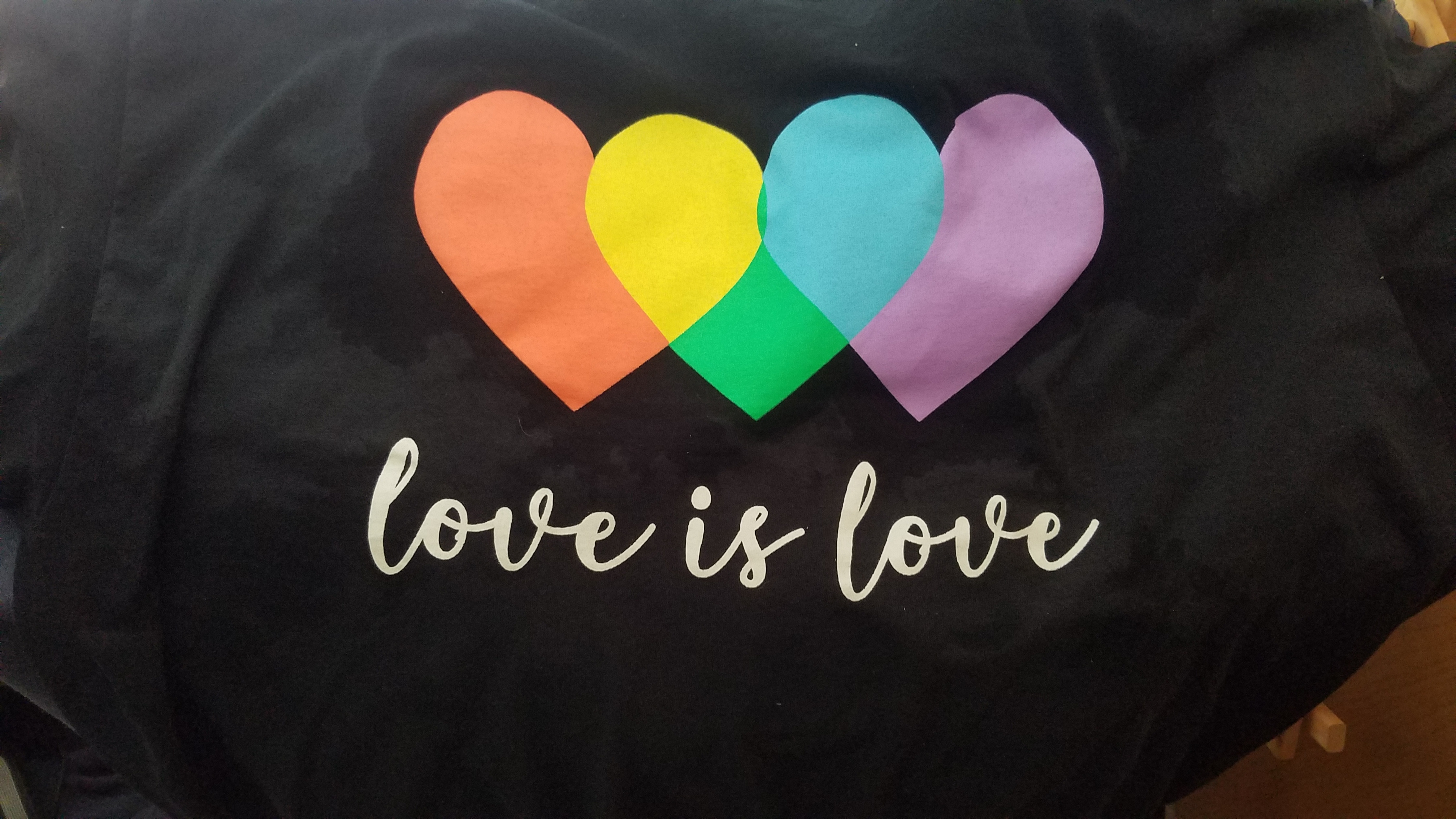
T-shirt I wore in the July 4, 2021 Coralville parade.

I received many compliments for the t-shirt I wore. I bought it from J.C. Penney for pride month yet didn’t attend any public events at which to wear it. The messaging, “love is love,” was very popular at the parade. People said, “I like your t-shirt,” multiple dozens of times. I said thank you when I could and Happy 4th of July. Someone shouted out, “go gay people!” I’m not sure what the sincere statement of support meant but acknowledged it.

It’s hard to say if I will attend future parades. I made it through yesterday and it was enjoyable. As long as that’s the case there is a reason to participate.