Categories
Living in Society

Iowa’s First District Democratic Primary Race

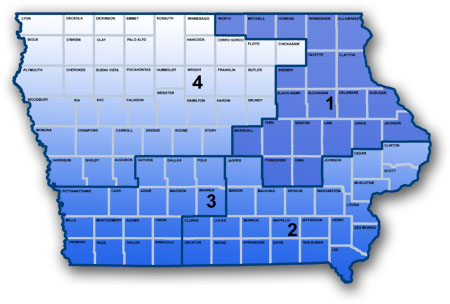
Iowa Congressional Districts

(AUTHOR’S NOTE: Since I live in the second district, I won’t be writing a lot about this race, but felt it important to acknowledge what’s going on in the first district. My views do not represent those of our beloved publisher or our other writers).

Five Democrats are at various stages of jumping into the race to represent the first congressional district when Rep. Bruce Braley exits the house, hopefully for the U.S. senate, after the 2014 general election. Of the five, I met only one, Swati Dandekar. I encountered Dandekar in my former life in the transportation business where we were introduced by one of the state’s key Republicans. We also had a chat in Des Moines while I was advocating against House File 561, the nuclear power finance bill. I said my piece about her here, and have nothing further to add. Let’s take a look at the other four candidates.

The remaining four U.S. house candidates, in alphabetical order, are: Anesa Kajtazovic, Pat Murphy, Dave O’Brien and Monica Vernon.

Anesa Kajtazovic is the face of the future of the Democratic party. She has served in the Iowa house since January 2011, and the only question about her for Democrats is whether or not now is her time. Yesterday she announced on Facebook and twitter that she is making a special announcement at press conferences in Marshalltown, Waterloo, Cedar Rapids and Dubuque on Aug. 20. Candidates don’t make four-stop tours to announce they aren’t running, so she is expected to make it official. She seems to believe now is the time.

Pat Murphy is the face of the past of the Democratic party. He already has done fundraising the way experienced pols do, and my former legislators Ro Foege and Nate Willems recently held a fundraiser for him. The Democratic activists with whom Blog for Iowa has spoken, who have had contact with Murphy, are not enthused about his candidacy. There is something to be said for experience, but in a field that has three women and several fresh faces, a Pat Murphy primary win would represent more of the same for Iowa Democrats and that could be problematic in the general election.

Dave O’Brien’s brief biography is what I know about him. He is a Cedar Rapids attorney and according to his web site, “his law practice consists primarily of fighting for Iowans who have been injured by the negligent and wrongful acts of others.” Where I come from, that’s called being an ambulance chaser, and has a negative connotation. Perhaps that’s an unfair comment, and as the campaign progresses, Democratic activists who don’t know him will get a chance to do so. At the starting line, he presents nothing unique or exciting in his resume, but that could be fixed. Bruce Braley is a progressive Democrat. O’Brien says he is one too, but that remains to be discovered.

Finally, there is Monica Vernon, a two-term city councilwoman from Cedar Rapids. Vernon posted on her Facebook page, “the last thirty years of my life were devoted to raising a family, growing a business and working hard to make my community a better place. As a Cedar Rapids city councilwoman, I have tackled extremely difficult issues as we recovered and rebuilt our community after the flood. Since the devastating storm of 2008, I have continued to work with other local, regional and national leaders on forward thinking, short and long term strategies to spur economic development, improve neighborhood safety and more.” It’s a well crafted and earnest statement. Perhaps the pizzazz will be forthcoming. Best of luck Monica.

Besides bloggers and political activists, few people I know are engaged in politics at the end of one of the best summers we have had in recent years. As an outsider looking into the first district, the opinions of this author don’t matter much. I look forward to seeing how the race plays out and what first district Democrats decide in the June 3, 2014 primary.

~ Written for Blog for Iowa.
Categories
Work Life

Tea Time in Cedar Rapids

Hay Bales
Hay Bales

CEDAR RAPIDS— A friend is saying her long goodbyes to Iowa before moving to Florida, so I broke from the tomato canning extravaganza to have coffee with her at a shop in Cedar Rapids. We exchanged gifts. I brought summer squash, cabbage, tomatoes and other produce. She brought an arrangement of Hydrangea for my spouse. We had just an hour before I had to leave for the farm, so we were concise, something that can often be difficult among people of a certain age with much in common.

We covered a lot of ground, including her recent attendance at the Democracy Convention in Madison, Wis. However, the substance of our chat was the systemic dismantling of the union movement in our post Reagan world, coupled with the decreasing relevance of today’s union leaders. That’s a mouthful, but the upshot is that corporations have been working hard to reduce labor costs and shed union contracts. The result for our generation has been a large cohort of middle aged managers and specialists whose positions have been systematically eliminated through outsourcing, reorganization, or the work of human resources consultants like Towers Perrin and Hay Group. What’s a person to do?

For a long time, I chased the available labor from downsizing and off-shoring, hoping to find over the road truck drivers. The idea was that as long term factory workers, they would possess behavior that was stable and well suited to the boredom and long hours a truck driver’s job entailed. What I found was people who would do almost anything to preserve their way of life, get their children through high school and continue living in the community they worked so hard to create. During those years from 1987 until 1993, I had some of the toughest conversations of my life, with people who were desperate to go on living and had the rug pulled out from under them so workers in Mexico, and later China and South Korea, could manufacture the appliances, auto parts and other goods they made for so many years.

A return of unions in private companies seems unlikely, mostly because workers who will accept less than a living wage dominate the unskilled labor pool. There is no shortage of people who will work for an hourly wage around $9 per hour. In some communities, like Minneapolis-Saint Paul, Minn., service industry companies have included minimum wage labor availability assessments in their expansion plans, and it has not been a substantial constraint. There are plenty of people willing to work in the unskilled market, which is what most non-professional jobs are.

When a person takes a job, there are inherent compromises. For a while, I supervised fuel purchasing where our company spent more than $25 million per year. Knowing what we know about the impact of CO2 emissions in the atmosphere, burning fossil fuels in heavy trucks contributes to global warming. I also knew that if I didn’t want the job, someone else would. This created an institutional bent toward doing things we know are wrong despite our self-consciousness about the behavior.

Politicians say they want to help create jobs, but during our conversation, we were not so sure. What people want is to live with economic security and the promise of American life. Few, if any corporations have that in mind when they lay out a business plan. What’s most important is maximizing return on investment, and that includes laying off highly paid, long-term employees, then hiring two low-wage workers for the same money. I’m not complaining. I’m just sayin’ that’s the way it is. And how progress will continue in our turbulent world.

Categories
Home Life Kitchen Garden

Will Work for Food

Preserving Eggplant
Preserving Eggplant

LAKE MACBRIDE— Two batches of pickles are fermenting in crocks downstairs, the second started three days after the first. The rule is to place cucumbers in the brine and let things get started for three days before checking. There was scum to skim on the first this morning— evidence the pickling process is proceeding as expected. The reason for a second batch is a local grower had excess cucumber seconds which were offered and taken to serve my dill pickle addiction.

Eggplant is abundant. I peeled and cut three into half inch rounds. They were baked for 15 minutes at 425 degrees, cooled and then frozen and bagged for future use, most likely in eggplant Parmesan. By then, the freezer was reaching capacity, and eggplant is not an everyday preference.

Last processed yesterday was two tubs of broccoli. This is part of a work for food barter, and unexpectedly came about while discussing seconds and surplus with a grower. All told, it took me about four hours to process the two tubs with a total yield of 20+ pounds frozen. The first tub, which yielded 8-1/2 pounds, was returned to the grower as compensation for the produce. I kept the second, added two heads I already had in the refrigerator, and that was the balance.

It’s a shame we had to compost the stems, as they are some good eating. If better organized, I would have made a big batch of soup stock using carrot, onion, celery, bay leaves and the broccoli stems and canned it in quarts. Our household uses a lot of stock.

The squash beetles mentioned yesterday avoided the butternut squash seedlings and congregated on the withering acorn squash plants. I need to study natural pesticides before I pull those vines, as the bugs will likely next migrate to the new cucumber plants, and infringe on my plans for more dill pickles. It is remarkable that I had tremendous abundance of zucchini and yellow squash before the squash beetles showed up.

The grower with whom I’m working on the broccoli and tomatoes stopped by to drop off some canning jars. We toured my local food operation which is situated on 0.62 acres. It is revealing to see what other growers notice about a home garden: the apple trees, my compost bin made from four pallets, the healthy Brussels sprout plants, my deer-deterrent fencing, and my pile of cut brush waiting for a fall burn after the garden is finished. She asked if I turned the compost. I won’t until spring when it is spread on the garden plots.

A local food system centered around a single household is both simple and complex. Cooking and preserving food are practices that have been around since hunting and gathering gave way to agriculture and domestication. Fresh food is sourced from a garden and a mix of growers. Specialty items are purchased where they are available at local retail outlets. There is a constant balancing act that regulates types and quantities. The refrigerator contents reflects how things are going, hopefully with the majority of foodstuffs having no commercial label.

While endeavoring to earn money for the tax man, insurance companies and lenders, we have to eat. The question becomes, what takes precedence? We can live without bankers, but sustaining a life requires a sophisticated, ever evolving local food system. The pay is not much, but the rewards are renewable.

Categories
Kitchen Garden Work Life

Suddenly it’s Busy

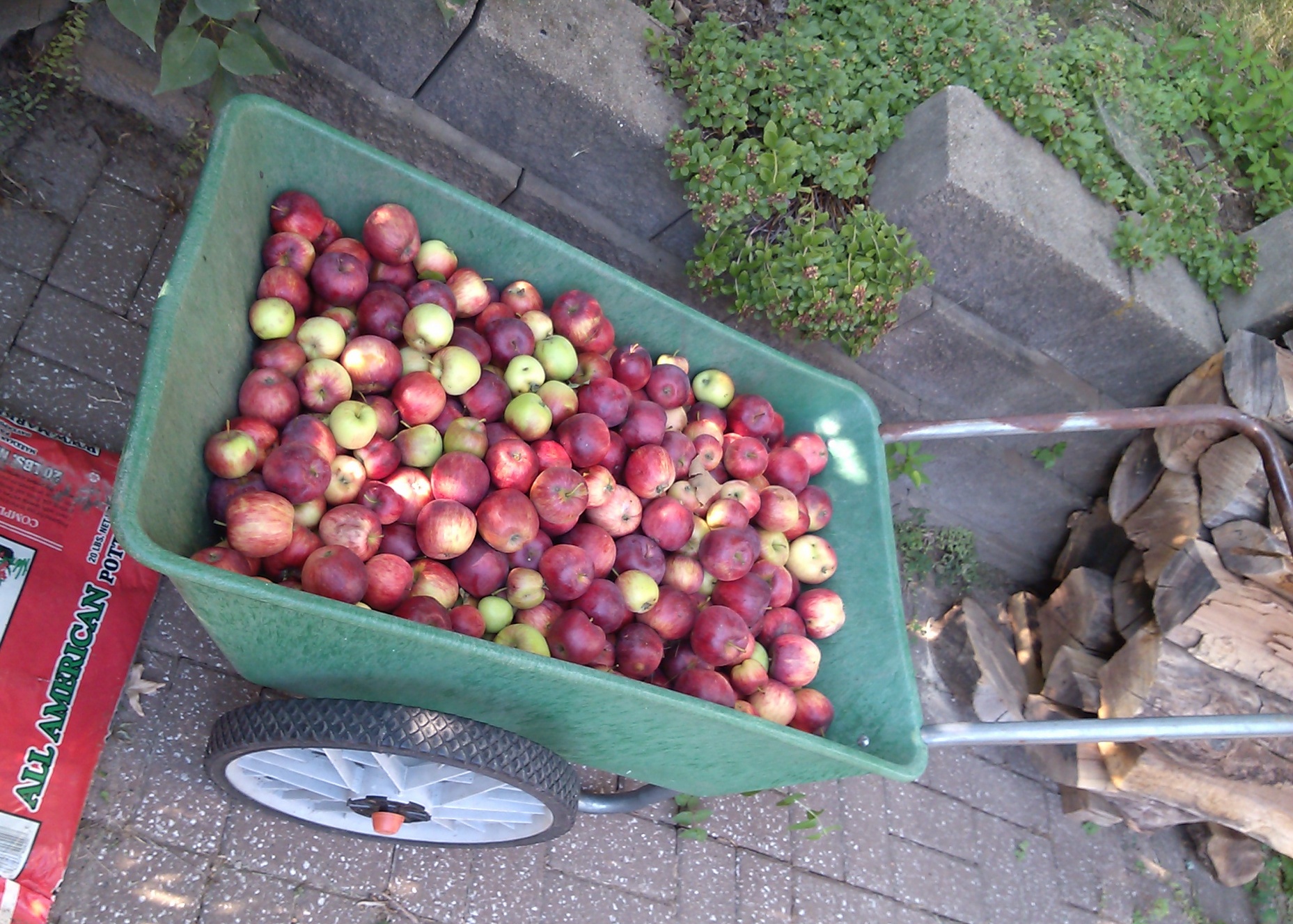
Apples for Livestock

LAKE MACBRIDE— Part of yesterday was clearing the dead and dying squash plants from the garden and planting turnips and transplanting butternut squash seedlings. It is dicey as to whether the squash will produce because of the timing of first frost compared to the 110 day growing cycle. Too, the abundance of squash beetles have nowhere to go without the zucchini and yellow squash plants, so even though they had not found the seedlings this morning, one suspects they will visit and if they like it, attempt to stay.

In that plot, the Brussels sprouts are thriving, as are the three kinds of peppers, Swiss chard and collards. This is the most bountiful year of gardening we’ve had.

In the cool downstairs await six bins of tomatoes and two of broccoli for processing. This is part of a work for food arrangement with a local organic grower. Combine it with the approaching and massive apple harvest and there will be plenty of work to do.

Yesterday I planted three trays of seedlings: lettuce, kale, broccoli, kohlrabi and squash. There is plenty of time left during the growing season for these crops to mature, and I am particularly hopeful about new cucumbers for pickling.

As summer races toward Labor Day and October frost, there is much to be done in the garden and in life. We have to eat to live, and because of this summer of local food, there will be no shortage there. It’s enough to sustain a life on the Iowa prairie, at least for a while.

Categories
Living in Society

Crazy Talk from Ames

Ted Cruz Boots Photo Credit Mike Wiser

Conservatives met in Ames this weekend at the Family Leader Summit 2013, making the case for detractors of Iowa’s first in the nation caucuses with their extreme views and media circus.

While views expressed at the event are in the minority among Iowans, who gave Barack Obama their seven electoral votes in 2012, Iowa conservatives garner broad bandwidth in the news media. President Obama and the congress are on vacation, so it was a slow news day.

Family Leader spokesperson Bob Vander Plaats indicated a number of news media outlets were credentialed. Iowa City’s Adam B. Sullivan posted,
Media CountC-SPAN has partial coverage archived, including speeches by Rick Santorum and Donald Trump, the latter appearing to be the media darling of the event.

Tumpmentum …although some disagreed, Not Going to work With his usual style, Trump named the impossible dream for Republicans,
Trump Quote

The event hit some of the current conservative memes, including the tug of war over who is the most conservative freak to occupy airspace about the 2016 Republican presidential nomination,
Blown Away Speakers touched on immigration,
Larry the Cable Guy … abortion,
Koslow … abolishing the IRS,
IRS … a call to break the law, King Defy IRS … and more votes to repeal Obamacare,Obamacare There were also bits of advice rendered,
Weird …and, Gay Agenda There was analysis, Analysis Gay… and,Analysis Ron Paul

Seems like a bunch of crazy talk to me, but what would a progressive blogger know? Oh, that’s right, I’ve read Sun Tzu, “pretend inferiority and encourage his arrogance.” There’s more on twitter at the hashtag #FLS2013 if readers can stomach it.

~ Written for Blog for Iowa

Categories
Kitchen Garden Work Life

Working in the Onion Patch

Two Wagon Loads of Onions

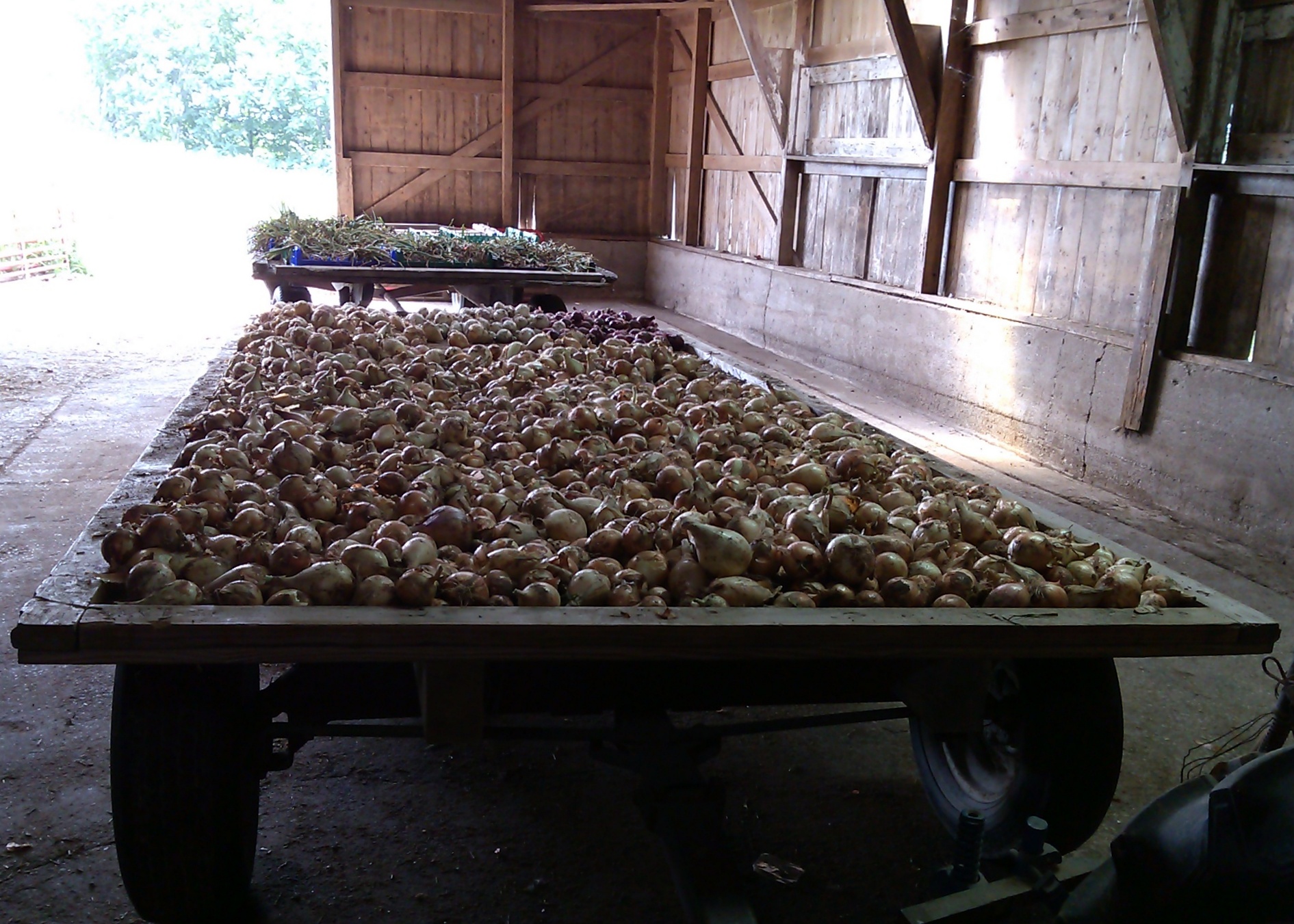
RURAL CEDAR TOWNSHIP— The onion harvest is in at the CSA, and more than two tons of white, red and yellow onions have been arranged in the germination house and barn to dry. Today begins the third day of trimming the excess leaves and arrange them for further drying. A few more four hour shifts and the project will be complete. Onions are one of the most popular vegetables, so the shareholders at the CSA will enjoy continuing to receive this bounty in their shares.

Trimming Onions
Trimming Onions

I filled the blank spaces in my garden’s cucumber row yesterday afternoon and gave the new patch a good watering. The zucchini are about done, the vines withering and yellowed. Same with yellow squash. There are butternut squash seedlings to plant, although I’m not certain they will make the 90-100 day window needed to mature— another experiment. Next weekend I begin paying work at a local orchard, helping with the weekend surge of city dwellers who come out for family entertainment and apples. That means this weekend will become a working time in the yard and garden, getting caught up on weeding, grass mowing, tree trimming, and preparing garden plots for the next iteration of planting.

White Onions
White Onions

Fall crops will include turnips for the greens, radishes, lettuce and spinach for sure, adding to the most prolific of gardening years here in Big Grove. (Note to self: prepare more trays for germinating seeds).

My first crop of apples is getting close to ripe (there will be two harvests this year, plus pears), which means the CSA operator and I have to stay in touch with the work for tomatoes project so everything can get processed as it comes in at the same time. In my garden, the large tomatoes are beginning to ripen. We’ve been eating fresh tomatoes for about three weeks.

In the kitchen the storage space is filling up with onions, potatoes and apples, and the soup stock is getting used, making room for the approaching tomato harvest in a week or so. There is a lot to do before Labor Day.

Categories
Environment Social Commentary

The Founders and Climate Change

Thomas Paine
Thomas Paine

It must get a Republican’s hackles up when a Democrat talks about the founding fathers. After all, it was Republican Warren G. Harding who coined the term, first using it in his keynote address at the 1916 Republican National Convention. The term is less than one hundred years old, much younger that our family roots in Virginia where ancestors named their male children after well known revolutionaries from the state. Leave it to a Republican to omit women as founders, but women’s suffrage and the 19th amendment to the U.S. Constitution wouldn’t come until four years later. Harding, while elected as president in a landslide in 1920, was never a visionary, unable to see the scandals in his own administration.

What we know about the founders was they were part of a natural aristocracy, or gentry, as Stow Persons described it in his book “The Decline of American Gentility,” based more on talent and taste than birth or financial status. 13 were merchants, seven were major land speculators, 11 were large scale securities speculators, 14 owned or managed plantations or large farms operated by slaves, eight received a substantial percentage of their income from holding public office and the rest were occupied as small farmers, scientists, physicians, retirees and other occupations. There is no evidence my forbears were included in this group, although they were in Virginia by 1680.

I never thought much about the founders while growing up, focusing on those revolutionary figures who were from Virginia, where my father’s family settled: George Washington, Thomas Jefferson, Patrick Henry and  James Madison. I also liked Thomas Paine, who while not a Virginian, wrote the practical sounding and popular pamphlet “Common Sense.” He also wrote “The Age of Reason,” his book that advocates deism, promotes reason and freethinking, and argues against institutionalized religion in general and Christian doctrine in particular. We’re getting to the point of this post.

Thomas Jefferson, James Madison, Thomas Paine, Benjamin Franklin, Ethan Allen and George Washington were deists, or influenced by them. Deists insisted that religious truth should be subject to the authority of human reason rather than divine revelation. Consequently, they denied that the Bible was the revealed word of God and rejected scripture as a source of religious doctrine.

They were also products of the Age or Enlightenment which was a cultural movement intending “to reform society using reason, challenge ideas grounded in tradition and faith, and advance knowledge through the scientific method.” These views proved to be unpopular, and emblematic of this was the fact that only six people attended Thomas Paine’s funeral as he had been ostracized for his ridicule of Christianity.

Anyone who knows this history must see the irony of modern day citizens who constantly refer to the founders, yet eschew the scientific method, especially as it pertains to climate change. We know why that is.

In mass society, media plays an important role in educating the public, just as Paine’s “Common Sense” informed the American Revolution. The public’s attention has been bought and sold by the hydrocarbon industry through prolific and continuous advertising. The executives of the oil, coal and gas industry must know the science of climate change, and that they are mortgaging their children’s future to make a buck near term. Yet they continue their work as slaves in the fields of corporatism.

There was an age of enlightenment, but its promotion of scientific inquiry has today been replaced by something else. A combination of misinformation, partisan politics and fundamentalist faith. Arguments about the science of climate change fall on many deaf ears, and opposing voices create a voluminous din that echoes in valleys carved over millennia that predate Europeans on this soil.

As I write this post, I am reminded of William Faulkner’s Nobel Prize acceptance speech.

I decline to accept the end of man. It is easy enough to say that man is immortal simply because he will endure: that when the last dingdong of doom has clanged and faded from the last worthless rock hanging tideless in the last red and dying evening, that even then there will still be one more sound: that of his puny inexhaustible voice, still talking.

My response is simple, climate change is real, it’s caused by us, the effects on humans are getting worse, and we can do something about it without changing our way of life or hurting our economy. We should do something about it before it’s too late. The founders resolved the issue of their time, now is the time for us to return the favor by solving the climate crisis.

Categories
Home Life Social Commentary

On Urban Chickens

Chicken Feeding
Chicken Feeding

LAKE MACBRIDE— It is with a bit of trepidation that I venture into another expository piece about urban chickens. As people continue to move from rural areas to cities, attracted by jobs, apartments, and a type of society reliant upon the aggregation of diverse human interests, to raise chickens at home seems anachronistic.

By definition, city life eschews barnyard animals. Getting rid of urban chickens, pigs and cows was part of the rise of the public health movement. Whether intentional or not, urban society, by definition, replaced the need to produce one’s own food. Why else would so many people have left the farm but to take advantage of society’s mass production capacity? To seek a return of urban livestock is a throwback to an era that was not necessarily better.

Nearby North Liberty is considering an ordinance to allow city folk to raise chickens in their yards. As I mentioned in my March post, this type of pursuit seems to be a material interest in pursuit of respectability among peers, rather than about nutrition. What makes the North Liberty proposal different is the requirement for neighborhood consent, rather than providing a courtesy notification of a chicken coop under construction. If passed, the ordinance would build community feelings, predictably on both ends of the love-hate continuum. Already there’s squawking.

At first reading, it is unclear to whom the ordinance would apply:  whether or not the city would preempt home owners associations with a local address from making their own rules. The way the current ordinance is written, home owners associations could be more restrictive and disallow home chickens even if the city does permit them. Preemption has a long and controversial history in Iowa, notably as it applies to concentrated animal feeding operations where lobbying groups want control centralized in Des Moines in the self-interest of focusing their lobbying efforts with less resources. I’m confident the city council will work through this issue.

Some cried foul over the 25 foot rule (the coop, fowl house, or fenced pen area shall be a minimum of 25 feet from any property line), saying it was too restrictive, or the chicken coop location would be aesthetically challenged. This aspect of the draft ordinance serves my point that urban chickens are more like pets than food sources. More like a landscaping ornament or a window treatment for a view of lives where there is not enough constructive work to do.

The limit is four chickens, kept in a confinement facility— hens only. There were no instructions on how to determine if a chick was a rooster or a hen, but a Facebook friend resolved the issue by saying, “once a cockerel is old enough to crow, it’s big enough for the dinner plate.” This raises the issue of chicken slaughter. My grandmother lived on a farm, and knew the process well. During my time in French Army Commando School, we learned how to turn the gift of local partisan support into food for survival. Slaughtering animals for meat just doesn’t go with contemporary notions of city life. Maybe it should.

What I am saying is the idea of urban chickens is adjunct to local food systems. It is more an expression of bourgeois libertarianism in a consumer culture, than a revolution in local food production. Gil Scott-Heron famously wrote “the revolution will not be televised,” and we are hearing too much about regulation of urban chickens on the T.V., so a reverse logic applies: the local news is covering the story, so therefore it can’t be a revolution.

In the end, a community should have self-determination on how people live. I’m not against urban chickens, but don’t see the point. It seems like a lot of work and expense for a small number of boutique pet chickens. Why not buy the best eggs from the grocery store, or farmers market, or barter for eggs and save the money? And maybe get a dog or cat at the animal shelter, as they make better pets.

Categories
Social Commentary

Directions in High Summer

Lake Macbride
Lake Macbride

LAKE MACBRIDE— Some days it’s hard to know the path. On Friday, still tired from long days in Chicago and facing a full slate of regular work combined with the search for paying work, it was a bust. Saturday was better, engaging in society— a slow walk with neighbors and friends.

Part of living in Iowa is an endless stream of birthdays, graduations, anniversaries and other celebrations. On Saturday there were two, the one year wedding anniversary reception for a friend in the peace and justice movement, and a 50th wedding anniversary reception for a neighbor I got to know shortly after we moved to Big Grove. Both events served great food and drink, and enabled me to get caught up with friends.

Conversations included a discussion of dating in the 1960s, the recent Green Party national convention in Iowa City, next week’s Veterans for Peace national convention, what to do with zucchini, demonstrations for nuclear abolition, nuclear power, Blackhawk and Poweshiek, pioneer cemeteries, gardening, a YouTube video shot in high summer and more.

I don’t often visit Central City, where one of the events was held, and stopped for directions. Off Highway 13, a local was selling produce. He had a grain wagon decorated with advertising for his farm stand on the highway. When I asked if he was from the area, he said, “of course.”

He sold seasonal produce, the usual fare, including melons, zucchini and tomatoes. He had a flat of Missouri peaches, fresh and made into jam, and when asked about them, showed one he had begun to slice, offering a taste. Sweet and juicy. I bought a pound and a half for two dollars and he gave me directions to the park where the event was being held. Of course, he knew where it was.

Two decades after the rise of the Internet, being with people in social settings remains compelling. We are drawn to events with a craving for company. Bearing cards with handwritten notes, hoping to give greetings and hear stories, little has changed over centuries.  It is an important part of sustaining a life on the Iowa prairie, and help in finding our way in a turbulent world.

Categories
Social Commentary

Chicago Settles In

Police Call Box
Police Call Box

CHICAGO, Ill.— My third day in Chicago and most noticeable is how isolate and deserted everything seems. Metra riders move deliberately through the motions of public transit, saying little. Well groomed, they move diligently toward their destinations, one wearing plastic bags on her feet to keep the rain from the dressy work shoes. The 59th Street station has been empty each time I rode the train.

On the way to my bed from the station, I passed countless police telephones and friendly security people in drizzling rain, as if to say there may be danger on this quiet street, but people are watching in the dim blue light of the call boxes. Sleep came quickly after a long day.

This morning, I drove along Lake Shore Drive and through the truck marshaling area for McCormick Place to parking Lot B. It’s cheap there, $14 the day, and an easier getaway after today’s work. The meeting room was accessed through a labyrinthine path of underground, past truck docks and security, with the din of fans and clatter of forklift trucks. Almost alone, I found the path, avoiding doors locked against early morning intruders and riding escalators up and down the levels of the building. I solemnly made may way to the concourse in search of coffee.

I’m no longer new to Chicago, and have driven and walked her streets— no longer do I get lost. It is a city that minds its own business, with nose to the grindstone of industry. A place where external signs hide everything that matters. Chicago has settled in to lives more diverse than Sandburg envisioned. The city of big shoulders is hunched over into individual lives within the enclaves of a consumer society.