I looked at a live image of the inside of my large intestine on the monitor. It originated from a camera in the tip of a a colonoscope being operated by the physician who performed my first colonoscopy 11 or 12 years ago. It is a humbling and fascinating experience. No polyps, so I’m good for another ten years.
Medical practitioners recommend a colonoscopy for people aged 50 and older as a screening for colorectal cancer, the third most common cancer diagnosed in both men and women in the U.S. With the changes initiated by the Patient Protection and Affordable Care Act, insurance companies are required to provide the procedure without any charge, co-pays or incidental expenses.
The worst part of the procedure is clearing the bowels the day prior to the office visit. As the anesthesia wore off, we were ready for a meal and stopped at Salt Fork Kitchen for breakfast on our way home.
Check that off this year’s to-do list. Now the work begins anew.
I called into the warehouse and got a shift for Saturday. Three days off in a row would have been too much, and we can use the income. I’m also writing three stories for the newspaper and contemplating what else can be done to generate income to pay bills and reduce our debt.
Caesura came between the weary past and tomorrow’s promise with the colonoscopy.
When I get to the warehouse, I’d better fill the tank because we’re not off fossil fuels yet and my Subaru has a few miles left in it before heading to a scrap heap.
When I had my first colonoscopy there was no President Obama, no Patient Protection and Affordable Care Act, I hadn’t begun blogging, and I was on my employer’s health insurance plan.
The company I worked for would have liked nothing better than to present a cash payment to employees in lieu of paying their 65 percent share of health insurance. However, people they asked wouldn’t go for it.
My second procedure is scheduled Friday and I’m curious to see how it will be paid for by the health insurance plan purchased through the ACA marketplace for some $14,400 annually.
The ACA requires health insurance providers to cover recommended preventive services without any patient cost-sharing such as co-pays and deductibles. A colonoscopy is one of these services.
Information is seeping out through administrative cracks in the health care system. It began with a voicemail from the doctor’s office. My insurance company wouldn’t pay for the sodium sulfate, potassium sulfate and magnesium sulfate solution called a “bowel prep kit.” The kit came with two 6-ounce bottles of the solution and a handy plastic measuring cup. I asked our local pharmacist if I could buy it directly as I remembered it was inexpensive. With a $10 off manufacturer’s coupon it would have been $110, making it worth the trip to the clinic in the county seat to pick up a physician’s sample of the brew.
What I am finding in my limited personal health care is the ACA is peeling off add-on procedures that used to be covered by health insurance. No add-ons to physicals, colonoscopies, and other preventive procedures, at least in my experience.
I don’t know, but the change has to have affected gross margin for these businesses and reduced the cost of health care. Whether savings will be passed on in terms of premium reductions remains to be seen, but I doubt it.
While I didn’t receive a bill for my last physical examination, the hospital sent me a bill for lab tests, which I paid. We’ll see if there are any more cracks in the system after my procedure. If there are, I’ll be posting again.
In Iowa, the Democratic Party organizes the nuts and bolts of statewide campaign operations around something called the “coordinated campaign.”
The coordinated campaign has been a blessing and a curse.
On the short list of preparations for 2016, one hopes the coordinated campaign is blown up and re-invented into something that can win against what has become a better organized Republican campaign operation. 2014 brought us Senator Joni Ernst, Governor Terry Branstad, and continues to re-elect incumbents each election cycle. Iowans deserve better than that.
As much as one believes that Democratic elected officials would provide better policy and governance for the vast majority of Iowans, the message is not getting out and Republicans are suppressing the wackiness found in extreme elements of their party enough to garner substantial, and winning support in the electorate. Most active Democrats I know are good people, willing to do the work of a political campaign. The problem has been with the way party leadership organizes each cycle’s effort, and what work is getting done.
What is the coordinated campaign, exactly?
It is a pooling of resources through the Iowa Democratic Party from campaigns up and down the ticket into a unified field effort.
Candidates pay to play, and the focus is usually on the big ticket races: president, governor and members of the U.S. Congress.
A manager and central staff have been hired to run the program and develop campaign options for approval by stakeholders in coordinated campaign.
The coordinated campaign organizes a field program with a paid canvass and targeted mail campaigns designed to help turn out Democratic voters and persuade targeted voters to vote for Democratic candidates.
In addition to statewide candidates, the coordinated campaign works on statehouse races in an effort to build a Democratic majority in the Iowa House and Senate.
Political insiders might nit pick with some of this, or add additional details, but this is the broad picture of what has been the coordinated campaign in the years since 2004 when I have engaged more actively in politics.
Why do I say the coordinated campaign should be blown up?
Democrats require some organizing mechanism, but continuing to repeat the past will produce the same results. Here are four reasons to blow up the coordinated campaign:
1. There is limited buy-in from local activists to what the coordinated campaign has planned. Campaign choices—locating resources like paid staff, offices, house parties and mailers—are made by others and local activists talk among themselves that some decisions don’t make sense. They have been asked to participate, but that participation has been framed as staffing a shift at an established phone bank or door-knocking event outside our precinct. It has been a clear disconnect from precinct politics that used to be a Democratic strength.
2. Republicans were stunned by the Democratic organization of the 2006 and 2008 campaigns, and they caught up. I used to laugh at Team Nussle’s efforts to organize phone banks and canvasses in 2006, but no more. The Republicans—partly due to the political leadership of Terry Branstad and Republican Party of Iowa chair Jeff Kaufmann— have caught up and surpassed Democrats, as evidenced in the results of the 2014 general election.
3. Democrats failed to articulate their message. Where Republicans made significant inroads is their effectiveness of identifying stakeholders in government and offering solutions. They framed solutions as bipartisan, but the core message that won elections is the sense of belonging their campaign helped create. Because the coordinated campaign focuses canvasses and get out the vote efforts on targeted voters, it left messaging to others, and a broad sector of the electorate on the table. Republicans have been Hoovering these voters up.
4. Democrats don’t get the role of third party resources. Because of its structure, the coordinated campaign made poor use of third party resources. As if when the check wasn’t deposited in the bank account, it didn’t exist. Tom Steyer’s NextGen Climate took a drubbing from liberal bloggers in the 2014 campaign, and some of the criticisms were rightly placed. However, liberal bloggers are not the coordinated campaign. In a time of the Citizens United ruling, Democratic leaders must figure out how to better balance outside resources to advance Democratic issues, while walking the legal tightrope of campaigns not coordinating with third parties. Some accuse Republicans of coordinating with outside groups illegally. Unless lawsuits are forthcoming and prevail, the role of third party resources in campaigns has been a Republican advantage. As annoying as it is that Senator Ernst wears an Americans for Prosperity pin at public events, Republicans have become masters of campaign finance laws, giving them an advantage the coordinated campaign can’t match.
Few others have taken the coordinated campaign to task in public. While there are no solutions offered here, I invoke the rule of 1,000 words. Ideas toward a better process will be the subject of a future post.
The twitterverse is in angst about yesterday’s passing of David Carr. I don’t recall reading his work until this morning. I may have missed something.
The most important news to come out of the peculiar stew of New York City journalism this week was not Carr’s death nor NBC News Anchor Brian Williams’ suspension for lying about the war in Iraq, nor Jon Stewart’s announcement he will be leaving The Daily Show.
It was the death of Bob Simon in an auto accident. An ignoble end to an engaged journalist who has been part of my life since the 1970s.
The 73-year-old CBS veteran, who won 27 Emmy Awards in a career spanning five decades, had to be cut from a mangled livery cab that rear-ended a Mercedes-Benz and slammed into a concrete median near W. 30th St. ~New York Daily News
The CBS obituary was less graphic, but for those of us who were fans, like Simon, we can take what the world dishes out.
My memory of Simon will be his assignments at 60 Minutes after being held hostage during the First Gulf War.
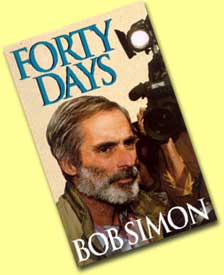
During the early days of the Persian Gulf War in 1991, Simon was imprisoned and tortured by the Iraqi army along with three CBS News colleagues. He later chronicled the experience in a book, “Forty Days.”
“…This was the most searing experience of my life,” Simon told the Los Angeles Times. “…I wrote about it because I needed to write about it.” ~ CBS News
My reaction to his first 60 Minutes segments after being released was that considering where he had been, they were puff pieces. That is not a criticism—he deserved a break.
On Simon’s death, Sir Howard Stringer, who led CBS while Simon was in prison, said, “Simon was every inch the network correspondent from the golden age.”
Responding to a question on CBSN about whether Simon was ever afraid in the field, Stringer recalled working with him in Northern Ireland in the ’70s during a confrontation between the British army and the Irish Republican Army.
“There was no sense of this being anything but another day in the life, and I don’t think he ever thought about it very much,” Stringer said. “I never was aware of him being afraid of anything. I mean, he volunteered for everything.”
Unique circumstances make figures in the national media possible. There are successes and failures—trials and twittering. There are a few that have been in difficult situations and fewer still that report from them on a national platform.
Bob Simon was one of them, and his presence will be missed.
We look up from the grindstone and notice everything has changed. When did that happen?
Most often it’s climate—torrential storms that ripped through the yard, knocking down trees and branches—but it is more than that.
It may the human condition: a long walk to our worldly end—replete with biological aging, physical ailments and the like. It’s not only that.
We have milled life’s bounty and used it, only to find that the wheat berries, oats and corn we like have all changed from abundance to scarcity. We make bread from the flour, but it no longer sustains us.
Bit by bit, we are confronted with changes we didn’t expect.
I don’t visit John’s Grocery much, but this story about Wally the Wine Guy is just one of several about the changes in that neighborhood where I briefly lived after graduate school. He moved to a new gig in the downtown grocery store after 26 years at John’s.
I like some of the changes in downtown Iowa City: the tall buildings in the pedmall with high-end apartments, the constant bustle of businesses opening then closing, the proliferation of student housing that can make landlords a tidy sum and keep downtown populated.
Other changes not so much, particularly the demise of Murphy-Brookfield Book Store, and what is now a struggling Riverside Theatre that gave up Shakespeare in the Park because for three of the last six years, they were flooded out in City Park, resulting in reduced attendance and a financial loss. Something’s changing and it’s not just that people are aging, although that’s part of it.
Wally went corporate is how I read the story. He might as well if the deal is sweeter and the opportunities to service a new clientel more profitable. Can’t blame him for that, and as I said, I don’t frequent John’s Grocery much. They already have plans for a replacement.
We must adapt to change as we can. We don’t have to like it, although we should look up from our work and notice— from time-to-time.
Deeply invested in an economy of multiple income sources, part time work, no benefits and flexible hours, discussions in the national media about job growth, the 30-hour work week, and changing job descriptions fall upon deaf ears.
I’m happy to sustain a life in a turbulent world, avoiding big jobs like the one left in 2009, and take my chances with what work circulates at the bottom of the rain barrel during a long drought. Most wouldn’t call that making a living, but the easy-money jobs are all gone, if they existed once upon a time. People, including me, do what they must to sustain life.
Things didn’t change this year, or in the last five years. This experience is the result of an intentional movement, one that saw its best days during the Reagan administration.
The truth is we all have to make a life. Even if suicide is painless, it is no option at all.
What matters more, what helps us go on, is the drive ever forward in our lives. Not toward some dark and pearly other world destiny, but with the exercise of free will and intent, toward making the commons a better place. Taking care of ourselves, while important, is not the endgame.
Without good health and economic security, it would be hard to do anything. Some of us are lucky to have a stable, if somewhat precarious platform built on years of hard work, good health and a safe upbringing and neighborhood. If we are one of the lucky ones, it is important to remember John Donne, “no man is an island,” and recognize that unlike the bard, we are of an age.
In my worklife, dating to the 1960s, there have been only rare times when I worked a Monday through Friday day shift job, most notably while at the University of Iowa in the early 1980s. Nonetheless, there is a cultural resonance to “the weekend,” even if I haven’t really had one since those government employment days. Whether with a high paying job or what I’m doing now, work always beckons, regardless of the day of the week.
The saving grace is the brief respite when a workday is followed by one more open. A chance to open a bottle of wine purchased from the discard cart at the grocer, or enjoy a snack from newly bought food from the warehouse club—chez nous.
Tonight, after a shift at a job, grocery shopping and a meeting in the county seat, only then will I succumb to escape, then sleep soundly.
It seems upside down, but Monday really is my Friday and the work goes on with nary a day off. I’m not complaining, just trying to understand life in this turbulent world so it can be sustained.
There is a piece to be written about education and how it is supported in Iowa, although not the one that comes to mind.
It is a timely topic because the way our K-12 schools receive government funding includes what is called “State Supplemental Aid,” or as some slow to cultural adaptation legislators call it, “allowable growth.” The legislature is supposed to set the amount of SSA within 30 days of the presentation of the governor’s budget. They don’t always do that.
We know, with some certainty, that the bulk of a child’s education is not about school time. In fact, children do better in formal schools if they have a broader context of learning that includes family time, formal outside activities, and other social constructs to engage them. It’s not just me saying this.
“One in every five students drops out of high school and roughly 1.2 million students fail to graduate from high school each year,” reported the United Way in a 2012 issue brief titled, “Out-of-School Time.”
“Local United Ways and their partners must ensure that children and youth from birth through young adulthood have meaningful supports and opportunities across all settings (e.g., families, schools, communities).”
Education begins at home, and includes the society in which we live. The Iowa K-12 schools are a subset of that, and one doesn’t have to be a home schooler to appreciate it.
For some, it never gets far from there. Family life becomes an unending series of coaching, sharing, counseling, correction and stimulus moments injected, intentionally or not, into the arc of a child’s life. School becomes one more thing.
In our family, going to school was positive. Not only did we purchase special clothing and gear, and update our immunizations, the prospect of learning with other neighborhood children provided a broadening experience—one we couldn’t replicate at home.
There was some stress and uncertainty, and we didn’t agree with everything the schools taught, or the social environment they created, but the overall impact was positive. We learned how to get along in a diverse society, and that was and remains important. That applies to my own schooling and to my perceptions of our daughter’s time in K-12.
The other day I encountered a very young child in a stroller looking toward a conversation between the presumed mother and a store clerk. Silent and intent, the soon to be toddler took it all in. What unscripted learning took place? What observations did the child have and from what framework? The child focused on speech coming from the boisterous one. It was a look of wonder that is hard to forget.
Enter my Catholic upbringing and the concept of “free will.”
The question of free will ranks among the most important philosophical problems. The view adopted in response to it will determine a man’s position in regard to the most momentous issues that present themselves to the human mind.
On the one hand, does man possess genuine moral freedom, power of real choice, true ability to determine the course of his thoughts and volitions, to decide which motives shall prevail within his mind, to modify and mold his own character?
Or, on the other, are man’s thoughts and volitions, his character and external actions, all merely the inevitable outcome of his circumstances? Are they all inexorably predetermined in every detail along rigid lines by events of the past, over which he himself has had no sort of control? This is the real import of the free-will problem.
The progressive view is that life is not predetermined by circumstances of family or acculturation. Environmental factors may come into play, but every American can have the opportunity to share in the American dream, and the role of government is to give people a hand up in what often is a struggle toward an equitable and secure life in society. Public school funding is an important way governments do that.
This gets lost in the public debate on school funding. The Iowa House Republicans view setting SSA as a negotiation. They passed a bill—along party lines—to set the figure at 1.25 percent. This was a starting point, they said, intentionally set very low, and in line with the governor’s budget.
The Senate is expected to pass a bill setting the figure between four and six percent. One doesn’t have to be Jeane Dixon to see a settlement around three percent.
Interested parties will advocate for an SSA number and the process will be ugly. The schools will uniformly say it is not enough and cut budgets in response to the final amount. That will be ugly too.
School funding is one more reason elections matter and people should get involved in the political process. That they don’t is a problem our K-12 school system helped create. There is no bigger indictment than yesterday’s Des Moines Register headline, “only 23 percent of millennials can name their state’s senators.”
In our community, people remember attending the one-room schoolhouse Big Grove Township School #1, now called the Stone Academy. It closed recently, in 1953. Whenever there is talk at the legion or at public events about the school, an old timer or two will say, “I went there,” and recap who else did.
There is no going back to the one-room school house, and that’s a good thing. Living in Iowa, our schools have great facilities and well educated teachers and administrators. Yet something is missing.
As a society, we spend a lot on education. Details for Iowa can be found in the 2014 Annual Condition of Education Report. It’s not about the money, it’s about our priorities.
What is missing is a sense of connection. People may be connected to a local community the way a Stone Academy graduate is, but many won’t live here that long. They don’t want that type of connection.
It is not for me to say what people want, or how they get there, except to say I have hope that as a society we recognize we are not in the world alone. The interdependence of societies, cultures and resources on this blue-green sphere is becoming increasingly important. Education can and must play a role in bringing this outlook to the fore.
For the most part we tolerate diverse views. However, relativism has proven to be a false path toward resolving conflict and isolation. There is no right answer, just a notion that when we support education, it means a lot more than government budgets to support public schools. It means a type of engagement the creates hope for more than the success of an individual at the expense of community.
We are a long way from that type of sustainability, and it is unclear that education, in schools, at home and in society, is getting the job done.
That’s why I believe we should support education more than financially and more than we have.
Both of us had commitments in town, so the foot of snow had to be dealt with. I was outside digging at 4 a.m., illuminated by a full moon and clear sky. It took two hours.
After our daughter moved to Colorado, I would run on the lake trail by moonlight. It was a bit crazy, but I never turned an ankle or fell. It seemed necessary to get five miles in before work at the office, just as snow removal by moonlight was necessary yesterday. Moonlight activities have turned from recreation to mandates in the life we now live.
Not that the scooping was without therapy. Yet an unwelcome tick tock accompanied me as the deadline to depart for the warehouse approached.
The moon set as I finished the second third of the 80-foot driveway. Turning the car around, headlights replaced inconstant moon while spreading sand on the snow-packed gravel that connects our property to the rest of society. Didn’t want either of us to get stuck there.
During my Climate Reality training in Chicago, Al Gore that pointed out something that should have been obvious: in the morning, people pick up their mobile phones and catch a few swipes before turning on the lights. While doing so this morning, I found this:
“Apps, gadgets, hearts, likes. Taps, clicks, swipes, screens. These numb us with comfortable titillation. They thwart us from dreaming the unimaginable. They make us altogether too sensible to ever pursue of the unreasonable.”
While living by moonlight may be necessary, we should do it less sensibly from time to time. There is a chance to transcend la vie quotidian to effect change in a turbulent world. In fact, that may be why we are here.
Twelve participants in the Great March for Climate Action made a reprise visit to Washington, D.C. last Wednesday.
Ed Fallon, march founder, tried to get meetings with the White House and the Environmental Protection Agency to coincide with the end of the march last September, however, key people were unavailable at the time.
The White House meeting did happen, with Dan Utech, special assistant to the president for energy and climate change; Rohan Patel, special assistant to the president and deputy director of intergovernmental affairs, and Angela Barranco, associate director for public engagement at the White House Council on Environmental Quality. My story about the meeting in the Iowa City Press Citizen is here.
Fallon was unable to attend the meeting with EPA later that day. Marchers met with Joseph Goffman, senior counsel, assistant administrator for air and radiation and Mark Rupp, deputy associate administrator for intergovernmental relations. After the EPA meeting, marchers fanned out and met with their congressional representatives.
The Great March for Climate Action was not a stroll in the park for the core group of 35 marchers who made some or all of the way from Los Angeles to Washington. There were physical challenges including weight loss, foot and leg problems, fatigue and stress. They dealt with extreme weather events physically, notably in Nebraska where they encountered a giant hailstorm unlike any they had previously experienced. More than anyone I know, Fallon and company walked the walk, experiencing personal hardship to do so. The meetings in Washington were both a culmination and a new beginning for participants in advocating for climate action.
“Officials recognize that climate change is difficult for many people to grasp,” Fallon said. “The eight months along the march route allowed us to experience the situation directly, and this places us in a unique position of credibility.”
In addition to the White House meeting, Fallon called on Senators Chuck Grassley and Joni Ernst, and Representatives Dave Loebsack (IA-02) and David Young (IA-03) to advocate for climate action. While the results of the meetings were mixed, marchers had the ear of their elected representatives. All four politicians voted for a bill to build the Keystone XL pipeline, something the marchers adamantly oppose.
Last night, Fallon posted a photo of himself and Miriam Kashia of North Liberty with Senator Joni Ernst on his Facebook page.
“Between driving, meetings and presentations, I’m behind on getting these posted,” Fallon wrote. “Our meeting with White House staff on climate change: very encouraging! Our meeting with Senator Joni Ernst: not so much.”
Having gained standing by walking the walk on climate change, it opened doors. What marchers found on the other side wasn’t all they had hoped. While they were away from Iowa, the electorate brought to power our most conservative congressional delegation in a while, notably absent Senator Tom Harkin.
In effecting progressive change there are two important parts. Electing people who represent our views and advocating for our causes with them. In 2014, progressives did not fare so well on the former, which makes the latter more difficult.
While some may not like looking at photos of Fallon and company posing with these politicians, they are doing their part for progressive change. If we don’t like the current crop of politicians, we can’t give up.
“Obviously we were all disappointed with the outcome of the last election, and there are a lot of reasons for it and I’m happy to take on some of the blame,” said President Barack Obama at the House Democratic Issue Conference on Thursday. “But one thing I’m positive about is, when we’re shy about what we care about, when we’re defensive about what we’ve accomplished, when we don’t stand up straight and proud… we need to stand up and go on offense, and not be defensive about what we believe in.”
It’s an open question whether progressives will get organized for the next election. It’s clear we won’t unless we emulate the Great March for Climate Action and walk the walk—beginning now.






 Journey Home
You must be logged in to post a comment.