Categories
Living in Society

Drake University Democratic Debate

Drake University Photo Credit Cedar Rapids Gazette

The winner in last night’s debate at Drake University’s Sheslow Auditorium was the American people as Hillary Clinton, Martin O’Malley and Bernie Sanders discussed, and actually debated issues that matter. This is in sharp contrast with the multi-level Republican debates.

Only 700 people had tickets to attend, so I closed the door of my study, put on my headphones and shut down all browsers except the CBS live stream. I took notes using Microsoft Outlook.

It is ironic that Twitter, a debate co-sponsor, was pretty useless once the questioning began. With an avalanche of more than a thousand Tweets per minute, it was more than a person could comprehend, let alone participate effectively in. I opted to listen to the actual debate.

From here, the race is between Clinton and Sanders. Martin O’Malley had his last chance to gain traction in the race, and he whiffed.

One of O’Malley’s campaign taglines is “new leadership.” He failed to demonstrate it last night. When directly asked about his lack of experience in international affairs, O’Malley dodged the question. He won’t break loose from low polling numbers by dodging key questions. Without more support, he lacks a path to win any of the four early states.

As noted previously, it is hard to find fault with O’Malley’s core positions. The trouble is with his narrative. His style of using personal anecdotes, pointing to what he did in Maryland, is part of the reason he isn’t getting traction despite solid Democratic policy positions. O’Malley says the country needs new leadership, but doesn’t provide meaningful evidence to back up his assertion he has that capacity.

Then there were two.

There is a lot to like about both Clinton and Sanders. As with the results of a single poll, there is not as much meaning in a single debate performance as some supporters assert. At the same time, Clinton is the better debater and it showed.

Clinton’s response to the question about her campaign contributions from Wall Street demonstrated her mastery of the debate form. She began with a curious statement about needing to “do more” to regulate Wall Street. She didn’t say the words, but essentially lit the fuse for Sanders and O’Malley to go off on their position of re-instating Glass Steagall. Clinton’s position is re-instating Glass Steagall is not enough, and she was able to frame the discussion on her terms.

Reforming Wall Street and reducing the influence of money in politics is Sanders’ signature issue. It appeared Clinton got Sanders’ goat because he brought Glass Steagall up in the next question even though it wasn’t the topic. As long as there is money in politics (which there will be forever) and presidents appoint financiers from Goldman Sachs and J. P. Morgan Chase to key positions in their administration (which Sanders said he would not do), the appearance of impropriety will exist. Clinton didn’t shake this completely, but defended herself well in the debate.

The other topic where Clinton was able to frame the debate to her advantage was about increasing the minimum wage. Sanders and O’Malley support the Democratic party platform plank to raise minimum wage to $15 per hour. Clinton supports $12 per hour.

In asking the question, Kathie Obradovich of the Des Moines Register gave framing favorable to Clinton, mentioning the concerns of Alan Krueger over raising the minimum wage to $15 per hour. Insiders would have known Clinton’s deviation from the party platform and that her position is partly a response to Krueger. As Clinton pointed out during the debate, Nobel Prize winning economist Paul Krugman agrees with her. While both Sanders and O’Malley piled on Clinton, she maintained the upper hand on this topic.

A couple of people remarked in social media about Sanders’ increasing hoarseness during the two hours. I was reminded of John Kerry having the same issue with losing his voice on the trail in 2004. Kerry made the decision to send running mate John Edwards to an event in Cedar Rapids so he could save his voice for an upcoming debate. It’s insider baseball, but as I listened to Sanders I thought he should have backed off some of his events the previous day to save his vocal chords. He was able to adequately speak, but the hoarseness was a distraction. Clinton was not without fault in this regard. She sounded like she needed a drink of water as her laughter cackled across the stage after her competitors said things she must have thought were outrageous.

Tony Leys of the Des Moines Register made this comment on Twitter:

Some don’t want to hear it, but the Democratic primary debates are about Iowa, New Hampshire, South Carolina and Nevada period. While Sanders’ reference to bloated spending on the nuclear weapons complex may provide traction in New Hampshire, Clinton was the only candidate to use the reality of Terry Branstad’s Iowa effectively.

There are two more national debates before the Feb. 1 Iowa caucuses.
Categories
Living in Society Social Commentary

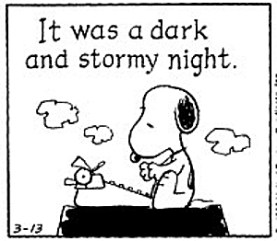
Dark And Stormy Night

Photo Credit Charles Schultz

I reached into the rusted storage cabinet to find the silicone spray.

The padlock needed lubricant before securing the employee locker at my newest job.

It’s not like I’ll keep valuables inside. My lunch and mobile device when I’m working, my box cutter, tape measure, name tag, note pad, ink pen and radio earpiece when I’m not.

I expect to enjoy helping people solve everyday problems at the home, farm and auto store. Problems like having a corroded padlock.

Tuesday’s thunderstorm blew the remaining apples off the tree. We had a tornado warning so I turned on the television to view weather radar. It turned out the remote that controls the analog to digital converter went missing. I couldn’t tune in. One of two things will happen: 1. Get rid of the TVs altogether, or 2. Buy a digital set. No hurry on a decision because television viewing is a dying practice when life offers better options.

The apples in storage need using before turning to compost so I made applesauce – the first of many batches over the coming days. To give it a twist, I added cinnamon, allspice and cloves with a handful of dried fruit. It was delicious.

The terrorist attacks in Paris were breaking news when I returned from my first day of work at the store. The morning after details are sketchy. The death count mounts. Reasons are unknown. The French border remains closed.

I have two direct connections. My friend Ed Fallon is currently in Normandy marching to Paris on foot for the December convention of the parties on climate change. Al Gore was broadcasting the Live Earth – 24 Hours of Reality event from Paris, and suspended programming to recognize and respect unfolding events. I’ve been to Paris a few times, but that was decades ago.

“Once again we’ve seen an outrageous attempt to terrorize innocent civilians,” President Obama said last night. “This is an attack not just on Paris, it’s an attack not just on the people of France, but this is an attack on all of humanity and the universal values that we share.”

Social media was quick to respond with memes. Commentators became immediate experts in terrorism whether they knew anything or not. It was predictable and sad.

Humanity is on the move, not only from Asia, Africa and the Middle East. Rather, civilization as we know it appears to be collapsing.

In the wake of World War One, William Butler Yeats wrote “The Second Coming,” which in part says,

Turning and turning in the widening gyre
The falcon cannot hear the falconer;
Things fall apart; the centre cannot hold;
Mere anarchy is loosed upon the world,
The blood-dimmed tide is loosed, and everywhere
The ceremony of innocence is drowned.
The best lack all conviction, while the worst
Are full of passionate intensity.

Almost a century later it is unexpected that “gyre” has come to define the largest ecosystem on Earth and home to a very large collection of man-made debris in the Pacific Ocean. The detritus of a deteriorating civilization coming together.

We feign shock at the latest unfolding terrors when it’s the bigger picture that may injure us.

I’ll take the apple peels and kitchen food waste to the compost bin. Cold weather may delay the deterioration until spring. One can only believe that the new season will also bring hope. So too for our society, although in the darkest hours that seems far from certain.

For now, I’ll lock up my gear and continue to solve everyday problems. And contribute to hastening the compost and tilling it into into the soil for next year’s garden. It’s no satisfaction, but rather what I can do to create hope.

Categories
Living in Society Social Commentary Work Life

Oscar Mayer’s Long Road

Author at Kraft Foods Oscar Mayer plant on Second Street in Davenport, Iowa Nov. 25, 2011
Author at Kraft Foods Oscar Mayer plant on Second Street in Davenport, Iowa, Nov. 25, 2011 Photo Credit Dan J. Czolgosz

DAVENPORT — The Kraft Foods Oscar Mayer plant on Second Street will be razed as its new owner, Kraft Heinz, plans to move operations and layoff much of the workforce at the long-time meat packing plant.

Wednesday’s announcement, that Kraft Heinz will close seven plants in the U.S. and Canada over the next two years as part of a downsizing that will eliminate 2,600 jobs, or roughly 14 percent of its North American factory workforce, was widely anticipated by workers.

The company plans a new Davenport facility, contingent upon government financial support, however, some view it as a devil’s bargain because the net impact will be to lose about 800 jobs.

United Food and Commercial Workers Local 431 had not been consulted about the changes.

“They threw the union under the bus,” plant employee Curtis Grant of Eldridge said in an interview with the Quad City Times.

Concessionary bargaining is nothing new to Local 431 whose members ratified a four-year contract with Kraft Foods Oscar Mayer on Nov. 13, 2014. The sticking point in those negotiations was insurance and pensions.

“Now with Heinz, the company is basically telling Davenport give us subsidies to shutter the Second Street plant and build a new facility on the north side or we will close completely and take all the work to Missouri,” said a local worker who requested anonymity via email. “Both the city and the union are painted into a corner. And now with them talking about building a new $200 million plant, the building trades are excited to get those jobs. It’s a devil’s bargain.”

In the takeover of Kraft Foods by Heinz, business partners Warren Buffett of Berkshire Hathaway and global investment firm 3G Capital hope to reduce expenses by $1.5 billion by exploiting synergies among operations and consolidating back office functions including supply chain management, accounting and administration.

On Friday, Berkshire Hathaway reported third-quarter profits more than doubled to $9.4 billion as the completion of the Kraft-Heinz merger boosted the paper value of its stake in the food giant. The deal was good for the third richest man in the world.

Thursday, the Iowa Department of Economic Development announced a $4.75 million incentive plan for the Davenport plant closing, including $3 million once the facility is razed.

“We are glad that Davenport, was able to successfully compete for a new, state-of-the-art manufacturing facility that will certainly position it for future growth,” said Debi Durham, director of the IEDA in a press release. “As major brands merge in this sector, consolidation and modernization will be the outcome.”

Durham said to the Quad City Times she is aware of the potential negative perception of providing state-funded financial assistance to a company that is downsizing its workforce both in Iowa and nationally.

“The optics are not lost on us, and believe me, the sensitivity is not lost on us. We care about people,” she said. “So we do the plays that we believe give us the greatest opportunity for the future, and I think that was what you saw here today.”

Durham said offering financial assistance to a company that is downsizing is not unique and could become more common as more large companies merge.

“We’re going to see more of this,” Durham said. “You’re seeing large mergers going on at a very high level between equals. And any time that happens and we have facilities, that’s something to watch for us.”

It appears Durham’s department has become like a turkey vulture picking over the carrion of what used to be a robust manufacturing economy and the middle class it supported.

If we consider what the Davenport plant makes – bologna, Lunchables, and other branded, highly processed meat products – this day had to come. In part, consolidation of the food industry is a reaction to the fact that tastes have changed and sales of some traditional products have declined. The processed meats industry is experiencing declining consumption of meat in general, and an interest in healthier options, according to data aggregator Statista, Inc.

The World Health Organization supports moderation of consumption of preserved meats to reduce the risk of colorectal cancer and has been doing so since 2002. On Oct. 29, WHO released a new report regarding the connection between red meat and cancer. Juxtaposition of this story with news about Kraft Foods Oscar Mayer, and Buffett’s third quarter financial results tells a broader story. Things have changed since Oscar F. Mayer immigrated from Germany and began selling sausages from his butcher shop in Chicago in 1883.

This story hits personally because not only did my maternal grandmother, my father and I work at the plant, the rise of Oscar Mayer as a global brand framed my early participation in our consumer society. I’m not alone in that.

When the Mayer family sold the company to General Foods in 1981, the Reagan revolution that resulted in decimation of the middle class had already begun. While it would have been hard to predict today’s outcome in 1981, what’s happening is not surprising in that context.

The two year transition to plant closure will hopefully enable employees to figure out what to do with the rest of their lives. Perhaps that is the best that can be expected.

Here is the entire statement provided to employees at one of the affected plants:

“Following an extensive review of the Kraft Heinz North American supply chain footprint, capabilities and capacity utilization, we are announcing the closure of seven manufacturing facilities in North America: Fullerton, California; San Leandro, California; Federalsburg, Maryland; St. Marys, Ontario, Canada; Campbell, New York; Lehigh Valley, Pennsylvania; and Madison, Wisconsin. In a staged process over the next 12-24 months, production in these locations will shift to other existing factories in North America.

We are also planning to move production from our existing Davenport, Iowa, facility to a new, state-of-the-art location within the Davenport area; and move part of our cheese production from our Champaign, Illinois, facility to other factories within our network, which will create will make Champaign a center-of-excellence in dry and sauce production. Both moves will take up to two years to complete.

Our decision to consolidate manufacturing across the Kraft Heinz North American network is a critical step in our plan to eliminate excess capacity and reduce operational redundancies for the new combined Company. This will make Kraft Heinz more globally competitive and accelerate the Company’s future growth.

We have reached this difficult but necessary decision after thoroughly exploring extensive alternatives and options. This action will reduce the size of our North American factory-based employee population by a net number of approximately 2,600 positions.

At the same time, we will invest hundreds of millions of dollars in improving capacity utilization and modernizing many of our facilities with the installation of state-of-the-art production lines.

We will treat our people with the utmost respect and dignity. At the appropriate time, affected employees will receive severance benefits, outplacement services and other support to help them pursue new job opportunities. Kraft Heinz fully appreciates and regrets the impact our decision will have on employees, their families and the communities in which these facilities are located,” Michael Mullen, SVP of Corporate & Government Affairs.

“Additionally, Kraft Heinz is announcing that in 2016 we will move Oscar Mayer and our US Meats Business Unit from Madison, Wisconsin to our co-headquarters in Chicago. The move will bring 250 jobs to the Chicago area.

Members of the Oscar Mayer and US Meats Business Unit will have the opportunity to move with the business to Chicago. The move centralizes all our U.S. Business Units to our co-headquarters of Chicago and Pittsburgh, which will drive increased collaboration and efficiency.”

Categories
Living in Society

Hillary and the Narrative

Hillary Clinton Walking to the Stage at S.T. Morrison Park, Coralville, Iowa
Hillary Clinton Walking to the Stage at S.T. Morrison Park, Coralville, Iowa, Nov. 3, 2015

CORALVILLE — Hillary Clinton held a town hall meeting in S.T. Morrison Park on Tuesday with more than 500 people in attendance, according to event organizers.

After a brief speech, she called on audience members, taking 13 questions covering a wide range of international and domestic issues.

Her command of the current political scene and experience with politics at the highest level was on display. For the wonkier among us the exchange was welcome.

If voters could set aside preconceptions formed since Clinton was first lady of Arkansas, she would be the clear choice to lead our country for four or eight years. Whether caucus goers will give her that chance remains uncertain despite her continuous lead in the polls since she declared her candidacy April 12. Supporters I spoke with in queue to enter the seating area seemed likely to turn out for her despite minor grievances with Clinton and her campaign.

Johnson County is the strongest liberal center in Iowa, and according to New York Times correspondent Amy Chozik, “Sanders Country.” Her narrative is as follows:

On Tuesday, Mrs. Clinton plans to answer Iowans’ questions at two town-hall-style events in Coralville, near Iowa City, and Grinnell, another university town. Both are known as Bernie Sanders country because of the devoted liberal college students who have been intrigued by his candidacy, but Mrs. Clinton, feeling emboldened, will seek to make inroads in the areas to talk about her plans to lift middle-class incomes.

The trouble is the narrative doesn’t reflect the complexity of the community. As John Deeth pointed out, Johnson County is different from the rest of Iowa. That difference is not only in its presidential politics, and the role of the student vote, but in Iowa City ballot initiatives like the 21 Bar Referendum; thrice failed county-wide efforts to gain approval of expanded jail capacity and a more secure courthouse facility; and the board of supervisors decision to raise the minimum wage coupled with the prompt rejection of the ordinance by some cities. I get that Ms. Chozik works on a deadline and has to keep it simple for her readers, but narratives that ignore the complexity of society in favor of pabulum-style writing should be an affront to people who know better.

Another problem with the narrative is depiction of Clinton as a poll-watcher feeling emboldened by the surge since mid October. This is ridiculous in light of the fact that one of Hillary’s key Iowa supporters is former Iowa Democratic Party chair Sue Dvorsky who lives in Coralville. Why wouldn’t one of Clinton’s biggest fans invite the candidate to the park where her husband, state senator Bob Dvorsky, has held his annual birthday party fund raiser?

While I appreciate that Chozik spends time in Iowa reporting on the run up to the caucus, and her stories do add value, corporate media narratives shaped the opinions of people with whom I queued before the event. They give people something to talk about, and there is already enough gossip in our community without the media adding more.

Not everyone likes the policy wonk Clinton was on Tuesday. People who live on the surface of what is happening in society, who don’t have the advantage of being physically close to a candidate like we can be in Iowa, get their information largely from mass media. On the playing field that is cable news, print or social media, and network news, one brief story is juxtaposed with another at a continuing and mind-numbing pace. It makes for a bitter soup of life. That Hillary Clinton knows policy inside out from personal experience makes her unique in the race. The media format and content as presented by many serves to distract viewers from that.

The Iowa caucuses are a blessing and a curse. Our first in the nation status enables almost anyone who wants to get up close and personal with a candidate who campaigns here. On the other hand, organizing people to caucus for a candidate can be an exercise in frustration, beginning with the fact that people don’t want to hang out for more than a couple of hours taking care of what most believe is irrelevant “party business.” The Democratic Party process excludes people as much as it welcomes.

Hillery Clinton in Coralville, Iowa, Nov. 3
Hillary Clinton in Coralville, Iowa, Nov. 3, 2015

My main challenge in attending the town hall was light. I wanted a few decent photos on my inexpensive Kodak camera as the sun would be setting when Clinton spoke. Sunset is still magical to me. I chose a seat west of the stage so the setting sun would be at my back. Of 200 shots, about six were keepers, including this one of Clinton with the sun illuminating her.

As writers, what we see and hear is influenced by who we are as much as by what is said and done by our subjects. Input is filtered and shaped by our biases, learning, and method of information collection, the way an anthropologist influences ethnographic interviews with questions asked. Hearing the entirety of what a candidate has to say at an event like Tuesday is pure Iowa. Or, as Sue Dvorsky posted on Facebook about the town hall, “The breadth of topics were a credit to our community, and answer the question ‘Why Iowa?’ And the depth of her responses answer the question ‘Why Hillary?'”

Categories
Environment Reviews

Reading Naomi Klein

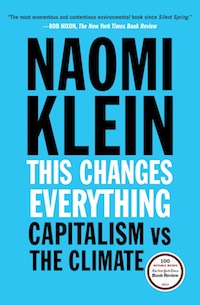
This Changes EverythingUnlike the climate crisis story spoon fed to us in decreasing numbers of corporate media stories, in social media memes, and in fleeting conversations at community gatherings, in This Changes Everything: Capitalism vs The Climate, author Naomi Klein said there is a nascent, global movement preparing to take climate action.

“The climate movement has yet to find its full moral voice on the world stage,” Klein wrote. “But it is most certainly clearing its throat—beginning to put the very real thefts and torments that ineluctably flow from the decision to mock international climate commitments alongside history’s most damned crimes.”

If you haven’t read Klein’s 2014 book, you should. Not because of a desire to take sides in the public discussion of global warming and the need to keep global temperature increase to two degrees or less. But because a). reading a paper book can be good for us, and b). with Klein you can hear her broader story and learn new things. Here’s more on why you should pick up a copy at your library or bookstore if you haven’t already.

In Iowa, as home to the first in the nation caucuses, we are inundated with stories about politics. Elections matter, and we have seen how in the Republican awakening after Barack Obama’s 2008 election. Progressives hardly understood that Republicans, though in the minority in the Congress, would exercise such power that much of Obama’s agenda was sidelined from the beginning. Republican comebacks in 2010 and 2014 have turned the congress from Democratic to Republican, and right-wing hardliners have more input to the legislative process than their numbers warrant. Taking climate action in Congress has, for the most part, been a non-starter.

“It’s not just the people we vote into office and then complain about—it’s us,” Klein wrote. “For most of us living in post-industrial societies, when we see the crackling black-and-white footage of general strikes in the 1930s, victory gardens in the 1940s, and Freedom Rides in the 1960s, we simply cannot imagine being part of any mobilization of that depth and scale.”

“Where would we organize?” Klein asked. “Who would we trust enough to lead us? Who, moreover, is ‘we?'”

Klein’s book frames answers to those questions: People are organizing everywhere, resisting unbridled extraction of natural resources by corporations. “We” includes almost everyone.

This Changes Everything reviews the recent history of the climate movement. It covers extreme extraction of natural resources that leave behind waste heaps, fouled water and polluted air, then are burned and produce atmospheric gases that warm the planet. Everyone from fossil fuel companies to environmental groups have been involved in what Klein calls “extractivism.” There is a growing resistance, including environmental groups divesting from investments in the fossil fuel industry, indigenous people mounting court battles, and community groups violating international trade agreements to move to renewable energy sources. The book is a snapshot of where the climate movement currently stands.

While Klein has her point of view, she depicts the complexity of a global network of fossil fuel companies seeking to extract hydrocarbons scientists tells us must be left in the ground. While the resistance may not have found its full moral voice, Klein’s book makes the case it won’t be long and recounts the significant inroads indigenous people and communities near extraction sites are making.

When we talk about taking climate action, Naomi Klein’s work should be part of our conversation.

~ Written for Blog for Iowa

Categories
Work Life Writing

Working to Write

Passport and Notebook
Writer’s Tools

I work to write.

It became clear at CRST Logistics I couldn’t combine writing with a career the way William Carlos Williams, Wallace Stevens, and every college teacher who took ink to paper did.

I transitioned to being a purveyor of writing and speaking. It has been tough to consistently secure enough income to support the new métier.

Yesterday I finished the season at the orchard. Freelancing for the newspaper slowed down. It is time once again to set writing aside and work on that necessary task – generating cash to pay expenses.

What do I want to do? Whatever I can to cover ongoing expenses, pay down debt, and enable my writing.

While not a neophyte in the art of the job search, I have a lot to learn. The work I’ve done in retail and as a correspondent may not be around the way it has been.

A recent article at Business Insider lists jobs that are at risk of being automated. The list includes not only retail salespersons and newspaper correspondents, but loan officers, receptionists, taxi drivers, security guards, fast food cooks, bartenders, financial advisers, and musicians. These are all position I might have considered. Suffice it this job search must identify more sustainable work than what these professions offer.

“A significant factor in the decline of the quality of jobs in the United States has been employers’ increasing reliance on ‘non-regular’ employees,” Steven Hill wrote at Salon, “(It is) a growing army of freelancers, temps, contractors, part-timers, day laborers, micro-entrepreneurs, gig-preneurs, solo-preneurs, contingent labor, perma-lancers and perma-temps.”

I embrace such a lifestyle, yet creating a sustainable portfolio of such work has been challenging. Careful attention to budget and managing expenses is essential and is the easier part of the process. What is hard is recognizing the life-cycle of a specific engagement and properly planning for a continuous revenue stream.

“Where I landed after a career in transportation was with a portfolio of activities, some paid and some not,” I wrote in a presentation for the Solon Public Library, “I value all of the work I do and have to make choices on how I spend my time. My life is a systematic and thoughtful process of continuous evaluation and improvement.”

I need to get better at it.

The transition of newspapers, like what is happening at Gannett, is ongoing and incomplete. More and more, the local paper has articles written by reporters further up the organizational structure, blocking out space for freelancers. I enjoyed a good run writing for the Iowa City Press Citizen, but there hasn’t been a story offered in a month. The lesson learned is it is okay to take work to build experience, but as a freelancer the thread to the newspaper can be dependent upon a particular editor. Mine left a while back.

In a world where companies increasingly do away with full time employees using apps and algorithms to manage a pool of part-time workers, being a fulfillment person in such a system has its vagaries and downside. To make such jobs work requires a personal infrastructure to take care of basic needs separately from companies who offer employment. For many years this was exactly what companies wanted – a flexible, variable labor expense that could be ramped up during peak demand and ramped down during the slow times in a business cycle. I developed a support structure where part-time or temporary jobs can be plugged in, but underestimated the continuous need for business development.

During a recent interview for a retail sales position, I was asked my salary requirements. I need between $20,000 and $24,000 per year to pay expenses and may have priced myself out of the job. The reality is we must make our own opportunities or subjugate our lives to what has become a new form of indentured servitude. Instead of booking passage to prosperity in a new world, today such workers struggle to get by in a society that seems interested only in making a buck from you’re here today, gone tomorrow labor.

I worked for great people during much of my working life. Going forward, knowing my potential manager before taking a job will be an important consideration. This learning came from constant experimentation and reflection on the jobs I’ve held since re-purposing in 2009. It’s no secret a significant reason people leave jobs is they don’t get along with their manager.

Yesterday I multi-tasked at the orchard, something we do when the end of season draws near. In addition to helping customers find apples to pick, I prepared samples of eight varieties of apples. Customers, other employees and I had many engaged conversations about apples, their parentage and uses – it’s great work if you can get it. It was the last day of the season and my manager invited me back next year.

Since I work to write, I said yes.

Categories
Living in Society Social Commentary

Five Things About Iowa City

Iowa City Old Capitol

By design, we built our home not in, but close to Iowa City when we moved back to Iowa from Indiana. The intention was to be within commuting distance of jobs in Iowa City, Cedar Rapids and the Quad Cities. Over the years I’ve worked in all three, so the idea has been validated.

Iowa City is a UNESCO City of Literature. With my long interest in culture, it was inevitable to have some relationship with Iowa City. That is, as long as I considered myself to be an Iowan, which these days is not a given.

The University of Iowa dominates the culture of Iowa City, providing a diverse mix of people and an economic engine some take for granted. There’s sports as well, although I’m not a fan and haven’t been to a Hawkeye game for more than a decade and that was mandatory for work. I lost interest in the Hawkeyes during the Ray Nagel years.

There are things to like about Iowa City and here’s my short list.

County Seat – It is convenient to live near the county seat. I enjoy paying my property taxes in person and voting at the auditor’s office. I have come to know many elected officials and encounter some of them at the county administration building when I’m there. As a community volunteer, and as an elected official, I’ve consulted with elected officials and staff, and the proximity has been valuable.

Change – Iowans are moving from rural to urban areas and Iowa City has changed in a way to support incoming and transient people. Changes in downtown over the years have been arguably for the better. I remember people running down Wilfreda Hieronymous for her urban renewal developments. I was living in an apartment above a restaurant just before the wrecking ball tore it down to make way for her Old Capitol Center. People hated it. I hated it because of losing the $85 per month rent on a three-room apartment across the street from Schaeffer Hall. In the long run the development of downtown has been a good thing.

Personal History – I demonstrated against the Vietnam War on the Pentacrest the spring of 1971, and saw George McGovern campaign there in 1972. We married at the Unitarian Universalist Church on Gilbert Street and Iowa Avenue. Our daughter was born at Mercy Hospital. I had my last conversation with an uncle on the west steps of Old Capitol. I’ve come to know and love spending time at the intersection of Market and Linn Streets, meeting with friends at the ever-changing coffee shop there. We still buy the occasional pie from Pagliai’s Pizza when I’m in the city before dinner time. These and a hundred more memories are an attraction.

High Culture – Iowa City attracts writers and musicians from around the world and there are opportunities to have a moment with them. I ran into James Van Allen on Market Street, Frederick Exley at the dental clinic, and Donald Justice at UPS. Over the years, I attended readings and events with John Cheever, Saul Bellow, Margaret Atwood, James Laughlin, Hunter Lovins, Edward Albee, William Styron, Toni Morrison, Robert F. Kennedy Jr., and many more.  I heard guitarists Andrés Segovia, Duane Allman, Albert King, Freddie King, Luther Allison, Jerry Garcia, Bonnie Raitt, Greg Brown, Christopher Parkening and others. The convergence of creativity is unique in the land of the sleepy ones.

Old Things Giving Way to New – With each passing year the Iowa City I know is fading. Old buildings have been torn down and construction is everywhere. The public discussion about historic preservation is a unique, peculiar and engaging endeavor. There is controversy about money and incentives given to developers – when hasn’t there been? Development has been part of Iowa City’s history for as long as I can remember.

Iowa City is making people and corporations rich, while attracting new poverty and crime. Urban sprawl seems uncontrolled. On the outskirts of the city, distinct neighborhoods with singular cultures are nascent. It is a sign of life in a turbulent world.

When I visit Hamburg Inn No. 2, I remember No. 1. I park on Brown Street and walk to town on the grid of streets laid out in the 19th Century, remembering what was here, considering what will be here. Eventually the old grid will give way to something new, and I don’t mean large multi-use properties that currently are in vogue. It is hopeful and energetic – engaged.

I would be loathe to give up our current home to move to Iowa City as so many retirees are doing. There is a cottage industry in people my age seeking something in the county seat. Despite the attractions, I’m not ready to move there, at least not yet.

Categories
Living in Society

Hillary Post-Jefferson Jackson

HillaryClinton-HardChoicesBeginning with the first debate on Oct. 13, it has been a fast and wild ride for Democrats.

Hillary Clinton held her lead in the polls, and Bernie Sanders appears to have reached a ceiling of support. Vice president Joe Biden won’t enter the race for president. Webb and Chafee bowed out. The Benghazi hearing turned to Clinton’s advantage due mostly to the Republican bubble combined with the fact that most viewers understand the political nature of the investigation. As I write, 6,000 ticket holders are ready to grace the HyVee Hall in Des Moines on Saturday to hear speeches and have some fun before the real work of organizing the caucuses begins with the end of year holidays.

What about Hillary Clinton?

I re-read my reasons for supporting Hillary, and find no need to switch. At the same time, some intertwined questions give progressives pause. Is she too close to Wall Street? How will she handle international trade and its relationship with the environment, labor and working Americans?

As the Democratic choice is reduced to one between Clinton and Sanders, the contrasts between them are what matters most.

Bernie Sanders has called for breaking up the big banks like he is beating a drum. In May he introduced a bill in the U.S. Senate “to break up the nation’s biggest banks in order to safeguard the economy and prevent another costly taxpayer bailout,” according to his campaign web site.

“No single financial institution should have holdings so extensive that its failure could send the world economy into crisis,” Sanders said. “If an institution is too big to fail, it is too big to exist.”

Clinton doesn’t go that far. Instead she supports reforms that would close loopholes in the 2010 Dodd-Frank Wall Street reform bill and strengthen enforcement against financial wrongdoing. Read the details of the plan here.

The difference is this. In order for Sanders to break up the big banks, he needs the cooperation of the Congress. For that to happen, the “political revolution” mentioned in his every speech must happen first, along with correction of Republican gerrymandering after the 2010 census. That’s a tall order for the Sanders agenda and if he has truly hit the ceiling of support, less likely to happen.

When we consider Clinton’s plan for reform, it has its challenges as well. Both President Obama and JP Morgan Chase CEO Jamie Dimon lobbied the Congress to reinstate banned federal subsidies for derivatives trading in Dodd-Frank. The plan Clinton announced would repeal these perquisites, returning to the original intent of Dodd-Frank. She too will need the support of the Congress to make that happen.

Skeptics point to Clinton’s treasure trove of campaign donations from Wall Street and question whether she will actually execute the reforms she proposed. Clinton pointed out that as a U.S. Senator she represented Wall Street in the Congress, literally, so the point is well taken. This question is less about her relationship with Wall Street and more about whether or not the electorate will engage in the general election and bring needed change to our government regarding Wall Street and across the board.

Both Sanders and Clinton oppose the Trans Pacific Partnership, based on what is known about the recent agreement (which has not been finalized). Progressives fear TPP will be another step toward globalization with consequences for the environment, labor and the way of life for many Americans.

The impact of globalization has been devastating in the U.S. as large businesses got larger and manufacturing moved to countries with lower labor costs and less stringent environmental regulation. Because of wage stagnation, middle class people have been compelled to purchase low cost goods produced in other countries, thus encouraging a cycle that isn’t in our best interests. Patterns set during the post-World War Two era were broken up with harsh consequences for workers and their families.

Bernie Sanders has voted against trade agreements such as NAFTA, CAFTA and the TPP. He has also voted yes on withdrawing from the World Trade Organization. Hillary Clinton shares her husband’s legacy which includes NAFTA, the World Trade Organization and the General Agreement on Trade and Tariffs. These entities epitomize the hopes for increased trade with globalization. They also brought along environmental degradation and substantial changes in the U.S. workforce experience.

Between Sanders and Clinton, who has the better policy?

The answer seems less than clear. There is little agreement and less understanding among members of the electorate about the relationship between trade, globalization, environmental degradation and labor. There are no simple answers when people want simplicity in a complex world.

What we know is the interests of Wall Street align, for the most part, with interests in globalization. We are back to the basic difference between Sanders and Clinton in implementing change during a potential administration. Sanders calls for a revolution, and Clinton does not. Sanders assumes down ticket wins to support his positions will happen as a corollary to his “revolution.” Clinton takes the world as it is and intends to improve it.

Given Hillary Clinton’s long involvement in globalization as a path to economic prosperity, one asks whether her views have changed since her husband’s administration and how. She repeatedly said she is not planning for Bill Clinton’s or Barack Obama’s third term, but rather her own first term.

Answers have not been forthcoming. Globalization has been indirectly referred to in this campaign. There is no trade section on Clinton’s campaign website and the issue is much deeper than her skepticism about the TPP.

These issues matter, and remain at the core of the differences between Sanders and Clinton. Globalization is also at the core of concern about jobs, the environment, and a U.S. middle class lifestyle that has been under assault beginning with the Reagan administration.

Going into the Iowa Democratic Party’s Jefferson Jackson dinner, Clinton looks to be the nominee more than she did when she entered the race. It is up to progressives to look past the horse race and press her on these issues.

Categories
Living in Society

Iowa Caucus Notes

Caucus-goer
Caucus-goer

Going into what is arguably the biggest political event of the year for Iowa Democrats — the Jefferson Jackson dinner on Saturday — the Feb 2 caucus is coming into focus.

Despite a field of six plus Joe Biden, the contest has never been about more than two candidates, front runner Hillary Clinton and Vermont Senator Bernie Sanders. That is not expected to change.

If Biden enters the race for president, he will suck the oxygen from candidates Martin O’Malley and Larry Lessig. Lincoln Chafee isn’t running an Iowa campaign and Jim Webb bowed out earlier today.

In any case, if Biden runs, O’Malley gets very few or no delegates. If not, O’Malley has a chance to hoover up those dissatisfied with Clinton and Sanders as the alternative and maybe get viable. In 2008, the Bill Richardson, Joe Biden and Chris Dodd groups attempted viability this way to no avail, at least in my precinct where the caucus was 95 Obama, 75 Edwards and 75 Clinton.

There are two tickets out of Iowa and Clinton and Sanders have them booked. Not much can happen to alter that outcome.

It is not certain, but Hillary Clinton will likely be the party’s nominee for president and win the 2016 election, at least according to Las Vegas odds makers today. There may be some local variations. Sanders may take Johnson County, and other Iowa liberal centers, but lose the state to Clinton. I wrote my expectation Sanders will win back yard New Hampshire some time ago. Having been through a 50-state campaign before, Clinton is the odds-on favorite beyond Super Tuesday.

There is work to get out the caucus for our candidates. There are some Democratic issues remaining to be addressed, not the least of which is activating voters who care less and less about belonging to a political party. It’s hard to see how the Jefferson Jackson dinner will be a breakout event for any candidate as we slog toward the caucus and the 2016 general election.

Categories
Work Life

Walmart, Work and Value

Working in the Barn
Working in the Barn

The consensus in social media was Walmart’s substantial stock decline on Wednesday – in advance of lower earnings projections – couldn’t have happened to a better group of jerks.

The jerks are the five individuals and groups who together own half of outstanding Walmart stock – the Walton family.

When people talk about re-distributing wealth, in part, they mean taking it from the Waltons, even though it was not just members of the one percent that got hit as Walmart stock is part of many portfolios owned by small investors and retirement funds.

The $14.7 billion valuation loss came after the CEO Doug McMillon briefed a group of financial analysts that earnings would decline sharply between now and 2018 because of a substantial investment in human resources which includes employee training, raising the average wage to $10 per hour, and adding more middle managers to improve the customer experience. The company also plans a significant investment in technology to be more competitive in e-commerce.

That Walmart would point to their February decision to raise the wage of its associates as a contributing cause of the lower earnings projection was called out by union members.

“Walmart should be ashamed for trying to blame its failures on the so-called wage increases. The truth is that hard-working Walmart employees all across the country began seeing their hours cut soon after the new wages were announced,” said Jess Levin, a spokesperson for the United Food and Commercial Workers International Union.

It’s a fools game for unions to use Walmart as a proxy argument for the need for union representation, something that should stand on its own merits. The discussion about wages and needs of low income workers is not about wages. It is more about valuing work in our society. Whatever one thinks of the pay and benefits at Walmart, they provide jobs – more than 2.2 million of them globally.

A complicating factor is 260 million people per week shop at Walmart globally. The average U.S. Walmart shopper is a white, 50-year-old female with an average household income of $53,125. Walmart is a mainstay of an economic system where people rely on low prices as wages have been stagnant.

At the same time Walmart’s stock value declined, some view it as a buying opportunity. On whatever rocky shoals the company finds itself, the fact remains that as a mature business four percent of the global population shops there every week. It isn’t going anywhere. The Waltons’ stake seems likely to rise in value again, and there is no serious activity underway to take anything from the Waltons.

Walmart is a target because it is the largest private employer in the U.S. Fairly or not, the company is used as a proxy for what’s wrong in our economic system. Focusing attention on Walmart is a diversion from what should be our target. It has less to do with Wall Street and everything to do with valuing work people do everyday with low or non-existent pay.

As long as we complain about Walmart and fail to take action to respect workers, the Waltons will be fine, and the rest of us no better than we were before they rose to the one percent.

~ Written for Blog for Iowa