LAKE MACBRIDE— This week has been a whirlwind— the action is not finished. Another Climate Reality talk in Independence tonight, followed by a full weekend of warehouse work. In between, there are three newspaper articles to write and the usual proof reading. This not to mention all the home work that needs doing. I should be able to come up for air by Wednesday.
Last night was time with friends in Waterloo, where we attended a double bass concert and my Climate Reality in Iowa talk. Afterward, we went for dinner at a nearby Mexican restaurant and talked until way too late. I arrived home near midnight.
The benefit of presenting a talk about climate change is the intellectual process of questions and answers. I leave half of the time for that, and it always proves to be the most rewarding part of the hour. A question came from a woman who said she was getting cynical about all the petitions, and asks to write letters to elected officials— a seemingly futile effort. Don’t give up, I said.
I spent the drive home watching the road, and feeling the energy from that room. There was no trouble sleeping after falling into bed.
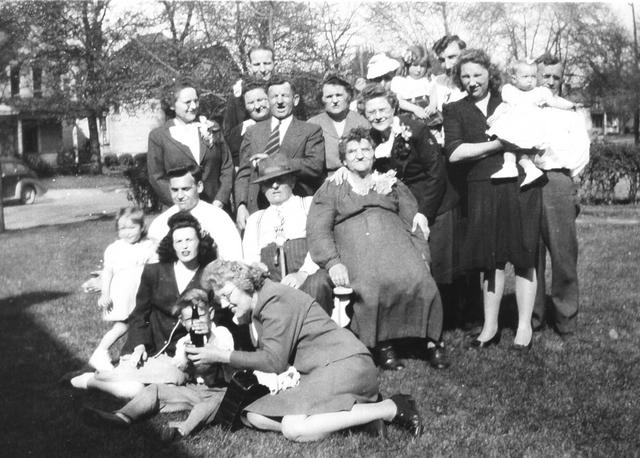
LAKE MACBRIDE— Easter was the biggest holiday after Christmas while I was growing up, although its importance diminished when I left home at age 18. This photo of my maternal grandmother’s parents— my great grandparents— typified the gatherings of an era that is gone.
Things are more casual today, and seldom do we gather on the lawn for a photo. If we did, our small family wouldn’t have many people in the image. A sign of the times and choices made when we were young.
Our next door neighbor gave birth to her third child on April 10 and yesterday she carried the baby in the yard while we talked about our shared lot line. The baby, swaddled in a blanket, didn’t make a sound. We walked the length of the line, discussing the easement and placement of gardens, hers and mine. The two younger children and her husband joined us. It was a pleasant moment in a life of neighboring.
The lettuce is not up in the garden. In fact the surface looks pretty dry. After the newspaper proof reading, I plan to spend the balance of the day preparing a bed for spring vegetables and working in the yard and garden. There is a lot to be done.
Lingering in the pre-dawn darkness, there is an hour to write, read and think before the rising sun of Easter morning.
LAKE MACBRIDE— Sunday and Monday rain was welcome and much needed. According to the Community Collaborative Rain, Hail and Snow Network, 2.7 inches fell. The ground remains too wet for planting, and this morning, temperatures dipped below freezing— it’s 25 degrees presently and too cold for outdoors work. There was a large crew at the farm yesterday, so the soil blocking for the week got done without me. If the ground dries later in the week, there will be planting, but for now there is a schedule gap— also welcome and much needed.
The sound of cello on my smartphone alarm woke me at 1 a.m. to view the total lunar eclipse. Still in my bedclothes, I pulled up the blinds and the sky was as clear as it gets. The eclipse had just begun.
I pulled on my jeans and a shirt, donned my winter coat, and went outside to witness the proceedings. The houses were mostly dark and moonlight reflected off the surface of the lake. Only the sound from a distant I-380 could be heard. I was the only person outside in my neighborhood. It was worth breaking deep sleep to watch as Earth dimmed the moon for a while.
There were spectacular images and a live stream available on the Internet, but I preferred my own view, filtered by the atmosphere and my aging retinas, captured on a handheld digital camera. Along with the light pollution from Cedar Rapids and Iowa City, the Milky Way could be seen. And so many stars.
Checking my email on the smartphone before heading back to bed, I found my state representative, Bobby Kaufmann, formally announced his campaign for re-election yesterday. That’s not really news, just a tick mark off a list of political events I am monitoring. The newspaper asked me to do interviews with the two candidates in the Democratic primary, and I accepted the assignment. The newspaper work gives me more reason to keep my views in this race to myself.
When I returned to bed, I slept a full five hours, and am ready for the day with the unexpected gift of a couple of hours to myself. A rarity in sustaining a life on the Iowa prairie.
LAKE MACBRIDE— Canned beans are delightful because the processor calculates the moisture content of each batch and cooks them accordingly. The product is consistent, and we use a lot of them. We are also willing to pay a premium for USDA organic. Recently, we began buying them by the case from our local grocer.
In our town of 2,200 the cost of goods is much higher than what can be found in large grocery and box stores a few miles away. Sometimes items are ridiculously high.
Most locals don’t buy organic, and the store manager is reluctant to carry slow moving goods. There is a carrying cost of inventory. They do have buying power and access to warehouse inventory. When asked, the buyer was willing to buy special items for us as long as we bought a case or more. We tried our first bulk order this week.
It was simple. Two cases of dark red organic kidney beans and one case of organic black beans for an average price of $1.07 each. A savings of 23 percent over the closest chain store, and 30 percent over buying them from the shelf when they used to be offered. I ordered on Thursday, and they were ready to pick up on Monday. It’s hard to beat the deal.
What is significant is that by special ordering in bulk, we could leverage our local retailer’s network and save money on things we buy, but others don’t. This could have broader implications, not the least of which is expansion of bulk purchases in town to include other items currently being purchased through Walmart, HyVee and others.
What matters is not where we shop, but how we live. By negotiating with local retailers and growers, there is an opportunity to eliminate what is worst about the big box stores and grocery chains… things that make them unsustainable.
By buying locally more often, and custom ordering, society might take a step toward reduction of the carrying cost for a broad and mainly idle inventory. There will always be a need for impulse items, and there should be a premium for them. Yet with proper planning, negotiating and bartering, grocery expenses could be less, and the quality of food higher. A paradigm shift is in the works.
How shall we live? At least in part by buying organic canned beans from a local retailer.
LAKE MACBRIDE— The germination rate of indoor seeds has been 59.3 percent. Seeds leftover from the 2013 season are performing better at 96.3 percent, with a dismal performance of 46.9 percent for 2014 seeds. Not sure of the trouble, however, will start way more than needed in order to ensure there are enough plants for the garden.
The lettuce seeds have done particularly poorly. They are some of the same used at the greenhouse where I work, so the problem must be me— soil and water.
“We are planning to live to be one hundred,” said a friend about she and her partner yesterday. “I’m not sure we will make it, but we are planning for that.”
This was in response to a statement I made that there is a life after the socially accepted retirement age of about 60. In addition to the seven ages of man, we need a eighth lying between ages 60 and 80. She said it should go to one hundred. If one can resolve the issues of this American age, then there may be perquisites. But it runs against social norms in a way that only the most compelling logic could assert such a thing. Just think of all the financial planners who would be out of a job.
As April begins, I know two things. I can’t give up working on a new paradigm and I am sick of winter soup.
LAKE MACBRIDE— Snapping a photo with my handheld device reduces automobile search time. When I learned about willing suspension of disbelief in high school, I took it to heart, and applied the concept to much of what I do in public. So much so, I forget where the car is parked after an event… more often than I would like. A photo helps.
This morning the moon was a yellow crescent, refracted by the atmosphere on the horizon. I was taking the recycling bin to the curb. From above, ancient starlight fell on me through the darkness. It was cold, the cold and starlight and crescent moon were invigorating on a groggy morning.
Two months in, my jobs as newspaper correspondent and warehouse worker seem to have taken. That’s good news. A stable financial platform is important to sustaining this errant life of writing. While the two don’t produce a living wage, they get me closer than I was last year— a footing upon which to leverage aspiration’s ascent.
I understand ranges: of potential pay for each part time job; and of the time investment required to produce it. I’m entering into the period we called stability operations in the military. Settling in, and working toward other important goals.
In the news stream of images, articles and recordings that is social media, I came upon a list of the 20 most popular TED talks. After watching a few of them, it occurred to me that a very small percentage of my time has been spent answering the question why? I’m not talking about the lengthy intellectual excursions taken during my undergraduate dalliance with western philosophy. Rather, what motivates me to eschew the six figure job I left for doing what I love? There are three things.
My outlook on life in society was formed after being an altar boy at our local convent. Rising early, I walked to our elementary school, where the nuns lived on the top floor, and assisted the priest with morning Mass. It was in Latin. After Mass, I had an hour or so at home before returning to school for classes. I read pulp magazines bought at the corner drug store. An epiphany that morning was the nature of intellect and language.
We are separate from language, and everything else perceived by the senses. Language is a medium for communication, and our faith is that there is another reality outside sensory perceptions to perceive us, and if we are lucky, to communicate with us. Just as the starlight traveled for years to illuminate my morning walk from the curb, so too is everything our senses perceive: light, not stars. This epiphany remains with me, grounded in experience, not in the ideas of others.
Secondly, money is a means to an end. Founded on a life of sensory perceptions, in which we know not the existence or motivation of others, life becomes a quest for truth and meaning. Such a quest is to rid our consciousness of utter alone-ness. Accumulation of wealth is simply not that important. While raising our daughter, we were able to get through it all financially: buying a house, securing food and clothing, transportation, and formal education. While I made some progress over a 25 year career in transportation, other than addressing an occasional abstraction about needing more money, we used money to live as best we could.
The final point: the necessity of self-realization. The signs that I needed to leave my long career were everywhere. The conventional wisdom was to continue working as I had until reaching full retirement at age 68. What I also knew was life expectancy was such that if healthy, I would have another 20 years to work. It became a compelling enterprise to shift away from work I felt was unsustainable to something that would see me through the years 60-80. Something less reliant upon a single source of income. Once I realized this and accepted it, my days as a transportation worker were numbered, leading me here.
The photo of the parking ramp was taken last week. It was a brief step toward finding a way. Now that I’m on a path, it is proving much easier to follow it.
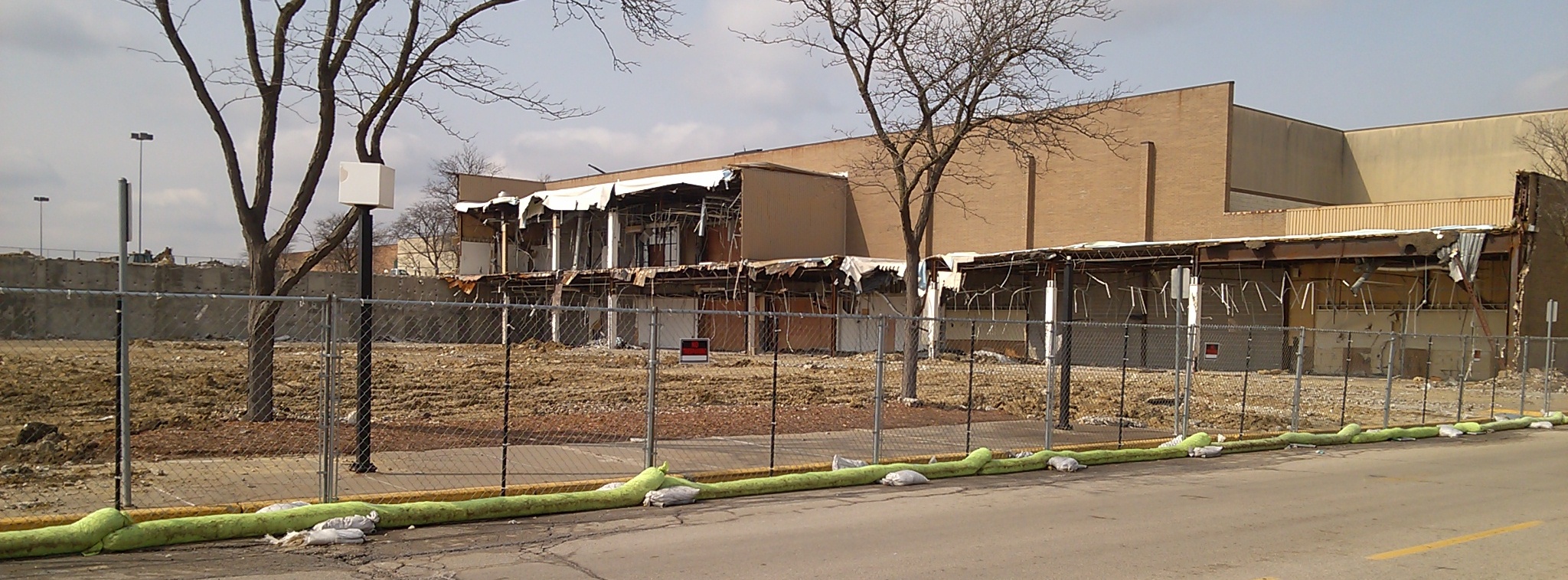
CEDAR RAPIDS— Westdale Mall in Cedar Rapids is closing at the end of March. The 72 acres will be re-purposed, retaining two of the anchor stores, J.C. Penney and Younkers (which remain open), and replacing the mall with housing, and recreational and commercial endeavors. Many of us believed malls were a bad idea when this one was built. We had a longer view of social progress than others, yet there is no feeling of vindication as stores and jobs go away.
The stores I visited at Westdale were the picture framer, J. C. Penney, Montgomery Wards, and one or two of the jewelers. Probably others, but memory is a fickle master. Shopping has never been important to me, and the similarities between retail establishments outweighed the differences. There are other places to shop.
After taking this photo, I stopped at the nearby hardware store. That is, a hardware store equivalent. During the post-Walmart era every large box store has groceries, sundries and some amount of plumbing, heating and home maintenance goods. Menards is a hardware store because they sell lumber and a greater inventory of home improvement items. Too, contractors frequent Menards, and it is a home base for many small businesses. They may sell red Solo cups here, and run advertisements featuring American made goods, but their inventory comes from all over the world.
It was the first trip to Menards in a long time, a harbinger of spring work. I spent $124.73. There was a globe to replace the one knocked loose when the roofer’s hammering made one fall and break; a tank lever to fix a toilet; a bag of charcoal to remove a tree stump; two bags of grass seed to re-plant the ditch where the drought burned off last year’s planting; new gloves for the garage in deerskin, goatskin, PVC and cloth; two new seedling trays; two bags of seed starting soil; some two-cycle oil for a chainsaw project; a bag of zip ties; and a packet of organic beefsteak tomato seeds. All representing spring projects. I put up the light globe and fixed the toilet yesterday.
Visiting a hardware store is not necessarily a guy thing, as I know plenty of women who frequent what are now called home improvement centers. Yet, as a guy, there is nothing quite like returning home and emptying the vehicle of tangible evidence of the work to be done to sustain our lives on the Iowa prairie. It is a kind of hope yesterday’s spring snowfall could not hold back.
LAKE MACBRIDE— Mexican-style entrée with no name. Maybe that’s a better appellation for a layered and baked casserole using tortillas, tomato sauce, refried beans, cheddar cheese, green chilies, home made chili sauce. cilantro and canned corn. I would never go to the store and buy ingredients for the dish. Rather, it’s a way of using up pantry ingredients. Mighty tasty for lunch, or breakfast.
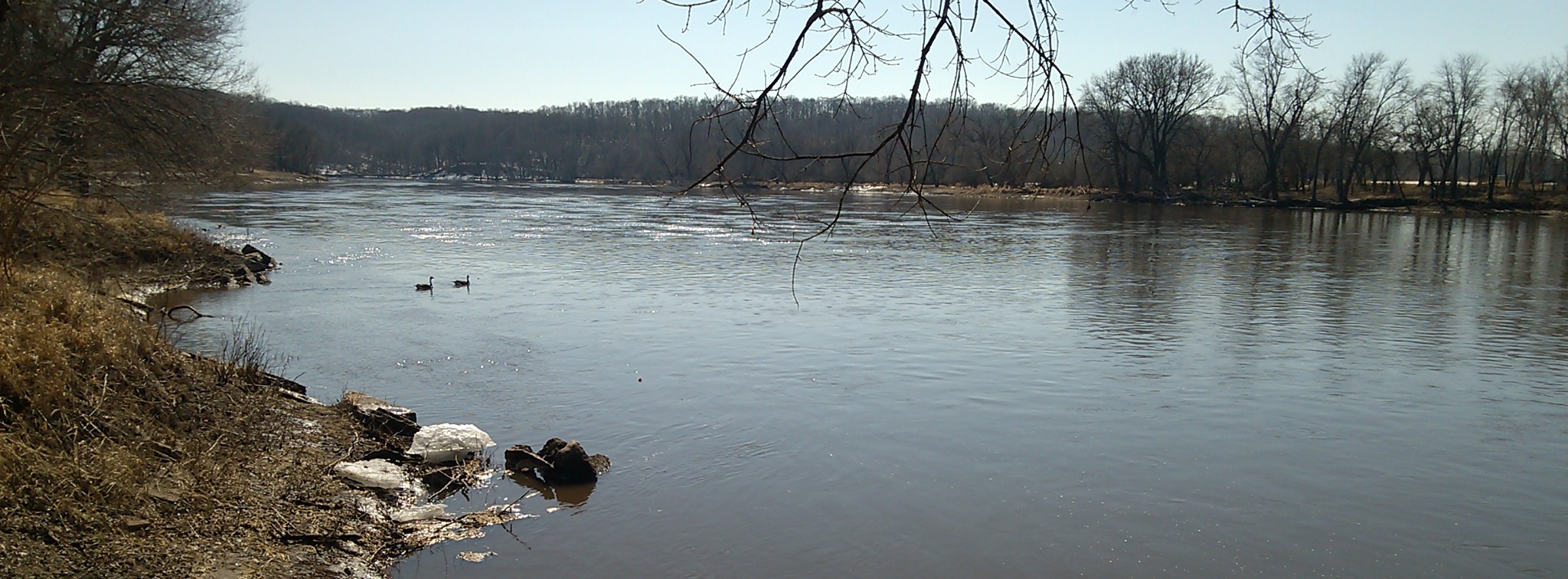
So it is with a lot of things in Big Grove. The contemplative musings of winter gave way to practical work: fitting too much stuff into the short days. Like the nearby Cedar River, my banks are swollen with the stuff of life— vital fluids coursing through the heart of the country. Winter has signaled its end, and the lengthening days do not recompense winter’s beating. There is a lot to schedule and do.
LAKE MACBRIDE— Taking the last of the root vegetables– four kinds of potatoes, three kinds of turnips, and beets– and six jars of canned goods, two kinds of beans, barley, peas, onion, celery and carrot, I made the last batch of winter soup last night. It cooked until bed time, when we turned the heat off to sleep. In the morning, I brought the mixture to a boil, then turned the heat down to simmer until it becomes soup.
All that’s left in the fridge from last year’s local harvest is a couple of daikon radishes and some cabbage. There is plenty of garlic in the pantry, and a single spaghetti squash, but that’s it for fresh. It will be a few weeks until spring produce begins to come in at the markets. The soup and remaining canned goods will have to last.
Yesterday, I finalized plans for a presentation titled, “Living Non-traditional Lives: Focus on Finances.” It is part of the American Library Association “Money Smart Week,” which is a national initiative in its fourth year between the ALA and the Federal Reserve Bank (Chicago) to provide financial literacy programming to help members of our community better manage their personal finances.
Here’s the blurb I posted on Facebook: “Will be speaking at the Solon Public Library on April 12 about living without working a conventional 5 x 8 job as part of Money Smart Week. I plan to focus on: my personal work history, including what it means to be a writer in a time of social media; the role of jobs, the role of households and family, and personal finance in alternative lifestyles (banking, debt, income, taxes, bartering, health care, transportation, communications), deciding what’s important (community engagement, family, stress management, health, time management).”
My Climate Reality colleagues are meeting in Johannesburg, South Africa today where Al Gore is making his slide show presentation. The organizers didn’t know the exact number of attendees, as visa and finance problems deterred some who had registered. However, it looks like about 700 new members of the Climate Reality Leadership Corps, from many nations, will join us at the conclusion of the 24th training session.
LAKE MACBRIDE— The schedule is getting packed. Over the next few days I am taking a rest from daily blogging.
I made the first pruning cut on the apple trees yesterday. There is a long way to go to get them in shape after many years of neglect, but it’s the beginning of sustaining a life in a turbulent world.




 Journey Home
You must be logged in to post a comment.