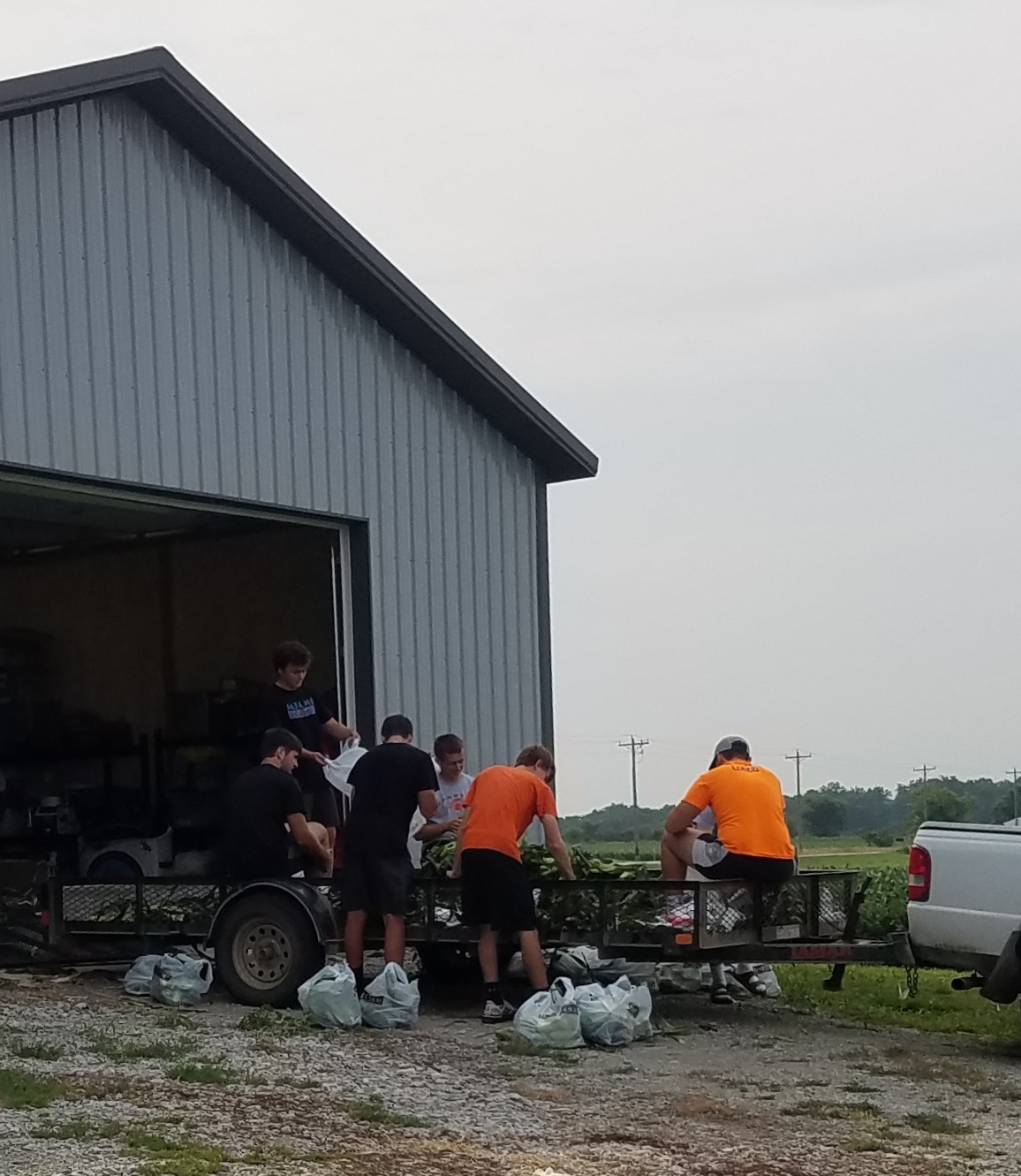
Young men bagging freshly-picked sweet corn at Rebal’s Sweet Corn farm stand.
The decision to buy sweetcorn and not grow it was easy. It takes a lot of garden space and my results haven’t been as consistent as one can buy at a farm stand. The farm stand where we’ve been buying sweet corn is closing after this season.
This will be our last year of selling sweet corn. Yes, the rumors are correct. After 35 years of business, we’re decided to bring it to an end. We’ve loved meeting all of you, and hopefully have provided the best sweet we possibly could. But it’s time for us to make a few changes in life. We’ve appreciated your business over the years, and all the wonderful comments you’ve given us. Wow! This is a hard post to write! Thank you all so much for your business, and we hope to see you one last time before the season ends and Rebal’s Sweet Corn comes to a final close.
They had corn on Friday so I bought ten dozen ears to freeze and eat fresh on the cob, on pizzas, and in leek and potato soup. Next year I’ll have to find a new grower but I don’t see re-visiting my decision to outsource this crop.
Leveraging the work of others is an important part of managing a kitchen garden. Rebal’s Sweet Corn fits into my local food paradigm of knowing the face of the farmer. We will miss them when they move on.
This year four tomatillo plants are producing an abundance of the fruit. Due to a paucity of recipes so many are not a good fit for our kitchen garden.
Mainly I used tomatillos in salsa to provide texture and their green color. I also slice or dice them to add to stir fry. Because there are so many, I will freeze what I can’t use fresh and see how that works in the coming months. In years past, the plants did not produce so many fruits. Next year I’ll reduce the number of plants.
I asked for recipe ideas on social media and the responses were honest yet not viable.
A common pairing is with the meat of hogs or chickens. As a vegetarian household, that’s not an option.
Another idea is to mix them with avocados and other ingredients for guacamole. This one winds me up because I’m in the camp of people who believe the rise in popularity of avocados also drives deforestation. How bad is the rapidly expanded avocado business?
The short answer is that avocado farming is causing deforestation, destroying ecosystems, funding drug cartels, and contributing to climate change. In Michoacán, Mexico, the biggest avocado producing region in the world, farmers are illegally razing pine forests in order to plant lucrative avocado trees. The native pine trees make up an irreplaceable habitat to indigenous species, including the iconic monarch butterfly.
Young people look at me askance when I say I won’t eat avocados because of deforestation resulting from their popularity. Nonetheless, I’m pretty firm in that view and have been weathered by askance looks over the course of many years. No guacamole or avocado toast for me.
The reality is there is already too much to do in the kitchen with hundreds of tomatoes lined up for processing. I put the tomatillos from the photo on a baking sheet and stuck them in the chest freezer to get them out of the way. When frozen, I’ll put them in a zip top bag until I’m ready to use some. There are many dozens of them remaining on the vines to be used fresh or given away.
We have two Mexican restaurants in the area and they have taken excess jalapeno peppers before. We’ll see what I harvest and maybe stop by one of them to present tomatillos as a gift. At least they won’t go to waste.
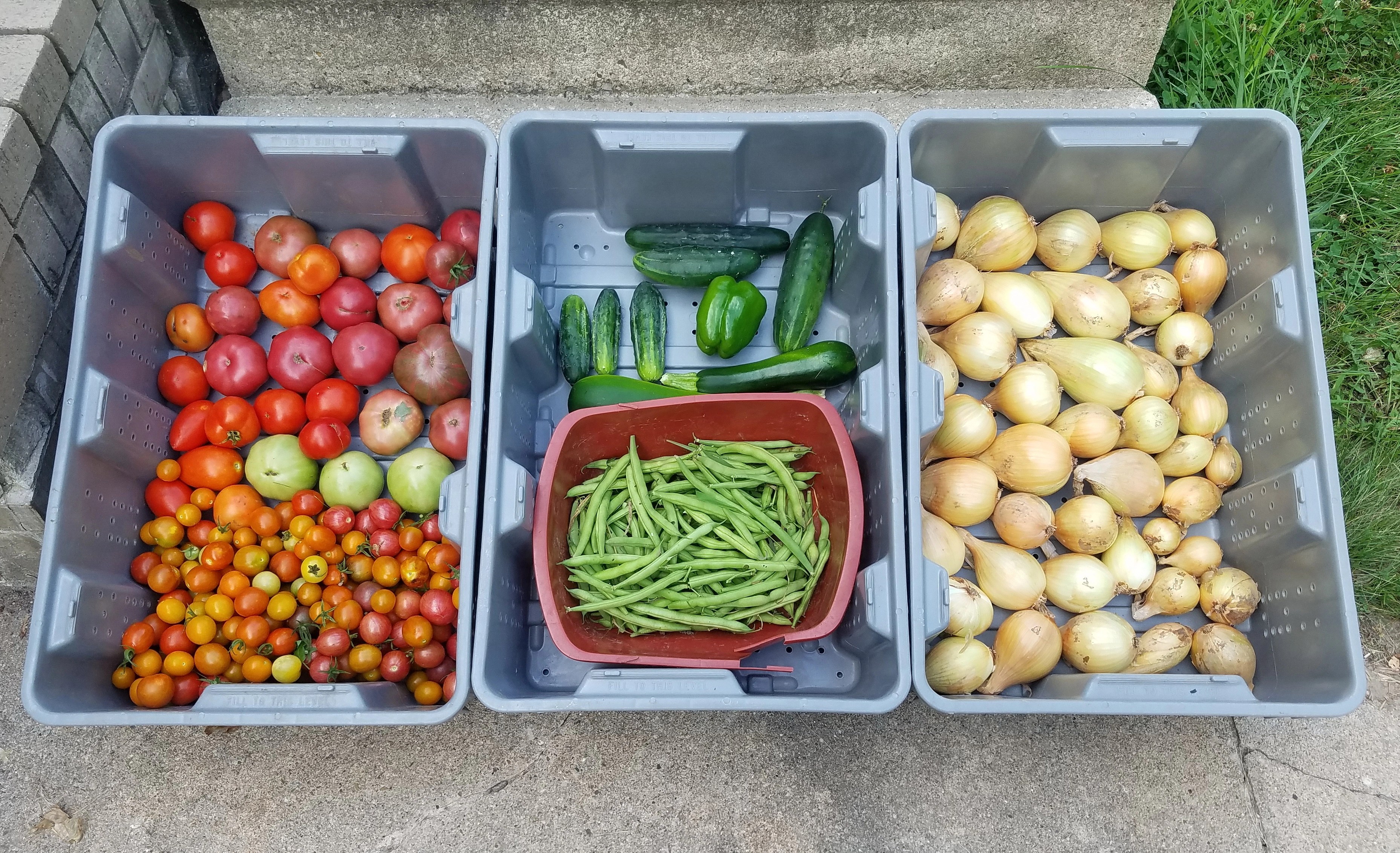
The onion harvest is in, sorted, cured and stored. There will be plenty of onions through winter and beyond.
The main lessons this year were to plant multiple varieties, keep them weeded and watered, and allow enough garden space to produce an abundance. The best results were from the starts purchased from Johnny’s Selected Seeds. I started my own from seed on Jan. 20, yet that wasn’t early enough. The fruit produced was smaller than the ones from the seed supplier, which are pictured above.
Onions started from seed, Rossa di Milano and Calibri Yellow, were small yet usable. I peeled, sliced and froze the yellow ones. They will be used mostly for winter soup. The small red onions are first to use for fresh eating in tacos and salsa, and sliced on sandwiches. Even though they are small, the flavor is outstanding. Every onion grown will find a home.
For the second year I produced a row of shallots, started from seed. They came out great. Shallots are long keepers and popular as gifts. If anything, I’ll plan to grow more shallots in 2022 and already bought the seeds.
I selected varieties mostly for storage qualities. I have had good luck storing Patterson, Ailsa Craig and Redwing, so they are repeats this year. Sierra Blanca is an experiment in white onions. All four varieties met growing expectations.
A bowl of onions is the heart of a kitchen. Growing one’s own onions is even better. There are four crates of onions in storage so our household is ready for cooking in the coming months.
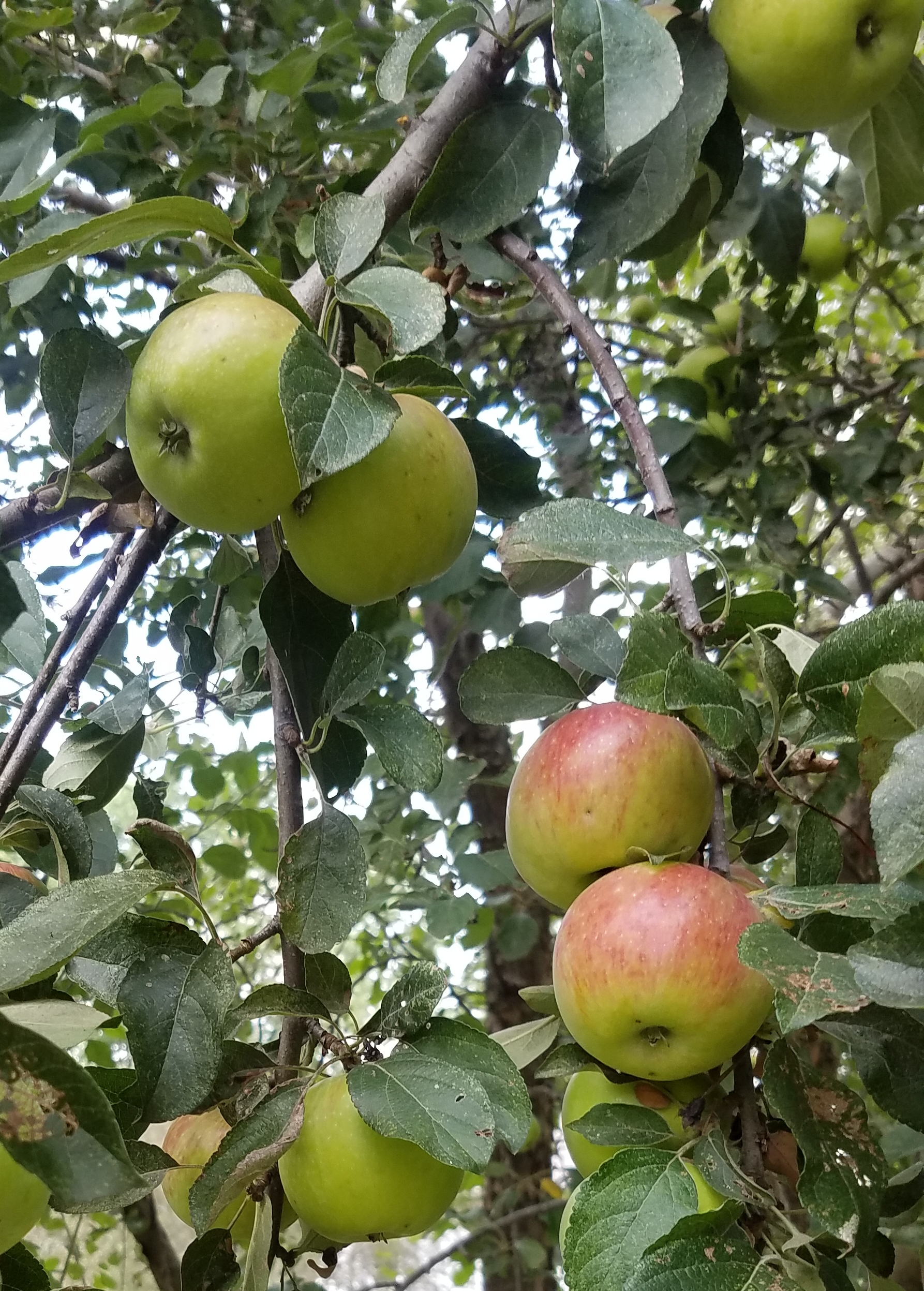
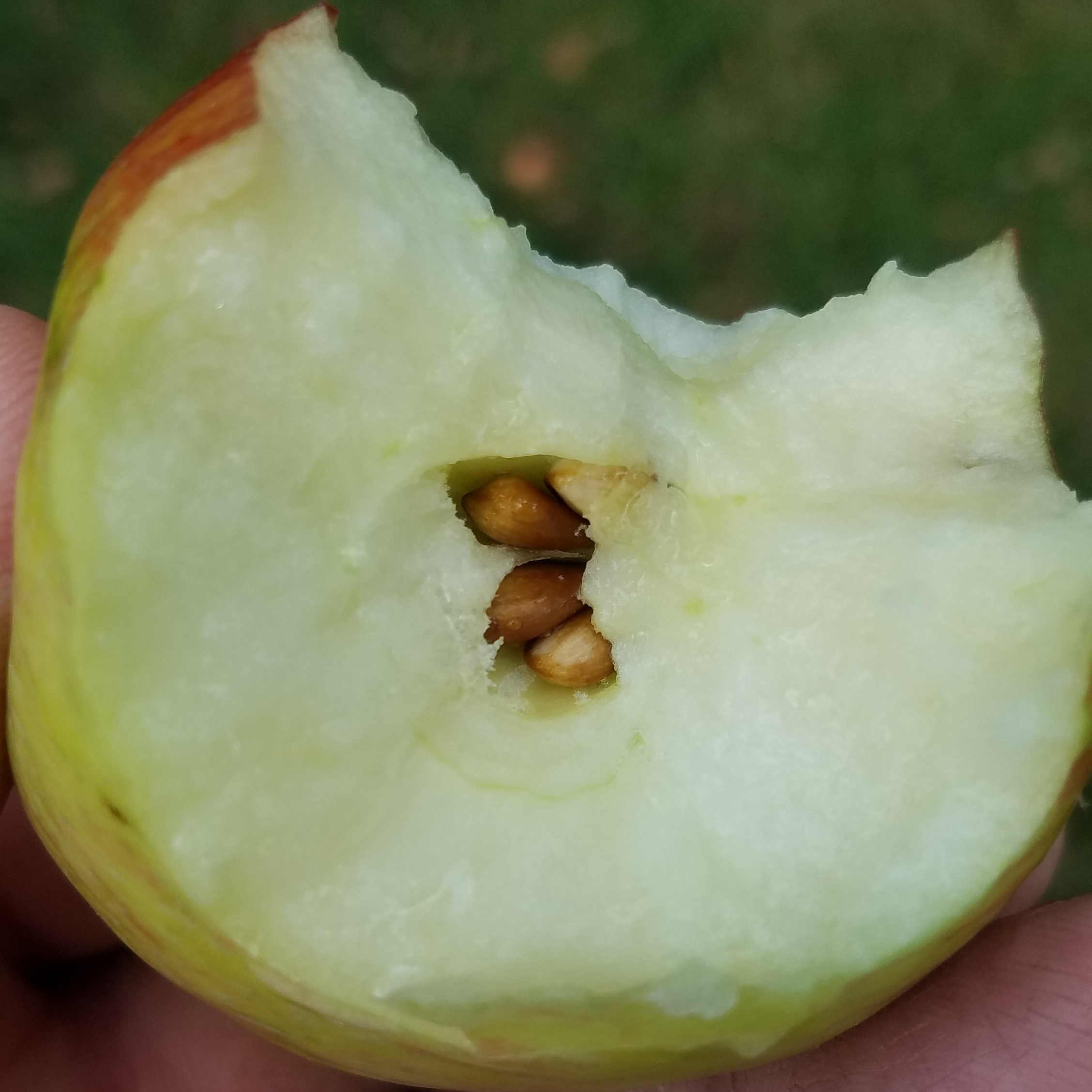
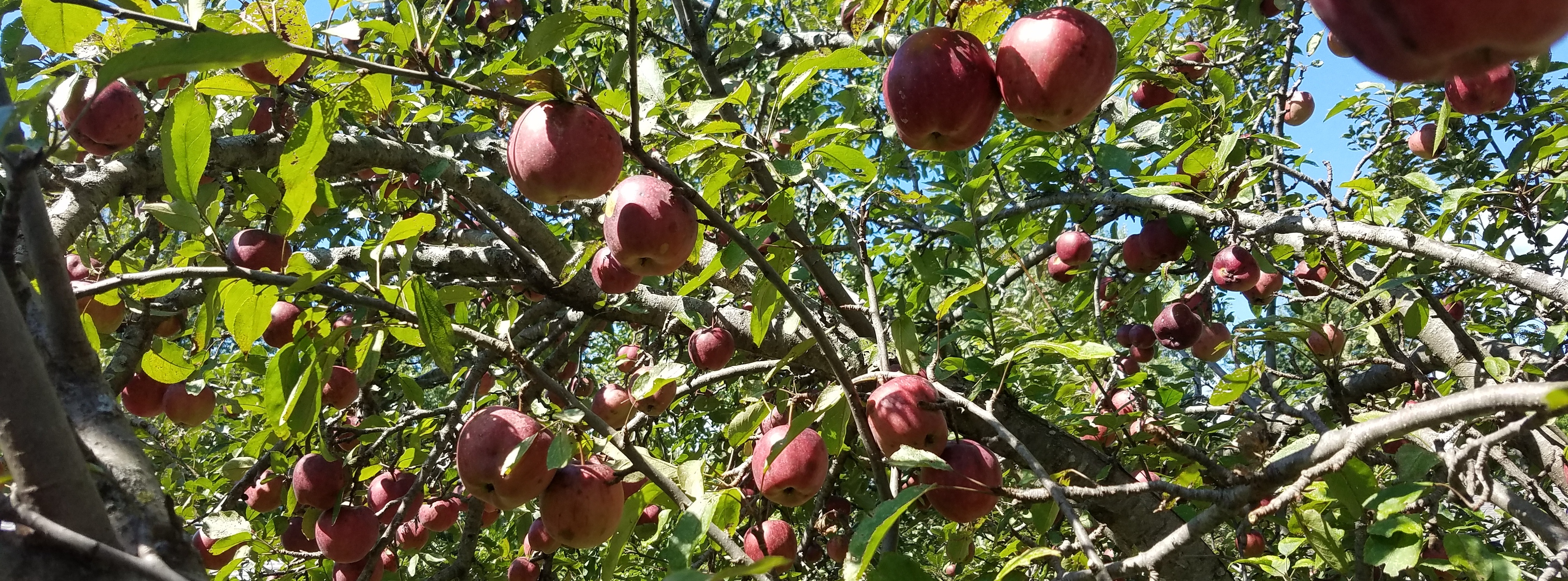
It took about an hour to harvest tomatoes. While working in the vines I heard an apple drop from one of the EarliBlaze trees every couple of minutes. Each time I picked an apple and tasted it they weren’t quite ripe. When I cut them open to view the seeds, they were not the characteristic dark brown yet.
It won’t be long. The ground is littered with what will be a meal for deer that roam our subdivision.
EarliBlaze apple seeds on Aug. 3, 2021.
Tomatoes and apples are big crops, which along with celery, garlic and onions, are money crops that will last until next year’s harvest. It is important to get these crops right. With apples, it is about waiting until they are ripe, picking them all at once, then processing them as quickly as possible.
August is for apples. The early varieties like EarliBlaze are used mostly for apple cider vinegar, fresh eating, an apple dessert or two, and if we need it, apple butter or apple sauce. They have plenty of sugar to ferment into home made apple cider vinegar. In August the Red Delicious variety continues to grow and won’t get full-sized and ripe until early October. It is important to know when to pick them and to provide the best possible growing conditions. I have never sprayed them and the Japanese Beetles have found other leaves to eat this year.
Summer stir fry.
We had stir fry for dinner last night and summer stir fry, based on what’s available from the garden, is one of the best tasting meals we eat all year. We have it once or twice a week.
Even though my work at the orchard was delayed until the end of the month, I can fill any apple gaps with what ripens there. In the next couple of years the new trees I planted will fill those gaps. Going forward, my work days are filled with canning, freezing and drying produce. It will be non-stop work from now until frost. The payoff is a freezer and pantry full of food to use until the process begins again next year.
It is the best definition of sustainability. Besides, what else is there to do in a kitchen garden?
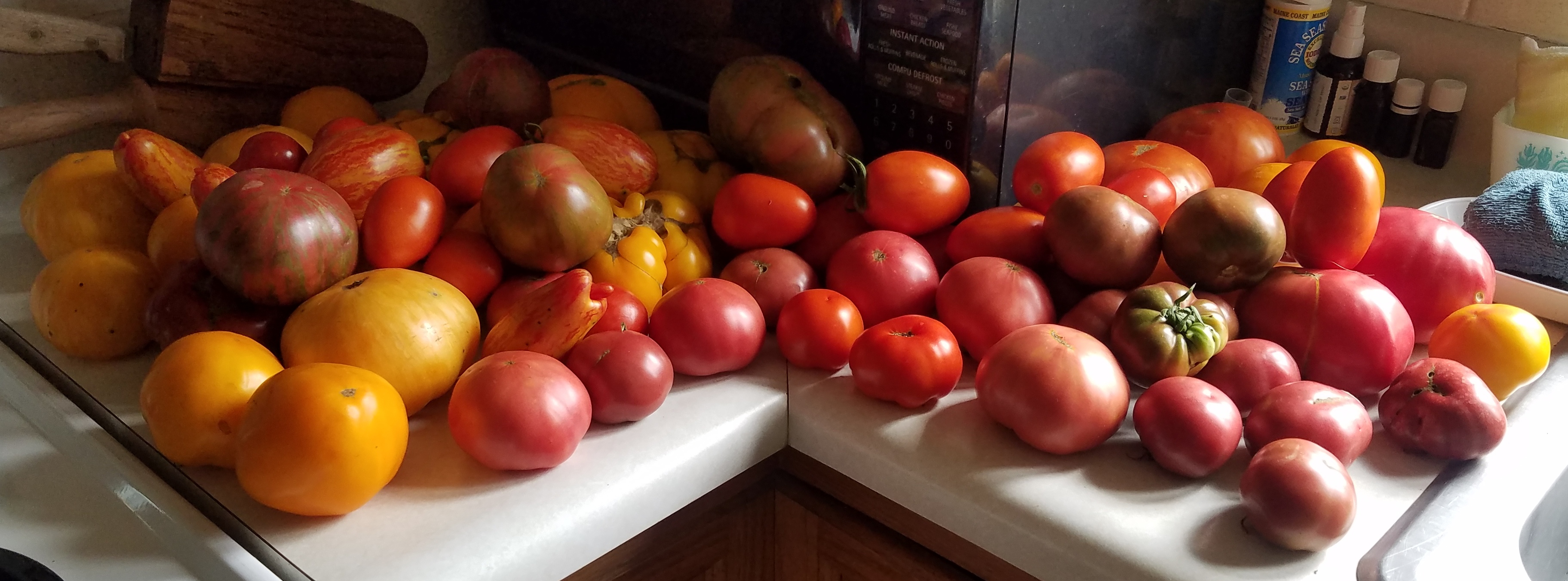
When a gardener plants more than a hundred tomato seedlings they expect to harvest tomatoes in August. Expectations met!
“I made weak coffee Sunday morning,” I posted on Twitter. “I hate weak coffee. I got distracted while measuring grounds into the French press. Distracted by the tomatoes taking over the kitchen. TOMATOES ARE TAKING OVER THE KITCHEN!”
No freak out here. I drank my coffee, cleaned and sorted the tomatoes, and have a home for yesterday’s surplus. I inspected the garden and there should be another crop today. An abundance of tomatoes is a good thing.
Growing enough Roma-style tomatoes to start canning whole ones is the challenge. I planted three varieties, Speckled Roman, Granadero and Amish Paste. Each has good flavor, and if there are enough, I’ll put one variety per jar. Canned whole Roma tomatoes are the mainstay of our pantry.
I used to can tomato sauce, tomato juice, and diced tomatoes. After the current stock is depleted, it will be whole tomatoes only. Canned whole tomatoes provide the best flexibility. It is an example of less being more. I open a jar of canned wholes and can make almost any tomato dish with it. I don’t think I’m going back to the old way.
A couple of 4-6 ounce tomato varieties are in this year’s mix. Their main contribution is flavor. Seeding and chopping them for salsa produces a very nice texture. I made a quart jar of salsa with the abundance. I used to freeze or can salsa and am moving away from that practice. Fresh is better. I’m growing Guajillo chilies to make a winter-time salsa to use on tacos, enchiladas and the like. I’ll add a bit of home made apple cider vinegar to preserve it in the refrigerator.
August is a busy month in the kitchen for a gardener. Not only are there tomatoes, but crates of onions, garlic curing in racks, and potatoes nicked during harvest needing to be used. Pears will be ripe soon. I check the EarliBlaze apple trees daily to see if they are ripe–they are getting close. Once they come in, the first bushels will go to apple cider vinegar making. Harvesting, storage and processing takes up most of August. It’s part of a commitment to growing one’s own food.
This morning I made strong coffee, the way I like it. I’m already fortified for another day in the kitchen garden. It’s life, as good as it gets.
The owner of the orchard and farm asked me to return to work as a mapper a few weeks ago. The mapper helps customers find ripe apples in the orchard during u-pick season. I first worked there in 2013 and did every year since, except for last year because of the coronavirus pandemic.
I noticed on Instagram they were already picking Viking and Pristine apples so I texted him. It is typical for me to begin work there in August.
After seven messages we determined he continued to need me and that I would go over today to fill out employee paperwork. There is a new manager of the retail barn sales operation to which this position reports. There have been other changes since 2019 as the orchard and farm expanded its offerings beyond apples. I’ll need an orientation. I haven’t worked for someone else since April 2020.
This work suits me. It is two days per week with a fixed ending date of October 31 when the last of the fall apples ripen and are picked. I earned about $2,000 in 2019. You can’t live on it yet there is a use for the income. I don’t work solely for the money any more.
While cases of COVID-19 are on the rise in Iowa and across the United States, I’ve been vaccinated and most of the work is outdoors. Hard to say what I’ll run into. In evaluating the risks I didn’t see many of them. After being at home for more than a year, I’m ready for regular human contact with apple seekers.
Working at the orchard adds a fruit element to home food processing. I checked my store of apple products and I’m still working off applesauce, apple butter, apple cider vinegar and dried apples from previous years. My three trees look to produce a big crop this year, and I’ll get some pears. I’ll mainly use apples from the orchard for varieties I don’t grow and use my own harvest to ferment more apple cider vinegar and eat fresh.
Work at the orchard fits well into my idea of a kitchen garden. With a continuing big harvest from the garden a greater portion of each day is spent cleaning and processing vegetables. Adding fruit makes sense. Working at the orchard provides a chance to discuss seasonal produce, cooking, and eating with other people interested in the same thing. By the time I get to October our pantry and freezer should be stocked and the household well-positioned for winter.
I believe I’ll be a better person for going back to work.
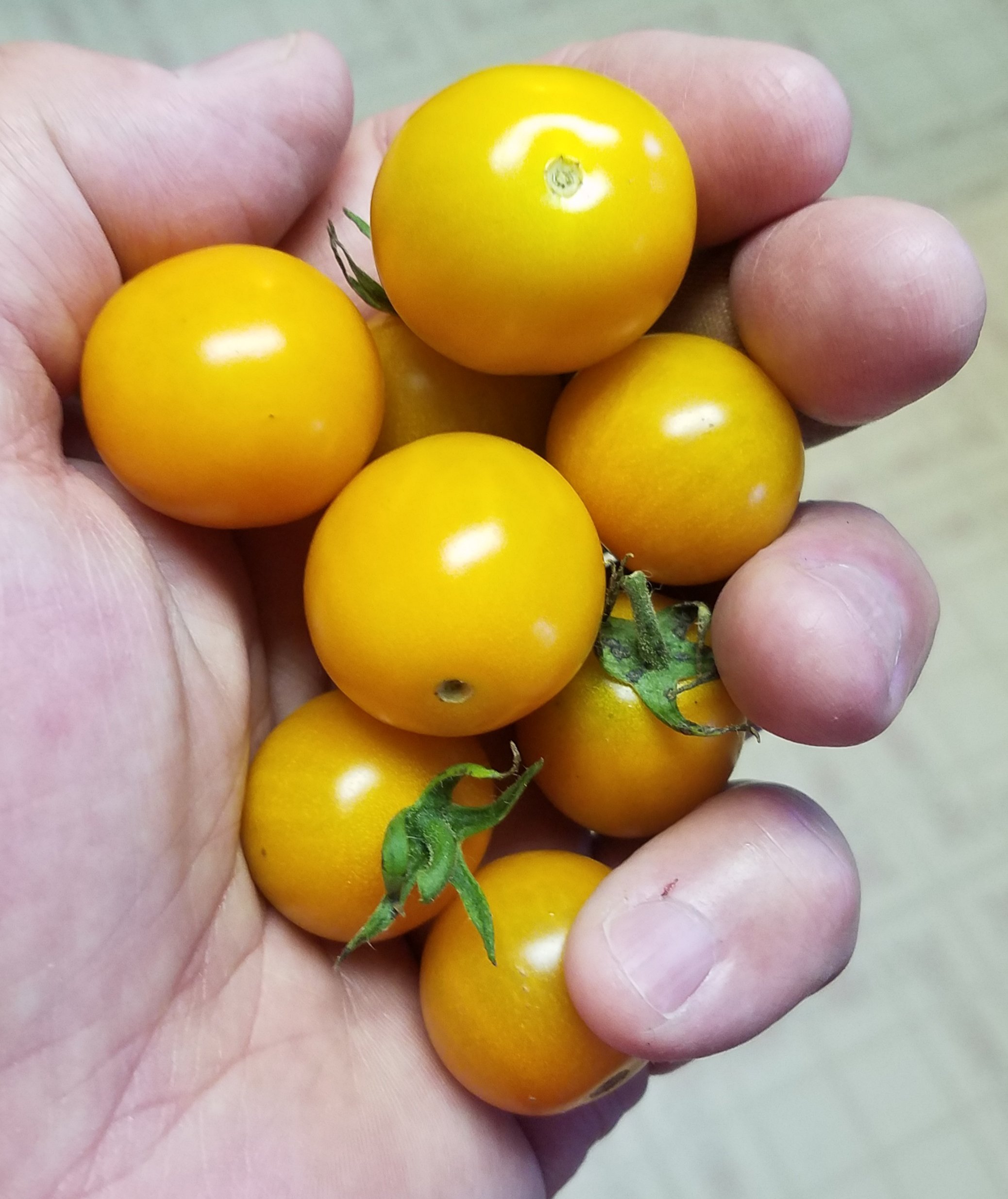
Volunteers at the local food bank couldn’t wait to taste the cherry tomatoes I donated Monday morning. As soon as they were weighed in they tried some as I pointed out different varieties. It is surprising our city of 2,615 people has a need for a food bank, yet business is brisk. I enjoy the social aspect of donating to the food bank.
A group of civic-minded people noticed a number of area residents drove ten miles to the county seat to use a food bank. They felt the local need was real. The community pantry was organized in 2012 by a board that consisted of local residents and representatives from area churches. “It is able to provide food and needed supplies to residents due to the generosity of our community and businesses,” according to the pantry Facebook page. Here’s a link to the Cedar Rapids Gazette article from when it opened.
A key consideration for gardeners is reducing food waste by timely consuming, storing and processing garden produce. Having a local food bank provides one more way to reduce waste. So far this season I made six donations. While they aren’t much in the scope of things, everything helps feed people who are struggling to put food on the table. Why shouldn’t pantry clients receive fresh produce?
Local food production makes a difference in reducing reliance on the drought-ravaged growing areas of California, Arizona, Florida and Texas. Just like with victory gardens during World War II, the aggregate effect of local people growing food is positive. As dry conditions continue, especially out west, consumers will have to rely more on local food production.
If you garden, figure out how to donate part of your production to help others. It makes a person feel like an important part of society and that alone makes it worth doing. The benefit to recipients is tangible.
Despite near drought conditions most of this growing season, our garden is producing the best crop I can remember. Our ability to irrigate is most of that. I’m also becoming a better gardener. We don’t have it as bad as California does.
Because of dry conditions over an extended period of time, California farmers are letting fields go fallow. Without rain or irrigation there is no point in putting seeds in the ground. California Governor Gavin Newsom issued three drought emergency proclamations this year, in April, May and July. The state called for residents to reduce water use by 15 percent to stretch supplies and protect water reserves. While this drought is not the worst on a 1,000 year time line, it is bad and if it continues it will affect what shoppers see in grocery stores. It goes without saying prices will trend upward.
Because of drought in western states, what we do in our Midwestern back yards increases in value.
When Michael Pollan released this video in 2010, the landscape for local food was different. His focus was on the amount of fossil fuel it took to produce vegetables in California and distribute them across the United States. He also discusses the energy required to make processed foods, like Hostess Twinkies. While avoiding global warming remains a reason to eat locally, with drought made worse by climate change, supply becomes an issue. If California farmers are not planting crops, if almond trees are not sustainable there, how will we get nutritious food? There are few better solutions than growing one’s own and sourcing locally.
Like most everyone I’ve bitten my tongue. I also scalded it with hot food and beverages. It healed, at least I think it has. As I prepare food from our kitchen garden, some days I don’t notice the taste, partly due to damaged taste buds.
The first cherry tomatoes are such a burst of flavor one must notice. Some days I swoon with how good a dish prepared in our kitchen tastes, even one I make often. Days when taste is dormant are sad ones–distracted with life, eating becomes a simple necessity, a chore.
“Today, food has taken on value, which goes beyond the simple act of eating,” Massimo Bottura, who operates a three-Michelin-star restaurant in Modena, Italy said on a BBC program called The Future of Food. “I was born with the will to be contemporary. When you are truly contemporary, your mind is constantly projected toward the future. There is always more future in my future.”
What does that mean in an Iowa kitchen garden?
I mastered enough techniques to convert raw food into meals. Few ingredients have me consulting with cook books about how to prepare or serve them. For example, a few days ago I harvested a dozen bell peppers and knew to parboil them to make stuffed peppers. I knew how to prepare the dish with rice, onion, celery, tomato, garlic and other ingredients on hand. Hard to say where I learned the technique yet it is part of culinary me. There are many techniques resting behind the door of consciousness. It gives me confidence in the kitchen, enough confidence to put meals on the table each day without consulting recipes. Does it go beyond a single meal into the future? That is more tricky.
I make soup often and attribute it to my Polish heritage. I can consistently produce a certain flavor profile. In the past I made big batches of soup and water-bath canned the extra. No more. I focus on flavor in smaller amounts done over and over through the gardening season. My typical soup starts with mirepoix: celery, onion and carrot. From there, I add what is available, including pearled barley, lentils, turnips and potatoes if I have them. Yesterday I added radicchio leaves, cabbage, kale, grated zucchini, and part of a jar of canned whole tomatoes. Salt and bay leaves seasoned the soup. Because the crop is coming in, I added diced broccoli stems. It simmered all day and by supper time was a meal. While this is not specifically a Polish soup, my heritage influenced the preparation. It suited my palate.
It is a struggle to get beyond the meal currently being prepared. After a trip to the garden, and a tour of the refrigerator and pantry, I get ideas about what to prepare each day. As the gardening season proceeds there are more choices. I’ve found the more our cuisine is driven by ingredient availability and freshness, the better the meal. That’s not surprising, although not particularly noteworthy. I enjoy cooking, and eating home-prepared meals more than restaurant fare. I’m nowhere near the level of Bottura. We get by in our kitchen.
I don’t know if my palate is truly damaged, and live with what I have. When a dish comes out really well I enjoy eating it. Much of the time I’m distracted from living and eating by outside concerns. My best plan for the future of food is to grow great ingredients and pay attention to the preparation. With practice I’ll get better and occasionally I will touch the sublime. That’s what a home cook can hope.
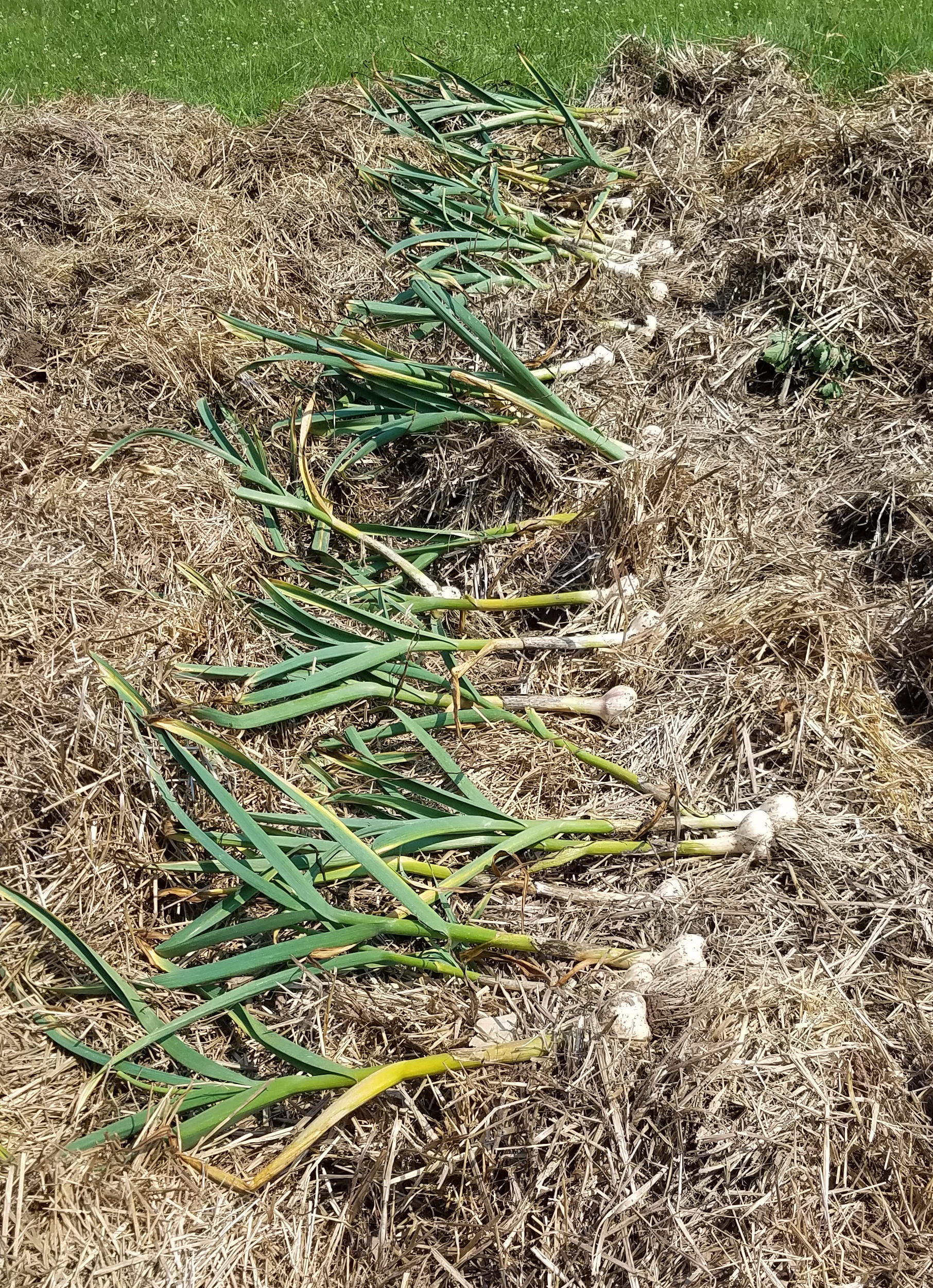
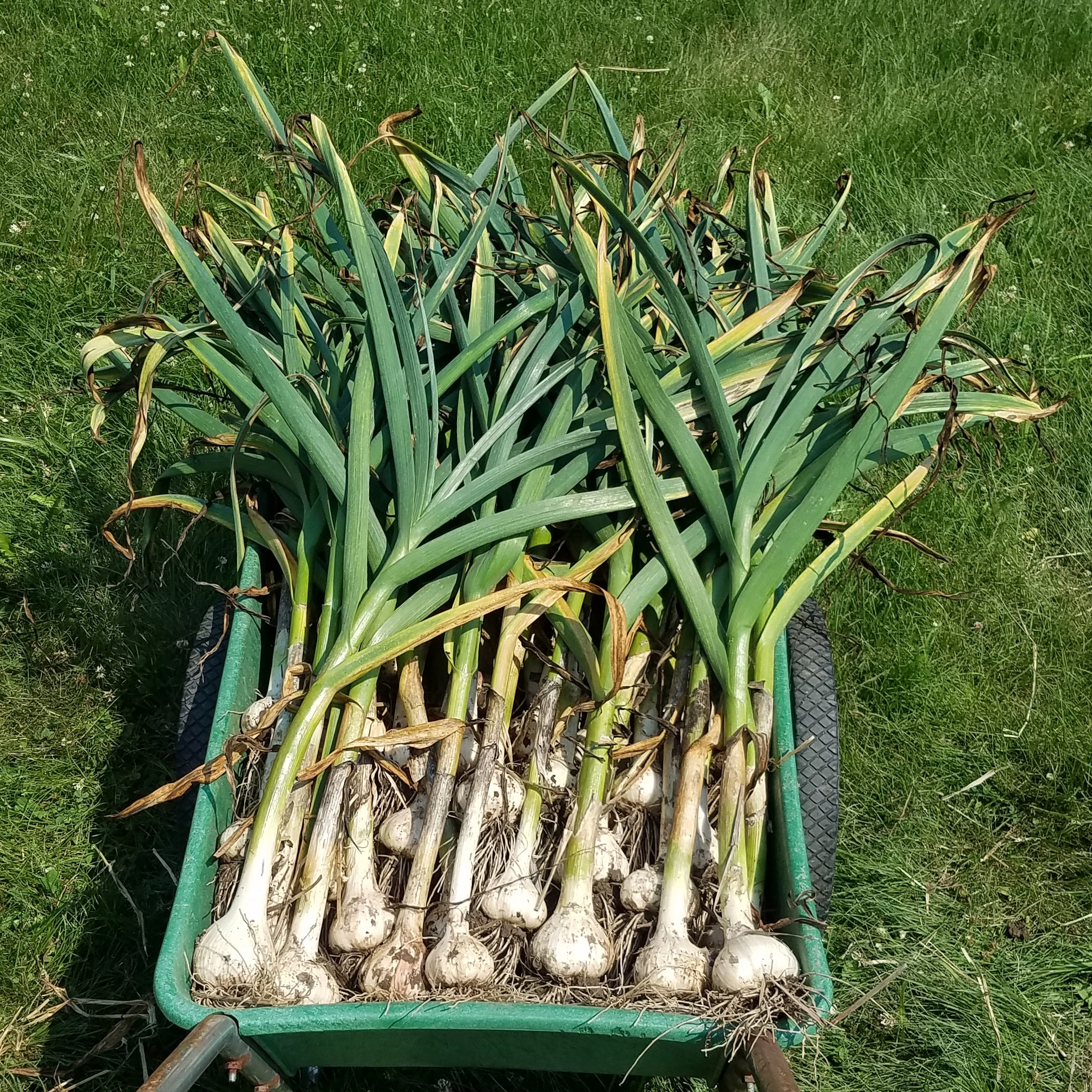
It was a good garlic harvest this year. All the heads looked solid and disease-free. I hit only one with the spade. The yield was 75 head, or enough for a year in the kitchen and to seed next year’s crop.
Harvested garlic.
It took about two hours to dig it. The work went easily because I had weeded the plot. This is my third year growing garlic at home and experience pays with this crop.
The entire crop in a cart.
I made the garlic rack last year out of simple materials. I use the sawhorses for something else during the year. The present challenge is to let it dry thoroughly, then cut the roots and leaves to make the heads look like what we buy in the store.
This variety has a long history on the farm where I work. The heads and cloves are large, and the flavor is what we want. Planted in October 2020 and harvested yesterday, garlic spends to most time in the ground of anything I grow. In the pandemic year of 2020-2021, it did well.






 Journey Home
You must be logged in to post a comment.