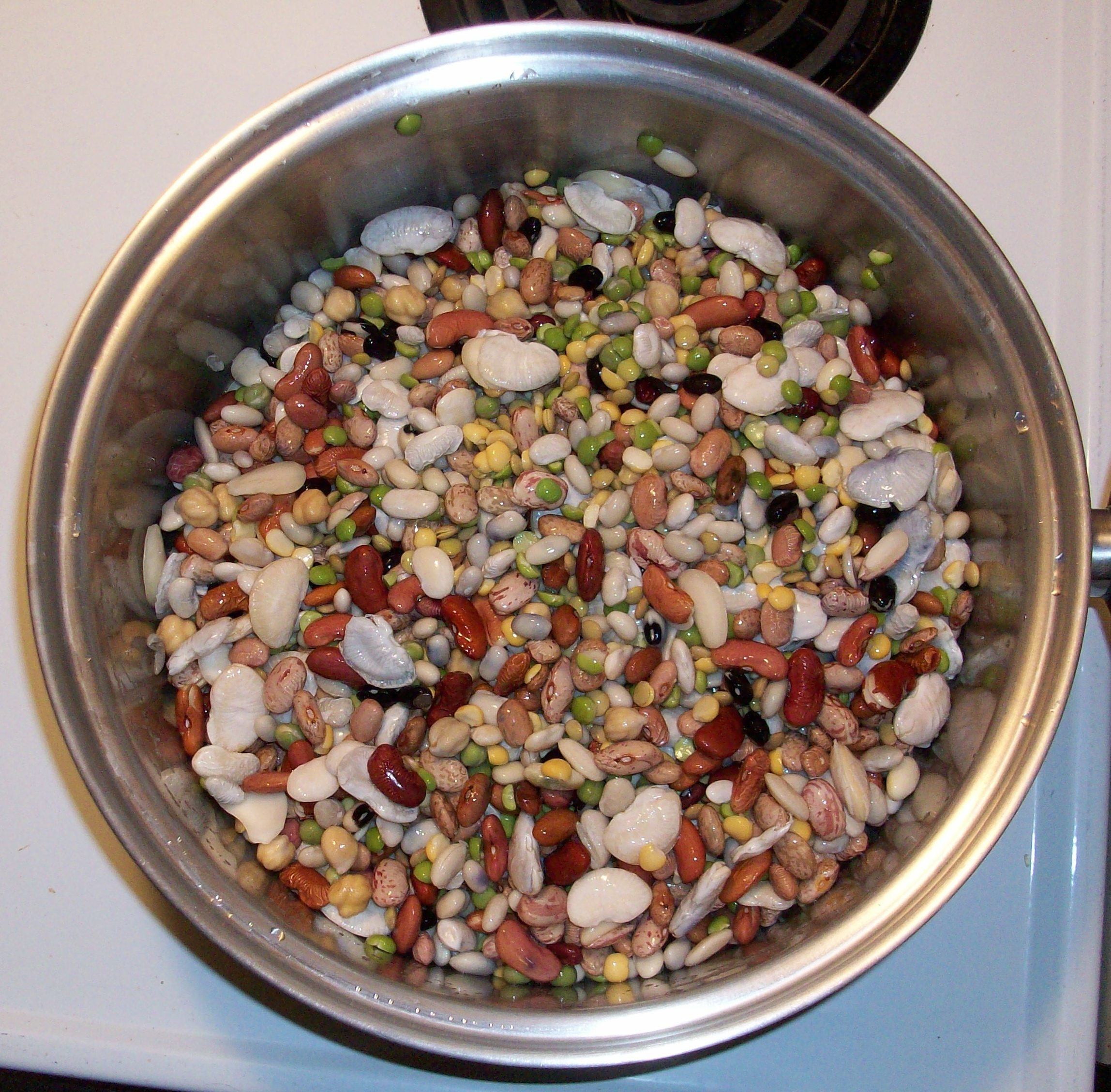
Bill Monroe wrote a song called “Lonesome Road Blues” in which a verse goes, “They feed me on cornbread and beans, lord, lord. I ain’t a-gonna be treated this way.” It is doubtful that Bill Monroe was the first to use cornbread and beans in a song lyric this way, but he gets to the point that cornbread and beans is an inexpensive meal, a staple in the antebellum Southern states. I recall being served cornbread and beans by a high school buddy’s spouse on a visit to Springfield, Illinois. I didn’t want to tell him what that meant. They divorced soon afterward.
In Big Grove Township, beans, or bean soup is a winter staple. I occasionally make bean soup and alternately serve it with biscuits or cornbread. It is a seasonal culinary marker and not a reflection of poor treatment, although I continue to like “Lonesome Road Blues.”
Cooking is a form of food processing, and without it, the dried beans would be inedible. The only processed food ingredient I used in the soup was some stock made earlier in the season from garden and pantry ends. I used corm meal in the cornbread, but it is such a basic pantry item, that we don’t consider it “processed.” This food preparation is still pretty close to the source, and eating products made with cornmeal should be okay in moderation.
When we live like we do, with labor closer to the production of everything, we become more aware of where our food comes from, and what it takes to make it. It has changed how we shop. When we go to the big grocery stores, there are lots of aisles that we do not even explore. In the frozen foods section, we seek out fruits, vegetables and several meat substitutes. I almost never go down the cereal aisle. There is usually an aisle for seasonal promotions and we never go there. We make our own greeting cards or use old ones laying around. I suppose others buy these things, but living closer to food sourcing and production frees us from this “need.”
So I’ll make cornbread and beans this season, and look forward to it. It will be a treat the first time we make it, leading, perhaps, to a second. To every thing, there is a season. We should treat ourselves right with cornbread and beans.
Editor’s Note: This post was taken from one on Sept. 21, 2010 and revised. The message about what it means to be a writer seems as timely as ever. In 2010, it was a revelation.
A writer in the 21st Century writes at every opportunity. Spending a life writing a dozen novels has become a thing of the past. The interaction with readers is more intimate, direct, and often. An email, a book review on Amazon.com or Goodreads, a blog post, a letter to the editor, an opinion piece in the newspaper, a technical article, a poem, or a work of fiction, all carry equal weight in how they take up a reader’s attention. Add in social media, and there opportunities aplenty to write.
Readers have plenty of material in which to engage. The diversity and abundance of available writing is a proximate cause of the low number of books Americans read each year. We are using our eyes and ears to take in information constantly, just not reading books.
As the number of writing venues exploded, the ability to generate revenue was diminished. There are a few folks who capitalize on this multitude of writing opportunities. However, constructing a view of where they fit into the life of a writer who writes for wages is both customizable and unlikely. Earning a living wage primarily from writing is as difficult as it has ever been.
Yet the writer’s life is something to which to aspire. The quiet of morning and a few hours typing at the keyboard is important: an organized effort to bring order to a chaotic world with words. In a world where corporate media reminds us constantly that in order for our consumer society to maintain growth, we need to get out there and start buying things: consume the consumables.
A 21st Century writer lives close to the means of production. The idea of buying anything that does not serve our indigenous subsistence or our writing is outside the ken. Many contemporary writers don’t fit well into a consumer society.
Unawares, I have been developing an approach to writing that includes many media. I hope to refine my approach and continue my writing voyage, hoping it produces recognition for what it is among readers, if not a living wage. That this approach is uncertain is accepted. Inherent uncertainty is a risk worth taking.
Each end of year holiday season I find a book by or about one of our presidents and read it as a gift to myself. Since that slugabed Barack Obama hasn’t published his second book of presidential memoirs (volume one was published in 2020), I settled for Bill Clinton’s post-presidency memoir Citizen: My Life After the White House published Nov. 19 this year. There are plenty of reasons to read Clinton.
My position about Bill Clinton and this book is that since he survived heart disease and a case of sepsis he ought to write a post-presidency memoir so historians can benefit from the information gathered herein. Indeed, there is granular information about the accomplishments of the Clinton Foundation. The first two parts of the book cover those years in detail lest we forget Bill and Hillary Clinton were do-gooders, all over the world. Let’s face it, though. Bill Clinton is a political animal and the third part of the book, “Politics, Rewriting History, and Reviving the Foundation in a Still Uncertain Future,” in which he discusses politics, is what many were waiting to hear.
Clinton points to Newt Gingrich and his Contract with America as the source of today’s divisiveness in society. When Republicans won the 1994 midterm elections and installed Gingrich as Speaker of the House, it was he who changed our politics to be more confrontational. From shutting down the government twice, to welfare reform, to a capital gains tax cut, to impeaching Bill Clinton as president, Gingrich made it so our politics would never be the same as it was. We are still suffering from the conservative detritus in his wake in national politics. He supported Donald Trump’s claims of a stolen election, and claims of voter fraud in the 2020 presidential election.
Important in Citizen is Bill Clinton’s account of Hillary Clinton’s political life through her run for the presidency in 2016. While their story is familiar, he makes a strong case for what happened and why. It is a story infrequently told in major media outlets and worth reading here.
Clinton also reviews some of his major accomplishments, like the Crime Bill and the Family and Medical Leave Act. There is no shortage of moments when he honked his own horn about his many accomplishments as president, including job creation, converting the budget deficit into a budget surplus, and connecting more schools to the internet. Clinton makes a solid case that his administration did many things that benefited middle-income workers.
Beginning around 2016, Clinton received criticism from the left that his signing the 1994 Crime Bill and the 1996 welfare reform bill were actually him (and Congress) caving to the far right. He defends himself rationally as the “explainer in chief” is wont to do. It is important to recall that in the end, Clinton was one of the good guys among politicians and advanced Democratic causes.
I recommend reading Citizen: My Life after the White House by Bill Clinton. It is important to know the history of Democratic politics and Clinton was in the middle of it.
Coffee is $2.02 per 16 ounce cup at the Casey’s in Colfax. I stopped there enroute home after an overnight visit to my spouse and her sister. I made many trips to Des Moines this year, and almost always stop in Colfax to see what’s going on at the convenience store. That usually means seeing what new employees greet me, as employee turnover appears to be constant. This Casey’s is an easy off and on the interstate and I usually purchase a lottery ticket, gasoline, and a beverage or snack. The sameness of the offering is comforting.
I started the day with a Keurig cup of coffee at my sister-in-law’s home. I forgot my bottle of instant espresso, which I prefer when I can’t make my own coffee in my own machine. I am an early riser and foraging in the kitchen is better than leaving the house in search of a cup. The Keurig cup served during the hours before the others awoke and got out of bed.
I have been spending so many nights in Des Moines, I bought a 28-inch wide camp cot with 600 pound capacity. I brought pillows, sheets, and a blanket from home, and borrowed a feather blanket from my sister-in-law for added cushioning. It is not the best, yet it is sufficient. Once the transition in Des Moines is finished, we’ll have the cot for overnight guests at home.
My travel from home to Des Moines is in four segments. Leaving home, I cross Lake Macbride and the Coralville Reservoir to access Penn Street which leads to Interstate 380. I take 380 South to the large intersection with Interstate 80, then exit West on 80. There is a long, mostly straight stretch of 80 that leads to the outskirts of Des Moines where Colfax is found. From Colfax, the congestion begins and the highway expands the number of lanes. I follow 80 to Interstate 235 to the exit for the state capitol, then it’s a multi-mile journey to my destination. I have the route memorized. That long stretch of Interstate 80 drives quickly.
If I have no extra chores while in Des Moines, my tank holds enough fuel to make the round trip without stopping. Usually there is something extra, and then Colfax is my go-to fuel stop. Coming from Des Moines, arriving in Colfax is a release of the tensions of congested traffic. On this week’s trip, truck traffic was heavy all the way, which again built tension after resting in Colfax. I made it home safely.
We need places like Colfax. Without these trips, I would not have considered the place important. Just another stop on the interstate highway. Yet our mind needs patterns and in cases like this we create our own. Gasoline, coffee and lottery tickets are available all along the interstate highways. That I pick Colfax for my stops is a bit of creativity I own and enjoy. I look forward to stopping at the Colfax Casey’s.
Editor’s note: This is a letter to the editor of the Solon Economist in response to Caden Bell’s opinion saying the Duane Arnold Energy Center nuclear power plant should be reopened.
I don’t understand the logic of reopening the Duane Arnold Energy Center because life is like a cartoon called The Simpsons. I’ve never seen an episode of that show, so maybe I’m missing something. What I do know is Caden Bell offers no logical reason to reopen the Duane Arnold Energy Center nuclear power plant in his Dec. 5 opinion in the Solon Economist.
First things first. The technology at Duane Arnold is old. The physical plant is old. Its permit has been renewed twice. There is a limit to the life of these facilities built in the 1970s. Why throw new money after old technology? We shouldn’t.
If Iowa were to do anything regarding nuclear power, we should at least wait until known problems have been resolved. Bill Gates is working on that. Gates received a permit for a small modular reactor in Wyoming. If there is a future for nuclear power in the energy mix, it is not in plants like Duane Arnold, but in small modular reactors if the bugs can be worked out. That is a big if. The future of nuclear power relies on such projects. Give Gates and company time to do the work.
Who will pay? The nuclear energy industry relies heavily on federal subsidies. Bell offers nothing about financing the return of nuclear power in Iowa. It remains a key issue with any electricity source. His opinion is useless without addressing who will pay.
My recommendation is Bell return to watching The Simpsons and keep opining about real-world issues like nuclear power among his university friends.
~ Published in the Dec. 12, 2024 edition of the Solon Economist.
It’s no secret I use a mobile device. I recently discovered a metric in settings called Digital Wellbeing which tallies the number of minutes of screen time on my device. I was shocked to see I averaged 5 hours, 50 minutes of screen time per day during the previous seven days. Just by being aware of my time I reduced it from 6 hours, 30 minutes on Friday to 4 hours, 29 minutes on Saturday. I need a more organized approach to reduce screen time.
Eschewing social media completely is not a good option. I rely upon the interactions with “friends” and “followers” and the relationships they have grown into. On Threads, these are mostly people I know only through the platform. On BlueSky, these are people I know in person or others I followed during my long time on X (2007- 2023). Threads is about art, photography, and sharing each others’ work. BlueSky is about staying tuned to whatever we call the national discussion inside a liberal bubble. Facebook is still there, although I am paring that group down to people with whom I have a tangible, in-person link. In most cases, I know Facebook friends from personal interaction. I have a couple of active friends on Instagram, but mostly I view posts by people I don’t know. I also view short videos there, something I hadn’t intended yet takes a lot of my screen time today. These four programs represent the as-is situation with social media.
Six hours of screen time in a day is not acceptable. While the entertainment value it provides is already baked into our monthly budget, the cost is in how my brain accommodates the input. Without completely understanding it, I know it has a deleterious effect. That is reason enough to cut back.
Killing time is not an interest of mine. So what am I seeking from screen time? I’ll just make a list:
On Threads, I curated a feed that informs me about what our small community is doing. Mostly, we share photos of cups of coffee, and daily, regular posts which are habit forming. One person showcases a different pair of socks each day. I see photographs, works of art, and short posts about how the day is starting across multiple time zones. When I wake, the Australian and New Zealand accounts are already on morning of the next day. While I’m doing this, I make my own daily post with the outdoors ambient temperature, time, a brief composition, and a photo of my coffee cup. I drink coffee while scrolling to see what followers are doing today. We all have morning routines, and this is mine. I return for updates a couple of times each morning and afternoon. By 6 p.m. I shut my mobile device off for the day.
After the November election there was a movement of people from X to BlueSky. A lot of the folks I followed on X made the transition. Some I followed on Threads decided BlueSky was a better platform. In any case, I’m there and posting a couple of times each day. It has been easy to regulate how much time I spend there because I am less interested in any “national discussion.” Threads is my go-to.
My sights are set on reducing time on Instagram. The number of accounts I follow there is small and only a handful post regularly. It has become a site with two main functions: automatically cross post photos I upload to Facebook, and following a few accounts that offer something unique. If I reduce screen time, the largest initial share of cuts will come from Instagram. I went into settings and set a timer to notify me when I spend 90 minutes in a day on Instagram. We’ll see how that goes.
Facebook used to be great, but now it has been reduced the way a balsamic reduction is made. Besides publicizing my work, I belong to two groups: my high school class group I founded to facilitate organizing a couple of reunions, and a group I started for our home owners association. These two useful functions are likely the reason I still have a Facebook account.
The gist of this is to cut way back on Instagram time, and not dally when I’m doing something purposefully. In theory, everything I do on social media should be purposeful. I’ll give that a week or so and see if my screen time is reduced. What I would much rather be doing is spending time face-to-face with my friends. Here’s an example:
I had a chance to spend an hour with a dear friend in a deserted cafe this week. We were bathed in sunlight, although I preferred a seat that was shaded. We talked about our books, our health, and our plans. It was an oasis of calm and warmth in the increasingly turbulent world in which we live. I need more time spent like that. Likely we all could use it.
With Al Gore and Company in Chicago 2013. This is about half the attendees. I’m in there somewhere.
The 29th Conference of the Parties was a disappointment. Fossil fuel interests hindered the ability to accomplish constructive things since the beginning of the process. Now, they stopped anything except the most minimal action at COP29. Former Vice President Al Gore summarized the situation in this statement:
November 23, 2024
While the agreement reached at COP29 avoids immediate failure, it is far from a success. On the key issues like climate finance and the transition away from fossil fuels, this is — yet again — the bare minimum.
We cannot continue to rely on last-minute half measures. Leaders today shirk their responsibility by focusing on long-term, aspirational goals that extend far beyond their own terms in office. To meet the challenge of our time, we need real action at the scale of months and years, not decades and quarter-centuries.
This experience in Baku illuminates deeper flaws in the COP process, including the outsized influence of fossil fuel interests that has hobbled this process since its inception. The Kingdom of Saudi Arabia has been particularly obstructive. Putting the future of humanity at severe risk in order to make more money is truly disgraceful behavior. Reforming this process so that the polluters are not in effective control must be a priority.
On climate finance, our primary task in the coming years must be to not only fulfill and build upon the financial commitments agreed to at COP29, but to unleash even larger flows of affordable and fair private capital for developing countries.
Ultimately, coming out of COP29, we must transform disappointment into determination. We can solve the climate crisis. Whether we do so in time to meet the goals of the Paris Agreement will depend on what comes next.
The climate is changing. Do humans have the capacity to protect all we hold dear from the ravages of the climate crisis? Time will tell. The Conference of the Parties is our last, best hope to stave off the worst impacts of human-caused climate change.
Like with so many other parts of my life, my reading was punk in 2024. I had to cut back on my goal to 52 books because I picked some long ones that weren’t that interesting. There were some real winners this year and a bit of ticket punching. Here is the best of the lot. I’m on Goodreads so you can find me here.
The best book I read was Lessons in Chemistry by Bonnie Garmus. I recommended it to others repeatedly, and would likely read it again once a bit more water goes under the bridge. The combination of discrimination against women in science, a single mother, a cooking show, and daring women who view her television program to change the status quo was irresistible. I don’t often read a book twice, but expect this will be an exception.
I read multiple books that attempt to write the history of our times and forecast our immediate future. The best of these was Ari Berman’s Minority Rule: The Right-Wing Attack on the Will of the People―and the Fight to Resist It. I’ve been following Berman since he emerged from his home in Fairfield, Iowa to become more prominent on the national stage. Few people have written about the Trump administration as he does in this book. It is worth reading just for that. Other books I would categorize with Berman include something lost, something gained by Hillary Clinton, Nuclear War by Annie Jacobsen, and Attack from Within: How Disinformation is Sabotaging America by Barbara McQuade.
Important memoirs and biographies I read this year include On Call: A Doctor’s Journey in Public Service by Anthony Fauci and The Art of Power: My Story as America’s First Woman Speaker of the House by Nancy Pelosi. All told, I read ten books in the memoir/biography category in 2024. None of them was a dog.
I read a number of books from my “To Be Read” pile. Noteworthy are the ones that serve as historical artifacts: In the Spirit of Crazy Horse by Peter Mathiessen, Narrative of Sojourner Truth by herself, Starved Rock: A Chapter of Colonial History by Eaton G. Osman, Wakefield’s History of the Black Hawk War by John Allen Wakefield, and Chief of Scouts, As Pilot to Emigrant and Government Trains, Across the Plains of the Wild West of Fifty Years Ago by William F. Drannan. While the to be read pile is not as glamorous as getting new books, it is valid work to be done. These were all worth the work.
Not the End of the World: How We Can Be the First Generation to Build a Sustainable Planet by Hannah Ritchie is a new book by what I would call a young person (She was born in 1993). Ritchie brings a new perspective to environmental and nuclear weapons issues that has been wanting in the current literature. To say the book was refreshing would be an understatement.
The Cooking of Provincial France by M.F.K. Fisher discussed the cuisine of French provinces and provides many traditional recipes from these regions. More than that, it made the case for cuisines that rise up from the geography of soil, water, terrain, and animal husbandry to create foodstuffs, and by association, people, distinct to a region. This stands in sharp contrast to homogenized food ingredients as are available in grocery stores, or whose seeds are planted locally even though the environment has not nurtured them as if they were native to the region. The lesson from this Time-Life book was unexpected: when people are tied to food produced in a specific, local region, they gain a resilience some in the United States find wanting in our food culture.
I also read from my close circle of friends and acquaintances. Thom Hartmann published The Hidden History of the American Dream: The Demise of the Middle Class―and How to Rescue Our Future. Maureen McCue published Dancing in a Disabled World in October. I believe we have a duty to read books written by people we know. The conversations I have with Hartmann and McCue about their books inform my own writing.
The whole list of books I read this year is posted as a Reading Challenge on Goodreads. If you are on that platform, I hope you will follow me so I can follow back to see what you are reading.
The reason the president-elect’s plan to deport millions of immigrants will fail has little to do with his ability to strong-arm law enforcement, and potentially the U.S. military, into corralling people in large, fenced-in Texas prisons. He may be able to do that. Missing is that immigrants are a part of the fabric of American society in a way that promotes and values the individual nature of people. While Trump talks about mass deportations of millions of people, each of the targeted people will have a name, a face, and a presence in the community in which they find themselves. To treat them as a fungible commodity, thus dehumanizing them, goes against the American grain and Trump will encounter that. I believe this is a significant enough obstacle that whatever the plan is, it will fail.
Where will federal officers find all these undocumented immigrants? They may have some records, like those Iowa Secretary of State Paul Pate is trying to obtain regarding non-citizens who registered to vote. Voter fraud is so rare that will not fill Texas stockades.
When children of immigrants attend public schools, they are visible. Will teachers turn them over to federal authorities? It’s an open question. I suppose they are counting on people to snitch on their neighbors. In my neighborhood, I suspect that fellow who flies the Gadsden flag near his Trump 2024 flag might serve as a MAGA snitch. I hope not, yet this sounds a bit like North Korea, actually. It is like the North Korea portrayed in Barbara Demick’s book Nothing to Envy: Ordinary Lives in North Korea where neighbors snitch on neighbors. Maybe that’s what Republicans want in the United States.
In his book, The Audacity of Hope, then Senator Barack Obama recounted the story of how in 2006, Senator Chuck Grassley and he worked together on immigration reform. According to Obama,
Under the leadership of Ted Kennedy and John McCain, the Senate crafted a compromise (immigration reform) bill with three major components. The bill provided much tougher border security and, through an amendment I wrote with Chuck Grassley, made it significantly more difficult for employers to hire workers illegally. The bill also recognized the difficulty of deporting twelve million undocumented immigrants and instead created a long, eleven-year process under which many of them could earn citizenship.
The reasonableness of this story makes it seem more like a fairy tale than actual behavior of U.S. Senators.
Locally, the story we hear in the community is more granular and personal. There is an increase in the number of immigrants from countries other than Mexico. Parts of Iowa, especially university centers are international communities. We find landlords rent to immigrants more often and schools enroll more immigrant children. People who work in social safety net organizations like free medical clinics, food banks and neighborhood centers see a large number of immigrant clients. Public Health workers in Northwest Iowa require some staff members to speak Spanish to work effectively with immigrant communities. An increasing number of churches are being founded by immigrants. These are some of the things we see. The point is we know these people as individuals with a personality and a life woven into ours.
Because of the way Trump framed mass deportations, people are running scared, and I don’t mean undocumented residents. If the expectation is that undocumented residents will be found harboring kilos of fentanyl, there will be disappointment, especially here in Iowa. Anyone who has read Methland by Nick Reding or Dream Land by Sam Quinones knows that’s not how illegal international drug trafficking works.
The problems caused by a flawed immigration system are many. Native born workers have seen a decline in standard of living. Businesses want access to inexpensive labor provided by immigrants. Undocumented workers compete with native born/naturalized workers on an uneven playing field for jobs. Guest workers and work visa programs replace permanent jobs with temporary jobs without benefits or the legal protections guaranteed to most U.S. workers. Undocumented immigrants are most likely to receive abuse and mistreatment in social situations and in housing and employment. There is a language barrier and skin color may be different. Non-Christian religious backgrounds result in discrimination and mistreatment. All of these are symptoms. So what can we do?
Whatever that is, I expect the Trump administration to pay it little attention. Remember, Trump was the person who begged Republican Senators to kill the long negotiated immigration reform bill because he wanted to use the issue to get elected. Well, Mr. Trump. When your program deteriorates into chaos, what then? We all know you aren’t concerned about immigration. Let’s hope some of the real people involved as targets in the proposed mass deportations get a lifeline from the rest of us.
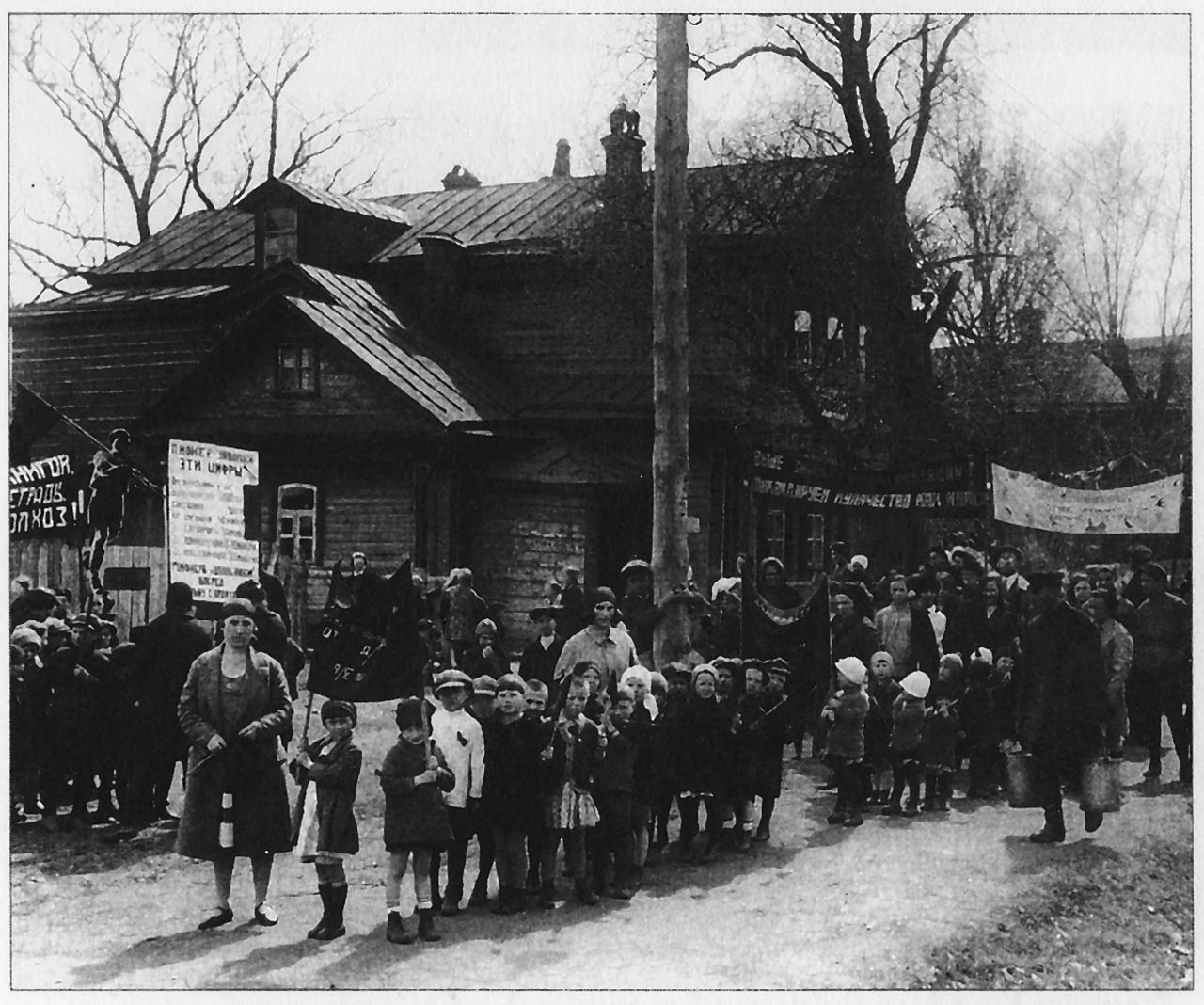
Dekulakisation. A parade under the banners “We will liquidate the kulaks as a class” and “All to the struggle against the wreckers of agriculture”. Photo Credit: Wikipedia.









 Journey Home

You must be logged in to post a comment.