Categories
Writing

A Standing Military

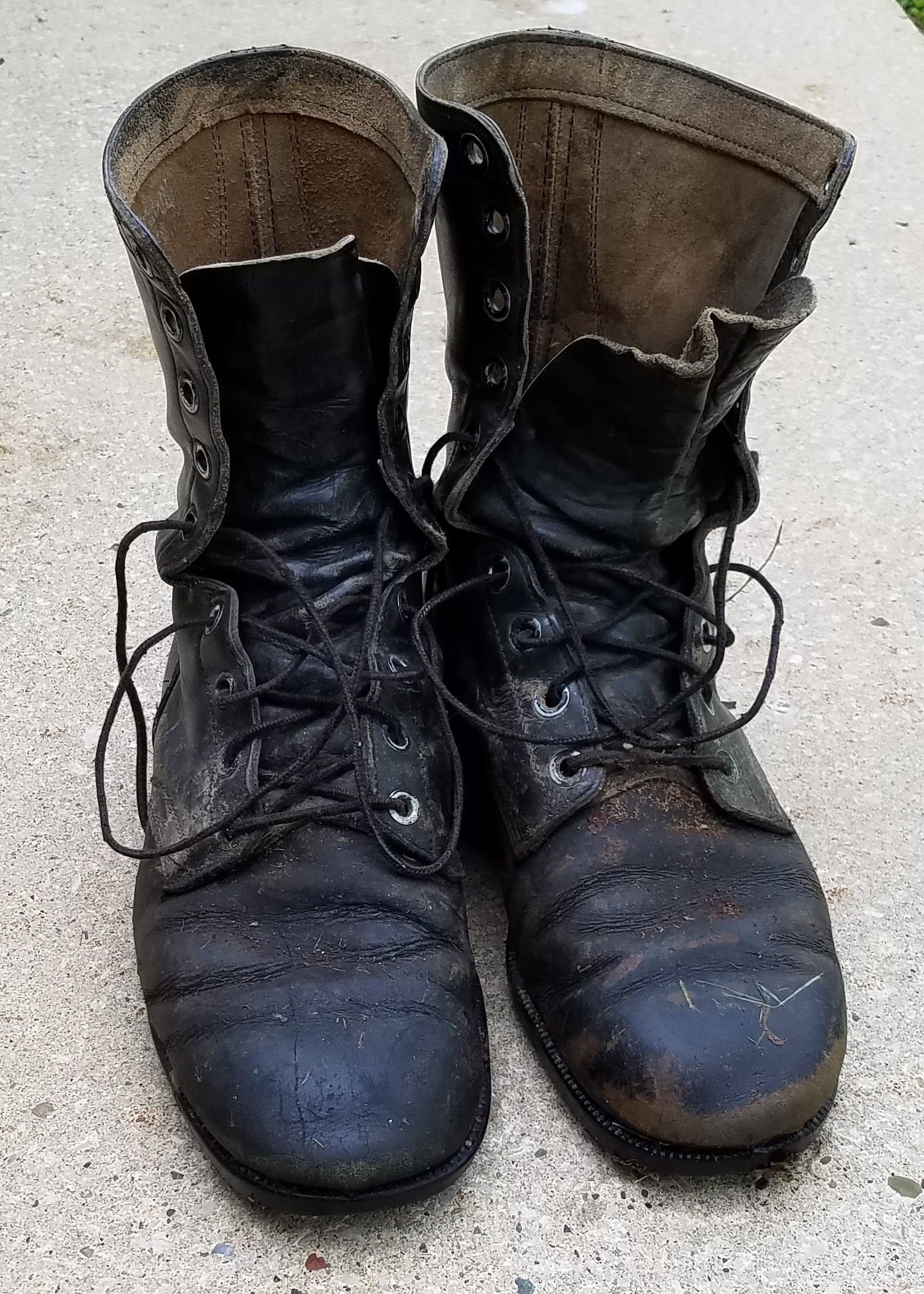
My Army Boots

Mother took me downtown to a federal office building to register for the draft. I was 18. I have my draft card with the Selective Service number on it in a trunk with other memorabilia from the time.

Dad served as an army paratrooper during the occupation of Japan. There is a photograph of him and Uncle Don, fresh from Tallahassee, with parachutes strapped on, ready to jump.

It was with a sense of family history, personal commitment, and duty that I followed the law by registering. Not all of my friends would contemplate entering military service, a couple of conscientious objectors were among my cohort. I felt no such compulsion and if I were called up, I would go.

In the eighth grade I had an assignment to read the newspaper and clip articles about topics which engaged me. The spiral-bound notebook I made has a section on the Vietnam War, including a newsprint photograph of a soldier that had just been hit by small arms fire and was falling to the ground. Going to the war was a real possibility, one I didn’t take lightly.

Like so many young people, I was enraged by the killing of four college students at Kent State University on May 4, 1970. A neighborhood friend organized a peaceful protest march to the military armory. I carried an end of a mocked up coffin representing one of the dead students in Ohio. A photograph of us made the local newspaper. I came to feel strongly the Vietnam War was wrong.

I took a student deferment as I had the option, and wanted to exercise it, delaying military service until after graduation from the university. I ended up cancelling the deferment when it became clear during sophomore year my draft lottery number would not be called. I was off the hook and breathed a sigh of relief as the Vietnam War was ongoing, and only crazy people wanted to fight there.

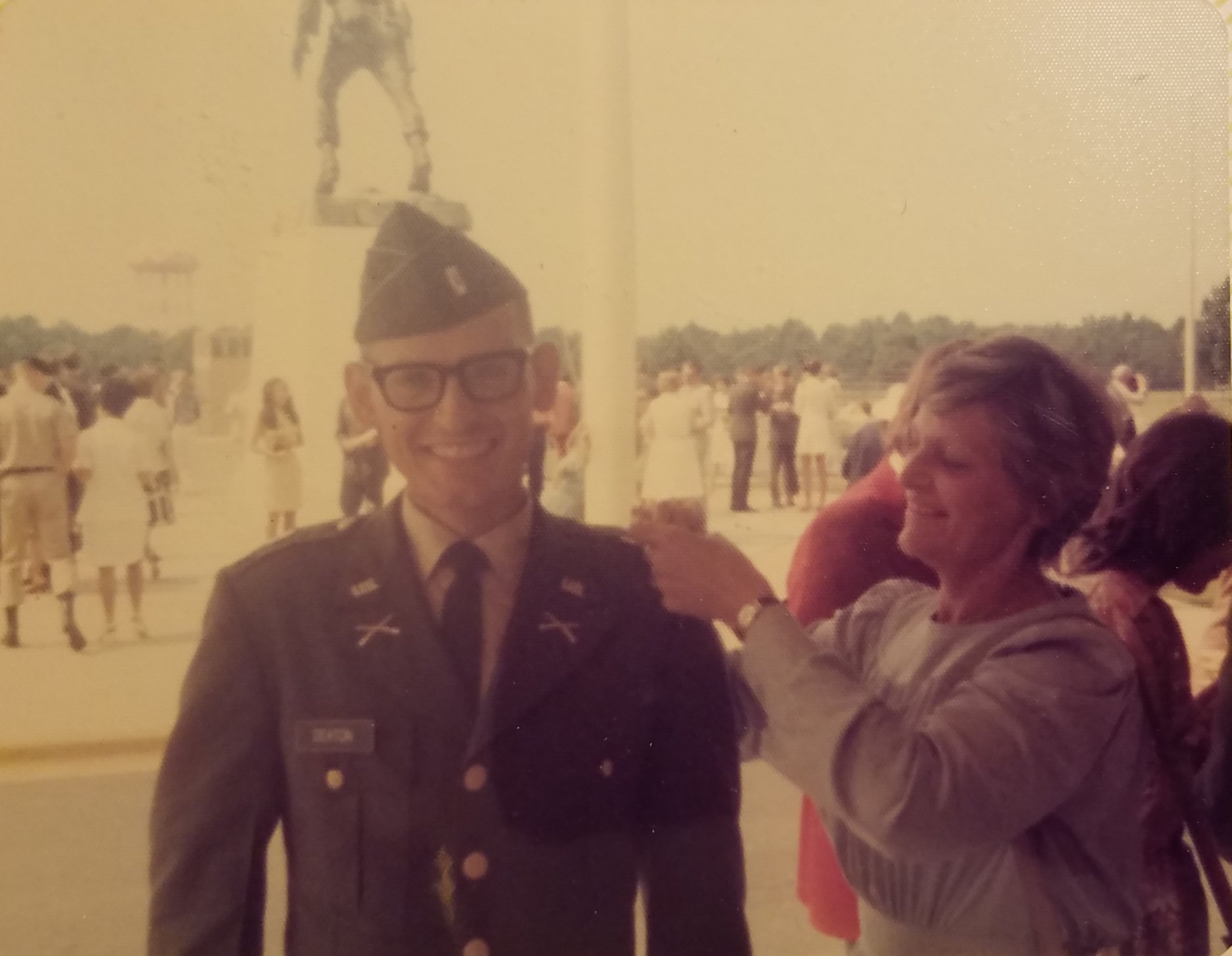
The conclusion I reached once the war ended on April 30, 1975 was the military was a mess and citizens had a personal, civic responsibility to improve it. That led me to explore options for enlistment. I enlisted to become an officer and left Davenport in January 1976, the bicentennial year. It was somewhat patriotic.

When I arrived for basic training at Fort Jackson, South Carolina I entered a different world. There were about a dozen white guys like me who had enlisted for officer training. They came mostly from New England and states above the Mason Dixon line. The majority of the company was comprised of local black guys and Puerto Ricans, many of whom knew each other from home and had enlisted together. There were a couple of white guys seeking to get on the draw with the Alabama National Guard, although they struggled to perform basic military tasks. At the time I believed Alabama did not send its best people. If you asked me in 1976 who would fight in our wars, my answer would have been black and Puerto Rican soldiers. It was a volunteer army and that is mostly who volunteered.

Ingrained in me was the liberal idea of equal rights under the law and equal protection. It mattered not that I was in a racial minority in basic training because it felt normal to me. I’d been exposed to different races and ethnicity when our family visited Florida where Father attended high school. I also shared a bunk house at YMCA camp to which staff had assigned all of the black campers plus me. Equal protection and equal rights used to be an American idea yet even as a grader I knew we had a long way to go. In South Carolina, in the military, it was obvious we weren’t equal as all the officer candidates were white.

The Unites States requires a standing military to meet our global commitments. Until the current president assumed office the United States stood as a force for good all over the world. Deployment on tough missions had become a norm. We continue to have a global military footprint, although its role has changed. Arms sales have become increasingly important to the U.S. under Trump’s “America First” foreign policy. The administration is changing the balance of power in the Middle East and elsewhere. We hope President Joe Biden can restore respect for the U.S. during his administration. What remains constant, though, is the need for a citizen armed forces and a standing army.

In his book, Who Will Do Our Fighting For Us? George E. Reedy, who extensively studied the selective service during the Nixon administration, wrote, “I believe that democracy can live more easily with the conscripts than it can with the professionals. The former do not like what they are doing — and that is precisely the reason they should be preferred.”

The need for military troops ebbs and flows. Some skills are highly specialized and require a longer term service commitment. Aircraft pilots are an example of this. For the most part, our military trains for specific missions and ramps up to meet staffing requirements. When operations end, units stand down. That is a normal progression and endemic to how the U.S. military operates. Having people from all walks of life, rather than dedicated professionals, enables citizens to witness our military and make sure we do good. That begins with a commitment to service, duty and honor when we consider our options in society. For me, the choice was easy.
Categories
Writing

Laying Out Davenport

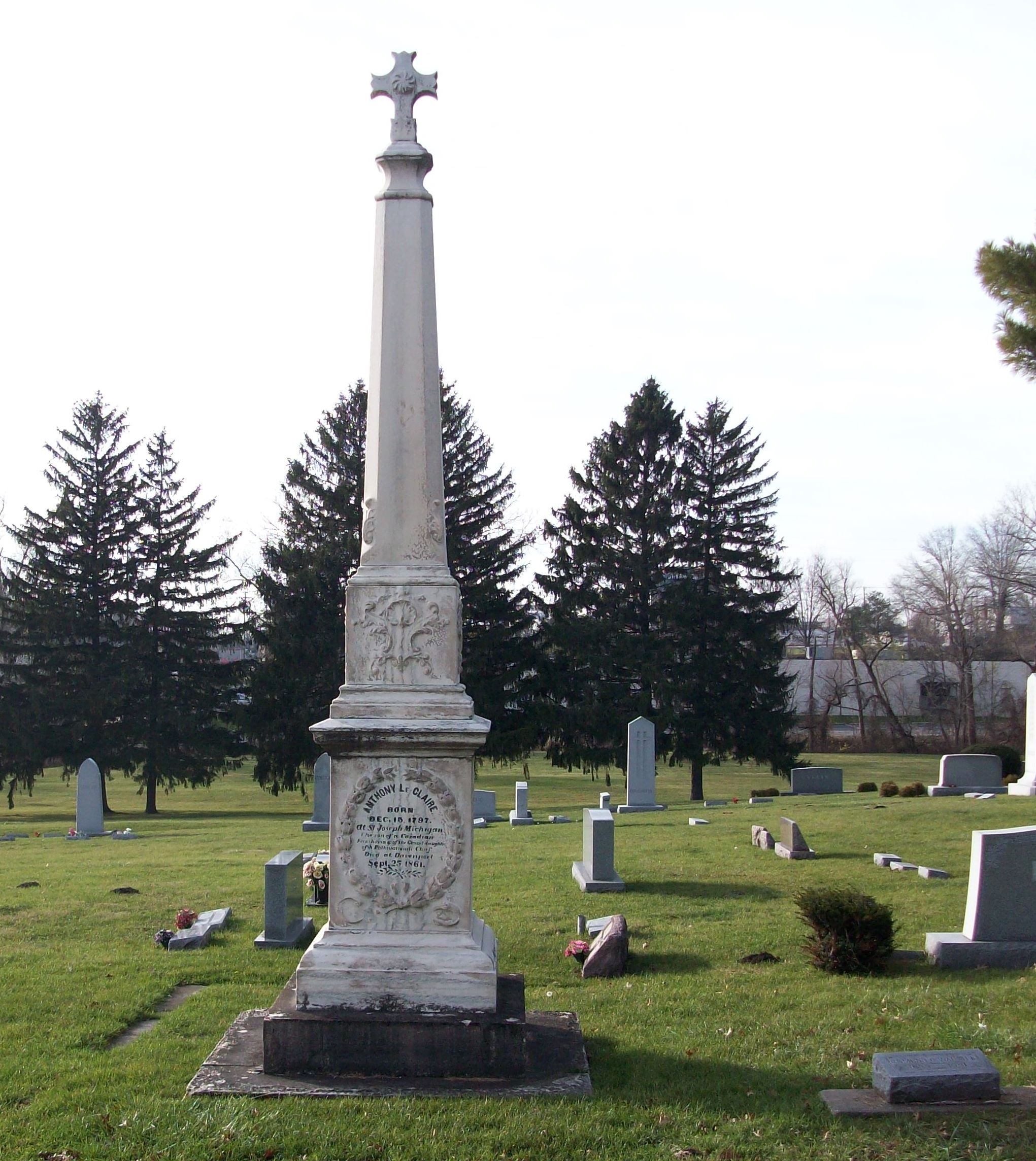
Antoine LeClaire Monument, Mount Calvary Cemetery, Davenport, Iowa.

By the time the City of Davenport was laid out, the Black Hawk War had ended. American men involved with the war, including some who would later become famous — Zachary Taylor, Abraham Lincoln, Winfield Scott, and Jefferson Davis — had departed. There was this land on the Iowa side of the Mississippi River.

With the Indian tribes removed, something needed doing with it, or so they believed. By any measure, the enterprise was a commercial venture in an arbitrary location. Its lackluster beginnings would haunt the city, certainly until I was born more than a century later.

(Spelling and punctuation preserved from the original text).

In the fall of 1835 a group of men met to form a company for the purpose of purchasing land and laying out a town site on the Iowa side of the river across from the fort. These men met at the home of Colonel George Davenport to discuss the issues concerning the town. Other than George Davenport the following men attended the meeting and became part of the company: Major William Gordon, Antoine LeClaire, Major Thomas Smith, Alexander McGregor, Levi S. Colton, and Philip Hambaugh. Another member of the company was Captain James May, in Pittsburg, Pennsylvania at the time.

The spring of 1836, Major Gordon surveyed the land that was to become the City of Davenport. The spot selected was west of the LeClaire Reserve and bounded by what is now Harrison Street on the east, on the north by Seventh, west by Warren, and south by the river. It included 36 square blocks and six half blocks. The cost of the entire platt was $2000.00.

In May, the area had been divided into lots, streets, and a proposed business section. Then the enterprising company offered an auction. People were brought from St. Louis by a steamboat and docked on the river front. The sale continued for two days. During the day the area was shown and in the afternoon an auction was conducted. In the evening the ballroom of their steamboat hotel was turned into a place for a lavish party in hopes that the second day of the auction would be as big a success as the company had hoped for. Unfortunately the sales were far from what was expected. Only fifty or sixty lots were sold at $300.00 to $600.00 apiece.

The promotional adventure to sell the city of Davenport was not a success in the number of sales made or amount of money collected. Most of the lots went for low prices to St. Louis speculators who hoped to make a profit on a resale.

A Clearing in the Forest by Gayle A. McCoy
Categories
Writing

Night Owls

Night owls.

Chances are someone in our household is awake.

I am an early riser, usually beginning my day by 2 a.m. My spouse is often still up from the previous day.

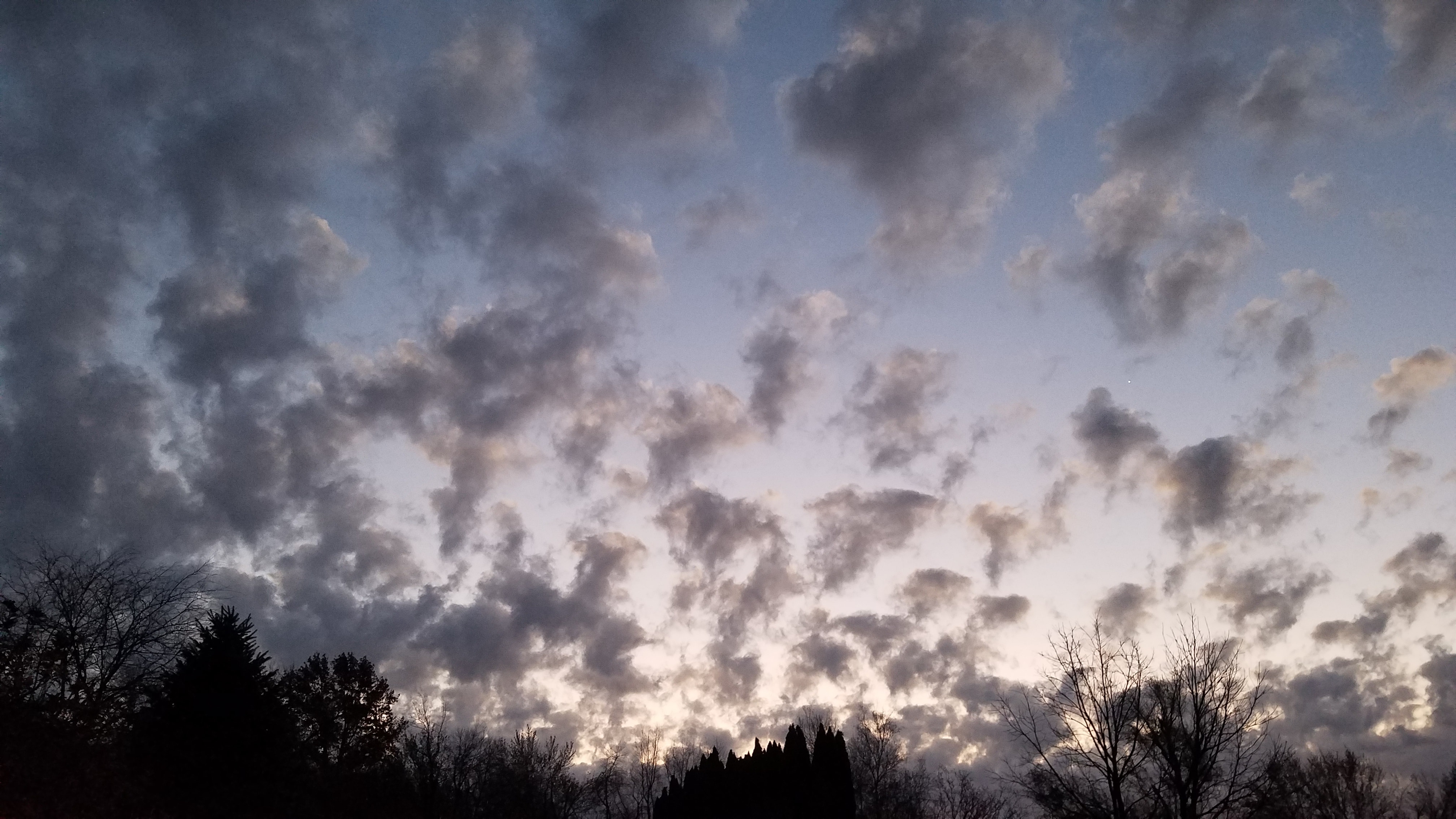
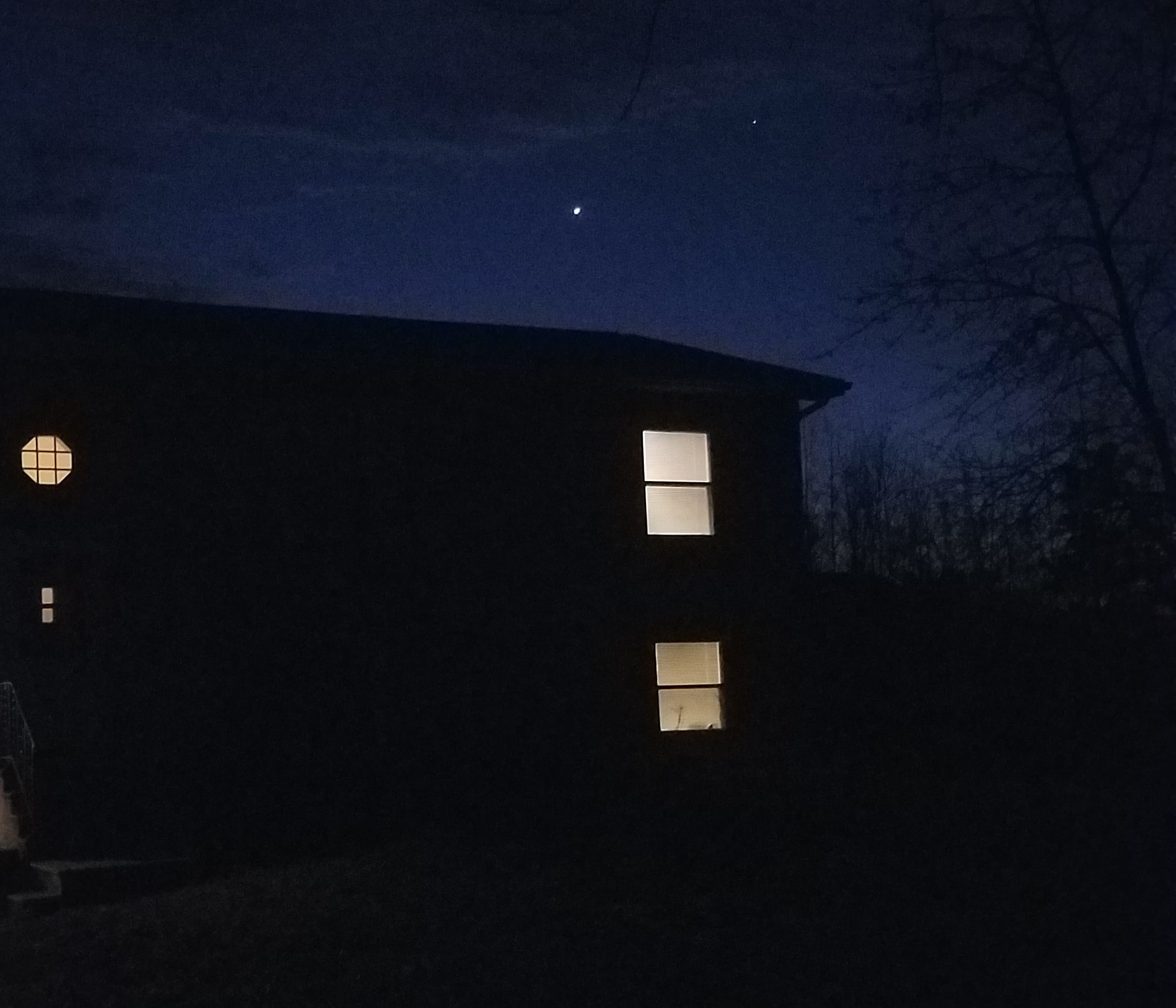
Two windows on the southwest side of the house are illuminated once I reach my writing desk, hers above mine. The planet Jupiter is not always hanging above us as in the photo. We are night owls.

Early rising provides a six-hour shift at my desk before the world wakes up. It is the quiet writers need.

Saturday I culled books. I purged duplicates from the stacks to be donated or given to friends, and put some in a reading pile. I spent the most time reading and considering books that were off grid. That is, they didn’t appear on Goodreads or Amazon, and they had no IBSN, a numbering convention that began in 1967. Many books I will consult for my autobiography predate IBSN. Others were printed privately. It’s a different world when we get off the grid.

I put Who Will Do Our Fighting for Us? by George E. Reedy, with an introduction by Senator Edward M. Kennedy, on my desk. The U.S. military, when I enlisted in 1975, was a backdrop for understanding the role of citizen participation in society. The dialectic Reedy explores is between a conscription and a volunteer army. Reedy favored conscription because such soldiers don’t like what they were doing. “That is precisely the reason why they should be preferred,” he wrote.

I participated in the draft lottery and had the number 128 when I was eligible to be called up. That year they called only through 125 so I could finish my undergraduate degree at the university and fulfill my selective service requirement without a student deferment. It turned out I enlisted after the end of the war in Vietnam.

The other off grid book was A Clearing in the Forest by Gayle A. McCoy. It’s a biography of Colonel George Davenport, one of the founders of his namesake city where I was born. I’m more familiar with his business partner Antoine LeClaire. The plan is to write 500-750 word historical/autobiographical sketches of important places in my life and use them to set the scene for autobiography sections. Both founders require further study before getting to the Davenport segment. I put the biography on my bedside table.

It was a decent fall day yet too cold for bicycle riding. I followed my usual walking route to the public boat docks and back, about 2.5 miles. I was the only trail user wearing a face mask. News media reported a run on grocery stores as there was at the beginning of the pandemic. It is getting dire with reports of high levels of infection in nursing homes, care centers, and at the state prisons. In normal times all of this would be scandalous.

On Friday the Carroll Times Herald published a story about family and friends who contracted the coronavirus. It is anchored around friends playing Euchre and how the virus spread among them. “A spreading sickness” is poignant and timely just before Thanksgiving. Link here to read the first of three parts.

I like the photo in this post. Under a clear sky, light shines from rooms where we live quiet lives. We turn inward for a few hours before dawn, focused on our work. We can be ready when the rest of the world wakes up. What we increasingly find is we are not the only night owls during the disruption caused by the coronavirus pandemic.

Categories
Writing

Last Fall Days

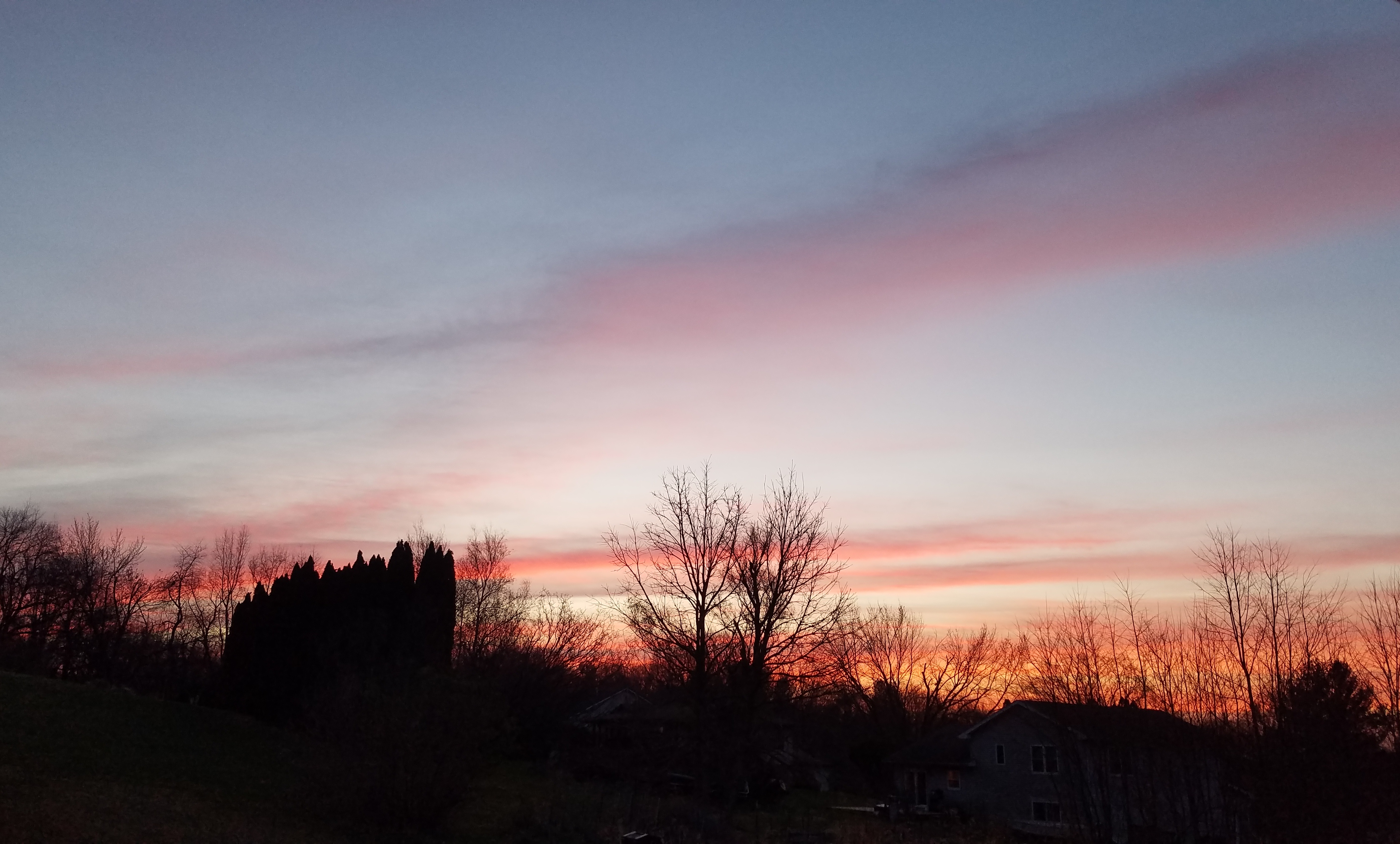
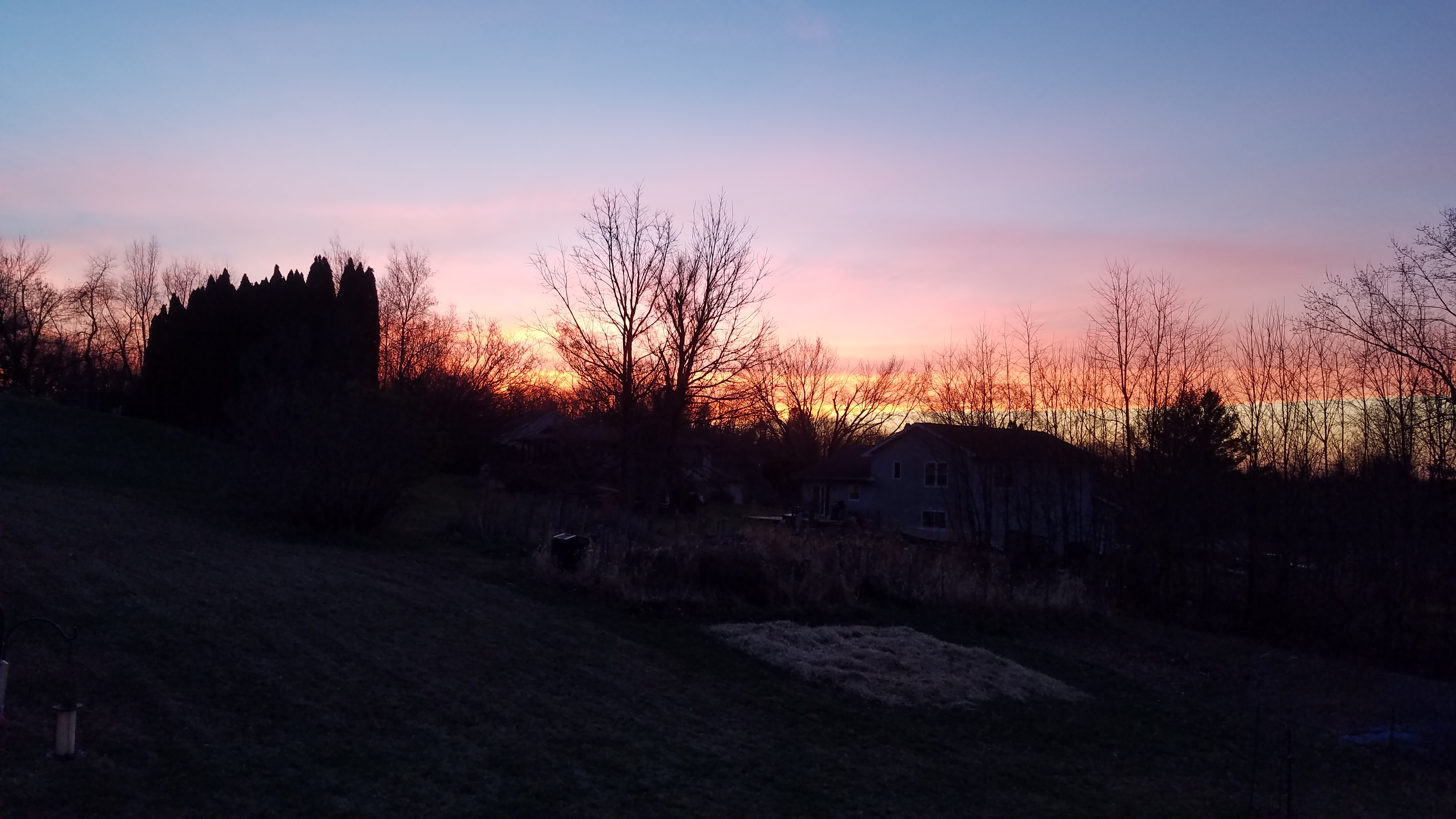
Sunrise Nov. 20, 2020.

Leaves fell from deciduous trees in our yard revealing squirrel nests high in the canopy.

The last few days have been warm, in the 70s. Meteorologists say temperatures will cool as autumn’s last month begins. Yesterday the wind died enough to take a bicycle out on the trail. I wore a face mask as the coronavirus pandemic is escalating in Iowa. Our neighborhood is dotted with homes in quarantine because someone in them contracted the virus.

More people on the trails have begun to wear face masks. The state park is a place where people can gather, social distance, and chat with masks on. The color of water with flocks of pelicans, Canadian geese, and other waterfowl slowly swimming the surface is always pleasant. The peace was disrupted last Sunday when a 21-year old student from the university crashed his automobile near the state park entrance resulting in his fiery death.

The idea of a week persists despite many reasons why it shouldn’t. There is a weekend kicked off by Friday’s handmade pizza dinner. Saturday is a time for getting outdoors and working on projects in the garage, garden and yard. Sunday has become a day to take it easy, spend a long hour with the Sunday newspapers, and take an afternoon nap. By Sunday afternoon it’s time to read email, make phone calls and prepare for the coming week. Weeks have become anchored by such weekends.

To help our friends at the used bookstore in the county seat I bought some children’s jigsaw puzzles for our public library. I emailed the library supervisor and they had been discussing buying more puzzles. It turned out to be a win-win-win scenario. Because shipping is so expensive I will mask up to make a trip to pick them up, then deliver them to the library. The bookstore and library have excellent protocols for protecting everyone from transmission of the coronavirus so I feel safe making the trip.

The library is again taking donations for the Friends of the Library used book sale. It’s uncertain when the next one will be, however. They stopped taking donations at the beginning of the pandemic so it’s positive to hear they resumed. I’m running out of room and plan to donate a couple hundred in the first go-around. I’ll do my best to refrain from buying more at the sale.

We made a list of items for a Thanksgiving dinner. It has been a long time since we left home or had guests here for the holiday. I’m not sure what happened other than we have a small family. This year it will be the two of us again with phone calls and video conferences mixed in with meal preparation. We usually eat leftovers for a week or more after the meal. We used to make special meals for Christmas, our birthdays and wedding anniversary, and Independence Day, but not so much any more. When I pick up the puzzles I hope to find some organic cranberries and oranges to make cranberry relish, a household Thanksgiving tradition.

I’m not sure how much longer to ride the bicycle this year. Suffice it that if the weather holds I’ll continue. Weird weather has come to characterize Iowa and so many other places. We feel the impact of the climate crisis every day. To our benefit, climate change created a zone of temperate weather over our home and the region. While it has been exceedingly dry this autumn, there is hope for precipitation over the next few months. Gardening and farming should yield abundance as they have since settlement after the Black Hawk War.

Today, I’m planning a typical weekend Saturday while embracing the idea such typicality is fleeting. Our lives can be over in a moment, like that of the young man who died a week ago. We must cherish our lives as we can because all we have is the present. As bad as it seems some days, considering the alternative, it is not so bad.

Categories
Reviews

Favorite Movies

Morning in Iowa.

Someone asked, “What is your favorite movie and why?”

I had to think. After considering some options I answered, “The Lion King because of the music.”

I’m not sure that was completely right.

I’m also not sure which movie was the last I saw on television or in a theater. In the time of the coronavirus I watch movies on my desktop computer, either from a disk or streaming. I do keep track of what I watch. The last was on line, Public Trust: The Fight for America’s Lands.

When our daughter visited in December 2014 we watched a video cassette recording of Christmas in Connecticut together, part of a series of “dinner and a movie” events we discontinued as a regular thing. In 2017 I watched The Brainwashing of My Dad from a disk on my desktop. It was a powerful story of a family where the father got caught up in right wing media hegemony to his detriment, and then came out of it — a happy ending. I also watched The Princess Bride (for the first time) on Amazon May 31, 2013. Too many cultural references to avoid it forever. Since 2012, I watched about 20 movies, not many.

When we talk about “favorite movies” what does that mean? For me it means films seen long ago, the memory of which persists. The Lion King fits that description and I would view it again. I’d listen to the CD of the soundtrack more. There are about a dozen movies that mean something to me.

Blade Runner: We saw this at a theater the first time Jacque and I did something together outside of work where we met.

Out of Africa: Because of the cinematography. It’s a gorgeous film and I don’t use the “g” word often.

The Conformist: Few films of that era stick with me the way this one does.

The Matrix: How could someone with a Cartesian outlook not love this movie?

In a Year of 13 Moons: I was obsessed with Rainer Werner Fassbinder the way he was obsessed with subjects and themes in this movie.

Lord of the Rings Trilogy: I recall my argument with Father Harasyn as a freshman in high school about whether J.R.R. Tolkien’s books were literature. I lost the argument and was not given credit for reading them. The movie is a faithful rendering of the book.

The 400 Blows: I was enamored of Francois Truffaut during graduate school. Not as much now, but still.

The Tree of Wooden Clogs: I could easily have been one of the peasants in this film. The cinematography of Ermanno Olmi was unlike anything I’d seen.

Apocalypse Now: The first film I saw in a theater after returning stateside from Germany. It alone launched an interest in movies that persisted for the following five or six years.

Patton: The go-to film for soldiers maneuvering in the Fulda Gap. We would show it on a film projector run by a diesel generator. I knew to carry several replacement bulbs for the projector when we left garrison.

The Sound of Music: Grandmother insisted our family see this together and she paid for the tickets. She would have been the Maria Rainer character if life had been kinder to her.

There are others yet few recent ones. As the holidays draw near, and we contemplate the events of 2020, there are worse things to do than consider things we love. Movies have been part of my life in society as they are for many.

Categories
Living in Society

Stage Transition

Central Casting, Nov. 20, 2012.

Today was the last shift for our daughter at Walt Disney World in Orlando, Florida. It’s a bittersweet moment.

She arrived for permanent, full time work as an entertainment technician on Nov. 20, 2012. The coronavirus pandemic disrupted any plans she had last March. After six months on furlough she took an assignment outside technical stagecraft in retail sales as part of an agreement negotiated by her union. She took a substantial reduction in pay.

It was not why she journeyed to Florida so she asked again about a transfer to live performance, then gave proper notice and ended her work today. We discussed how live theater would always be an option for work before she took the job. Who knew the pandemic would happen? She worked hard and was well liked.

Doors that opened also close behind us, creating new beginnings. We hope for a positive outcome, especially on the other side of the pandemic.

Following is a blog post she made the day after checking in through the doors in the photo.

Down the Rabbit Hole…again.

Yesterday, I was up early in anticipation of my on-boarding appointment at the Walt Disney Casting building.  I didn’t really know what to expect, but as I had been sent a packet of materials right after my phone interviews, I was sure that they would be important.

The Casting building is prominently displayed on the highway leading to the Downtown Disney area.  You can see the large gold letters standing out against the brightly colored building, shining in the Florida sun.  There is still a thrill in seeing them, even all this time later.

The inside of the casting building is draped in images from Alice in Wonderland. This seems a terribly fitting image as one joins the ranks of the Disney Cast. Working for the Walt Disney Company really is a strange world where the rules aren’t quite the same and the characters all seem to have their own language.  One can become tongue-tied just trying to say the right thing. Fortunately, I’m still able to translate decently and spent all of my morning with a smile on my face. The strangest part for me was actually seeing cubicles again.  I am so used to being out in the park to work, there’s something strange and foreign about the office setting.  It did remind me of what I left back in Colorado though.  That strange contrast of just how different the outside world really is.

I met some very nice women who were also waiting for their paperwork to be processed.  It continues to fascinate me how, even in a company as homogenizing as Disney can be, there is still such amazing diversity among people’s own stories and personalities.  Along with that: I really must brush up on the Spanish.  I’m terribly out of practice.

I spent most of the rest of the day recovering from my two days drive. That long on the highway had not done well for my sense of direction or my personal health. The rest seemed to do me very well though, as I feel much better this morning. Some of that may have to do with my two cups of coffee this morning; that seems to have solved my headache problem.  Dear Former Office Job: I learned many things from you, but I do not appreciate the caffeine addiction, thanks.

Today, there is much to do. I must visit an apartment office, and I’m hoping they have something suitable and available, as I really don’t want to search much more at this point.  I’m currently in the midst of the Tourist district, so trying to get my bearings is quite a pain.  Everything is smashed in very close together and the drives and turns here are rather a mess in comparison to other places I’ve lived. I am also hoping I’ll have time to drive up to Orlando and visit my gym.  I have been too long away and it’s starting to be noticeable in my midsection. (I’m sure the 3 days of driving in the last week and a half didn’t help any either).

All that aside, I should be truly settled here shortly and will let you all know once that happens.  In the mean time, Live well and have a Magical Day. ;)

Who am I now? A blog post on Nov. 21, 2012 by Elizabeth Deaton
Categories
Writing

Taking Up Residence

Photo Credit – Wikimedia Commons

While visiting home at Thanksgiving in 1976 I considered what I wanted to accomplish overseas while in the military.

What are the points of emphasis going to be? I can see two major ones in addition to my duties as a U.S. Army officer: writing and traveling.

What can be said about writing is that I will buy a typewriter and work a story at a time. If something good develops BRAVO!

As far as traveling is concerned, I will make the best possible use of my time and finances to travel, seeing the people, talking with them, eating with them, and viewing their ART and ARCHITECTURE.

This is no modest task in itself but one which must be undertaken for the full experience of the country’s culture. It should prove most pleasant.

Journals, November 25, 1976

I underestimated how engaged I would become as an Army officer. When we were in garrison my day started well before dawn with a simple breakfast in my bachelor officer’s quarters followed by a shower and a drive from Martin Luther King Village near the Mainz main railway station to Robert E. Lee Barracks in Mainz-Gonsenheim. It was well after dark when I returned to King Village. If the officers club across the street from my quarters was open, that’s where I would find camaraderie and dinner.

When we were in the field, we were gone for as much as three weeks at a time. Our field operations were maneuvers in the Fulda Gap and other strategic spots in central Germany. When we were on maneuvers we got very little sleep. We would road march with our tracked and wheeled vehicles from the barracks to the area around Fulda when we were rehearsing for a potential Soviet invasion. When the trip was longer we’d load everything on flatbed rail cars. The rail car loading was a scene from old World War II motion pictures.

We also spent time at designated training sites like Grafenwöhr, Hohenfels and Baumholder. For an extended period of time I split my week between Baumholder (Tuesday-Saturday) and Mainz (Saturday-Monday), which made for never ending weeks. I was young and up to it. I listened to Armed Forces Radio in my pick up truck on the drive home every Saturday, almost like clockwork.

Because I studied French in college I served as an exchange officer with a regiment of French marines in Brittany. Our battalion commander in Mainz told me if the balloon ever went up, that is, if Soviet troops invaded West Germany, I would most likely be transferred to a position where I could use my French language skills as a liaison officer. I also took a platoon through French Army Commando School in Vieux-Brisach where I served as French-English translator. My French-speaking skills improved considerably because of these assignments.

I held three different positions in the 2nd Battalion, 87th Infantry, a mechanized infantry unit part of the 8th Infantry Division and V Corps. I started as a platoon leader, then became a company executive officer, and spent the rest of my tour of duty as the battalion adjutant. These were positions where I learned what it meant to command troops and used almost every skill I learned before entering the Army. It was life, as good as it gets.

I did buy a typewriter, and still have it. My main writing turned out to be in my journal which covers from Dec, 28, 1975 until Oct. 22, 1979. In reading my journals for this project I’m both lucky and glad to have them.

Some friends from home stayed with me for a while in Mainz. I met Dennis and Diana while working a part time retail job in high school. I took leave and we toured Germany, France, Spain, Italy and Switzerland in a rented Volkswagen sedan. Dennis is of Belgian descent and asked me to write for his newsletter at the Center for Belgian Culture of Western Illinois in Moline. It took some time and my first article was titled To Belgium and Back: November 1977. He published two more of my Belgian travel diaries the following year.

As far as travel goes, I had experiences that would have been impossible outside an Army unit. During our field training exercises I got to know some parts of the Fulda Gap better than I knew Mother’s neighborhood in Iowa. As a soldier I was both threatened with a gun by a German reveler during Fasching, and welcomed into people’s homes while stranded in parts unknown. There was still resentment lingering from World War II, especially among people who lived through it.

During my trips to France I felt a part of history. The marine unit to which I was attached was on alert to mobilize to the Republic of Djibouti after the African state declared independence from France. I would have deployed with them, although luckily we didn’t.

During an amphibious landing on Belle-ÃŽle-en-Mer we were immediately helicoptered to a drop zone further inland. I missed the U.S. ambassador from Paris who was waiting for me on the beach and had come to greet me. I also think he heard my French was a bit questionable, which it was on that assignment. He finally caught up with me under a poncho, next to a barn, at a farmstead where the owners served us dinner of hard cooked eggs, potatoes and sparkling cider all produced on their property.

There were trips to Roman ruins in the Taunus Mountains on weekends, rock climbing near Trechtingshausen, and many visits to the Rheingau wine country. A number of battalion officers made a trip to Luxembourg where a field officer in the Luxembourg Army showed us historic sites related to World War II. Everywhere we went we felt part of history.

While my quarters weren’t fancy, they were an outpost where I took up residence and deployed all over Europe during my time in Mainz. It was a unique experience for which I am thankful.

Categories
Writing

Leaving Fort Benning

Fort Benning, Georgia.

13 November 1976
Fort Benning, Georgia

Whatever malaise I felt once has now subsided. I am in excellent health, with the swine flu and Hong Kong flu injections rolling around my bloodstream. Aside from a few bits and pieces of personal affairs I am ready to depart for Europe.

But most of all I feel as if my major problems, stemming from my youth, are solved. I have come to understand the human condition and have come to terms with it. I have made some modest inroads in society with only one major faux pas and am involved with what could earmark a successful life.

As always one asks by what standards is success judged? To this I answer first of all good health. Without this one is hard pressed to be successful. Without health, success can be judged only in terms of living within whatever handicap one possesses. While in the eyes of many, myself included, this is an admirable achievement, for me success must include good health. This is not to be in comparative terms but free from bodily ailments which distract the mind/spirit relationship.

Second in the measure of success comes adequate food, clothing and shelter — with imagination in their implementation. The basic needs must be taken care of with style and diversity in order for success to be achieved.

Next in considering success is a spirit/mind awareness. The spirit must be able to sort itself out from the mind. Upon sitting back, the spirit must be able to observe the actions of the mind. If this can be achieved then success is evident.

The last and most important aspect of success is the ability to be in communication with the other members of the human race. To be open minded and willing to believe, knowing that each person is capable of letting the divine essence shine through.

I by these terms am now a success and hopefully I will remain successful for the rest of my life.

May the Lord have mercy on my soul, that success not swell my pride, that I may also live through the next week.

~ Excerpt from my personal journal before departing Fort Benning, Georgia for Thanksgiving in Davenport. From there I would drive to Terre Haute, Indiana, and then to Charleston, South Carolina, where I would ship my vehicle to Bremerhaven, West Germany and take up residence in Mainz.

Categories
Writing

A Kitchen with Five Doors

Morning in Iowa.

When our parents bought a home in Northwest Davenport the kitchen quickly became the center of family activity.

The home was an American Foursquare built in 1910. It had an expansive front porch facing Marquette Street with mature maple trees on either side of the walkway. There were two tall pine trees on the south side of the house, and a silver maple next to a detached tar paper garage in back near the alley.

The entryway had leaded glass doors leading to a foyer where a staircase led upstairs to three bedrooms, a bath, and more stairs to the unfinished attic. Abundant mahogany woodwork adorned the foyer. To the right was the living room with leaded glass windows and a wide pocket door separating it from the dining room. The dining room had a bay window with leaded glass. The dining and living rooms were large enough for home entertaining which consisted of parties for us children, family gatherings, and card parties organized by Mother. On Dec. 26, 1982 there was an open house to celebrate our wedding with friends, family and neighbors.

The kitchen was small by today’s standards. Every inch of wall space had something on it. The centerpiece was a large enameled, cast iron sink with a left side drain board. The drain board also served as countertop space. There was a gas range in one corner, a space for a refrigerator, and a small table set against two windows on the north side of the room. It was a kitchen with five doors.

There was a door leading to the foyer between the range and the refrigerator. Sometimes that door was kept shut. Another door, perhaps the most used, led to the dining room. One led to a pantry that included a built in china cabinet and other shelving. There was a door to the basement, and one to a small vestibule with a closet and yet another door to the back porch. In all, the house had livable space of 1,561 square feet on 0.15 acre, a regular city lot. It seemed like more space because the basement and attic were quite usable.

Our kitchen was a place of transition in the period I lived there from Summer 1959 until leaving for university in 1970. By that I mean food came in through the doors and was processed for storage or prepared as meals. We hauled groceries up the back or front steps, depending on where the automobile was parked. We took canned goods to the basement for storage in a handmade wooden cupboard designed for the purpose in an era of home canning. In those days there was less processed and prepared food and more raw ingredients. Our kitchen was about more than food storage and preparation.

Mom’s friends stopped by unannounced and entered the kitchen through the vestibule without knocking. Model Dairy had home delivery to a milk case on the back porch and occasionally Mother spoke to the milkman. The kitchen was a bustling center of social activity we took for granted.

We most often entered and left home through the kitchen. Mother would usually be there or in the dining room. We told her where we were going and asked permission to leave the yard. There were coat hooks in the vestibule for storing everyday outerwear. In winter, when we came indoors we took off our shoes and put them by the furnace register next to the range to dry.

Countless meals were prepared in the kitchen, typically by Mother. We had a family cuisine different from other families in the neighborhood. It became a discussion topic among my friends and neighbors. I ate some meals at the small table by the windows when my brother and sister weren’t around. I didn’t spend much time cooking with Mother yet recall my friend Dan and I gathering at the range to watch her make tacos while we were in high school. I took little of Mother’s cooking technique with me when I left home. My main memories of food are her bringing serving bowls, dishes and platters full from the kitchen to the dining room table where we gathered for meals.

After Father died we began a transition to the dining room as the central gathering place. When I returned from university, or later travels, that room became the focal point. We talked for hours around the dining room table. As we aged, our relationships with each other changed in front of us. Some of those conversations were memorable.

Yet it is the kitchen with its five doors I remember most about that period. What went on there was formative and stands in stark contrast with how our lives would change. It created in me a sense of normalcy.

Categories
Writing

Process Part One

It seems like a small thing yet we need a place to spread our work during a writing project.

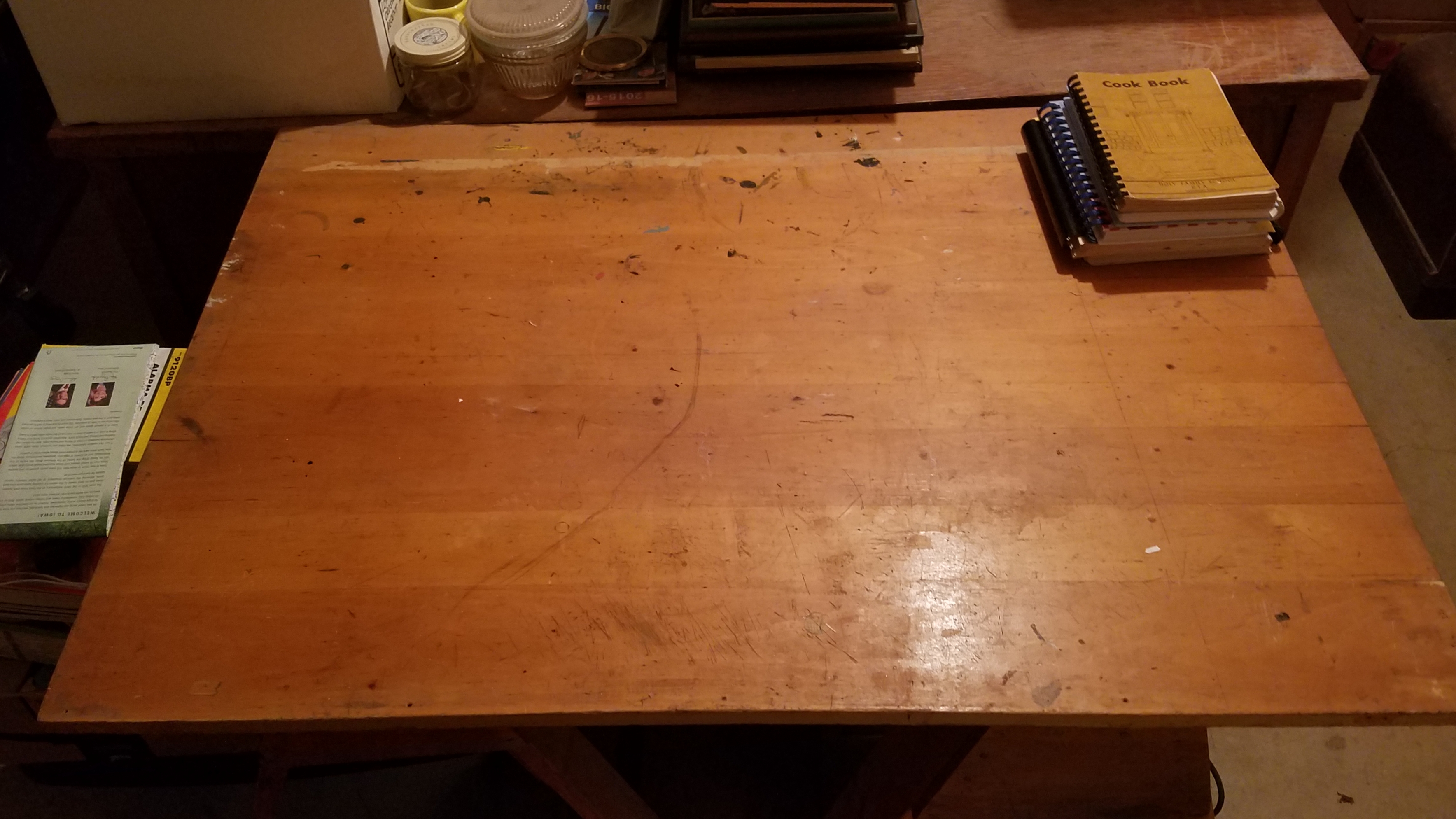
I moved all the books piled on this table to the chest freezer for the time being. Hope we don’t have to get in it for a while.

The books in the photograph are cook books produced in the neighborhood where I spent the years from 1959 until 1970. I don’t understand the extent of cultural artifacts presently scattered around our home and will use this table top on sawhorses to transition them into some kind of order. That’s the plan, anyway.

Conceptually my present writing is coming together. It will be a compilation of thematic sections, some drawn from past writing and some new. I’ll use longer fragments written over the years, some of them quoted verbatim, and others highly edited.

Framing this will be brief historical essays about important places, including about Piety Hill and environs, where Mother was born; Lincoln County, Minnesota, where Grandmother was born; and Glamorgan, Virginia, where Father was born. Other important places are Davenport, Iowa City and Cedar Rapids, Iowa; Mainz, Germany; Tallahassee, Florida and Southern Georgia; Lake County, Indiana; and of course Big Grove Township where we settled in 1993.

There will be a second frame about work: Mother, Father and Grandmother during the period before I left for college; and highlights of my work history including high school jobs, summer work while in college, military service, the interim period between finishing graduate school and marriage, my transportation-related career, and the varied work experiences after my July 2009 retirement.

By reducing these topics to brief, separate sections I expect to provide background so I can focus on more interesting subjects.

Even though I have a table on which to lay all this out, not everything will fit. That will force choices — a good thing.

It’s clear from the progress of the coronavirus pandemic the state will be stressed for a while. Cedar Rapids to our north is doing poorly. State Senator Rob Hogg reported yesterday, “Cedar Rapids is now number one in the country for the fastest increase for coronavirus cases in metro areas with more than 50,000 people.” With cooler weather and winter coming, it’s a good time to work on indoors projects. So, I shall.