It snowed overnight, meaning winter is trying to maintain its grip. The forecast is for snow to continue until 10 a.m. It will all melt, maybe later today, tomorrow for sure.
I reread wrote here yesterday’s post and stand by it. There is more work to do to flesh out what happiness means in measurable ways. It has to mean more than staying busy. I need to get busy with that, though.
There is lots to do today so I’ll leave this piece I wrote in 2012. Guess I’m feeling somewhat indigenous today.
At some level, we belong to an indigenous population. We are not that different from everyone else. I grew up in a neighborhood, and socialized with a cohort with whom I continue to have occasional contact. While elementary school teachers did their best to break us from our tribal leanings, some of us gripped our native culture, and the idea that we were all on the same footing. We wouldn’t let go as the teachers attempted to split us into groups, a talented tenth, and everyone else. I continue to have a strong sense of the culture shared with my cohort, even after so many years, and diverse experiences since the sixth grade.
Regular readers may be familiar with my usage of the “what’s in it for me” culture. This mindset is present in society, especially in business, but in other places as well. Where people have reasons for participating in things, and growing out of the need to make a profit, behaviors turn utilitarian, and therefore alienating. If there is nothing in a behavior that serves to profit me, why do it? In this scenario, the question, what’s in it for me requires an answer.
Individuals should strive for self-sufficiency, but not to the detriment of society and the commons. This includes managing our lives so we give more than we take from society. It includes managing the vast sea of words seeking its way to our consciousness. It includes dealing with tough problems that are greater than any individual, in concert with others. It includes the idea that there is no individual without the one of which we are all a part.
I searched “How is the GDP doing right now?” The answer returned from the internet was “U.S. GDP or Gross Domestic Product is the total value of goods produced and services provided in the U.S. It is at a current level of 27.94T, up from 27.61T last quarter and up from 26.41T one year ago. This is a change of 1.19% from last quarter and 5.80% from one year ago.” I’m not sure what this means to an ordinary guy like me.
I’m most interested in our family income, our consumption of goods and services, and the quality of life we produce for our family and in roles we assume among the rest of society. The group French President Nicholas Sarkozy put together at the time of the 2008 financial crisis thought like I do. Such items should be part of how we measure performance of the broad economy. That GDP doesn’t is part of the problem with using GDP. The committee enumerated such concerns in their recommendations and pointed out obstacles to accurately collecting this data and conveying it in a generic report. It’s been more than ten years and I don’t know if anything came of it.
My life sometimes seems like it is on generic autopilot, continuously moving from one task to the next, with little emotion and a hope to make it successfully through each day, week and month. I made it so far. There has to be more in life.
Because we live on a fixed income, tasks I undertake are devoid of financial concerns. They are weighted toward what has to be done and what I want to do. I know which activities are too expensive and which must be delayed until they will fit in the budget. This knowledge creates a quality of life.
For example, after replacing some major appliances (stove, washer, dryer and furnace) our electricity expense reduced by 20 percent year over year. Replacing decades old appliances was something we would not have done except for the fact they couldn’t be cost-effectively repaired. In the case of the furnace, replacement parts were simply not available. We had to replace them. Money saved on electricity will be assigned other uses. It will be a non-item in the bigger picture. Our quality of life is better for having new appliances.
Our health care is in turmoil right now because the University of Iowa bought Mercy Hospital. The practitioner I saw in town already jumped ship. Staff at the clinic seemed uncertain what would be next and reported some people were keeping options open on a month-to-month basis until a transition plan was known. This tumult is part of the story of our financial condition as it relates to health care.
The rest of the health care story is that since getting on Medicare, I’ve had very little to co pay. If it was $10 over the years, that would be a high estimate. My insurance comes from Medicare, which deducts the premium from my Social Security payment, combined with a supplemental health insurance plan and a Medicare Part D prescription drug plan. My experience is different from my cohort who belong to Medicare Advantage programs. It is different from people who are on Medicaid or on private health insurance. The country needs to convert to Medicare for All and do away with private insurance completely. How differently people solve health care needs creates a challenge when it comes to measurements like the GDP.
Household maintenance and health care are two measurements of our financial and personal condition. There are others like our health, who does household tasks like simple repairs, grocery shopping, cooking, cleaning, laundry, and care giving. We also measure net worth, monitor loans, and prioritize major repairs around the property. We keep a balance sheet. When it comes down to dust, I feel like we are doing alright, yet have no real idea whether we are.
I am glad the GDP is rising… except for the way the environmental costs of exploitative industries are omitted… except for the way the numbers favor large business and government interests. Production looks good this quarter. How will it look to our children ten or twenty years from now?
I have a sketchy relationship with GDP. The more I learn, the less I like it. I need to develop my own narrative of how things are going.
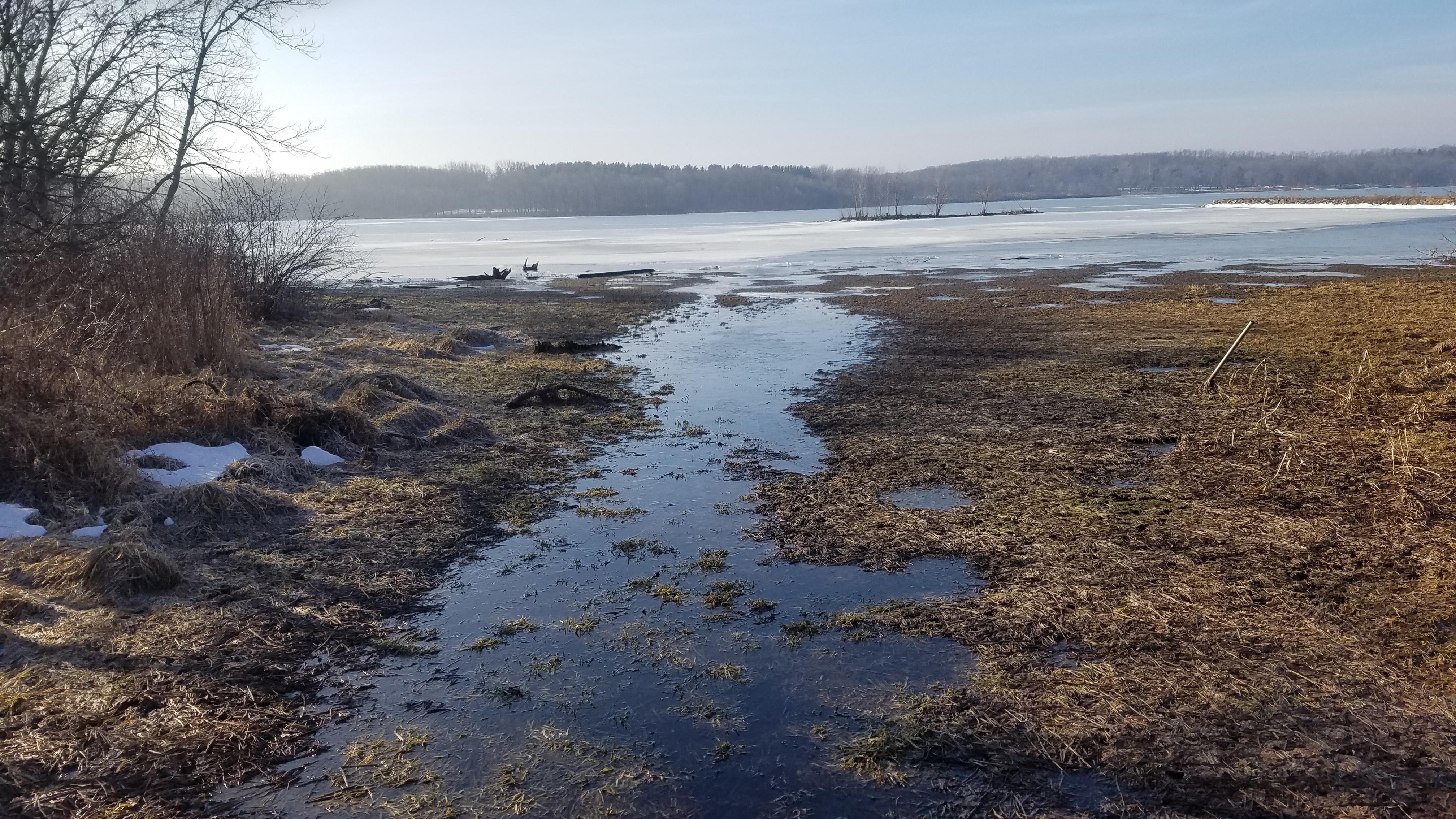
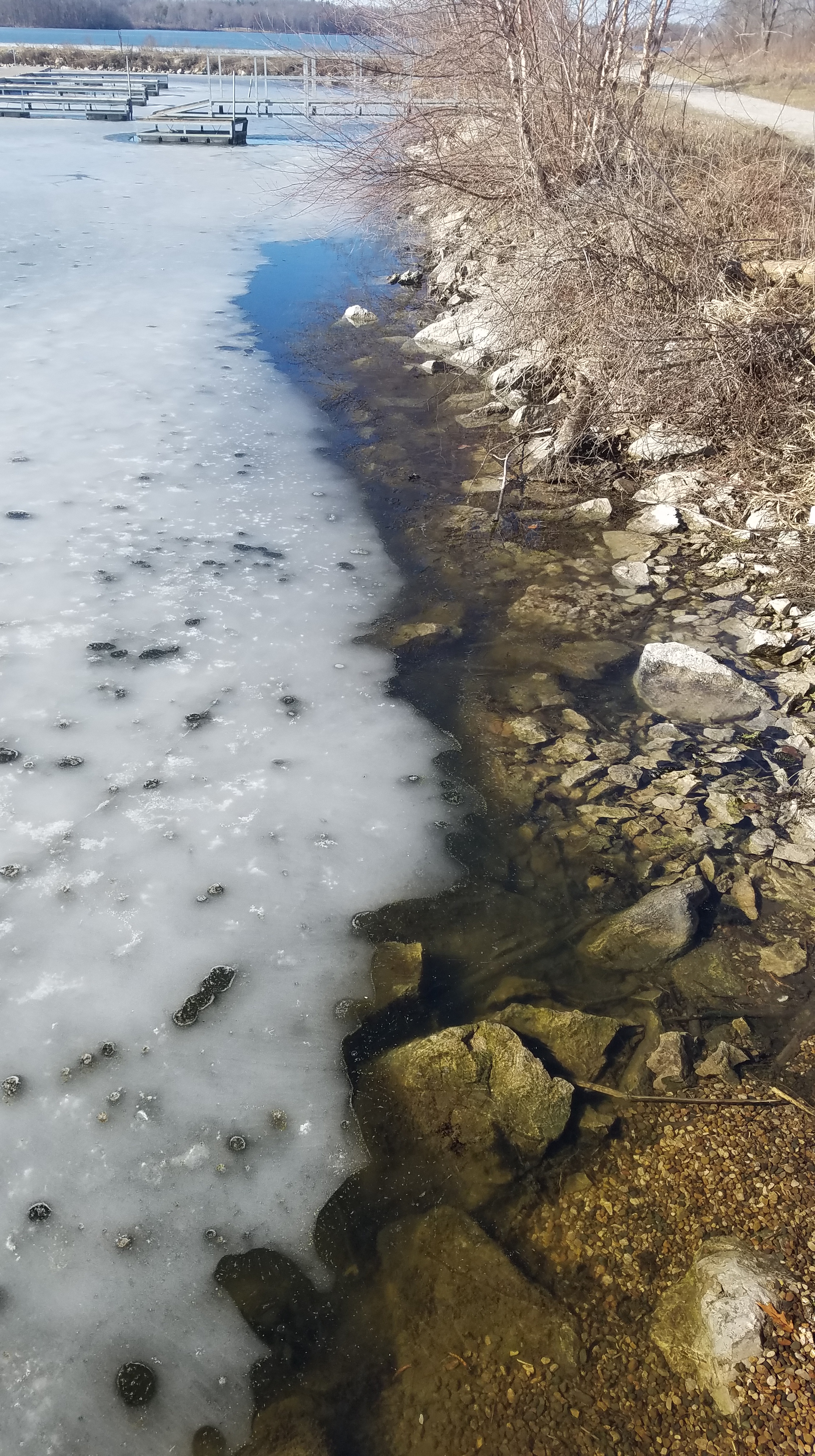
It is good to begin walking the lake shore trail now that most snow melted. Getting outdoors and breathing fresh air is a boon to our existence. Not that many in modern American society care much about that.
How do we measure happiness? Certainly, the GDP (Gross Domestic Product) doesn’t adequately factor it in. Neither does the CPI (Consumer Price Index). Maybe these indices should consider human welfare instead of production numbers and the price of things. There are ways to do that.
Not holding my breath.
As far as being a human, living in the United States, I’m doing fine. We have adequate retirement pensions, plenty to eat, basic necessities, and a positive net worth when the value of the house is added. We get along better than billions of other humans do. But am I happy? I don’t know, which by default is a no.
The next time I walk on the lake shore trail I’ll have to give the matter of personal happiness some thought. Not too much thought, though. That would be just another job.
There is not much traction in Iowa for nuclear disarmament causes. Iowans are occupied with a state government taking public money away from public school systems and giving it to private ones. In several important ways Iowa is becoming a paternalistic, uneducated, and cruel place to live and that occupies a lot of our bandwidth. All the same, Iowans know the risk posed by nuclear weapons. If used, they could disrupt society all over the globe. Few, if any, people want that.
“Presidential leadership may be the most important factor that determines whether the risk of nuclear arms racing, proliferation, and war will rise or fall in the years ahead,” Daryl G. Kimball, Executive Director of the Arms Control Association wrote. Most Iowans are aware of the existential threat posed by nuclear weapons. However, they don’t vote for a president based on nuclear weapons policy positions. In fact, Republicans no longer write a national platform, so who knows what their policies are? Elections today have become more tribal in nature and much less issue oriented.
A lot is at stake regarding nuclear weapons proliferation during the 2024 election. As the primary season began in Iowa, the expected nominees for president are Joe Biden and Donald Trump. We have a good idea how they will address nuclear weapons related issues based on their past behavior. Biden would follow time-tested methods of controlling nuclear weapons at home and abroad: through negotiations, treaties and agreements with nuclear armed states and with those like Iran and North Korea that develop nuclear weapons capabilities. Trump is belligerent and it’s hard to know what he would do. The uncertainty about his potential actions if elected president is itself a nuclear risk. A crucial factor in whether one of today’s nuclear challenges erupts into a full-scale crisis, unravels the nonproliferation system, or worse will be the outcome of the U.S. presidential election.
“Russian President Vladimir Putin’s full-scale attack on Ukraine and threats of nuclear use have raised the specter of nuclear conflict,” Kimball said. “To his credit, Biden has not issued nuclear counter threats and has backed Ukraine in its struggle to repel Russia’s invasion.”
Well before Putin’s nuclear rhetoric regarding Ukraine, Trump engaged in an exchange of taunts with North Korean leader Kim Jong Un in 2017. In response, North Korea pursued its own nuclear weapons program, creating more risk of a nuclear detonation.
Trump hasn’t seen a long-standing international agreement he likes. The New Strategic Arms Reduction Treaty expires in 2026. Trump didn’t agree to an extension in 2021 when he was in office. Biden extended it by five years just under the wire. If elected, Trump seems unlikely to sign a new agreement with Russia. Biden, on the other hand, proposed new talks with Russia on a post-2026 nuclear arms control framework.The war in Ukraine seems likely to delay progress on such talks.
In November, senior Chinese and U.S. officials held the first arms control talks in years. Progress seems possible with Biden. Trump? Not so much.
Iranian leaders continue to increase capabilities to produce weapons-grade uranium in response to Trump’s 2018 decision to withdraw unilaterally from the 2015 Joint Comprehensive Plan of Action. He proposed imposing tougher U.S. sanctions to pressure Iran into negotiating a new deal. They now are threatening to pull out of the NPT if the United States or other UN Security Council members snap back international sanctions against Iran, according to Kimball.
The U.S. has not ratified the Comprehensive Nuclear Test Ban Treaty. The Trump administration did not help when in 2018 it declared the U.S. did not intend to ratify the treaty, and in 2020 when senior Trump officials discussed resuming explosive testing to intimidate China and Russia. Biden, on the other hand, has reaffirmed U.S. support for the treaty; and his team proposed technical talks on confidence-building arrangements at the former Chinese, Russian, and U.S. test sites.
How do nuclear disarmament activists get a grip on the need to disarm, both in the U.S. and abroad? Article VI of the Nuclear Non-proliferation Treaty already called for elimination of nuclear weapons. The question is one of political will. On that, we look to the November elections to see if the country will have any.
~ This article was first published in the February 2024 edition of The Prairie Progressive.
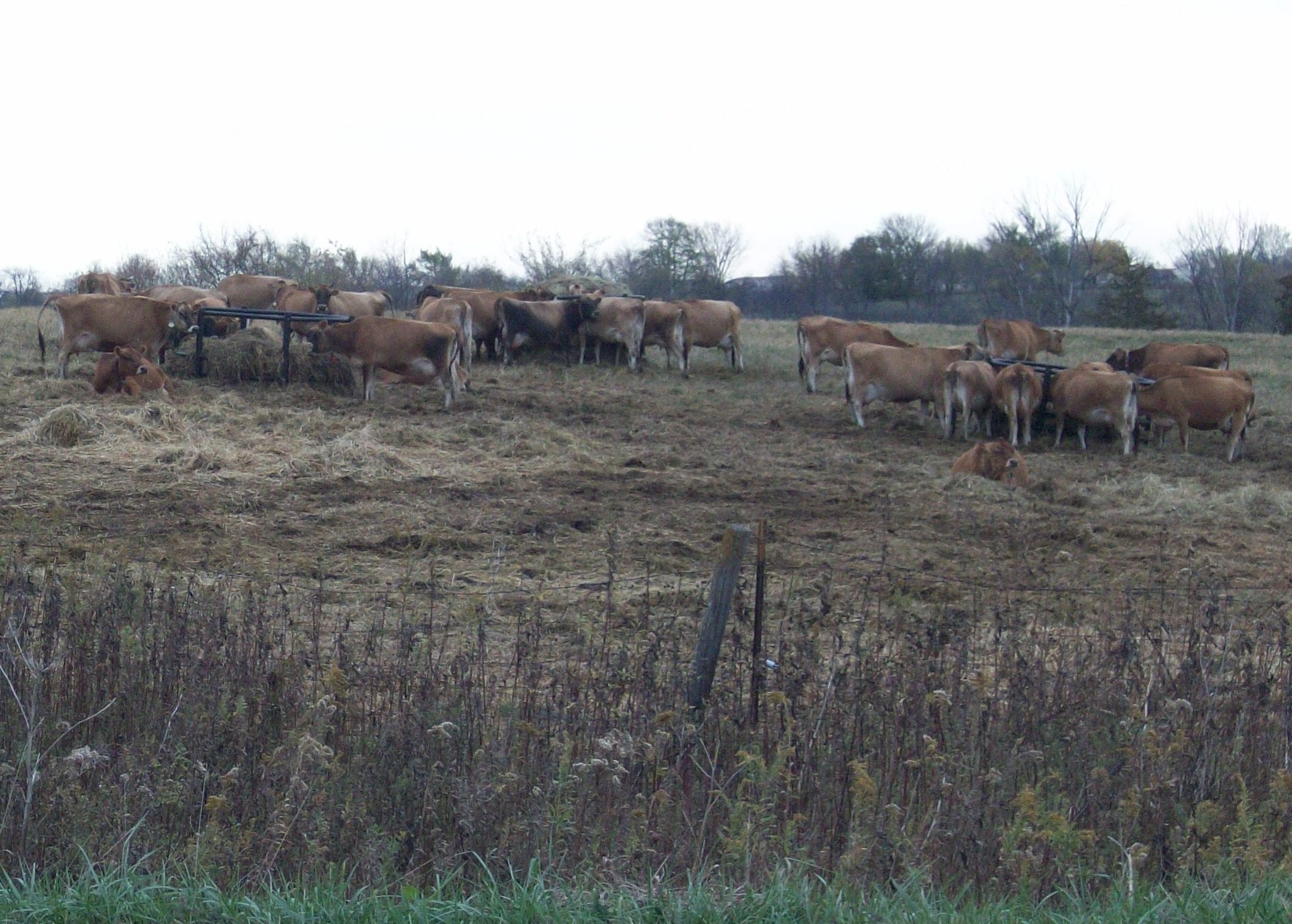
We, as a society, should be eating less meat. Why? Producing meat is an inefficient way to make food. Much of our agricultural production goes to animal feed where most calories are wasted because animals have lives to live. For example, for every 100 calories a cow eats, it produces three calories in meat. It’s not much better for sheep, dairy, pigs and chickens. Not only is meat-production inefficient, it requires a lot of land: half of the world’s habitable land is used for agriculture. Three quarters of that is used for livestock. (In Iowa, half the corn crop is used to manufacture ethanol). Add it all together — greenhouse gas emissions, land use, water consumption, and air and water pollution — and there is a strong case for meeting human nutritional needs other than from livestock.
R. Buckminster Fuller was the first person I read who said there is enough food produced in the world to feed everyone comfortably. He canceled the notion there wasn’t enough. What nature couldn’t provide, science would, he said, in the form of improved fertilizers, plant genetics, better land use, and distribution and packaging. Where we are each day is a beginning point for the rest of our lives. Each generation develops new insights into what makes our world work and how to improve it, including food production and distribution. Humanity is fraught with potential to feed ourselves.
“Man is a complex of patterns, or processes,” Fuller wrote in I Seem To Be A Verb. “We speak of our circulatory system, our respiratory system, our digestive system, and so it goes. Man is not weight. He isn’t the vegetables he eats, for example, because he’ll eat seven tons of vegetables in his life. He is the result of his own pattern integrity.” Understanding our “pattern integrity” and how it relates to the physical world is a key challenge of agriculture. It is also a source of planetary degradation because of how we pursue agriculture, especially through livestock culture.
Hannah Ritchie points out in her book, Not the End of the World: How We Can Be the First Generation to Build a Sustainable World, “Our battle with agriculture has been centered around one thing: having enough nutrients in the soil at the right time.” During the early 20th Century, German chemists Fritz Haber and Carl Bosch developed what is called the Haber-Bosch process which converts nitrogen and hydrogen into ammonia which can be used as fertilizer. The advances in plant genetics developed by Norman Borlaug are well known. Between Haber, Bosch and Borlaug, they created the Green Revolution which enhanced food production three-fold from historical levels. This is the kind of science to which Fuller referred.
Changing how we live regarding agriculture is about more than personal choices. I have no regrets choosing a mostly ovo-lacto vegetarian diet beginning in the 1980s. In the early period, there was no strict line between meat culture and vegetarianism. I did not eat meat at home, and when I was out, especially with business clients or close family, I sometimes did. It was a non-issue. I guess you would call 1980s me a casual vegetarian.
As I age, I have less interest in eating meat: partly because it is expensive to buy, and mostly because it has no viable role in the cuisine I developed in our kitchen-garden. The issue with personal choices is they are not scalable to a level where it would make make a significant change in land-use policy. It would take a lot of people leveraging the power of the pocketbook to turn things around regarding consumption of meat and associated environmental degradation.
When addressing global environmental problems we can lose hope because of their scale. By identifying a big part of the problem has been livestock and meat production, we have something tangible to grasp, something within our control. By reducing consumption of meat we contribute to a solution to our environmental crisis. There is something good in that.
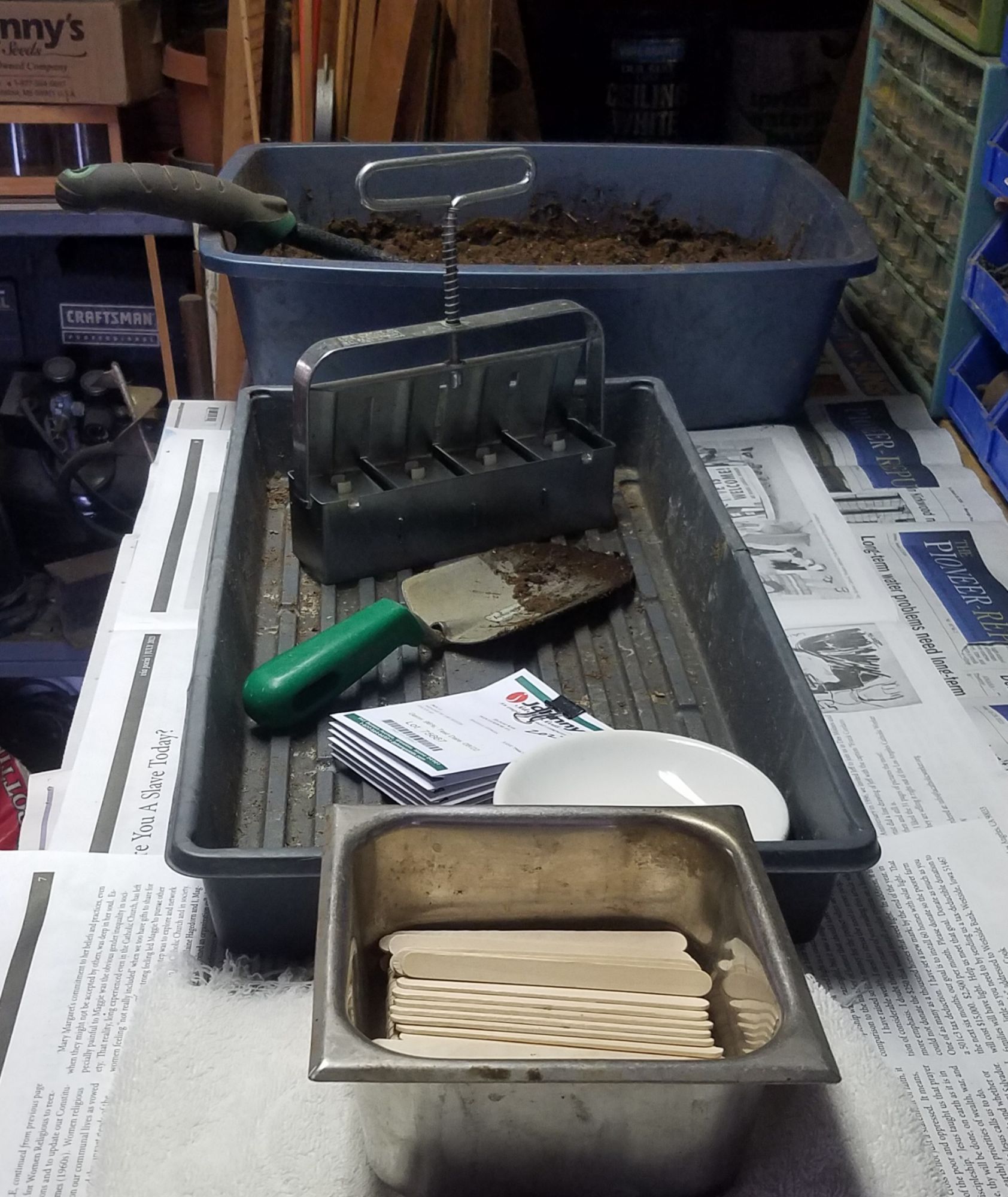
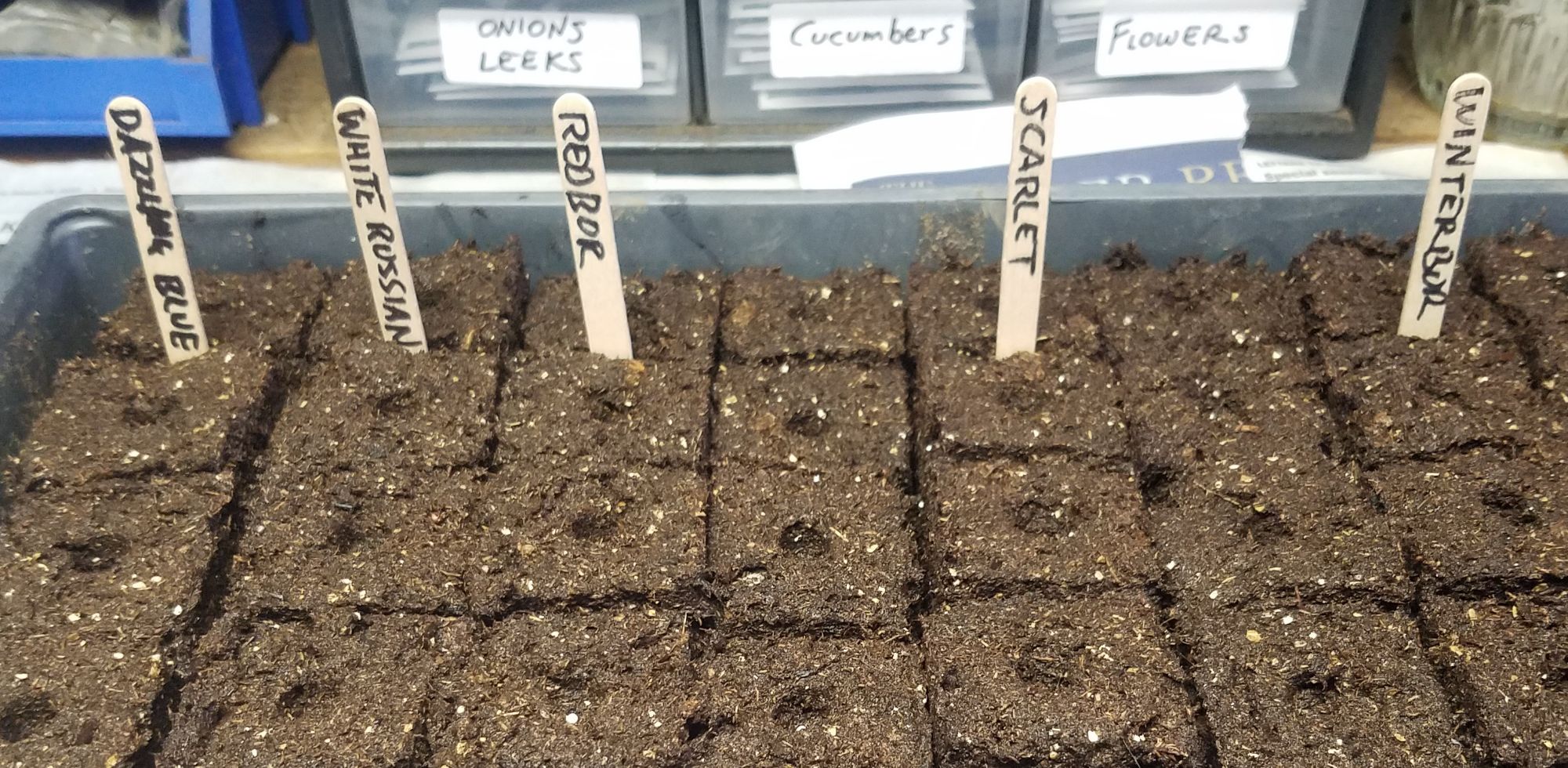
Tools to make the first tray of garden seedlings. Kale went in on Feb. 3.
I’ve been chatting it up with some neighbors on social media. There was consensus we hunkered down inside our homes for most of January because of snow and freezing ambient temperatures. There is hope for a break in winter and we’d just as soon move into spring. Personal productivity lags in winter. It’s time to step up the pace.
The idea of a “week” still resonates. Monday means start of the week, Friday is for closing down activities, Saturday is to perform a number of small household tasks, plus help our child with their small business. Sunday remains a day of rest, sort of. It’s not the same as when I worked full time. Then I knew that Friday usually meant casual clothes, voluntary trips to the office, and time to pursue my writing and family life.
I walked about the garden. The green I saw from the kitchen was collards that had been eaten more than I could tell from a distance. I had no interest in picking through the leaves, especially with a freezer full already available. I suppose the cruciferous vegetable-eating insects that survive the cold don’t have a lot to choose from in winter.
On Saturday I planted the first seeds for the garden and put the tray on a heating pad under a grow lamp. They are mostly last year’s seeds and that should not be a problem for kale. Kale is one of the vegetables I have mastered growing. It was something to see the tools lined up and ready to start. I worked with the garage door open for the fresh air and because we seem to be exiting the Iowa deep freeze.
Solon Economist – 2016. This building was sold and torn down since the photo was taken.
The Daily Iowan, the independent newspaper of the University of Iowa, announced this week it is buying the Solon Economist and Mount Vernon Sun beginning Feb. 1. The stated intent is to provide learning opportunities for journalism students. Fine with me. The newspaper seemed likely to fold as it changed hands multiple times since Doug and Lori Lindner sold the Solon Economist in 2011.
It is also fine with the current staff who posted on social media they are positive about the change and hope it will yield more advertising revenue and more subscribers. Presumably deep university pockets will backstop it if new ownership doesn’t make the paper financially successful. Like the employees, I’m optimistic and hopeful for a positive outcome.
My question is about the University of Iowa owning these weekly newspapers, after they bought Mercy Hospital. What’s going on over there? Public entities shouldn’t acquire private businesses whether or not there is an educational purpose. In this the Mercy deal is much more significant in size and community impact. Buying newspapers is in the same vein. Ownership of the Daily Iowan and these new acquisitions is by the non-profit corporation Student Publications, Inc., so there is a firewall between them and the university. The final structure of Mercy under the university is not finalized, yet there is expected to be a firewall there as well.
Because of our relationship working as freelance reporters for the Solon paper, Economist Editor Chris Umscheid publishes my letters to the editor of the 600 subscription paper. There are a few locals who write letters, each with our own distinct issues. There is very little news in the paper, but that’s been the case since Brian Fleck owned it before selling to the Lindners. If the state eliminated the requirement to publish government docs like budgets and council meeting minutes, I doubt the Economist would survive without that revenue. Maybe the acquisition by the Daily Iowan will help.
I’m waiting for the dust to settle. I may have more to say when it does, or after I read the first few editions under the new owners. That’s the news from Big Grove Township on a Wednesday.
Dubai, UAE site of COP 28 – Photo by Aleksandar Pasaric on Pexels.com
I met with State Senator Joe Bolkcom before he retired to discuss ways to mitigate the effects of climate change. He told me something important as we finished our conversation. “Join a group and get active,” he said. What does that mean?
With a challenge so big it involves all of the populated regions of the globe, one person’s impact is not as useful as when we work with others to solve the climate crisis. As we face its challenges, it is important for our own sanity to feel like we contribute to solutions as individuals. Actions like reducing gasoline use, reducing natural gas use, reducing electricity use, eating less meat and dairy, and growing some of our own food are all important. These actions matter, yet what matters more is what we, as a society, do collectively. That was Bolkcom’s point.
On Dec. 13, 2023, delegates to the 28th Conference of the Parties (COP 28) agreed to transition away from fossil fuels. This despite heavy lobbying from delegates representing fossil fuel interests to do nothing.
Nearly 200 countries struck a breakthrough climate agreement Wednesday, calling for a transition away from fossil fuels in an unprecedented deal that targets the greatest contributors to the planet’s warming. The deal came swiftly — with no discussion or objection — in a packed room in Dubai following two weeks of negotiations and rising contention. It is the first time a global climate deal has specifically called to curb the use of fossil fuels.
Is the cup half full or half empty? Citizens engaged in solving the climate crisis should take the positive which this agreement represents even though it falls short of our aspirations.
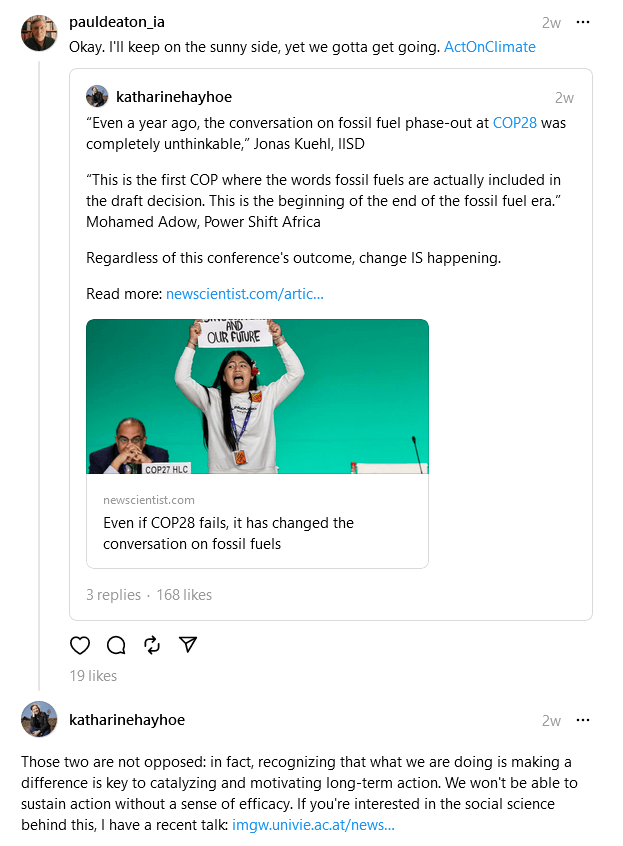
When I activated an account on Threads, one of the first accounts I followed was climate scientist Katharine Hayhoe who is active on that platform. We had this exchange about COP 28, in which I quote-posted her report from COP 28:
As Hayhoe said in the talk referenced above (Here is a link), the challenge is to move from worried to activated. It is not only possible, it is imperative that advocates for solving the climate crisis do so.
Back to my question, is the cup half full or half empty when progress toward transitioning from fossil fuels saw such resistance at COP 28?
Senator Sheldon Whitehouse (D-RI) said after COP 28 closed, “A small, self-interested minority of states cannot be allowed to block the progress necessary to put our entire planet on a path to climate safety.”
2023 was a disastrous year for our climate. We experienced the hottest year on record and the extended Iowa drought impacted corn and soybean yields. Rivers and lakes began to dry up. What gets overlooked is that just as the climate crisis seems to get worse, actions to tackle the problem are ramping up. There were environmental wins out of COP 28:
The cost of solar power has fallen by around 90% and wind by 70% in the past decade.
The majority of new energy capacity being added in the U.S. and globally is solar, wind, and battery storage; these renewables already account for nearly 14% of the U.S. energy production and 12% worldwide.
Electric vehicles are becoming cheaper and more attractive. For the first time, more than one million EVs have been sold in the United States in a calendar year.
At COP28, delegates took a historic step in establishing a loss and damage fund, the latest development in a three-decades-long fight to have wealthy, high-emitting countries compensate vulnerable, developing ones for the harms of climate change.
For more positive news, read Katarina Zimmer’s complete article on Atmos.
Despite its shortcomings, COP 28 marked a major step forward for the environmental movement. For the first time ever, a COP agreement explicitly acknowledges the main culprit responsible for the climate crisis is fossil fuels. While the agreement falls short of what many of us wanted, it still reflects progress in a decades long struggle to address the climate crisis. We should keep on the sunny side and build on this progress by finding other, like-minded people and getting active.
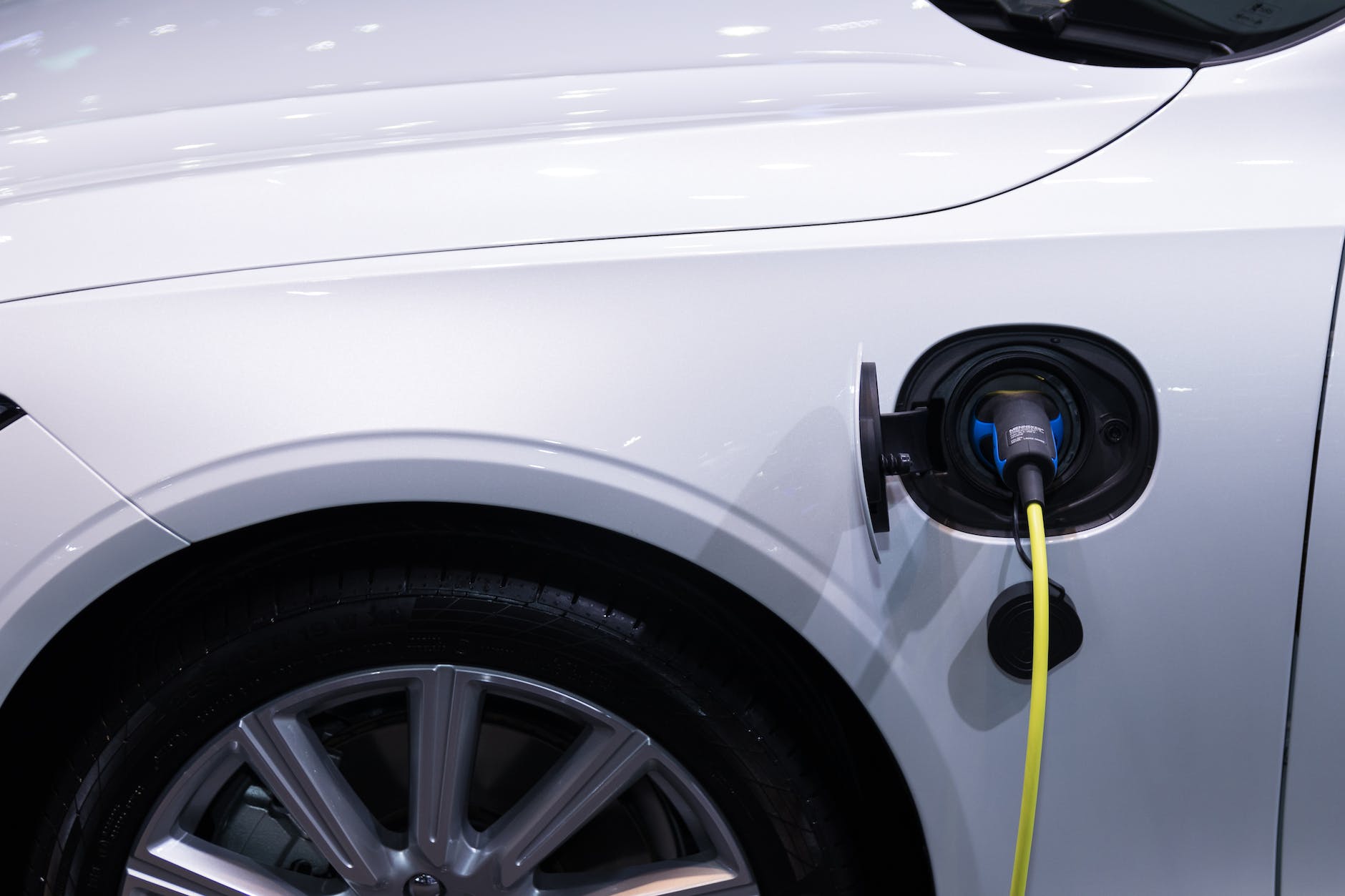
When we couldn’t get new parts for our 2002 Subaru in 2022, we decided to get a replacement car. First of all, it rots that basic suspension parts are unavailable from the manufacturer of a relatively new and otherwise fine car. Second, we wanted an electric vehicle, yet manufacturers couldn’t even tell us when we could get one. It was more than a year’s wait for some basic models with actual delivery date unknowable, they said. Demand was so high, they apparently didn’t mind missing a few sales. We resolved the immediate crisis by getting a used subcompact that gets 38 miles per gallon of gasoline.
The 45th President had something to say about electric cars during his Christmas message to the nation. He said he hopes supporters of “Electric Car Lunacy… ROT IN HELL.” Our Congresswoman, Mariannette Miller-Meeks is on board with the former president and wrote a column on the topic in our local newspaper, the Solon Economist. Not only does she have her lips busy kissing Trump’s behind, she is unabashedly in favor of the Iowa ethanol and biodiesel crazes. Heaven help us that the Environmental Protection Agency attempt to regulate a livable climate and infringe on our “freedom,” I wrote sarcastically.
Miller-Meeks takes the tone of a serious person, yet she is not one. While her predecessor, Democrat Dave Loebsack supported corn ethanol and biofuels, Miller-Meeks let her membership on the Energy and Commerce Committee, and Conservative Climate Caucus go to her head. She became a parrot for what the oil and gas, and corn ethanol and biofuels lobbies want from Washington. This compared to a legislator that looks out for all of the people she represents.
In her column, she wrote, “For one reason or another, the Biden administration has relentlessly pushed its fixation on electric vehicles (EVs), or vehicles that have an electric motor in place of an internal combustion engine, on everyday Americans.” We know the reason, and I suspect Miller-Meeks does as well. 2023 has been the hottest year in recorded history for our atmosphere and oceans. At this rate, global heating will soar past the recommendations of scientists who study it for a living. The scale of the problem demands bold solutions, which is what the EPA proposed. Is two-thirds of all new vehicles being electric by 2032 the right number? Given the ramp up time and obstruction from the corn ethanol, biofuels, and oil and gas industries, it may not be good enough.
Miller-Meeks took her corn ethanol/biofuels show on the road to COP 28 in Dubai. She had a story to tell which is reprinted below from her weekly newsletter.
At COP, I had the opportunity to speak at the U.S. Pavilion to discuss how our farmers across Iowa and the United States are the backbone of this country and our economy. I highlighted how Iowa is a leading producer of soybeans, corn, pork, and eggs in the United States, even while reducing fertilizer and pesticide use with adoption of sustainable regenerative Ag practices. Further, I mentioned how our farmers help fuel the world with lower carbon, cleaner emissions liquid fuels.
I had the opportunity to discuss how we have taken advantage of the geographic composition of our state to support the entire gamut of renewables, from wind to solar to ethanol, biodiesel, biomass, manure, and compressed renewable natural gas.
In Iowa, we can introduce innovative technologies like carbon capture and underground storage to our biofuel refineries. We’ve added hydropower at Lake Red Rock, and advanced nuclear energy is being revisited to provide capacity and dispatchable continual base load to the energy mix. We have the Ames Lab, one of the U.S. national labs, that adds to the exciting research conducted at the University of Iowa and Iowa State.
We have a story to tell, and I was honored to represent our district and our agricultural priorities at COP28, and I am excited to continue to tell the story about how Iowa is setting the example and creating systems to support and harness clean energy to secure a cleaner, healthier planet for generations to come.
Miller-Meeks Weekly Script, Dec. 17, 2023.
By filling her time at the U.S. Pavilion with all of these things, she avoided addressing the real and increasingly dangerous challenges of a heating planet. While she is good at cramming buzz words into these paragraphs, notably, she avoided mentioning electric vehicles. It may sound like she is saying a lot, but in truth, she is saying nothing but that we should continue the status quo. That is simply not good enough to create a livable world.
Iowans should consider buying an electric vehicle when they need a replacement for an internal combustion vehicle, and vote Miller-Meeks out of office in 2024.
Adam Smith’s The Wealth of Nations is a book seldom read in its entirety. Libertarians went through multiple iterations of winnowing the more than five hundred fifty pages into something more readable, something more closely matching their ideological viewpoint. One time, they serialized a right wing version in Reader’s Digest. I will never read it. I don’t know anyone who has read it, certainly not Iowa’s current crop of right-wing politicians. They may know the phrase “invisible hand” even if they don’t use it when enacting policies that make life worse for many Iowans.
The invisible hand is a metaphor for the unseen forces that move the free market economy. Ronald Reagan referred to it as the “magic of the marketplace.” With economic freedom comes prosperity they say. Only it doesn’t. This is truly magical thinking.
This week it was announced Koch Industries is buying the Iowa Fertilizer Company in Wever. This facility has been a story of money changing hands among large, wealthy entities from the gitgo. The $110 million in financial incentives from the state finally comes home to roost with a company that is so deeply embedded in Iowa Republican politics we forget to notice their presence. Is this Adam Smith’s invisible hand of the market, or just the greedy hands of industrial capitalists?
Right wingers believe in the efficacy of the people as individuals with each making their own decisions in a free market economy. This holiday season they emphasized their belief that people, as a group or social class, don’t mean much of anything to them as they work to please corporate sponsors.
Last night, Governor Kim Reynolds released her Christmas message to Iowans, which I quote in full:
“From a humble stable in Bethlehem more than 2000 years ago, the world was given the greatest gift of all time, a newborn King sent to bring light to the world.
“This Christmas season, the part of the world where Jesus was born is impacted by war. And yet, his promise of peace is everlasting.
“As we gather to celebrate this joyous holiday with family and friends, let us be reminded of the many blessings that we enjoy as a free people and the responsibility we have to each other as children of God.
“On Christmas and always, may we be the light in the darkness.
“Kevin and I, and our family, wish you and yours a Christmas filled with joy and light.
“God bless you and Merry Christmas.”
Office of the Governor Press Release, Dec. 22, 2023.
Let this sink in: “Let us be reminded of … the responsibility we have to each other as children of God.”
That is, unless one is poor and can’t afford health insurance. By privatizing Medicaid, the state created an expensive, inefficient process that denies care to some who need it. In that case forget about our shared responsibility to provide needed health care.
That is, unless one is a child who qualifies for the free lunch program where Governor Reynolds on Friday rejected available federal funds to pay for a summertime EBT card for hungry children. In that case, you can go hungry, and by the way, she said, you need to go on a diet because you kids are obese.
That is, unless one lives in our substandard nursing homes where the state is as much as 41 months behind in conducting annual inspections in violation of federal regulations. In that case you can just drop dead.
Where is the idea of Christian charity to bind us together in meeting common needs? Where is the invisible hand to lift up the poor and provide adequate opportunity to achieve minimum financial needs? I submit it is busy in the pockets of the wealthy, delivering government benefits that frame their success, of a kind the poor will never see.
This Christmas season we must vow to change how we treat the poor with our votes… in 2024 and beyond. Republican politicians are not listening. Voting them out of office is the only thing they might understand.





 Journey Home

You must be logged in to post a comment.