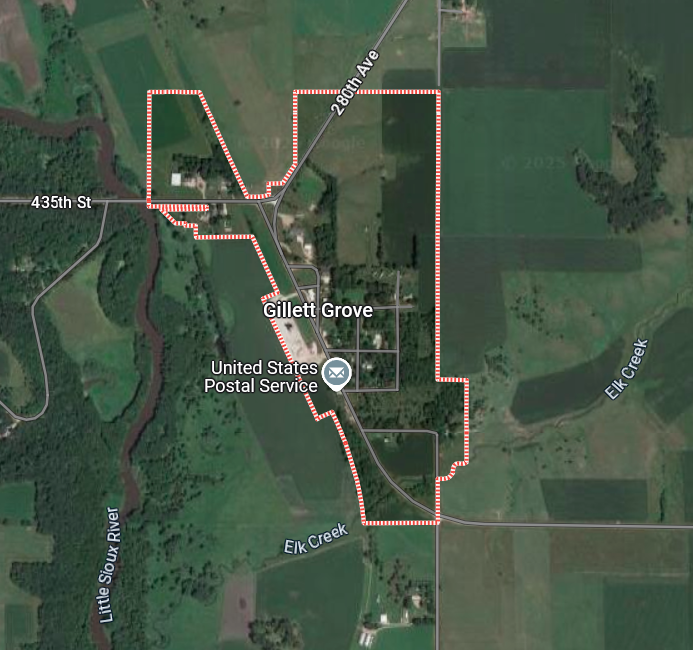
Gillett Grove, Iowa has a post office and 30 people, according to the 2020 U.S. Census. In 2000, there were 55 people. The whole of Clay County, where the town is located, appears in decline. In some ways, Gillett Grove typifies rural Iowa.
How did this come up? The way many things come up in a household: we got talking.
Its history is brief. “First settlers appeared in Gillett Grove in 1856 and the town, named after the Gillett brothers, was incorporated on May 13, 1874,” according to the website Travel Iowa. “The town was originally located west of the (Little Sioux) river and one and half miles North until 1899 when it was moved to the east side of the river along with the arrival of the railroad.” I don’t see railroad tracks on Google Maps.
The high school for the South Clay Community School District was located in Gillett Grove. It also served Webb, Dickens, and surrounding rural settlements. In a relatively rare for Iowa occurrence, this consolidated district was dissolved in 2010 when it had 132 students.
The website Zillow lists the sale of a house at 506 3rd Street at auction for $25,300. Built in 1900, the outbuildings appear to be worth more than the dwelling. It’s a fixer-upper, definitely. Who might live in such a place in this rural city with limited visible economic activity? It’s an open question, yet the website suggests the property could garner $816 per month in rental income.
How many towns and hamlets like Gillett Grove exist in Iowa? More than a few. There is not time to write about them all. What we do is discuss our connections with some of them and wonder what life might be like living there. Then the conversation ends and I’m glad to live where we do.
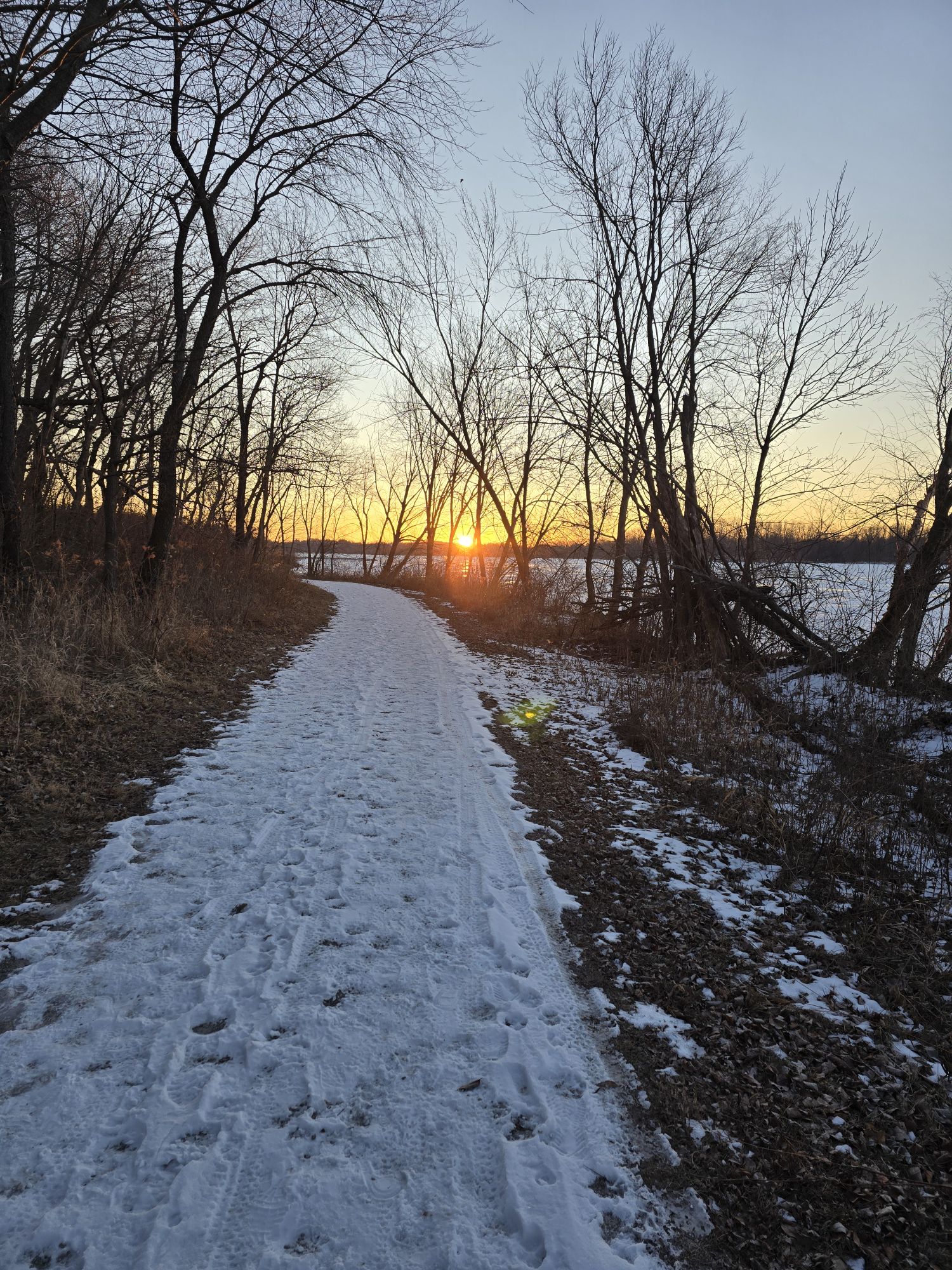
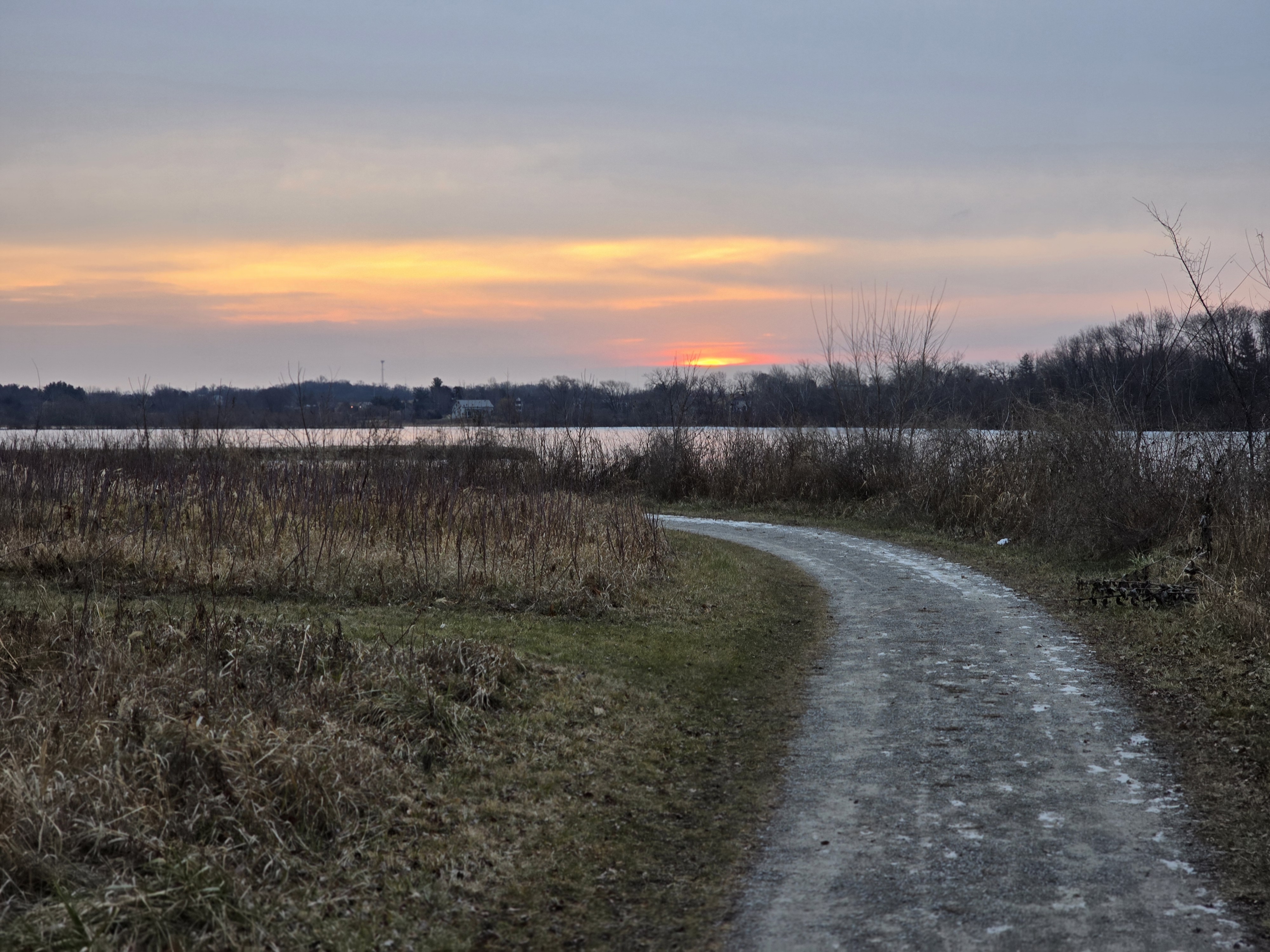
January and February are the best months to hunker down and write. I get outside almost every day to take a brisk walk along the state park trail. Some mornings the landscape looks like this. Then it’s back indoors and to work.
Today we’ll experience ambient temperatures in the 40s. I decided to run the buckets of compost out to the garden composter. They started to stink in the garage, so it was time to go. On January 28, it should not be this warm, but it is.
NextEra Energy Resources filed a request with the federal Nuclear Regulatory Commission to potentially restore the facility’s operating license as demand for electricity surges to power large data centers needed to handle the growth of artificial intelligence, the Cedar Rapids Gazette reported on Saturday. The plant was damaged during the 2020 derecho and has not been repaired. If the license were issued, management expects the nuclear power plant to be back on line sometime in 2028. My question about this is who pays? Except for those parts of the operation paid by the Department of Energy, all costs should be paid by the potential customers. We shouldn’t pretend bringing Duane Arnold back on line serves the public good.
The other question, and I believe it is the right one, relates to re-starting the Duane Arnold Nuclear Power plant because of the big electricity needs to power Artificial Intelligence. What people are not talking about is using new power plants to generate electricity for another energy hog, crypto-currency, to the detriment of our economy. Shouldn’t we be talking about that?
I’m losing confidence in our local media to cover this issue. For the most part, they seem to be writing stories based on industry generated information and not any specific facts.
Well, at least the compost is out in the bin ready to make a soil conditioner. That, I know I can put to good use.
According to the sensor installed on the north side of the house, the ambient temperature was 13 degrees below zero Fahrenheit when I began writing this post. The sun is rising and it warmed up. We’re not at zero yet, although the high is forecast at 25 degrees. Today the weather is weird again.
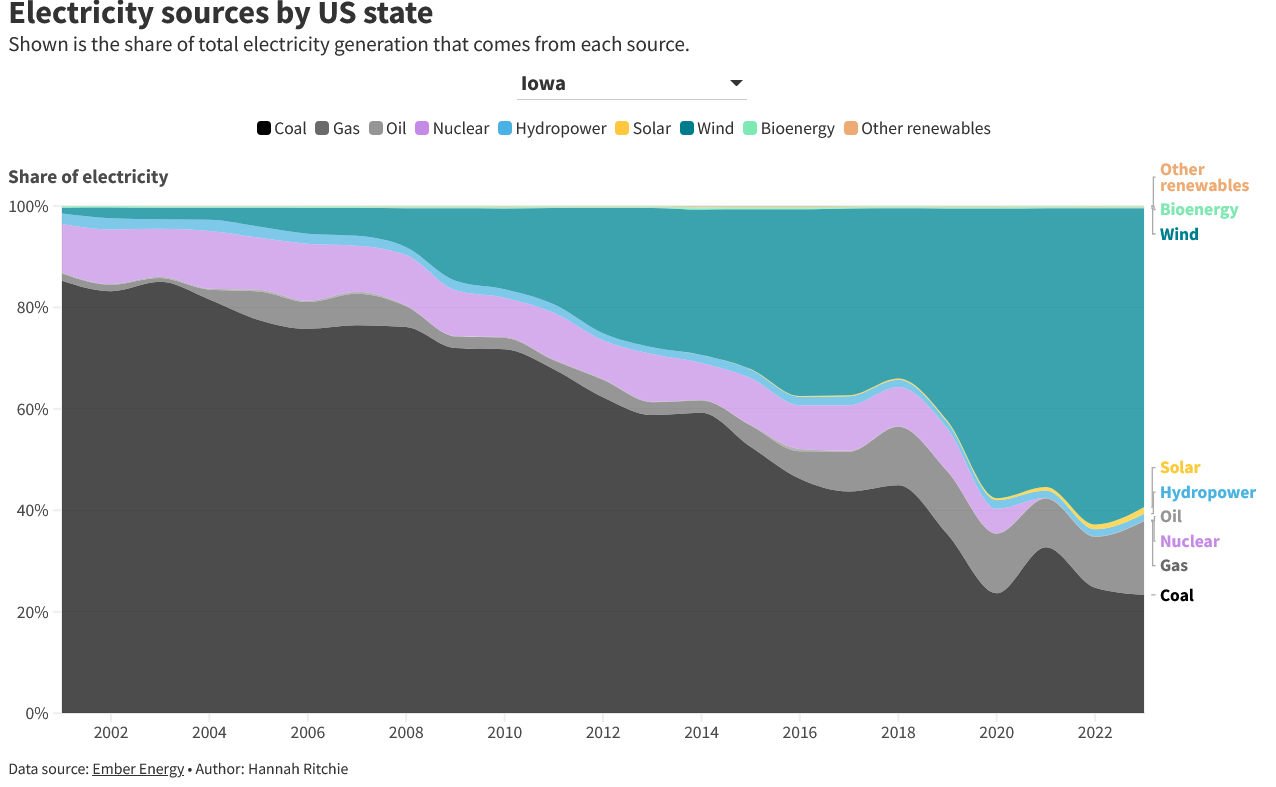
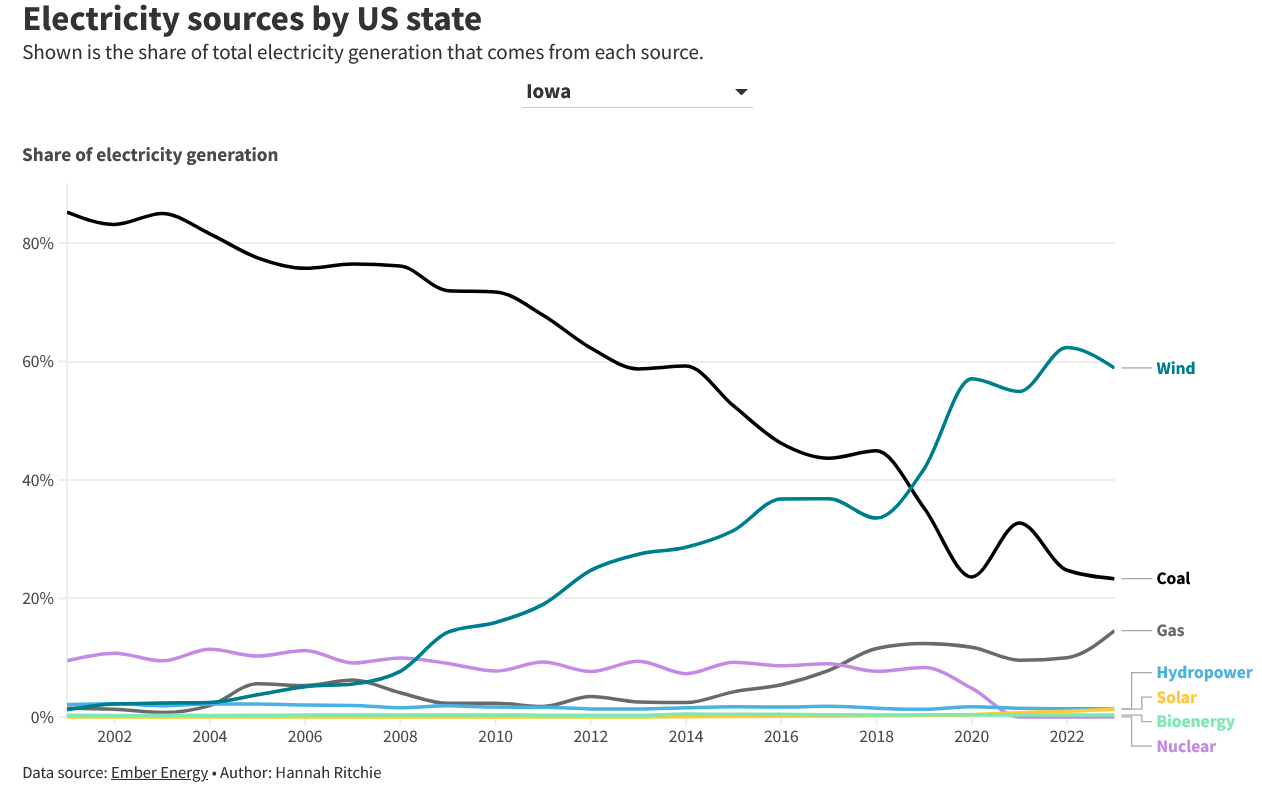
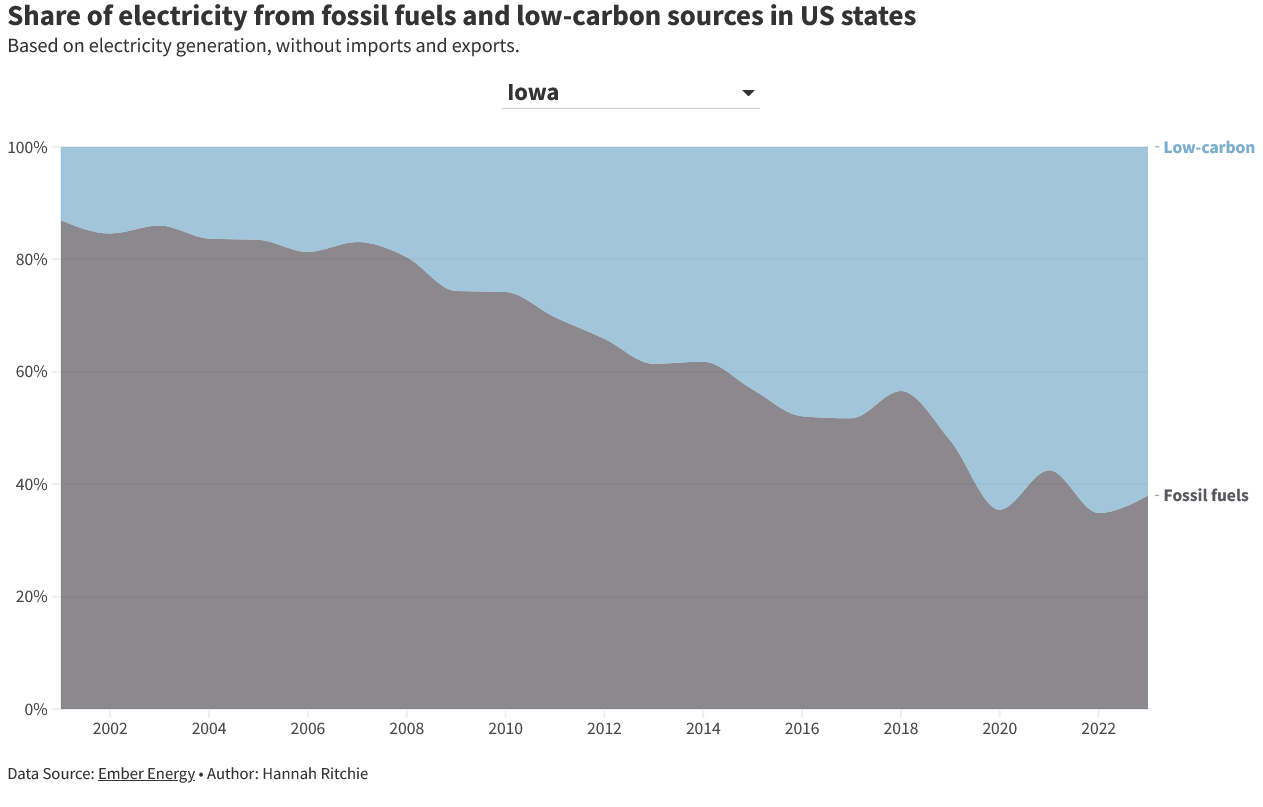
Iowa is a leader in wind energy and has plenty of room to improve our solar capacity. There are environmental issues with every form of electricity production, yet burning fossil fuels is our most immediate danger because of the role of carbon dioxide in enhancing the greenhouse effect. Despite today’s low temperatures, Iowa is simply too darn hot.
The trend on the following chart is the right one. As a state, we need to move more quickly.
It seems obvious to me that to get to zero fossil fuels used to generate electricity Iowa needs to install many more solar panels. There are issues with both wind and solar generated electricity.
The wind doesn’t always blow and the sun doesn’t always shine. They can be addressed. One of the key strategies to deal with intermittency, which is what this is called, is to improve the forecasting and planning of renewable power generation and demand. Another strategy is to invest in storage and integration solutions that can balance the supply and demand. A third strategy is to foster innovation and adaptation. This involves developing and deploying new technologies, designs, and practices that can enhance the performance, efficiency, and resilience of renewables. We need the will to solve these problems.
So the news about electricity generation in Iowa is positive. We just need more renewables and technological solutions to deal with intermittency so we can replace fossil fuels altogether. To a reasonable mind, this can be accomplished. Now we just need our regulatory and governmental authorities to get on board.
94 cookbooks rest within arm’s reach of my writing table. Hundreds more are stored in boxes in the next room. What do you do with them once your cooking technique moves beyond recipes?
Last year I donated several hundred cookbooks to Goodwill. I bought each one for a reason. Those reasons became obsolete. As a result, there are more cookbooks for disposition among what remains. (I sorted this cookbook thing out previously).
Obsession with cookbook recipes is not what I’m getting at when I write, “A cook not a chef.” It is a cook’s job to prepare food and get it on the table. Increasingly, if I use a recipe at all, it is the springboard for making something recognizable and nutritious for dinner. A cook’s work does not rely on an understanding of flavor, technique, or any of the fancy stuff of being a chef. A cook is the quotidian day worker in our lives preparing simple fare for plain folks. I am a cook, not a chef.
What brought all this up? I need more bookshelf space where I write and cookbooks seem like they are taking too much of it. Maybe I could get rid of some of them. It is pretty hopeless, however. I went through the shelves and found Colorado Collage by the Junior League of Denver. I scanned through it and determined almost every recipe could be a springboard for some other dish, yet none of them fit into the wheel house of my cookery. I put the book in the passenger car seat and will drop it off at the public library either to be put in their stacks or sold at the annual used book sale. My review sums up the situation:
For a community cookbook, this has high production values. It would be a fun book to use when developing a new dish, but it’s use would be to modify their recipes to fit the culinary culture of the cook. This was not a good fit for me.
I met Murray through my part time job in high school. He went to West High School, and I went to Assumption. Today, I might call him a gear head. Maybe I called him that then.
He was building a “hot rod” at a gas station on Brady Street. When I last saw it he had stripped it down to the frame. Part-by-part he assembled it himself. He planned to use it to “ride the ones” (driving the one-way streets in downtown Davenport with other high school aged kids with cars). I don’t think he had any other real plans for his hand-made car. It seemed to be more about the process.
“Right to repair is a legal right for owners of devices and equipment to freely modify and repair products such as automobiles, electronics, and farm equipment,” according to Wikipedia. “Right to repair may also refer to the social movement of citizens putting pressure on their governments to enact laws protecting a right to repair.”
In the late sixties, we hadn’t heard the term “right to repair.” Murray assumed he could do what he wanted to get his vehicle street legal. He knew what being street legal meant. Today, manufacturers are tightening the screws on repairing vehicles, farm equipment, and electronic devices, blocking users and owners from working on their stuff. It seems anti-American… and wrong.
I don’t think denying the right to repair will stand in 21st Century America.
My maternal grandmother had no hesitation about taking apart her stove and fixing a burner. She was born in the late 1800s, and that’s what she learned growing up. When I saw her do this, the stove came with her rented apartment. A younger person might have just called the landlord.
When I studied the rural Minnesota community where my great, great grandfather settled, there were two blacksmith shops in a community of about 200 families. At a distance from major commercial centers (if such even existed in the 1800s), and with Original Equipment Manufactured parts distribution (not called that or even in existence then) a long and slow process, locals devised indigenous solutions to mechanical problems with available materials and said blacksmiths. This seems so American, so pragmatic.
No one would argue about modern day equipment, vehicles, and farm implements being more complicated than they were in the late 1800s. If a wheel fell off a wagon and broke, the owner would mend the wheel, axle, or both and start operating it again. The computer technology embedded in modern equipment was in an unforeseeable future. Likewise, computer-aided design enabled such precision that would be hard to replicate using a hammer, anvil, and heat. Where is the balance between the owner of a piece of equipment fixing it themselves and the manufacturer insisting that only they had the expertise to do so? This aspect of society is changing and to many of us, it make no sense.
I lost track of Murray when I went to university. Last time I saw him he was working at a gas station on Riverside Drive in Iowa City. Sometimes I think about what society is losing with fewer gear heads and people like my grandmother around. We changed in ways that shut the door on returning to a life where folks knew how every device in their home worked and how to fix it. It is one way our lives have gotten poorer with increased technology.
Some Friday night I’ll have to go ride the ones in my home town to see if teenagers still do. Somehow, I doubt it.
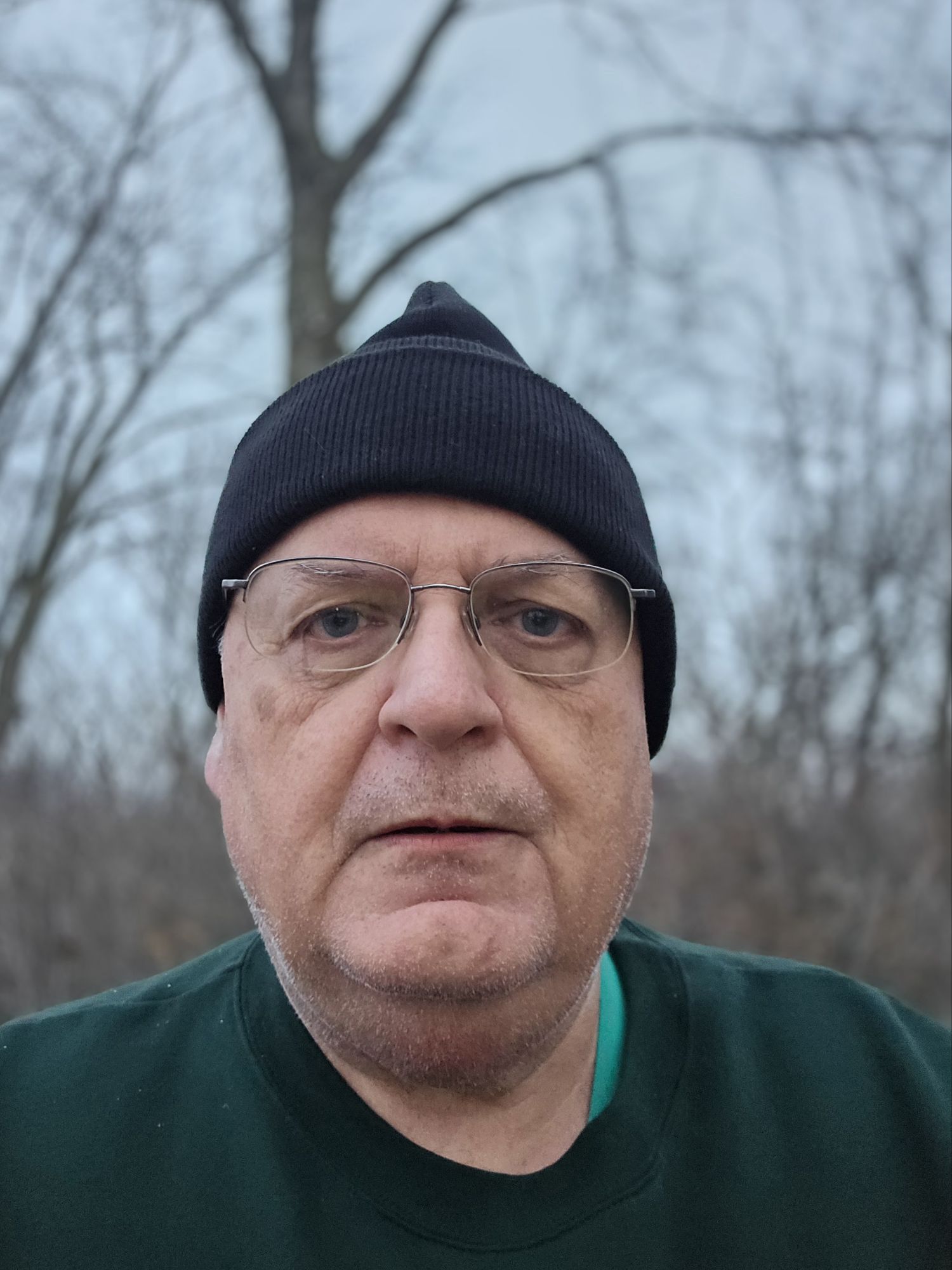
This is the face of a man trying to understand how his Android camera works. The background on the state park trail was planned. The green sweatshirt is my standard winter uniform, although I own sweatshirts in several colors. The watch cap was a gift from a farmer friend. My unshaven face is because I’m at the end of my once every three days shaving cycle. I’m looking at the lens because that’s what I think I should be doing. As selfies go, this is graded C-minus. It reinforces my belief I am not photogenic.
As if 2024 was not bad enough, today’s Cedar Rapids Gazette reported the University of Iowa is ending the American Studies Department in anticipation of anti-diversity legislation effective next year. I graduated from the progran in 1981 when it was a loose interdisciplinary group not even formalized into a department until 2000.
One of my valued possessions is a copy of Charles and Mary Beard’s The Rise of American Civilization with Alexander Kern’s signature inside the cover. I bought it for a buck at the library’s used book sale. I doubt Republicans behind anti-DEI knew of Kern’s early leadership in American Studies at Iowa, or of the Beards’ seminal work. I think that is the point of the anti diversity movement: public schools will only teach one version of American history, the one we legislators approve.
I’ve been around long enough to remember local folks questioning why we should build a big, fancy library in our town with population about 2,000. The money was donated, then the building was deeded to the city for one dollar. The expense of permanent staffing generated some griping. We live in a time when it is not a long distance from these attitudes rising to the surface again, and this time closing the library permanently. I hope not, but here we are.
On the positive side, this week a federal judge struck down key parts of an Arkansas law that would have allowed criminal charges against librarians and booksellers for providing “harmful” materials to minors. Nevertheless, Iowa leads the nation in the number of banned books.
Let’s face it. These discussions and repression of information in public helped make 2024 a difficult year all around.
I’ll likely continue to make selfies. Once I figure out the camera, I might work on posing. For now, I’ll deal with life as it presents itself. What else are we to do?
Coffee is $2.02 per 16 ounce cup at the Casey’s in Colfax. I stopped there enroute home after an overnight visit to my spouse and her sister. I made many trips to Des Moines this year, and almost always stop in Colfax to see what’s going on at the convenience store. That usually means seeing what new employees greet me, as employee turnover appears to be constant. This Casey’s is an easy off and on the interstate and I usually purchase a lottery ticket, gasoline, and a beverage or snack. The sameness of the offering is comforting.
I started the day with a Keurig cup of coffee at my sister-in-law’s home. I forgot my bottle of instant espresso, which I prefer when I can’t make my own coffee in my own machine. I am an early riser and foraging in the kitchen is better than leaving the house in search of a cup. The Keurig cup served during the hours before the others awoke and got out of bed.
I have been spending so many nights in Des Moines, I bought a 28-inch wide camp cot with 600 pound capacity. I brought pillows, sheets, and a blanket from home, and borrowed a feather blanket from my sister-in-law for added cushioning. It is not the best, yet it is sufficient. Once the transition in Des Moines is finished, we’ll have the cot for overnight guests at home.
My travel from home to Des Moines is in four segments. Leaving home, I cross Lake Macbride and the Coralville Reservoir to access Penn Street which leads to Interstate 380. I take 380 South to the large intersection with Interstate 80, then exit West on 80. There is a long, mostly straight stretch of 80 that leads to the outskirts of Des Moines where Colfax is found. From Colfax, the congestion begins and the highway expands the number of lanes. I follow 80 to Interstate 235 to the exit for the state capitol, then it’s a multi-mile journey to my destination. I have the route memorized. That long stretch of Interstate 80 drives quickly.
If I have no extra chores while in Des Moines, my tank holds enough fuel to make the round trip without stopping. Usually there is something extra, and then Colfax is my go-to fuel stop. Coming from Des Moines, arriving in Colfax is a release of the tensions of congested traffic. On this week’s trip, truck traffic was heavy all the way, which again built tension after resting in Colfax. I made it home safely.
We need places like Colfax. Without these trips, I would not have considered the place important. Just another stop on the interstate highway. Yet our mind needs patterns and in cases like this we create our own. Gasoline, coffee and lottery tickets are available all along the interstate highways. That I pick Colfax for my stops is a bit of creativity I own and enjoy. I look forward to stopping at the Colfax Casey’s.
Editor’s note: This is a letter to the editor of the Solon Economist in response to Caden Bell’s opinion saying the Duane Arnold Energy Center nuclear power plant should be reopened.
I don’t understand the logic of reopening the Duane Arnold Energy Center because life is like a cartoon called The Simpsons. I’ve never seen an episode of that show, so maybe I’m missing something. What I do know is Caden Bell offers no logical reason to reopen the Duane Arnold Energy Center nuclear power plant in his Dec. 5 opinion in the Solon Economist.
First things first. The technology at Duane Arnold is old. The physical plant is old. Its permit has been renewed twice. There is a limit to the life of these facilities built in the 1970s. Why throw new money after old technology? We shouldn’t.
If Iowa were to do anything regarding nuclear power, we should at least wait until known problems have been resolved. Bill Gates is working on that. Gates received a permit for a small modular reactor in Wyoming. If there is a future for nuclear power in the energy mix, it is not in plants like Duane Arnold, but in small modular reactors if the bugs can be worked out. That is a big if. The future of nuclear power relies on such projects. Give Gates and company time to do the work.
Who will pay? The nuclear energy industry relies heavily on federal subsidies. Bell offers nothing about financing the return of nuclear power in Iowa. It remains a key issue with any electricity source. His opinion is useless without addressing who will pay.
My recommendation is Bell return to watching The Simpsons and keep opining about real-world issues like nuclear power among his university friends.
~ Published in the Dec. 12, 2024 edition of the Solon Economist.
It’s no secret I use a mobile device. I recently discovered a metric in settings called Digital Wellbeing which tallies the number of minutes of screen time on my device. I was shocked to see I averaged 5 hours, 50 minutes of screen time per day during the previous seven days. Just by being aware of my time I reduced it from 6 hours, 30 minutes on Friday to 4 hours, 29 minutes on Saturday. I need a more organized approach to reduce screen time.
Eschewing social media completely is not a good option. I rely upon the interactions with “friends” and “followers” and the relationships they have grown into. On Threads, these are mostly people I know only through the platform. On BlueSky, these are people I know in person or others I followed during my long time on X (2007- 2023). Threads is about art, photography, and sharing each others’ work. BlueSky is about staying tuned to whatever we call the national discussion inside a liberal bubble. Facebook is still there, although I am paring that group down to people with whom I have a tangible, in-person link. In most cases, I know Facebook friends from personal interaction. I have a couple of active friends on Instagram, but mostly I view posts by people I don’t know. I also view short videos there, something I hadn’t intended yet takes a lot of my screen time today. These four programs represent the as-is situation with social media.
Six hours of screen time in a day is not acceptable. While the entertainment value it provides is already baked into our monthly budget, the cost is in how my brain accommodates the input. Without completely understanding it, I know it has a deleterious effect. That is reason enough to cut back.
Killing time is not an interest of mine. So what am I seeking from screen time? I’ll just make a list:
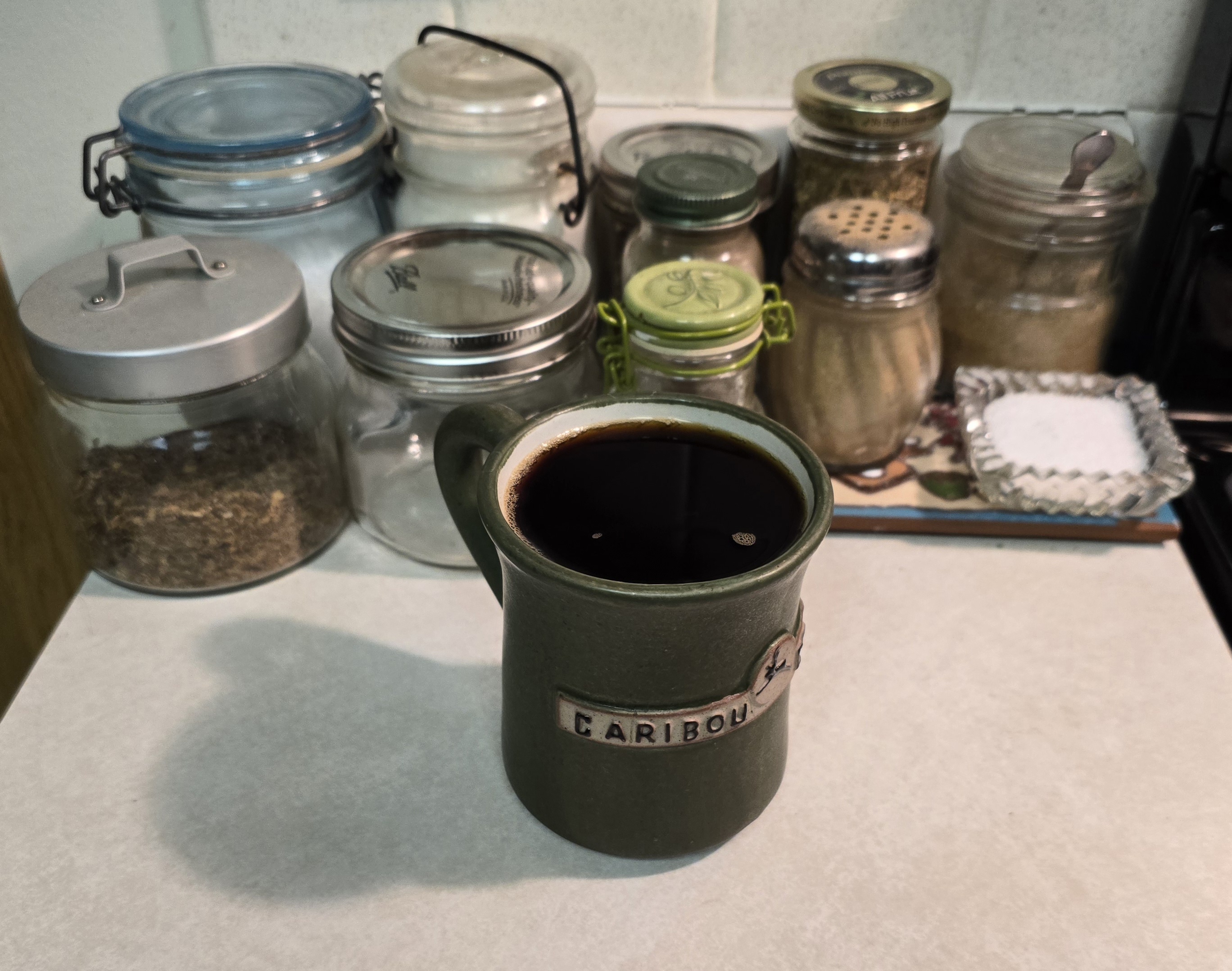
On Threads, I curated a feed that informs me about what our small community is doing. Mostly, we share photos of cups of coffee, and daily, regular posts which are habit forming. One person showcases a different pair of socks each day. I see photographs, works of art, and short posts about how the day is starting across multiple time zones. When I wake, the Australian and New Zealand accounts are already on morning of the next day. While I’m doing this, I make my own daily post with the outdoors ambient temperature, time, a brief composition, and a photo of my coffee cup. I drink coffee while scrolling to see what followers are doing today. We all have morning routines, and this is mine. I return for updates a couple of times each morning and afternoon. By 6 p.m. I shut my mobile device off for the day.
After the November election there was a movement of people from X to BlueSky. A lot of the folks I followed on X made the transition. Some I followed on Threads decided BlueSky was a better platform. In any case, I’m there and posting a couple of times each day. It has been easy to regulate how much time I spend there because I am less interested in any “national discussion.” Threads is my go-to.
My sights are set on reducing time on Instagram. The number of accounts I follow there is small and only a handful post regularly. It has become a site with two main functions: automatically cross post photos I upload to Facebook, and following a few accounts that offer something unique. If I reduce screen time, the largest initial share of cuts will come from Instagram. I went into settings and set a timer to notify me when I spend 90 minutes in a day on Instagram. We’ll see how that goes.
Facebook used to be great, but now it has been reduced the way a balsamic reduction is made. Besides publicizing my work, I belong to two groups: my high school class group I founded to facilitate organizing a couple of reunions, and a group I started for our home owners association. These two useful functions are likely the reason I still have a Facebook account.
The gist of this is to cut way back on Instagram time, and not dally when I’m doing something purposefully. In theory, everything I do on social media should be purposeful. I’ll give that a week or so and see if my screen time is reduced. What I would much rather be doing is spending time face-to-face with my friends. Here’s an example:
I had a chance to spend an hour with a dear friend in a deserted cafe this week. We were bathed in sunlight, although I preferred a seat that was shaded. We talked about our books, our health, and our plans. It was an oasis of calm and warmth in the increasingly turbulent world in which we live. I need more time spent like that. Likely we all could use it.
With Al Gore and Company in Chicago 2013. This is about half the attendees. I’m in there somewhere.
The 29th Conference of the Parties was a disappointment. Fossil fuel interests hindered the ability to accomplish constructive things since the beginning of the process. Now, they stopped anything except the most minimal action at COP29. Former Vice President Al Gore summarized the situation in this statement:
November 23, 2024
While the agreement reached at COP29 avoids immediate failure, it is far from a success. On the key issues like climate finance and the transition away from fossil fuels, this is — yet again — the bare minimum.
We cannot continue to rely on last-minute half measures. Leaders today shirk their responsibility by focusing on long-term, aspirational goals that extend far beyond their own terms in office. To meet the challenge of our time, we need real action at the scale of months and years, not decades and quarter-centuries.
This experience in Baku illuminates deeper flaws in the COP process, including the outsized influence of fossil fuel interests that has hobbled this process since its inception. The Kingdom of Saudi Arabia has been particularly obstructive. Putting the future of humanity at severe risk in order to make more money is truly disgraceful behavior. Reforming this process so that the polluters are not in effective control must be a priority.
On climate finance, our primary task in the coming years must be to not only fulfill and build upon the financial commitments agreed to at COP29, but to unleash even larger flows of affordable and fair private capital for developing countries.
Ultimately, coming out of COP29, we must transform disappointment into determination. We can solve the climate crisis. Whether we do so in time to meet the goals of the Paris Agreement will depend on what comes next.
The climate is changing. Do humans have the capacity to protect all we hold dear from the ravages of the climate crisis? Time will tell. The Conference of the Parties is our last, best hope to stave off the worst impacts of human-caused climate change.



 Journey Home
You must be logged in to post a comment.