Twelve participants in the Great March for Climate Action made a reprise visit to Washington, D.C. last Wednesday.
Ed Fallon, march founder, tried to get meetings with the White House and the Environmental Protection Agency to coincide with the end of the march last September, however, key people were unavailable at the time.
The White House meeting did happen, with Dan Utech, special assistant to the president for energy and climate change; Rohan Patel, special assistant to the president and deputy director of intergovernmental affairs, and Angela Barranco, associate director for public engagement at the White House Council on Environmental Quality. My story about the meeting in the Iowa City Press Citizen is here.
Fallon was unable to attend the meeting with EPA later that day. Marchers met with Joseph Goffman, senior counsel, assistant administrator for air and radiation and Mark Rupp, deputy associate administrator for intergovernmental relations. After the EPA meeting, marchers fanned out and met with their congressional representatives.
The Great March for Climate Action was not a stroll in the park for the core group of 35 marchers who made some or all of the way from Los Angeles to Washington. There were physical challenges including weight loss, foot and leg problems, fatigue and stress. They dealt with extreme weather events physically, notably in Nebraska where they encountered a giant hailstorm unlike any they had previously experienced. More than anyone I know, Fallon and company walked the walk, experiencing personal hardship to do so. The meetings in Washington were both a culmination and a new beginning for participants in advocating for climate action.
“Officials recognize that climate change is difficult for many people to grasp,” Fallon said. “The eight months along the march route allowed us to experience the situation directly, and this places us in a unique position of credibility.”
In addition to the White House meeting, Fallon called on Senators Chuck Grassley and Joni Ernst, and Representatives Dave Loebsack (IA-02) and David Young (IA-03) to advocate for climate action. While the results of the meetings were mixed, marchers had the ear of their elected representatives. All four politicians voted for a bill to build the Keystone XL pipeline, something the marchers adamantly oppose.
Last night, Fallon posted a photo of himself and Miriam Kashia of North Liberty with Senator Joni Ernst on his Facebook page.
“Between driving, meetings and presentations, I’m behind on getting these posted,” Fallon wrote. “Our meeting with White House staff on climate change: very encouraging! Our meeting with Senator Joni Ernst: not so much.”
Having gained standing by walking the walk on climate change, it opened doors. What marchers found on the other side wasn’t all they had hoped. While they were away from Iowa, the electorate brought to power our most conservative congressional delegation in a while, notably absent Senator Tom Harkin.
In effecting progressive change there are two important parts. Electing people who represent our views and advocating for our causes with them. In 2014, progressives did not fare so well on the former, which makes the latter more difficult.
While some may not like looking at photos of Fallon and company posing with these politicians, they are doing their part for progressive change. If we don’t like the current crop of politicians, we can’t give up.
“Obviously we were all disappointed with the outcome of the last election, and there are a lot of reasons for it and I’m happy to take on some of the blame,” said President Barack Obama at the House Democratic Issue Conference on Thursday. “But one thing I’m positive about is, when we’re shy about what we care about, when we’re defensive about what we’ve accomplished, when we don’t stand up straight and proud… we need to stand up and go on offense, and not be defensive about what we believe in.”
It’s an open question whether progressives will get organized for the next election. It’s clear we won’t unless we emulate the Great March for Climate Action and walk the walk—beginning now.
Yesterday the U.S. Senate voted 98-1 that climate change is real. More specifically, “to express the sense of the Senate that climate change is real and not a hoax.” Senator Roger Wicker of Mississippi was the lone vote against the amendment to the Keystone XL Pipeline bill.
The Senate wouldn’t go so far as to say that climate change is influenced by human activity, thus providing wiggle room for the climate deniers who voted for this amendment.
Senator James Inhofe (R-OK) wrote the book on climate change as a hoax, co-sponsored and voted for the amendment. Once he took the gavel as chairman of the Senate Environment and Public Works Committee Inhofe proceeded to lay out his view of the matter on the Senate floor, including explaining what he meant by a climate change hoax. Emily Atkin took apart his presentation on Climate Progress, but here we are—a climate denier is now in charge on an important Senate committee.
This week, NASA released the largest photographic image of the Andromeda Galaxy ever, rendering the meaning of the Senate votes small by comparison. Comedian George Carlin said “the planet is fine, the people are fucked.” This too gets lost in the scope of the universe in which we live.
Nonetheless, life as we know it continues and where we’re bound is rarely certain. This week’s lesson is to be cautious about inflating our relevance as we endeavor to sustain our lives in a turbulent world.
With sun shining and temperatures above freezing, yesterday was a pleasant day to be out and about in the county seat.
Four interviews for the newspaper, a stop at a used bookstore, and afternoon conversation with friends over coffee. We discussed the world as we know it… and politics.
There was news in the political world. Governor Terry Branstad gave his inaugural address after omitting any mention of a key local issue—supplemental state aid to the K-12 school system—in his condition of the state address earlier in the week. He left it to analysts to figure out he plans to underfund schools this budget cycle. One of the local school districts is advocating for a six percent increase in funding. The governor proposed roughly one percent depending upon how the numbers are interpreted.
The Iowa legislature is open for business after the formalities of the first week, and K-12 funding is one of many issues they will consider this session.
Today, the Iowa Democratic party is expected to elect a new chair to replace outgoing Scott Brennan. Not having a dog in the race, I wish them well.
On Tuesday the president delivers his state of the union address to a joint session of congress. The television audience is expected to be the lowest of any of his state of the union speeches. Iowa’s junior Senator Joni Ernst has been selected by congressional Republicans to deliver a rebuttal immediately following.
There has been a lot of very public political action this month, but what I would like to know is what area families have to say about this political window dressing. I’d also like to identify the voters who were for both Dave Loebsack and Joni Ernst in 2014. I believe unlocking their motivations is key to understanding the electorate and determining a path forward after a disastrous general election.
During the 2012 campaign we door-knocked an enclave in northwest Cedar County. Because of the low number of homes, I decided we would knock on every door, rather than the lists created by algorithms in the party’s voter database. It was eye-opening.
What we found was families who were giving considered thought about candidates before voting. They were willing to listen and debate and be open minded. There was no presumption of voting for one or the other candidate, even if the voter had a party affiliation. If we had followed the algorithm, we would never have found them and the lesson therein.
The model used by Democrats to target voters has outlived its usefulness. The idea that outside organizers can invade the high population areas of the state and produce a victory may have worked for a while, but has grown stale and ineffective. What must happen is a return to the basics, where community political organizers—people who live in the community and are not hired consultants—canvass every voter in their geography and look for supporters. We haven’t been doing that for a couple of cycles.
The simple truth is Republicans have gotten effective at exploiting the every voter canvassing method, and the 2014 election results stand as evidence. Democrats are in a position of playing catch up, and my sense is in many cases they don’t realize what is going on.
So before we lock into the political stress and storm of the 114th Congress and the 86th Iowa General Assembly, let’s pledge to spend some part of each week talking to people in our neighborhood. By identifying issues important to people, we will gain information that can work toward winning the next general election, where like the one just past, a lot will be at stake.
The ambient temperature dropped four degrees since waking. Morning’s gray light brightened the plains as the new day arrived without fanfare.
One of the dozens of viruses and colds making the rounds has me feeling punk. That’s understating it. The arc of disease seems to be on the downside: there is energy to post a few items.
In what seemed like a fragmented, hesitantly delivered speech, Governor Branstad today reported “the condition of Iowa is strong.” It is hard to argue with the general topic areas of his initiatives for the coming legislative session: moving the economy forward, education reform, strong and healthy families, agricultural production, protecting our resources, transportation, safety and security, and open government. It was Branstad’s 20th condition of the state address, and we’ve heard much of it before.
A couple of progressive web commenters complained that Branstad used fallacious job creation numbers and made no mention of “middle class priorities” like increasing the minimum wage. There was a decided lack of interest in the speech, so few were likely listening to the commentators or the governor.
No protests in the Capitol rotunda ahead of governor’s condition of the state. Quietest I’ve seen it… #iagovpic.twitter.com/Jldx8ORq37
No one is listening. There is a lack of interest in government among a middle class that makes up most of 3.1 million Iowans. If some have their interests, written on a legislative agenda, most do not. The disinterest goes beyond what the 86th Iowa General Assembly does or does not accomplish.
The bubble in which we Americans live is real and is becoming the ridicule of the world. It is as if we took what’s best about our country and locked it up in a strongbox to protect it from those who might steal it. We venture from our borders to loot planetary resources, wage war and assert hegemony where we can. We have become exceptional in these things and our culture is the less for it.
The near term prospects for making a change are not good.
That’s not to say it is hopeless. In a world that has grown increasingly small during my lifetime, global cooperation is more important than ever. The rest of the world is coming together around a few issues—the environment, nuclear abolition, and poverty—but like in the French rallies over the weekend, the U.S. has been noticeably absent.
The current debate over Iran is a good example. Much of the world has come together to bring Iran’s nuclear program into compliance with their obligations under the Nuclear Non-proliferation Treaty to which they are a party. A deadline was set to conclude the talks, but the State Department asked for more time. Political hawks believe this is a stalling tactic on the part of the Iranians to further develop enriched uranium for nuclear warheads. The State Department and those who watch it believe negotiations are almost finished and a resolution at hand.
Rather than give the negotiations more time, the Republican majority in congress is poised to pass new sanctions against Iran.
“If we pull the trigger on new nuclear-related sanctions now,” Samantha Power, U.S. ambassador to the United Nations said, “we will go from isolating Iran to potentially isolating ourselves.”
The political hawks don’t mind, because to them, all that matters is assertion of American hegemony and sovereignty.
The late Howard Zinn points us in the right direction for action.
“History is instructive,” Zinn said in a 2005 interview.
And what it suggests to people is that even if they do little things, if they walk on the picket line, if they join a vigil, if they write a letter to their local newspaper. Anything they do, however small, becomes part of a much, much larger sort of flow of energy. And when enough people do enough things, however small they are, then change takes place.
This short piece may not be much—it is a little thing. But what ails me is not a virus contracted while living in society, or the cold weather. It is the disinterest in things that matter: a reversion to what in the Siouan language was Ioway—the sleepy ones. We must wake up and soon.
Joni Ernst will make history two ways tomorrow when she is sworn in as Iowa’s next U.S. Senator. Both are because of her gender. She will be the first female to represent Iowa in the U.S. Congress, and the first female military veteran to become a senator in the history of the upper chamber. Here’s hoping her accomplishments during the next six years transcend gender.
“I am there to work for Iowa and to work for what I believe is the best path for the United States of America,” Ernst said in a Des Moines Register interview. “I would love for people to give me the benefit of the doubt just as I give others the benefit of the doubt.”
Ernst won the 2014 general election and there’s little reason not to give her the benefit of a doubt. If Iowa progressives were to walk away from Ernst and senior colleague Chuck Grassley, the chances of their issues being heard in Washington would be reduced from slim to none.
Let’s say the slate is clean for Ernst. What are are the expectations?
If Ernst mirrors Chuck Grassley’s constituent services operation that would be a plus. Whether one agrees with Grassley or not, his office is consistently efficient at getting back with a response. When I have visited Grassley’s office in Iowa or in Washington, staff would take an appointment and devote reasonable amounts of time to hear me out. Ernst should do no less.
One of my concerns about Ernst during the campaign was that she is a field grade military officer. Her appointment to the Senate Armed Services Committee is equally concerning. Control of the military should be in the hands of civilian political leadership rather than the cadre of military officers. Ernst recently decided to stay in the National Guard so she begins with a liability. The test for Ernst will be whether she can take the necessary steps to reduce the U.S. military budget. In particular, the nuclear complex budget is bloated, with a plan to modernized weapons that have little practical use on the modern battlefield. Will Ernst be a yes-woman for military expenditure or will she demonstrate thoughtful restraint in cutting the defense budget? We’ll be watching.
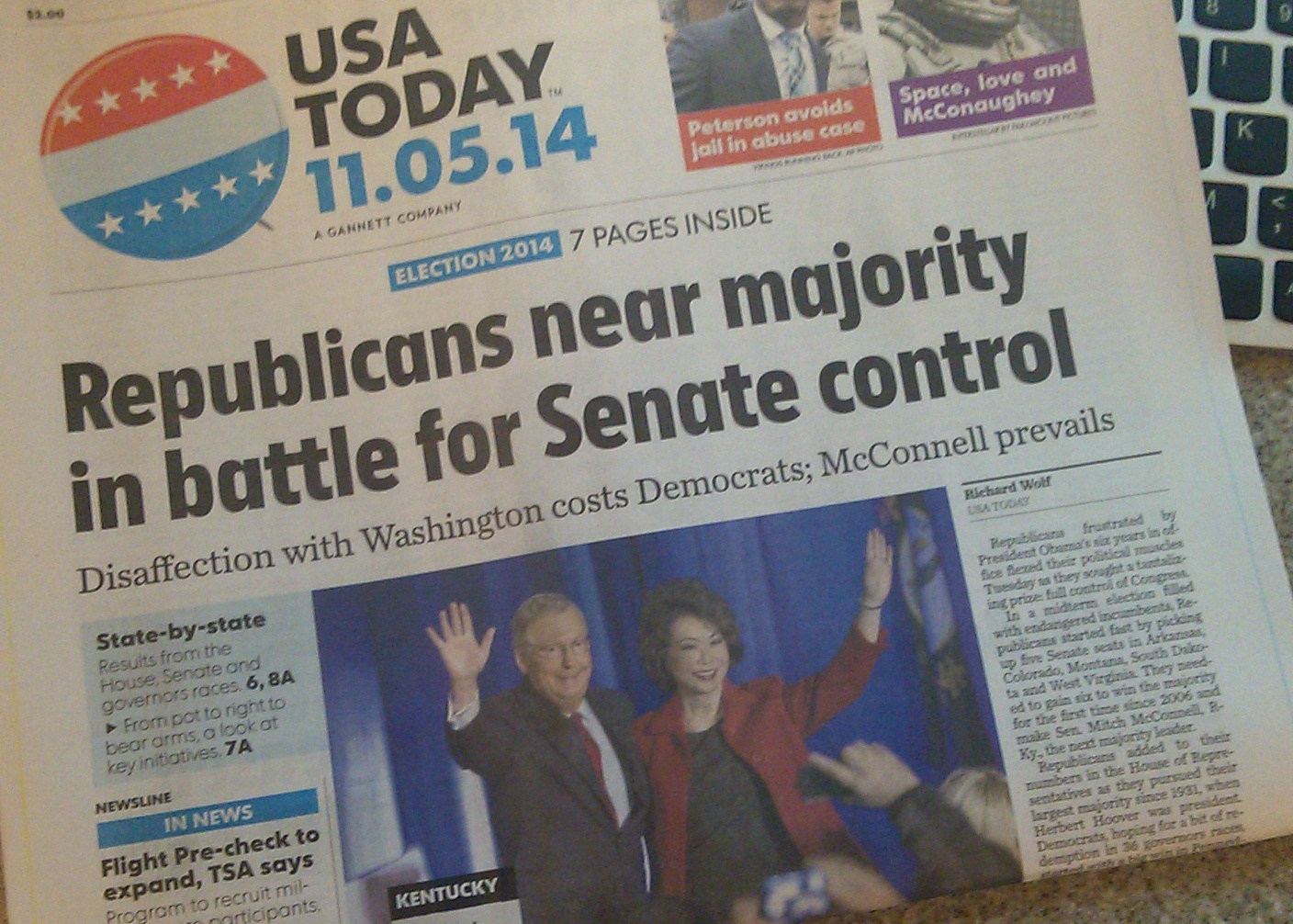
Incoming Senate majority leader Mitch McConnell has a to-do list that includes forcing approval of the Keystone XL pipeline, repeal of the Patient Protection and Affordable Care Act, and approving new sanctions against Iran instead of allowing the diplomatic process begun by the Obama administration to continue. Ernst is expected to support McConnell’s initiatives as a junior senator.
The senate Republican caucus was well disciplined when they were in the minority. They rarely broke ranks until the voting got close. They blocked many Democratic initiatives, something the Democrats will presumably do during the 114th Congress now that the tables are turned. One expects Ernst to keep her nose to the grindstone and a low profile as she gets started in the senate. That includes sticking with Republicans where it matters.
All told, Ernst has an opportunity to distinguish herself. Whether she is able to rise above politics and do so is an open question that soon will be answered.
LAKE MACBRIDE— During the run-up to the Nov. 18 vote on S-2280, a bill to approve the Keystone XL Pipeline, I messaged Senators Tom Harkin and Chuck Grassley, asking them to vote no. Harkin voted no, Grassley yes.
Senator Grassley sent along an explanation of his vote, which is pasted below. As he indicated, the motion failed to pass the Senate. What this letter doesn’t say is that I asked him to vote no, without any other comment. I have been around politics too long to believe that logic and rational thinking have much to do with why a U.S. Senator votes a certain way.
The framing of Grassley’s response points out the challenges opponents of the pipeline will have once the 114th Congress convenes. His arguments are rational in their way, if misguided.
It is hard to disagree with building a pipeline per se. There are many pipelines in the world, and they are a mode of transportation that serves the oil and natural gas industry, which in turn supports political stability. As Grassley pointed out, building pipelines creates jobs.
This is not a partisan issue. In Hillary Clinton’s secretary of state memoir, she mentions building pipelines several times, always as a solution to energy problems which in turn increases political stability around the globe. It will be hard to win the argument against Keystone XL because of the existential fact of it being a pipeline.
If oil prices continue to decline, the economic conditions which made the Tar Sands viable will erode. The reasons for declining oil prices are complex, but it boils down to a combination of increased U.S. shale oil production, lack of willingness by OPEC to curb production, and our society’s addiction to fossil fuels. It seems unlikely that the oil and gas industry will allow prices to get too low, and we are not in control here, except for our personal energy choices.
Something’s got to give to reduce reliance on fossil fuels. Plugging an electric car into our household grid is not an answer if all we do is switch our energy source from gasoline to coal and nuclear, both of which have their own risks to human health. Grassley doesn’t directly mention decreasing reliance on fossil fuels as an issue in his response.
The argument about what happens to the oil in Texas is unresolved, despite Grassley’s assertion otherwise. The issue with refining, in light of increased U.S. oil production, is one of limited capacity. It has been a while since I was familiar with refining operations, but I suspect refineries are still running every minute they can to keep up with demand.
Could the refineries re-tool to handle Tar Sands oil? Yes, definitely. Is there an economic reason to do so when there is plenty of Middle East oil entering the Gulf of Mexico at a low price? Probably not in the short term, and there appears to be little interest in increasing refining capacity in light of the current regulatory environment. Going forward, one would expect the Tar Sands crude oil to be exported the way U.S. light sweet crude currently is—because the refineries are already doing all they can to keep up with imports.
Grassley’s right to say we should decrease our reliance on imported oil. The simple fact is there is not enough oil being produced in North America to meet U.S. needs, and as I mentioned, there are economic constraints to refining capacity. What is missing is affirmation of the need to decrease use of fossil fuels, and that’s more the problem with the response.
The trouble for opponents of Keystone XL is that Grassley takes apart many of their arguments in a way that will build political support for a likely re-consideration of the project in 2017, if not in 2015. It is important to read his response and learn from it… and hope the climate doesn’t reach the tipping point while we dance around what most needs doing: reducing and eliminating our reliance on fossil and nuclear fuels.
Charles E. Grassley
Washington, D.C.
December 4, 2014
Thank you for taking the time to contact me. As your Senator, it is important for me to hear from you.
I appreciate knowing your concerns regarding the crude oil pipeline from Canada to Nebraska called the Keystone XL pipeline. On November 18, 2014, the Senate held debate and voted on S. 2280, a bill to approve the Keystone XL Pipeline. I was an original cosponsor of this bill and supported its passage. However, the bill failed by a final vote of 59-41, one vote short of the 60 votes necessary for it to pass the Senate.
The pipeline would supply more than 800,000 barrels a day of Canadian crude oil to U.S. refineries and help to counteract both insufficient domestic oil supplies in the United States and reduce dependence on less reliable foreign sources. The Keystone XL pipeline is a $7 billion, 1,700 mile pipeline that would create thousands of private-sector jobs at no cost to American taxpayers.
In 2008, TransCanada applied for a presidential permit from the State Department to construct and operate the pipeline. Due to environmental concerns, the State of Nebraska approved a modified route in January, 2013. Following this modification, the State Department released a draft Supplemental Environmental Impact Statement (SEIS) on the new presidential permit application. The State Department noted that oil sands development would go ahead regardless of the production of the pipeline by using different pipelines or rail to get to market. The report essentially found that the pipeline would not accelerate greenhouse gas emissions or significantly harm the environment along its route.
After nearly six years of rigorous regulatory review, the State Department issued its fifth environmental review on January 31, 2014. This fifth review reached the same conclusion as earlier reviews. It found that the pipeline will have no significant impact on the environment and is the safest way to transport the oil. It also found that rejection of the pipeline will not affect Canada’s decision to develop these oil resources. The administration had been in the middle of a 90-day review period for federal agencies assessing the State Department’s environmental study when, on April 18, 2014, the State Department announced an indefinite extension of the agency comment period.
Opponents of the Keystone pipeline argue that the pipeline will not increase oil and gas supplies in the United States, rather, that all of the Canadian crude would be sold to world markets. Even President Obama reiterated this claim when he said the pipeline would allow the Canadians to “pump their oil, send it through our land, down to the Gulf, where it will be sold everywhere else.” However, the Washington Post “Fact Checker” disproved this claim. It noted that the State Department’s final environmental impact statement specifically disputed claims that the oil would pass through the United States and be loaded onto vessels for ultimate sale in foreign markets. It found that the crude oil would almost certainly be refined in the United States, with at least 50 percent of the refined products remaining in the U.S. market. It stated, “market conditions could change, of course, but there is little basis to claim that virtually all of the product, or even a majority, would be exported.”
The energy and economic development benefits of this pipeline are too important to delay any longer. We need an all-of-the-above approach to meet the country’s energy needs and give consumers choice. That means oil, ethanol, electricity from wind, and nuclear power. A pipeline would be safer than transporting oil by rail. Canada will produce this oil with or without U.S. involvement in the shipment. I’d rather work with one of our strongest allies than continue to get oil from the volatile Middle East or Venezuela.
What is needed now in the United States is an increased supply of oil. It is simple economics. If you increase the supply, you decrease the price. We are still relying on a very finite amount of oil. We must increase our own domestic supply of energy while promoting the use of alternative sources of energy at the same time. I will continue to support these goals with your thoughts in mind.
Again, thank you for taking the time to contact me. I appreciate receiving your comments and urge you to keep in touch.
I re-read Jennifer Jacobs’ 50 most wanted Democrats article twice and have to say I disagree with her framing.
In the first place, the Republican caucuses are a place where only registered Republicans who show up get to vote, not “where each Iowan gets one vote,” as Jacobs asserts.
Second, I know very few Iowa Democrats who jumped on board some presidential hopeful’s campaign because they were able to associate with people on this list. For example, when Dave Loebsack co-hosted Evan Bayh at Jim Hayes’ home in Iowa City, a crowd gathered, but to say it helped Bayh during his 2008 presidential bid, other than to help him decide to bow out, would be optimistic and self serving. Who would even say that besides someone like Jacobs?
Third, the selection of political activists for the list also serves Jacobs’ point of view. These are folks with whom she presumably has a relationship, and depends upon to present a “balanced” view of Democratic politics. Her view is anything but balanced, and stroking this group only builds her relationship with them, rather than saying anything about how Democrats select candidates.
Finally, this group more represents the problem with the Iowa Democratic Party than a leverage point for presidential hopefuls to gain support. If this list is our set of leadership, we are doomed to defeat as long as they are around. Jacobs clearly gets that wrong. What’s needed is a new, more diverse and much younger set of faces.
If we recall Dunbar’s number, Jacobs has limits on cognitive recognition, and setting fifty Democrats may be a reasonable limit for that part of the political spectrum, at least in her world.
A couple of points:
Is Roxanne Conlin not able to gather a crowd or raise money for Dems? Everyone who believes that, stand on your head.
Jerry Crawford? Really?
Zach Wahls? Besides a flash of celebrity, what does he add?
This sentence about Sarah Benzing is a killer. “Although the latest campaign she managed, Bruce Braley’s, was branded the worst U.S. Senate campaign in the country, Benzing has a good track record.”
I don’t seek to run people down, and know many people on this list. I’m just sayin’. Jacobs is trying to frame who we are as Democrats. If we sit by and let that happen, we had better get used to Republicans running the state.
BIG GROVE TOWNSHIP— Completing this year’s election ballot took more time than usual, partly because I was torn in a couple of the races when I arrived at the auditor’s office to cast my vote.
I began by flipping it over to write in DeWayne Klouda as township trustee.
Klouda had been discussing his re-election for a couple of board meetings, so I called him after the sample ballot was released without his name. His paperwork had not arrived in the auditor’s office by the filing deadline.
Running a write-in campaign where there is no candidate is straightforward. I wrote and issued a press release saying he was running, and once that was in the paper, and through word of mouth, we got enough people to write him in to be elected. Sigh of relief, because he possesses the institutional knowledge of our board. Our clerk was on the ballot uncontested, so he won re-election as well.
The last item I voted was the state house race between incumbent Republican Bobby Kaufmann and Democrat David Johnson.
Early this cycle, the Cedar County Democrats chair called and asked me to stay out of the race. He wanted the effort to be directed from Cedar County. Since our effort failed in 2012, I had had my chance, and felt obligated to step aside, and did. When there was a competitive Democratic primary, I answered questions for both candidates, and interviewed them for the Solon Economist, but campaigned for neither one over the other. Our 2012 campaign had defeated Johnson in the primary, and if he wanted to run again, I wasn’t going to stand in the way this time.
After the election, Iowa City blogger John Deeth commented about the race on his Facebook page, and I responded:
The most positive aspect of this state-house election was that it defined the Democratic base as 32 percent (for the entire district), which, not surprisingly, equals the active Democratic registrations at 31.9 percent. I know there were defections back and forth among party-registered voters, but the base turnout number will help future candidates know that their campaign should focus almost exclusively on building a coalition to get to 50 percent plus one using no preference voters, new voters and Republicans. IMHO, this is the new normal.
What I’m saying is that every candidate has a plan to win, and in that plan, the Democratic base is a solid number. We now know what that is in HD73. Winning elections is about bringing voters into a coalition, and the Democratic base is not enough to win. In my precinct, there were 136 straight ticket D voters among 957 votes cast. Take them and the 174 straight ticket Rs out and you have 647 or 68 percent of the electorate to work with.
Kaufmann won our precinct 611-323 (65.4%-34.6%). For perspective, in 2012, a presidential election year and the first election for the newly minted House District 73, Democrat Dick Schwab won the precinct 559-525 (51.6%-48.4%). What happened? It’s not about party registrations.
After winning in 2012, Kaufmann built a reputation as an energetic and responsive state representative who worked with constituents regardless of party. During the campaign, he door knocked our house at least three times and was constantly in the local newspaper doing something to serve constituent interests. Some argue that yard signs don’t win elections, but the fact that Kaufmann’s name was plastered everywhere built name recognition, and like any advertising, it takes a number of impressions to make a sale. He had that.
It turned out that Kaufmann’s more controversial votes in the legislature did not matter as much to most constituents, as his high level of energy and willingness to talk about any issue and produce results.
For Johnson’s part, I wasn’t privy to what his campaign was doing, but I received a couple of mailers asking for donations, along with one from an outside group criticizing Kaufmann. My only human contact with Johnson, after I wrote the articles for the primary, was at public events, mostly outside the district. He wasn’t an active presence in the precinct. I did not see him one time in our precinct, although to be fair the precinct is geographically large, and I might have missed him.
In October I receive a call from the Cedar County Democrats chair who asked about Johnson’s prospects. I responded he would carry the base, which is what he did. The trouble was he didn’t build on the base.
By winning back-to-back elections, Kaufmann made it more difficult for Democrats to beat him during the three elections remaining before the 2020 U.S. Census and re-districting.
SCHILLER PARK, Ill.— The preliminary election returns for Big Grove Precinct arrived at 10:47 p.m. yesterday from the county auditor’s office. It will be a couple of days before the township trustee write-in votes will be tallied. Once those results are in, I’ll include a more complete analysis of the results and their meaning. For now, suffice it to say that the precinct voters behaved predictably.
Ours is a precinct made up of voters minted in reaction to the firestorm that has been our national media discourse since 2000. They vote on the perceived merits and qualifications of candidates rather than by party alliance. This is highlighted by the straight-party ticket voters: 136 Democratic, 174 Republican and 6 New Independent Party IA (whoever they are) out of 957 voters.
This cycle, they elected Joni Ernst to the U.S. Senate to replace retiring Senator Tom Harkin, 54 to 43 percent (This and all percentages in this post are in Big Grove Precinct only). Finally, Iowa is to send a woman to Washington.
Incumbent Democrat Dave Loebsack was returned to the U.S. Congress 51 to 49 percent. One hopes Dr. Mariannette Miller-Meeks has now gotten the message after her third attempt—we don’t want her.
We followed the rest of the state on statewide office elections, although more analysis about those races will be forthcoming once I have studied the differences. Terry Branstad gets a chance to serve as governor for the longest time of any American governor, including the ones who bridge the Revolutionary War with their service.
Our state senator, Bob Dvorsky, was uncontested, and is well liked, and he easily won reelection with 97 percent of the vote.
Incumbent state representative Bobby Kaufmann beat challenger David Johnson 65 to 35 percent. More analysis of this race will be forthcoming, but Kaufmann ran the superior ground game, by dominating media and sign advertising, and with his physical presence in the precinct.
Incumbent supervisor John Etheredge was the top vote-getter among the three board of supervisor candidates with 58 percent of the vote. Mike Carberry was next with 46 percent, and incumbent Janelle Rettig trailed with 39 percent. Based on county-wide voting, Rettig and Carberry will be sworn in as supervisors. This race is of particular interest to a discussion of the post 2000 voters, so watch for more on this.
Other uncontested county-wide races had Janet Lyness, Kim Painter and Tom Kriz garnering 99 percent of the vote. We retained judges, voted for people who were on the ballot for minor elected roles, although less than enthusiastically.
As the dateline indicates, I am away from home. More when I return later today.
Half of our household budget is paid from wages earned by working in the warehouse. It’s a constant worry and last night highlighted a couple of things.
Up all night coughing due to a cold, or something, I called off today. My worries were about 1). being sick, 2). leaving my superior in the lurch by my absence, and 3). losing the $50 or so, I would have earned today. Each took its mental toll as I rolled and coughed and finally called off around 4 a.m. so the voice mail would be waiting when she arrived to open the office.
It was a reasonable decision, as the condition might worsen had I gone in and worked on my feet, giving people breaks. Coughing and hacking over food samples can never be good, so in the end everyone was served. I suppose the worry serves a purpose too.
After my call, the display on my mobile phone showed the outside temperature was 22 degrees—the first hard frost. A friend wrote:
“I was close to tearful about all my reddish orange raspberries that would have been perfect for harvest in just say three more days. Last year they were completely done a few days before any freeze. Sigh. It was a banner year for raspberries and I’ve loved them all! But I guess harvesting berries past Oct. 31 is really asking for climate change!”
So the season spins, its markers passing rapidly, but recognizably as we tread on in life’s journey. At 1:30 p.m., I had stopped coughing enough to feel ready to sit in my writer’s seat and get to work—tissue box at the ready. I turned from worry to no worries.
Some people worry about a Hillary Clinton presidency, but not me. Few people have the breadth of experience she does, and fewer still focus on the advancement of human rights the way she does. This week she was at the Hamburg Inn No. 2 in Iowa City with Rep. Bruce Braley to have a pie shake—and be seen there. Specifically, a chocolate-bourbon-pecan-flavored pie shake, according to media. It was a sign of something.
I finished her recent memoir, “Hard Choices,” in between coughing spells this morning.
“Now, more than ever, the future is very much on my mind,” she wrote in the epilogue. “Over the past year, as I’ve traveled around our country once again, the one question I’m asked more than any other is: Will I run for President in 2016? The answer is I haven’t decided yet.”
Far be it from me to opine on the matter of whether she should run for office again. But if she does, positives outweigh negatives, by a distance. In sooth, she has no competition among the parade of potential 2016 aspirants testing the political waters in Iowa this election cycle. That is, if experience matters.
If experience doesn’t matter, as a nation we have lost our way.
In my self-imposed quarantine, I’m hoping a couple of things. 1). that I recover my heath well enough to work at the warehouse tomorrow, as we need the income, 2). that Iowans reject Joni Ernst on Tuesday, and send Bruce Braley to the U.S. Senate, and 3). that Hillary Clinton gives fair consideration to throwing her hat in the ring for 2016.
Hopefully that pie-shake reminded her that Iowans are not so bad.






 Journey Home
You must be logged in to post a comment.