Categories
Living in Society

Iowans for Sherrie Taha

Sherrie Taha for Iowa Secretary of Agriculture

The fact that Sherrie Taha, candidate for Iowa Secretary of Agriculture, supports reduction of food imports to Iowa only makes sense.

“Rather than import the bulk of the food we eat from outside of our state, we need to reintegrate local food production back into our local economies,” said Taha. “We have great farmers markets. Now it’s time to take local food production to the next level and keep the bulk of our food dollars recirculating in our local communities.”

Set aside the inherent risks of recurring drought on the California Central Valley, and turbulent world-wide food pricing, and there remains the commonplace that Iowans can grow more of their own food. If local food production were diversified and scaled up, Iowa could do what it does best to produce more meat, dairy and vegetables for local consumption, and improve the state’s food security.

It’s a message few have heard, and not enough may have heard to tip the general election in Taha’s favor.

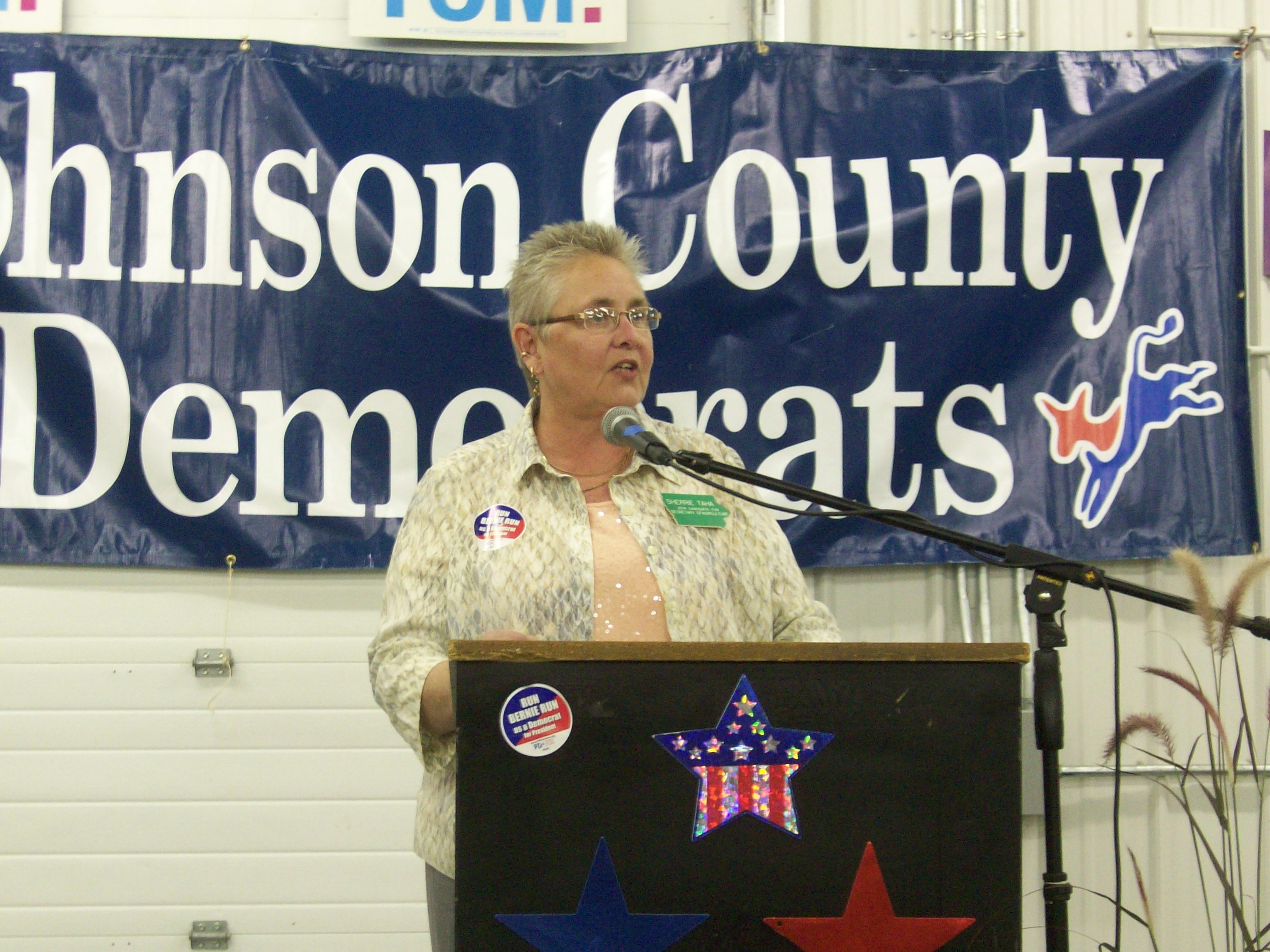
Last Sunday, Taha spoke in Iowa City. Her speaking slot followed a number of high-profile speakers that included Rep. Dave Loebsack, Rep. Bruce Braley, Michigan Senator Debbie Stabenow and Vermont Senator Bernie Sanders. After Sanders, a segment of the crowd dispersed, but most would have liked what Taha had to say if they stayed.

“If you eat, if you drink water, if you breathe the air around us, you have a personal stake in how the Iowa Department of Agriculture and Land Stewardship (IDALS) works,” she said. “What that means to me is that along with the corn growers and the soybean association, I’ll invite groups like the Iowa Environmental Council, the Sierra Club, and consumer groups (to get involved at IDALS). We all have to have our interests addressed. Decisions that are made (at IDALS) need to take into consideration the long-term best interests of every Iowan.”

Taha went on to enumerate reasons to consider voting for her, focusing on her experience as a commissioner for the Polk County Soil and Water Conservation District. She said Iowa needs a better process for reducing soil erosion and improving water quality than the voluntary nutrient reduction strategy instituted during the incumbent’s administration.

While Taha faces an uphill battle against an entrenched incumbent, it is hard to concede that global food security can be left to proponents of the industrial model for agriculture. Because of Iowa’s prominent role in agriculture, the person who leads IDALS matters and it should be Sherrie Taha.

Click here to learn more about Sherrie Taha and to get involved with her campaign.

~ Written for Blog for Iowa

Categories
Living in Society

3 Things about the Iowa Senate Race

Jefferson's Autobiography
Jefferson’s Autobiography

Partisan politics, and the manner in which the founders set up the federal government with its bicameral legislature, yielded an inability to deal with problems much beyond our noses. The founders planned it that way.

“A government of representatives, elected by the people at short periods, was our object; and our maxim at that day was, ‘where annual election ends, tyranny begins;’ nor have our departures from it been sanctioned by the happiness of their effects,” wrote Thomas Jefferson to Samuel Adams in February 1800.

With due respect to a fellow Virginian, the Congress seems unable to solve the most pressing issues of our time and that is becoming problematic. In a choice between Congressman Bruce Braley and State Senator Joni Ernst, Braley is the only choice to meet today’s needs. He isn’t perfect, but who is?

The constant reference to getting things done through bipartisanship by both candidates indicates a failure to understand the nature of what the founders intended in favor of politics of the day. That is not all bad, but it misses the point.

What has changed since the 18th century is humanity’s increasingly global perspective and interconnectedness. I’m not only talking about the Internet, although that is part of it. On any given day, I run into people from most inhabited continents, but from China especially. They are in Iowa to study at the university, but they have an opportunity to make connections that was unlike anything the 1700s. These travelers will take home what’s best about Iowa, and I don’t mean corn, soybeans and pork.

Additionally, business has gone global. When I worked for the oil company, we did business in 89 countries. With their merger with BP, the footprint grew even broader.But that is not all of what is different.

A global perspective on business was evident in the 18th century, and one might say the “discovery” of the Americas was part of business growth. At the same time, the need and desire to comprehend laws and culture throughout the globe and leverage that information for profit has grown to a scale unimaginable three hundred years ago. The U.S. is not isolated from the rest of the world, and it is unbecoming for politicians to assert that we can do what’s best for Iowa without examining a global context.

That said, there are three things I would like to hear from the Republican contender to be Iowa’s junior U.S. Senator, but likely won’t.

I would like to hear something other than that there is a problem with Social Security. Ernst is a parrot of the Congressman Paul Ryan plan for Social Security. In a cynical ploy to retain votes, she asserts keeping the sacred trust to seniors and those approaching retirement, but advocates doing something else, although she hasn’t decided what, for younger people. She indicated privatizing Social Security is on the table, but what she really means is that future retirees will have to fend for themselves.

She recently criticized Braley for not solving the problems with Social Security during his eight years in Washington, but the truth is that Republicans have never been fans of Social Security and have worked to chip away at its benefits since its inception. Ernst is no different and Braley has defended Social Security.

I would like to hear how Ernst would address our nuclear complex. The late Robin Williams pointed out, “remember the big weapons− huge weapons− the ones that really can do us in− are not in the hands of us. Something much bigger. Whether you believe in intelligent design or just a guy named Phil who’s pissed.” The threat of nuclear annihilation is not funny, even if Williams was. Would Ernst have the U.S. join the international humanitarian campaign to abolish nuclear weapons, or is she already under the spell of John Bolton and other conservative hawks that continue to assert U.S. hegemony through a weapon that could end or change permanently civilization as we know it without solving any of our most pressing problems?

Finally, I would like to hear what Ernst will do about the tangible impact on business and society of our changing climate. I heard and previously wrote about her lack of understanding about climate change as stated in the debate with Braley. Either she is incompetent to be a U.S. Senator, or she can learn. If she can learn about climate change, what is she willing to do to protect our common interests in air, water and the conditions that currently nurture life in Iowa and throughout the globe? Bet we don’t hear from her on that either.

The challenge this election cycle is the media and its corporate backers have created such a firestorm of disbelief among voters, that many are expected to skip this cycle. There are more than three things I’d like to hear from Ernst, but I am already confident of where Bruce Braley stands, so why should I insist. That would be time taken away from convincing people to vote for Bruce Braley.

Click here to get involved with the Braley campaign.

Categories
Living in Society

Iowa’s Final Stretch – 2014

Photo Credit BruceBraley.com

LAKE MACBRIDE— With yesterday’s top of the ticket U.S. Senate debate between U.S. Representative Bruce Braley and State Senator Joni Ernst, the Iowa political season moves into the final stretch. For those who don’t recognize it, that’s a horse racing metaphor, and at this point, Ernst looks to lead by a nose, although based on the aggregate of polling, it is still neck and neck.

A lot can happen between now and Nov 4. Braley is leveraging the existing ground organization of the Iowa Democratic Party, comprised of the usual cast of characters plus a contingent of out of state organizers. Ernst is doing a “full Grassley,” which means talking to the faithful in all 99 Iowa counties. Both candidates are raising every nickle they can.

Both have third party groups, financed by people we know, advocating for their respective campaigns. Based on the candidate comments last night, Charles and David Koch are causing the most trouble for Braley, and NextGen Climate, financed by venture capitalist Tom Steyer, is hitting Ernst’s campaign hard enough for her to omit from her comments the other groups backing Braley. The playing field is not equal between the Koch Brothers and Tom Steyer, but there is a tendency to depict it as such. There are other groups supporting both candidates, but they didn’t get a mention during the debate.

The race will be won by whoever secures the largest number of so-called “no-preference” voters. If the truth will out, and one hopes it does, Braley will win. Whether it will is an open question. Both Braley and Ernst confirmed who they are in their responses last night, something that is not news to those of us paying attention. The trouble is it will be a couple of weeks before most people, no preference voters particularly, start engaging. Most that I know with this registration have not begun to engage in the race.

Ernst was asked, “what do you believe about climate change? What would you do about it?” Her response began, “I grew up drinking well water on a farm. My dad is a conservationist. Most Iowa farmers are phenomenal conservationists.” The head scratching began.

“I don’t know the science behind climate change, but I cannot say one way or another whether it is man-made or not,” she continued.  “I have heard arguments on both sides.”

In framing up a well worn climate denier argument, Ernst affirmed her relationship with the oil and gas lobby. More importantly, she revealed that she does not have the intellectual capacity to evaluate what many believe is the most important issue of our time. This has larger consequences when applied to issues of war and peace, helping the needy, controlling our national budget, nuclear disarmament, and many others.

Her statements about the relationship between recycling, conservation, the Environmental Protection Agency, Cap and Trade, farming and well water would not stand up to the light of day if people could hear what she said. Whether the Braley campaign will effectively get the word out to likely voters remains another open question.

For those of us in the working class, this is pretty theoretical. We have bills to pay and a reality in which to live, one that is not always pleasant, as this news story indicates.

Richard Engel Interview
Categories
Living in Society

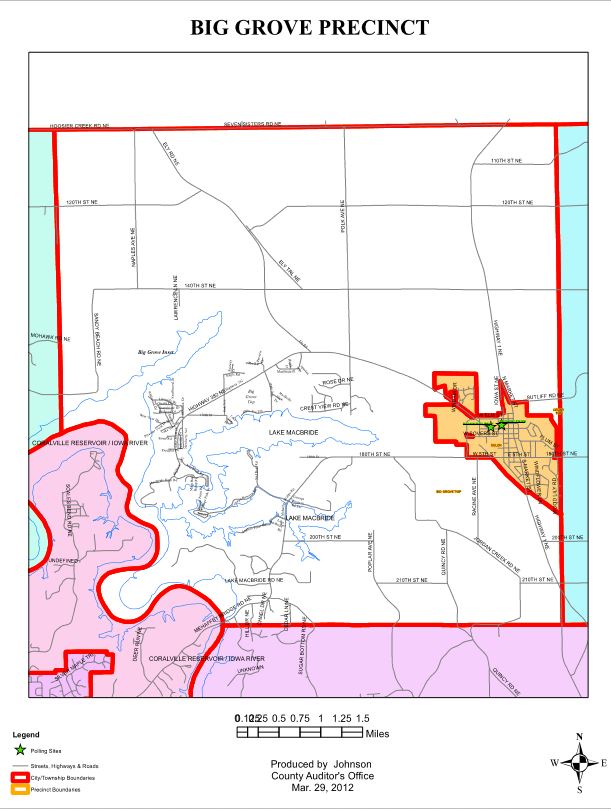
Early Voting in Big Grove

Big Grove Precinct
Big Grove Precinct

BIG GROVE— Early voting for the Nov. 4 general election begins on Sept. 25, and I’m in no hurry. I’m also willing to bet that I’ve given more thought to the entire ballot than most voters in the precinct.

The top of the ticket is easy, with votes for Bruce Braley and Dave Loebsack almost foreordained. Given the views of their competition, there is no contest.

We were sick of Terry Branstad the last time he gave up the governorship. He has done nothing to endear us enough to vote to retain him in office. There are four other gubernatorial candidates, and the only reasonable alternative is a vote for Jack Hatch and Monica Vernon, the Democratic candidates for governor and lieutenant governor.

Tom Miller for attorney general and Mike Fitzgerald for state treasurer are solid and expected to win. Based on everything they do for the state, they merit our vote. I particularly appreciate Miller’s help during the 2012 campaign I managed, and Fitzgerald’s College Savings Iowa, which made a significant contribution to college affordability in our household.

Brad Anderson will get my vote for secretary of state. I met him, I like him, and going backward to Paul Pate or the minor party candidates would be the wrong direction. Secretary of state is an important job, and making life easier for small businesses and including as many voters as possible in elections represents what should be the foundation of our society. It hasn’t been that way under the current Republican’s tenure.

The other statewide races need study. I’m not sure what qualities to seek in a state auditor, and while I lean toward Democrat Jonathan Niederbach, and will likely vote for him, I’m not quite ready to say yes.

Secretary of Agriculture is a key race in our household, and the Democrats fielded a candidate with weak credentials in Sherrie Taha. I met Bill Northey and have heard him speak several times. I don’t feel a need to vote the strait ticket, and this is a race where I might vote for the Republican. Jury is still out on that.

State Senator Bob Dvorsky is running unopposed, and I have been communicating with him about the needs of our precinct, especially with regard to Lake Macbride, since we moved to Big Grove two decades ago. Another easy vote, even if there were a challenger. The same holds true for the court house races: Tom Kriz for treasurer, Janet Lyness for county attorney, and Kim Painter for recorder are all running unopposed, and I know and support them.

For state representative in House District 73, there are two candidates, Democrat David Johnson and Republican incumbent Bobby Kaufmann. Since I waged a campaign to defeat each of them in 2012, neither represents my best option. How I decide to vote won’t be discussed here or anywhere else in public.

There is a three-way race for two seats on the county board of supervisors, with incumbent Janelle Rettig, Mike Carberry and John Etheredge on the ballot. My votes will go to Rettig and Carberry. Although I’ve gotten to know Republican Etheredge better during his term, he is likely to be the burr that gets sanded off in the wood shop that is this heavily Democratic county.

I am one of three township trustees and one position is on the ballot after the resignation of long-time trustee Elmer Vanourney, and subsequent appointment of Dewayne Klouda to replace him. Klouda will get my write-in vote since he failed to file in time. Ryan Hajek is on the ballot for clerk, and was appointed when Klouda moved to trustee. He is interested in the work of the trustees, and will get my vote.

Figuring out the rest of the ballot is more difficult.

The other non-partisan offices? Who knows? There are five candidates for five positions on the ag extension council, and one supposes that if they are interested enough to get on the ballot, why stop them? Same with the single candidate to fill a two-year term. Soil and water commission has two candidates for two positions. Judicial retention in the court of appeals, District 6 District Court and District 6 District Associate? Again, who knows? They had to file for retention, so at least we know they want it that much. This is always a puzzler unless there is some controversy.

There are two ballot issues, the Local Option Sales Tax, and the county court house bond issue. I don’t support increasing sales tax, and once the ballot is printed, I’ll see what my choices are. I will vote for the court house bonding, and there is almost no public opposition to moving forward with it, so hopefully it gains the 60 percent required.

What I’m saying here is that voting early is good for the top of the ticket, but can be bad for down-ticket candidates and issues. Understanding as much as possible before we vote is important. If that means waiting until election day, then so be it.

Categories
Writing

Friday In Iowa – Writing In Public

Throes of Creation by Leonid_Pasternak
Throes of Creation by Leonid Pasternak

“I’ve been reading the paper lately,” said Kevin Samek to the Solon City Council on Aug. 6 during the citizens speak agenda item. “I’m a little concerned about the north sewer trunk.”

Samek had been reading my newspaper articles about the council and this long-standing community issue.

He went on to express his concerns about the way council was handling finances regarding the sewer line, and on a second topic said that public safety could be improved on Main Street by lowering the speed limit.

Council addressed his concerns by lowering the speed limit on Main Street from 25 to 20 miles per hour, and by unsuccessfully attempting to reach agreement with a developer over the sewer line at their Aug. 20 meeting. Samek filed to run for city council shortly afterward.

Two things about this story explain why some of us write in public.

Samek read my newspaper articles, and then did something about it, first by speaking to council, and then by deciding to run for public office. Informing and activating people to take action is what public writing is about. Whether we write for a newspaper, a blog, in social media, or appear on television or radio, the purpose is similar. We attempt to say something meaningful to readers and urge them to action.

The second important part of this story is that someone was there to witness the work of the city council and report on it. Often I am the only person seated in the gallery at council meetings and if I don’t write about them, it is doubtful anyone outside government would. Being there and having a point of view is important to restoring our Democracy. Writing publicly about what we witness is equally so. This is true not only for our government, but for much else in society.

As my summer job with Blog for Iowa ends, I urge readers to get involved with community life and take progressive action. We each have a unique perspective that is needed. There is a world out there and not enough people witnessing its reality and sharing it in public. Or, as Saul Bellow said more artfully, “there’s the most extraordinary, unheard-of poetry buried in America, but none of the conventional means known to culture can even begin to extract it.”

My hope is that people read what I wrote this summer and were moved to do something about issues that are important to them. As the political season turns to the fall campaign thanks for reading my summer posts. My advice is to never give up.

~ Written for Blog for Iowa

Categories
Environment Living in Society

Climate Change is Really Political

2012 Drought Conference

If one didn’t think the U.S. discussion of climate change was political, think again. U.S. Rep. David McKinley (R-West Virginia), added an amendment to a House appropriations bill to fund the Department of Energy and the U.S. Army Corps of Engineers that would prohibit the two agencies from using funds that would “design, implement, administer or carry out specified assessments regarding climate change.”

Another way to put it, from McKinley’s perspective, is if you don’t like science, ban it.

House Republicans took exception to the Department of Defense addressing the recommendations of the National Climate Assessment, and have added two agencies whose work is directly related to mitigating the effects of extreme weather to their list.

The floor debate captured the essence of the politics of climate change:

“Spending precious resources to pursue a dubious climate change agenda compromises our clean-energy research and America’s infrastructure,” McKinley said on the House floor. “Congress should not be spending money pursuing ideologically driven experiments.”

Speaking against the amendment, Rep. Marcy Kaptur (D-Ohio) said it disregards the research of the overwhelming majority of climate scientists.

“The Republicans, in general, don’t seem to trust the scientists,” Kaptur said. “This amendment requires the Department of Energy to assume that carbon pollution isn’t harmful and that climate change won’t cost a thing. That’s nothing but a fantasy.”

What next? Click here to read the rest of David Gutman’s coverage of this story in the Charleston, West Virginia Gazette.

And consider that June 2014 was the hottest month on record since records have been collected. Politicians like McKinley would deny the reality of human contributions toward global warming at the same time climate data released from the National Climatic Data Center of the National Oceanic and Atmospheric Administration, found that the worldwide average temperature over land and sea in June 2014 was 1.3 degrees Fahrenheit hotter than the 20th century average of 59.9 degrees. That is reality.

People seeking scientific proof of anthropogenic global climate change are barking up the wrong tree. The goal of science, if unlike McKinley, we accept science, is not to prove, but to explain aspects of the natural world.

Around 1850, physicist John Tyndall discovered that carbon dioxide traps heat in our atmosphere, producing the greenhouse effect, which enables all of creation as we know it to live on Earth.

Carbon dioxide increased as a percentage of our atmosphere since Tyndall’s time at the beginning of the Industrial Revolution. As a result, Earth’s average temperature increased by 1.5 degrees Fahrenheit.

The disturbance of the global carbon cycle and related increase in carbon dioxide concentrations in the atmosphere is identifiably anthropogenic because of the isotope signature of atmospheric carbon dioxide.

We can also observe the effects of global warming in worldwide glacier retreat, declining Arctic ice sheets, sea level rise, warming oceans, ocean acidification, and increased intensity of weather events.

It is no wonder almost all of climate scientists and all of the national academies of science in the world agree climate change is real, it is happening now, it’s caused by humans, and is cause for immediate action before it is too late.

Politicians like McKinley don’t get it, and advocate against reality. That’s nothing new for some members of the Republican Party.

~ Written for The Climate Reality Project

Categories
Living in Society

Iowa’s Summer Campaign Has Begun

Photo Credit BruceBraley.com

A small group of local, long-time political activists met last week with one of the 80 or so paid organizers for the Coordinated Campaign of the Iowa Democratic Party. Electing Bruce Braley as Iowa’s next U.S. Senator was at the top of our to-do list.

We don’t see each other often, but share the experience of working on election campaigns over many cycles. We know what it would mean if power in the U.S. Senate switched from Democratic to Republican leadership. If it’s up to us, that won’t happen, and each person at the meeting was willing to invest resources of time, money and thoughtful participation toward electing Braley to the U.S. Senate.

What does that mean in 2014?

It means participating in canvasses organized by paid staff, attending candidate and party-sponsored events when our schedule permits, and writing checks to campaigns when we have resources. That’s only part of the picture. Increasingly, it’s a small part.

More than anything, modern political campaigns require each of us be engaged in a community, without regard for political affiliation, and do things that make sense to advance our views. In rural communities especially, the human landscape of society doesn’t change enough from one election cycle to the next to pretend neighbors and friends don’t remember what was said in a letter to the editor, or at an event the last cycle. This persistence of memory can be a blessing and a curse in political campaigns.

Campaigns send a lot of requests for political donations, almost none of which get acted upon. The rationale is a variation on a theme that the numbers justify them. That is, if a request is sent to 10,000 people, there will be a financial return. This cycle, I am hearing more about Charles and David Koch, The Heritage Foundation and political action committees than ever. Campaigns keep sending the messages reinforcing a negativity that is hard to ignore.

At the grassroots, people understand the difference between a political action committee and a candidate, and at the end of the day, when there is an extra $25 in the checking account, a donation will go to a candidate, not a third party. Plenty of folks feel that way.

The summer’s string of parades, picnics, car races, music concerts, annual gatherings and county fairs is only just beginning, and political candidates are attending. We don’t put a lot of stock in what a particular candidate may say at an event, but there is an unspoken expectation they will show up in person from time to time, and that through these and other presences in person and in media, we will get to know them.

The weather has been exceptionally good for outdoors gatherings, and 2014 will be a summer to remember if for no other reason than that. Politics affects our lives, but we go on living.

Summer is the time to get involved with a political campaign, so start by checking out the Iowa Democratic Party. In case you missed it, Bruce Braley could use your help as well.

~ Written for Blog for Iowa

Categories
Living in Society

Summer Politics Kickoff

American Flag
American Flag

The Associated Press released a summary of the Iowa primary races over the Memorial Day weekend and tomorrow the voting will end, framing the summer and fall campaign. Going into election day, here is what to watch for:

The front window race is for U.S. Senate, between Rep. Bruce Braley and whoever emerges from the field of five Republicans. State Senator Joni Ernst of Red Oak is leading former business executive Mark Jacobs in the polls. Both of them are ahead of the remainder of a field that includes Sam Clovis of Sioux City, Mark Whitaker of Ankeny and Scott Schaben of Ames.

“My opponents will be tripping over themselves to see who can come up with the most extreme ideas to get their base riled up,” said Braley in a recent statement. “Iowa could very well determine control of the Senate this year. We are the force that could stop extreme Republicans from taking over.”

Considering the Iowa electorate and our relatively close margins in recent presidential years, an Ernst nominee from the Republicans would be better for Braley’s campaign because of the need to appeal to voters in the middle of the political spectrum. Ernst would polarize, Braley would draw from the middle. As Braley’s recent television commercial indicates, his appeal is to the middle.

It is not clear any Republican Senate candidate could garner the required 35 percent to win the nomination during the primary. For those with the stomach for it, the Iowa Republican’s Kevin Hall discusses this Republican issue here. Blog for Iowa will cover Braley’s race closely.

Here is a breakdown of the other primary races for federal office:

First Congressional District:

Democrats: Swati Dandekar of Cedar Rapids, Anesa Kajtazovic of Waterloo, Pat Murphy of Dubuque, Dave O’Brien of Cedar Rapids and Monica Vernon, also of Cedar Rapids. Blog for Iowa believes Swati Dandekar belongs in the Republican primary due to her close ties with conservative business interests. This is not a new opinion.

“Dubuque businessman Ron Blum leads a Republican field that includes Cedar Rapids businessman Steve Rathje, who has run unsuccessfully for U.S. Senate and House, and Marshalltown lawyer Gail Boliver,” according to the Associated Press.

Second Congressional District:

Democrat Dave Loebsack will face the winner of a Republican field that includes Mark Lofgren, Mariannette Miller-Meeks, and Matthew Waldren. Miller-Meeks seems convinced she will win. A MMM primary win would be welcomed by Team Loebsack because there is nothing new to see there, except ferreting out the extend of her involvement in the settlement scandal.

Third Congressional District:

Former Democratic State Senator Stacey Appel of Ackworth will face the winner of a Republican field that includes six candidates: Bob Cramer, Joe Grandanette, Monte Shaw, Matt Schultz, David Young, and Brad Zaun. The Republican nomination seems unlikely to be decided tomorrow, and may go to convention.

Fourth Congressional District:

Democrat Jim Mowrer will face incumbent Steve King in the general election, as both are unopposed in the primary.

Please click on the follow button to stay updated on Blog for Iowa’s for continued coverage of the 2014 midterm elections in Iowa.

~ Written for Blog for Iowa

Categories
Living in Society

The Circus is Assembling

Caucus-goer
At the Caucus

LAKE MACBRIDE—A friend wrote a letter to the editor politely asking us to boycott the May 26 and 27 appearance of elephants in the Shrine Circus at the county fairgrounds. It was a brief letter, reflective of her ongoing concern with the treatment of animals. Here it is in its entirety:

Wild animals do not belong in the circus.
I was disappointed to learn that a circus that uses elephants and other wild animals is coming to Johnson County. Please do not support this circus. The only way wild animals can be trained and controlled is through abuse and intimidation. They lead miserable lives so some people can be “entertained” and others can benefit economically.
To learn more about elephants, please watch the documentary “An Apology to Elephants.” It is available at local libraries.

Last night a colleague from Washington, D.C. called to discuss a program on which we are working. Basically, I am running behind schedule on my part and he was giving me a nudge. As circuses were already on my mind, the conversation turned to the Iowa caucuses.

All kinds of people will come out of the woodwork to Iowa to advocate for their issues in hope of influencing the 2016 presidential election. Some parts of what they say are worth hearing, and outsiders like my friend are fascinated with caucus chat. I told him about billionaire Tom Steyer’s hiring a friend of mine to work on the caucuses, about U.S. Chamber President Tom Donohue’s Iowa connections, and recent activity of the Heritage Foundation in Cedar Rapids. The spell was cast and I escaped close scrutiny on my tardiness.

A broken clock shows the correct time twice a day, and likewise I find myself agreeing with Republicans from time to time. It was regarding skepticism about the merits of capitalism spoken on the campaign trail in New Hampshire.

Yesterday, Arnie Alpert, a program coordinator for American Friends Service Committee in New Hampshire, posted about the visits of Senator Mike Lee of Utah and Senator Marco Rubio of Florida, where the wingers spoke about the problems with cronyism. The gist of it is that small businesses can’t compete against large corporations and their crony capitalism.

“As the Presidential campaign heats up, alongside a growing movement of citizens concerned about the floods of corporate cash washing through the election system, it will be interesting to see whether populist attacks on Big Business find a secure home in the GOP,” wrote Alpert. Who knows? Might happen, but I doubt it.

In Iowa our caucuses are much like a circus replete with rings of advocacy and a clown car of candidates. It seems unlikely Republicans will bring the caliber of performance they did in 2012, since with Obama subject to term limits, it is an open race, and much of the electorate is wising up to the need for common sense. Plus, faves Michelle Bachmann and Sarah Palin may stop by, but are unlikely to be major players this cycle.

As far as the Democratic side goes, there will be dalliances with Elizabeth Warren, Bernie Sanders, Jim Webb and others, but the fundamental question is whether Joe Biden will run a third time, or Hillary Clinton a second.

Thing is, there are expected to be plenty of candidates, especially on the Republican side, and they are not elephants, so my friend’s admonition need not apply.

Categories
Living in Society

Honey Locust in Bloom

Honey Locust Grove
Honey Locust Grove

LAKE MACBRIDE— Honey locust trees are in bloom around the lake country. It is another step in the steady march through the calendar of our awareness. We expect the blooms now, and so they have come.

The newspaper in the county seat announced their endorsements for the statehouse primary elections and picked Dennis Boedeker in Iowa House District 73. I stopped by our local newspaper yesterday, and they are running my candidate comparison articles side-by-side this week. We don’t endorse, but there are clear differences between the two Democratic candidates. Boedeker was recruited by political insiders to run for office, whereas his primary opponent David Johnson is self-activated, making his fourth attempt to win a seat in the Iowa legislature. I have no clue who will win the primary, and don’t care to speculate. From talking to locals, there have been no indications that Johnson’s time has come, and that’s no endorsement.

Sullivan Ballou
Sullivan Ballou

The Republican incumbent Bobby Kaufmann read Sullivan Ballou’s letter at the legion’s Memorial Day observance. We had a brief chat after the ceremony, before the crowd headed to the legion hall for coffee and kolaches. Kaufmann has been a constant presence in the district if the two Democratic contenders have not.

Rain fell around 3 a.m., beating against the house. Would that the garden were planted. Instead, rain is a hindrance to garden progress. I’ll work a shift at the CSA in the greenhouse instead and hope the ground dries out later today or tomorrow.