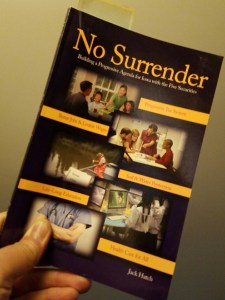
If interested in Iowa Democratic politics, read No Surrender: Building a Progressive Agenda for Iowa with the Five Securities by former state senator Jack Hatch. Read it now.
There are few long, contemporary narratives about the state of the Iowa Democratic Party. Hatch’s 2016 book recounts where we are, where we have been and where we could go.
The importance of the book is twofold.
It serves as a great way for political newcomers to get up to speed on Democratic politics. The results of the 2016 general election activated people around the state to become more involved in politics. No Surrender serves as a briefing book of major policy issues and how Democrats addressed them. Our approach stands in sharp contrast to Republicans, according to Hatch.
The author has standing to address flaws in Democratic approaches to elections and governance. A 22-year state legislator, chair of the White House Task Force of State Legislators for Health Care Reform, and 2014 gubernatorial candidate, Hatch tells the story of the rise of Democrats in 2006 and what we did while occupying the governor’s mansion and holding majorities in both chambers of the legislature. He also recounts how we fell. To be effective going forward, politically active Democrats need the sense of history No Surrender provides.
As with most contemporary political writing, there is a short shelf life to this book. Nonetheless, Hatch asserts Democratic values are more enduring: a progressive tax system, better jobs and livable wages, soil and water protection, life-long education, and health care for all.
Hatch lays out how a focus on policy could contribute to Democratic electoral wins and effective policy-making going forward. No Surrender provides a framework for policy-making much needed in these turbulent political times.
Civilian control of the military is an American value our president doesn’t appear to share.
A report last Friday from the American-led military coalition in Iraq indicated scores of non-combatant civilians huddled in basements for protection had been killed in U.S. bombing raids with as many as 200 casualties.
During a 2015 interview on NBC, candidate Trump made his intentions regarding Islamic State and their assets clear.
“With ISIS, you kill them at the head. You take the oil,” he said. “That’s where they’re getting their money. If you bomb the hell out of it, you bomb the hell out of it. You’ve got to stop their wealth. They have tremendous wealth.”
It is one thing to destroy the economic assets of the Islamic State and quite another to kill civilians as coalition forces attempt to drive them from Mosul.
The official government position is that rules of engagement with enemy combatants have not changed with the new administration. At the same time, coalition partners indicate the rules have been relaxed. In the fog of military explanations the truth is obscured.
If the report is true, we know why. It’s because the president turned our wars over to his generals and shouldn’t have. The president’s disregard for civilian control of the military is evidenced by the fact the Congress had to pass a law to enable former Marine Corps General James Mattis to become Secretary of Defense.
Our president should be hands-on when it comes to our wars in Iraq, Syria, Yemen and Afghanistan. There is little evidence he is and innocent people are paying the price.
“The objective is to destroy the coherence of the enemy’s defense, to fragment and isolate enemy units in the zone of attack, and to secure operationally decisive objectives.” U.S. Army Field Manual No. 3-09.22
The political battlefield changed during the first session of the 87th Iowa General Assembly. Democratic efforts to hold the line while in the minority have been difficult at best. One distasteful bill after another has been signed into law by the governor.
On Dec. 1, 2016 I wrote, “The current Iowa Democratic Party should be completely blown up — new people, new office, new strategy, new tactics, new everything.”
I still believe that, although Iowa Republicans are doing some of that work without us. They are doing everything they can to weaken the Democratic hand in 2018 and beyond.
The swing toward Trump and more general Republican values has been an eye opener. What worked in 2006, the last time Democrats elected a governor, won’t work now. The good news is people who were not politically engaged before 2016 are getting involved in protecting what’s left of Democratic values in government — even if the horse is out of the barn.
The General Assembly has devolved into the majority saying, “f*ck you we’re doing whatever the hell we want.” The debate about bills seems mostly among Republicans. Egregious bills restructuring Iowa’s politic landscape are too numerous for a short post. I’ll mention just one: House File 516
While a majority of Iowans support use of identification at polling places, if passed by the senate, HF516 may impact marginal voters in Iowa who either don’t have an ID or are discouraged from participating in the process. Democrats have relied on those votes in the past. The bill passed the House on March 9. The Senate companion bill, Senate Study Bill 1163 passed subcommittee March 1. The bills are solutions looking for a problem.
“There is the ‘fake’ problem of ‘fake’ people casting votes – it is simply not a problem in Iowa,” Iowa Senate Minority Leader Robb Hogg said in in his 2017 opening day remarks at the state capitol. “People aren’t risking severe criminal penalties to cast an illegal vote. We don’t need government barriers to voting in Iowa. Voting is a fundamental right.”
“The fact is voter ID laws are intended to suppress the vote of the elderly and disabled, people who are home bound and/or do not normally drive,” Eva Mitchell posted on the Iowa Democratic Party web site.
These arguments miss the point. Under the guise of “election integrity” Secretary of State Paul Pate is working to adopt a nationwide agenda to create conditions more favorable for people to vote for Republican candidates. Republican operatives believe they do better in elections when the electorate is constricted. With less voters, their minority views on almost everything have the potential to dominate our elected offices and the legislative agenda. To my point, they are doing that now, without a Voter ID law. Any Voter ID law signed by the governor will force Democrats to develop a new playbook for future campaigns.
The Democratic Central Committee elected political consultant Derek Eadon as chair on Jan. 21. I met him during the 2007 Obama campaign. He seems like a decent guy. A lot is resting on Eadon’s shoulders as Iowa Republicans won the 2016 presidential contest by 9.6 points, and took control of the Iowa legislature.
If and when a Voter ID bill becomes law Democrats will have to adjust. What is more concerning is the Republican artillery barrage has only just begun. They control the legislature now and will until the 88th Iowa General Assembly begins in January 2019. People say the second session of a general assembly is less toxic but I don’t believe that — not now, not ever. Conventional ideas about politics flew out the window last year.
It rots to be in a defensive position. The key to maintaining viability as a party is to hunker down, let the shells fall where they will, and rebuild. It is incumbent upon the new party leadership to focus not only on people who register to vote as Democrats, but to build an electorate that supports our candidates.
For now, Democrat activists resist, constituents should contact legislators, and, if Eadon and his leadership team are worth their salt, rebuild our defenses to conduct a counter attack to recapture the legislature. This is possible, indeed likely over time. Time is the one commodity in short supply for Democrats as Republicans reshape the political landscape.
(Editor’s Note: A feverish writing session over two days resulted in this analysis of my house district. Maybe it’s too far into the weeds. Maybe it’s re-litigating a failed past campaign. Maybe there is something here after the fever has broken).
Progressive activists would like to see Rep. Bobby Kaufmann (R-Wilton) removed from the Johnson County delegation to the Iowa legislature post-haste.
Claiming ignorance about Kaufmann’s voting record, Democratic activists recently lamented that part of the liberal bastion is represented by a son of the Republican Party of Iowa chairman.
If people did their homework it would be clear the R after his name stands for Republican.
Those same activists suggested the state party help recruit a candidate against Kaufmann and others who ran unopposed in 2016. The sentiment belies progressive attitudes about IDP involvement in local races. Candidates recruited by the IDP have been viewed negatively, with prejudice.
Local activists worked to recruit a candidate against Kaufmann in every general election since redistricting. Kaufmann beat Dick Schwab in 2012 (9,068 to 7,016); David Johnson in 2014 (8,448 to 4,035), and ran unopposed in 2016 (12,388 of 16,889 votes, including write-ins and under votes). The attitude during the prelude to 2016 was that running someone against the incumbent would have been a waste of time and resources because of his popularity among district voters.
His success in Republican politics begs another question.
Is Kaufmann popular or just entrenched — part of the continuing Kaufmann family dynasty, the undeserving inheritor of the crown, embedded in the tribal loyalty of rural residents?
That’s hard to say. Kaufmann worked for his wins. During the 2012 campaign our team worked hard for the Democrat. Everywhere we went and in every aspect of the campaign, Kaufmann, his father and brothers worked equally hard. While less familiar with the 2014 campaign, little about his work ethic appeared to change.
At the end of the day, Kaufmann is a Republican. Senators Chuck Grassley, Joni Ernst, Rand Paul and Marco Rubio have all helped him raise campaign funds. He endorsed Rubio for president in the Cedar Rapids Gazette. He made a joint appearance with Tana Goertz, Apprentice finalist and state chair of Donald Trump’s Iowa campaign.
He is actively involved in the Republican House caucus, voting for SF 166 (Supplemental State Aid to Schools), HF 516 (Voter ID), HF 291 (Collective Bargaining) and HF 517 (Iowa Gun Laws). No progressive legislators voted for these bills.
What does the average Jane make of Rep. Kaufmann?
“Both (Democrats and Republicans) in Wilton vote for the Kaufmanns,” a district resident posted on social media. “Their roots run deep, and they remind voters about that all the time. They are also great at marketing their common folk ideals and charm, so people think how much they truly listen to them, and what independent thinkers they are, which we know is a bunch of $%&!”
On March 1, the Secretary of State reported active voter registrations in the district were again led by no preference registrants. The numbers were 6,360 Democratic; 6,392 Republican; 82 Libertarian; 7,884 No Preference; and 25 other. The appearance is the district could be a level playing field with the right candidate should one arise. It’s more complicated than registrations.
As Johnson County population continues to grow it seems likely Kaufmann will be sanded off in the woodshed of 2021 redistricting.
Until then, progressives should either quit complaining and work with Kaufmann where there is common ground, or join in a campaign to unseat him. I’m certain both money and shoe leather would be welcome in a struggle against the Republican flood that jumped the river banks in November.
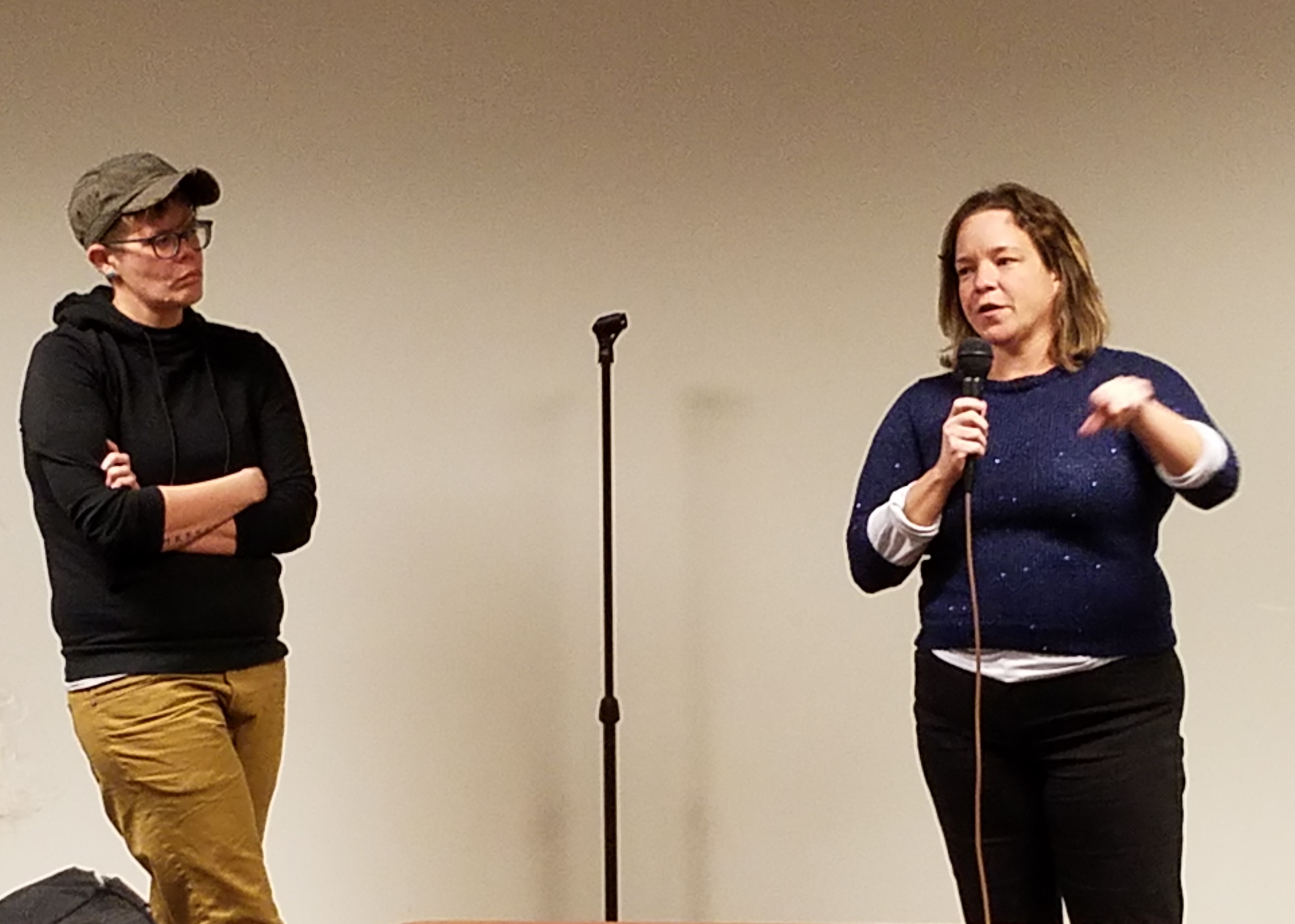
Kate Revaux (left) and Monica Biddix at the Iowa Democratic Party Building Blocks Listening Tour March 7, 2017 in Coralville
The Iowa Democratic Party has its work cut out between now and the 2020 presidential election.
About 75 people gathered last night at the Coralville Public Library to air grievances, express hopes, make observations and promote causes to party representatives.
Almost everyone who wanted to speak got a chance at the Building Blocks Listening Tour event.
“We do have to pick ourselves up,” Congressman Dave Loebsack said at a December State Central Committee meeting. “We have to get up off the mat, folks. There’s no way around it. We just have admit that, you know, we’re not doing particularly well as a party in the State of Iowa right now and we know that for a fact and so we’re not going to give up. We’re going to pick ourselves up. We’re going to make it better.”
The series of Building Blocks Listening Posts represents the beginning of how the party will accomplish this.
People tend to hear what we are predisposed to hear at such events. In an effort to be objective I recorded part of the event and gave up after about an hour. I found no moments of inspiration or of brilliance, only the butcher block work of gathering ideas and culling them. A couple of themes emerged in the group dominated by Johnson County residents.
A number of attendees expressed concern that part of Johnson County was represented by Republican Bobby Kaufmann. I didn’t recognize the speakers and don’t believe they lived in the district. Kaufmann beat Dick Schwab of rural Solon in the 2012 election and David Johnson of West Branch in 2014. No one ran against Kaufmann in 2016. The attitude at the time was doing so would have been a waste of time and resources because of his deep popularity among district voters. Such concerns were more an airing of grievances than anything useful to local activists. Prior involvement by the Iowa Democratic Party in the House District 73 race has been consistently viewed negatively by district activists.
Many commented about improving Democratic Party messaging, and this is likely the most significant takeaway for the moderators. In short, the message was get a message and sell it.
Some spoke about the billionaire donor network using the Republican party as a tool to implement policy. Two suggested Democrats should take only small-sized donations. Others mentioned the influence of the funding network in the electoral process. Moderator Kate Revaux asserted Democrats will never be the party of big donors the way Republicans are.
Another recurring comment was about the supposed divide between rural and urban voters. Commenters tended to paint rural residents as monolithic voting blocks when anyone who spends time in rural Iowa knows better. One hopes other listening posts garner better feedback on this.
More than once Revaux mentioned pulling groups of activists who sprung up after the Jan. 20 inauguration under the umbrella of the state party. The party needs their help, she said. Whether this is likely, needed or possible remained an open question.
The question Revaux asked at the beginning of the meeting, “what is the Iowa Democratic Party doing right?” went without answer. To some there were no IDP positives.
There was not a lot actionable in the 90 minute session. I did catch up with some friends and met my county party chair, so not all was lost.
A report on the state-wide Building Blocks tour is to be published in April. Democrats may know who they are individually, but from this meeting, the party appears to continue to wander in the wilderness. It remains to be seen if we will find our way.
In a couple of hours I removed cages, stakes and last year’s brush from the cherry tomato patch, turned over and broke up the soil, planted six kinds of lettuce, and posted the afternoon’s highlights on social media:
First spade of dirt turned; chives, walking onions, spring flowers up; lilacs, apple trees and pears budding (a lot); Caracas early carrots (57 days) planted; six kinds of lettuce (Wildfire mix, Ridgeline Romaine, Edox Butterhead, Red Salad Bowl, Australian Yellowleaf and Sanguine Ameliore) planted in the ground. I got out the mower to clear the brush from a small patch of garden because it was too windy to burn. It’s March 4 and spring has sprung.
First Spade
Taking soil from one of the sunken containers I mixed a bag of leftover soil mix from last year with it in a green cart. I refilled the container and planted carrots, covering them with straw from the tomato patch. I poured a bucket of water into the container through the straw. It felt good to get into our garden.
Buds of apple blossoms appeared in abundance. If they bloom normally and pollinate it will be a bumper crop. The arrival of pollinators and timing of the last frost will be crucial. Fingers crossed everything goes well. Last year’s apple crop was virtually non-existent. We are due for a good one.
Lettuce Seeds
February was the warmest on record in Iowa. The frost was out of the soil and the green up will not be long. It is very early to be doing much in the yard and garden.
About 20 people gathered in our nearby town to chat over beverages and hors d’oeuvres with Congressman Dave Loebsack. For some it was the first time to meet personally with a U.S. congressman. The event lasted an hour and a local organizer took notes and discussed a plan of political action with the many young people in attendance. I listened with some members of my own cohort (older folks table) and snapped a couple of photos.
Coffee with Our Congressman
The main group discussion was about the Patient Protection and Affordable Care Act and plans for the new administration to repeal and replace it. A bill is being crafted in the U.S. House of Representatives, but Loebsack hasn’t seen it even though he is on the committee that will eventually consider it. It rots to be in the minority for this and many other reasons.
Loebsack has been targeted by Republicans for the 2018 election.
“President Donald Trump’s 10-point win in Iowa in the 2016 election is emboldening the Republican Party to take on the state’s lone Democratic congressman,” according to the Quad-City Times.
Loebsack has been targeted since his 2006 election. We don’t assume re-election is in the bag and will have to see how the campaign rolls out. Already there are third party negative ads about Dave and a lot of work needs doing to retain the seat.
We turned the first spade of political soil yesterday as well.
Shed no tears because it has been an unfair fight between the moneyed class and the rest of us.
I hear laments about lack of organization, policy and management within the Democratic party and shake my head.
Neither “organization” nor “policy” nor “management” reflect an answer to the question why Republicans were so successful against Democrats in 2010 and afterward.
I hear about “wings” in the Democratic party: progressive, establishment, left, moderate and neoliberal. I don’t know about you, but I came to the Democratic party and stayed because of the big tent it continues to represent.
After the Jan. 21, 2010 U.S. Supreme Court decision in Citizens United, a few very rich people took advantage of the political climate and used vast amounts of money to organize a political staff that would work toward effecting long held policies. Rich people declared war on the rest of us and appear to be winning.
Key Democrats, including the Obama White House, were caught off guard by the rising influence of dark money, had no viable response, and suffered the November 2010 defeats with which we are familiar: lost majority in House of Representatives, lost half dozen U.S. Senate seats, and Republicans gained control of legislatures and governorships in about two dozen states.
Moneyed interests have been fighting progressive reforms for a hundred years. They didn’t like Roosevelt (Teddy or Franklin) and in my opinion the current times have parallels with the Harding-Coolidge-Hoover era when moneyed interests last governed. It didn’t turn out well then nor do I believe it will now.
Today’s trouble is while people are becoming politically active — more now than when it would have mattered last year — there has been no sustainable response to the advent of dark money in politics. That is the progressive problem wanting an answer.
My ancestors and I have never been moneyed. Privileged by our Midwestern farm, coal mining and manufacturing roots, occasionally we had windfalls and were flush with cash — only for a while. More often, living paycheck to paycheck has been our stock in trade.
Hardened by the shit storm politics has been, many, including me, accept it and work toward remediation as we can. My people know disappointment and how to go on living. I don’t cry much, nor should any of us who believe we can do better.
As the current administration destroys our work, it’s hard not to wonder if any trace will be left when they are done. The taste of salty tears awakens us to a life we knew and believe we can know again. It is no longer our time.
The month since the inauguration of our 45th president was characterized by sleepless nights, stress and constant weariness.
It’s not sustainable.
With that in mind, I’m planning to reduce the political content on this blog and focus on other, equally important issues.
How do we grow food as global temperatures steadily, predictably increase? What kinds of work will sustain us and contribute to a greater good? How can we contribute to peaceful coexistence in an increasingly torn society?
I don’t know the answers, and these topics are each political in a sense. I expect to write about them and more as I make the final workingman’s lap while eyeing hope beyond the finish line.
I’ll continue to write pieces for publication in friendly blogs and local newspapers and re-post them here… and letters, like this one to state representative Bobby Kaufmann prior to the Iowa legislature’s voting to reform Iowa’s collective bargaining laws this week. Friends said I was too polite, but unlike this bill, soon to be law, that’s no crime.
Bobby,
Every teacher I know is upset about this bill and the uncertainty of it. That includes a teacher in HD73 who doesn’t belong to the union and who voted for Trump because of his position on abortion. As I said Saturday in Lowden, I don’t understand the rush to passage and the lack of explanations to teachers and the general public. The bill dropped a week ago and a final vote is expected this week. That’s not reasonable.
On the other hand, I do understand. Republicans won a majority in the legislature and Governor Branstad has wanted a bill like this, probably since Chapter 20 was adopted. The Republican party has the political power to push the bill through and I expect they will.
Here are my issues:
I appreciate that in this letter you attempt to gain feedback from constituents. There is little evidence your colleagues have done likewise. Some say Speaker Upmeyer hasn’t held a forum like you do yet this session.
Your “listen to both sides” comment fails to take into consideration that the proponents of this bill are way out in left field. There is nothing moderate about the bill. There is not even a pretense of meeting “the other side” between the 40 yard lines to work out a reasonable compromise as was done when Governor Ray signed Chapter 20.
You can’t legitimately tell me this bill doesn’t come directly from the playbook of the American Legislative Exchange Council. We both know Speaker Upmeyer is a board member of ALEC and the governor has been involved with them as well. The fact that there has been virtually no Democratic input, combined with a tacit unwillingness to consider opposing points of view, makes this action a tops down, like it or leave it proposition. That’s not good for our house district or for Iowa.
Iowans don’t like what happened in Wisconsin during the recall election of Governor Walker. You tapped into it in your letter below by invoking “DC union lobbyists.” The photos of the capitol during the public comment time last night resembled those from Wisconsin a lot. If the political class, including union lobbyists, have faulty rhetoric, what’s worse is attention paid to them is a distraction from the employees who will be impacted by the legislation.
Finally, I think you are smarter than to draw false equivalencies about “both sides.” As you may recall from the Lowden forum, people with differing views can respectfully discuss issues that are important in our society. By my count, there were five Democrats, one Republican, one Independent and three people who didn’t indicate their party. Truth is it didn’t matter what political party people belonged to because most of the issues we discussed involve all of us. I believe that is the future of Iowa politics, unlike the zero sum game Republicans put forth in this bill.
Government support for citizens from the state has been significantly diminished since Governor Branstad was re-elected. The mental health consolidation has gone badly and the Medicaid privatization has been disastrous. Tax credits to business are out of control and negatively impact state revenue, requiring budget cuts.
I hope you will work within your caucus to enable stakeholders to have a say in revising Chapter 20. A lot more than union members will be watching to see how you and your Republican colleagues treat our public employees.
Thanks again for your work in the legislature. Thanks for asking for my opinion.
LOWDEN, Iowa — Iowans are paying attention to government in a way they didn’t before 2017. Planning for the growing season is well underway in Iowa, yet we always make time for politics while the legislature is in session.
On Saturday a couple of farm friends and I attended a legislative listening post with State Representative Bobby Kaufmann.
Ten people arrived to hear our state representative and we held a wide-ranging discussion of issues connected to state government. It was the kind of forum that across the state is giving way to larger events, with hundreds of people. Large forums make it difficult to have any discussion, so I appreciated the intimacy of a small-town get-together where despite political differences, attendees made an effort to respectfully engage with each other.
Key discussion points included consolidation of mental health services, pesticide drift, IPERS (the state government employees retirement plan), and solar tax credits. My main issue was concern the legislature would disallow net-metering for people who install home solar panels. Kaufmann indicated a bill had been written, but didn’t have broad support, nor would he support it. He said a solid majority supported renewing the solar tax credit.
Last Tuesday the Iowa House of Representatives introduced House Study Bill 84 to revise Chapter 20 of Iowa Code which pertains to collective bargaining by government employees. Other states with Republican legislatures and governors have passed such a bill, but the Iowa version is a wish list of everything the Republican party seeks to nullify in public unions. It is much worse for government employees than in states like Wisconsin.
House Speaker Linda Upmeyer is Iowa’s first woman to so serve. She is a board member of the American Legislative Exchange Council which is widely believed to be author of the bill. The bill is expected to receive a final vote and be signed by Governor Terry Branstad within the next week. Because of Republican majorities in both chambers of the legislature, moving quickly is possible. Kaufmann speculated a reason for rushing the bill was because Branstad wanted to personally sign it before going to China as U.S. Ambassador.
On Sunday thousands of people rallied against the bill at the state capitol in Des Moines. In Cedar Rapids a couple hundred people rallied. There is a public hearing later today. Bottom line is Republicans don’t need or want input from the community on this bill despite statements by Upmeyer and others. Here is how Upmeyer framed the bill in her legislative newsletter last week:
This week, the House introduced House Study Bill 84, which updates Iowa’s law regarding collective bargaining for public employees. The law, originally passed in 1974, has remained relatively untouched for four decades. Over the last 40 years, largely due to arbitration requirements, the scales have been tipped to favor government unions and put management and taxpayers at a disadvantage. House Republicans believe the law deserves a thoughtful review to rebalance the scales and ensure that Iowans have a fair and equitable system that works for public employers, employees, and taxpayers.
If one reads the 68-page bill it becomes clear this is one of the most hostile to union bills to come up in Iowa, Upmeyer’s buffering rhetoric notwithstanding.
Because of Republican success in many precincts around the second congressional district during the 2016 general election, incumbent Dave Loebsack’s seat is being targeted by Republicans. Kaufmann denied rumors of his challenging Loebsack in 2018. His father, Jeff Kaufmann, is chair of the Republican Party of Iowa and is publicly behind the campaign. Negative advertisements about Loebsack, funded by a political action committee, have already begun to air.
The 90 minutes of the forum went quickly. On the trip home we talked about farming.
Around Iowa farmers are assessing soil conditions, planning crops and capital expenditures, buying seeds, repairing equipment, and lambing. The last few days have been warmer than usual yet the ground is still frozen six inches below the surface. I start work at my friend’s farm Feb. 26.
Living in Iowa includes engagement in politics. It is a common thread in community life, something that helps us balance efforts to sustain our lives in a turbulent world.
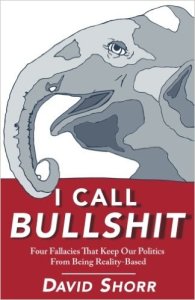
I was predisposed to like David Shorr’s latest book.
Shorr and I met in 2009 when I persuaded him to write an opinion piece for the Des Moines Register advocating for Senate ratification of the Comprehensive Nuclear Test Ban Treaty. He willingly did so with co-author Tom Tully. It ran Dec. 15, 2009, titled, The real peace prize: Ban nuclear testing.
I found his new book valuable to surviving the tumult created by the recent election of a Republican president with Republican majorities in the federal government and the Iowa statehouse. His explanation of why Republicans “have wandered off into substantive incoherence” is cogent. His description of four fallacies regarding job creation, healthcare, foreign policy and voter suppression helped turn social media buzzwords into nuggets of understanding. I particularly enjoyed his discussion of why President Donald Trump makes House Speaker Paul Ryan look like a moderate politician when he isn’t.
While readers may take issue with some of Shorr’s arguments, that’s really his point: we should be able to disagree and make social progress at the same time. Until our national and local politics returns to reasonably working together, this book will help us get by and make the case for reality-based politics again.









 Journey Home
You must be logged in to post a comment.