In addition to calling the American Library Association a “Marxist” organization, and asserting librarians should be arrested for materials found within the walls of spaces they manage, there is an anti-intellectual movement in Iowa to eliminate public libraries. There isn’t a bill for that, because it is a sub rosa campaign. The intent is there, yet supporters hide it because they are dishonest.
Our local library community responded to the bad bills filed by members of the Iowa legislature. They sent an email to patrons and published a guest column in the March 11, Cedar Rapids Gazette. Click here to read the guest column. Shedding light on what this small minority is attempting is the best way to defeat these bills. Anyone with common sense realizes the value our libraries represent in our communities.
I sent this email to my district legislators:
Dear ___
I live in your district urge you to vote no should HF521/SF235 come up for a vote. The bills would repeal current exemptions from Iowa obscenity laws for educational institutions and libraries.
Here is my reason.
The basic question is who should decide what content is available in public libraries and schools? I submit it is someone trained in library science and rooted in the community. We should empower librarians to do their job and settle any disputes regarding content, including those relating to obscenities, without getting run out of town on the rail. The obscenity exemption protects government employees who seek to do their job.
Should we have public libraries? I believe we should because they benefit the entire community, especially those who have limited means. We need an arbiter of what resources are in our libraries, and that person should be a trained librarian.
Vote no on HF521/SF235.
Thanks for considering my request.
Regards, Paul
Supporting your local library includes standing up for them when an unreasonable minority tries to impose their values on the rest of Iowans. The time to contact legislators is now.
Editor’s Note: House File 274 passed out of subcommittee on Monday, Feb. 17, 2-1.
A bill in the Iowa legislature seeks to repeal Section 728.7 of Iowa Code. This section provides a long-standing obscenity exception for libraries and educational institutions. According to the bill, nothing in code prohibits the use of appropriate material for educational purposes in any accredited school, any public library, or in any educational program in which a minor is participating. It further provides that code does not prohibit the attendance of minors at an exhibition or display of art works or the use of any materials in any public library. People are worried that children are being exposed to obscenities enough in public spaces to change how public institutions operate. This bill should be cause for concern for anyone who uses a public library.
I looked through our local library’s policy statements and found this:
Including materials in the collection does not constitute endorsement of their contents. The Library recognizes that any given item may offend some patrons, but, because the Library follows accepted principles of intellectual freedom, it will not remove specific titles solely because individuals or groups may find them objectionable. (Solon Public Library website, October 2022).
The language regarding children and censorship more directly addresses the concern:
Censorship is a purely individual matter. While an individual or group is free to reject material, no library staff person shall restrict access to the rest of the community. Selection of materials is not restricted by the possibility that children may obtain materials their parents may consider inappropriate. While materials are shelved by recommended age, patrons of any age may use materials in all sections of the library (see ALA Bill of Rights, Article V). Responsibility for children rests solely with their parents or legal guardians. (Solon Public Library website, October 2022).
So yes, House File 274 directly addresses existing library policy related to the American Library Association Bill of Rights. Here is the entire ALA Bill of Rights. On Monday, Feb. 17, at 11:30 a.m., an education subcommittee of the Iowa House meets in Room 103 at the State Capitol to consider the bill.
Here is a typical pro comment from the public comments section of the bill where more than a few words were used:
02-11-2025 Jonathan Huber:
I support House File 274 because it aims to protect minors from exposure to obscene content. By repealing the obscenity exemptions, Iowans can ensure that educational and public spaces remain safe and appropriate for all students. It’s important to have clear standards that prevent the distribution of material that could be harmful or offensive. This bill helps create a more secure learning environment where students can focus on their education without the risk of encountering inappropriate content. This bill prioritizes the well being of our youth.
Here is another:
02-12-2025 Sonya Swan
Our children are our future. When a child sees something, they cannot “unsee” it. Those images are forever in their precious little minds. When they read something obscene the result is the same. As an educator, I choose the materials for the children I teach very carefully. Our public institutions, have an obligation to omit obscene material for minors regardless of the location (school or library) or the function. Please repeal 728.7
Here is a con comment:
02-13-2025 Steve Clarke
Dont pass this bill the current exception in 728.7 allows for the use of appropriate material for educational purposes. Nobody is advocating for Playboys and Xrated movies. This is part of the larger cultural wars being waged. Protect our society by denouncing censorship.
Here is a longer con comment:
02-13-2025 Sarah Smith
Do NOT pass this bill. It is not the role of libraries or librarians to determine what children can or cannot readthat responsibility belongs to parents. Rather than restricting access to books, we should encourage parents to be actively involved in their childrens reading choices.If I come across a book I dont want to read or a news channel I dont want to watch, I simply choose not to engage. Thats the beauty of intellectual freedomthe ability to decide for ourselves. HF 274 imposes unnecessary restrictions that would hinder libraries from fulfilling their mission, limiting access to information and stifling the freedom to read.Our communities thrive when libraries are empowered to serve without political interference. Please vote against HF 274 and protect our right to read, learn, and think freely.
If I can figure out the technology, I plan to watch the subcommittee meeting online. In the meanwhile, I recommend you take a look at the comments and tell your state representative to vote no should this bill make it to the full house.
UPDATE: I submitted this comment on the bill:
“Vote no on this bill. There was and is a valid reason for this exception. I hope the committee will consider these things: Perhaps the raciest part of the public library is the romance genre section. It would be okay with me to eliminate this section completely, although many patrons read romance novels. It persists. A local group developed a solution in which a sticker is placed on romance library books suitable for Christian readers. It seems like a workable compromise, better than repealing this section of code. Secondly, I have been shocked at the content of a few books I checked out from the library. I’m thinking of the Elton John memoir Me. John talks openly about his sexuality and if I found it shocking, so could others. Should graders have access to this book? It’s not for me to say, nor for legislators. It is for parents to say. The American Library Association’s Bill of Rights is clear on this: “A person’s right to use a library should not be denied or abridged because of origin, age, background, or views.” If a citizen’s group or individual objects to a book, resolution should take place at the local library or with the library board. As with my example of the racy romance novels, a solution can likely be devised at the local level. Republicans have super majorities and can enact what they will, including advancing the idea that Iowa will become a nanny-state. No reasonable person wants that. Please vote no on this bill. Thanks for reading my comment.”
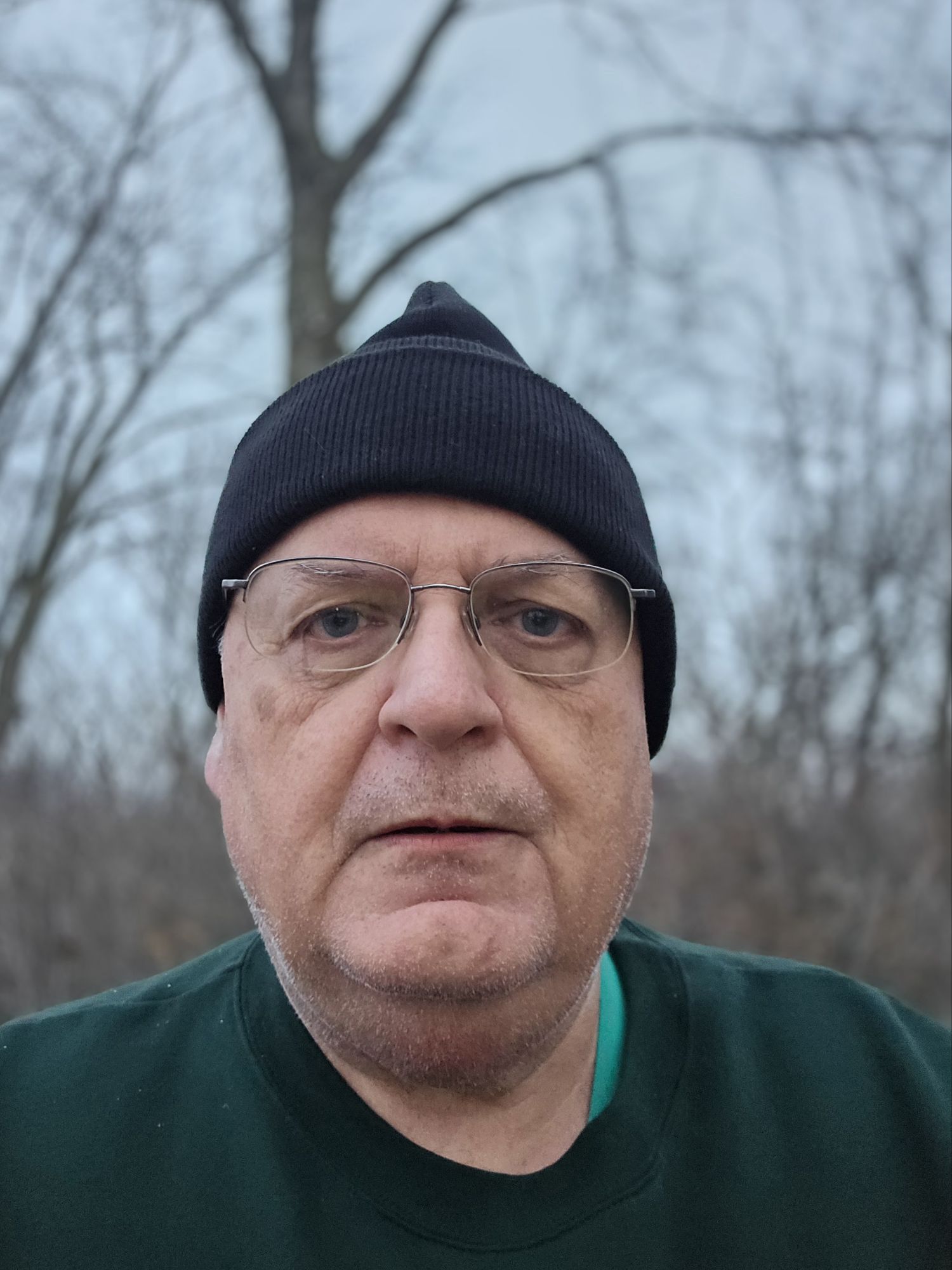
This is the face of a man trying to understand how his Android camera works. The background on the state park trail was planned. The green sweatshirt is my standard winter uniform, although I own sweatshirts in several colors. The watch cap was a gift from a farmer friend. My unshaven face is because I’m at the end of my once every three days shaving cycle. I’m looking at the lens because that’s what I think I should be doing. As selfies go, this is graded C-minus. It reinforces my belief I am not photogenic.
As if 2024 was not bad enough, today’s Cedar Rapids Gazette reported the University of Iowa is ending the American Studies Department in anticipation of anti-diversity legislation effective next year. I graduated from the progran in 1981 when it was a loose interdisciplinary group not even formalized into a department until 2000.
One of my valued possessions is a copy of Charles and Mary Beard’s The Rise of American Civilization with Alexander Kern’s signature inside the cover. I bought it for a buck at the library’s used book sale. I doubt Republicans behind anti-DEI knew of Kern’s early leadership in American Studies at Iowa, or of the Beards’ seminal work. I think that is the point of the anti diversity movement: public schools will only teach one version of American history, the one we legislators approve.
I’ve been around long enough to remember local folks questioning why we should build a big, fancy library in our town with population about 2,000. The money was donated, then the building was deeded to the city for one dollar. The expense of permanent staffing generated some griping. We live in a time when it is not a long distance from these attitudes rising to the surface again, and this time closing the library permanently. I hope not, but here we are.
On the positive side, this week a federal judge struck down key parts of an Arkansas law that would have allowed criminal charges against librarians and booksellers for providing “harmful” materials to minors. Nevertheless, Iowa leads the nation in the number of banned books.
Let’s face it. These discussions and repression of information in public helped make 2024 a difficult year all around.
I’ll likely continue to make selfies. Once I figure out the camera, I might work on posing. For now, I’ll deal with life as it presents itself. What else are we to do?
I heard about the Library of Congress partnership with Twitter to archive all of Twitter, past, present and future since its launch in 2006. I hadn’t heard the project went bust with insufficient funding in 2017. Too many tweets, one presumes.
Should we care? We should, but not because there is profound knowledge on Twitter.
Yes, noted scholars create multi-tweet threads with reasoned arguments, citations, and links to references. Yet what role does that play in advancing learning? The potential audience seems limited on Twitter. Wouldn’t the same argument inform more effectively in a newspaper, blog, or scholarly journal? It would be more targeted, for sure. Such targeting would garner better impact on learning than the transitory ephemera of Twitter..
News writers use tweets as a source of quotations from prominent people. A quote is a quote, I guess. It’s easy, which prompts the related sentence, “they are lazy.” What point are they making? Why not get an actual quote from a news maker? I know the answer: access is easier on Twitter. Definition of the word “access” is peculiar here.
With hundreds of millions of tweets per day, who could read all of that to glean valuable content? Some form of artificial intelligence or tweet-bot, maybe. Not a human. I can’t think of who would want to review all of that. I hardly look at my own tweets from yesterday, let alone something I posted in 2008. There are three hundred million or more tweets per day.
If a user considers their universe in Twitter, a time line can be carefully curated. It is only within this curation that any of it has much meaning. Archiving Twitter would seem to preserve little of that personal vantage point. Tweets are a fungible commodity only to the extent an individual user loses their individuality. We Americans resist that.
The role for libraries and archives with regard to Twitter and other social media platforms is to push governments to define better laws regarding collection, archiving, and ownership of our posting. As the example of Cambridge Analytica during the recent presidential election illustrates, there were few rules about scraping the internet to collect detailed voter information and using the aggregated data to influence the election. At what point does that become an illegal invasion of privacy? The answer hasn’t been defined and doing so falls in the wheelhouse of people who spend their lives compiling archives of information and documents.
When we examine the history of libraries and archives, my bet is as much that was important has been lost as was saved. I think of the Protestant Reformation and its raiding of libraries and archives to destroy the physical records of the Catholic Church. There are plenty of other examples. Regarding Twitter, if the Library of Congress can’t preserve it, then who can and to what end?
With planetary warming, we may not have to trouble ourselves with these questions for much longer. If archives exist to tell the story of humanity’s demise to beings living multiple millennia from now, there is no point. Like us, I doubt future such beings will be much interested in those billions of tweets.


 Journey Home

You must be logged in to post a comment.