LAKE MACBRIDE— So begins the quiet time. Snow covers the ground, temperatures are well below freezing, and life turns inward toward family and friends, and reading, writing and cooking, as we approach the winter solstice. Somewhat spontaneous, and upon us all at once, there is practiced ritual to help us make it through the days.
Christmas at Home
Since making the last CSA delivery during Thanksgiving week, these days have also been a time of recuperation. The year’s physical labor was not without its toll. Tendons, ligaments and connective tissue are not as flexible as they once were, so despite a cautious approach to work, I have been a bit sore. Recovery is well under way, but I don’t recall that aspect of life from previous holiday seasons. Who knew naproxen sodium and skin moisturizer would become as prevalent as Christmas greetings and holiday lights?
All Roads Lead Home
Today, I’ll write and mail the fundraising letter for a social group. I’ll read a book, and plan for next year. There are a few errands in the hopper as we move toward the weekend. Then there will be the bustle of house cleaning, and decorating from the boxes of stored memories kept below the stairwell. One can get lost in the pattern and there is a yearning to do so because of its comfort and familiar warmth.
A time to let go of ambition and desire, and to return to being native.
LAKE MACBRIDE— Having a headache rots. Having one on Saturday rots more. Last Saturday, my headache was bad enough to cancel the whole day’s schedule with the exception of working at the newspaper. That wasn’t the worst of it.
Something happened to shuffle my memory, creating chunks and particles that float before my mind’s eye like the colored shapes in a kaleidoscope. As it happens, I try to recognize the bits and pieces. They are familiar, but disjointed from whatever associations may have existed. The sense is they are important, but maybe not. It has been a weird few days since then.
Whatever it was, Saturday stands as a line between my past and what will be— something I need more than want. We all cling to memories and forget they serve our future, not nostalgia for days of yore. It was a clean cut, enabling a fresh approach to each day’s endeavors. Yet the bits and pieces persist.
The effect has been to concentrate on creating well considered cultural objects: writing, food, trips in the car, segments of time spent with others. One fears, and to some extent welcomes, the idea we only live once and had better make the best of it. That is where I’m finding myself today.
Whatever was lost on Saturday may not be found, and it’s time to let go and move on after the shuffle.
LAKE MACBRIDE— It became clear the planned Thanksgiving dinner was not going to happen when the well outage persisted into its third hour. We live in a rural subdivision with a public water system managed by volunteers. They took prompt action when the water stopped around 12:15 p.m., but the contractor lives in Toddville, so it took an hour or so for him to arrive once contacted. After the second hour of no water flow, we decided the gallon jug plus a few on-hand containers of water were not enough to finish preparing the menu in yesterday’s post. We rescheduled the vegetarian feast for Saturday, and I made a pizza requiring only a cup of water for the dough. Life is change and adaptation.
The cause du jour this holiday weekend is retail and restaurant workers called in to work on Thursday so people could shop after Thanksgiving dinner. I don’t get it.
Having lost count of the number of holidays I have had to work, I know what it’s like to sacrifice family time for a job. Working holidays included the only Thanksgiving my mother spent with us since our wedding. Even so, it’s hard to share the sense of moral outrage others express about low wage workers having to work on Thanksgiving. And I plan to continue the off and on annual trek to Farm and Fleet with a friend from high school later today, Black Friday or no. But maybe I do get it.
There is a progressive movement to increase the minimum wage, and selected low wage Thanksgiving workers have been used as a prop by unions and progressive organizations to call attention to the issue. It’s advocacy 101. To the extent low-wage workers support it, I’m with them. I’m not convinced the vast majority do.
There are complicated reasons why a person would accept a low paying job. It’s always partly about the money, and who couldn’t use more of that? But it’s also about social networking, a sense of self-esteem, and the systemic reliability of the paycheck. The latter is almost never discussed, but it is important.
There is a stark difference between working for a small business and a large corporation with an established compensation program, and adequate cash flow. When a person begins work with a large corporation, there is a detailed and consistent process for generating a paycheck, one that is usually well explained during orientation and training. There are hiccups, but over the long haul, having such a process benefits both the employer and the employee. Working for a small business is different, and given a choice, people often choose to accept low wages and work for a large corporation. What you see is what you get, less subject to personality and its inherent inconsistencies, both of which are often found in small businesses.
That said, U.S. workers have a right to organize and form a union. Why is it that so few (6.6 percent in 2012) private sector workers form a union? Why is it private sector unionization efforts so often fall flat? The simple fact is that for low wage workers, union organizers represent one more thing to deal with in an already complex cultural fabric. Because a union can’t make any promises, there is little reason to join an organizing effort unless one is already disposed to do so. Too, the potential fluidity of lowly paid work is such that rather than deal with the drama of a union organizing effort, a person can easily move on to another position. As I have written previously, unions must become more relevant to low wage workers to have a chance to organize them. This is something they have failed to do, at least in my experience.
As the sun has risen, there is work to do before taking off to meet up with my friend. He’s a union member so I’m sure we won’t cross any picket or protest lines today. We may buy something, but if we do, it will only be something we need. I’m thankful for the working life that put me in this position… and not only on Thanksgiving.
LAKE MACBRIDE— The school crossing guard at Fillmore and Locust told me President Kennedy had been shot on my way back to school. I don’t recall walking the last block, but upon arriving at the sixth grade classroom, our teacher pulled down the window shades while we waited for news.
In the fifty years since, this memory persisted, with immediacy, and its uncertainty. I’m still don’t understand what it meant or what it means.
The crossing occurred three blocks from where I was born, a block and a half from where my mother had just served lunch, and a couple of hundred feet from the Catholic church where my parents wed, my grandmother had worked, and where I was baptized, confirmed and attended my father’s funeral. A couple of hundred feet ahead was the duplex where as a toddler I visited my maternal grandmother. That neighborhood was at the core of who I was.
I don’t recall much from the rest of sixth grade, after which we attended school in the new building, and experienced the first of many renderings. I was placed in a classroom with the group of kids who were bound for college, and separated from most of my neighborhood friends. In high school we were rent further as the boys were separated from the girls. After high school, we belonged to the world, and college, and I left not knowing I was also leaving Davenport for good. None of it had anything to do with the Kennedy assassination, and I’ve known that all along.
50 years later I attended an event in the county seat where a local author, the owner of an independent bookstore, one of my graduate school professors and someone else spoke about the day Kennedy died. Familiar icons were mentioned, and the bookstore had a table full of JFK books for sale outside the room. That hour provoked this post, and that seems okay. Because without the noon event, I would not likely have thought of President Kennedy at all today, as I had long ago moved on, almost forgetting how simple life was then.
LAKE MACBRIDE— Politicians glom on to veterans like there is no tomorrow. Veterans vote, we live in society, and most of us served and left the military behind without comment or regret. Politicians should work to reduce the number of veterans we are creating as a society, rather than glomming onto our service for political reasons. That could be their service, and the nation would be grateful.
The newspaper work is finished for today. The focus will be on home work. The atmosphere is calm, so the brush pile can be burned, preparing a space for planting garlic tomorrow or next week. There are lots of apples for processing into applesauce, apple crisp and maybe some dehydrated apples. That is, once the dried herbs in the dehydrator are removed and cleaned. The last of the fresh tomatoes will be turned into a pot of chili for supper. There are more turnip greens for soup stock, and a drawer full of root vegetables in the refrigerator— plus whatever else is harvested today. There is a whole afternoon of kitchen work.
Having gone to town this morning I hope to remain on the property, or within walking distance. Maybe once the brush is burned, I’ll take a walk on the lake trail, but no further. It’s what’s called living, and we don’t do enough of it. And it’s time to get on with it.
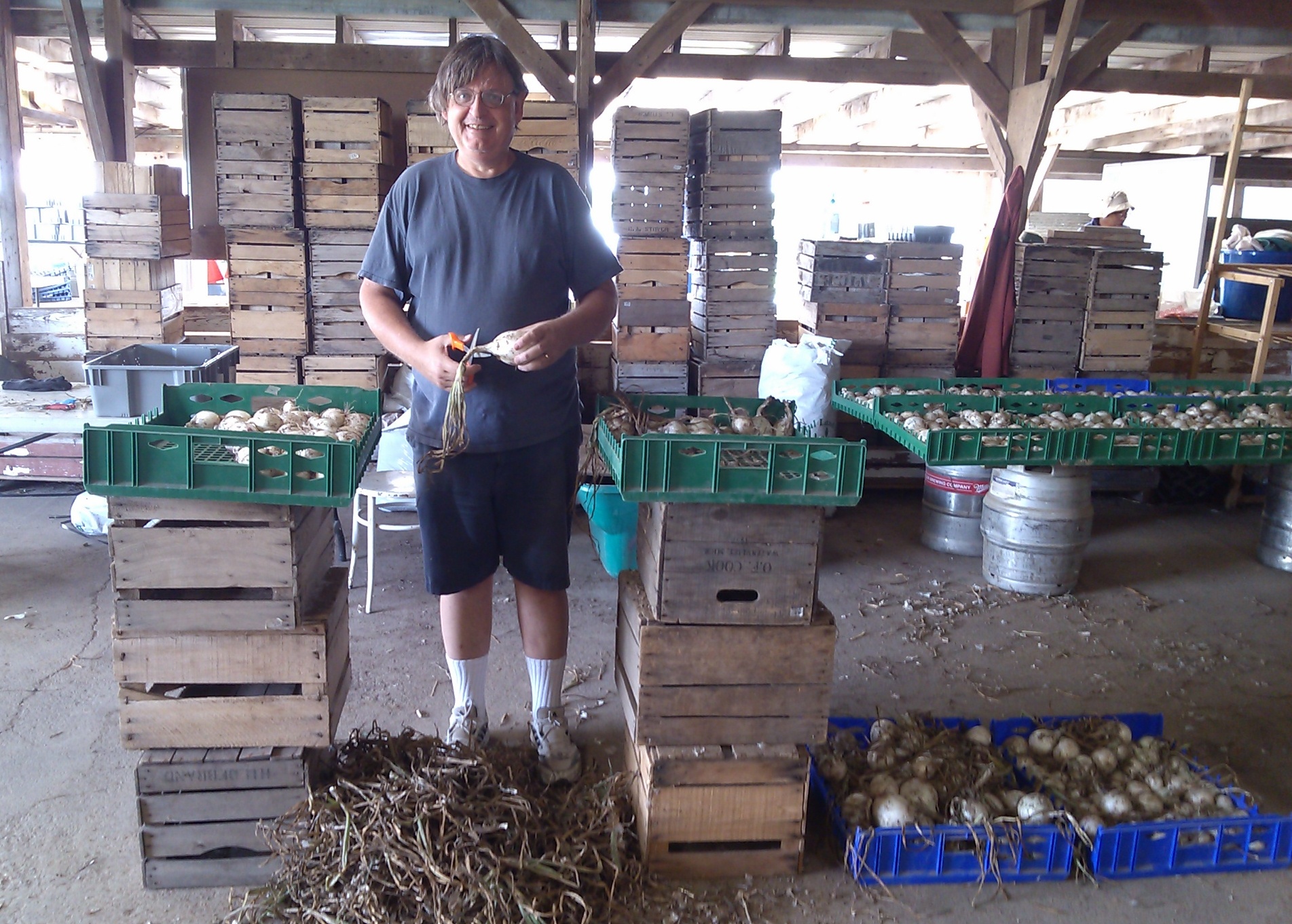
LAKE MACBRIDE— Napping when the email arrived, an hour later I woke, read it and made it over to the farm at a quarter to noon to clean onions. It was solitary work removing the tops and roots, and sorting them into crates. It took five hours. While I worked, one person was at a meeting in town, two sorted and cleaned potatoes, and another sorted spaghetti squash. Silent, but communal work in support of our local food system. Around 1 p.m. everyone else had finished and was gone, leaving me with my thoughts and work.
One of the ironies of this year has been that while working a lot of hours in local food production, my time in the kitchen has been limited. I prepared a number of seasonal dishes, but there was little experimentation or cooking for pleasure. Most of the kitchen time was spent preserving food, rather than preparing meals, converting that part of our home to a temporary mini-factory.
Rendering fresh produce into a shelf-stable product is a vital part of summer abundance. This year there are some new items: dill pickles, sweet pepper sauce, and grape and raspberry jam. As fresh cooking turns to pantry cooking, the household is ready.
In the declining light of the barn, something enveloped me. It was as if the world had been shut out as my pile of onions leaves mounted. I returned briefly to youth, and the holiday time. When there were trips to the drug store to see what seasonal offerings were made. There were trips to used book stores, to secure a supply of winter reading material, even though there was plenty to read already in the house. An trip to the liquor store to buy some wine made of German Riesling grapes, or distilled French spirits: Armagnac, cognac and Calvados. The luxuries of plain living all.
When the onion cleaning was done, the sun was setting and I headed home along the gravel back roads littered with fall foliage and deer crossings. For dinner I cooked veggie burgers and served them on buns bought from the day old rack at $1.40 for eight. Condiments were ketchup and a slice of onion, sides of coleslaw and baked beans. Comfort food for a hearty meal.
What did my onion day dreams mean? It’s hard to say, but the actuality of that feeling took me back to a time of less worry, and living in each moment. A time when our potential seemed unlimited as we left home to see what the world had to offer. In some ways, that journey was never completed. Who knew it would end up in a quiet barn cleaning onions?
LAKE MACBRIDE— Since July, my agenda has been packed with paid and unpaid work. As autumn yields to winter, I found myself working twelve days straight. Feeling similar to how I felt after returning to garrison after long periods of military field work, I’m making time to take care of basic necessities, and have created this chronicle of how things went.
3 a.m.— Rise, make coffee, read messages and articles, write emails, daily planning.
5 a.m.— Breakfast of pancakes with apple butter on top.
7:05 a.m.—Rearrange cupboard above the refrigerator (clean off thick layer of dust on top). Organize shelf stable goods in the pantry.
9:16 a.m.—Create work space in garage and downstairs.
9:45 a.m.— Pick up paychecks and empty canning jars, chat with two of my favorite farmers, take recycling to Iowa City, get groceries at North Dodge HyVee.
11:47 a.m.— Lunch, start dish washer.
12:32 p.m.— Scan paychecks into the bank account.
12:57 p.m.— Take a nap.
1: 27 p.m.— Select the ripe tomatoes from the counter to make pasta sauce, and get started.
2:09 p.m.— Sort cracked garlic for planting/eating.
2:37 p.m.— Finish prep work and start pasta sauce to simmer.
3:03 p.m.— Pay bills. Read mailers from Wellmark and Delta Dental on changes to plans for compliance with the Affordable Care Act.
3:34 p.m.— Take nap #2.
4:25 p.m.— Clean up to do prep work for dinner, and bask in the glory of a day on my own.
4:26 p.m.— Realize the the existential struggle for existence in the post-Reagan society restarts tomorrow.
LAKE MACBRIDE— Some part of the last 11 days has been paid work at one of four jobs. If it rains today, there will be a day off. No rain, and there are three possibilities for paid work. I’m hoping it rains, but a day off means working at home on a couple of the too many projects at hand. In this post-Reagan retirement there is never a real day off, but it’s fun to pretend. A lot can happen as the world wakes up this morning.
For now, it’s time to head to the kitchen, make breakfast and a list of priorities for today. That is, unless the phone call comes that there is work.
UPDATE: The phone call and email came, and I captured two work assignments.
LAKE MACBRIDE— At the end of the season, before the last gleanings from the garden have turned to compost, home cooks prep and cook and preserve to make use of summer’s bounty.
Foraging in the refrigerator as if it were foreign turf, forgetful of how the mix of cut onions, diverse greens and leftovers arrived, the best is culled for a hearty fall soup. Kale and onions, Brussels sprouts and broccoli stalks, celery and carrot, a turnip, some potatoes, frozen sweet corn, and everything else suitable goes into a large, stainless steel stock pot.
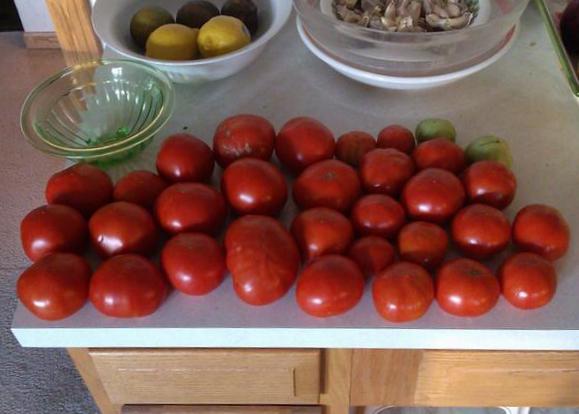
Tomatoes are selected from the counter, their numbers diminishing without replenishment from the garden patch. Cutting away the soft and dark spots, they were cored and pulsed on low speed in the blender, skins and all. The red puree was poured all at once into the simmering ingredients. A handful of leftover farfalle, bay leaves, some dried red and black beans, and chervil were added. The pot simmered more than an hour on low heat. It was soup for dinner.
At 3:15 a.m. I brought the graniteware water bath canner from downstairs to the kitchen. Using the wire rack, four quarts and a pint of applesauce, plus the pepper puree made this weekend, were lowered into the pot which was then filled with warm tap water. Moving the heavy pot to the stove, I turned the heat on high to process the jars of summer goodness. Now breakfast.
While working in the local food system, one never knows when or where the next paying job will come along. I finished the season at the orchard yesterday, at one CSA the work is clearing the field, which won’t take too long, then there is the planting in the high tunnel and fall share help, which will end soon as well. There is the prospect of cutting firewood at another farm, but weather seems likely to intervene before long. It begs the question, what’s next?
While invited to return to the warehouse after the season, it doesn’t pay enough given the investment in health and well being required. It is a fallback position to pay some of our bills should no other opportunities present themselves. There are a lot of low wage jobs around town, but they present the same problem of occupying space without providing enough income. I’m confident something will materialize.
While there is fresh food, I’ll continue to eat well and stock the pantry for winter. Mostly, we eat to live, and there is still time to make deposits in the food pantry. Hopefully there will be enough reserves to see us through until spring.
RURAL SOLON— While finishing a shift of deconstructing tomato cages, I walked along the row of frosted bell pepper plants toward the gate. It snowed yesterday and hard froze last night. I picked six pepper survivors for the flat side upon which to sit on the baking sheet. There was a lot of food that survived the snow and frost, but we enjoy stuffed peppers a time or two during each year, and that was my choice.
When it was time to begin preparing the meal, I cored, parboiled and stuffed the peppers with a mixture of rice, eggs, a blend of Italian cheeses, cooked onion and garlic, and dried rosemary and sage. They were topped with leftover pasta sauce and went into a 350 degree oven for 22 minutes. We had a working family supper, served with sweet corn and fresh tomato slices.
On a cold day food fresh from the oven, made with local ingredients raised by people we know is as good as it gets. It is a simple pleasure, one that bears repeating if that is possible.




 Journey Home
You must be logged in to post a comment.