Categories
Environment Living in Society

Train Wrecks and an Ag Summit

Galena Train Derailment

As punctuation to my article Why Bakken Oil is Dirty, last Thursday’s BNSF oil train derailment in a remote area near Galena, Ill. tells the story better than I could.

It is the third Bakken oil train derailment in the last three weeks according to National Public Radio.

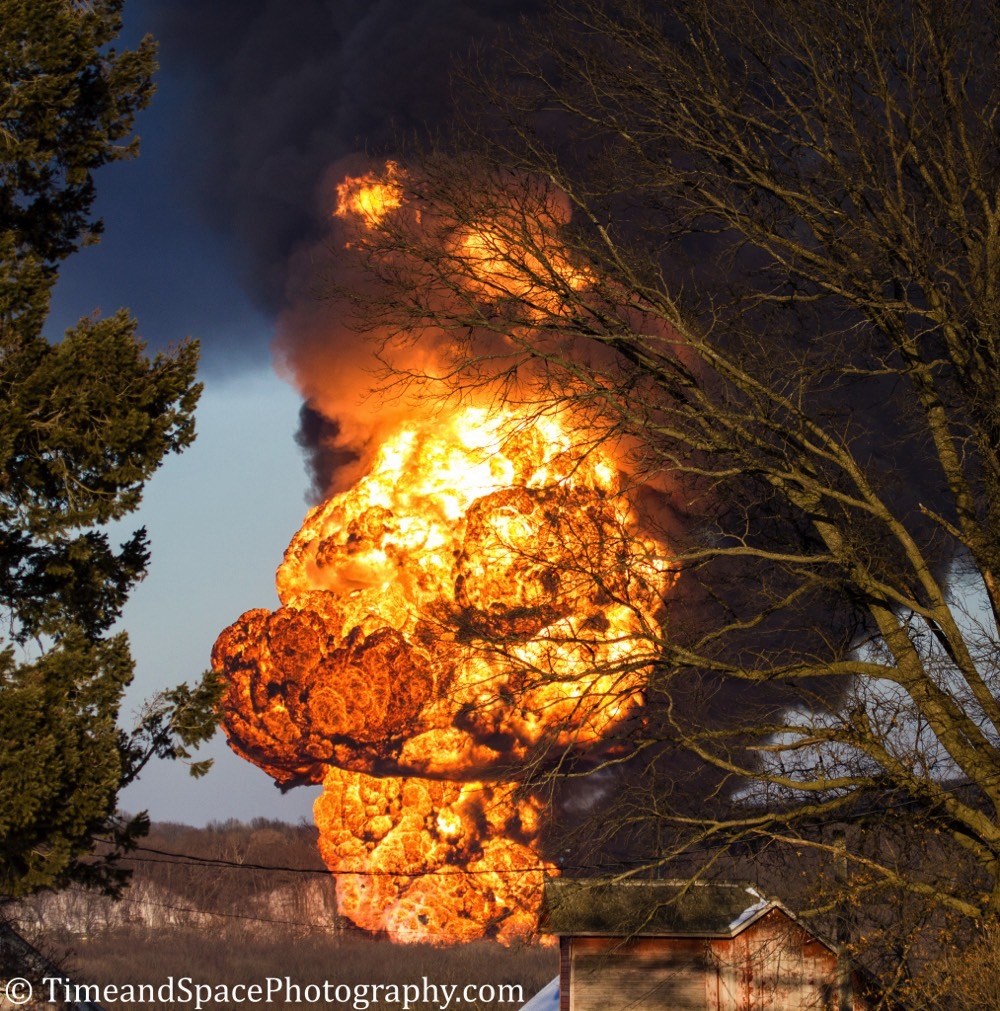
Carrying light sweet crude to market from the Bakken field, the train derailed on tracks inaccessible to first responders, rupturing at least five tank cars of 21 that left the tracks, igniting a pyre that could be seen for miles. No one was injured and officials are investigating the causes. Because of the location, accessible only via a bicycle path, fire fighters decided to let the fire burn itself out. Remediation of the oil spill will be difficult because of the location, but no oil has made its way to the Mississippi River yet. As I write, the fire is still burning.

BNSF was quick to report the rail cars were a newer, safer model voluntarily designed to be less prone to rupture. Critics say it’s not good enough. Being a level headed Iowan, I’m willing to wait until the investigation is complete before condemning anyone but ourselves and our addiction to fossil fuels.

“In the coming days, we need to look at not just the safety of the rail cars, but the safety of what is being put into those cars,” U.S. Senator Dick Durbin told NPR. “There is mounting evidence that stricter standards are needed in the handling of Bakken crude which appears to be particularly volatile. We can’t wait. The safety of our communities depends on it.”

News coverage of the accident revealed that the State of North Dakota will require oil producers to remove excess natural gas from the crude oil before shipping it by rail to help reduce volatility, according to NPR. What exactly that means, and whether it will make a difference is uncertain. It confirms what I said in my last article about the volatile nature of the Bakken crude oil being shipped, and the role the refining process plays in its volatility.

Photo Credit: Quad City Times

While the Galena fire burned, Bruce Rastetter’s Des Moines Ag Summit proceeded on schedule, serving up Republican nostrums the way cattle in a CAFO are fed. All twittering eyes were on the summit, leaving a void among Democrats. Democrats don’t have anything similar to this, so it was a great way for Republicans to build party support. Disagreement and agreement with looney ideas is part of Republican party-building, and they are getting better at it with each election cycle.

Iowa Citizens for Community Improvement, who demonstrated at the Ag Summit and held their own event, are neither Democrats nor lefties, despite repeated corporate media attempts to characterize them that way. In my experience, they are issue-oriented individuals who band together to make points about life in Iowa, using visible, direct action tactics in their advocacy. The reason they receive media characterization at all is Democrats cede the space to Republicans on these presidential candidate cattle calls. There is nothing else for political reporters and bloggers to cover.

Rastetter contributed over $60,000 to the Branstad-Reynolds re-election, and $1.49 million to various candidates over the last 16 years according to FollowtheMoney.org. Who is the Democratic equivalent? Maybe Fred Hubbell, who gave $60,000 to the Hatch-Vernon campaign.

Hubbell may be well known to political insiders but most Democrats only know vaguely that he is an attorney, if they even know that. He would be no useful substitute to the hated, loved, and very public Rastetter.

Democrats had the Harkin Steak Fry as a comparable event, although last year’s was to have been the last. Maybe it will return, but that’s up to Harkin, not us.

For the first time in a long while, I didn’t hear that our county party was having an off-year caucus last week until after it had begun. I arrived home from work just as it was finishing. If a couple of people hadn’t been covering it on twitter, it would have passed unseen. That’s a train wreck of a different kind.

As we hope for spring, society begins to make more sense. For now, winter’s cold remains, and there’s plenty to keep us busy as we sustain our lives on the Iowa prairie.

Categories
Environment

Are Property Rights a Climate Action Tool?

WHY-WHY-NOT-MELBOURNE2-4_0For many, protecting property rights is high on the list of priorities. It’s the American way, shouldn’t it be so? A related and perhaps better question is whether climate advocates should use eminent domain as a tool to advocate against energy related projects.

Answers are elusive.

When the U.S. Supreme Court decided in Kelo v. City of New London that the general benefits a community enjoyed from economic growth qualified private redevelopment plans as a permissible public use under the Takings Clause of the Fifth Amendment, property rights advocates were up in arms. There is a role for eminent domain when governments initiate the process, but private developers should have no such rights, they said.

Kelo may mean that when U.S. infrastructure projects are developed by foreign corporations (TransCanada Corporation’s Keystone XL Pipeline) or by U.S. corporations (Energy Transfer Partner’s Dakota Access Pipeline or Clean Line Energy Partners’ Rock Island Clean Line), foreign or private domestic entities have the right to initiate condemnation process and take easements and other property to build their projects.

In a March 2 article in the Des Moines Register, William Petroski reported, “a majority of Iowans support plans for a crude oil pipeline in Iowa and a wind electricity transmission line project, but they overwhelmingly oppose the use of eminent domain for both projects.”

Politicians have argued that these projects create jobs, decidedly temporary ones, and in today’s economy people should accept such jobs, implying they should also cede eminent domain rights to U.S. or foreign corporations. This couldn’t have been clearer than the Keystone XL Pipeline bill passed in the U.S. Congress, vetoed by President Obama.

Kelo is not without emerging challenges.

On Feb. 18, the Iowa Supreme Court heard oral arguments in Clarke County Reservoir Commission v. Edwin D. and Deloris A. Robins Revocable Trust. The case is an appeal of an April 8, 2014 lower court decision wherein “Judge Sherman W. Phipps of the Fifth Judicial District of Iowa ruled in favor of CCRC’s ongoing Squaw Creek Watershed project, confirming it is for a public use, public purpose or public improvement as defined in the Iowa Code,” according to Amy Hansen of the Osceola Sentinel-Tribune. Developers seek to make a recreational lake much larger than the size required to serve water needs for the community to enhance property values as they sell adjacent lots.

Whatever the outcome of challenges to the Kelo decision, climate advocates are damned if they do and damned if they don’t regarding use of eminent domain as a tool. The contrast between the Rock Island Clean Line and the Dakota Access Pipeline exemplifies the problem.

On Aug. 20, 2014 while on the Great March for Climate Action, David Osterberg of the Iowa Policy Project said Iowa needed a way to get wind-generated electricity out of western Iowa to markets. His view is not unique among climate action advocates. The Rock Island Clean Line offers one such solution, but some property owners along the proposed route won’t allow an easement voluntarily. Osterberg said the Rock Island Clean Line wasn’t perfect, but it did offer a solution to shipping electricity to markets. The implication is that eminent domain may have to be used by a Texas company to build the project, although Osterberg did not say that specifically.

Use of eminent domain to stop the Dakota Access Pipeline is favored by climate action advocates. Because Bakken Oil is dirty, advocates seek to obstruct access to market through Iowa. Eminent domain has made unlikely partners in the Iowa legislature, where Senator Rob Hogg, who has given more than 100 presentations for The Climate Reality Project founded by Al Gore and is author of America’s Climate Century, began partnering with Rep. Bobby Kaufmann, a crop and livestock farmer and small business operator who is also a member of the Farm Bureau and National Rifle Association, to oppose the Keystone XL Pipeline on eminent domain grounds.

As the Iowa Utilities Board evaluates the proposal for the Dakota Access pipeline, eminent domain has more traction than the argument that fossil fuels should be left in the ground because of their contribution to anthropogenic climate change. Climate action advocates favor the latter argument, but will support the former.

Property rights advocates like Kaufmann are unlikely to go both ways on the eminent domain issue.

“The Bakken (Dakota Access) Pipeline and the Rock Island Clean Line should pick out baby names and choose a honeymoon destination, because the two issues just got married,” said Kaufmann in a Jan. 31 interview with the Solon Economist. “You’ve got two different companies that want to ship two versions of energy. They’re both private Texas companies and both want to ship a product out of our state without allowing anyone in our state to tap into it.”

Use of eminent domain hinges upon “public use.” Set aside creation of a number of temporary jobs and the public use of conveyances for energy related products is elusive, especially with the Dakota Access Pipeline. In any case, corporations benefit more than people in both Iowa projects and with the Keystone XL Pipeline.

Property rights can be a tool for climate action advocates, but it has been an imperfect one at best.

Categories
Environment Writing

Snow Fell

Snowstorm
Snowstorm

Snow fell as I drove home on Mehaffey Bridge Road through the lakes—a crystalline, sparkling snow. The wind blew as the sky darkened with imminent nightfall. I had turned the radio off.

I passed a frozen pond where a herd of deer and a flock of wild turkeys browsed—for what I couldn’t discern. A bald eagle flew overhead while entering the lane to our house. What other wildlife existed in the winter landscape went unnoticed, obscured by three historic species.

It is a time of change. This morning there is no Iowa City Press Citizen as the newspaper returned to a Monday through Saturday issue. They had been doing a brief cover, then inserting another Gannett Company paper, Des Moines Register, inside. Today the county seat is again without a daily newspaper.

That’s not to say there isn’t news. It’s just that people get news from a lot of other sources, including talking with neighbors and friends in person and over electronic media. Since I began writing for newspapers, I have read ours more. Despite the informative stories found inside each issue, news and news writing are not what they were, and the Monday issue is frequently quite thin. I predict newspapers will survive, but they compete for eyeballs in a way that has changed and continues to change. The economics of competition has led to less news coverage in newspapers and everywhere as we focus on the obvious.

I arrived home and turned the radio on to A Prairie Home Companion. That has changed too. One wonders how long it will continue once Garrison Keillor moves on.

Thinking about the mango-orange spread I bought last week, I put two tablespoons in a dish, added four tablespoons of home made salsa, mixed them together, and opened a bag of organic tortilla chips for a welcome home snack. Jacque was at work and not expected for a couple of hours.

The sweet taste of the mango came first, then the heat of capsaicin. It was crunchy, sweet, salty and spicy all at once. A perfect example of what living in these times means. We want it all at once.

We don’t often linger in falling snow to see what else is there. I’m certain it’s more than deer, turkeys and eagles.

Categories
Environment

Why Bakken Oil is Dirty

Bakken-Pipeline-Proposed-RoutePeople who care about hydraulic fracturing say the oil coming from the Bakken formation in North Dakota, Montana and Saskatchewan is dirty. It is. All oil is dirty, and my two cents is we should leave what’s there in the ground. That won’t go over well in North Dakota where discovery of the Parshall Oil Field in 2006 created an oil boom.

What makes Bakken crude oil problematic is that it contains more volatile organic compounds (VOCs) than oil shipped from wells in other regions of the country. This makes the oil more flammable, so when there is a train derailment, as there was in Lac-Mégantic, Quebec in 2013, the oil easily ignites and creates hell on Earth. (Read Adam Federman’s article in Earth Island Journal here).

Because so little public study has been conducted on Bakken crude oil and the operations that produce it, scientists don’t fully understand why the oil is so flammable. There are suspected causes.

The Bakken formation shale oil boom developed from almost nothing to more than a million barrels of crude oil daily in a short period of time. According to Federman, the infrastructure doesn’t exist in the Bakken to fraction off the VOCs as is done with other oil production facilities. The oil is shipped with the VOCs in it, making Bakken crude oil more flammable. There’s more Bakken crude oil today, it poses a real threat to public safety, and the transportation modes used are not regulated well enough for the commodity’s characteristics.

One of the frequent concerns in the Bakken is there are not enough suitable rail cars available to meet shipping needs. Lack of transportation capacity to get the oil to market is an issue. This created a business opportunity, and that’s what the Dakota Access pipeline is about.

Debate over trucks vs. rail vs. pipeline to transport Bakken crude oil is wasted time. Each mode of transportation has its own issues, and most transportation experts agree pipeline is the safest of the modes of transportation. Regardless of transportation mode, if there is a spill, first responders will be required to deal with a commodity on which they have in most cases received inadequate training. That problem could conceivably be fixed, but awareness of the issue hasn’t adequately emerged as we wait for the Iowa Utilities Board’s public healing on the Dakota Access oil pipeline.

Combine the increased flammability of Bakken crude oil with lack of proper shipping regulations and capacity, and we know why it is called dirty oil.

Categories
Environment

Road to Paris Comes Through Iowa

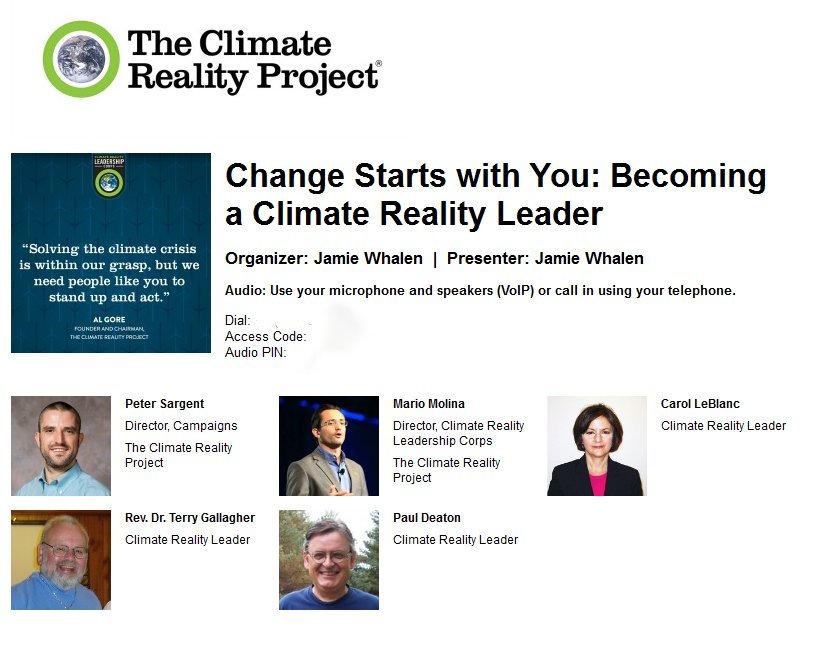
WHY-WHY-NOT-MELBOURNE2-4_0On Tuesday, The Climate Reality Project announced three North American trainings, one of which will take place within a short commute from my home. Here is the announcement email I received from colleague Mario Molina:

Dear Paul,

Our New Delhi, India training is coming to a close, and we have some important news to share with you as we continue along the Road to Paris.

We’re hosting three trainings in North America this coming year — and we’re going to need your help to grow the Climate Reality Leadership Corps! Below are the upcoming training locations and dates:

Cedar Rapids, Iowa: May 5-7
Toronto, Canada: July 9-10
Miami, Florida: September 28-30

Will you share this exciting information with your networks today? We know some of our best new Climate Leaders will be sent to us from you, and we trust your judgment. As a matter of fact, our training in New Delhi boasted the highest ever referral rate from existing Climate Reality Leaders.

Each one of these trainings is a key stop along The Road to Paris, and it’s extremely important that by the time COP21 descends on Paris, we have a strong, loud, and dedicated group of leaders to demand climate action.

Training applications are now open, so don’t let these future leaders wait. Their opportunity to make a difference in this crucial fight for a safe climate could be waiting in Cedar Rapids, Toronto, or Miami.

Thank you for your unwavering commitment to climate action, and for inspiring your friends, family, and colleagues to join you.

Warm Regards,

Mario E. Molina
Climate Reality Leadership Corps Director
The Climate Reality Project

Categories
Environment Living in Society

Is Iowa Prepared for a Megadrought?

State Senator Joe Bolkcom (D-Iowa City)

State Senator Joe Bolkcom, member of the natural resources and environment committee, spoke last Tuesday at the capitol about environmental issues.

“Is there anything related to the environment you would like to see covered in greater detail?” I asked.

“There are some questions around megadroughts coming mid-century,” he said. “Have we dedicated enough attention and resources to protecting underground water systems?”

Bolkcom pointed to a number of concerns: recent defunding of the Department of Natural Resources underground water monitoring system; gaining an understanding of the water withdrawal rate for ethanol plant operations; a needed review of policy by the  Environmental Protection Commission; a review of DNR regulations pertaining to water permitting; the need for a geological survey of water resources, the Silurian and Jordan aquifers specifically; and the impact of water usage by data centers such as Google and Facebook. He had given the matter considerable thought.

“Should we have other thoughts about the Jordan and Silurian aquifers as we head toward 2050?” Bolkcom asked. “Today, once an industrial user secures a permit, they can withdraw as much water as they want.”

There were more questions than answers during my brief time with Bolkcom, but his thrust was that Iowa needs to do more to ensure resiliency during extended drought conditions.

It is difficult to forget the severe drought of 2012. Governor Branstad called a special meeting of agriculture groups in Mount Pleasant that July. (Read my coverage of that meeting here.) Climate change was completely absent from the discussion, even if farmers had to deal with its enhancement of drought conditions. To paraphrase the reaction, farmers planned to plow the crop under, capitalize the loss, and plant again the following year.

What if the drought extended more than a season or two? What if it lasted for decades? According to a study released this month that’s what we can expect.

“Droughts in the U.S. Southwest and Central Plains during the last half of this century could be drier and longer than drought conditions seen in those regions in the last 1,000 years,” according to a Feb. 12 press release issued in conjunction with a new study led by NASA scientists.

“Natural droughts like the 1930s Dust Bowl and the current drought in the Southwest have historically lasted maybe a decade or a little less,” said Ben Cook, climate scientist at NASA’s Goddard Institute for Space Studies and the Lamont-Doherty Earth Observatory at Columbia University in New York City, and lead author of the study. “What these results are saying is we’re going to get a drought similar to those events, but it is probably going to last at least 30 to 35 years.”

When Bolkcom referred to megadroughts, this is what he meant.

The potential exists for megadroughts more severe than any in recent history, according to the study published in Science Advances by Cook, Toby R. Ault and Jason E. Smerdon.

“Future drought risk will likely exceed even the driest centuries of the Medieval Climate Anomaly (1100–1300 CE),” the authors wrote. “The consistency of our results suggests an exceptionally high risk of a multidecadal megadrought occurring over the Central Plains and Southwest regions during the late 21st century, a level of aridity exceeding even the persistent megadroughts that characterized the Medieval era.”

Whether Bolkcom’s questions find answers is uncertain, however he is alone among legislators I spoke with in asking them. He was correct that members of the public haven’t engaged on something the legislature should be taking up during its 86th General Assembly.

~ Written for Blog for Iowa

Categories
Environment

Dakota Access Pipeline Update

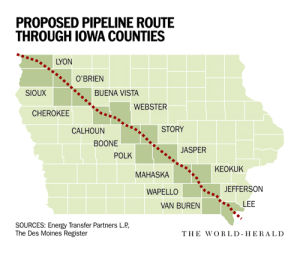
Bakken-Pipeline-Proposed-RouteThere has been a lot of news about the Dakota Access Pipeline (aka Bakken Oil Pipeline) during the last three months. Where does the project stand? Here’s an update based on information gathered this week.

On Jan. 20, Dakota Access, LLC, an Energy Transfer Company, filed its petition for a hazardous liquid pipeline permit with the Iowa Utilities Board in Docket No. HLP-2014-0001 according to Donald Tormey, IUB spokesperson.

After the petition has been fully reviewed by board staff and is determined to be sufficiently in order, an order will be issued by the board setting the date for a public hearing.

“Due to the size of this project, the petition review process will take considerable time and there is no certain way to predict an exact hearing date,” Tormey said. “When a hearing date is established, it will be posted on the Board’s hearing and meeting calendar on the IUB website.”

During a meeting with state Senator Joe Bolkcom (D-Iowa City) yesterday, he said a bill has been introduced into the legislature to increase the amount of liability insurance for companies seeking to pursue large projects such as the Bakken Oil Pipeline. State Rep. Bobby Kaufmann (R-Wilton) said he is seeking House support for a similar bill.

Wally Taylor and Pam Mackey Taylor, representing the Iowa Chapter of the Sierra Club, were at the capitol soliciting signatures on a letter to the IUB opposing approval of the Dakota Access project. The draft letter cited four reasons for opposition. The pipeline would provide no benefit to Iowans, landowners would be forced to give up their land by eminent domain, pipelines leak, and the pipeline will further enable this country’s addiction to oil.

A new pipeline will delay the U.S. transition to clean and renewable energy and more fuel-efficient vehicles according to the Sierra Club.

The period for filing comments, objections and letters of support is still open according to Tormey. Anyone seeking to file objections, comments, and letters of support in this docket may do so by using the Iowa Utilities Board’s Electronic Filing System (EFS), citing the docket number, and clicking on the “Submit Filing” tab and following all instructions to log-in as a guest. Persons lacking computer access may file written comments by mailing them to the Iowa Utilities Board, Executive Secretary, Docket No. HLP-2014-0001, 1375 E. Court Ave., Rm 69, Des Moines, Iowa 50319-0069

The direct link for electronic submissions is here. To view other filings, click here.

~ Written for Blog for Iowa

Categories
Environment Sustainability

Sustainability in a Turbulent World

Earthrise 1968
Earthrise 1968

An approach toward sustainability begins the way Hollywood movies sometimes do—with a view of Earth from space, successively narrowing the frame until we arrive at street level. In U.S. cinema the final shot is of individuals, characters mis en scene.

A new perspective is possible with the launch of the Deep Space Climate Observatory last week. Aboard a Falcon 9 rocket, the 1,250-pound satellite was sent on a 110-day trip toward the L1 Lagrange point, a gravitationally-stable location nearly a million miles from Earth in line with the sun. While monitoring streams of particles from the sun, it will also look back to Earth. That’s a beginning point.

In a life one has to make choices. Using the Hollywood convention, my public focus can be narrowed as follows:

In the global community I make two engagements: nuclear abolition and dealing with the consequences of global warming. This means continued involvement with International Physicians for the Prevention of Nuclear War and the Climate Reality Project. IPPNW won the Nobel Peace Prize in 1985, and the Climate Reality Project’s founder, Al Gore, won it in 2007 along with the United Nations’ Intergovernmental Panel on Climate Change. These organizations have standing, and are worth engaging.

Nuclear weapons and global warming both impact people’s health and survival, which aligns my view with that of public health. On Tuesday, Pamela Mollenhauer of the State Hygienic Laboratory told me, “One can’t speak of the environment and health separately because they are intertwined.” Issues relating to nuclear weapons and climate affect us all and are likewise different sides of the same environmental coin.

My involvement in nuclear abolition is being part of the international humanitarian campaign. This movement has not gained traction in the U.S., but around the world people and nations are calling for nuclear weapons abolition.

The U.S. position is abolition will come through the established Nuclear Non-proliferation Treaty process. Advancing the NPT has stymied because the nine nuclear states fail to take their obligations under the treaty seriously enough to make progress. Quite the opposite is happening. The Obama administration is about to launch a massive modernization program expected to spend hundreds of billions of dollars on the U.S. nuclear complex over the coming three decades. If I spent all my time with the humanitarian campaign, it would be a full time job.

The effects of global warming are becoming increasingly evident, requiring action.

“We’re here to remind people that a changing climate is resulting in environmental degradation that is having severe health impacts we can’t afford to ignore,” said Dr. Maureen McCue of Iowa Physicians for Social Responsibility on Tuesday. The PSR advocacy targets are also mine.

“Climate change poses enormous threats to our health. Heat waves, immense storms, floods, droughts and expanding disease ranges are just some of the dangers we face,” said an article in the Fall 2014 issue of PSR Reports. PSR enumerated four main targets for advocacy.

The Clean Power Plan is a proposed national plan that will build on a rule proposed by the Environmental Protection Agency. States would be required to significantly reduce carbon dioxide emissions from power plants. EPA is expected to finalize the rule this year and then states would implement. In Iowa, the Clean Power Plan would be administered by the Iowa Department of Natural Resources. A few Iowa legislators are aware this rule is coming, but many are not.

Moving beyond fossil fuels is a key concern and Iowa has been a leader in promoting renewable energy. Iowa must move from coal-fired and nuclear power plants to renewable energy for electricity generation. A key possibility is distributed generation.

More wind, more solar, and distributed generation of electricity are part of Iowa’s energy future. Our state is a leader in using wind resources to generate electricity. Solar powered electrical generating stations offer cost-effective potential. A constraint has been an electrical grid fraught with partisan issues between land owners, regulated utilities, merchant plant advocates and investors, and complex contracts and agreements regarding distribution. Logically, it makes sense to use the sun directly to generate electricity, but so often industries invested in other processes drag our collective feet. This complex work calls for our attention.

Energy efficiency is about more than changing light bulbs. Demand for electricity has been dropping in Iowa, partly because the generation, distribution and use of electricity has become more efficient. This is a complicated issue, but taking steps toward energy efficiency is doable. Advocating for changes in building codes, expansion of mass transit, creating bike friendly communities, and recycling, reduction and reuse strategies all help take us there. We must also deal with related issues in the rural landscape that dominates our state but each census has fewer people.

There is a lot to be done beyond economic survival and maintaining our personal good health. Getting things done requires recognizing and setting goals that create a path toward what is possible—to sustain our lives on the blue-green sphere that is our only home.

Categories
Environment

Climate Change is Real

Andromeda Galaxy
Andromeda Galaxy

Yesterday the U.S. Senate voted 98-1 that climate change is real. More specifically, “to express the sense of the Senate that climate change is real and not a hoax.” Senator Roger Wicker of Mississippi was the lone vote against the amendment to the Keystone XL Pipeline bill.

The Senate wouldn’t go so far as to say that climate change is influenced by human activity, thus providing wiggle room for the climate deniers who voted for this amendment.

Senator James Inhofe (R-OK) wrote the book on climate change as a hoax, co-sponsored and voted for the amendment. Once he took the gavel as chairman of the Senate Environment and Public Works Committee Inhofe proceeded to lay out his view of the matter on the Senate floor, including explaining what he meant by a climate change hoax. Emily Atkin took apart his presentation on Climate Progress, but here we are—a climate denier is now in charge on an important Senate committee.

This week, NASA released the largest photographic image of the Andromeda Galaxy ever, rendering the meaning of the Senate votes small by comparison. Comedian George Carlin said “the planet is fine, the people are fucked.” This too gets lost in the scope of the universe in which we live.

Nonetheless, life as we know it continues and where we’re bound is rarely certain. This week’s lesson is to be cautious about inflating our relevance as we endeavor to sustain our lives in a turbulent world.

Categories
Environment

Keystone XL and the Senate

Brush Fire
Brush Fire

LAKE MACBRIDE— During the run-up to the Nov. 18 vote on S-2280, a bill to approve the Keystone XL Pipeline, I messaged Senators Tom Harkin and Chuck Grassley, asking them to vote no. Harkin voted no, Grassley yes.

Senator Grassley sent along an explanation of his vote, which is pasted below. As he indicated, the motion failed to pass the Senate. What this letter doesn’t say is that I asked him to vote no, without any other comment. I have been around politics too long to believe that logic and rational thinking have much to do with why a U.S. Senator votes a certain way.

The framing of Grassley’s response points out the challenges opponents of the pipeline will have once the 114th Congress convenes. His arguments are rational in their way, if misguided.

It is hard to disagree with building a pipeline per se. There are many pipelines in the world, and they are a mode of transportation that serves the oil and natural gas industry, which in turn supports political stability. As Grassley pointed out, building pipelines creates jobs.

This is not a partisan issue. In Hillary Clinton’s secretary of state memoir, she mentions building pipelines several times, always as a solution to energy problems which in turn increases political stability around the globe. It will be hard to win the argument against Keystone XL because of the existential fact of it being a pipeline.

If oil prices continue to decline, the economic conditions which made the Tar Sands viable will erode. The reasons for declining oil prices are complex, but it boils down to a combination of increased U.S. shale oil production, lack of willingness by OPEC to curb production, and our society’s addiction to fossil fuels. It seems unlikely that the oil and gas industry will allow prices to get too low, and we are not in control here, except for our personal energy choices.

Something’s got to give to reduce reliance on fossil fuels. Plugging an electric car into our household grid is not an answer if all we do is switch our energy source from gasoline to coal and nuclear, both of which have their own risks to human health. Grassley doesn’t directly mention decreasing reliance on fossil fuels as an issue in his response.

The argument about what happens to the oil in Texas is unresolved, despite Grassley’s assertion otherwise. The issue with refining, in light of increased U.S. oil production, is one of limited capacity. It has been a while since I was familiar with refining operations, but I suspect refineries are still running every minute they can to keep up with demand.

Could the refineries re-tool to handle Tar Sands oil? Yes, definitely. Is there an economic reason to do so when there is plenty of Middle East oil entering the Gulf of Mexico at a low price? Probably not in the short term, and there appears to be little interest in increasing refining capacity in light of the current regulatory environment. Going forward, one would expect the Tar Sands crude oil to be exported the way U.S. light sweet crude currently is—because the refineries are already doing all they can to keep up with imports.

Grassley’s right to say we should decrease our reliance on imported oil. The simple fact is there is not enough oil being produced in North America to meet U.S. needs, and as I mentioned, there are economic constraints to refining capacity. What is missing is affirmation of the need to decrease use of fossil fuels, and that’s more the problem with the response.

The trouble for opponents of Keystone XL is that Grassley takes apart many of their arguments in a way that will build political support for a likely re-consideration of the project in 2017, if not in 2015. It is important to read his response and learn from it… and hope the climate doesn’t reach the tipping point while we dance around what most needs doing: reducing and eliminating our reliance on fossil and nuclear fuels.

Charles E. Grassley
Washington, D.C.
December 4, 2014

Thank you for taking the time to contact me. As your Senator, it is important for me to hear from you.

I appreciate knowing your concerns regarding the crude oil pipeline from Canada to Nebraska called the Keystone XL pipeline. On November 18, 2014, the Senate held debate and voted on S. 2280, a bill to approve the Keystone XL Pipeline. I was an original cosponsor of this bill and supported its passage. However, the bill failed by a final vote of 59-41, one vote short of the 60 votes necessary for it to pass the Senate.

The pipeline would supply more than 800,000 barrels a day of Canadian crude oil to U.S. refineries and help to counteract both insufficient domestic oil supplies in the United States and reduce dependence on less reliable foreign sources. The Keystone XL pipeline is a $7 billion, 1,700 mile pipeline that would create thousands of private-sector jobs at no cost to American taxpayers.

In 2008, TransCanada applied for a presidential permit from the State Department to construct and operate the pipeline. Due to environmental concerns, the State of Nebraska approved a modified route in January, 2013. Following this modification, the State Department released a draft Supplemental Environmental Impact Statement (SEIS) on the new presidential permit application. The State Department noted that oil sands development would go ahead regardless of the production of the pipeline by using different pipelines or rail to get to market. The report essentially found that the pipeline would not accelerate greenhouse gas emissions or significantly harm the environment along its route.

After nearly six years of rigorous regulatory review, the State Department issued its fifth environmental review on January 31, 2014. This fifth review reached the same conclusion as earlier reviews. It found that the pipeline will have no significant impact on the environment and is the safest way to transport the oil. It also found that rejection of the pipeline will not affect Canada’s decision to develop these oil resources. The administration had been in the middle of a 90-day review period for federal agencies assessing the State Department’s environmental study when, on April 18, 2014, the State Department announced an indefinite extension of the agency comment period.

Opponents of the Keystone pipeline argue that the pipeline will not increase oil and gas supplies in the United States, rather, that all of the Canadian crude would be sold to world markets. Even President Obama reiterated this claim when he said the pipeline would allow the Canadians to “pump their oil, send it through our land, down to the Gulf, where it will be sold everywhere else.” However, the Washington Post “Fact Checker” disproved this claim. It noted that the State Department’s final environmental impact statement specifically disputed claims that the oil would pass through the United States and be loaded onto vessels for ultimate sale in foreign markets. It found that the crude oil would almost certainly be refined in the United States, with at least 50 percent of the refined products remaining in the U.S. market. It stated, “market conditions could change, of course, but there is little basis to claim that virtually all of the product, or even a majority, would be exported.”

The energy and economic development benefits of this pipeline are too important to delay any longer. We need an all-of-the-above approach to meet the country’s energy needs and give consumers choice. That means oil, ethanol, electricity from wind, and nuclear power. A pipeline would be safer than transporting oil by rail. Canada will produce this oil with or without U.S. involvement in the shipment. I’d rather work with one of our strongest allies than continue to get oil from the volatile Middle East or Venezuela.

What is needed now in the United States is an increased supply of oil. It is simple economics. If you increase the supply, you decrease the price. We are still relying on a very finite amount of oil. We must increase our own domestic supply of energy while promoting the use of alternative sources of energy at the same time. I will continue to support these goals with your thoughts in mind.

Again, thank you for taking the time to contact me. I appreciate receiving your comments and urge you to keep in touch.

Sincerely,
Chuck