In America’s Climate Century, Iowa State Senator Rob Hogg asserts, “climate change is the defining historical issue of the 21st century.” If it is, one wouldn’t know it from listening to people, and that seems the point of the book: to educate citizens of the potential negative effects of human-caused global warming, to persuade about the immediacy of the problem, and to outline ways for citizens to engage in solutions.
As Hogg points out, there is broad consensus in the scientific community that the planet is warming and the cause is related to human activity. As a member of the Iowa Senate, Rob Hogg is one of a very small number of the 150 members in both chambers willing to work on addressing climate change. This book is a plea for like minded citizens to join him. We should.
The book is written by an Iowan to encourage advocacy and this perspective informs the narrative. If you live in Iowa and are concerned about the consequences of climate change, you should consider reading America’s Climate Century. It is a primer of key issues, with step-by step suggestions on how to advocate for political change that will address them.
America’s Climate Century was a quick and engaging read, with personal anecdotes and bullet pointed to-do lists. Whether one knows a lot or a little about greenhouse gas emissions and their consequences in the form of global warming and more frequent and intense weather events, the book was informative and easy to understand.
I found value in reading the book and recommend it to others whether you live in Iowa or elsewhere.
Pursuit of new nuclear power in Iowa was a bad idea when then governor Tom Vilsack began promoting it, and remains so. MidAmerican Energy’s announcement in the Des Moines Register today, that the utility “has scrapped plans for Iowa’s second nuclear plant and will refund $8.8 million ratepayers paid for a now-finished feasibility study,” was welcomed by people throughout the state. In the end, talk about nuclear power was a weird combination of the vaporous breath of politicians combined with a financially stable and well capitalized public utility owned by one of the richest men on the planet. The discussion Vilsack started is over for now.
In an email to members, Dianne Glenney, co-founder and communications contact for the grassroots organization S.A.F.E. (Saving America’s Farmland and Environment) wrote, “we have learned more about the dangers of nuclear energy than we ever wanted to know. But, we are much better informed now and an informed citizenry is primed to be a watchdog for future happenings, to report issues when they happen, and to take action.” While S.A.F.E. came into being only after the utility’s planned sites for a new nuclear power plant were recently announced in Muscatine and Fremont counties, Glenney’s words summed up the four-year process that stopped MidAmerican’s nuclear ambitions. Knowledge is power, and by 2013, the Iowa electorate had been educated about nuclear power.
As always, there is more to the story.
The idea that there was a nuclear renaissance in the United States was a product of the imagination of politicians, the nuclear industry, corporate media and the richest Americans. The nuclear disaster in Fukushima, Japan on March 11, 2011 brought the risks of nuclear power to the public’s attention. Shortly after the earthquake and tsunami that caused the failures, MidAmerican Energy’s Bill Fehrman asserted in an Iowa Senate Commerce Committee meeting that small modular reactors would solve some of the problems of Fukushima. The public wasn’t buying it, at least to the extent that they would support the legislation Fehrman said was necessary for the utility to get the financial backing of Wall Street to build a new nuclear power generating station. In today’s announcement, MidAmerican conceded that lack of an approved plan for a small modular reactor was problematic, citing as one of the reasons for pulling the plug, “there is no approved design for the modular nuclear plant it envisioned.”
A final decision by the Nuclear Regulatory Commission to deny a license to the Calvert Cliffs III nuclear reactor, slated for southern Maryland, is evidence that if there was a nuclear renaissance, it may be over from an NRC perspective.
Another part of the story is the abundance of natural gas resulting from increased exploration and discover using the hydraulic fracturing process. With the cost of natural gas going down, interest in more expensive nuclear power is waning. It is important that MidAmerican Energy noted the potential regulation of carbon as an impediment to building a natural gas power generating station, something that did not stop Alliant Energy from seeking approval for such a plant in Marshalltown.
The current solution to the radioactive nuclear waste produced by nuclear power generating stations is no solution at all. The plan is to store it on sites where it is generated until the federal government figures out what to do with it. Reasonable people can’t seriously consider adding new nuclear power capacity until this long standing deficiency is addressed.
Dianne Glenney of S.A.F.E. wrote last night, “no one should have to live under the strain of a potential nuclear power plant in their neighborhood, community, state and/or country. Someone is always downwind of every nuclear plant.” Now enough Iowans know this. Let’s hope we don’t forget.
WILTON—About 65 people gathered at the Wilton Community Center last night to view a screening of the documentary, “The Atomic States of America,” hosted by the group Saving America’s Farmland and Environment (S.A.F.E.). Attendees also heard an update from two of the group’s co-founders Dwight and Dianne Glenney. S.A.F.E. began with a group of farm families who rose in opposition to MidAmerican Energy’s plans for a nuclear powered generating station on 150th Street near Wilton.
No surprise that a group of farmers would fight a large corporation in the biblical terms of David v. Goliath when MidAmerican Energy bought options on 729 acres of prime Iowa farm land in the middle of an established rural community to build a power plant. According to Glenney, the electric utility has three possibilities for the land should they exercise the options: build a nuclear powered generating station, build a natural gas powered generating station, or do nothing. S.A.F.E. is organized so their Davids can remove MidAmerican’s Goliath from their lives and the land options expire without action.
I first met some of the group in October 2012 when Iowa Public Interest Research Group hosted a community organizing meeting to oppose siting a nuclear power plant near Wilton. My advice at the time was, “your most effective voice is with your state legislators when they convene the 85th General Assembly… Let your legislator know you’re opposed to it.” Since then, members of S.A.F.E. engaged their elected officials, securing resolutions opposing nuclear power from the Cedar and Muscatine county boards of supervisors. They also recruited state representatives Bobby Kaufmann and Tom Sands to support their efforts. Membership is approaching 400 people who have signed their petition and joined S.A.F.E.
According to Dwight Glenney, the group has been researching nuclear power during the time since the October meeting. What they learned moved the group from a not in my back yard approach to more general opposition of nuclear power in Iowa, in the United States and globally. Glenney indicated there are options besides nuclear power to supply electricity to meet growing demand in the state.
He reported that MidAmerican Energy has completed their three-year study of the feasibility of nuclear power in Iowa and is expected to deliver the report to the Iowa Utilities Board this week. Dianne Glenney reported on grassroots organizing activity of fundraising, letters to the editor, production of an information packet, attendance at legislative forums and other items.
S.A.F.E. makes a strong point that they are not affiliated with any so-called “green” groups, and that is a strength of the organization. By remaining strictly grassroots, with members of the community effected by MidAmerican Energy’s plans for rural Wilton being the primary stake holders in the group’s activity, they have an independent and unique voice that dovetails with other concerns of rural Iowa.
What’s next? S.A.F.E. supports building any new electricity generating facility on existing power plant locations so that new land is not taken out of farm production. According to Dwight Glenney, it makes sense from the standpoint that the logistical support of transmission lines, roads and infrastructure is already in place. They also plan to advocate with the Iowa legislature for a ban on nuclear power, similar to what 13 other state legislatures have enacted. Such a ban may be permanent, or until the unresolved problem of disposal of radioactive spent fuel is addressed by the federal government. S.A.F.E. is working with their legislators to introduce bills regarding these issues during next year’s second session of Iowa’s 85th General Assembly.
Dwight said that if the issue is resolved, and MidAmerican Energy decides not to build a power plant near Wilton, any funds remaining in their bank account will be divided three ways and donated to local Future Farmers of America groups. For the time being, they asked for financial support and for people to join their growing membership. If you would like to learn more about S.A.F.E., email Dianne Glenney at diglenney@live.com.
LAKE MACBRIDE— Does Tom Vilsack’s 2007 consulting agreement with MidAmerican Energy matter any more? It does, but not in the way conservative pundits characterized it, as a form of political corruption, after President Obama appointed Vilsack to his current job as secretary of agriculture.
The case can be made that beginning in 2003, then governor Tom Vilsack was a driver in governmental policy that created a regulatory environment for Iowa’s growth in renewable energy. Particularly in wind powered electricity generation. MidAmerican Energy was a key partner with Iowa government in developing wind farms in Carroll and Crawford Counties, and in other parts of the state. Most people agree, wind energy, along with ethanol production and biofuels development, have been good for Iowa. Vilsack should be given credit for his policy contributions to the development of Iowa’s renewable energy capacity.
At the same time, Vilsack was promoting all forms of electricity generation in Iowa, so the state could become a net exporter of the commodity. His advocacy for coal, natural gas and nuclear power generation is often forgotten, and resulted in a favorable regulatory environment for utilities to consider, and in some cases, build new coal and natural gas fired power plants. The release of CO2 pollution into the atmosphere by these new plants contributes to warming the planet and the liability of its climatic consequences. Tom Vilsack gets some of the blame.
Vilsack’s consulting relationship with MidAmerican Energy was said to help the company develop renewable energy sources, but it would be naive to believe the conversations he had with his client did not include coal, natural gas, nuclear and other sources of energy, especially since Vilsack made an issue of them as governor.
Why would Warren Buffett’s MidAmerican Energy pursue the legislative changes required in Iowa to make an investment in nuclear power more palatable to Wall Street investors? It is because Tom Vilsack started the conversation. His Oct. 12, 2006 speech to the Council on Foreign Relations (CFR) is evidence of this. Vilsack said,
“In the last seven and a half years we’ve had six new power plants built, some of them state-of-the-art coal and natural gas facilities. We have embraced renewable energy and have now become the number one state in the country for wind energy per capita. And we, of course, have expanded dramatically our interest in ethanol and soy diesel, to the point where the state of Iowa is now the number one producer of each.
And we’ve been able to do this by working with the private marketplace and private sector in partnership. We changed regulations to provide greater stability for our utility companies so that they make the billions of dollars of investment to build new plants.”
If we consider HF 561, an act relating to the permitting, licensing, construction, and operation of nuclear generation facilities, from Iowa’s 84th General Assembly, the legislature attempted to do exactly what Vilsack said in 2006 was the intent, to provide a regulatory environment to attract investment money in new nuclear power plants. From the CFR speech,
We should take a look at the long-term impact of nuclear. […] we ought to be looking at ways in which either the risk (of nuclear waste) can be matched with opportunities that folks are looking for, or that we can create a compensation system that makes it easier for people to assume and accept that risk.
Vilsack sought to open a door that was closed for decades with regard to new nuclear power and its radioactive waste. He started the conversation. When the people of Iowa saw how the conversation would develop, that the high risks of nuclear power would be borne by rate payers so that Wall Street would invest, they saw through MidAmerican’s ploy and rejected the changes proposed by the legislature.
By then, Tom Vilsack was in Washington, but his energy legacy lived on back in Iowa.
LAKE MACBRIDE— The idea that a revolution should take place in the home kitchen is not unique to this blog. My focus on the relationship between the home kitchen and local food— that the latter won’t be viable in the way it could be without changes in the former— is not unique either. However, a recent New York Times article, “Pay People to Cook at Home” by Kristin Wartman demonstrates the disconnect between what is going on at the grassroots level regarding local food and priorities in urban cultural centers.
“Those who argue that our salvation lies in meals cooked at home seem unable to answer two key questions: where can people find the money to buy fresh foods, and how can they find the time to cook them? The failure to answer these questions plays into the hands of the food industry, which exploits the healthy-food movement’s lack of connection to average Americans.”
Her solution, as the title of the article suggests, is to pay people to cook at home, “(to place) a cultural and monetary premium on the hard work of cooking and the time and skills needed to do it,” including a government program. My suggestion is she hop on the shuttle from her home in New York City down to Washington, D.C. and witness the vast sea of farm industry lobbyists on Capitol Hill. She may then realize that hell would freeze over before any help in paying home cooks would be forthcoming from the federal government.
One can agree with the idea of placing a cultural premium on the value of home cooking, although we don’t necessarily want to return to the era of my great grandmother and her kitchen garden (see photo). The question is how, as a society, do we get there?
The future of local food and a revival of home cooking with whole foods is more dependent upon economics than upon time. If the economics are great, people will find the time. It is common knowledge among local food enthusiasts that the current economic paradigm regarding food, cooking and eating depends upon cheap energy.
Wendell Berry recently asked Michael Pollan, “what will be the effect on farming, gardening, cooking and eating of the end of cheap energy? Are physical work and real cooking going to remain optional?” Readers can listen to Pollan’s answer here. The gist of it is that as cheap energy fades from view, people will be required to become more self-reliant as a form of adaptation to the environmental crisis. This would likely drive more of whatever were least expensive, including local food and home cooking if they provided superior value, something it is not clear they do, at least for now.
The relationship between local food systems and cheap energy is important. I dismiss so-called food miles as an overly simplified argument. There is a complex but valid argument about the relationship between artificially low energy prices and high prices in local food systems that is worth pursuing. It is further complicated by the fact that the end of cheap energy will be delayed due to the proliferation of hydraulic fracturing and the abundance of natural gas it produces. The complexity of the relationship between energy prices and local food requires further exposition in another post.
People can agree that obesity is a national and local problem. They can agree that chronic diseases, related to eating habits (including salt, sugar and fat consumption), drive a segment of higher health care and related health insurance premium costs. Where there is difficulty agreeing is in answering the question whether to take a homemade brown bag lunch to work, or spend the 30-minute break going to the gas station to have $1 per slice pizza for lunch. Today, the economics of direct food prices drives the decision at one of my workplaces.
The revolution in the home kitchen will begin once we deal with the environmental crisis, cheap fuel and the false notion that there is not enough time for what is important. The economics of food are driven by these things. That won’t happen anytime soon, not until the importance is escalated by some imminent, existential reality. It is not as simple an answer as creating another government program.
A better answer may be to seek ways to recognize the value of all work in society. That too is a complex problem wanting an answer. Something this blog is working toward.
WILTON—Dean Crist, vice president of regulatory affairs for MidAmerican Energy Company told a group estimated by the media at between 300-450 people last night, “we’re going to have to burn less coal because of environmental regulations, we need to replace that with something.” The company spokesperson said the electric utility has no plans to build any type of power plant in Iowa, including a much discussed nuclear power plant. No surprise here.
Over the coming decades, public utilities must replace a number of aging power plants, including the fleet of 104 nuclear reactors in the United States. Utility executives view coal, nuclear and natural gas power plants as central to their overall plans, because of their scale and ability to turn them off and on to match demand. MidAmerican Energy and others have a growing generating capacity in renewable energy, especially wind and solar power, but what has been going on in Iowa for the last three years has been an effort by the company to persuade regulators and the Iowa Legislature that nuclear power is an option.
Companies like MidAmerican Energy are playing a long game, and meetings like the one last night seem to be a minor blip on their radar screen. While growth in demand for electricity slows, there are legitimate issues they must resolve regarding generating capacity during the next 50 years. Having been blocked in their legislative agenda, other approaches will be taken. It is up to members of the public to maintain vigilance as their plans unfold.
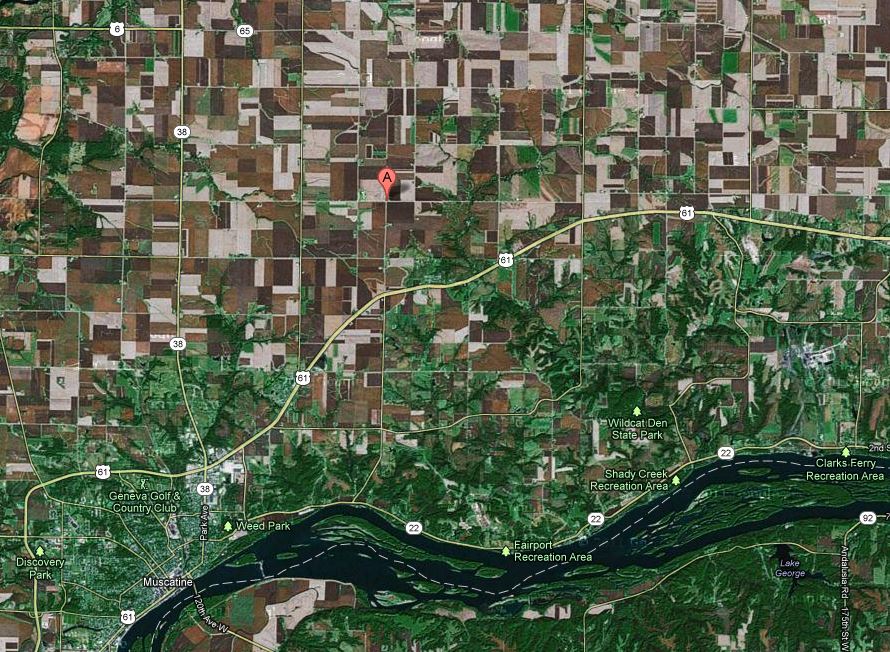
LAKE MACBRIDE— A group called Saving America’s Farm Ground and Environment (S.A.F.E.) is hosting a meeting tomorrow about MidAmerican Energy’s study of two sites in Iowa where they may propose to build nuclear power plants. A representative from the electric utility is scheduled to brief the group about their plans, something they did previously only in a private meeting with land owners near the proposed site at 150th Street and Sweetland Road in rural Muscatine. My friends at Blog for Iowa posted details about the meeting here. Under different circumstances, I would attend, but alas, I have to work a job to pay my utility bills.
Nuclear Power Plant Site
If the global mind exists, as Al Gore posits in his book “The Future: Six Drivers of Global Change,” it is powered by electricity. How society will produce the electricity to communicate is an open question. In a consumer society, electricity also powers cooking, laundry, staying up after sunset, and a host of personal and industrial tasks. Participants in a consumer society don’t often consider the question because the electric utility bill is inexpensive compared to other budget items.
What people do know is they don’t want a nuclear power plant in their back yard, and that is why people in Muscatine County are getting together. The memories of Chernobyl and Fukushima are too fresh, there is no safe level of radiation, and while the geography of the proposed site appears to be in the middle of nowhere, it is on prime farmland, and of interest to people from miles around.
MidAmerican Energy has a track record of obfuscation about their nuclear plans, and tends to operate in a perpetual salesmanship mode full of talking points and puffery. Locals are skeptical of their assertions, but until now, have been denied access to the discussion. This makes tomorrow’s meeting important, especially if the utility company is willing to listen.
A simple truth about nuclear power is that it is too expensive for anyone to capitalize, including Warren Buffett’s MidAmerican Energy, without financial considerations that a public utility can get only through legislative action. MidAmerican’s legislative agenda regarding new nuclear power was blocked during the 84th Iowa General Assembly. In a sense, the community resistance to a new nuclear power plant is putting the cart before the horse. Nonetheless, we should be listening to hear the reaction and press coverage of the concerned citizens meeting tomorrow. If we care about sustainability in a turbulent world, this activity is one to watch.
 In America’s Climate Century, Iowa State Senator Rob Hogg asserts, “climate change is the defining historical issue of the 21st century.” If it is, one wouldn’t know it from listening to people, and that seems the point of the book: to educate citizens of the potential negative effects of human-caused global warming, to persuade about the immediacy of the problem, and to outline ways for citizens to engage in solutions.

 Journey Home
You must be logged in to post a comment.