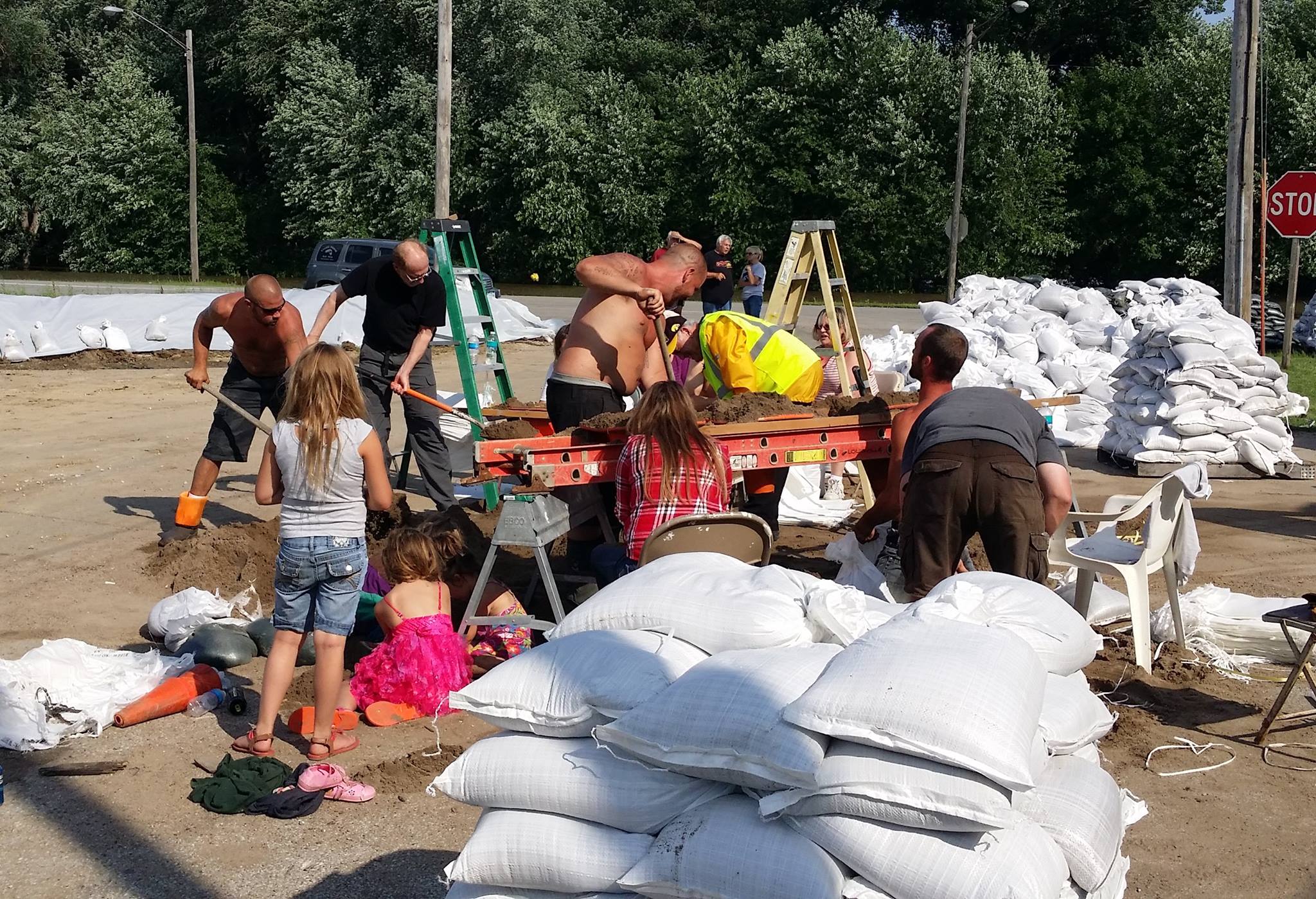
LAKE MACBRIDE— It’s June and Credit Island on the Mississippi River is expected to flood. Our U.S. Congressman was there yesterday to fill sandbags as part of an effort to prevent damage. Thing is, Credit Island has been flooding for as long as I can remember, and likely always will. People with businesses there should be used to it by now.
Part of the War of 1812 was fought on Credit Island, but I remember it more for the very flat golf course where my father, friends and I played from time to time. We would stop to hit a few balls into the river on the back nine.
Sandbagging on Credit Island
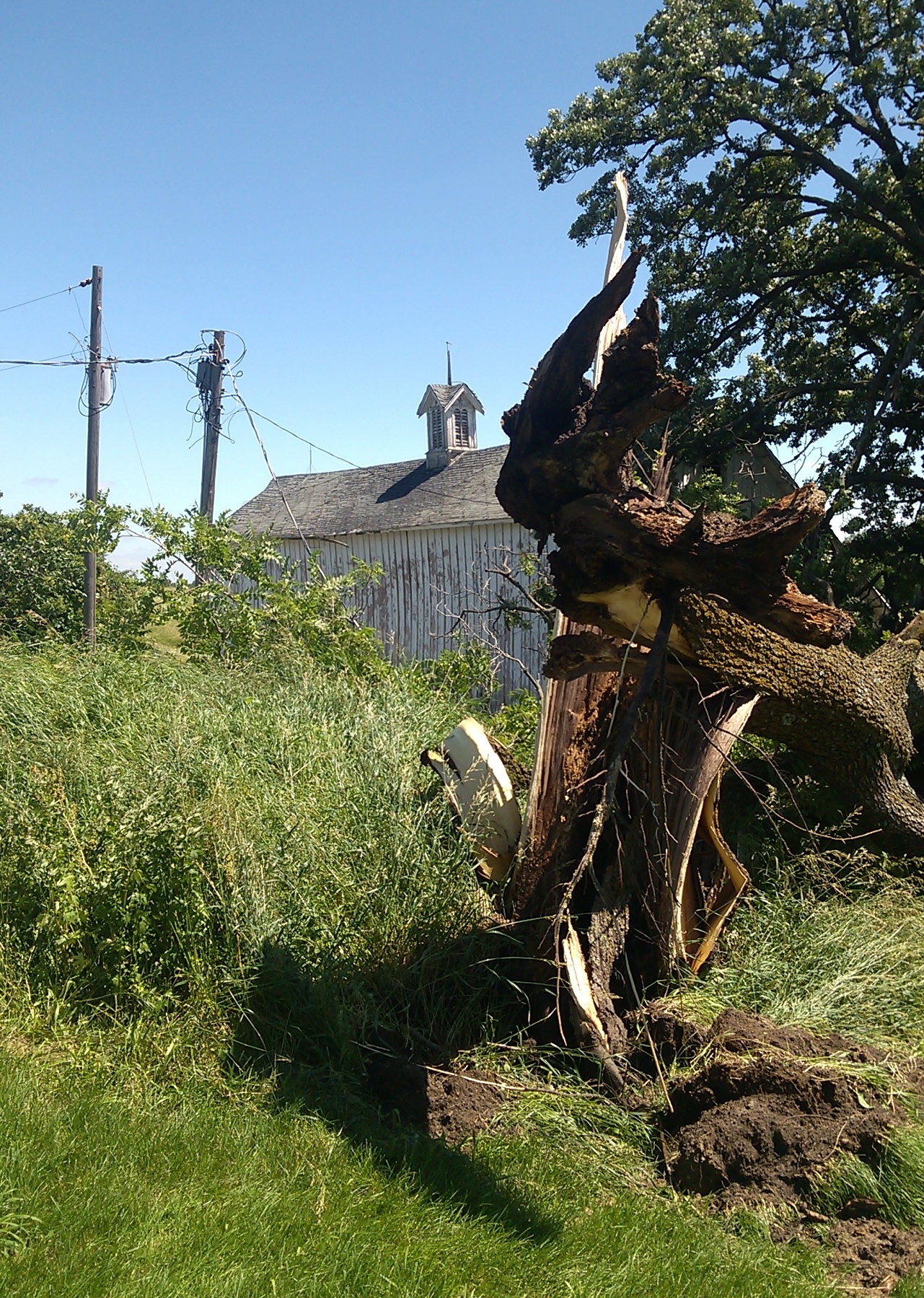
Our CSA had an old walnut tree knocked over by the storms. It rests on the electrical wire, waiting for the electric company to come turn off the juice so the tree can be chainsawed and removed from the main entryway.
The report isn’t published yet, but the state climatologist said yesterday that Iowa had its third highest June rainfall since record keeping began. What was bad about the recent storms was their intensity— made worse by our changing climate.
Locally there was not much damage. Last year’s extreme storms took out the weak trees and shrubs, so besides straightening a few tomato cages, there was little work to do in the yard. The rain is feeding a jungle that needs mowing soon.
Conditions look perfect for getting outside. Something one hopes to do soon.
LAKE MACBRIDE— Leadership on what matters most for our future will come from outside the United States. It’s not that Americans are bad people— for the most part, we aren’t. However, many of us have mistaken the advancement of bad ideas as the right ideas, and there is a difference.
The most recent example was last week’s vote on an amendment to the National Defense Authorization Act (NDAA). The NDAA is one of the few pieces of legislation that still works through the legislative process the way most of them did back when Congress did more legislative work. Rep. David McKinley (R-WV) offered an amendment which would “prevent the White House from sending funds to the U.S. Global Change Research Program National Climate Assessment, the Intergovernmental Panel on Climate Change’s Fifth Assessment Report, the United Nation’s Agenda 21 sustainable development plan, or the May 2013 Technical Update of the Social Cost of Carbon for Regulatory Impact Analysis Under Executive Order 12866.” McKinley questions the validity of climate science research generally, but, according to his website, also argued that reducing the use of coal wasn’t worth the harm it would do to the economy. The amendment passed the House, and is expected to advance to the Senate.
I understand coal country better than most mid-westerners. My family tree has long roots in Appalachia, predating the discovery of coal in Boone County, West Virginia by John Peter Salley in 1742. My career in transportation and logistics took me to Boone County and I learned about its dependence on coal. When the Coal Valley News announced our truck driving school, it was front page news, next to a story about United Mine Worker layoffs in the county seat.
Meeting with businesses, the governor’s office, the school board, local residents and others, I got to know the issues around coal. People didn’t like the mine owners and operators, but were dependent upon them. If life has changed from company-owned coal camps for most, coal camps still exist along with poverty and an extreme dependence on coal to extract a life. The question, “what are we supposed to do without coal?” resonates there if answers don’t.
There is no greater good in McKinley’s legislative work, and there is little point in arguing with climate deniers like him. The preponderance of evidence is that climate change is real, it is happening now, and its effects are causing harm. As the business community wakes up, we are increasingly able to place a dollar figure on the social and economic costs of global warming and related climate change. Economics will drive action to mitigate the causes of climate change, as making a profit remains paramount for businesses. Like it or not, West Virginia, part of mitigation of global warming means drastic reductions in the amount of coal used across the globe.
At the same time, bad ideas like McKinley’s have enough support to advance, making the U.S. Congress less relevant in addressing the most important issue of our time. That’s why I say leadership on climate change, as well as on nuclear abolition and other threats to life as we know it, will come from outside our country. For whatever reason, too many Americans embrace bad ideas to sustain the political will for positive change.
What I don’t get about West Virginia and coal country is that while there is a church in almost every neighborhood, another argument should resonate equally with self-serving economic interests, but doesn’t.
If God is the author of creation and wants humans to do anything, high on the list would be to care for creation. We have not upheld that responsibility even though it transcends politics. Instead, people like McKinley look to mammon for their inspiration, forsaking all of us in the process.
Belief in God is not the same usage as belief in climate change, because the efficacy of the harm done to humans by climate change will out regardless of what people believe or don’t believe. Like many concerned citizens I feel we must wake up to the threat to human health posed by climate change before it’s too late. If the U.S. won’t lead, then others will, because taking action won’t wait for U.S. politicians to get on board with the obvious.
Student Physicians for Social Responsibility tour Kirkwood Community College
CEDAR RAPIDS– Iowa played host to the national organization Physicians for Social Responsibility (PSR) from May 6 through 10 at the Hotel at Kirkwood.
Iowa held center stage for meetings convened by national and international leaders of the 52 year old, Nobel peace prize winning organization. Thanks to the kind attention and assistance of the many expert hotel staff and the Kirkwood Community College affiliated training programs, this remarkable, first ever, national PSR gathering concluded a successful meeting on Saturday, May 10.
Those who attended the meetings work to address and reduce the humanitarian and health risks posed by the growing threat of nuclear weapons, the changing climate, and toxic environmental degradation. These first time visitors, initially quite skeptical about Iowa, were especially appreciative of its many unique offerings, both practical and recreational, available in and around the Kirkwood campus and the greater Cedar Rapids area.
The intractable challenges of our times were addressed in the meetings with U.S. Senate staff, Iowa elected officials, and online participants followed by experiences arranged by the Hotel at Kirkwood staff. Participants concerned about sustainability were able to visit and learn from the Kirkwood wind turbine and training center, the new Cedar Rapids LEED certified library with its green roof and inviting community center atmosphere, and the Kirkwood gardens and greenhouse. These tours, combined with the tasty, locally sourced and produced meals at the hotel, and an evening at the Cedar Valley Winery all served to showcase Iowa’s forward looking spirit and renew participants hopes for the future.
The troubled world presents us with so many new dangers and challenges. But the practical and creative talents of Iowans, especially those involved in Kirkwood’s uniquely integrated educational programs, services, entrepreneurship, and hotel partnership, manifest ample reasons for a positive outlook.
Board members, chapter leaders, staff and students from across the country join Iowa PSR in extending our deepest appreciation and gratitude to our hosts in Iowa. A special thanks to Tom Larkin of Senator Tom Harkin’s office, State Senator Rob Hogg of Cedar Rapids and State Representative Sally Stutsman of Johnson County. PSR leaders departed Iowa renewed by the gracious hospitality, insights and new sense of possibility gained by their experience.
LAKE MACBRIDE— Green up has come and blossoming trees paint the landscape with their white and red petals. Back in the day, when work took me to Georgia and Tennessee, I managed to see dogwood in bloom most years. It was ersatz when reminders of spring were close by if we could have but recognized them.
Spring weather has been dicey and farmers are adapting. One farmer got sick of the fields coated with a thin layer of mud and headed into the house to stop looking at it. For some, planting began yesterday. With modern technology, the whole state could be planted in under a week— one of the ways farmers have adapted to global warming and climate change, although most wouldn’t talk about this.
The central question regarding global warming and climate change is whether people will join together and do something about it. Some are, and more will, but most don’t connect the dots. A common obstacle to progress has been that some people feel the problem is too big to deal with. There is no denying it is a complex problem that doesn’t lend itself to easy solutions.
What’s a person to do? Go on living.
If we don’t take care of ourselves first— by sustaining our lives together— we have little to offer. Taking care of ourselves is not optional.
At the same time, being self-centered is not good for us, or for society. There is plenty to occupy our bodies and minds on earth, and while some days we just get by, on others we rise to our potential and contribute something to a greater good. If this were a cafeteria, I would have another serving of the latter.
Life in consumer society may resemble a cafeteria, where we get a choice on everything, but it is not that. We have a home place, and somehow it has gotten to be a storage shed rather than a center for production. Once we make our choices, then meaningful articulation of our life becomes more important than accumulating additional things.
In the end, the case for taking action to mitigate the causes of global warming and climate change will be made by the environment itself. The environment doesn’t care much about humans.
It will become abundantly clear, and some say we are already there, that humans control our environment in a way we couldn’t when the population was much smaller. Logic won’t make the case to sustain what we have. It will be made of our existential experience and awareness that our lives have meaning beyond answers to the questions where will I stay tonight, and what will be my next meal. When people go hungry or without a place to sleep, it is difficult to think about much else, making change nearly impossible.
We live in an environment ready for change and there’s more to it than singlular voices on the platted land.
LAKE MACBRIDE— I will be speaking about personal finance, the environment and nuclear abolition four times between April 19 and 24. If you are nearby, please consider attending one of these events:
April 19, 11 a.m.: “Alternative Living: Focus on Finances” with Solon resident and writer Paul Deaton. Paul gave up his 9 to 5 job to focus on his writing. He will describe his creative methods of putting food on the table and how he covers his expenses to survive and thrive. Part of the American Library Association Money Smart Week, Solon Public Library, 320 W. Main St., Solon, Iowa.
April 19, 1 until 3 p.m.: Soap Box Speech on the environment: “Mount Tambora, Mount St. Helens and Nuclear Famine” at the Celebration of Life at Old Brick, 20 East Market St., Iowa City, Iowa.
April 23, 6:30 p.m.: “Earth Week: Climate Reality in Iowa” at 220East, 220 East Fourth St., Waterloo, Iowa.
April 24, 6:30 p.m.: “Earth Week: Climate Reality in Iowa” at the Independence Public Library, 805 1st St. East, Independence, Iowa.
11 a.m.: “Alternative Living: focus on finances” with Solon resident and writer Paul Deaton. Paul gave up his 9-5 job to focus on his writing. He will describe his creative methods of putting food on the table and how he covers his expenses. – See more at: http://www.soloneconomist.com/content/solon-public-library-50#sthash.PGm9t3cj.dpuf
11 a.m.: “Alternative Living: focus on finances” with Solon resident and writer Paul Deaton. Paul gave up his 9-5 job to focus on his writing. He will describe his creative methods of putting food on the table and how he covers his expenses. – See more at: http://www.soloneconomist.com/content/solon-public-library-50#sthash.PGm9t3cj.dpuf
11 a.m.: “Alternative Living: focus on finances” with Solon resident and writer Paul Deaton. Paul gave up his 9-5 job to focus on his writing. He will describe his creative methods of putting food on the table and how he covers his expenses. – See more at: http://www.soloneconomist.com/content/solon-public-library-50#sthash.PGm9t3cj.dpuf
11 a.m.: “Alternative Living: focus on finances” with Solon resident and writer Paul Deaton. Paul gave up his 9-5 job to focus on his writing. He will describe his creative methods of putting food on the table and how he covers his expenses. – See more at: http://www.soloneconomist.com/content/solon-public-library-50#sthash.PGm9t3cj.dpuf
11 a.m.: “Alternative Living: focus on finances” with Solon resident and writer Paul Deaton. Paul gave up his 9-5 job to focus on his writing. He will describe his creative methods of putting food on the table and how he covers his expenses. – See more at: http://www.soloneconomist.com/content/solon-public-library-50#sthash.PGm9t3cj.dpuf
Hogg Uses Science to Explain Climate Change
To the editor of the Cedar Rapids Gazette
March 13, 2014
A March 8 guest column by Gary Ellis, “Global warming debunked,” suggested that state Sen. Rob Hogg had “confirmed” to the author that those who are concerned about climate change are acting based on “good intentions” not “good science.” That is not right.
I have read Hogg’s book on climate change, “America’s Climate Century,” and he carefully reviews the science that tells us that climate change is a major concern facing our country.
The book is an excellent introduction to the issue and I highly recommend it. It is available at area libraries.
I also have heard Hogg speak about climate change.
Again, Hogg does an excellent job explaining the science if you ever have the chance to hear him.
As Hogg points out, leading scientists have warned us that the effects of climate change are expected to increase substantially in the coming decades.
We urgently need to cut greenhouse gases and get ready for future climate-related disasters.
LAKE MACBRIDE— According to the National Oceanic and Atmospheric Administration (NOAA), January 2014 was the fourth hottest January on record. It was also the 347th consecutive month of global temperatures above the 20th century average. February is expected to be the 348th. From NOAA:
The combined average temperature over global land and ocean surfaces for January was the warmest since 2007 and the fourth warmest on record at 12.7°C (54.8°F), or 0.65°C (1.17°F) above the 20th century average of 12.0°C (53.6°F). The margin of error associated with this temperature is ± 0.08°C (± 0.14°F).
The global land temperature was the highest since 2007 and the fourth highest on record for January, at 1.17°C (2.11°F) above the 20th century average of 2.8°C (37.0°F). The margin of error is ± 0.18°C (± 0.32°F).
For the ocean, the January global sea surface temperature was 0.46°C (0.83°F) above the 20th century average of 15.8°C (60.5°F), the highest since 2010 and seventh highest on record for January. The margin of error is ± 0.04°C (± 0.07°F).
It is too damn hot, said as a resident of earth, located in an extremely cold Iowa winter.
LAKE MACBRIDE— An article about James Lovelock was recently updated and is in the news again. “Enjoy life while you can,” said Lovelock in 2008. “Because if you’re lucky, it’s going to be 20 years before it hits the fan.” Whether enough people are listening to his admonition about the inevitability of catastrophic climate change is doubtful. Whether we should is another question.
While the U.S. has its share of doomsday preppers, by and large the potential for social unrest, like in Ukraine, Egypt, Syria and Venezuela, is discounted by most people I meet. If some are stocking up at COSTCO, it is the result of a mathematical calculation of price per serving, and how long that over-sized box of crackers will last. Preparing for Armageddon is the last thing on shopper minds. As Americans, we have a high level of tolerance for injustice… as long as we perceive that as individuals, we are being treated fairly.
Our public awareness is influenced by a media bought and sold by a few wealthy people. Corporations influence our lawmakers, agriculture, retail stores, our utilities, and anything we do that requires our participation. Seldom has there been a large scale outbreak of social unrest, nor is one likely without a wholesale breakdown of consumer society. The wealthy are smart enough to prevent that from happening unless it serves their purposes.
Perhaps the most recent American social movement was the political tide that swept Republicans out of power and inaugurated President Barack Obama. Discontent with our government increased once the abuses of presidential power became more widely known after Sept. 11, 2001. It was a peaceful movement, even if we had yet to end two wars, and continued our questionable use of drones to target people in countries with which we are not at war.
It would take a lot for wide-spread, violent protest to topple the U.S. government. For that matter, protests against drones, economic issues, taxation, the Keystone XL pipeline, nuclear weapons installations, mountaintop removal coal mining and other issues pass largely unnoticed by society. In the middle east, it took a widespread drought, a shortage of export crops from Russia and Ukraine and high food prices to activate citizens for social change. Of course now we are getting back to climate disruption caused by global warming.
Helping mitigate the causes of global warming is at the top of my to-do list. I wrote about it at this link, “climate change is real, it is happening now, it’s caused by humans, and is cause for immediate action before it is too late.” Of course, according to Lovelock, it is already too late. Climate change is not the only worry we have about survival of life on the planet.
The other threat is the lingering possibility of a nuclear weapons exchange. In our post-Cold War era, this borders on the absurd. The two countries with the largest number of nuclear weapons are the United States and Russia. The war is over, so disarm. We can’t afford the hundreds of billions of dollar we spend on the nuclear complex, so disarm.
The humanitarian consequences of a small-scale, regional nuclear war, like between nuclear states India and Pakistan, are unthinkable. Conservative organizations like the Red Cross/Red Crescent Society and Rotary International are signing on to abolish nuclear weapons for that reason. They are most active outside U.S. borders.
Americans are already looking to enjoy life more, oblivious to the tangible threats we face. It is possible to mitigate the causes of climate change, work toward nuclear abolition, and enjoy life more. Once one has read Sartre not much seems futile, and engaging in life becomes its own reason to live. Whether we can make a difference is a question the naysayers would answer for us, something we can’t let them do.
On Thursday, Jan. 16, the U.S. Senate Committee on Environment and Public Works will hold a hearing entitled, “Review of the President’s Climate Action Plan,” begging the question, if a tree falls in a forest and no one is around to hear it, does it make a sound?
A well credentialed panel is scheduled to appear, including administrator of the U.S. Environmental Protection Agency Gina McCarthy. The hearing is important mostly to generate interest in a conversation about climate change that is on life support on Capitol Hill. (For more information about the hearing, click here). Who will be listening?
There aren’t enough votes in the 113th U.S. Congress to put a price on carbon emissions, something that is essential to slowing them. Recently, U.S. Senators Barbara Boxer (D-Calif.) and Sheldon Whitehouse (D-R.I.) announced formation of a task force to revive talk about climate change in the Congress, and to defend President Obama’s Climate Action Plan.
The goals of the task force are modest— introducing some small-scale bills intended to “use the bully pulpit of our senate offices to achieve (a) wakeup call,” Boxer said. She added, “we believe that climate change is a catastrophe that’s unfolding before our eyes and we want Congress to take off the blindfolds.” What will come of this year’s task force is unclear, but anyone paying attention can see the disruptive effects of changing climate on our society. However, as a writer on Daily Kos pointed out, it is another task force in another year, and legislation mitigating the causes of climate change, or dealing with its effects, is expected to be dead on arrival because the votes aren’t there.
Boxer has it right that people on the hill, and in the public, are asleep about climate change. The reason is the money spent by climate deniers. In December, Drexel University released a study of 140 different foundations funding an effort to delay action on climate change. The so-called Climate Change Counter Movement (CCCM) spent more than $900 million from 2003 through 2010. Author Robert J. Brulle wrote that the study was, “an analysis of the funding dynamics of the organized effort to prevent the initiation of policies designed to limit the carbon emissions that are driving anthropogenic climate change. The efforts of the CCCM span a wide range of activities, including political lobbying, contributions to political candidates, and a large number of communication and media efforts that aim at undermining climate science.” The efforts of CCCM have been successful, insofar as “only 45 percent of the U.S. public accurately reported the near unanimity of the scientific community about anthropogenic climate change,” according to the study.
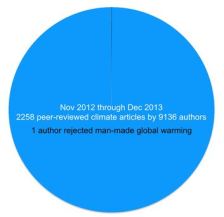
What does “near unanimity” mean? James Powell recently evaluated 2,258 peer-reviewed scientific articles about climate change written by 9,136 authors between November 2012 and December 2013. Only one article rejected anthropogenic global warming. This may not represent a consensus, but consensus is not the purpose of science. Science is to explain the world to us, and we don’t need to strike the word “near” to understand climate change is real, it’s happening now, human activity is causing it, and scientists believe that is the case.
I am not sure whether a group of rich politicians posturing in the Congress will make a difference. However, it’s the only game in town. They are willing to take positive action to support the president’s climate action plan, which doesn’t rely on new legislation that isn’t in the cards anyway. While not hopeful of meaningful action, fingers are crossed, and the game is on.
Following is this afternoon’s press release from the League of Conservation Voters:
WASHINGTON, D.C.– League of Conservation Voters (LCV) president Gene Karpinski released this statement on the creation of the Senate Climate Action Task Force, a group chaired by Senators Boxer and Whitehouse that includes more than a dozen senators committed to pushing for action on climate change:
“Big Oil and corporate polluters have worked with their allies in Congress to prevent action on climate change for far too long. This task force is the latest sign that environmental allies in Congress are fighting back, standing up for basic science and pushing for action on climate change. This is the type of strong leadership we need if Congress is finally going to get serious about addressing the climate crisis and meeting our moral obligation to future generations. We thank Senators Boxer, Whitehouse, Cardin, Sanders, Klobuchar, Merkley, Franken, Blumenthal, Schatz, Murphy, Heinrich, King, Markey, and Booker for speaking out on climate change today and look forward to continuing to work with them to address this vitally important issue.”
People seeking scientific proof of anthropogenic global climate change are barking up the wrong tree. The goal of science is not to prove, but to explain aspects of the natural world. Following is a brief explanation of climate change.
Around 1850, physicist John Tyndall discovered that carbon dioxide traps heat in our atmosphere, producing the greenhouse effect, which enables all of creation as we know it to live on Earth.
Carbon dioxide increased as a percentage of our atmosphere since Tyndall’s time at the beginning of the Industrial Revolution. As a result, Earth’s average temperature increased by 1.5 degrees Fahrenheit.
The disturbance of the global carbon cycle and related increase in carbon dioxide concentrations in the atmosphere is identifiably anthropogenic because of the isotope signature of atmospheric carbon dioxide.
We can also observe the effects of global warming in worldwide glacier retreat, declining Arctic ice sheets, sea level rise, warming oceans, ocean acidification, and increased intensity of weather events.
It is no wonder 97 percent of climate scientists and all of the national academies of science in the world agree climate change is real, it is happening now, it’s caused by humans, and is cause for immediate action before it is too late.






 Journey Home
You must be logged in to post a comment.