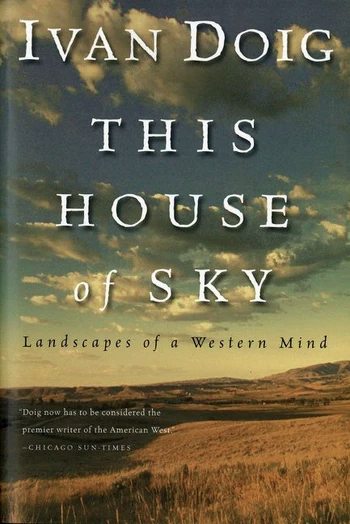
This House of Sky: Landscapes of a Western Mind by Ivan Doig is exactly what the title suggests. Descriptions of the author’s rural Montana life are vivid in their presentation of the hard-scrabble ranching life in which Doig came up. Out of that challenging youth — farming, sheep herding, haying, rural community — he became a writer giving voice to western life.
“In my Montana upbringing, I had worked in a lambing shed, picked rock from grainfields, driven a power buckrake in haying time and a D-8 Cat pulling a harrow during summer fallowing and a grain truck at harvest, herded sheep, trailed sheep, cussed sheep — even dug a well by hand and whitewashed a barn –and now I didn’t seem to be finding other people who had done any of that,” Doig wrote in the introduction.
I worked eight years on a farm that raised lambs, although not on the scale of Doig’s Montana. It was an entry point into a life I hadn’t known existed. My experience provided me a way into This House of Sky that many readers might not have. Life experiences can be a form a literacy regardless of how many books we read.
My grandmother grew up in farming communities in Minnesota and Illinois, and could likely relate to the grandmother in the book. Working from a home, while isolated on a farm, took a lot of knowledge, skills, and energy. Such women literally made a home from almost nothing. While Grandmother did not read a lot of books, I might have persuaded her to read this one.
When This House of Sky was published in 1978, many Americans still had farm connections. Today, far fewer do as that knowledge of hand work was eclipsed by mechanization. Today people don’t harvest hay the same way Doig describes before he left home.
Is there a modern readership for the book?
While I brought farm experience to the book, other readers might bring something else. This book can meet readers where they live. Doig’s detailed description of Montana has many common hooks, including the arc of his’ father’s emphysema, the culture of nine bars and saloons in White Sulphur Springs, and the role of women and men in western society.
Whatever a reader brings to This House of Sky, there is a thoughtful world to explore and briefly inhabit.
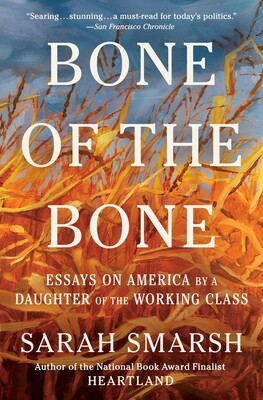
Sarah Smarsh’s strongest work to date is in Bone of the Bone: Essays on America by a Daughter of the Working Class. Her first book, Heartland, was a sensation; her second, She Come By It Naturally, fell flat for me. Smarsh’s strengths are well suited to the type of short essays in Bone of the Bone.
In 2019, I attended an event in Iowa City where Smarsh was interviewed by Pulitzer Prize-winning columnist Connie Schultz. Smarsh later wrote about this night in the essay, “In the Running,” where she described her consideration of a run for U.S. Senator from Kansas. At the time, I felt she was reserved. Reading the essay, I learned that in the green room before it started, she discussed the choice between being a writer and running for office with Schultz and husband Sherrod Brown. Brown was in Iowa exploring a presidential run, and earlier that day I heard him speak to small group of elected officials and activists about the dignity of work. Smarsh ends the essay by deciding not to run. In retrospect, her reserve that night makes sense.
When Smarsh assumes the persona of “Daughter of the Working Class,” I’m both thrilled and slightly annoyed. Thrilled because she writes from a perspective we hear too rarely: a woman who grew up poor and worked her way into public life. Annoyed because the persona sometimes feels deliberate, as if it stands between the reader and the fuller self behind it. I sensed that in Iowa City and again in this book. She makes the journey worth it.
What I admire most about Sarah Smarsh is how she integrates rural landscape, domestic life, and work into a lived sense of place. Her prose is stripped to essentials, plainspoken without being spare, and that economy draws me in. I respond to this style because it treats labor and class not as abstractions but as daily facts, shaping how people live, eat, and speak to one another. Unlike many essayists, Smarsh’s didactic impulse is present but hidden, carried by narrative rather than argument. The writing rewards our attention without insisting on agreement.
Smarsh is at the height of her writing ability in Bone on the Bone, which appeals on many levels. I highly recommend it.
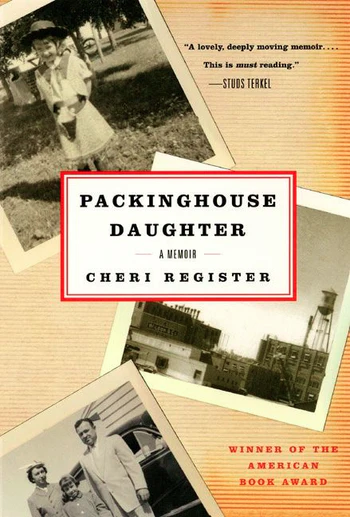
Packinghouse Daughter: A Memoir by Cheri Register is a book I wouldn’t have found except for patronizing an excellent local used bookstore. They have a deal where you set an amount of money to spend, tell them your interests, and they locate books that match. I have yet to be disappointed by their choices. One of the interests I presented was in memoirs written by female authors. They likely didn’t know the story of Wilson & Company was connected to me in multiple ways.
My father worked in a hog processing facility with a kill floor and everything else mentioned in this book through to the fertilizer processing tanks. He died in a plant accident in 1969. I worked there too, for two summers while at university. I even crawled into one of the large processing tanks to help a millwright fix it, learning about lockout/tagout for the first time. The first part of the book resonates completely with my experience, even though Register was older than I am. It is useful to know this history of Wilson & Company in Albert Lea, Minnesota exists.
Register claims hesitancy about writing the memoir about Albert Lea because it was her father who worked at Wilson’s and experienced many of the issues she mentions. I don’t know who can better tell this story than such a daughter whose father worked there and was invested in the job and packing plant employee community. She did the research and the narrative is better for it. She could have gone easier on herself. Register died March 7, 2018.
I was struck by the description of people moving from farms to the city to work in meat packing. This was true of my family where my maternal great grandparents left central Illinois to live in Davenport in retirement. Four or five of their daughters worked in a defense plant making coats during World War II. My maternal grandmother did, and also worked a stint at the Oscar Mayer hog processing plant where Father and I worked. That cohort is now buried in local cemeteries. This part of the book also resonates with my experience.
An exodus from farming and rural areas continues today as agriculture has grown larger and requires fewer workers because of computer automation and changes in operations. Those who relocate, for lack of a better term, are not choosing meatpacking as a profession — or even as a job. With consolidation in the meatpacking industry and increased automation, there are simply fewer positions available. It is hard, dirty work as well. As a result, the job-driven movement from rural areas to cities no longer exists in the same way it did in Albert Lea during the period covered by this book.
I found Register’s narrative deeply resonated with my experiences. It is must reading for anyone interested in the specific history of Wilson & Company or in meat packing culture. With changes in the industry happening post-WWII era, that culture would disappear without books like this.
In late November I’ve read 63 books this year. Not all of them were good, yet many of them were exceptional. This post is about books I am glad to have read this year.
The Politics of Resentment by Katherine Cramer
Cramer’s examination of rural political consciousness — and the resentment often directed toward “liberal elites” — is essential reading for any Iowan trying to understand where our politics may be heading. I remember the mass demonstrations in Madison during Scott Walker’s tenure, and Cramer uses his administration as a springboard for a broader exploration of government’s place in everyday life. Her account is grounded in the many conversations she held with rural Wisconsinites while conducting her research, giving the book both texture and credibility.
Queen Esther by John Irving
Beginning during my university days I had a small number of authors whose work I read with great anticipation shortly after a new book was released. First it was Saul Bellow, and then Joan Didion. When they died, that author became John Irving. Queen Esther is what I expect from an Irving novel.
The reason I enjoy reading Irving is when he writes about his time in Iowa City, it is the place I came to know. The Water Method Man was set there and he specifically mentioned 918 Iowa Avenue, with which I am very familiar. That feeling, along with other common experiences, gives me entree into the world he describes in his latest book.
There are some naysayers about Queen Esther, yet it is familiar fare which I am glad to access. Having traveled there myself, I particularly enjoyed the chapters about Vienna and Amsterdam. He describes the same Vienna I came to know and that draws me into the book. My review is here.
The Siren’s Call by Chris Hayes
There are other books about the attention economy, but Chris Hayes The Siren’s Call: How Attention Became the World’s Most Endangered Resource comes at a time when we need to hear his message. I hear the word “distraction” multiple times each day from friends and family. There is more there and Hayes gets to the heart of it. My review is here.
Source Code: My Beginnings by Bill Gates
Source Code: My Beginnings is a straight up autobiography of Bill Gates’ early years through development of Microsoft. The early coding he wrote was impactful in my life and in the broader society. To hear it directly from the source was a quick, informative read.
This is for Everyone by Tim Berners-Lee
Tim Berners-Lee is credited as being the inventor of the World Wide Web in 1989. His autobiography explains what happened. It is something that affects most people and worthy of reading.
Apple in China by Patrick McGee
The relationship between Apple and China is part of the news each day whether mentioned explicitly or not. I remember Iowa firms establishing a business relationship in China when I was in my 50s and found it curious that China would not let them own a majority stake in businesses they managed there. Apple in China: The Capture of the World’s Greatest Company explains the risk and what happened to the company because of it.
Breakneck by David Wang
While China is an engineering state, relentlessly pursuing mega-projects, the U.S. has stalled. America has transformed into a lawyerly society, reflexively blocking everything, good and bad. This book makes the case why China is so far ahead of the United States in manufacturing and in other areas of the economy. When we consider the United States, the concept of “lawyering up” is a negative for the betterment of society. Just look at our president and the number of lawsuits in which he is engaged.
The Devil Reached Toward the Sky by Garrett M. Graff
I previously read many of the stories in this oral history of the making and use of the atomic bomb. What sets Graff’s book apart is collecting first person accounts of that history. It brings a form of immediacy to a topic modern people tend to forget when discussing nuclear weapons and disarmament.
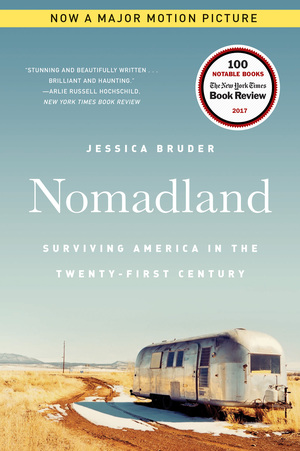
Nomadland by Jessica Bruder
I know many people looking for work without much success. Jessica Bruder wrote an autobiography about her experiences in a workforce unhinged from a predictable, daily schedule of work. She worked all over the country in seasonal or part-time positions, the most recognizable of which is the Amazon CamperForce program. Amazon leverages people displaced from regular work and have taken to living in recreational vehicles. They have a formal program to hire them in their warehouses during peak sales activity. This is just one example. This one is well worth your time for its window into a world most of us didn’t know existed. My review is here.
Eleven Days by Donald Harstad
The county sheriff recommended this book about a crime in the area where I live. I don’t read many crime novels, yet the local setting drew me in, and the tightly written narrative had me turning every page as quickly as I could.
2025 was a good year for reading. In retrospect, I should have read more poetry, so I’m making that a goal for 2026. To conserve resources, I expect to read more books from the public library and my own collection. I maintain my daily reading target of 25 pages, although that creeps up when I find a compelling book.
I’d be interested in what readers are reading in the comments.
I did not receive an advance reader’s copy of Queen Esther by John Irving. I emailed the bookstore in the county seat to make sure they would have it on publication day. On Nov. 4, I drove there and parked on Iowa Avenue, the same Iowa Avenue Irving described in The Water Method Man. I walked to the bookstore and couldn’t find it among new arrivals. After my inquiry, a sales associate found it in the back room and I bought it.
After Saul Bellow and Joan Didion died, Irving became my favorite author. I thought The Last Chairlift was his final novel and was pleasantly surprised and hopeful about this new one. It did not disappoint.
Anyone who lives in modern society has some familiarity with the issues that brought about the Hamas-Israel war. No book on those issues will have universal support, much less fiction. It seems risky for Irving to have tackled that and I admire him for it. Frankly, successful at age 83, what does he have to lose?
As someone who began reading Irving more than 40 years ago, I highly recommend Queen Esther. It is classic Irving.
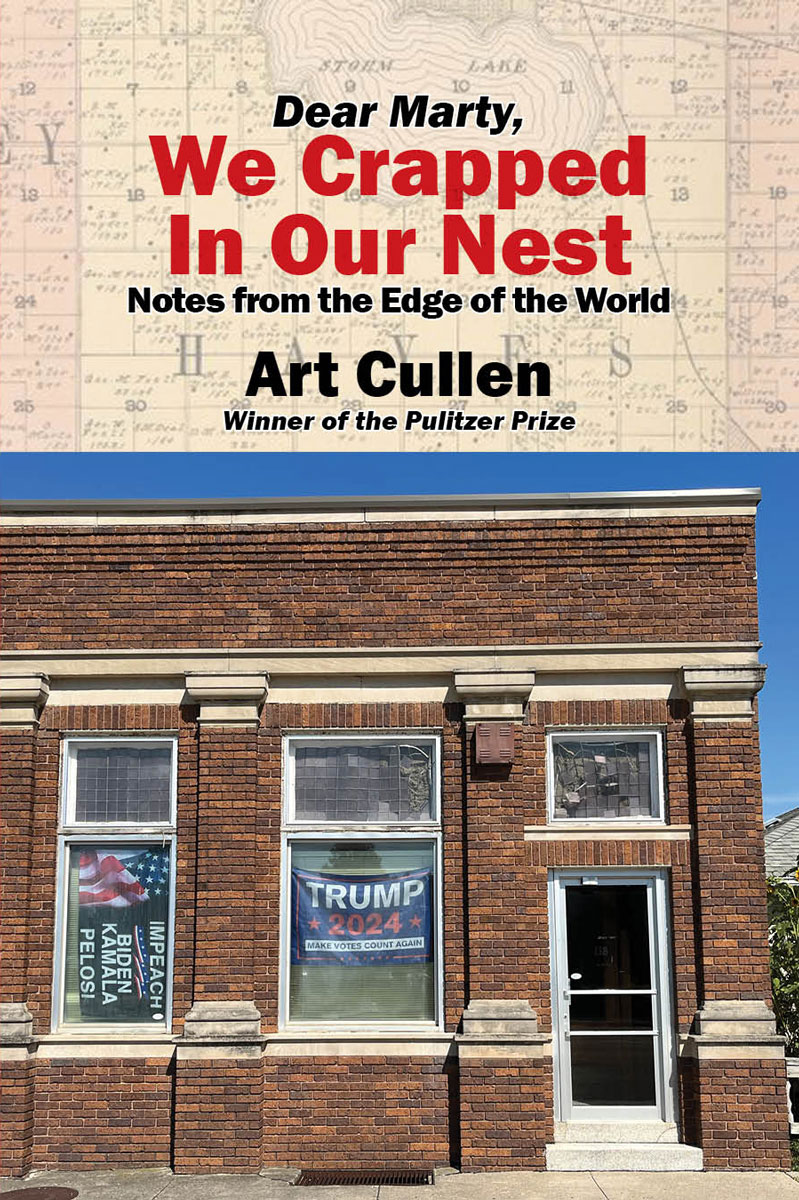
Art Cullen is the kind of writer I have to watch what I write about him in public. Chances are, unless the Good Lord takes him from us, I’ll run into him in some unforeseen context to experience consequences for writing anything too negative. Not that I would, Dear Marty, We Crapped in Our Nest: Notes from the Edge of the World is a well written narrative with a compelling story. Readers should buy a copy and read it.
I recognize many of the players, like Henry Wallace, Norman Borlaug, Fritz Haber, Carl Bosch, Frank Zybach, Aldo Leopold, Ricardo Salvador, and others. These men orbit the sun in an array of stories with which I was already familiar. Thanks to Cullen they were pulled together in a way that has me nodding in agreement. Even the politicians he mentions, Terry Branstad and Tom Vilsack particularly, make their planetary circle around the main theme of Iowa’s extractive agriculture. It’s not a particularly happy story, yet the confirmation bias I experienced created a positive afterglow that lasted the rest of the weekend as I finished the book.
What Dear Marty accomplished is an Iowa narrative, one of many out there, some of which are unknown. We need such narratives. They teach us how to live based on lessons learned or not learned from a tangible past and present. We need that as we live in a time when the U.S. Department of Agriculture set aside billions of dollars to pay for SNAP benefits in the event of a government shutdown. The government shut down, and Republicans refuse to use the money as intended. They instead politicized food insecure people to show they are in control. What are we, as a society, even doing here? I look forward to Cullen’s next column about things like this.
Cullen displays his skills as a newspaper writer in the book. That he could pull together this Iowa story can be attributed to research done to write weekly articles for his newspaper. He shared many of those articles in social media and I read them. This makes the story in the book familiar. It gave him a leg up on anyone else trying to write such an Iowa narrative.
The author makes a lot of sense in the chapter “Finding Center.” There are plenty of things we have in common with people in our neighborhoods, he said. We should just begin pursuing those common interests. This is such common sense, people are missing it. That or they are too busy working more hours, both paid and unpaid, and can’t take their noses up from the grindstone to catch a breath, much less engage in new things. I appreciate common sense. It’s value has diminished in the broader society.
This book reminded me of the late Donald Kaul’s How to Light a Water Heater and other War Stories. In it Kaul reprinted a bunch of his columns in a way that makes it look like they are in a newspaper. The difference between Washington D.C., where Kaul lived, and Spirit Lake is that Cullen actually used his columns to make something new and worth reading. Donald Kaul was no Art Cullen. Many of us are thankful the latter lives in Iowa.
It feels necessary for Kamala Harris to have written 107 Days. I’m glad she did. It was a quick read that touched the high points of her short presidential campaign. Hearing the story, in her voice, is important. It’s essential reading for anyone who follows presidential politics.
I make it a point to read or be familiar with every presidential memoir going back to Harry Truman, who was president when I was born. While Harris lost the 2024 election, she is part of the story of Joe Biden’s presidency and his eventual dropping out of the race for re-election. 107 days is not long enough for a modern presidential campaign and while Harris’ campaign staff worked diligently and smart in her recounting, they couldn’t get her across the finish line.
Harris chose not to make this a detailed account of her campaign. I respect that choice. It is a high level view full of her reactions to main events as they unfolded. There is value in that.
Even before it was published there were reviews out there. I don’t want to repeat, deny, or defend that work. My statement is if one is interested in U.S. presidential politics in the 21st Century, you should have 107 Days on your to be read list.
Jessica Bruder’s book Nomadland: Surviving America in the Twenty-First Century was recommended on social media. It contains the kind of crisp, clear writing, and solid narrative I seek to create. When combined with the topic of how septuagenarians and others fit in to a modern American economy where it is difficult to earn enough to afford a home, it was a quick read. I didn’t know it when British writer/photographer Marie Gardiner recommended it on BlueSky, yet it is smack in the middle of my reading sweet spot.
Bruder spent three years, driving 15,000 miles gathering information for the book. She interviewed countless people living in many different vehicles driving throughout the country. Each was making a life from dire financial circumstances combined with temporary jobs and a reasonably open road. The stories are compelling.
She worked as an associate at an Amazon warehouse in Haslet, Texas and participated in a sugar beet harvest in North Dakota. Neither job lasted long, yet they gave her a basis of experience to validate what the people she interviewed said. She immersed herself in the culture of the people about whom she was writing.
With a bit of a stretch, there is enough information to use the book as a how-to for living the nomadic life depicted. Bruder explains how people put together a life with complex facets. She presents examples of how people choose a vehicle in which to live. Finding adequate income through a combination of Social Security and temporary, seasonal jobs is important. Social programs like thrift stores, food pantries and SNAP also play a role. The book stresses how individualistic each solution to living can be. There is enough here to spark an interest in doing something similar.
Of Iowa interest is Adventureland in Altoona seeks labor among itinerant nomads called “Workampers.” They have a Workamper program that offers a free hook up campsite that includes electric, water, and sewer. There is no contract or time commitment to work at Adventureland. There are bonuses for working through the end of the season. Among the jobs on offer are ride operations, loss prevention, security, cook, ride maintenance technician, character performer, and others.
Bruder emphasizes the people she interviewed are not desolate. They are affirming members of a society hidden from most of us most of the time. There are few other, similar books. Recommend.
Large crop fields have been worked along many of the roads I traveled to Chicago this week. Ready or not, the season turned to spring. Next on my indoor planting schedule is tomatoes, followed by cucumbers and squash. I’m waiting for conditions outdoors to improve to tear down some of last year’s garden and prep the soil. It’s how I’ve learned to be a gardener.
I finished reading The Ministry of Time by Kaliane Bradley. I wrote a book review on the Goodreads social media platform:
The public library had this book and I heard about it from Barack Obama’s reading list. It was a fast-moving, engaging read. The 20k+ reviews already written on Goodreads are a trip and highly recommended. Here is a link to the page. Couple things to add:
The main value of this book is the author’s use of language. It is right on the surface and had me looking up things she wrote for usage. Most fiction I read does not engage like this. The writing worked sometimes, and sometimes not. I found this invaluable to my own writing.
Did not care for romanticizing tobacco use. Too many friends who died of lung cancer.
Lord Franklin’s search for the NW passage is being rediscovered. Not sure this fictionalized version helps or hurts. Probably not positive to actual history.
Hard to put down once started.
The imperfect character of the female lead was compelling.
Author’s summary of how she created the male lead from the historical record is a must read.
Rated 5 stars because among dozens of fiction books read in the past several years, this one stands out with enduring quality. It is likeable because it is different. Give it a go!
I’ve been away from my writing computer for two days. It’s time to get back to work on my memoir. Thanks for reading.
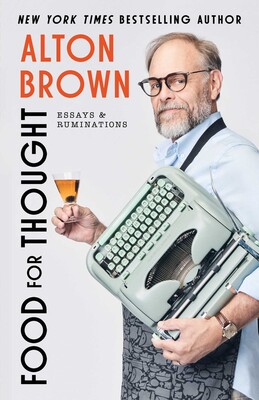
My reaction to Food for Thought: Essays & Ruminations by Alton Brown is it fills gaps in my personal culinary history. Brown occupied space after the formative experience I had in South Georgia in 1997 and 1998. While working on a logistics project at a clay mine and processor, after a 14-hour shift at the plant I retired to a motel room in nearby Thomasville. There I was exposed to Food TV Network, Emeril Lagasse, Mario Batali, Susan Feniger, Mary Sue Milliken, Julia Child, and others. It was a formative experience yet Brown came along after that period, airing his first episode of Good Eats on July 7, 1999.
During that work assignment I escaped into the T.V. During thirty minute segments I could forget extreme poverty and plain family restaurants that served a meat and three sides in rural Georgia, and engage in celebrity chefs who enjoyed what they were doing as locals did not. I had no kitchen at the motel so the interest was intellectual. My later involvement in the local food movement has its origins in the contrast between that poor, uninviting place in South Georgia and my nightly food escape. I learned a lot from Brown’s television programs when he later came on the cable channel and I watched them back in Iowa.
I didn’t know if I would enjoy his book. As I read, I liked it more with each turn of a page. For the kind of local food enthusiast I have become it is essential reading because of Brown’s unique role in televised, public cooking. Hearing his personal history, especially beginning with the premature and unexpected death of his father, informed the personality I remember from Good Eats.
After Good Eats ran its course, I fell off the Alton Brown bandwagon. I did not care for the stadium-style Iron Chef cooking competitions where he was a commentator. I also missed his coronavirus pandemic home cooking show on YouTube. By the pandemic, I had developed my own concept of a kitchen garden and no longer needed a recipe writer as Brown describes himself in Food for Thought.
The book is a miscellany of stories in the form of a memoir. As such one can both enjoy and not enjoy the writing, chapter by chapter. It was somewhat disappointing to read of Brown’s tobacco use and over-indulgence in alcohol. At the same time, the “Meals that Made Me” series is engaging and insightful. In all, the positives outweigh the negatives which is what I seek in a memoir.
If a person works in a modern, American kitchen, Food for Thought is well worth the time it takes to read.



 Journey Home
You must be logged in to post a comment.