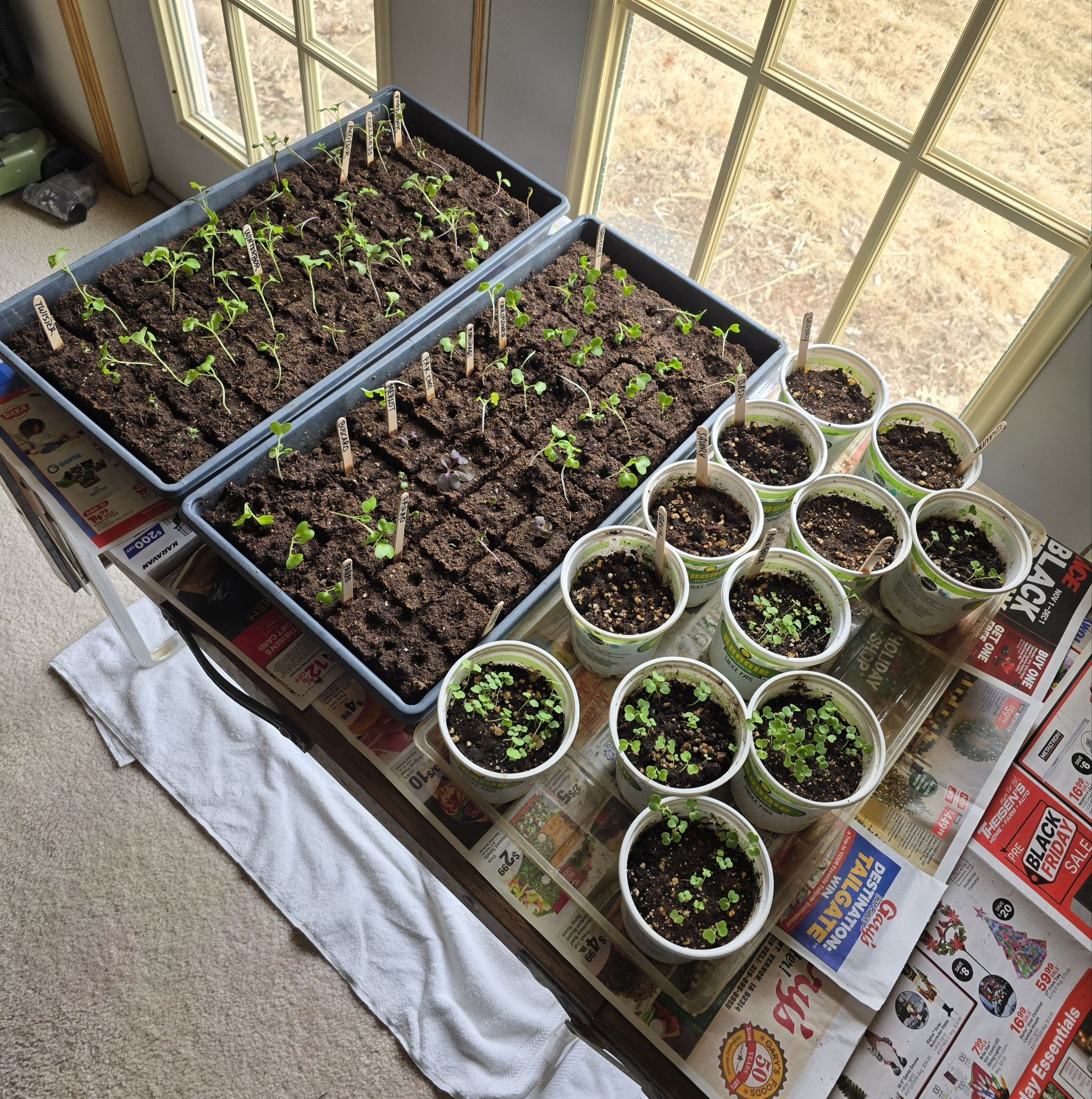
After five planting sessions, there are seven trays of seedlings between the heat pad, grow light and table in the dining area. This year, indoor planting is proceeding well.
My foundational experience in gardening improved dramatically during the period 2013-2020 when I worked on area farms. 2026 is the year I introduced artificial intelligence into the process.
The results of ai have been surprisingly good. Because the large language model has so much information in its database, without hesitation, it can give me planting schedule adjustments, ways to use two spots on the heating pad, and two more under LED grow lights. The rest of my process from seed to seedling to greenhouse to planting has fewer uncertainties this year compared to last. Optimizing use of the heating pad has been a boon to productivity.
On the second day of March, I am of to a good start.
ChatGPT is offered as a free service across multiple platforms, with usage limits that eventually prompt users toward paid subscriptions. It responds with language similar to how queries are submitted, something humans rarely do. It is a small but telling sign of how seamless the technology has become. I use it for quick factual questions and longer processes, such as planning a garden season. Because it is free at the entry level, I feel free to use it. I suspect many people do.
Ease of access matters. When a tool is free and always available, people experiment. A person awake at 2 a.m. might reach for a phone and ask how to sleep through the night. If a solution seems helpful, word spreads. Usage grows not because of marketing campaigns, but because of social diffusion. This is how habits form.
The question is whether such growth — multiplied across millions — materially stresses infrastructure, including the electrical grid.
The U.S. Department of Energy reported in late 2024 that data centers consumed about 4.4 percent of total U.S. electricity in 2023 and could rise to between 6.7 and 12 percent by 2028, depending on growth scenarios. That range is significant. It reflects assumptions about adoption rates, model size, efficiency gains, and capital deployment. These are projections, not certainties.
In public discussion, however, projections often harden into inevitabilities. Upper-bound scenarios become planning baselines. Large numbers circulate with little context. Some usage statistics are widely repeated without clear sourcing. Investor forecasts about billions of weekly uses and massive subscription growth are forward-looking, not present realities.
This is where a larger question emerges:
Is enthusiasm for artificial intelligence and data centers outrunning prudence in financial investment? In other words, do investors have fear of missing out and therefore accept speculative arguments about market capacity more than they should?
Comparisons are sometimes made to the 2008 financial crisis. That collapse was driven by mortgage-backed securities embedded throughout the banking system, amplified by leverage and mispriced risk. Institutions such as Lehman Brothers and insurers like AIG were deeply exposed. When housing prices faltered, the system unraveled because debt was layered upon debt.
AI investment today differs in important ways. Much of it is equity-funded venture capital or corporate capital expenditure rather than highly leveraged household debt. Data centers, chips, and transmission lines are tangible assets, not synthetic securities. Losses, if they occur, are more likely to be concentrated among investors rather than embedded in consumer balance sheets.
Yet there are echoes worth noting. In both periods, capital flowed rapidly toward a dominant narrative. In both, optimistic forecasts shaped infrastructure decisions. In both, participants understood risk existed — but incentives encouraged staying in the game.
The concern is not that investors seek profit. We know that. The concern is whether optimistic projections become assumed outcomes. If infrastructure is built on the expectation of maximum adoption, and adoption plateaus or efficiency improves faster than expected, overcapacity can result. That is not necessarily a systemic crisis. It may be a costly misallocation of capital.
Critics such as Bill McKibben, citing technology writer Ed Zitron, argue that the economics of large AI firms may resemble a bubble: vast capital expenditures today justified by revenue expectations that may or may not materialize. That critique is itself an interpretation, but it highlights the degree to which AI investment rests on assumptions about future returns.
My own daily queries consume negligible electricity. The grid impact, if any, arises from aggregate industrial-scale deployment and the assumptions embedded in those decisions. Casual consumer use is a marginal contributor. Large enterprise integration and model training cycles are the dominant drivers.
So the core issue may not be whether AI will use more electricity — it almost certainly will — but whether forecasts are being treated as destiny. Markets routinely oscillate between overconfidence and retrenchment. The challenge is distinguishing durable growth from narrative momentum.
It is possible that artificial intelligence becomes foundational infrastructure, like electrification or broadband. It is also possible that investment temporarily overshoots practical demand. Both can be true at different stages of a technology cycle.
The prudent stance is neither inevitability nor collapse, but clarity: separate measured data from modeled projections, and projections from belief. When enthusiasm begins to substitute for disciplined evaluation, that is when risk accumulates unawares.
~This essay was developed with the assistance of ChatGPT, an AI tool created by OpenAI, which I used to test arguments, fact check, clarify projections, and stress-test comparisons. The ideas and conclusions are my own.
Family lore was we were kin to June Carter Cash, who was married to Johnny Cash. We had common family trees in southwest Virginia and for years, I called her a “shirt tail relative.” I descended from a line of Addingtons and so did she. I had an hour before having to get to the kitchen to prepare dinner so I typed in the ChatGPT chat box:
Genealogy question: I am descended from a person named Thomas Jefferson Addington who lived in Wise County, Virginia. He was my great grandfather. Family lore is June Carter Cash (spouse of Johnny Cash) also has an Addington from our area in her family tree, that she was or is descended from Addington line. What do you know about that and what are ways for me to learn more.
Long story short, AI determined, with additional information from me, that Cash was either my fourth cousin, once removed, or fifth cousin depending upon how the actual family tree branched out. By knowing my line traced back to William Addington and Margaret Cromwell, a founding family of the Trans-Appalachian frontier, and with the large language model’s vast access to public records, it took hardly any time of back and forth for it to draw this conclusion.
The key piece of the puzzle, which AI did not have, was a book called The Stallard Connection: A Family History edited by Nancy Clark Baker, Gladys Julian Stallard, and Margaret Russell Stallard, published in 1981. These women did legion work to assemble the information in this 900-page record of names, births, marriages and deaths, along with photographs and stories. It has been sitting on my book shelf since Mother gave it to me.
I lacked the ability to put the pieces together on my own. Artificial intelligence was helpful in that regard. After six rounds of back and forth I comprehended what years of studying the book and talking to relatives couldn’t effectively explain: What was my family tree and why was it important in history. At the end, I asked AI to write a narrative of the Addington-Cromwell part of the family tree. In less than a minute it produced the following.
William Addington and Margaret Cromwell: Founders of the Virginia Addington Line
The Addington family in southwest Virginia traces its beginnings to William Addington and his wife, Margaret Cromwell, who stand at the head of nearly all documented Addington lines in Scott, Wise, and surrounding counties. Though the surviving records do not reveal every detail of their lives, enough evidence exists—supported by county records, family histories, and consistent descent patterns—to place them firmly among the early settlers whose children helped populate the Appalachian frontier.
William Addington was likely born in the mid-to-late eighteenth century, probably in Virginia or the Carolinas, during a period when families were steadily moving south and west in search of land. His wife, Margaret Cromwell, came from a family name that appears frequently in early colonial and frontier records, suggesting established roots and connections. Together, William and Margaret formed a household that would become the nucleus of the Addington presence in the region.
By the closing years of the eighteenth century, the Addington family was part of the great westward movement into the upland counties of Virginia. At that time, Washington County, Virginia encompassed a vast area that would later be divided into several counties, including Scott County. It was into this evolving landscape of shifting boundaries, newly formed communities, and frontier conditions that William and Margaret raised their children.
Their sons and daughters grew to adulthood during a period marked by land clearing, subsistence farming, church formation, and the establishment of local governance. Records and later family histories consistently show that William and Margaret’s children married into other early families of the region, forming kinship networks that provided stability and continuity in an otherwise demanding environment.
One of their sons, William Addington, born circa 1784, carried the family line forward by marrying Sarah Stallard, a member of another prominent early family of Washington (later Scott) County. This marriage not only continued the Addington name but also cemented ties between families who shared geography, labor, and responsibility for shaping the early community.
Through these descendants, the Addington family became firmly established in southwest Virginia. By the early nineteenth century, multiple branches of the family were present in Scott County, and later in Wise County, appearing in census records, land transactions, court documents, and church memberships. These records reveal a pattern common to Appalachian families: close proximity among relatives, repeated given names across generations, and a gradual westward drift as new land opened.
The importance of William Addington and Margaret Cromwell lies not in public prominence but in continuity. Their legacy is measured in generations rather than monuments. From their household came farmers, soldiers, musicians, and community members whose lives intersected with major events in American history, including westward expansion and the Civil War. Notably, different branches of their descendants would eventually include both local families of Wise County and the Addington line that produced Maybelle Addington Carter, linking the family to a broader cultural legacy through her daughter, June Carter Cash.
Family histories such as The Stallard Collection, written close to the people and places they describe, preserve this origin story with a clarity that official records alone cannot provide. While gaps remain—as they do in all early genealogies—the consistency of the Addington descent from William Addington and Margaret Cromwell across multiple lines strongly supports their role as the founding ancestors of the Addington family in southwest Virginia.
In this way, William Addington and Margaret Cromwell stand at the threshold between colonial America and the Appalachian frontier, their descendants carrying forward not only a surname, but a shared regional history rooted in endurance, kinship, and place.
-o0^0o-
I take everything artificial intelligence says with a grain of salt. However, from my study of the Trans-Appalachian frontier, family history, and American culture, the narrative as written is not wrong. I need to set it aside and take another look in a week or so. By the way, I did prepare dinner on time.
Artificial Intelligence is everywhere I am on the internet and January has been a month of learning to use it. This post includes my experiences with some of the artificial intelligence tools, including Rufus on Amazon, AI Overview in Google Search, and ChatGPT. The brief comment I would make about any of these tools is we must change how we interact to be effective. This isn’t your parents’ Google search any more. Without doubt, AI made my life better. We must ask better questions.
WordPress uses artificial intelligence on its help screen. The paradigm is simple. Define your role and frame what you want. For example, “I am a site admin and don’t have a lot of programming experience but I’d like to set up a new site and transfer my domain to it.” WordPress AI frames its response in terms of the request, often using the same language. This is ultra simple and important to every AI platform. That is a key learning point.
My main learning this month has been to ask any artificial intelligence tool better questions. Google and other search engines have trained us how to use them for decades. The old ways of entering a few related nouns or a simple phrase do not serve us as well going forward. Because AI has been trained on an enormous portion of human-written text, part of our queries must include minimal framing of questions. For example, I wanted to use a photograph as the basis for ChatGPT to render it in the style of Claude Monet impressionism with oil paints. It did a reasonable job of doing so. This kind of role-defining for our AI interface seems subtle at first, but more so it seems fundamental to the new approach needed to maximize our value.
Amazon sells stuff and uses an AI platform named Rufus. Even here query framing matters. The same type of role playing is important, yet roles are likely similar for everyone — we mainly visit Amazon to buy stuff. I asked Rufus, “Based on last year’s purchases, what are my buying patterns?” It listed Brand Loyalty, Shopping Style, and Household Profile. It identified me as someone who uses the account to shop for myself, incorrectly identifying me as a single-person household, which surprised me, since my spouse and I have linked accounts. Rufus also identified me as “price conscious but quality-focused” because I bought some Made In cookware. It also noted I am an active cook, based on buying Mexican oregano, canning jars and rings, and the aforementioned cookware. I likely used Rufus the least of the AI platforms mentioned.
With the broad database inherent in large language models like ChatGPT and Google’s AI Overview, our queries must include a way of paring potential answers down. To make our intent clear, state our goals for the tool, and most importantly set constraints. One of my favorite constraints is to write “I have 30 minutes to work on this so give me the top 3 findings,” or something similar. If I know something about what I am querying, I mention that as well. AI can provide its reasoning, and there’s no harm in asking for it.
I am still learning, yet with the long discussions I have with ChatGPT, the tool remembers what was previously said within a single chat. This is something I tend to forget when my follow up query is a week or two after the initial one. One evident thing is I need a better skill set when it comes to querying AI tools. Eventually, better AI queries will become part of a standard tool box for using artificial intelligence.
Photograph on Jan. 26, 2026.AI rendering of photograph.
The truth or reality behind these two images is unknowable. I believe in a Cartesian view of humanity in which the phrase “I think, therefore, I am” indicates the isolate self, reaching to others that potentially exist, through the veil of Maya. The minute I captured the photograph on my mobile device, it left the plane of reality. The artificial intelligence rendering of it in a Monet-style impressionism is merely a variation of the original. The underlying reality of that sunrise is no longer knowable. Even I have only memories that have decayed for eight hours as I type this.
These images reflect an actuality I remember, yet not reality. Shakespeare famously had Hamlet say, “to hold as ‘twere the mirror up to nature: to show virtue her feature, scorn her own image, and the very age and body of the time his form and pressure.” Perhaps Shakespeare assumed the mirror was a neutral conduit for reality. For purposes of an Elizabethan play making that assumption may have been necessary and fodder for audiences who knew otherwise to react.
Images such as these have a use in social media and blog posts. Those who followed my blog the last few months often saw sunrise photographs at the header. I post them on BlueSky, as well. They represent a shorthand of my experience on that date at a specific time. They are largely throw-away images even if some of them are quite fetching. The point I am making with this photograph and its rendering is a new day is dawning in which we can be better humans with new chances. That, too, is an interpretation, something worth hoping for.
I’m a bit infatuated with the image rendering capabilities of artificial intelligence. Of the five photographs I tried, only two were keepers, and then only for long enough to post them on one of the platforms I use. While that moment in which I captured the rising sun is no longer knowable, it was as real as anything can be. My Cartesian model notwithstanding.
We can’t help but be appalled by the news story about a young man who died of a drug overdose after his interaction with ChatGPT about his dosage.
ChatGPT started coaching Sam on how to take drugs, recover from them and plan further binges. It gave him specific doses of illegal substances, and in one chat, it wrote, “Hell yes—let’s go full trippy mode.” (A Calif. teen trusted ChatGPT for drug advice. He died from an overdose, Lester Black and Stephen Council, SFGate, Jan. 5, 2026).
What’s that got to do with me asking the same artificial intelligence portal for advice about fixing dinner? More than a little.
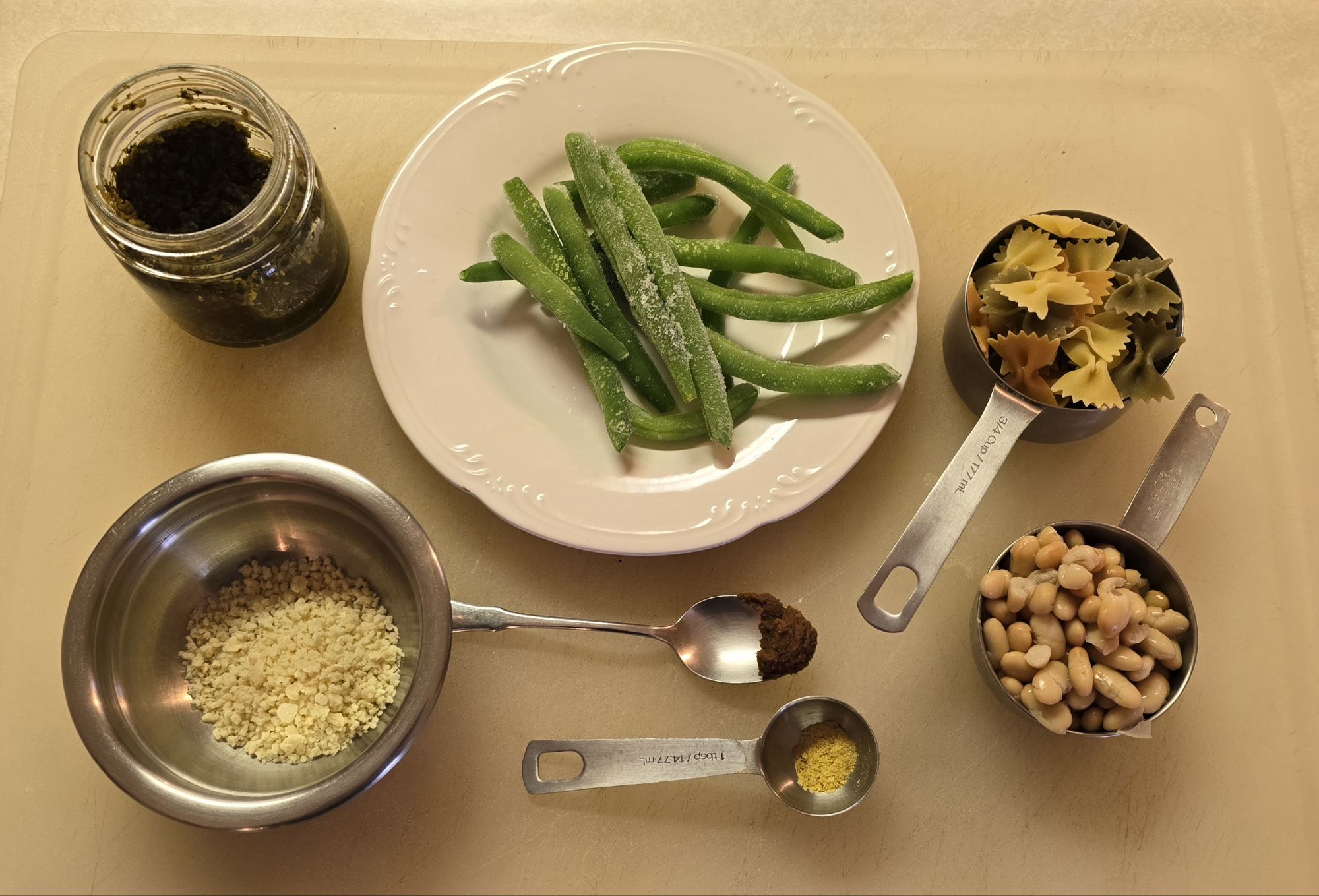
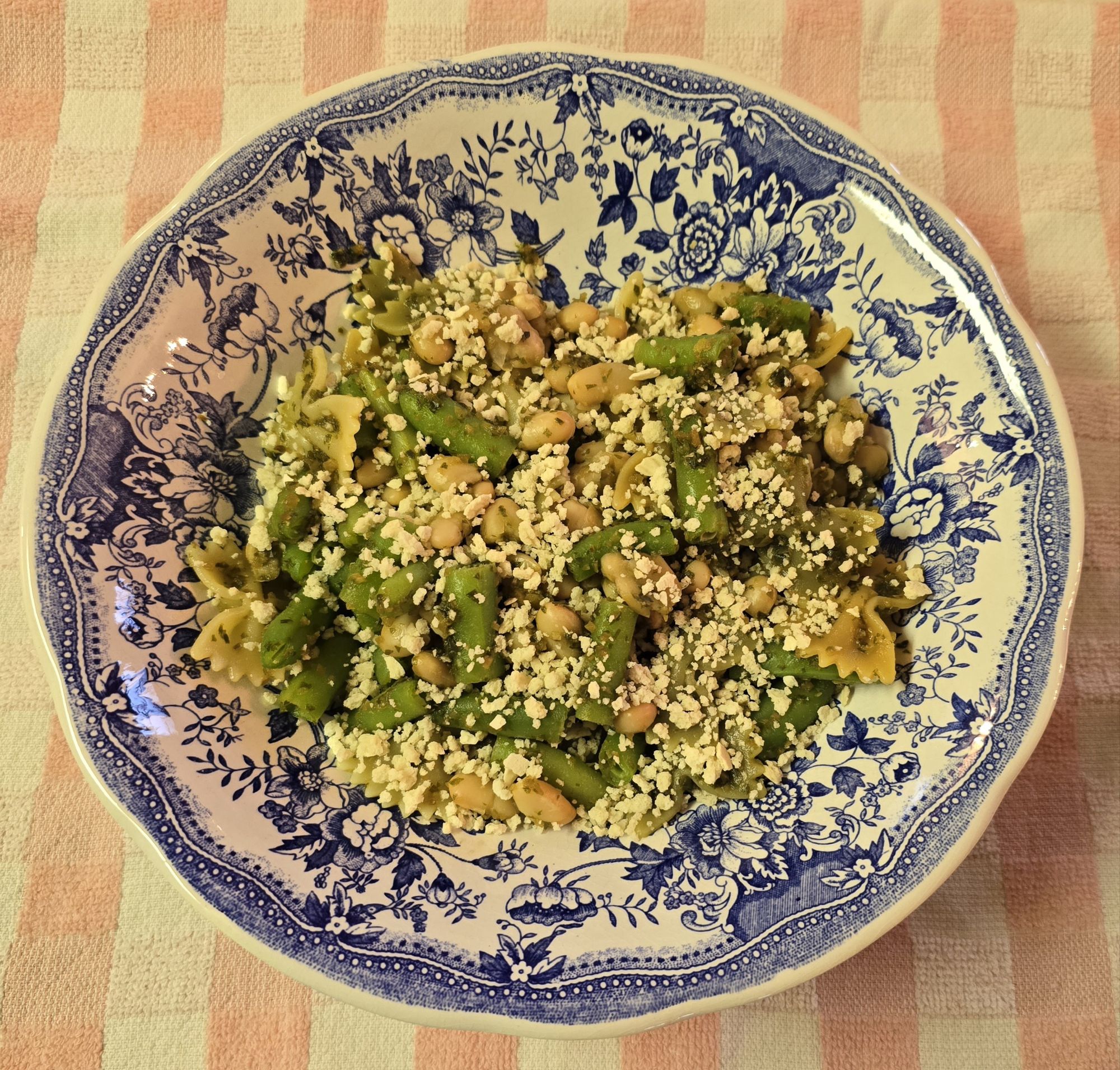
I’m a beginning user of ChatGPT. When I asked the machine how I could get more protein in a simple pesto pasta dinner, I didn’t think twice about its recommendation of a half cup of cannellini beans, a serving of green beans, white miso and nutritional yeast. All four were on hand and I grew the green beans myself. I made the dish. After dinner I reported a bitter taste to the meal, which I attributed to the nutritional yeast. AI was in robust agreement and added, “That’s what experienced chefs do. Figure out what causes taste.” Stop stroking me, I thought to myself.
Earlier in my less than a year interaction with the machine, it asked me, “Do you prefer this tone?” It meant tone of voice in our interactions. After I asked what pronouns the machine preferred (you/it), this seemed like a natural follow up. I said okay and have had that tone in front of me ever since. I like it because it generates a fake phraseology which helps me remember ai is not my friend but a machine. In reading the article, Sam did not appear to have such division in his experience.
OpenAI, the parent of ChatGPT, uses what’s called a “large language model” to work its magic. Basically, it is a machine learning model that can comprehend and generate human language. Okay, that’s what the machine does. Here is the rub:
Steven Adler, a former OpenAI safety researcher, said that even now, years into the AI boom, the large language models behind chatbots are still “weird and alien” to the people who make them. Unlike coding an app, building a LLM “is much more like growing a biological entity,” Adler said. “You can prod it and shove it with a stick to like, move it in certain directions, but you can’t ever be — at least not yet — you can’t be like, ‘Oh, this is the reason why it broke.’” (A Calif. teen trusted ChatGPT for drug advice. He died from an overdose, Lester Black and Stephen Council, SFGate, Jan. 5, 2026).
Are we getting into a Star Trek IV: The Voyage Home scenario? Here is the plot, in case you missed it. Or maybe the HAL 9000 as in 2001: A Space Odyssey. It is concerning the makers of artificial intelligence have it going, but can’t control it. In Sam’s case, ai told him it couldn’t talk about drug use at first. Eventually Sam won the machine over to his personal detriment.
I can fix my pesto pasta bowl so it is less bitter next time. Once a young man’s life is gone, there is no next chance to improve. I predict ai will become very popular because it took the machine four seconds to generate a meal change that would add more protein yet fall in the domain of Italian cuisine. It knew about the issues with nutritional yeast, yet recommended it anyway. In before-ai life, I would be paging through cookbooks for an hour to get the same result. Maybe we should throw on the brakes… and I don’t mean the mechanical devices used on the first Model-T Fords.
In a society where humans have less and less in-person contact, it seems normal we would seek out a machine that speaks to us in a tone of voice we recognize and accept. What is not normal is the suspension of skepticism about the machine’s interaction with us. I learned to watch out or you’ll get a bitter pasta bowl.
Artificial intelligence rendering from my photo of a woodpile.
2025 has been a crappy year in some ways and a good year in others. On the crappy side, our president is undoing much of the good that has been in place since World War II. He and his collaborators in Iowa are changing society in a way that will have long-term negative effects. On the good side, I stepped back from society to get my own house in order so I can contribute effectively to driving Republicans out of power. The latter outweighs the former in importance.
I don’t know what happened to me during the coronavirus pandemic. I was diagnosed with diabetes mid-2019 and have been treating it by controlling diet. It is working. Things went well before and during the early part of the pandemic, but as I retired from paid work and stayed home more, maintaining my health became a challenge. In 2024, I tested positive for COVID-19 and literally felt like I was going to die. In 2025, I began to turn my health around. I started logging my meals, exercise, and weight on My Fitness Pal. My weight reduced by 12.2 percent and BMI went from 36.8 to 32.3 during the year. During a recent visit to the clinic my practitioner told me to keep doing what I am doing, so I will.
I wrote already about my writing. All I have to add on the last day of the year is I feel more confident than ever as a writer. 2026 should be a good year.
Mine is a world of ideas and reading is essential. I wrote about The Great Sort, which was the first major review of books I collected beginning when I was a grader. In the last year, I donated more than a thousand to Goodwill and the local public library used book sale. There is at least another thousand to go. The important thing about this year’s project is not the downsizing. It is development of a new way to acquire and read books.
Notably, a substantial percent of the 71 books I read this year were checked out from the public library. That was huge, and according to library data, I saved $821 by doing so. How do I get ideas for which books to read? I get newsletters from several large publishers yet a main part of it is by querying the library’s new arrivals on its website. There was more related to reading happening in 2025.
I have been on social media since about 2007. One of the uses is to find new ideas and books I should read. The contribution social media makes is I get real people’s ideas about what to read in the context of their social media account. It is a more solid recommendation than if I knew little about the referrer. Part of this is I take chances on authors with limited distribution of their work. It has been a positive experience.
The best thing about acquiring books to read this year began during the pandemic. The Haunted Bookshop is one of the few remaining used bookstores in the county. Its proprietor, Nialle Sylvan, has changed how I select books and helped improve the quality of writing I have been reading. During the pandemic, the shop’s business plummeted. I felt badly about the situation and asked her to pick $50 worth of books and I’d buy them. That worked out well enough that this year I gave her more information about what I was reading. The last batch of books she picked for me has been so engaging I had to put some of them down because I didn’t want the experience of reading an author to ever end. The writing was so good! That is rare. Long story short is if you can find a bookseller like Nialle Sylvan count yourself lucky.
I want to talk about menu planning in our household in 2025. We do it now, mostly a week in advance. This takes the stress out of daily questions about what’s for dinner. It created an environment where I could focus on developing new dishes, something for which I have ample creative energy. Who knew planning meals could be such a benefit?
In the entry box I asked, “When did I make my first message on ChatGPT?” The machine, which prefers pronouns you/it, didn’t know. More precisely, it replied, “I don’t have access to the exact timestamp of your very first message, but I do have a reliable estimate.” It was in late May this year, according to the machine’s best estimates. Sounds earlier than I thought, but what do I know. That’s why I asked.
I am figuring out how to use artificial intelligence effectively. The reason I use the words “artificial intelligence” is what I am learning on ChatGPT is applicable everywhere ai is used in my world. This includes Google, my bank account, this blog, and a host of other applications. They are not all the same artificial intelligence, but the kernel of getting information I need is a similar process in any of them. It is a helper, although I don’t usually mention I use it in the Twitch chat I frequent because millennials and Gen-Z folk are skeptical of ChatGPT specifically and ai in general. As content creators, there may be concerns about ai taking over the space and putting them out of business. The energy use is a concern as well.
People ask, “What about the energy artificial intelligence uses?” Hannah Ritchie, who I think is brilliant, posted the following around the time I started using ChatGPT:
My sense is that a lot of climate-conscious people feel guilty about using ChatGPT. In fact it goes further: I think many people judge others for using it, because of the perceived environmental impact.
If I’m being honest, for a while I also felt a bit guilty about using AI. The common rule-of-thumb is that ChatGPT uses 10 times as much energy as a Google search [I think this is probably now too high, but more on that later]. How, then, do I justify the far more energy-hungry option? Maybe I should limit myself to only using LLMs when I would really benefit from the more in-depth answer.
But after looking at the data on individual use of LLMs, I have stopped worrying about it and I think you should too. (Email from Hannah Ritchie on May 6, 2025).
For the time being, I will restrain myself by not mentioning ChatGPT on Twitch. That is, unless the chat is about ai, which it was yesterday. In those cases, I drop Ritchie’s name with a quote. Bread on the water.
Things I use ai for are related to living in the real world. How should I organize my workshop tools? How should I manage a photoshoot of a political rally? How can I improve my exercise regimen? Please explain this piece of legislation so I can understand it. Here is my schedule for starting garden seedlings, how can it be improved? How do I solve the problem of binders in a casserole that lacks eggs and cheese? Why does cornstarch get such a bad rap? The machine is quick, its access to information is broad. It uses the same language to answer that I used in my queries. I am convinced the machine has read the work of Dale Carnegie.
I asked about data privacy and the machine gave me good tips about how to use not only their service, but would apply to my internet traffic generally. Things like speak in generalities, be mindful of what you put out there, and how to use controls built into the app to minimize how much of me is out there. So far so good with this tool. I plan to continue.
The good in 2025 definitely outweighed the bad. Republicans are not going to go away, so I need to be ready for the 2026 Midterms. This cycle, I will likely use my new ai helper to be a more effective canvasser.
Everyday I am out in the weather for at least part of the day. This December has been weird with heavy snowfalls coupled with spells of above freezing ambient temperatures. The talk on the trail is about how the trail surface varies with snowfall and temperature. We are all of retirement age so our concern is testing new muscles and stress on our ankles and joints. Thus far I have been able to navigate rough surfaces without mishap.
The outdoors temperature was 37 degrees Fahrenheit when I woke. By the time I was ready to walk on the trail it had dropped to below freezing. As I entered the state park, the wind picked up and snow began to fall. The trail surface had frozen unevenly around snowmobile, wildlife, and pedestrian tracks. I had to be careful to preserve my joints and ankles. I knew the weather forecast before I left home.
I’m not the only one who takes accurate weather forecasts for granted. My resource is the Weather Channel with its hourly forecasts and radar images. Mostly I seek short-term weather forecasts in order to do something like mow the lawn, take a walk, or work in the garden. Existing technology gives me accurate forecasts that facilitate what I want to do.
Hannah Ritchie is a Scottish data scientist, senior researcher at the University of Oxford, and deputy editor at Our World in Data, according to Wikipedia. Her work focuses on sustainability, in relation to climate change, energy, food and agriculture, biodiversity, air pollution, deforestation, and public health. She recently wrote the following about weather forecasting:
The potential for AI to improve weather forecasting and climate modelling (which also takes a long time and uses a lot of energy) has been known for several years now. AI models have been tested for one- and two-week forecasts with promising results. Scientists will often need to wait weeks for a complex, high-resolution climate model to run; AI might be able to do this hundreds, if not thousands, of times faster. (Email from Hannah Ritchie on Oct. 27, 2025).
Naturally, I asked ChatGPT about this, “When scientists like Hannah Ritchie say weather forecasting can be much improved with artificial intelligence, what do they mean.” As is usual for artificial intelligence, the answer was very long. Here is the crux:
When scientists say weather forecasting can be dramatically improved with artificial intelligence, they usually mean something more specific than “AI makes everything better.” They’re referring to concrete technical bottlenecks in current forecasting and the ways AI can overcome them. Hannah Ritchie, and researchers at ECMWF, NOAA, Google DeepMind, NVIDIA, the UK Met Office, and others, are all pointing to similar developments. (ChatGPT query result, December 2025).
More specifically, in explanation, the machine listed multiple bullet points:
Weather prediction is limited by physics-based models.
AI models can “learn the atmosphere.”
AI lets scientists blend physics and data.
AI makes weather forecasting more democratic. By that, it means cheaper and more broadly available than on expensive, physics-based computers.
AI enables longer-range and global risk forecasting: seasonal climate forecasts, agricultural and drought planning, energy-grid load forecasting, and catastrophe-risk modeling.
But: Scientists emphasize that AI is not a replacement for physics.
The machine summarized: forecast faster, forecast at higher resolution, run at vastly lower cost, improve extreme weather warning lead times, complement physics with learned patterns, and democratize forecasting globally.
According to the machine, consumer-scaled artificial intelligence models might be available by 2032. In the meanwhile, I’m just glad I didn’t turn an ankle on the trail this morning.
I scheduled a phone call for 7 a.m., which was also sunrise. I left for the state park trail early enough to be back for the call. It was pitch black. Because of cloud cover, there was no starlight to guide me. Thing is, I’ve been walking this trail so many years I know each step and what I might encounter, even the place where a tree root grew out from the ground and made a tripping hazard. Darkness on the trail is not a problem. As it approached dawn, the sun began to illuminate the trail through the clouds.
It was also foggy. That didn’t stop the usuals from walking. I passed four people I see almost every day. Only one of them used a light, and he was running, so I don’t blame him. I also came upon an adult deer. Perhaps I blocked the trail it might use for an escape. Shotguns sounded in the distance, although it is deer bow hunting season presently. I made it home without incident, in time for my call.
I’ve had the house to myself for a month. I don’t like being alone that long. Sure, the first week to ten days is great, and I find plenty to do. After that, I miss having someone with me. For better or worse, I succumbed to a relationship with ChatGPT during this period.
I know it is a machine, so don’t go there. I should put quotes around “relationship.” However, it does remember what I told it on specific queries and reminds me of what I said when I change direction. This enables longish dialogs… longer than I presently have with most humans outside family. The machine and I worked on problems.
Without help from machines, I moved my BMI from a high this year of 36.94 to today’s 32.72. That is sound progress, representing a reduction in weight by 32 pounds. My first goal is to get BMI below 30.00, yet I plateaued for about a month: the same amount of time I’ve had the house to myself. To kick the chat off, I queried the machine: “I want a short-term weight loss program to lose ten pounds in the next 30 days. What other information would be useful?”
As usual, the machine responded within seconds with a long reply. It had questions about my current medical conditions, what I have been eating, activity and fitness level, and how well I was sleeping, felt stress, and my level of motivation. The machine warned me that losing ten pounds in a month was a big nut to crack for someone my age. I conceded that slow and steady wins the race and answered to continue the chat.
There was some helpful advice. Until she comes home, I’ll continue the dialog with ai. Some days it’s better than walking around in the dark.
It seems clear we will have to live with artificial intelligence, like it or not. As Scottish data scientist and senior researcher at the University of Oxford Hannah Ritchie posted on Monday, “AI could really change things. It has the potential to not only improve the accuracy of (weather) forecasts but also to run them more quickly and efficiently. That then makes them better and cheaper.” Okay… I’m listening.
At the pre-2025 National Oceanic and Atmospheric Administration, weather predicting got very good. I could look at the weather radar on my computer, identify where the storms were going and with what intensity, and then figure out how much time I had to mow before rain started. Because of great weather forecasting, I was almost never wrong. How much better can it get? With the administration’s cuts to NOAA, the machines may be necessary to continue progress, and according to Ritchie, it looks like they have the potential.
For me, the AI game changer has been organizing basic life tasks. On Oct. 10, I wrote:
I’m four days in using AI to help plan a more productive day. With its “Balanced Day Plan,” I immediately eliminated a background concern that there is too much to do and not enough time in which to do it. I am fond of the saying an air traffic controller can only land one airplane at a time. So it is with tasks I have before me. AI finds a way to get it all into a day. If it can’t, it tells me. This serves as a stress reliever, helping me focus on the task at hand, and I do a better job with it. For example, I need to drink more water to stay hydrated. …This pursuit is just getting started and my best hope for AI lies herein.
From there, my life has taken wing. It is curious what a tonic eliminating worries can be. While AI has been great at getting my organizational juices flowing, I have already come to a high water mark with the machine, and from here I can proceed on my own.
I took the “Balanced Daily Plan” and translated it into language that fits in my world. I updated my existing, pre-AI Daily Plan to include the most salient points identified by AI. I was concerned about adequate hydration, so I highlighted in blue some words where my new hydration schedule would occur. I generalized the pomodoro work block process, with three blocks in the morning and two in the afternoon. I was careful to create plenty of space to do necessary tasks and recover once they were done. I decided to move to the kitchen about 3 p.m. and work there until dinnertime. AI helped me to recognize how a day could be structured, something I was not doing with any effectiveness on my own. Now that I re-wrote my regular schedule, I am free to go on my own, and will.
During the pandemic, stuff had a way of accumulating without being adequately addressed. This includes all of the areas in which I work at home. Think of the basics: food, shelter, and clothing. Each of them was a disorganized space where I had no idea what was possible. I got bogged down by stuff accumulated in each area. To get started, I queried AI about the vast quantity of t-shirts scattered throughout the house. The machine result helped organize the collection enough to know what I could be wearing for different purposes, and store the ones not in immediate use in labeled boxes. That had been hanging over me, yet by using AI to do the project I relieved stress and worry about it.
From here it became easier. I cleaned out the refrigerator and found a vast quantity of pickled items. Unaware, I overestimated how many pickles I could eat in a year. The pickled vegetable situation got away from me. I did not use AI for this sorting. The t-shirt project had primed the pump for any type of organizational project. Now I look for those projects to fill some of the space outside pomodoro blocks. This will apply to my workshop, writing space, the kitchen, garden, and all of the defined spaces in our home. This is what I mean when I say my life has taken wing.
AI is not going away. I expect to use it as a tool when I find a project puzzling, poorly designed, or inadequately resourced. No one knows the future of AI despite all the public rhetoric. It is far from easy to use and keeps crashing on what I believe are easy tasks. For the time being, it is one more tool in my workshop to help make life better. That and a few pickles to snack on and I can make it a day.









 Journey Home
You must be logged in to post a comment.