Categories
Writing

Happy Holidays 2020

Christmas Coffee

Today is our wedding anniversary, which annually marks the beginning of a period of reflection from now until January. With the coronavirus pandemic, it will last longer than it has.

While the COVID-19 vaccine arrived in Iowa this week, it could be a while before I get vaccinated, and even longer before 70 percent of the U.S. population is, which experts say is needed to declare the pandemic over. The pandemic dominated much of what I wrote this year.

Mine has been a life lived in forward gear, without much reflection on the immediate past. Focused on the future, I endeavored to avoid the rear view mirror. That is, until this year when work on an autobiography began in earnest. I’m finding out who I was. It is not much different from who I am today.

The pandemic had me reading more books this year, 50 so far. The Reading List tab on the menu takes viewers to a list of what I recently read beginning with the most recent. The five best books I read this year were:

  • Wildland Sentinel by Erika Billerbeck.
  • Dreamland: The True Tale of America’s Opiate Epidemic by Sam Quinones.
  • The Human Planet: How We Created the Anthropocene by Simon L. Lewis and Mark A. Maslin.
  • American Primitive by Mary Oliver.
  • Deaths of Despair and the Future of Capitalism by Anne Case and Angus Deaton.

I appreciate visitors to this site, especially those who return often. I follow WordPress statistics and observe the most popular posts are those that offer something different. Politics, my autobiographical work, and the story about the black man found burning in rural Iowa got the most views this year. I wrote Autobiography in 1,000 Words in 2013 and it continues to get more views than any new post every year. I write often about cooking and gardening, my kitchen garden, yet that work does not garner as many views. I plan to continue posting next year.

Thanks for reading. After 46 straight days of posting I plan to take a break. If something big happens in my world, I’ll return to post about it. Otherwise, I hope to see you again in 2021.

Best wishes for happy holidays with hope for a better 2021.

Categories
Writing

Toward Citizenship in 1984

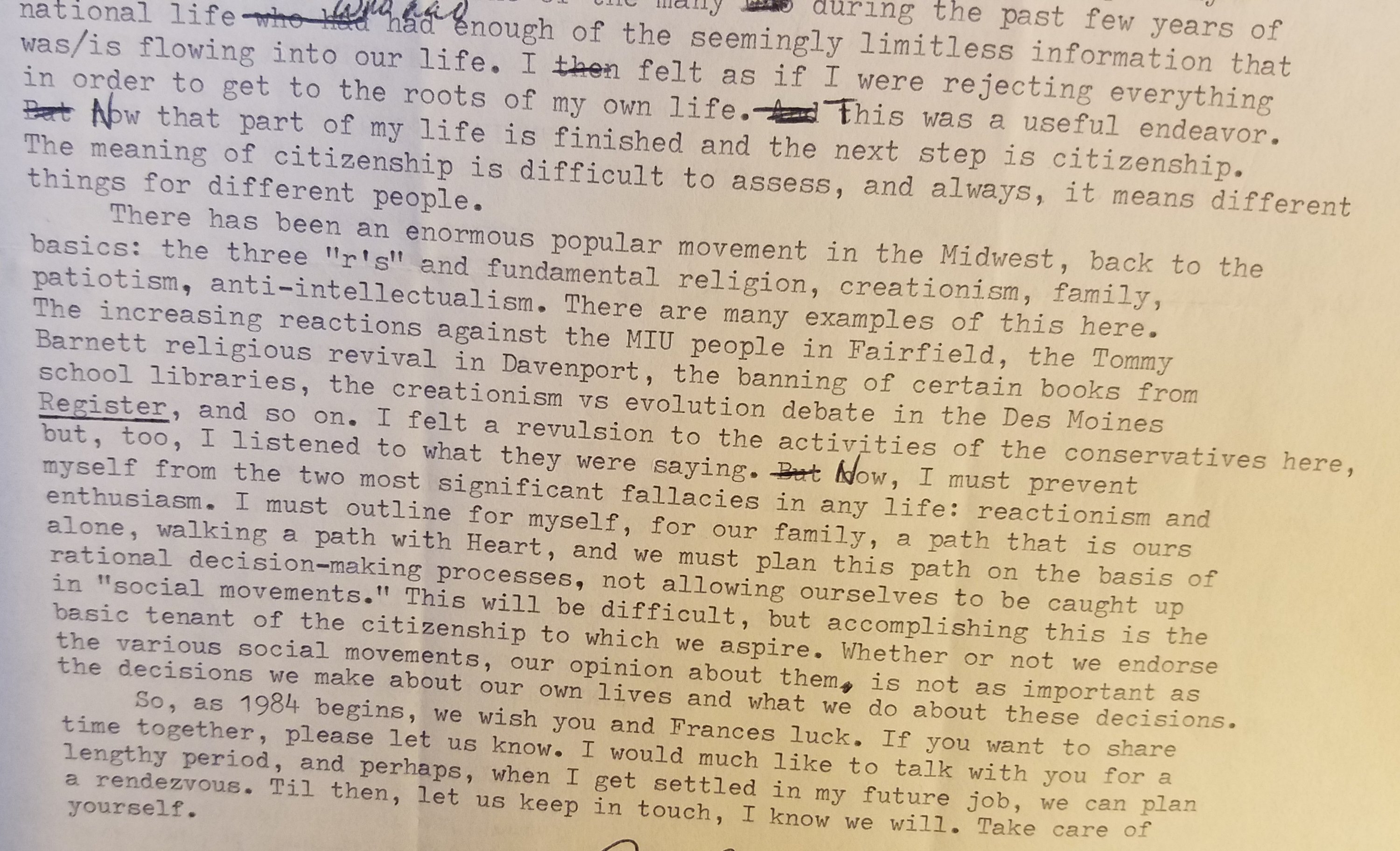
Fragment of a draft letter to Dennis, Jan. 14, 1984

This letter was written to my friend since high school Dennis Brunning. The following month I would accept my first job with CRST, Inc., as it was called then. The sixth paragraph describes the beginnings of what would become attributes of the modern Republican Party in Iowa and the roots of Trumpism. It is somewhat sad that I believed a path based on “rational decision-making processes” was possible. Maybe it is. In 1984 I didn’t expect anti-intellectualism to expand the way it has. I can’t recall if I sent the letter to Dennis, but presume I did. I re-typed the text verbatim, as much as it pained me to do so.

Dear Dennis,

Greetings again from our rented abode on Taylor Drive. It is a sunny Saturday, we’ve just finished the papers and morning coffee, and now I am about the work that will hopefully propel me into a secure economic orbit, somewhere outside this nuclear home.

In my daily work at the university I realize my days are numbered. I have outgrown the work I am doing there. It is time to move into the next position… and I wonder what that will be. I am unlike you. I have not got a profession in mind, and so, my path is not as direct as yours seems. But, together, Jacque and I will make for ourselves a life here.

That I read the Saturday morning newspaper is significant. During the past year I cut myself off from the outside world, lived within the confines of my married relationship, but no more. I seek now information about the rest of the world, and newspapers are a wealth of the type of things I want to learn.

I wish next to attain full citizenship in my native land. I think I was one of the many during the past few years of national life who had had enough of the seemingly limitless information that was/is flowing in our life. I felt as if I were rejecting everything in order to get to the roots of my own life. This was a useful endeavor.

Now that part of my life is finished and the next step is citizenship. The meaning of citizenship is difficult to assess, and always, it means different things for different people.

There has been an enormous popular movement in the Midwest, back to the basics: the three “Rs” and fundamental religion, creationism, family, patriotism, anti-intellectualism. There are many examples of this here. The increasing reactions against the MIU in Fairfield, the Tommy Barnett religious revival in Davenport, the banning of certain books from school libraries, the creationism vs. evolution debate in the Des Moines Register, and so on. I felt a revulsion to the activities of the conservatives here, but, too, I listened to what they were saying.

Now, I must prevent myself from the two most important fallacies in my life: reactionism and enthusiasm. I must outline for myself, for our family, a path that is ours alone, walking a path with Heart, and we must plan this path on the basis of rational decision-making processes, not allowing ourselves to be caught up in “social movements.” This will be difficult, but accomplishing this is the basic tenant of the citizenship to which we aspire. Whether or not we endorse the various social movements, our opinion about them is not as important as the decisions we make about our own lives and what we do about these decisions.

So, as 1984 begins, we wish you and Frances luck. If you want to share time together, please let us know. I would much like to talk with you for a lengthy period, and perhaps, when I get settled in my future job, we can plan a rendezvous. Til then, let us keep in touch, I know we will. Take care of yourself.

Paul

Draft Letter to Dennis Brunning, Iowa City, Iowa, Jan. 14, 1984

Categories
Writing

Monday Late Autumn

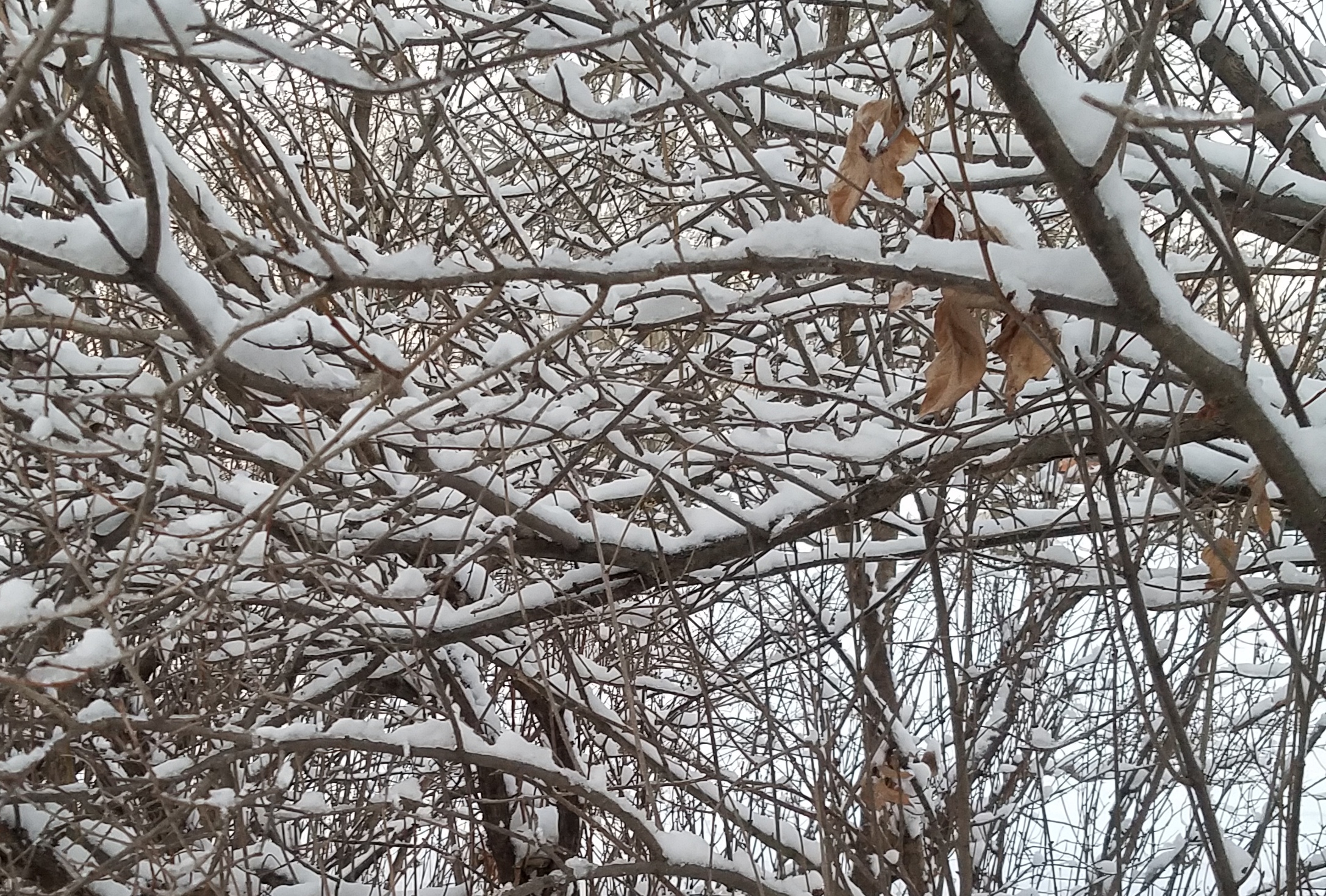
Lilac Bushes Dec. 14, 2020

I hope to address food in my autobiography by putting a dozen or so recipes in an appendix. That won’t be enough.

My earliest memory of food is from when we lived at the Fillmore Street duplex. I walked through the screen door from Grandmother’s kitchen, outside to the rear porch, and smelled cooking grease coming from Riefe’s Restaurant across the alley. I was a toddler. Insofar as Riefe’s became a recurring theme in my life, until it closed in 2015, I plan to write more about it and what we did there. For example, when I was an altar boy a friend and I went there for breakfast after serving Mass. A group of men from Northwest Bank across the street often met in the basement while we were there.

I’ll mention Happy Joe’s Pizza, not for the stores, but the story about Joe Whitty and his family living two doors down from our American Foursquare when he first came to town and worked at Mercy Hospital. He next worked at Shakey’s Pizza where my pals and I from Turn-Style would go after a shift. I don’t have a memory of actually eating in a Happy Joe’s Pizza restaurant, although I’ve been in his ice cream stores plenty of times.

In my files from the 1980s there are lists of types of meals and meal settings. There is plenty of material. Spargel in Mainz, my uncle’s coffee shop in Davenport, military food, fast food, catered food, Mom’s food, Grandmother’s food, the Deaton Diner… there is a lot.

There are also many snippets of writing like this:

Notes on Funeral Meals

A person at work went to his grandfather’s funeral. He chose to talk about food when I asked him about it. All home cooked, not like at Perkins.There were all kinds of food, main dishes, vegetables, desserts. They held it at the Lion’s Club after the burial.They had to hire a hall. He said the most significant aspect of it was going back to the table for food three times.

Personal Papers, undated, early 1980s

The broader narrative is not about food, though. To the extent food played a role beyond sustenance, it will be used as a narrative device which contributes to the main story. Like a pasta sauce, the volume needs to be reduced for it to be palatable.

Categories
Writing

View From the Kitchen Window

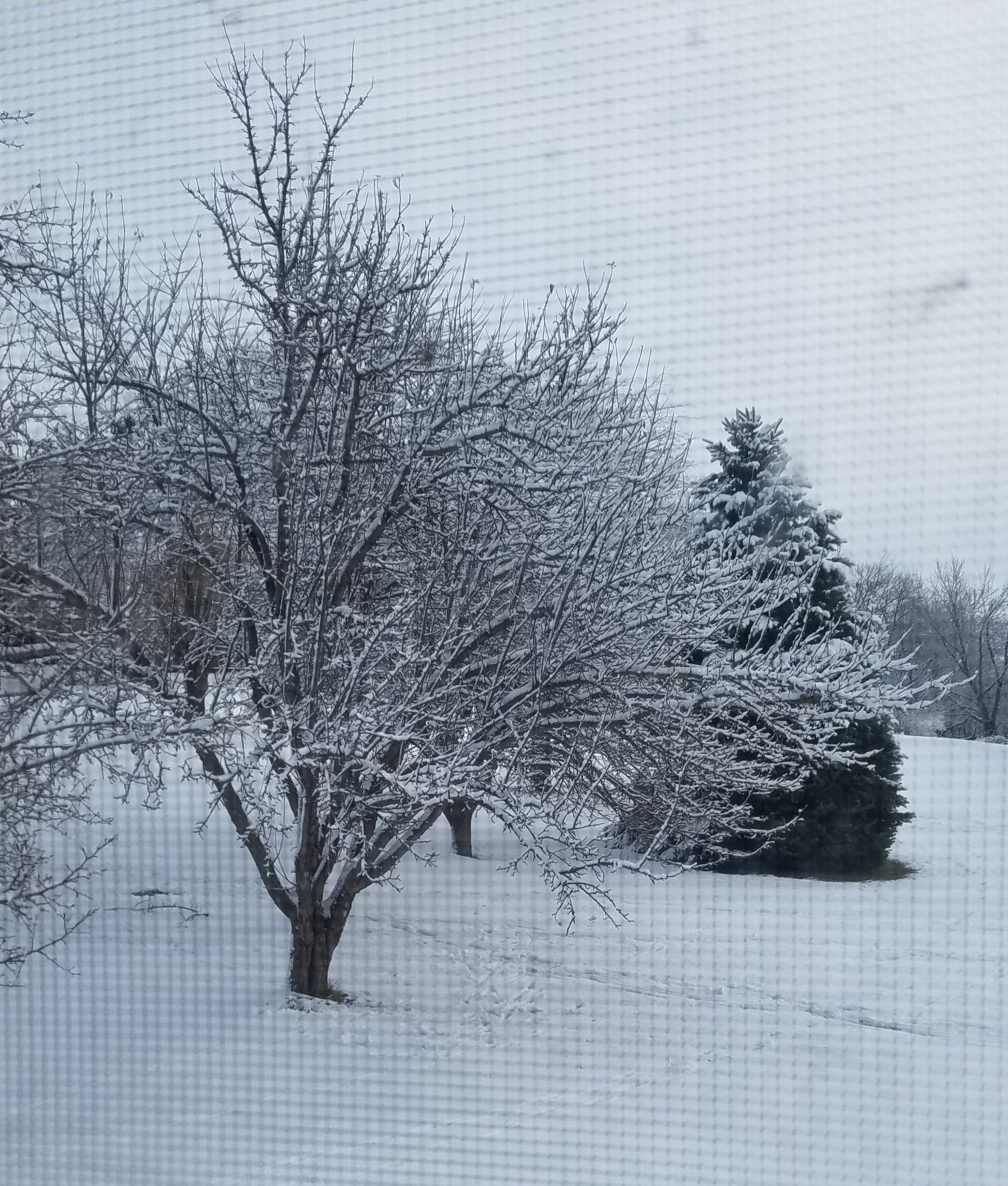
Backyard over the kitchen sink. Dec. 13, 2020

Time for an indoors day foraging for brilliance… or at least a few decent sentences.

Best wishes for a peaceful Sunday.

Categories
Writing

Big Grove in 2020

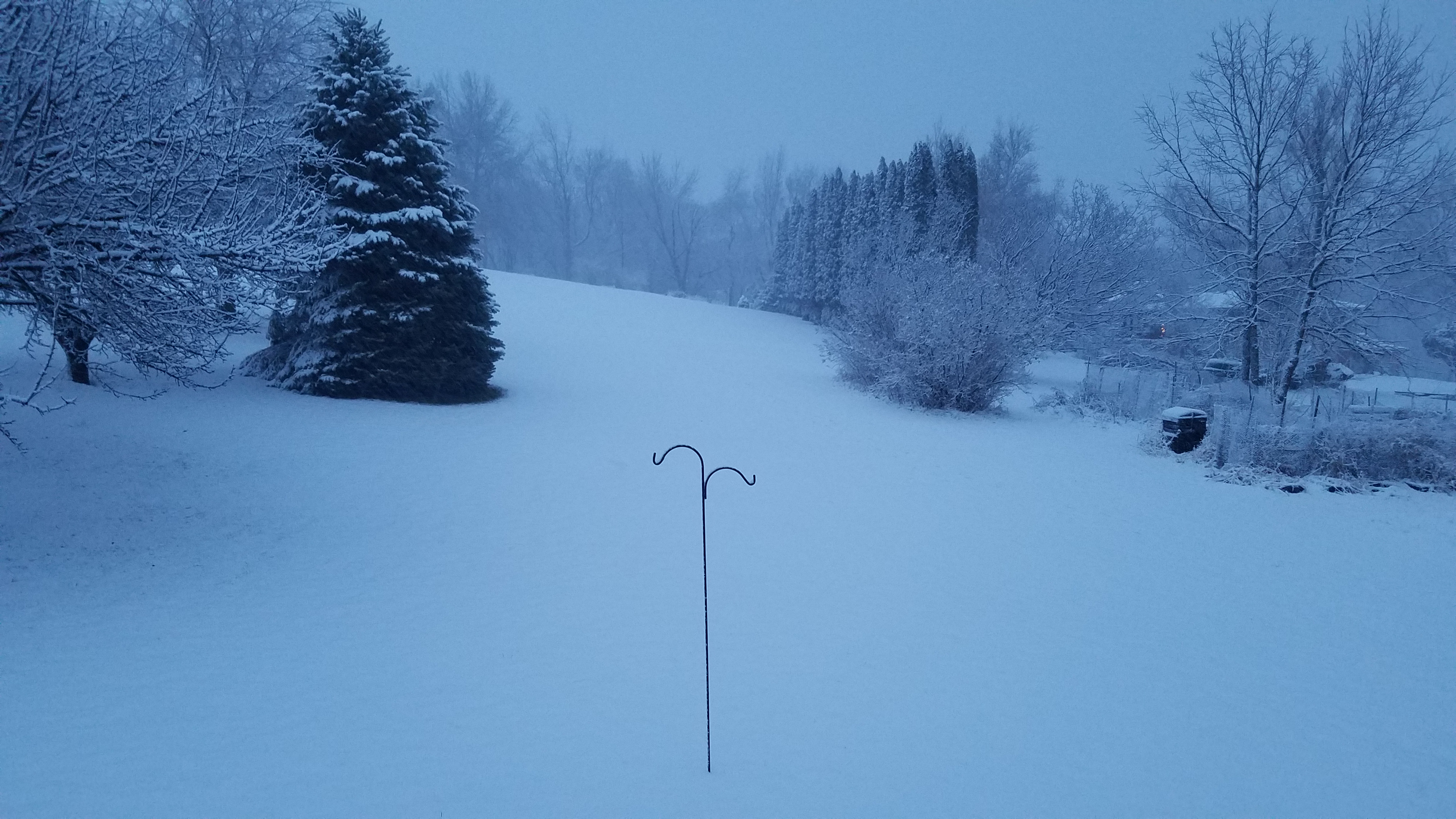
Overnight snowfall, Dec. 12, 2020

More than other recent years, 2020 contained significant events. The Iowa precinct caucuses, the coronavirus pandemic, the Aug. 10 derecho, the Nov. 3 general election. Take your pick. They all were important and framed much of what we did.

Yesterday I took the 1997 Subaru to the tire shop to investigate a leaking passenger side rear tire. The technician found a roofing nail in it. Apparently the derecho pulled nails from roofs across the region and redistributed them everywhere. That brings the total I spent of derecho recovery to $1,240.45, a lot less than what others spent.

Gardening came to a halt with the derecho. The tall locust tree had been struggling for a couple of years, since the extreme cold weather a couple of years ago. I watched as the wind of the derecho pushed it over onto the pepper and tomato plants. It needed to come out, so the wind did the work with some unwanted consequences.

One of three Bur Oak trees planted together after our daughter’s high school graduation almost blew over. On the agenda is to cut two of three down and let the third grow as it will. The oak trees were to symbolize the three in our family. I never expected them to get so big although taking two of them down was an eventuality I recognized when planting the acorns.

I raised vegetables in seven plots this year. Three were dedicated to one kind of plant: tomatoes, onions and garlic. The rest were a mix. Among the success stories were tomatoes, garlic, onions, shallots, peppers, celery, broccoli, kale, collards, chard, mustard, potatoes, zucchini, peas, green beans, tomatillos, cucumbers and basil. There were some unexpected volunteer butternut squash, and a forgotten patch of celery that produced a late crop. Less successful were eggplant, carrots, rutabaga, okra and herbs.

It was a dormant year for fruit trees. I harvested some pears which were juicy and delicious. I planted two new apple trees and a big branch blew down from the Red Delicious apple tree during the derecho. The grove of fruit trees is getting old and likely should be replaced in the next few years. We’ll see if there is a crop in 2021.

Above everything else, the coronavirus pandemic looms. It had me give up my retail jobs and endeavor to stay at home more. I went six weeks without buying any gasoline for our two cars. I read more books than I have in a long time. I wrote and cooked more.

This year will be memorable for the events. I hope it is a point of new beginnings with more focus on writing, on the kitchen garden, and on health. A lot more happened in 2020. Reducing it to several things is appropriate and more memorable. I feel both lucky and cursed to be alive at the end of 2020.

Here’s hoping 2021 builds on the rubble 2020 became.

Categories
Writing

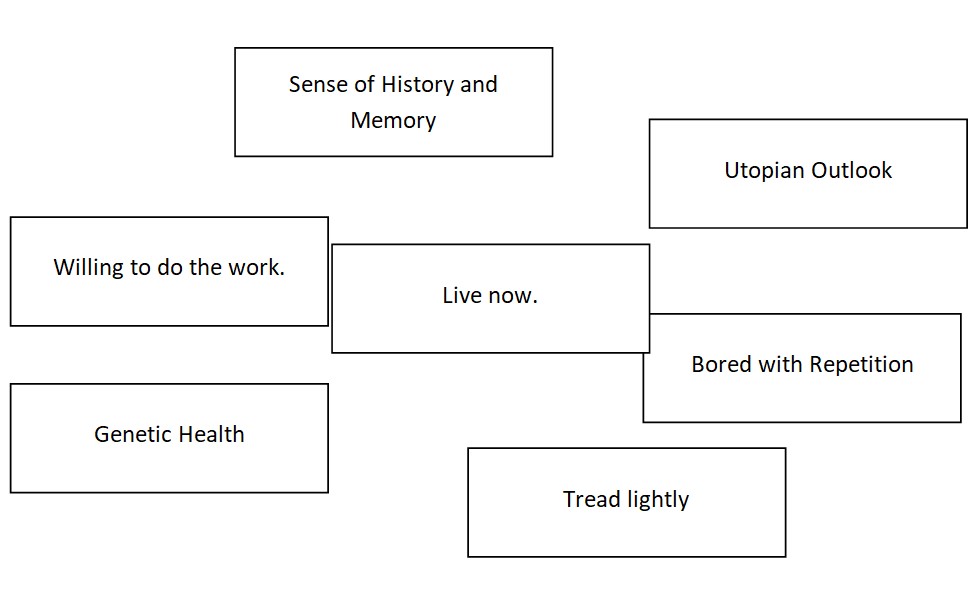
Diagram of a Life

I’m not sure how I felt about Ram Dass’ book Be Here Now by 2013 when I made this diagram. “Live now” in the center weaves a thread back to my first reading of Ram Dass shortly after the book came out in 1971.

There was a shortage of mass media and consumer goods to support the new life we believed was possible after the tumultuous 1960s. Be Here Now fed that appetite.

A writer has to have more going on than living in the moment. That’s what the diagram is meant to represent… I think. If these are some of my qualities as a writer, the one that stands out today is “utopian outlook.”

There is a utopian outlook in American society that shows itself in the manifest destiny myth, in our outlook toward business startups, in things as simple as setting up a home. We have a fundamental belief in systems and our role as chief actors in them. The example of Iowa’s remade landscape and the farms and businesses that now populate it offers no more perfect example of utopian outlooks.

Endemic to my writing process is an attempt to figure things out then build a platform of experience from which I can observe the world. I then hope to write pieces that add positively to society: letters, blog posts and opinion pieces. The success of such writing depends on a developed understanding of society combined with a utopian outlook which presumes its perfectibility. Well, if not perfect, then continuously improving.

In 2013 one part of my life had run out of fuel and money, and another was being formed from a series of low-wage jobs. As important as establishing a source of income was, there is no related box on the diagram. Money has never been that important to me, especially once I established a system to pay the bills.

I don’t think there is a western version of Ram Dass unless it was himself. Our survival depends on being here now. What may matter more is how we see the now. That’s what I’m working on as I write my autobiography.

Categories
Writing

How We Create

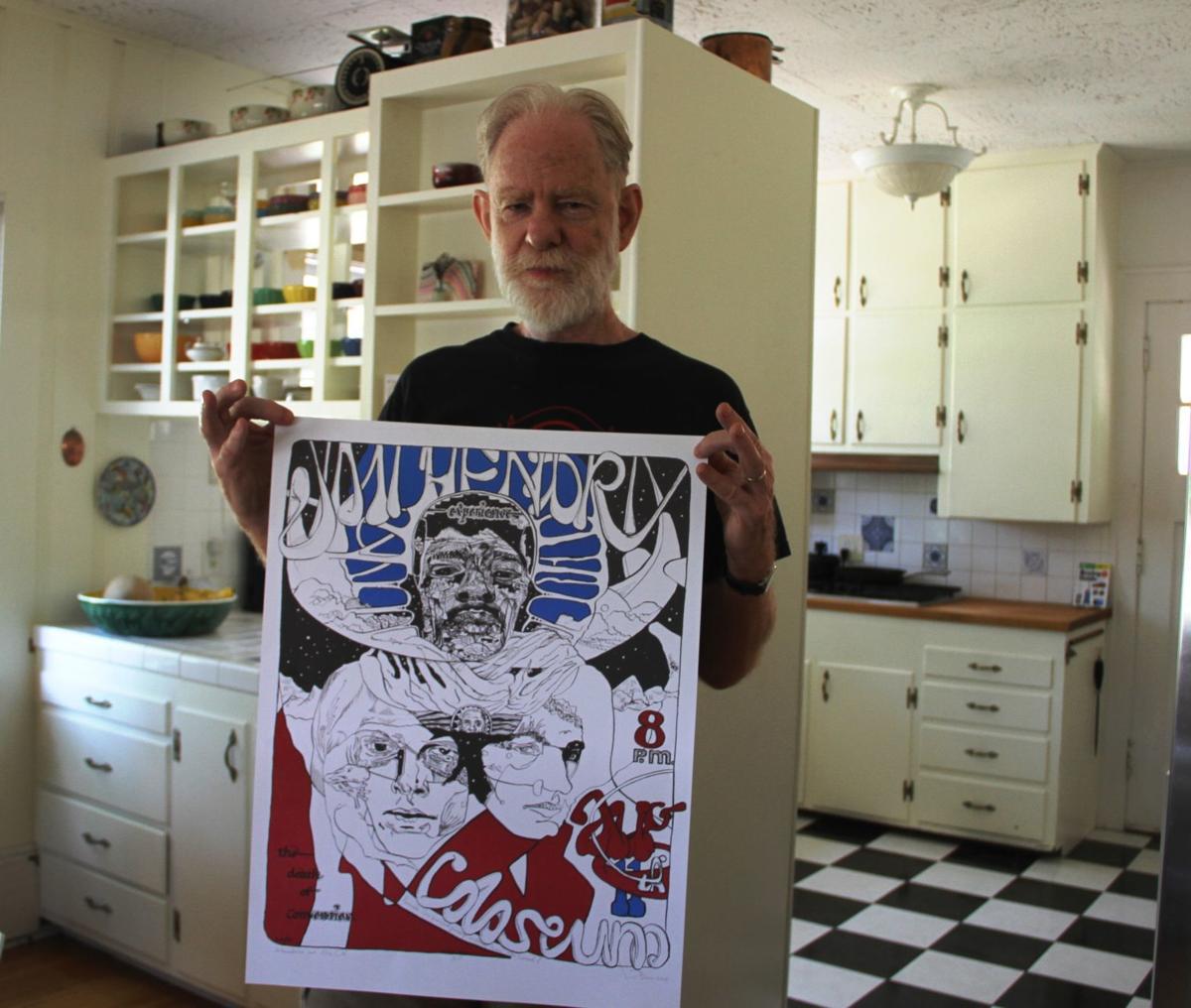
Leslie Bell on 50th Anniversary of the Jimi Hendrix Performance at the Col Ballroom in Davenport, Iowa with a reprint of the poster he made for the concert. Photo Credit – Quad City Times

How do we create?

Is creating work — writing, art, music, photography, film and television, radio, oral stories, events — magic? Sometimes it seems so because we can’t recognize how an end product came into being… it must be magic. Is creation the result of hard work, discipline and practice? Some of what I’ve written could have used more and smarter work.

“If you want to be a writer, you must do two things above all others: read a lot and write a lot,” Stephen King famously wrote. “There’s no way around these two things that I’m aware of, no shortcut.”

Over time I came to agree. Looking back at my extemporaneous writing — similar in technique to what Jack Kerouac did in stream of consciousness — it seems pretty lame. Creativity requires practicing the craft. Gaining awareness of other aspects of society is equally important to creativity. What King wrote about writing applies to other art forms.

In the 1960s and 1970s, I looked to Bob Dylan as a creative model, particularly during the time leading up to release of the album Bringing It All Back Home in 1965 through his work after the motorcycle accident with what would later become The Band. The stories of him living in Woodstock, New York, sitting at a typewriter for hours on end, and consuming the work of other musicians was how I envisioned myself.

The collaboration with Rick Danko, Garth Hudson and Richard Manuel, who lived at Big Pink in West Saugerties, New York, and with Robbie Robertson and Levon Helm, resulted in the bootleg tapes. A friend in high school secured a copy and we thought it was something. How my Dylan modeling played out over time is worth considering, but that will be later. Suffice it I knew I would be no Dylan but his work influences mine, even today. The process of his creative endeavor remains something to model.

I knew Leslie Bell mostly through my neighbor and friend John Kiley. I can remember only two personal interactions with Bell. I picked him up hitchhiking to visit a friend when he studied with Father Edward Catich at Saint Ambrose College. I also engaged his band to play at a high school class reunion. Everything else I knew about him was through someone else.

When I returned to Davenport from Germany, Bell and others had founded the Open Cities Film Society. While the films screened were less diverse that what I experienced in Iowa City where I attended graduate school, it was something available in a river city where a shoppie mentality continued to prevail among the populace. I don’t know how, if at all, Bell’s creative process influenced mine but this segment from a 2013 interview by Painter’s Bread is close to my creative process.

PB:  How do you go about making your work and what kinds of challenges have you experienced?
LB:  Since my work is improvised and doesn’t rely on models or observation, my working method requires a lot of front-loading. Film, novels, music, and life played out in real time all help me build an archive of possibilities. I certainly keep my eyes peeled when I’m out and about. The years I spent as a street photographer have helped me scoop useful experience from the broader kettle of stimuli in the form of interactions, gestures and changes in the social fabric.
In the studio, I begin with a blank canvas and no ideas. The canvas serves as a screen on which I can imagine random images, stories and compositions. I’m looking for a place to start—a strong-but-vague impulse. From that point on, it’s a process of call-and-response. I react to what’s on the canvas with a move that seems an appropriate extrapolation of the narrative, the color etc. I may not know what the painting is about until it’s almost done if at all.

Painter’s Bread, Leslie Bell Interview, Aug. 17, 2013.

Like many writers, I start with a blank page. I take a snippet from life, or a point from an outline, and type a couple of sentences on the screen. How and what I end up with is based on the “front loading” process to which Bell referred. The content seems better for diverse experience brought to the work. When adequately front loaded, the work product is better.

At the same time, there is magic to writing. When I hit on a sentence that stands out as universal, I can’t say where it came from. Such moments make the work worth while.

One has to let go of quotidian affairs while creating. Being grounded is important. It’s not always the point of a creative piece. Blending everything together takes practice… with a bit of magic to pull a good story together.

Categories
Writing

Father was a Union Man

Story draft page

Father’s death on Feb. 2, 1969 dominated my life for a long while afterward. For years I thought it would be the central theme of my writing. I now realize it was a reality through which I had to work. It wasn’t until military service that I began to get through it.

I started several short sketches like this one using different names for the characters. While I pretended they were fiction, clearly they represented our lives, thinly veiled. This fragment captures my discussion with Father about nationality. It took place in the dining room of the American Foursquare on Marquette.

At our grade school we were divided into groups: about half were descendants of German immigrants and half Irish. A small number of us who were neither were assigned with the Irish because there were less of them. Our conversation was soon after this division. At our 40th high school class reunion I asked a classmate about division into Irish and German groups. She had no memory of it.

Being an “American” rather than a son of immigrants came to define part of my character.

The fragment below was written at my apartment near Five Points in Davenport less than two months after leaving active duty. It is edited to pull different parts of it together. I didn’t change much.

Father was a union man. He forged implements of the modern farmer at the J.I. Case plant in Bettendorf, Iowa. He was a proud man, proud of his family and heritage. He stood with both feet on the ground.

The union offered him a job as chief steward once, and he took it for a while. He asked to be put back on the second shift so he could return to school, and be his own boss, to establish himself. Father knew who he was, where he stood, and where he was going.

One night after supper, Jim Peterson went into the living room, where Father was watching the news on television, and asked, “What nationality are our ancestors?”

Father looked up and without hesitation said, “American.”

Jim asked again, “But are they Polish, like Mom’s or what?”

Yes father knew who he was and if it was one thing he was not, it was someone else’s son.

At age forty he graduated from the Palmer College of Chiropractic, the oldest man in his class. In September, death in the form of a 1959 Ford found him walking from the Case plant after second shift and brought his efforts to a different culmination.

Personal Papers, Jan. 9, 1980
Categories
Writing

Pearl Harbor Day 2020

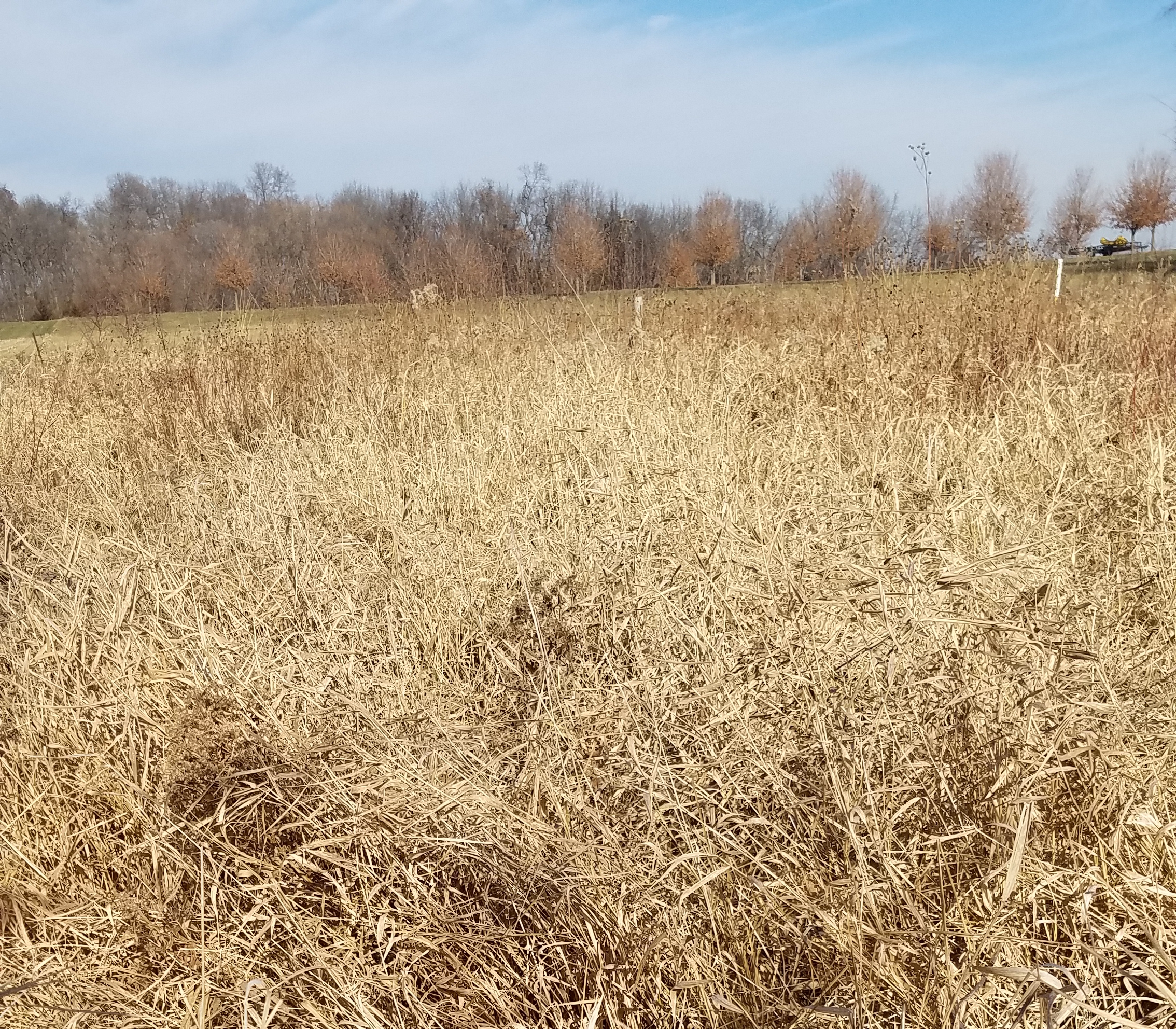
North of the trail. Dec. 5, 2020.

On Dec. 7 I remember our neighbor Bill who continued to witness about the bombing of Pearl Harbor until his death in 1994. Those were days before we recognized something called Post-Traumatic Stress Disorder. Rest in Peace, Bill.

A neighbor died of COVID-19 over the weekend. The neighborhood’s rate of infection by the coronavirus has me questioning the wisdom of exercising on the state park trail. On one hand, I understand how the virus is transmitted and have taken to wearing a face mask on the trail. On the other, it’s an exposure I simply don’t need as the pandemic peaks in Iowa. What I know for certain is I will go crazy if I don’t get outside over the remainder of fall and through winter.

I made a couple of work shifts of discovery while I was indoors. While I plan to write my autobiography in 2021, I’m also not in a hurry to proceed because there is so much material. Going through it takes time and if I seek to capture a life accurately, it is time well spent.

I’ll be spending this week getting a grip on the scope of the project. I’m not comfortable I understand what’s available to me yet. I’ll be doing that and determining how to exercise as the coronavirus pandemic yields a record number of cases, hospitalizations and deaths. Be well.

Categories
Living in Society

Dusty Books

Lake Macbride State Park, Dec. 2, 2020.

Wednesday was discovering thick layers of dust on shelved books in my writing room. A long stream of cobwebs wove its way along the top shelf of one side, through 15 toy trucks collected during my transportation career. To get any focused writing done, of the kind an autobiography represents, the books must be rearranged for quick reference… and dusted.

With all of that I managed a walk on the trail.

I’ve been writing about the closest congressional race in the country here in my congressional district. Yesterday Rita Hart’s campaign identified next steps after the results of the election were certified on Monday. She lost by six votes. Here is the unedited press release for readers as I get back to work planning 2021.

Make it a great day!

Rita Hart Announces Next Steps to Ensure All Iowans’ Votes Are Counted, Calls on Miller-Meeks to Join Effort

WHEATLAND, IOWA — Today, Rita Hart announced plans to challenge the latest vote totals in Iowa’s Second Congressional District, reflecting the need to count all votes cast in the Second District, including legally cast ballots that were not considered in the state recount process, which far outnumber the number of ballots needed to change the outcome of the election. Additionally, given the short six day timeline allotted for a state elections contest in Iowa and the volume of ballots left to be examined across 24 counties, Rita Hart plans to file a petition with the House Committee on Administration under the Federal Contested Elections Act, a decision that allows for enough time for all legally cast ballots to be considered, ensuring Iowans’ votes are accurately counted.

Since Election Day, significant errors in the counting process have led to confusion over whom Iowans in the Second District elected to represent them:

  • On November 6, Secretary of State Paul Pate announced a significant over-reporting error in Jasper County, triggering a county-wide recount. 
  • Then, on November 10, Pate announced yet another reporting error, this time involving under-reported votes in Lucas County. 
  • On November 23, the recount board in Jasper County conducted a machine recount that netted 9 votes for Rita Hart. However, at the urging of the Miller-Meeks campaign, the recount board conducted yet another recount on November 25 that netted just one vote for Rita.
  • Many counties did not fully review ballots to identify valid votes that the machines did not recognize, in part because of the time and burden that would have been required for such a thorough count.

Once the initial district-wide canvass was completed on November 12, the gap between the two candidates was 47 votes. After the state recount process, the margin has narrowed further to just 6 votes — making this the closest federal race since 1984. More Iowans’ votes were counted after the state recount process, but time constraints and a lack of standard rules prevented all votes from being counted. The Federal Contested Elections Act petition will ensure that more Iowans’ votes are counted.

“When the recount process began more than two weeks ago, Rita Hart was down by 47 votes. Since then, more Iowans’ ballots have been counted and Rita has continuously gained ground, narrowing the gap to a mere 6 votes. While that recount considered more votes, limitations in Iowa law mean there are more legally cast votes left to be counted. With a margin this small, it is critical that we take this next step to ensure Iowans’ ballots that were legally cast are counted. In the weeks to come, we will file a petition with the House Committee on Administration requesting that these votes be counted, and we hope that Mariannette Miller-Meeks will join us in working to ensure that every Iowans’ voice is heard,” said Rita Hart for Iowa Campaign Manager Zach Meunier. 

The Associated Press announced earlier this week that it will not declare a winner in the race until all legal options are exhausted.

On background:

  • According to Iowa law, a state election challenge must be completed by December 8, 2020. That tight timeline would not allow for adequate time in which to examine the ballots and evidence needed to ensure all Iowans’ votes are accurately counted in this historically close election.
  • Iowa law prohibits ballots not counting in the initial canvass from being considered in a recount. As a result, there are legally cast ballots that have yet to be counted, far exceeding the current 6 vote margin in this race. These ballots that still have not been counted include ballots cast by military members serving overseas, ballots that were not counted on Election Night despite being legally cast, and thousands of unexamined overvotes and undervotes.
  • It is unacceptable that ballots in an election this close would go uncounted, particularly those belonging to active-duty service members overseas.